How Governments Use Social Media to Reach Citizens: UK & Chechnya
VerifiedAdded on 2020/06/03
|77
|24741
|155
Thesis and Dissertation
AI Summary
This dissertation investigates the evolving landscape of government communication in the digital age, focusing on the strategic utilization of social media platforms by governments to engage with citizens, particularly the youth demographic (18-25). The research undertakes a comparative analysis, contrasting the approaches of the United Kingdom (UK), a parliamentary democracy, and the Chechen Republic, a region with a different political context. The study explores the various themes, including how governments leverage social media for information dissemination, the specific platforms employed, and the promotion of national identity. The methodology encompasses a detailed literature review, outlining the theoretical framework, and a comprehensive research methodology, including data analysis techniques. The dissertation aims to identify the strengths and weaknesses of each government's social media strategies, offering insights into how these platforms can be optimized to enhance citizen engagement, promote transparency, and facilitate effective communication in diverse political environments. The findings reveal that the Chechen Republic faces social issues that need resolution before it could improve its government use of social media. The dissertation concludes with recommendations for both governments to refine their social media strategies for more effective citizen engagement.
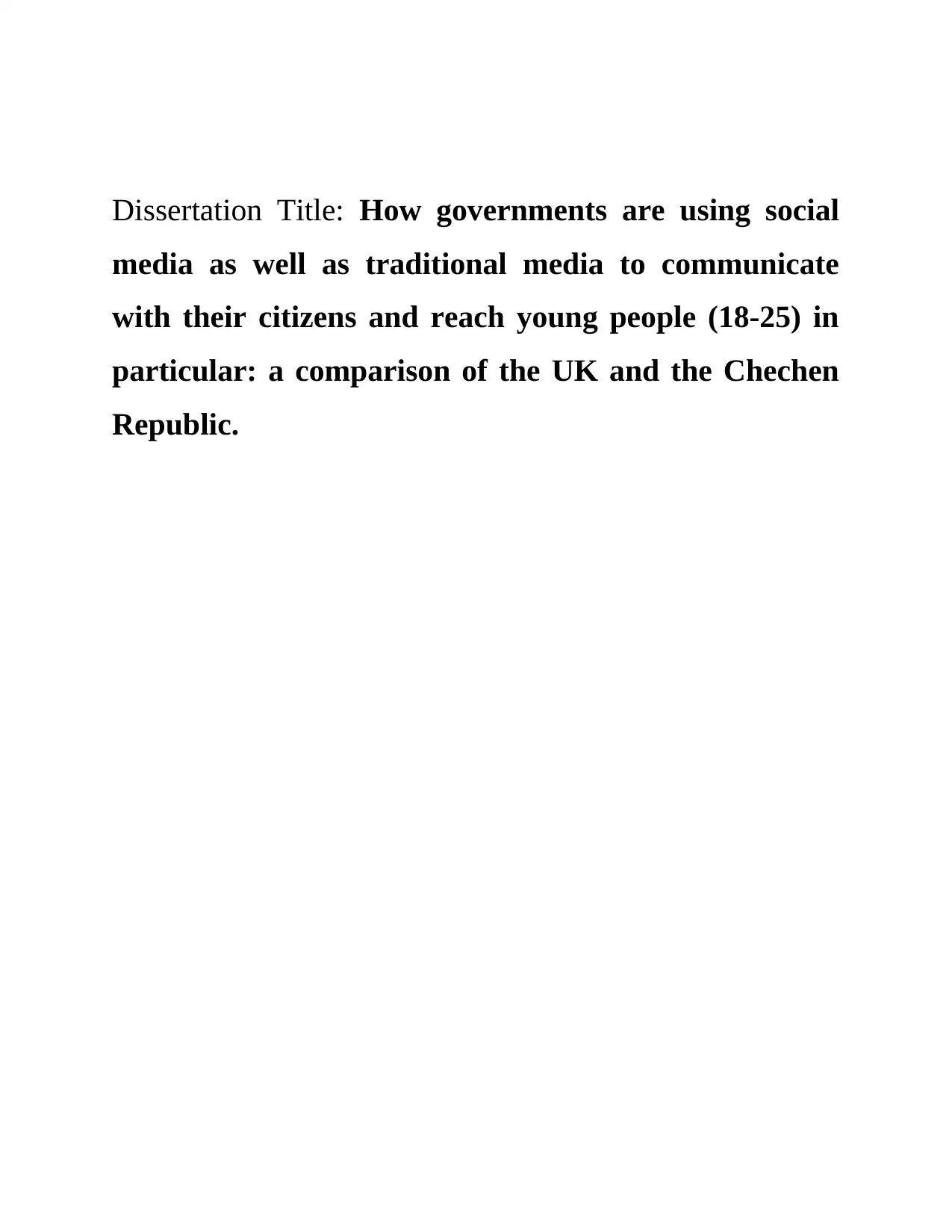
Dissertation Title: How governments are using social
media as well as traditional media to communicate
with their citizens and reach young people (18-25) in
particular: a comparison of the UK and the Chechen
Republic.
media as well as traditional media to communicate
with their citizens and reach young people (18-25) in
particular: a comparison of the UK and the Chechen
Republic.

Paraphrase This Document
Need a fresh take? Get an instant paraphrase of this document with our AI Paraphraser
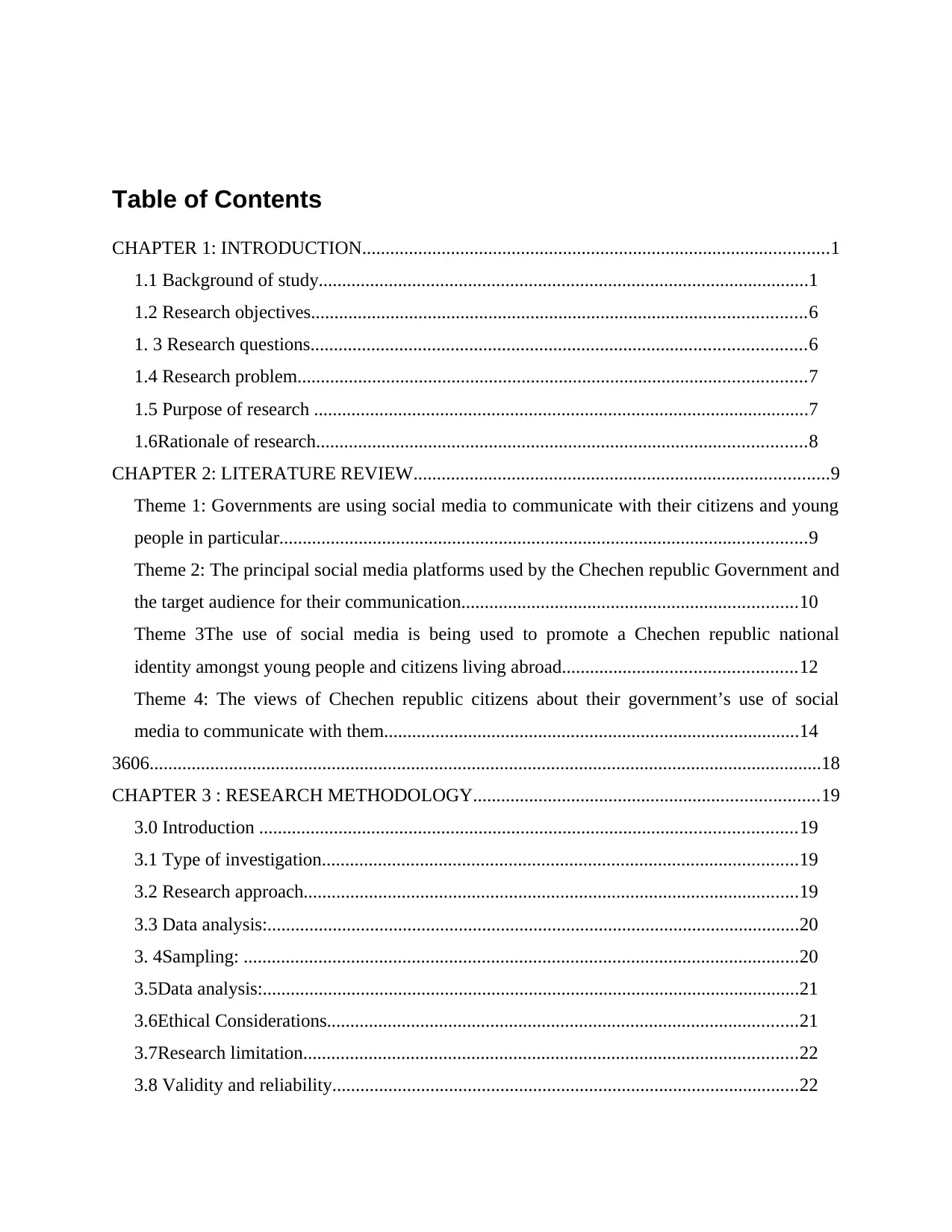
Table of Contents
CHAPTER 1: INTRODUCTION....................................................................................................1
1.1 Background of study.........................................................................................................1
1.2 Research objectives..........................................................................................................6
1. 3 Research questions..........................................................................................................6
1.4 Research problem.............................................................................................................7
1.5 Purpose of research ..........................................................................................................7
1.6Rationale of research.........................................................................................................8
CHAPTER 2: LITERATURE REVIEW.........................................................................................9
Theme 1: Governments are using social media to communicate with their citizens and young
people in particular.................................................................................................................9
Theme 2: The principal social media platforms used by the Chechen republic Government and
the target audience for their communication........................................................................10
Theme 3The use of social media is being used to promote a Chechen republic national
identity amongst young people and citizens living abroad..................................................12
Theme 4: The views of Chechen republic citizens about their government’s use of social
media to communicate with them.........................................................................................14
3606................................................................................................................................................18
CHAPTER 3 : RESEARCH METHODOLOGY..........................................................................19
3.0 Introduction ...................................................................................................................19
3.1 Type of investigation......................................................................................................19
3.2 Research approach..........................................................................................................19
3.3 Data analysis:..................................................................................................................20
3. 4Sampling: .......................................................................................................................20
3.5Data analysis:...................................................................................................................21
3.6Ethical Considerations.....................................................................................................21
3.7Research limitation..........................................................................................................22
3.8 Validity and reliability....................................................................................................22
CHAPTER 1: INTRODUCTION....................................................................................................1
1.1 Background of study.........................................................................................................1
1.2 Research objectives..........................................................................................................6
1. 3 Research questions..........................................................................................................6
1.4 Research problem.............................................................................................................7
1.5 Purpose of research ..........................................................................................................7
1.6Rationale of research.........................................................................................................8
CHAPTER 2: LITERATURE REVIEW.........................................................................................9
Theme 1: Governments are using social media to communicate with their citizens and young
people in particular.................................................................................................................9
Theme 2: The principal social media platforms used by the Chechen republic Government and
the target audience for their communication........................................................................10
Theme 3The use of social media is being used to promote a Chechen republic national
identity amongst young people and citizens living abroad..................................................12
Theme 4: The views of Chechen republic citizens about their government’s use of social
media to communicate with them.........................................................................................14
3606................................................................................................................................................18
CHAPTER 3 : RESEARCH METHODOLOGY..........................................................................19
3.0 Introduction ...................................................................................................................19
3.1 Type of investigation......................................................................................................19
3.2 Research approach..........................................................................................................19
3.3 Data analysis:..................................................................................................................20
3. 4Sampling: .......................................................................................................................20
3.5Data analysis:...................................................................................................................21
3.6Ethical Considerations.....................................................................................................21
3.7Research limitation..........................................................................................................22
3.8 Validity and reliability....................................................................................................22
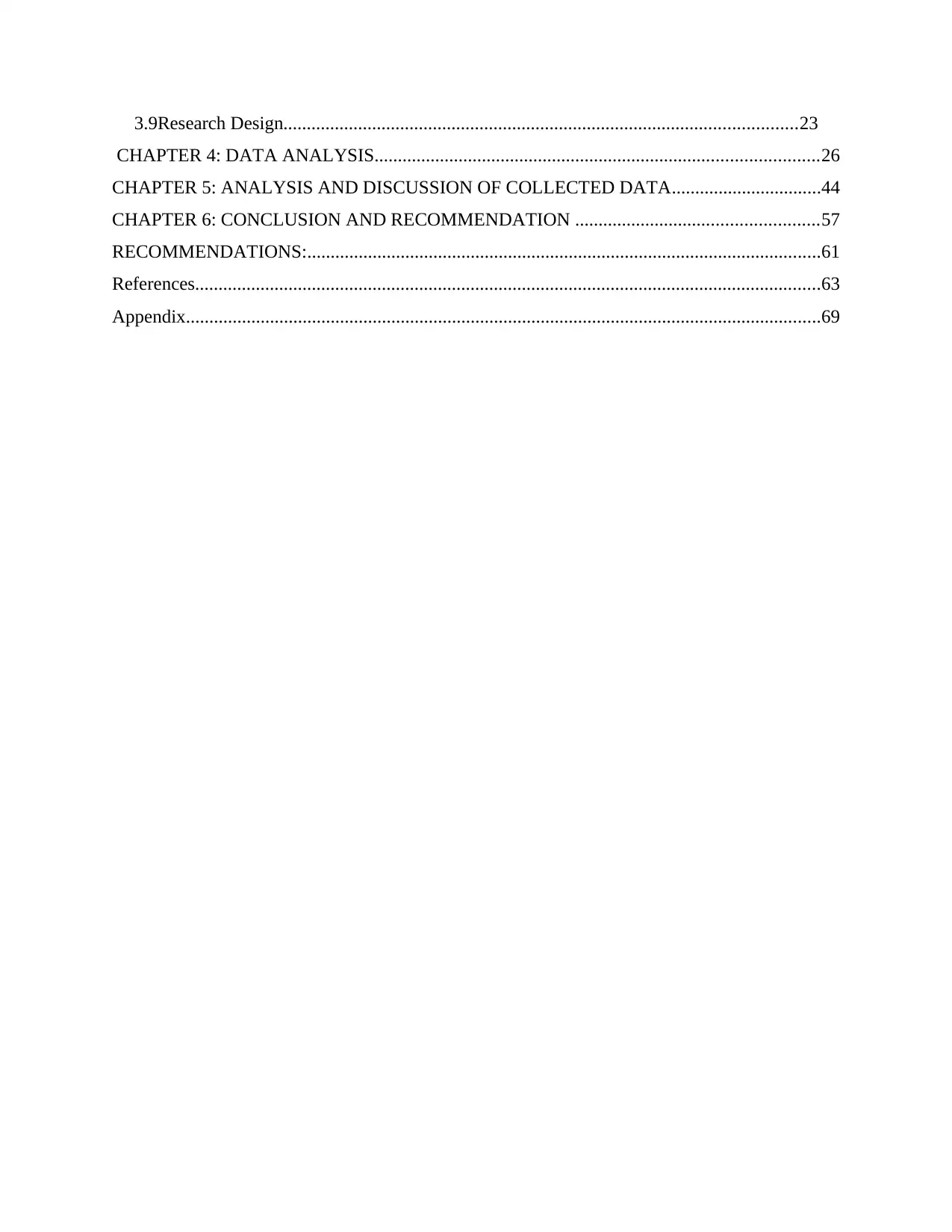
3.9Research Design..............................................................................................................23
CHAPTER 4: DATA ANALYSIS...............................................................................................26
CHAPTER 5: ANALYSIS AND DISCUSSION OF COLLECTED DATA................................44
CHAPTER 6: CONCLUSION AND RECOMMENDATION ....................................................57
RECOMMENDATIONS:..............................................................................................................61
References......................................................................................................................................63
Appendix........................................................................................................................................69
CHAPTER 4: DATA ANALYSIS...............................................................................................26
CHAPTER 5: ANALYSIS AND DISCUSSION OF COLLECTED DATA................................44
CHAPTER 6: CONCLUSION AND RECOMMENDATION ....................................................57
RECOMMENDATIONS:..............................................................................................................61
References......................................................................................................................................63
Appendix........................................................................................................................................69
⊘ This is a preview!⊘
Do you want full access?
Subscribe today to unlock all pages.

Trusted by 1+ million students worldwide
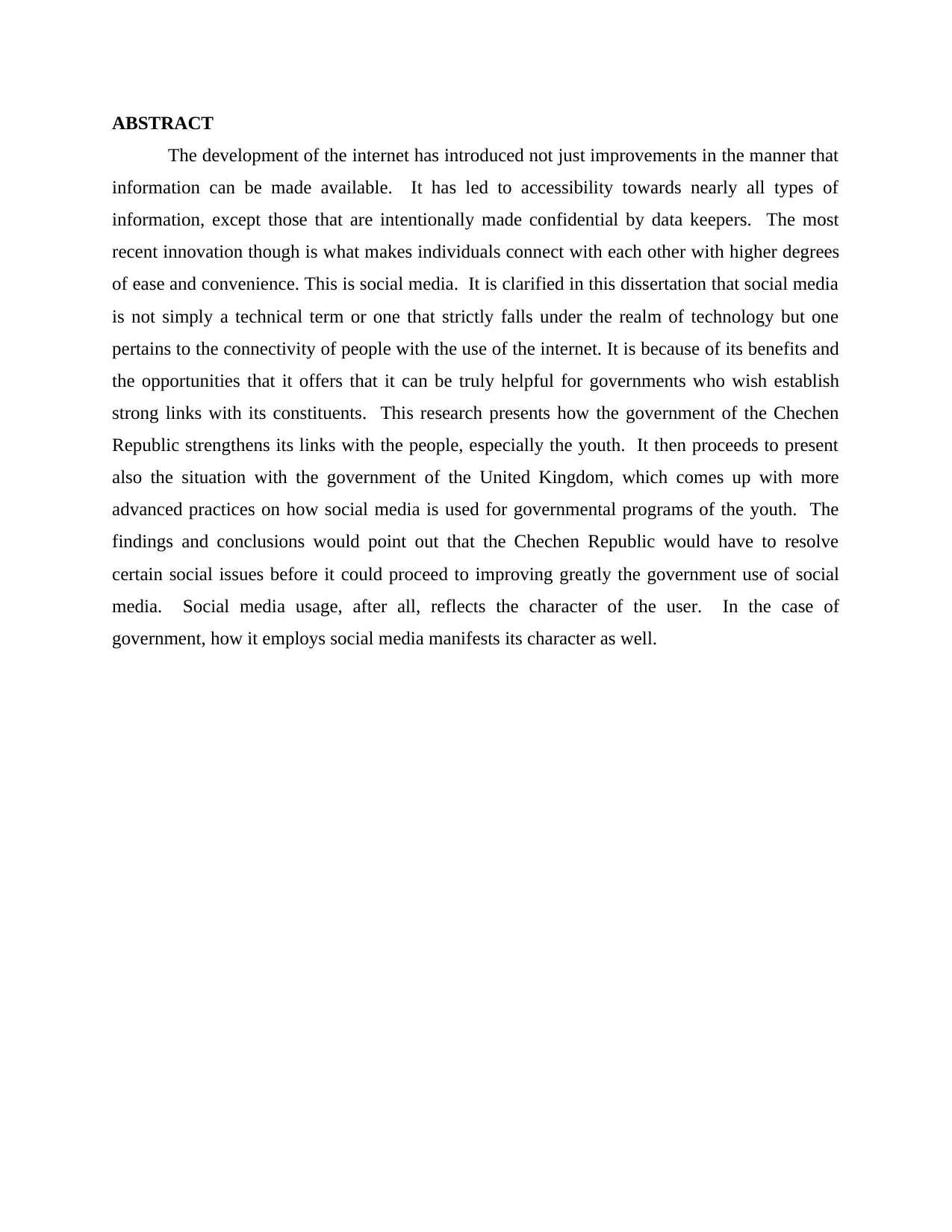
ABSTRACT
The development of the internet has introduced not just improvements in the manner that
information can be made available. It has led to accessibility towards nearly all types of
information, except those that are intentionally made confidential by data keepers. The most
recent innovation though is what makes individuals connect with each other with higher degrees
of ease and convenience. This is social media. It is clarified in this dissertation that social media
is not simply a technical term or one that strictly falls under the realm of technology but one
pertains to the connectivity of people with the use of the internet. It is because of its benefits and
the opportunities that it offers that it can be truly helpful for governments who wish establish
strong links with its constituents. This research presents how the government of the Chechen
Republic strengthens its links with the people, especially the youth. It then proceeds to present
also the situation with the government of the United Kingdom, which comes up with more
advanced practices on how social media is used for governmental programs of the youth. The
findings and conclusions would point out that the Chechen Republic would have to resolve
certain social issues before it could proceed to improving greatly the government use of social
media. Social media usage, after all, reflects the character of the user. In the case of
government, how it employs social media manifests its character as well.
The development of the internet has introduced not just improvements in the manner that
information can be made available. It has led to accessibility towards nearly all types of
information, except those that are intentionally made confidential by data keepers. The most
recent innovation though is what makes individuals connect with each other with higher degrees
of ease and convenience. This is social media. It is clarified in this dissertation that social media
is not simply a technical term or one that strictly falls under the realm of technology but one
pertains to the connectivity of people with the use of the internet. It is because of its benefits and
the opportunities that it offers that it can be truly helpful for governments who wish establish
strong links with its constituents. This research presents how the government of the Chechen
Republic strengthens its links with the people, especially the youth. It then proceeds to present
also the situation with the government of the United Kingdom, which comes up with more
advanced practices on how social media is used for governmental programs of the youth. The
findings and conclusions would point out that the Chechen Republic would have to resolve
certain social issues before it could proceed to improving greatly the government use of social
media. Social media usage, after all, reflects the character of the user. In the case of
government, how it employs social media manifests its character as well.
Paraphrase This Document
Need a fresh take? Get an instant paraphrase of this document with our AI Paraphraser
CHAPTER 1: INTRODUCTION
1.1 Background of study
In the age of the internet, the role of social media in society can no longer be denied or
even underestimated. Social media has made communication more open and inclusive. For a
long time, the media has always been dominated by those who have the financial, political, and
technological means. Those who belong to the marginalized sectors in society do not have
access it, rendering them voiceless and perpetuating their powerlessness. This is a social reality
that occurs regardless of the kind of government that rules society; whether it is democratic or
autocratic. Social media, however, has changed this situation. Due to the fact that it is very
accessible to nearly everyone, it has levelled the playing field when it comes to gathering and
providing information. It has, in fact, been a very potent weapon for transforming society or for
ousting an unpopular regime. It is often appreciated as the use of “social networking and online
forums range from sharing personal opinions to discussion of political events and political
activism” (McNeal & Schmeida 2015). Apparently, social media is no longer an observer’s tool
but a mover’s weapon of choice, as well.
This dissertation is a profound attempt at discussing the implications of the use of social
media by the government in order to touch base with its constituents, particularly the younger
generation. There is a clear reason why must governments continue to reach out to its
constituents. According to Houghton and Chin (2002), “the strategic objective is not so much to
provide better access to satisfy individual information needs but to ensure the public gets the
information the government wants to have.” This means that need for communication is not just
to satisfy demands for information from the citizens as expected in democracies.
Communicating to the constituents is also an avenue for government to provide citizens with
information that may help in perpetuating its rule. Without an effective means of
communicating with the people, a government will fail to make its constituents understand the
positive and beneficial features of the decisions that it may make. Of course, such a government
will make the people feel alienated just as it will make itself insensitive to them. As a result,
people will also fail to appreciate its government and may, in fact, seek its downfall. Without
using the mass media, the government would not also be able to listen to public opinions which
may lay the bases for new or amended policies. However, this is only possible if the mass media
are not entirely controlled by the government or are not covered by censorship. The ability of
1
1.1 Background of study
In the age of the internet, the role of social media in society can no longer be denied or
even underestimated. Social media has made communication more open and inclusive. For a
long time, the media has always been dominated by those who have the financial, political, and
technological means. Those who belong to the marginalized sectors in society do not have
access it, rendering them voiceless and perpetuating their powerlessness. This is a social reality
that occurs regardless of the kind of government that rules society; whether it is democratic or
autocratic. Social media, however, has changed this situation. Due to the fact that it is very
accessible to nearly everyone, it has levelled the playing field when it comes to gathering and
providing information. It has, in fact, been a very potent weapon for transforming society or for
ousting an unpopular regime. It is often appreciated as the use of “social networking and online
forums range from sharing personal opinions to discussion of political events and political
activism” (McNeal & Schmeida 2015). Apparently, social media is no longer an observer’s tool
but a mover’s weapon of choice, as well.
This dissertation is a profound attempt at discussing the implications of the use of social
media by the government in order to touch base with its constituents, particularly the younger
generation. There is a clear reason why must governments continue to reach out to its
constituents. According to Houghton and Chin (2002), “the strategic objective is not so much to
provide better access to satisfy individual information needs but to ensure the public gets the
information the government wants to have.” This means that need for communication is not just
to satisfy demands for information from the citizens as expected in democracies.
Communicating to the constituents is also an avenue for government to provide citizens with
information that may help in perpetuating its rule. Without an effective means of
communicating with the people, a government will fail to make its constituents understand the
positive and beneficial features of the decisions that it may make. Of course, such a government
will make the people feel alienated just as it will make itself insensitive to them. As a result,
people will also fail to appreciate its government and may, in fact, seek its downfall. Without
using the mass media, the government would not also be able to listen to public opinions which
may lay the bases for new or amended policies. However, this is only possible if the mass media
are not entirely controlled by the government or are not covered by censorship. The ability of
1
the government to actually be sensitive to public pulse would depend on the openness or the
freedom of the mass media. On the other hand, “increased control of the media facilitates the
coming to power of authoritarian regimes” (Malikova 2006). Hence, the importance of mass
media for governments, regardless of what kind it is, is undeniable.
Without describing the type of government that is existing, by observing how it makes
use or disregards the mass media, a conclusion about its characteristics can already be made.
Apparently, a democratic and free government has a tolerant attitude towards the media. While it
may also try to strengthen its own media outfit in order to have a means of leverage, it can never
totally deprive private media companies of their rights. A government that is openly
undemocratic will certainly show its character in manner that it handles the media. First of all, it
does allow the existence of private media outfits. Secondly, it will strengthen its hold of its own
media outfit to the point of monopolizing the information industry. There may arguments that
for as long as the government holds on to the ideals of fairness and objectivity in journalism and
in media, in general, the tendency to make its media outfit as a propaganda machinery would not
be possible. However, Graber and Dunaway (2014) explain that “the different forms of control
and ownership of the media affect not only media economics but also the substance of media
output.” Hence, the government-controlled media is not expected to be critical of the policies of
the state. Instead, it is expected to be very supportive of all state endeavors, whether these are
favored by or in favor of the people.
The government, with its maximum access to resources, has the capability of utilizing all
forms of mass media. Apparently, it has the means of determining which medium is most
effective in reaching out to the people. It determines the principal and secondary means and it
maximizes the use of each. Since its advent, the television has been one of the most effective
means of reaching out to people. Oftentimes, news programs, where information and
commentaries can be broadcasted, are scheduled at peak hours or the so-called primetime. Of
course, governments have continued the use of radio broadcasting and print as these remain
popular mediums of information. Again this is usually the case, regardless of the type of
government that is existing. However, it must be pointed out that these are traditional media that
is being discussed here. When government broadcasts information, whether through radio or
television, or when it publishes it through print, it one-sidedly communicates to its constituents.
For a government that declares itself to be democratic, this may be problematic since “one-sided
2
freedom of the mass media. On the other hand, “increased control of the media facilitates the
coming to power of authoritarian regimes” (Malikova 2006). Hence, the importance of mass
media for governments, regardless of what kind it is, is undeniable.
Without describing the type of government that is existing, by observing how it makes
use or disregards the mass media, a conclusion about its characteristics can already be made.
Apparently, a democratic and free government has a tolerant attitude towards the media. While it
may also try to strengthen its own media outfit in order to have a means of leverage, it can never
totally deprive private media companies of their rights. A government that is openly
undemocratic will certainly show its character in manner that it handles the media. First of all, it
does allow the existence of private media outfits. Secondly, it will strengthen its hold of its own
media outfit to the point of monopolizing the information industry. There may arguments that
for as long as the government holds on to the ideals of fairness and objectivity in journalism and
in media, in general, the tendency to make its media outfit as a propaganda machinery would not
be possible. However, Graber and Dunaway (2014) explain that “the different forms of control
and ownership of the media affect not only media economics but also the substance of media
output.” Hence, the government-controlled media is not expected to be critical of the policies of
the state. Instead, it is expected to be very supportive of all state endeavors, whether these are
favored by or in favor of the people.
The government, with its maximum access to resources, has the capability of utilizing all
forms of mass media. Apparently, it has the means of determining which medium is most
effective in reaching out to the people. It determines the principal and secondary means and it
maximizes the use of each. Since its advent, the television has been one of the most effective
means of reaching out to people. Oftentimes, news programs, where information and
commentaries can be broadcasted, are scheduled at peak hours or the so-called primetime. Of
course, governments have continued the use of radio broadcasting and print as these remain
popular mediums of information. Again this is usually the case, regardless of the type of
government that is existing. However, it must be pointed out that these are traditional media that
is being discussed here. When government broadcasts information, whether through radio or
television, or when it publishes it through print, it one-sidedly communicates to its constituents.
For a government that declares itself to be democratic, this may be problematic since “one-sided
2
⊘ This is a preview!⊘
Do you want full access?
Subscribe today to unlock all pages.
Trusted by 1+ million students worldwide
information flows have a depolarizing effect because they stimulate agreement” (Gainous &
Wagner, 2011). Without an avenue where the citizens can directly respond through the same
channel of information, the impression is that they agree with whatever the government says. On
the other hand, the traditional media, with its one-sided flow of information, can be very
advantageous for an autocracy or an oligarchy that does not tolerate opposing views from the
constituents.
Thus, it is clear that the traditional media has its limitations that tend to restrict freedom
of expression. The advent of the internet and the use of social media has provided a welcome
change. The internet has broken the barriers that the traditional media usually have. Social
media is, in fact, the latest truly mass-oriented medium of information that has taken a hold over
the populations of different countries. First of all, social media is user-controlled. It is not under
the monopoly of any single entity unless the government itself regulates the use of the internet.
The information it relays is user-generated. In the exercise of democracy, the free use of social
media genuinely democratizes the forms of expression. Since it is free of charge and since
internet connection is no longer a luxury, social media is very accessible. However, it is no
longer just the domain of the voiceless. While it may have been appealing to sectors who do not
have much access to the traditional media, the governments of many countries have found this to
be a necessary avenue for information as well. Code aptly defines social media as a “group of
Internet-based applications that enable communication amongst individuals and groups, the
creation and exchange of participative user-generated content, and the expression of individual
and collective agency” (2012). The keywords in this definition are ‘exchange’ and ‘user-
generated’. Unlike the traditional media, it is clear that social media can be utilized by anyone
and not just the government. However, when government uses this avenue, it clearly presents
itself as open to feedbacks from the citizens, whether these are positive or negative.
As pointed out earlier, the use of social media by the government may vary according to the type
of rule that is being perpetuated. If the government is one that rules a stable democracy, then it
is expected that the use of social media is according to its full potentials. If the government is an
oligarchy or an autocracy, it is expected that social media is controlled and utilized by
government only to uphold and advance its power over the people. On the other hand, if the
government is in a war situation, social media is vigorously used as a propaganda channel to win
the hearts and minds of the people. This is the reason why this dissertation intends to provide
3
Wagner, 2011). Without an avenue where the citizens can directly respond through the same
channel of information, the impression is that they agree with whatever the government says. On
the other hand, the traditional media, with its one-sided flow of information, can be very
advantageous for an autocracy or an oligarchy that does not tolerate opposing views from the
constituents.
Thus, it is clear that the traditional media has its limitations that tend to restrict freedom
of expression. The advent of the internet and the use of social media has provided a welcome
change. The internet has broken the barriers that the traditional media usually have. Social
media is, in fact, the latest truly mass-oriented medium of information that has taken a hold over
the populations of different countries. First of all, social media is user-controlled. It is not under
the monopoly of any single entity unless the government itself regulates the use of the internet.
The information it relays is user-generated. In the exercise of democracy, the free use of social
media genuinely democratizes the forms of expression. Since it is free of charge and since
internet connection is no longer a luxury, social media is very accessible. However, it is no
longer just the domain of the voiceless. While it may have been appealing to sectors who do not
have much access to the traditional media, the governments of many countries have found this to
be a necessary avenue for information as well. Code aptly defines social media as a “group of
Internet-based applications that enable communication amongst individuals and groups, the
creation and exchange of participative user-generated content, and the expression of individual
and collective agency” (2012). The keywords in this definition are ‘exchange’ and ‘user-
generated’. Unlike the traditional media, it is clear that social media can be utilized by anyone
and not just the government. However, when government uses this avenue, it clearly presents
itself as open to feedbacks from the citizens, whether these are positive or negative.
As pointed out earlier, the use of social media by the government may vary according to the type
of rule that is being perpetuated. If the government is one that rules a stable democracy, then it
is expected that the use of social media is according to its full potentials. If the government is an
oligarchy or an autocracy, it is expected that social media is controlled and utilized by
government only to uphold and advance its power over the people. On the other hand, if the
government is in a war situation, social media is vigorously used as a propaganda channel to win
the hearts and minds of the people. This is the reason why this dissertation intends to provide
3
Paraphrase This Document
Need a fresh take? Get an instant paraphrase of this document with our AI Paraphraser
examples of how social media in two distinct types of situations. The dissertation seeks to
present arguments and theories based on the examples in how social media is used by the United
Kingdom and the Chechen Republic, which is also commonly called as Chechnya.
The United Kingdom or the UK is a parliamentary democracy with a constitutional
monarch. The fact that it is under a monarchy would give the impression that it is not a
democracy since it would seem that absolute power resides in just one person, the King or
Queen. However, the parliament is where the real governmental function exists, with the
monarchy actually taking advice from it or the Prime Minister. In fact, the UK is considered as a
very free and democratic society. It has high regard for civil and human rights, particularly to the
right to free expression. It is not surprising that its press is one the freest in the world; sometimes
to the point of being criticized for abusing its rights to free expression as in the case of the
British tabloids. Under this context of how the UK treats its traditional media, one can easily
assume how lenient it is with its social media. However, despite the freedoms that its media
enjoy, there have been cases which exemplify that curtailment or infringement still happens in
the UK. These shall be discussed in the succeeding chapters.
The Chechen Republic has just recently achieved some form of stability after years of
war with Russia and with separatists. Compared to the UK, however, Chechnya is still not
mature as a democracy. In fact, it may be considered as a fragile democracy with the state
continuously asserting its strong-arm approach in order to establish order and to prevent the
outbreak of further clashes. In such situation, it is expected that its use of social media is
restrictive. The government of the Chechen Republic is making sure that social media cannot be
utilized by forces that supports separation from the Russian Federation as well Islamic militants.
BBC News country profile of Chechnya provides a very negative impression how the
government handles the media. According to it, Chechnya has a state controlled TV, which is
the most popular medium and that the “Chechen government has also made steps to tighten
online control” (18 August 2015). This description alone can already give the impression that
the freedom of expression in Chechnya is not realized; that it is not respected and it is not
protected by the state.
The study of how social media is used by the governments of the UK and Chechnya is a
study in contrast. This dissertation presents how both governments try to achieve its goal,
4
present arguments and theories based on the examples in how social media is used by the United
Kingdom and the Chechen Republic, which is also commonly called as Chechnya.
The United Kingdom or the UK is a parliamentary democracy with a constitutional
monarch. The fact that it is under a monarchy would give the impression that it is not a
democracy since it would seem that absolute power resides in just one person, the King or
Queen. However, the parliament is where the real governmental function exists, with the
monarchy actually taking advice from it or the Prime Minister. In fact, the UK is considered as a
very free and democratic society. It has high regard for civil and human rights, particularly to the
right to free expression. It is not surprising that its press is one the freest in the world; sometimes
to the point of being criticized for abusing its rights to free expression as in the case of the
British tabloids. Under this context of how the UK treats its traditional media, one can easily
assume how lenient it is with its social media. However, despite the freedoms that its media
enjoy, there have been cases which exemplify that curtailment or infringement still happens in
the UK. These shall be discussed in the succeeding chapters.
The Chechen Republic has just recently achieved some form of stability after years of
war with Russia and with separatists. Compared to the UK, however, Chechnya is still not
mature as a democracy. In fact, it may be considered as a fragile democracy with the state
continuously asserting its strong-arm approach in order to establish order and to prevent the
outbreak of further clashes. In such situation, it is expected that its use of social media is
restrictive. The government of the Chechen Republic is making sure that social media cannot be
utilized by forces that supports separation from the Russian Federation as well Islamic militants.
BBC News country profile of Chechnya provides a very negative impression how the
government handles the media. According to it, Chechnya has a state controlled TV, which is
the most popular medium and that the “Chechen government has also made steps to tighten
online control” (18 August 2015). This description alone can already give the impression that
the freedom of expression in Chechnya is not realized; that it is not respected and it is not
protected by the state.
The study of how social media is used by the governments of the UK and Chechnya is a
study in contrast. This dissertation presents how both governments try to achieve its goal,
4
particularly with the concerns on young people, using social media as a tool. Apparently, if there
is one generation that has appreciated much the great power of social media, it is the young. Not
only do the young people easily appreciate and learn the use of social media, such as Facebook,
Twitter, and YouTube, they are also the ones who are more than eager to express themselves
freely; sometimes to the point of rebellion. It is, in fact, because of this juvenile attitude towards
authorities that governments must be adept at using social media as well. It is through social
media that governments can make their presence and intervention felt in the lives of the young.
However, objectives that governments seek to realize vary. These depend on the kind of
governance that prevails. Does the government use the social media to enhance education and
stimulate participation of the youth in national programs or concerns? Or does government use it
as a means of repression, to quell possible political opposition or open rebellion among the
youth? The paper shall extensively present how the UK and the Chechen Republic react to the
needs and demands of the youth with the use of social media. It is, however, necessary that in-
depth discussions about the use of social media by government to reach out to its citizens in
general. After all, its understanding and appreciation of the role of social media can be
determined by its attitude towards the general population of the country.
As for its theoretical contribution, the dissertation aims to determine general conclusions
regarding the potential use of social media for governance. Apparently, as a means of
communication, social media does more than just deliver information to the constituents. Since
it has an interactive feature, it can either be useful for the strengthening or the weakening of
democratic processes and structures. The practical contribution of this dissertation, on the other
hand, is the explication of actual uses of social media in government functions. It is apparent
that communication is a very important component in every government service, program or
project. The dissertation shall provide details in the experiences of the two countries of such use.
It is clear that through the questions presented, the dissertation has a slant towards the Chechen
use of social media. The British use of social media has often been the subject of many literature.
This situation demands that more discussions about the use of social media in the Chechen
Republic is necessary.
5
is one generation that has appreciated much the great power of social media, it is the young. Not
only do the young people easily appreciate and learn the use of social media, such as Facebook,
Twitter, and YouTube, they are also the ones who are more than eager to express themselves
freely; sometimes to the point of rebellion. It is, in fact, because of this juvenile attitude towards
authorities that governments must be adept at using social media as well. It is through social
media that governments can make their presence and intervention felt in the lives of the young.
However, objectives that governments seek to realize vary. These depend on the kind of
governance that prevails. Does the government use the social media to enhance education and
stimulate participation of the youth in national programs or concerns? Or does government use it
as a means of repression, to quell possible political opposition or open rebellion among the
youth? The paper shall extensively present how the UK and the Chechen Republic react to the
needs and demands of the youth with the use of social media. It is, however, necessary that in-
depth discussions about the use of social media by government to reach out to its citizens in
general. After all, its understanding and appreciation of the role of social media can be
determined by its attitude towards the general population of the country.
As for its theoretical contribution, the dissertation aims to determine general conclusions
regarding the potential use of social media for governance. Apparently, as a means of
communication, social media does more than just deliver information to the constituents. Since
it has an interactive feature, it can either be useful for the strengthening or the weakening of
democratic processes and structures. The practical contribution of this dissertation, on the other
hand, is the explication of actual uses of social media in government functions. It is apparent
that communication is a very important component in every government service, program or
project. The dissertation shall provide details in the experiences of the two countries of such use.
It is clear that through the questions presented, the dissertation has a slant towards the Chechen
use of social media. The British use of social media has often been the subject of many literature.
This situation demands that more discussions about the use of social media in the Chechen
Republic is necessary.
5
⊘ This is a preview!⊘
Do you want full access?
Subscribe today to unlock all pages.
Trusted by 1+ million students worldwide
The aim of this dissertation is to investigate how the Chechen republic Government is using
social media to communicate with its citizens and to reach young people, in particular, at home
and abroad. The objectives are the following:
1.2 Research objectives
To review how governments are using social media to communicate with their citizens
and young people in particular.
To identify the principal social media platforms used by the Chechen republic
Government and the target audience for their communication
To explore how the use of social media is being used to promote a Chechen Republic
national identity amongst young people and citizens living abroad.
To examine the views of Chechen republic citizens about their government’s use of
social media to communicate with them.
To make recommendations for improving the use of social media by the Chechen
Government.
1. 3 Research questions
The research questions are constructed on the basis of objective of present research.
How are governments using social media to communicate with their citizens and young
people in particular?
What are the principal social media platforms used by Chechen republic government and
the UK?
How do social media promote Chechen republic national identity among the young and
citizens living abroad?
What are the views of the citizens in regard to government’s use of social media in
Chechen republic as compared to the UK?
What strategies can be adopted to improve the use of social media by Chechen republic
government?
The dissertation is divided into five chapters. After this Introduction, the Literature
Review follows. The Literature Review extensive discusses findings from previously written
6
social media to communicate with its citizens and to reach young people, in particular, at home
and abroad. The objectives are the following:
1.2 Research objectives
To review how governments are using social media to communicate with their citizens
and young people in particular.
To identify the principal social media platforms used by the Chechen republic
Government and the target audience for their communication
To explore how the use of social media is being used to promote a Chechen Republic
national identity amongst young people and citizens living abroad.
To examine the views of Chechen republic citizens about their government’s use of
social media to communicate with them.
To make recommendations for improving the use of social media by the Chechen
Government.
1. 3 Research questions
The research questions are constructed on the basis of objective of present research.
How are governments using social media to communicate with their citizens and young
people in particular?
What are the principal social media platforms used by Chechen republic government and
the UK?
How do social media promote Chechen republic national identity among the young and
citizens living abroad?
What are the views of the citizens in regard to government’s use of social media in
Chechen republic as compared to the UK?
What strategies can be adopted to improve the use of social media by Chechen republic
government?
The dissertation is divided into five chapters. After this Introduction, the Literature
Review follows. The Literature Review extensive discusses findings from previously written
6
Paraphrase This Document
Need a fresh take? Get an instant paraphrase of this document with our AI Paraphraser
researches and actual experiences in the use of social media by both the governments of the
Chechen republic Republic and the UK. The next chapter is the Research Design. It is here that
the methodologies in conducting the research as well as the rationales behind it are explained.
This is followed by the Findings, which is a separate chapter. This is where the results of the
research are presented in a quantitative and qualitative manner. It is the chapter that follows, the
Discussion chapter that provides in-depth analysis of the findings presented. It is here where the
implications of the results generated by the data gathered in the research are also explained.
Generally, the implications are those that have impacts on the government services in particular,
and in the government itself in general. The final chapter is where the Conclusions and
Recommendations are presented. After a thorough discussion is made, it is here where the
general conclusions about the use of social media by the two countries are derived and presented.
As a consequence, recommendations on how social media should be promoted as a government
method of communicating with the citizens are then presented at the end of the dissertation.
1.4 Research problem
Social media play significant role in present era in order to communicate with people
who live in different parts of country and abroad. However, the government is not using tool
effectively for communicating with people. Citizens are unaware of policy which are created by
government for welfare of people or for other reason.
The present research is based on investigating the way Chechen republic Government is
using social media to communicate with its citizens and to reach young people, in particular, at
home and abroad. It is essential for government to reach with the use of social media so that it
can easily target large number of citizens both young people for communicating effectively with
them.
1.5 Purpose of research
The present study is conducted with the main purpose that is to investigate the way
Chechen republic government is using social media for communicating with its citizens. The
purpose of the research will be analysed the gaps left by the previous investigator on the same
topic. There many research which have been conducted on research topic and its effectiveness is
measure. There is direct relationship between two which is has been revealed. It is right to use
social media by government which help in Communicating to the constituents is also an avenue
7
Chechen republic Republic and the UK. The next chapter is the Research Design. It is here that
the methodologies in conducting the research as well as the rationales behind it are explained.
This is followed by the Findings, which is a separate chapter. This is where the results of the
research are presented in a quantitative and qualitative manner. It is the chapter that follows, the
Discussion chapter that provides in-depth analysis of the findings presented. It is here where the
implications of the results generated by the data gathered in the research are also explained.
Generally, the implications are those that have impacts on the government services in particular,
and in the government itself in general. The final chapter is where the Conclusions and
Recommendations are presented. After a thorough discussion is made, it is here where the
general conclusions about the use of social media by the two countries are derived and presented.
As a consequence, recommendations on how social media should be promoted as a government
method of communicating with the citizens are then presented at the end of the dissertation.
1.4 Research problem
Social media play significant role in present era in order to communicate with people
who live in different parts of country and abroad. However, the government is not using tool
effectively for communicating with people. Citizens are unaware of policy which are created by
government for welfare of people or for other reason.
The present research is based on investigating the way Chechen republic Government is
using social media to communicate with its citizens and to reach young people, in particular, at
home and abroad. It is essential for government to reach with the use of social media so that it
can easily target large number of citizens both young people for communicating effectively with
them.
1.5 Purpose of research
The present study is conducted with the main purpose that is to investigate the way
Chechen republic government is using social media for communicating with its citizens. The
purpose of the research will be analysed the gaps left by the previous investigator on the same
topic. There many research which have been conducted on research topic and its effectiveness is
measure. There is direct relationship between two which is has been revealed. It is right to use
social media by government which help in Communicating to the constituents is also an avenue
7
for government to provide citizens with information that may help in perpetuating its rule. The
present concept is very essential regarding making good relation between government and
citizens. As this lead to accomplish success in communicating information to citizen of country.
As the use of social networking sites lead to provide chance to share their innvoative ideas and
policy on which they are working or will work in coming times.
1.6Rationale of research
There is increase the in the communication gap between the government and citizen it
becomes essential for the government to keep regular and effective communication with
Citizens. Communication is required not only for satisfying the demand for information from the
citizens which is expected in the democracies. As if there is no effective communication kept
with the people then will unable to make understand the positive and negative features of
constituents and the decision which it makes. Therefore, the present dissemination will provide
proper theoretical base for the readers and learners related to different social media tools which
government can use for an organisation. Along with this researcher also have different objectives
regarding the present study as it will assist in improving the theoretical knowledge related the
principal social media platforms used by the Chechen republic Government and the target
audience for their communication. Through evaluating the each and every aspects related to
present topic and it will able to provide suitable conclusion and recommendation to the
government for improving communicating through the use of social networking sites.
8
present concept is very essential regarding making good relation between government and
citizens. As this lead to accomplish success in communicating information to citizen of country.
As the use of social networking sites lead to provide chance to share their innvoative ideas and
policy on which they are working or will work in coming times.
1.6Rationale of research
There is increase the in the communication gap between the government and citizen it
becomes essential for the government to keep regular and effective communication with
Citizens. Communication is required not only for satisfying the demand for information from the
citizens which is expected in the democracies. As if there is no effective communication kept
with the people then will unable to make understand the positive and negative features of
constituents and the decision which it makes. Therefore, the present dissemination will provide
proper theoretical base for the readers and learners related to different social media tools which
government can use for an organisation. Along with this researcher also have different objectives
regarding the present study as it will assist in improving the theoretical knowledge related the
principal social media platforms used by the Chechen republic Government and the target
audience for their communication. Through evaluating the each and every aspects related to
present topic and it will able to provide suitable conclusion and recommendation to the
government for improving communicating through the use of social networking sites.
8
⊘ This is a preview!⊘
Do you want full access?
Subscribe today to unlock all pages.
Trusted by 1+ million students worldwide

1 out of 77


Related Documents


Your All-in-One AI-Powered Toolkit for Academic Success.
+13062052269
info@desklib.com
Available 24*7 on WhatsApp / Email
![[object Object]](/_next/static/media/star-bottom.7253800d.svg)
Unlock your academic potential
Copyright © 2020–2026 A2Z Services. All Rights Reserved. Developed and managed by ZUCOL.