Annotated Bibliography: Social Policy and its Impact in Australia
VerifiedAdded on 2020/07/22
|7
|1646
|85
Annotated Bibliography
AI Summary
This annotated bibliography provides concise summaries and critical analyses of five journal articles and one book chapter focusing on various aspects of Australian social policy. The articles cover a range of topics including social capital and justice for indigenous Australians, attitudes towards homelessness, social inclusion among young people, the relationship between life events, socioeconomic status, and psychological distress in mothers, and the role of local government in migrant and refugee settlement. Each entry summarizes the research methodology, key findings, and limitations, offering insights into the complex interplay of social factors and policy implications within the Australian context. The bibliography highlights the importance of social policies in addressing issues related to homelessness, social inclusion, and the well-being of vulnerable populations, such as mothers and migrants.

Annotated Bibliography

Paraphrase This Document
Need a fresh take? Get an instant paraphrase of this document with our AI Paraphraser

TABLE OF CONTENTS
REFERENCES................................................................................................................................7
REFERENCES................................................................................................................................7
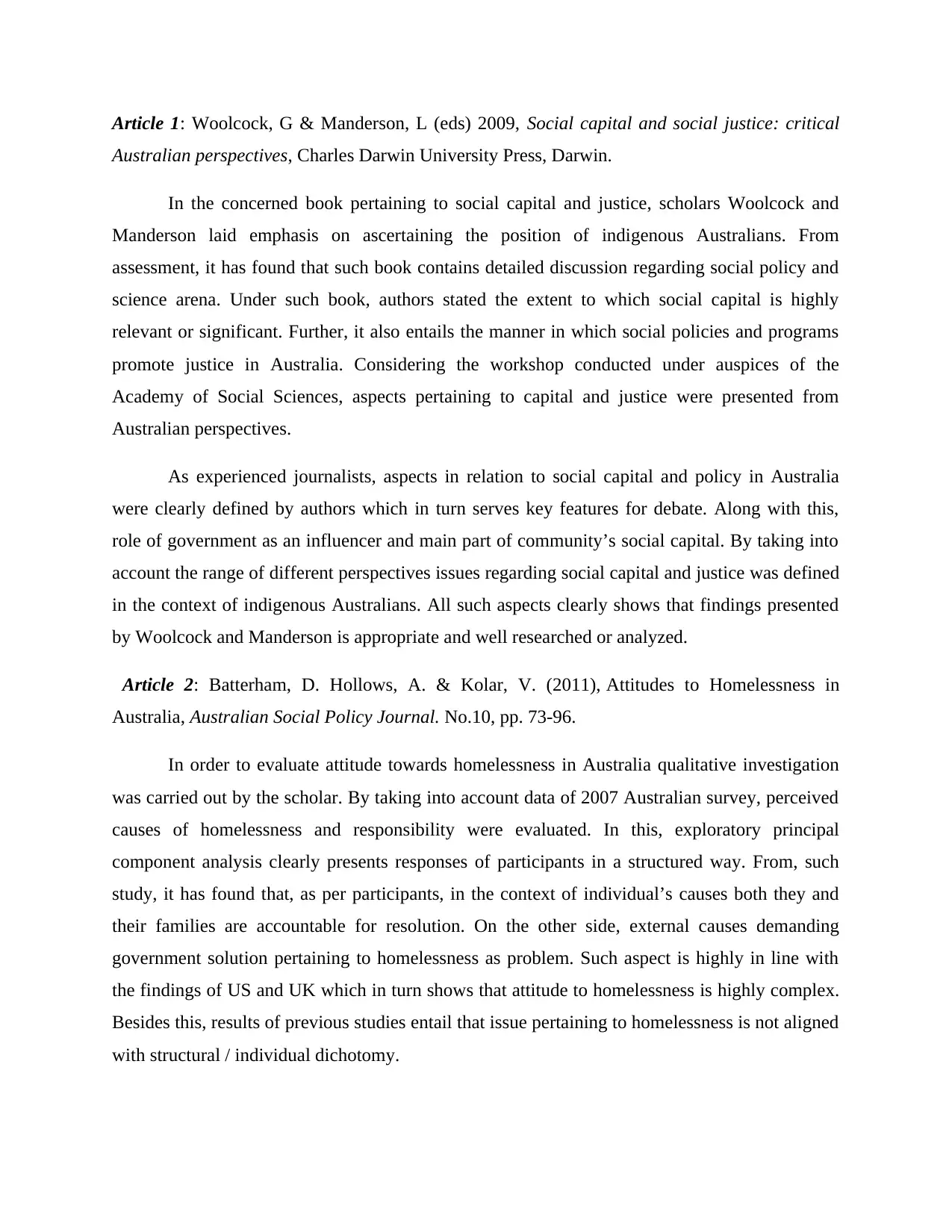
Article 1: Woolcock, G & Manderson, L (eds) 2009, Social capital and social justice: critical
Australian perspectives, Charles Darwin University Press, Darwin.
In the concerned book pertaining to social capital and justice, scholars Woolcock and
Manderson laid emphasis on ascertaining the position of indigenous Australians. From
assessment, it has found that such book contains detailed discussion regarding social policy and
science arena. Under such book, authors stated the extent to which social capital is highly
relevant or significant. Further, it also entails the manner in which social policies and programs
promote justice in Australia. Considering the workshop conducted under auspices of the
Academy of Social Sciences, aspects pertaining to capital and justice were presented from
Australian perspectives.
As experienced journalists, aspects in relation to social capital and policy in Australia
were clearly defined by authors which in turn serves key features for debate. Along with this,
role of government as an influencer and main part of community’s social capital. By taking into
account the range of different perspectives issues regarding social capital and justice was defined
in the context of indigenous Australians. All such aspects clearly shows that findings presented
by Woolcock and Manderson is appropriate and well researched or analyzed.
Article 2: Batterham, D. Hollows, A. & Kolar, V. (2011), Attitudes to Homelessness in
Australia, Australian Social Policy Journal. No.10, pp. 73-96.
In order to evaluate attitude towards homelessness in Australia qualitative investigation
was carried out by the scholar. By taking into account data of 2007 Australian survey, perceived
causes of homelessness and responsibility were evaluated. In this, exploratory principal
component analysis clearly presents responses of participants in a structured way. From, such
study, it has found that, as per participants, in the context of individual’s causes both they and
their families are accountable for resolution. On the other side, external causes demanding
government solution pertaining to homelessness as problem. Such aspect is highly in line with
the findings of US and UK which in turn shows that attitude to homelessness is highly complex.
Besides this, results of previous studies entail that issue pertaining to homelessness is not aligned
with structural / individual dichotomy.
Australian perspectives, Charles Darwin University Press, Darwin.
In the concerned book pertaining to social capital and justice, scholars Woolcock and
Manderson laid emphasis on ascertaining the position of indigenous Australians. From
assessment, it has found that such book contains detailed discussion regarding social policy and
science arena. Under such book, authors stated the extent to which social capital is highly
relevant or significant. Further, it also entails the manner in which social policies and programs
promote justice in Australia. Considering the workshop conducted under auspices of the
Academy of Social Sciences, aspects pertaining to capital and justice were presented from
Australian perspectives.
As experienced journalists, aspects in relation to social capital and policy in Australia
were clearly defined by authors which in turn serves key features for debate. Along with this,
role of government as an influencer and main part of community’s social capital. By taking into
account the range of different perspectives issues regarding social capital and justice was defined
in the context of indigenous Australians. All such aspects clearly shows that findings presented
by Woolcock and Manderson is appropriate and well researched or analyzed.
Article 2: Batterham, D. Hollows, A. & Kolar, V. (2011), Attitudes to Homelessness in
Australia, Australian Social Policy Journal. No.10, pp. 73-96.
In order to evaluate attitude towards homelessness in Australia qualitative investigation
was carried out by the scholar. By taking into account data of 2007 Australian survey, perceived
causes of homelessness and responsibility were evaluated. In this, exploratory principal
component analysis clearly presents responses of participants in a structured way. From, such
study, it has found that, as per participants, in the context of individual’s causes both they and
their families are accountable for resolution. On the other side, external causes demanding
government solution pertaining to homelessness as problem. Such aspect is highly in line with
the findings of US and UK which in turn shows that attitude to homelessness is highly complex.
Besides this, results of previous studies entail that issue pertaining to homelessness is not aligned
with structural / individual dichotomy.
⊘ This is a preview!⊘
Do you want full access?
Subscribe today to unlock all pages.

Trusted by 1+ million students worldwide
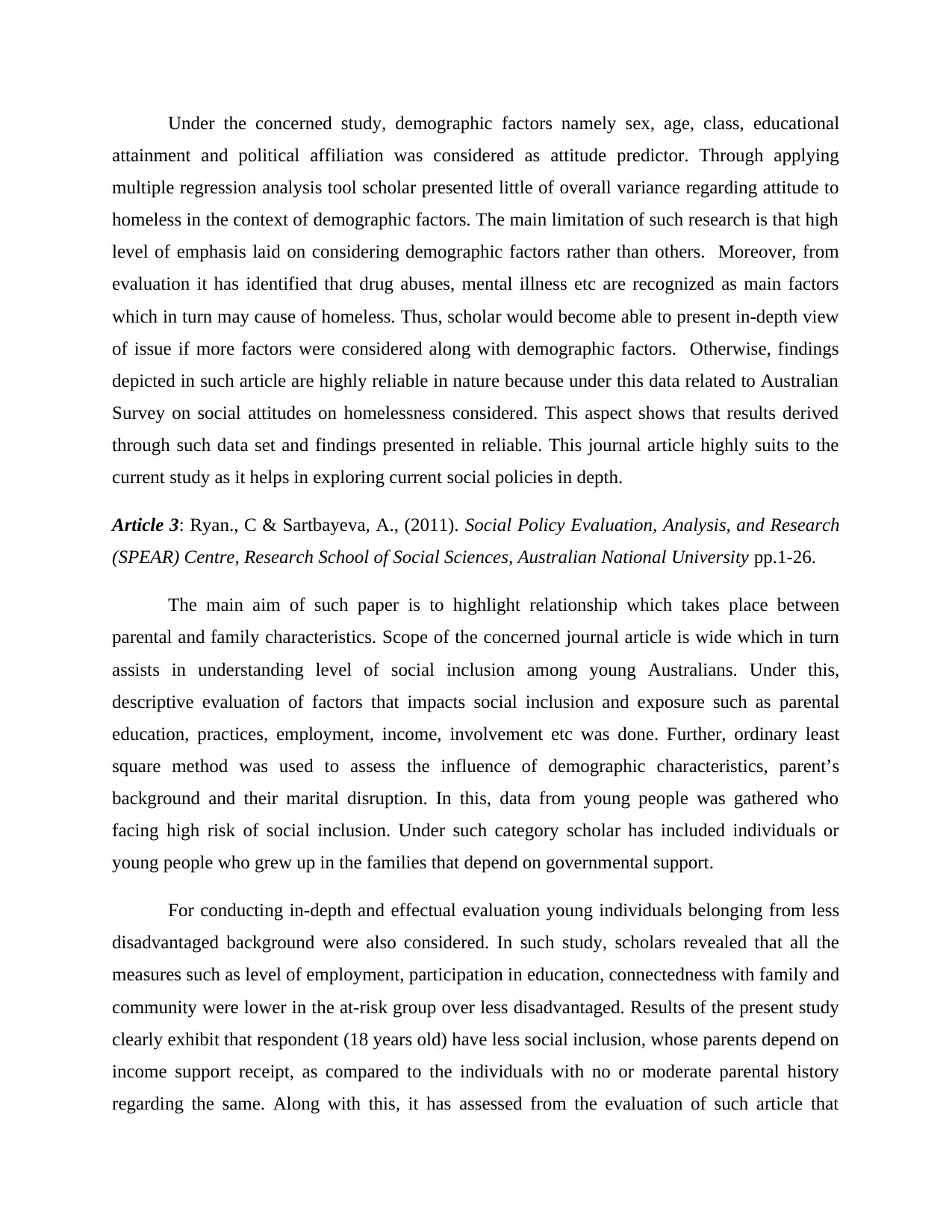
Under the concerned study, demographic factors namely sex, age, class, educational
attainment and political affiliation was considered as attitude predictor. Through applying
multiple regression analysis tool scholar presented little of overall variance regarding attitude to
homeless in the context of demographic factors. The main limitation of such research is that high
level of emphasis laid on considering demographic factors rather than others. Moreover, from
evaluation it has identified that drug abuses, mental illness etc are recognized as main factors
which in turn may cause of homeless. Thus, scholar would become able to present in-depth view
of issue if more factors were considered along with demographic factors. Otherwise, findings
depicted in such article are highly reliable in nature because under this data related to Australian
Survey on social attitudes on homelessness considered. This aspect shows that results derived
through such data set and findings presented in reliable. This journal article highly suits to the
current study as it helps in exploring current social policies in depth.
Article 3: Ryan., C & Sartbayeva, A., (2011). Social Policy Evaluation, Analysis, and Research
(SPEAR) Centre, Research School of Social Sciences, Australian National University pp.1-26.
The main aim of such paper is to highlight relationship which takes place between
parental and family characteristics. Scope of the concerned journal article is wide which in turn
assists in understanding level of social inclusion among young Australians. Under this,
descriptive evaluation of factors that impacts social inclusion and exposure such as parental
education, practices, employment, income, involvement etc was done. Further, ordinary least
square method was used to assess the influence of demographic characteristics, parent’s
background and their marital disruption. In this, data from young people was gathered who
facing high risk of social inclusion. Under such category scholar has included individuals or
young people who grew up in the families that depend on governmental support.
For conducting in-depth and effectual evaluation young individuals belonging from less
disadvantaged background were also considered. In such study, scholars revealed that all the
measures such as level of employment, participation in education, connectedness with family and
community were lower in the at-risk group over less disadvantaged. Results of the present study
clearly exhibit that respondent (18 years old) have less social inclusion, whose parents depend on
income support receipt, as compared to the individuals with no or moderate parental history
regarding the same. Along with this, it has assessed from the evaluation of such article that
attainment and political affiliation was considered as attitude predictor. Through applying
multiple regression analysis tool scholar presented little of overall variance regarding attitude to
homeless in the context of demographic factors. The main limitation of such research is that high
level of emphasis laid on considering demographic factors rather than others. Moreover, from
evaluation it has identified that drug abuses, mental illness etc are recognized as main factors
which in turn may cause of homeless. Thus, scholar would become able to present in-depth view
of issue if more factors were considered along with demographic factors. Otherwise, findings
depicted in such article are highly reliable in nature because under this data related to Australian
Survey on social attitudes on homelessness considered. This aspect shows that results derived
through such data set and findings presented in reliable. This journal article highly suits to the
current study as it helps in exploring current social policies in depth.
Article 3: Ryan., C & Sartbayeva, A., (2011). Social Policy Evaluation, Analysis, and Research
(SPEAR) Centre, Research School of Social Sciences, Australian National University pp.1-26.
The main aim of such paper is to highlight relationship which takes place between
parental and family characteristics. Scope of the concerned journal article is wide which in turn
assists in understanding level of social inclusion among young Australians. Under this,
descriptive evaluation of factors that impacts social inclusion and exposure such as parental
education, practices, employment, income, involvement etc was done. Further, ordinary least
square method was used to assess the influence of demographic characteristics, parent’s
background and their marital disruption. In this, data from young people was gathered who
facing high risk of social inclusion. Under such category scholar has included individuals or
young people who grew up in the families that depend on governmental support.
For conducting in-depth and effectual evaluation young individuals belonging from less
disadvantaged background were also considered. In such study, scholars revealed that all the
measures such as level of employment, participation in education, connectedness with family and
community were lower in the at-risk group over less disadvantaged. Results of the present study
clearly exhibit that respondent (18 years old) have less social inclusion, whose parents depend on
income support receipt, as compared to the individuals with no or moderate parental history
regarding the same. Along with this, it has assessed from the evaluation of such article that
Paraphrase This Document
Need a fresh take? Get an instant paraphrase of this document with our AI Paraphraser
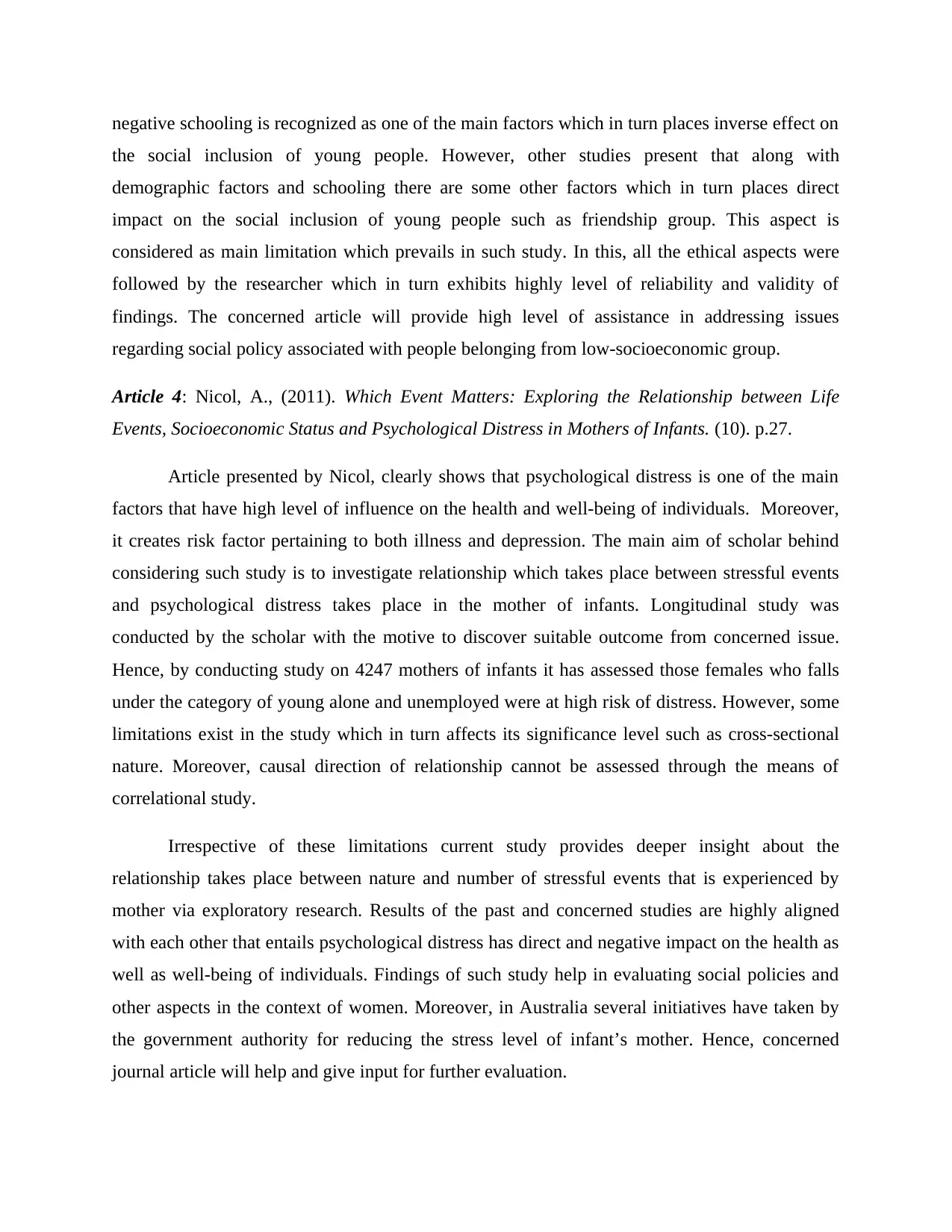
negative schooling is recognized as one of the main factors which in turn places inverse effect on
the social inclusion of young people. However, other studies present that along with
demographic factors and schooling there are some other factors which in turn places direct
impact on the social inclusion of young people such as friendship group. This aspect is
considered as main limitation which prevails in such study. In this, all the ethical aspects were
followed by the researcher which in turn exhibits highly level of reliability and validity of
findings. The concerned article will provide high level of assistance in addressing issues
regarding social policy associated with people belonging from low-socioeconomic group.
Article 4: Nicol, A., (2011). Which Event Matters: Exploring the Relationship between Life
Events, Socioeconomic Status and Psychological Distress in Mothers of Infants. (10). p.27.
Article presented by Nicol, clearly shows that psychological distress is one of the main
factors that have high level of influence on the health and well-being of individuals. Moreover,
it creates risk factor pertaining to both illness and depression. The main aim of scholar behind
considering such study is to investigate relationship which takes place between stressful events
and psychological distress takes place in the mother of infants. Longitudinal study was
conducted by the scholar with the motive to discover suitable outcome from concerned issue.
Hence, by conducting study on 4247 mothers of infants it has assessed those females who falls
under the category of young alone and unemployed were at high risk of distress. However, some
limitations exist in the study which in turn affects its significance level such as cross-sectional
nature. Moreover, causal direction of relationship cannot be assessed through the means of
correlational study.
Irrespective of these limitations current study provides deeper insight about the
relationship takes place between nature and number of stressful events that is experienced by
mother via exploratory research. Results of the past and concerned studies are highly aligned
with each other that entails psychological distress has direct and negative impact on the health as
well as well-being of individuals. Findings of such study help in evaluating social policies and
other aspects in the context of women. Moreover, in Australia several initiatives have taken by
the government authority for reducing the stress level of infant’s mother. Hence, concerned
journal article will help and give input for further evaluation.
the social inclusion of young people. However, other studies present that along with
demographic factors and schooling there are some other factors which in turn places direct
impact on the social inclusion of young people such as friendship group. This aspect is
considered as main limitation which prevails in such study. In this, all the ethical aspects were
followed by the researcher which in turn exhibits highly level of reliability and validity of
findings. The concerned article will provide high level of assistance in addressing issues
regarding social policy associated with people belonging from low-socioeconomic group.
Article 4: Nicol, A., (2011). Which Event Matters: Exploring the Relationship between Life
Events, Socioeconomic Status and Psychological Distress in Mothers of Infants. (10). p.27.
Article presented by Nicol, clearly shows that psychological distress is one of the main
factors that have high level of influence on the health and well-being of individuals. Moreover,
it creates risk factor pertaining to both illness and depression. The main aim of scholar behind
considering such study is to investigate relationship which takes place between stressful events
and psychological distress takes place in the mother of infants. Longitudinal study was
conducted by the scholar with the motive to discover suitable outcome from concerned issue.
Hence, by conducting study on 4247 mothers of infants it has assessed those females who falls
under the category of young alone and unemployed were at high risk of distress. However, some
limitations exist in the study which in turn affects its significance level such as cross-sectional
nature. Moreover, causal direction of relationship cannot be assessed through the means of
correlational study.
Irrespective of these limitations current study provides deeper insight about the
relationship takes place between nature and number of stressful events that is experienced by
mother via exploratory research. Results of the past and concerned studies are highly aligned
with each other that entails psychological distress has direct and negative impact on the health as
well as well-being of individuals. Findings of such study help in evaluating social policies and
other aspects in the context of women. Moreover, in Australia several initiatives have taken by
the government authority for reducing the stress level of infant’s mother. Hence, concerned
journal article will help and give input for further evaluation.
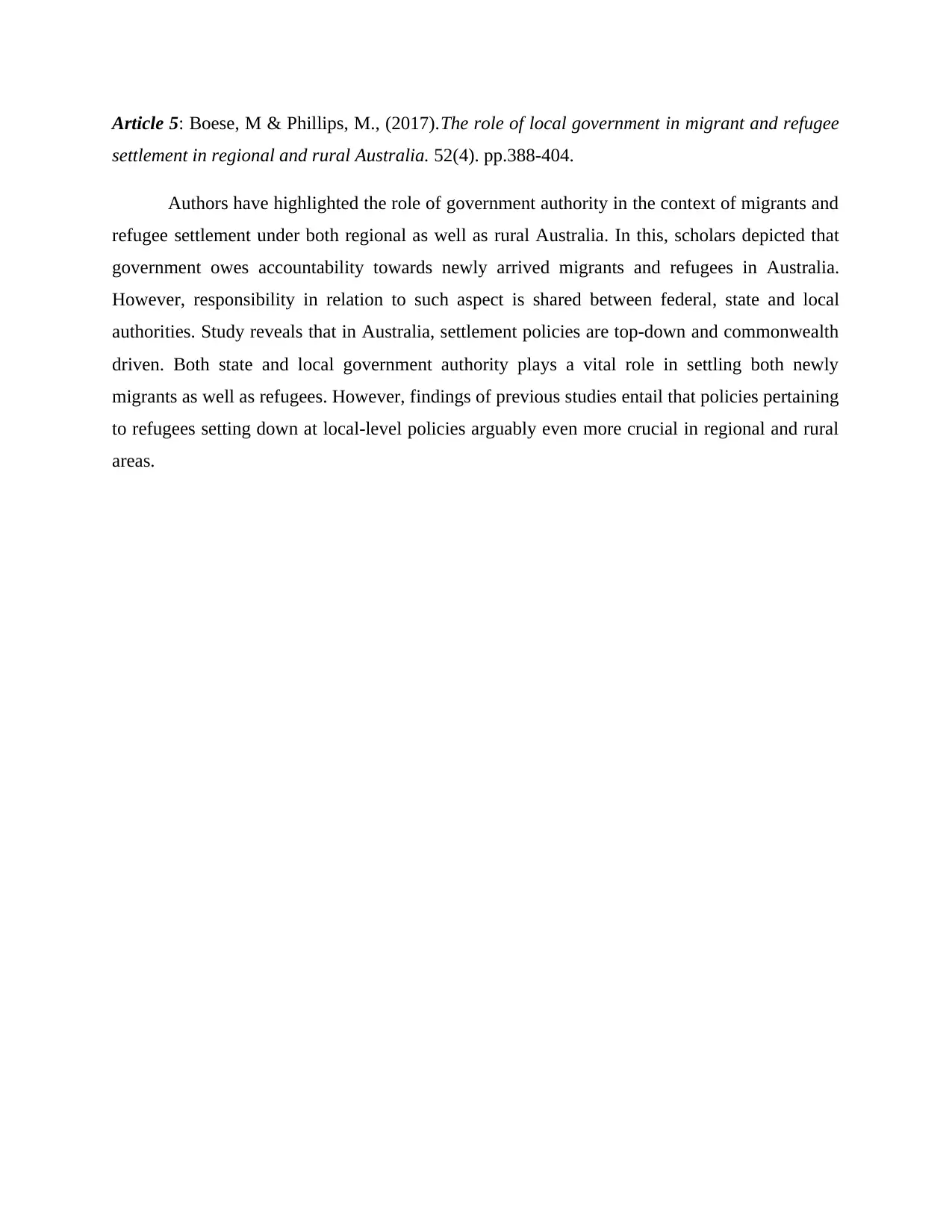
Article 5: Boese, M & Phillips, M., (2017).The role of local government in migrant and refugee
settlement in regional and rural Australia. 52(4). pp.388-404.
Authors have highlighted the role of government authority in the context of migrants and
refugee settlement under both regional as well as rural Australia. In this, scholars depicted that
government owes accountability towards newly arrived migrants and refugees in Australia.
However, responsibility in relation to such aspect is shared between federal, state and local
authorities. Study reveals that in Australia, settlement policies are top-down and commonwealth
driven. Both state and local government authority plays a vital role in settling both newly
migrants as well as refugees. However, findings of previous studies entail that policies pertaining
to refugees setting down at local-level policies arguably even more crucial in regional and rural
areas.
settlement in regional and rural Australia. 52(4). pp.388-404.
Authors have highlighted the role of government authority in the context of migrants and
refugee settlement under both regional as well as rural Australia. In this, scholars depicted that
government owes accountability towards newly arrived migrants and refugees in Australia.
However, responsibility in relation to such aspect is shared between federal, state and local
authorities. Study reveals that in Australia, settlement policies are top-down and commonwealth
driven. Both state and local government authority plays a vital role in settling both newly
migrants as well as refugees. However, findings of previous studies entail that policies pertaining
to refugees setting down at local-level policies arguably even more crucial in regional and rural
areas.
⊘ This is a preview!⊘
Do you want full access?
Subscribe today to unlock all pages.
Trusted by 1+ million students worldwide
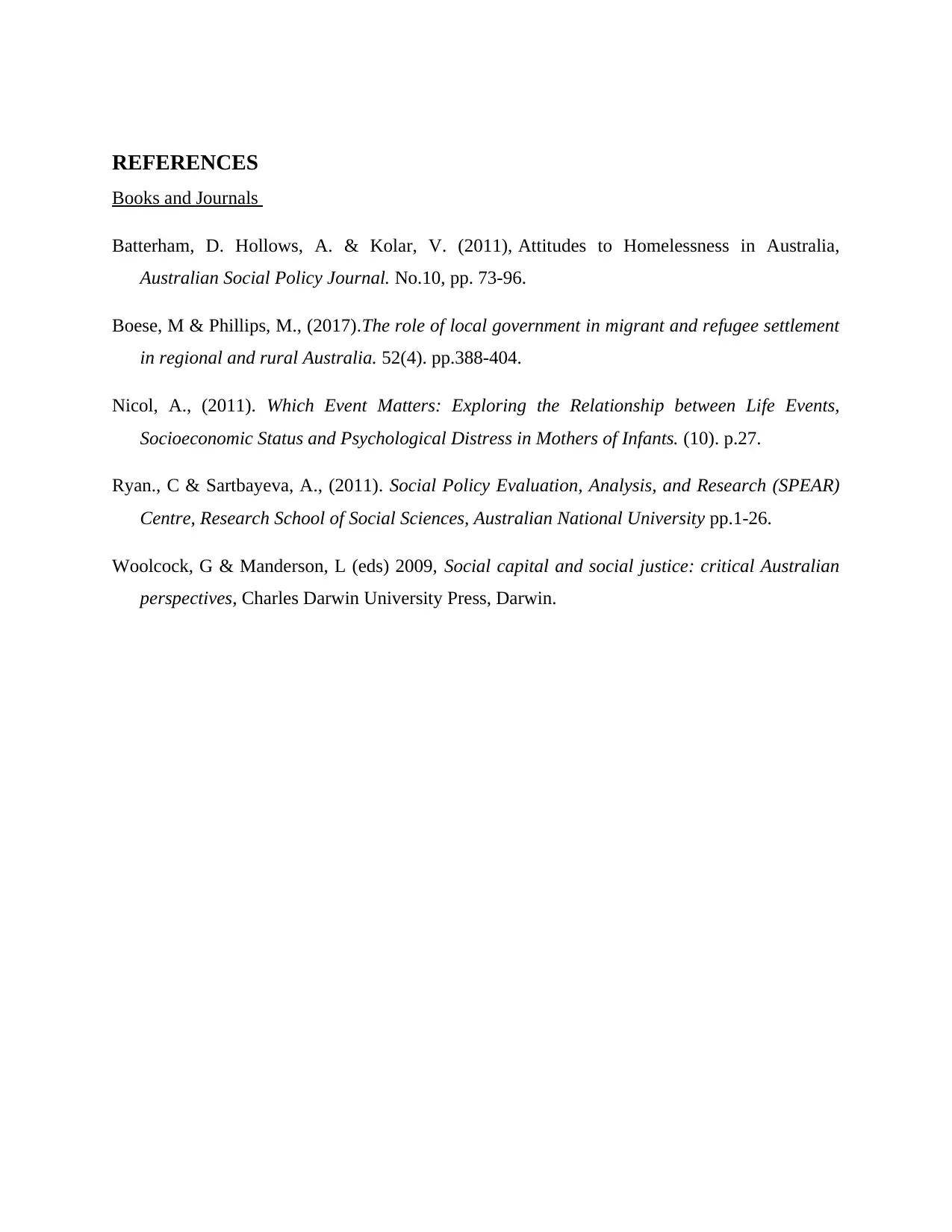
REFERENCES
Books and Journals
Batterham, D. Hollows, A. & Kolar, V. (2011), Attitudes to Homelessness in Australia,
Australian Social Policy Journal. No.10, pp. 73-96.
Boese, M & Phillips, M., (2017).The role of local government in migrant and refugee settlement
in regional and rural Australia. 52(4). pp.388-404.
Nicol, A., (2011). Which Event Matters: Exploring the Relationship between Life Events,
Socioeconomic Status and Psychological Distress in Mothers of Infants. (10). p.27.
Ryan., C & Sartbayeva, A., (2011). Social Policy Evaluation, Analysis, and Research (SPEAR)
Centre, Research School of Social Sciences, Australian National University pp.1-26.
Woolcock, G & Manderson, L (eds) 2009, Social capital and social justice: critical Australian
perspectives, Charles Darwin University Press, Darwin.
Books and Journals
Batterham, D. Hollows, A. & Kolar, V. (2011), Attitudes to Homelessness in Australia,
Australian Social Policy Journal. No.10, pp. 73-96.
Boese, M & Phillips, M., (2017).The role of local government in migrant and refugee settlement
in regional and rural Australia. 52(4). pp.388-404.
Nicol, A., (2011). Which Event Matters: Exploring the Relationship between Life Events,
Socioeconomic Status and Psychological Distress in Mothers of Infants. (10). p.27.
Ryan., C & Sartbayeva, A., (2011). Social Policy Evaluation, Analysis, and Research (SPEAR)
Centre, Research School of Social Sciences, Australian National University pp.1-26.
Woolcock, G & Manderson, L (eds) 2009, Social capital and social justice: critical Australian
perspectives, Charles Darwin University Press, Darwin.

1 out of 7


Your All-in-One AI-Powered Toolkit for Academic Success.
+13062052269
info@desklib.com
Available 24*7 on WhatsApp / Email
![[object Object]](/_next/static/media/star-bottom.7253800d.svg)
Unlock your academic potential
Copyright © 2020–2026 A2Z Services. All Rights Reserved. Developed and managed by ZUCOL.