Social Psychology Assignment: Real-World Bystander Effect Analysis

Verified

Added on  2022/08/13

|4
|738
|8
Homework Assignment
AI Summary
This assignment explores the bystander effect and diffusion of responsibility through a practical experiment. The student conducted an experiment on a campus, pretending to have lost their phone in two different scenarios: one with a small group of people and another with a larger group. The assignment details the student's actions, the behavioral responses observed in each situation, and the differences between the two conditions. It analyzes how the presence of more people led to a decreased sense of individual responsibility, supporting the concept of the bystander effect. The student compares helping responses and discusses the influence of social norms on individual behavior, concluding that the willingness to help is influenced by the social acceptability of the situation. The assignment references relevant psychological studies to support the analysis.
Document Page
Running head: SOCIAL PSYCHOLOGY
Social Psychology
Name of the Student
Name of the University
Author Note
tabler-icon-diamond-filled.svg

Paraphrase This Document

Need a fresh take? Get an instant paraphrase of this document with our AI Paraphraser
Document Page
1SOCIAL PSYCHOLOGY
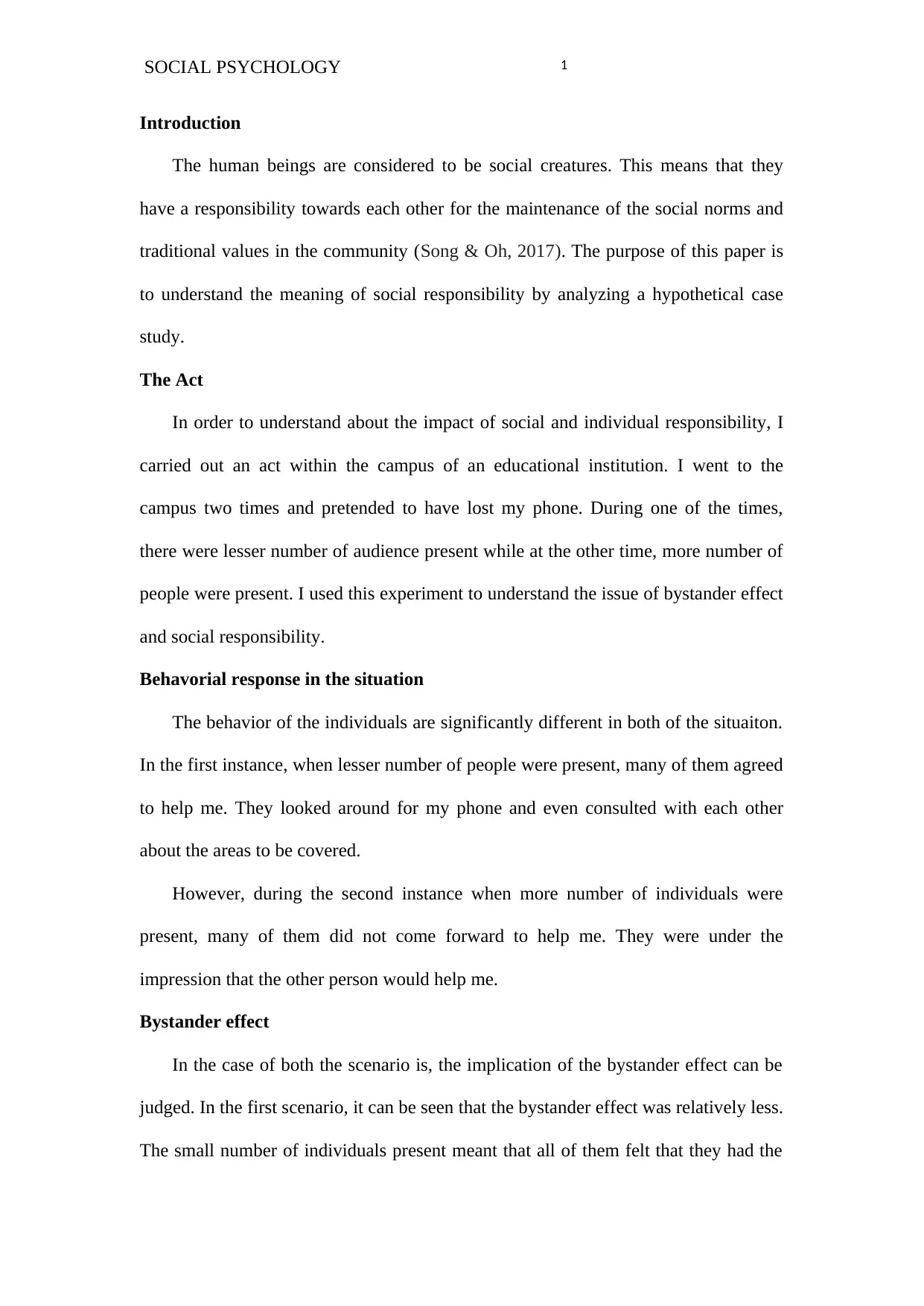
Introduction
The human beings are considered to be social creatures. This means that they
have a responsibility towards each other for the maintenance of the social norms and
traditional values in the community (Song & Oh, 2017). The purpose of this paper is
to understand the meaning of social responsibility by analyzing a hypothetical case
study.
The Act
In order to understand about the impact of social and individual responsibility, I
carried out an act within the campus of an educational institution. I went to the
campus two times and pretended to have lost my phone. During one of the times,
there were lesser number of audience present while at the other time, more number of
people were present. I used this experiment to understand the issue of bystander effect
and social responsibility.
Behavorial response in the situation
The behavior of the individuals are significantly different in both of the situaiton.
In the first instance, when lesser number of people were present, many of them agreed
to help me. They looked around for my phone and even consulted with each other
about the areas to be covered.
However, during the second instance when more number of individuals were
present, many of them did not come forward to help me. They were under the
impression that the other person would help me.
Bystander effect
In the case of both the scenario is, the implication of the bystander effect can be
judged. In the first scenario, it can be seen that the bystander effect was relatively less.
The small number of individuals present meant that all of them felt that they had the
Document Page
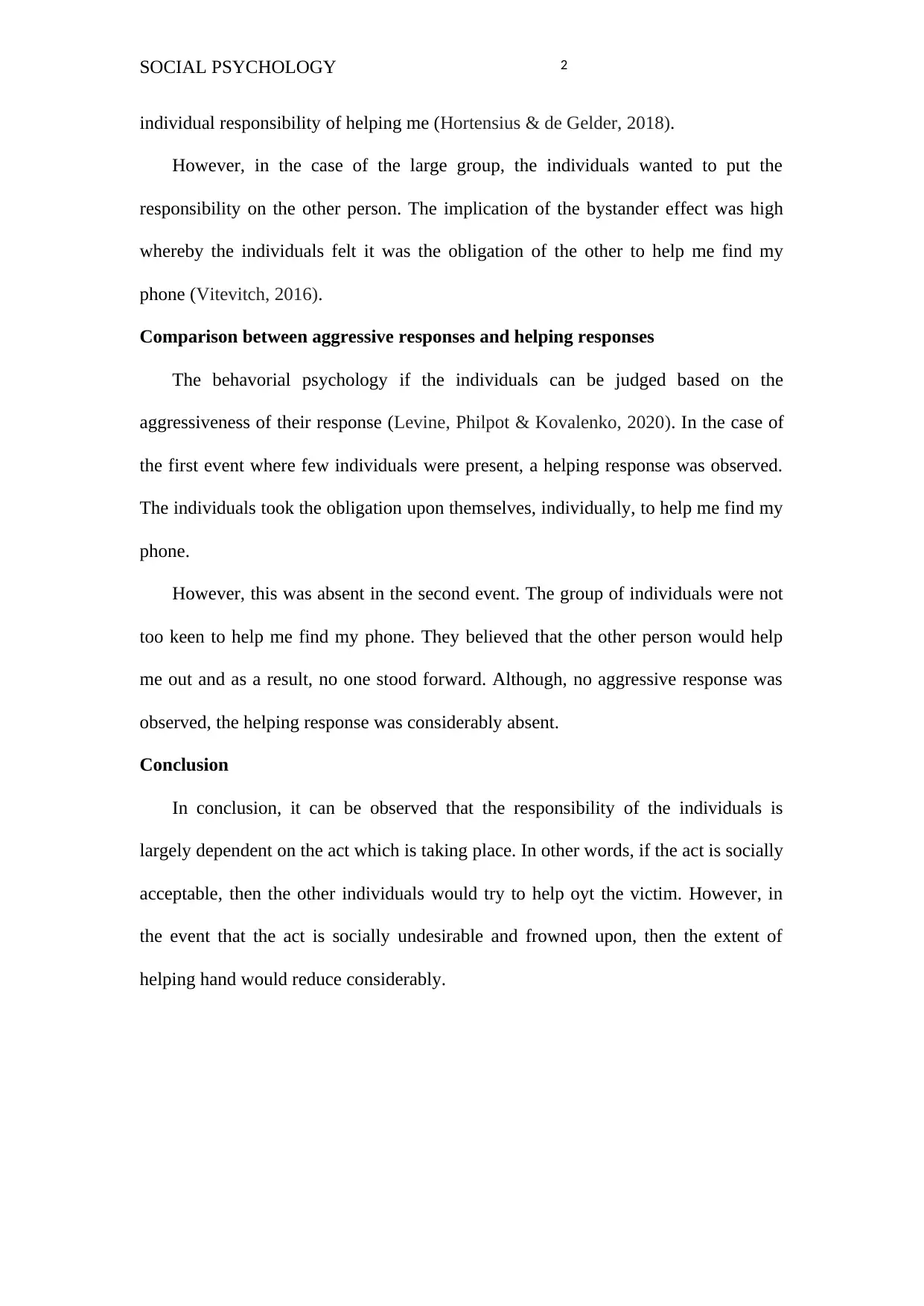
2SOCIAL PSYCHOLOGY
individual responsibility of helping me (Hortensius & de Gelder, 2018).
However, in the case of the large group, the individuals wanted to put the
responsibility on the other person. The implication of the bystander effect was high
whereby the individuals felt it was the obligation of the other to help me find my
phone (Vitevitch, 2016).
Comparison between aggressive responses and helping responses
The behavorial psychology if the individuals can be judged based on the
aggressiveness of their response (Levine, Philpot & Kovalenko, 2020). In the case of
the first event where few individuals were present, a helping response was observed.
The individuals took the obligation upon themselves, individually, to help me find my
phone.
However, this was absent in the second event. The group of individuals were not
too keen to help me find my phone. They believed that the other person would help
me out and as a result, no one stood forward. Although, no aggressive response was
observed, the helping response was considerably absent.
Conclusion
In conclusion, it can be observed that the responsibility of the individuals is
largely dependent on the act which is taking place. In other words, if the act is socially
acceptable, then the other individuals would try to help oyt the victim. However, in
the event that the act is socially undesirable and frowned upon, then the extent of
helping hand would reduce considerably.
Document Page
3SOCIAL PSYCHOLOGY
References:
Hortensius, R., & de Gelder, B. (2018). From empathy to apathy: The bystander effect
revisited. Current directions in psychological science, 27(4), 249-256.
Levine, M., Philpot, R., & Kovalenko, A. G. (2020). Rethinking the Bystander Effect
in Violence Reduction Training Programs. Social Issues and Policy
Review, 14(1), 273-296.
Song, J., & Oh, I. (2017). Investigation of the bystander effect in school bullying:
Comparison of experiential, psychological and situational factors. School
Psychology International, 38(3), 319-336.
Vitevitch, M. (2016). Network analysis and psychology. In Handbook of applied
system science (pp. 146-162). Routledge.
chevron_up_icon
1 out of 4
circle_padding
hide_on_mobile
zoom_out_icon
[object Object]