Diploma in Psychology: Social Research Family Intervention Analysis

Verified

Added on  2022/10/12

|6
|1434
|410
Report
AI Summary
This report analyzes a case study of Mr. Lau's family, examining the application of the family life cycle framework to address the family's crisis. The analysis focuses on Mr. Lau's challenges in managing his relationship with his adolescent daughter and his strained relationships with his siblings. The report recommends therapeutic sessions as a family intervention method, highlighting the importance of communication, trust-building, and addressing the impact of Mr. Lau's criminal past. The report suggests that a therapist can mediate family issues, explore the underlying causes of conflict, and facilitate forgiveness and acceptance. The report references relevant literature to support the recommendations and analysis.
Document Page
Running head: SOCIAL RESEARCH
Social Research
Name of the Student
Name of the University
Author Note
tabler-icon-diamond-filled.svg

Paraphrase This Document

Need a fresh take? Get an instant paraphrase of this document with our AI Paraphraser
Document Page
1SOCIAL RESEARCH
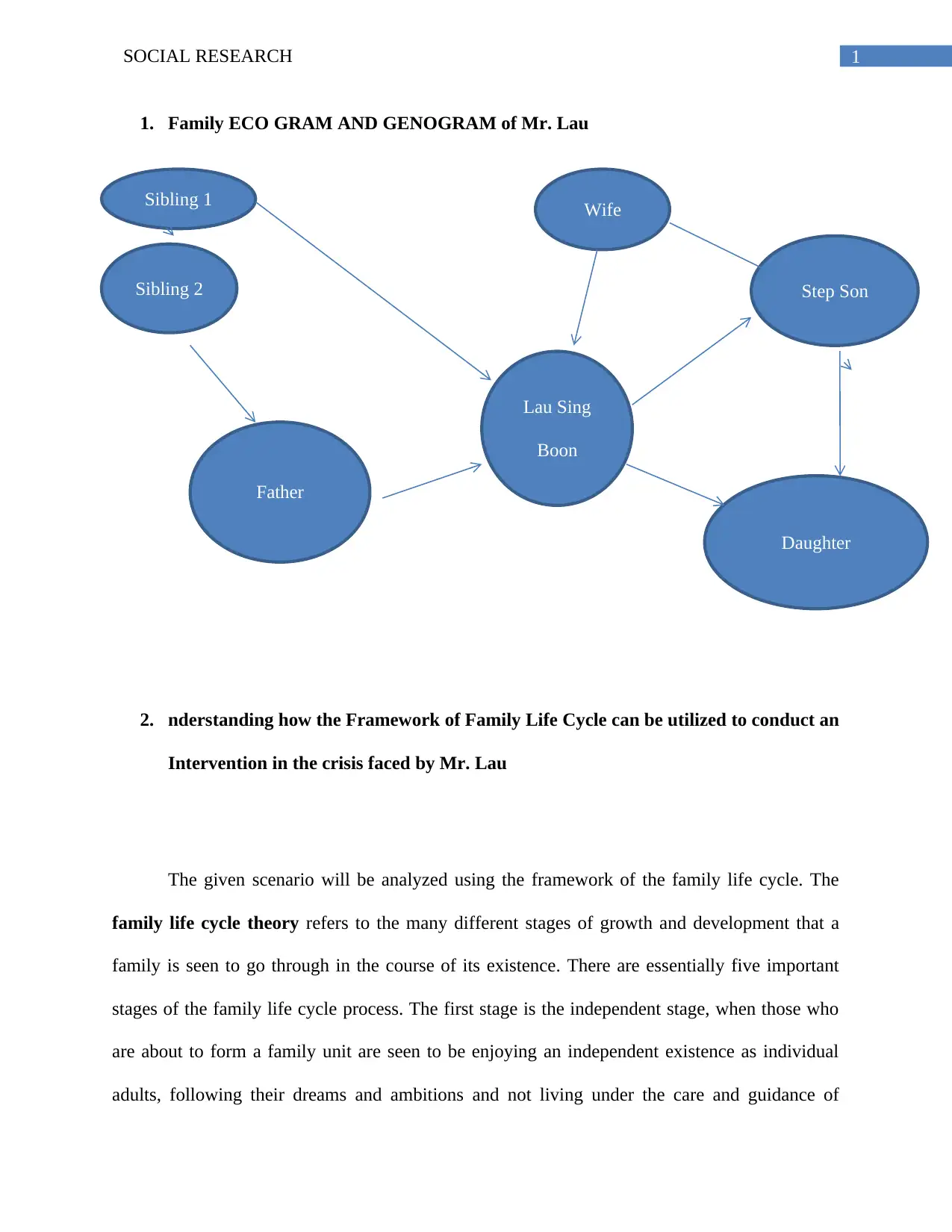
1. Family ECO GRAM AND GENOGRAM of Mr. Lau
2. nderstanding how the Framework of Family Life Cycle can be utilized to conduct an
Intervention in the crisis faced by Mr. Lau
The given scenario will be analyzed using the framework of the family life cycle. The
family life cycle theory refers to the many different stages of growth and development that a
family is seen to go through in the course of its existence. There are essentially five important
stages of the family life cycle process. The first stage is the independent stage, when those who
are about to form a family unit are seen to be enjoying an independent existence as individual
adults, following their dreams and ambitions and not living under the care and guidance of
Lau Sing
Boon
Wife
Father
Daughter
Step SonSibling 2
Sibling 1
Document Page
2SOCIAL RESEARCH
anyone. The second stage is marriage or the coupling stage when two people living
independently decide to come together, form a union by marriage and start a family. The third
crucial stage of the family life cycle process is the child bearing and the child rearing stage. This
is the stage when the married couple is seen to devote all of their energies into rearing their
children right up to the point when their children have become adolescent or are in their teens.
The fourth stage of the family life cycle theory entails the launching of adult children, helping
them to set out a career and consequently an independent existence for themselves and finally,
the fifth stage of the family life cycle theory is one that involves ageing gracefully or otherwise
in old age (Rapoport & Rapoport, 2019).
When it comes to analyzing the case of Mr. Lau, two of the issues that I would want to
work on, with him as a case workers are his tendency to control the life and activities of his
daughter and the negative perceptions and assumptions that he holds with regard to the
intentions of his siblings. It is clear from reading the case study that has been provided that Mr.
Lau belongs to the stage in the family life cycle when his children have entered the stage of
adolescence, that is, with his daughter being only 15 years of age as also the stage of launching
adult children, given the fact that his step son recently enrolled for duties in the infantry and who
is now away from home. The task of rearing an adolescent daughter is not proving to be easy for
Mr. Lau given that teenagers are often known to be rebellious and daring and do not want to be
controlled by their parents. As a case worker, I would make Mr. Lau understand that an
adolescent child needs to be granted a fair degree of independence, which is why he needs to be
more accepting of the fact that his daughter wants to go out and wishes to stay out late. I would
explain to him how she is going through a difficult transition from her childhood and pre-teens to
a time in her life when she slowly begins to act and think and feel like an adult. Mr. Lau has
Document Page
3SOCIAL RESEARCH
made a recent return to family life and he wishes to start afresh with establishing family
relationships. I would make him understand it is natural for his daughter to see him in a negative
light because of his criminal behavior and the only way he can win back her affections and trust
in him is by giving her the independence that she desires from it at this stage, and that if controls
are to be put in place, it should be the job of Mrs. Lau to do that. Mrs. Lau does not have a
criminal past and it will be easier for their daughter to accept instructions or orders from her,
than it would from Mr. Lau at the moment (Yan & Zhou, 2016).
It is also clear from the information that has been presented in the case study that Mr. Lau
is an aged individual and his siblings are also well into their middle age. This is the time in his
life when he should be growing closer to his family and reconnecting with his siblings as he is
going to need their support and companionship in old age. Mr. Lau’s step son is already away
from home and sooner rather than later, his daughter may also leave home to start an
independent life of her own. I would explain all of this to Mr. Lau and I would get him to realize
that instead of holding negative perceptions about his siblings and their intentions, he should
instead go ahead and try to connect with them once again, open up to them and let them in, and
see where it goes. This is imperative because by establishing a strong and steady relationship
with his siblings, his wife, his father and the rest of his family, Mr. Lau can successfully make a
return to normal social life (Yan & Zhou, 2016).
3. Suggested Family Intervention for Mr. Lau
A family intervention method that I would recommend for Mr. Lau and his family
members is therapeutic sessions. It is only when the family is made to go through repeated
tabler-icon-diamond-filled.svg

Paraphrase This Document

Need a fresh take? Get an instant paraphrase of this document with our AI Paraphraser
Document Page
4SOCIAL RESEARCH
sessions and intensive counseling sessions with an experienced therapist that they can gradually
learn to communicate with one another better and overcome the dark history of Mr. Lau.
Forgiving criminal behavior and moving on from criminal behavior is not the easiest thing to do
in the world (Dong & Krohn, 2017). A therapist can help to untangle all the issues that the Mr.
Lau and the immediate members of his family are faced with, especially with their regard to their
communication with one another. A therapist will uncover the real reasons why Mr. Lau is so
apprehensive of the intentions of his siblings, and arrive at an understanding of why it is he
would think that his siblings would want to poison the mind of his daughter against her father. A
therapist will also uncover and analyze the reasons behind his daughter’s rebellious behavior,
that is whether she is being rebellious just because she is in her teens or because she is truly
ashamed of being associated with her father because of his criminal behavior (Sexton, 2017).
The therapist would play the crucial role of a mediator in resolving the issues or problems in
communication and trust that Mr. Lau and the immediate members of his family are faced with.
It is only a therapist who can truly reason with not just Mr. Lau but the rest of his family, helping
them to overcome the negativity that they are surrounded by at the moment because of Mr. Lau’s
criminal behavior, and to move towards a path of forgiveness, healing and acceptance (Dishion
et al., 2016).
References
Dishion, T., Forgatch, M., Chamberlain, P., & Pelham III, W. E. (2016). The Oregon model of
behavior family therapy: From intervention design to promoting large-scale system
change. Behavior therapy, 47(6), 812-837.
Document Page
5SOCIAL RESEARCH
Dong, B., & Krohn, M. D. (2017). The protective effects of family support on the relationship
between official intervention and general delinquency across the life course. Journal of
developmental and life-course criminology, 3(1), 39-61.
Rapoport, R., & Rapoport, R. N. (2019). Leisure and the family life cycle. Routledge
Sexton, T. L. (2017). Functional family therapy. The Encyclopedia of Juvenile Delinquency and
Justice, 1-7.
Yan, S., & Zhou, Y. (2016). Research of Work-Family Balance Based on Family Life Cycle.
Open Journal of Social Sciences, 4(11), 218
chevron_up_icon
1 out of 6
circle_padding
hide_on_mobile
zoom_out_icon
[object Object]