Analyzing Social Responsibility in the Mining Sector Essay
VerifiedAdded on 2023/06/04
|9
|2231
|353
Essay
AI Summary
This essay examines social responsibility within the mining sector, emphasizing the critical need for organizations to balance profit motives with environmental conservation and societal welfare. It delves into the four dimensions of social responsibility: legal, ethical, economic, and philanthropic, illustrating how mining companies can adhere to regulations, ensure safe working conditions, contribute to economic prosperity, and engage in community development. The essay also addresses factors hindering social responsibility, such as greenwashing perceptions and inadequate regulations, and proposes solutions like enhancing public awareness and strengthening disclosure laws. Ultimately, it underscores the importance of social responsibility in improving brand image, fostering positive community relations, and promoting sustainable practices within the mining industry. Desklib provides access to a variety of student-contributed assignments and study tools.

SOCIAL RESPONSIBILITY 1
Social responsibility in the mining sector
By
[Student’s name]
Course
Institution
Date
Social responsibility in the mining sector
By
[Student’s name]
Course
Institution
Date

Paraphrase This Document
Need a fresh take? Get an instant paraphrase of this document with our AI Paraphraser
SOCIAL RESPONSIBILITY 2
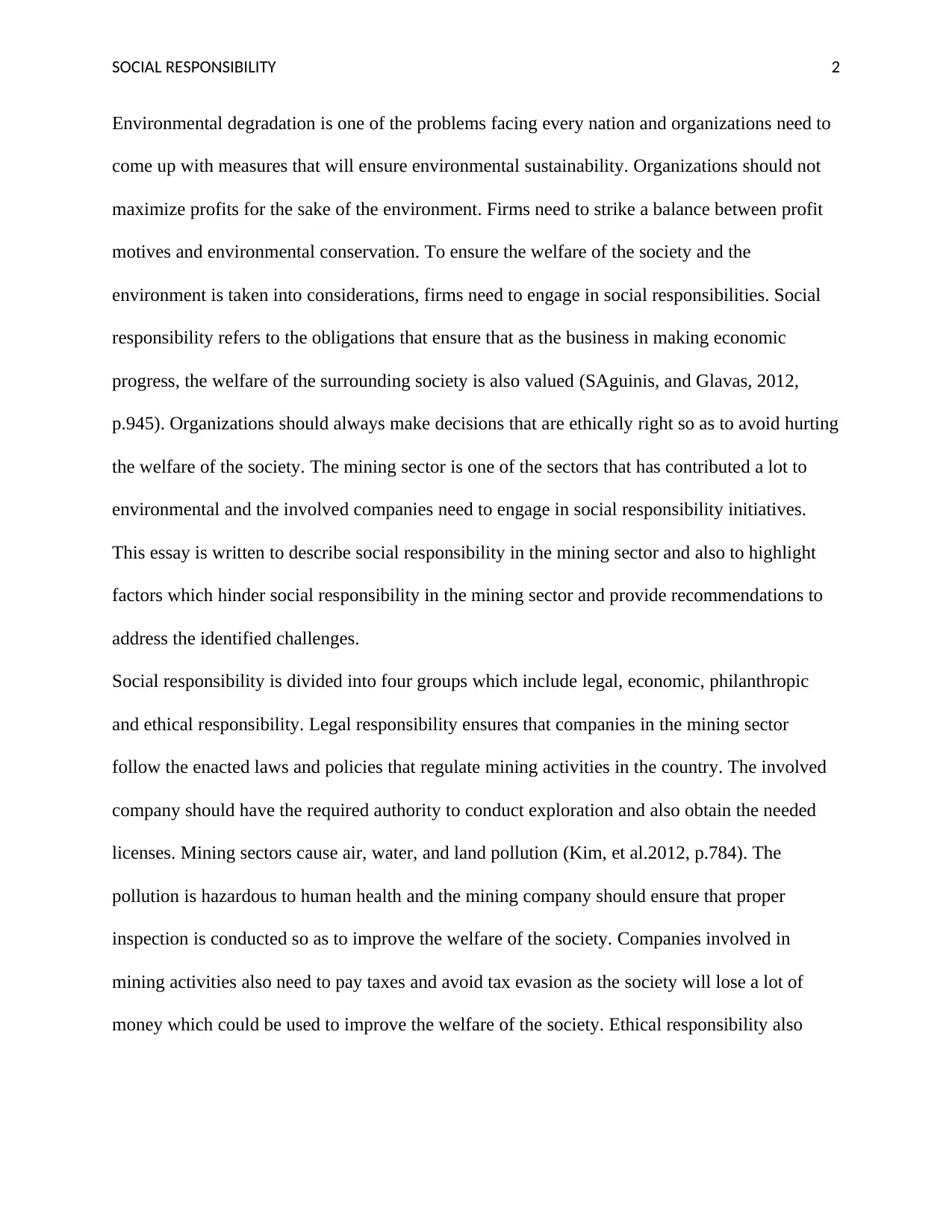
Environmental degradation is one of the problems facing every nation and organizations need to
come up with measures that will ensure environmental sustainability. Organizations should not
maximize profits for the sake of the environment. Firms need to strike a balance between profit
motives and environmental conservation. To ensure the welfare of the society and the
environment is taken into considerations, firms need to engage in social responsibilities. Social
responsibility refers to the obligations that ensure that as the business in making economic
progress, the welfare of the surrounding society is also valued (SAguinis, and Glavas, 2012,
p.945). Organizations should always make decisions that are ethically right so as to avoid hurting
the welfare of the society. The mining sector is one of the sectors that has contributed a lot to
environmental and the involved companies need to engage in social responsibility initiatives.
This essay is written to describe social responsibility in the mining sector and also to highlight
factors which hinder social responsibility in the mining sector and provide recommendations to
address the identified challenges.
Social responsibility is divided into four groups which include legal, economic, philanthropic
and ethical responsibility. Legal responsibility ensures that companies in the mining sector
follow the enacted laws and policies that regulate mining activities in the country. The involved
company should have the required authority to conduct exploration and also obtain the needed
licenses. Mining sectors cause air, water, and land pollution (Kim, et al.2012, p.784). The
pollution is hazardous to human health and the mining company should ensure that proper
inspection is conducted so as to improve the welfare of the society. Companies involved in
mining activities also need to pay taxes and avoid tax evasion as the society will lose a lot of
money which could be used to improve the welfare of the society. Ethical responsibility also
Environmental degradation is one of the problems facing every nation and organizations need to
come up with measures that will ensure environmental sustainability. Organizations should not
maximize profits for the sake of the environment. Firms need to strike a balance between profit
motives and environmental conservation. To ensure the welfare of the society and the
environment is taken into considerations, firms need to engage in social responsibilities. Social
responsibility refers to the obligations that ensure that as the business in making economic
progress, the welfare of the surrounding society is also valued (SAguinis, and Glavas, 2012,
p.945). Organizations should always make decisions that are ethically right so as to avoid hurting
the welfare of the society. The mining sector is one of the sectors that has contributed a lot to
environmental and the involved companies need to engage in social responsibility initiatives.
This essay is written to describe social responsibility in the mining sector and also to highlight
factors which hinder social responsibility in the mining sector and provide recommendations to
address the identified challenges.
Social responsibility is divided into four groups which include legal, economic, philanthropic
and ethical responsibility. Legal responsibility ensures that companies in the mining sector
follow the enacted laws and policies that regulate mining activities in the country. The involved
company should have the required authority to conduct exploration and also obtain the needed
licenses. Mining sectors cause air, water, and land pollution (Kim, et al.2012, p.784). The
pollution is hazardous to human health and the mining company should ensure that proper
inspection is conducted so as to improve the welfare of the society. Companies involved in
mining activities also need to pay taxes and avoid tax evasion as the society will lose a lot of
money which could be used to improve the welfare of the society. Ethical responsibility also
SOCIAL RESPONSIBILITY 3
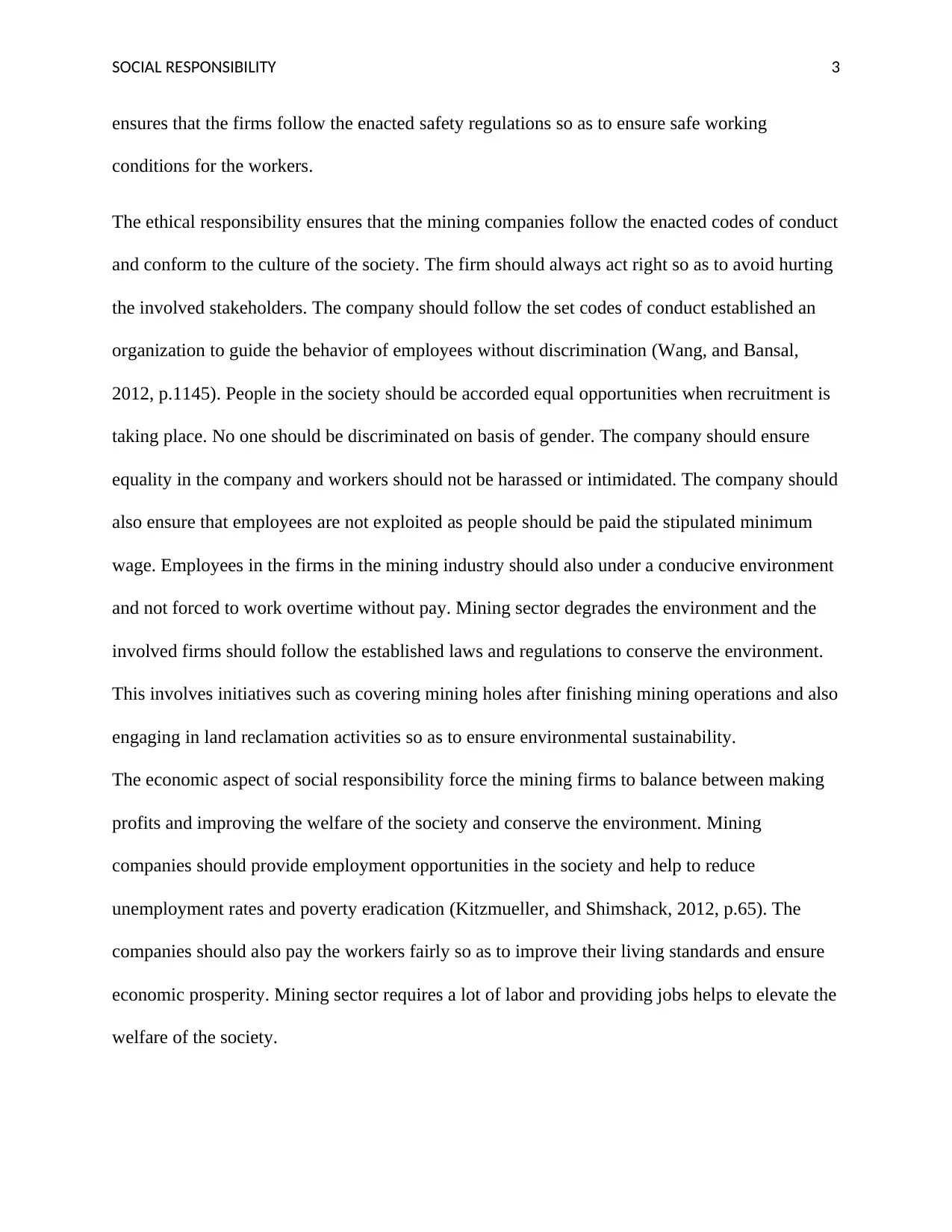
ensures that the firms follow the enacted safety regulations so as to ensure safe working
conditions for the workers.
The ethical responsibility ensures that the mining companies follow the enacted codes of conduct
and conform to the culture of the society. The firm should always act right so as to avoid hurting
the involved stakeholders. The company should follow the set codes of conduct established an
organization to guide the behavior of employees without discrimination (Wang, and Bansal,
2012, p.1145). People in the society should be accorded equal opportunities when recruitment is
taking place. No one should be discriminated on basis of gender. The company should ensure
equality in the company and workers should not be harassed or intimidated. The company should
also ensure that employees are not exploited as people should be paid the stipulated minimum
wage. Employees in the firms in the mining industry should also under a conducive environment
and not forced to work overtime without pay. Mining sector degrades the environment and the
involved firms should follow the established laws and regulations to conserve the environment.
This involves initiatives such as covering mining holes after finishing mining operations and also
engaging in land reclamation activities so as to ensure environmental sustainability.
The economic aspect of social responsibility force the mining firms to balance between making
profits and improving the welfare of the society and conserve the environment. Mining
companies should provide employment opportunities in the society and help to reduce
unemployment rates and poverty eradication (Kitzmueller, and Shimshack, 2012, p.65). The
companies should also pay the workers fairly so as to improve their living standards and ensure
economic prosperity. Mining sector requires a lot of labor and providing jobs helps to elevate the
welfare of the society.
ensures that the firms follow the enacted safety regulations so as to ensure safe working
conditions for the workers.
The ethical responsibility ensures that the mining companies follow the enacted codes of conduct
and conform to the culture of the society. The firm should always act right so as to avoid hurting
the involved stakeholders. The company should follow the set codes of conduct established an
organization to guide the behavior of employees without discrimination (Wang, and Bansal,
2012, p.1145). People in the society should be accorded equal opportunities when recruitment is
taking place. No one should be discriminated on basis of gender. The company should ensure
equality in the company and workers should not be harassed or intimidated. The company should
also ensure that employees are not exploited as people should be paid the stipulated minimum
wage. Employees in the firms in the mining industry should also under a conducive environment
and not forced to work overtime without pay. Mining sector degrades the environment and the
involved firms should follow the established laws and regulations to conserve the environment.
This involves initiatives such as covering mining holes after finishing mining operations and also
engaging in land reclamation activities so as to ensure environmental sustainability.
The economic aspect of social responsibility force the mining firms to balance between making
profits and improving the welfare of the society and conserve the environment. Mining
companies should provide employment opportunities in the society and help to reduce
unemployment rates and poverty eradication (Kitzmueller, and Shimshack, 2012, p.65). The
companies should also pay the workers fairly so as to improve their living standards and ensure
economic prosperity. Mining sector requires a lot of labor and providing jobs helps to elevate the
welfare of the society.
⊘ This is a preview!⊘
Do you want full access?
Subscribe today to unlock all pages.

Trusted by 1+ million students worldwide
SOCIAL RESPONSIBILITY 4
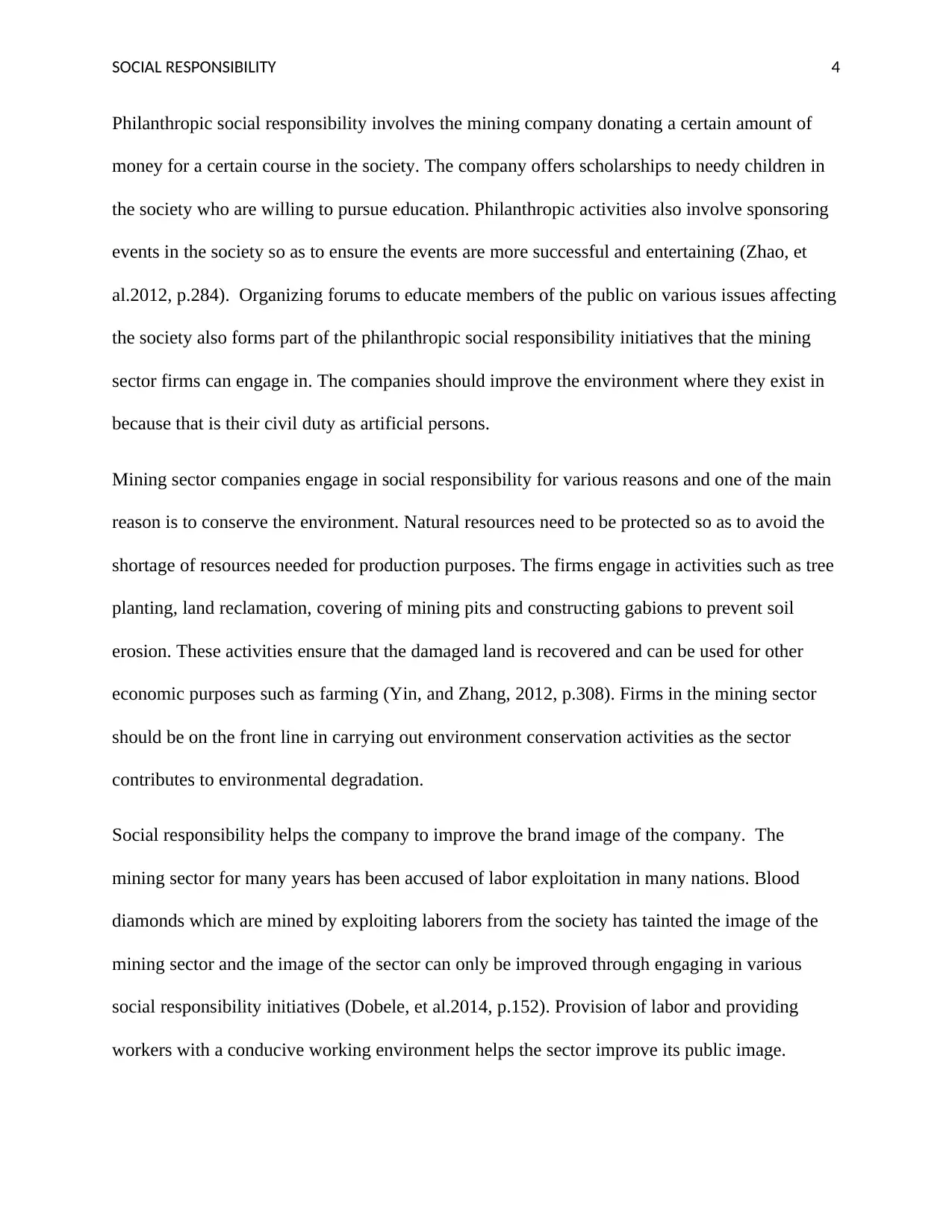
Philanthropic social responsibility involves the mining company donating a certain amount of
money for a certain course in the society. The company offers scholarships to needy children in
the society who are willing to pursue education. Philanthropic activities also involve sponsoring
events in the society so as to ensure the events are more successful and entertaining (Zhao, et
al.2012, p.284). Organizing forums to educate members of the public on various issues affecting
the society also forms part of the philanthropic social responsibility initiatives that the mining
sector firms can engage in. The companies should improve the environment where they exist in
because that is their civil duty as artificial persons.
Mining sector companies engage in social responsibility for various reasons and one of the main
reason is to conserve the environment. Natural resources need to be protected so as to avoid the
shortage of resources needed for production purposes. The firms engage in activities such as tree
planting, land reclamation, covering of mining pits and constructing gabions to prevent soil
erosion. These activities ensure that the damaged land is recovered and can be used for other
economic purposes such as farming (Yin, and Zhang, 2012, p.308). Firms in the mining sector
should be on the front line in carrying out environment conservation activities as the sector
contributes to environmental degradation.
Social responsibility helps the company to improve the brand image of the company. The
mining sector for many years has been accused of labor exploitation in many nations. Blood
diamonds which are mined by exploiting laborers from the society has tainted the image of the
mining sector and the image of the sector can only be improved through engaging in various
social responsibility initiatives (Dobele, et al.2014, p.152). Provision of labor and providing
workers with a conducive working environment helps the sector improve its public image.
Philanthropic social responsibility involves the mining company donating a certain amount of
money for a certain course in the society. The company offers scholarships to needy children in
the society who are willing to pursue education. Philanthropic activities also involve sponsoring
events in the society so as to ensure the events are more successful and entertaining (Zhao, et
al.2012, p.284). Organizing forums to educate members of the public on various issues affecting
the society also forms part of the philanthropic social responsibility initiatives that the mining
sector firms can engage in. The companies should improve the environment where they exist in
because that is their civil duty as artificial persons.
Mining sector companies engage in social responsibility for various reasons and one of the main
reason is to conserve the environment. Natural resources need to be protected so as to avoid the
shortage of resources needed for production purposes. The firms engage in activities such as tree
planting, land reclamation, covering of mining pits and constructing gabions to prevent soil
erosion. These activities ensure that the damaged land is recovered and can be used for other
economic purposes such as farming (Yin, and Zhang, 2012, p.308). Firms in the mining sector
should be on the front line in carrying out environment conservation activities as the sector
contributes to environmental degradation.
Social responsibility helps the company to improve the brand image of the company. The
mining sector for many years has been accused of labor exploitation in many nations. Blood
diamonds which are mined by exploiting laborers from the society has tainted the image of the
mining sector and the image of the sector can only be improved through engaging in various
social responsibility initiatives (Dobele, et al.2014, p.152). Provision of labor and providing
workers with a conducive working environment helps the sector improve its public image.
Paraphrase This Document
Need a fresh take? Get an instant paraphrase of this document with our AI Paraphraser
SOCIAL RESPONSIBILITY 5
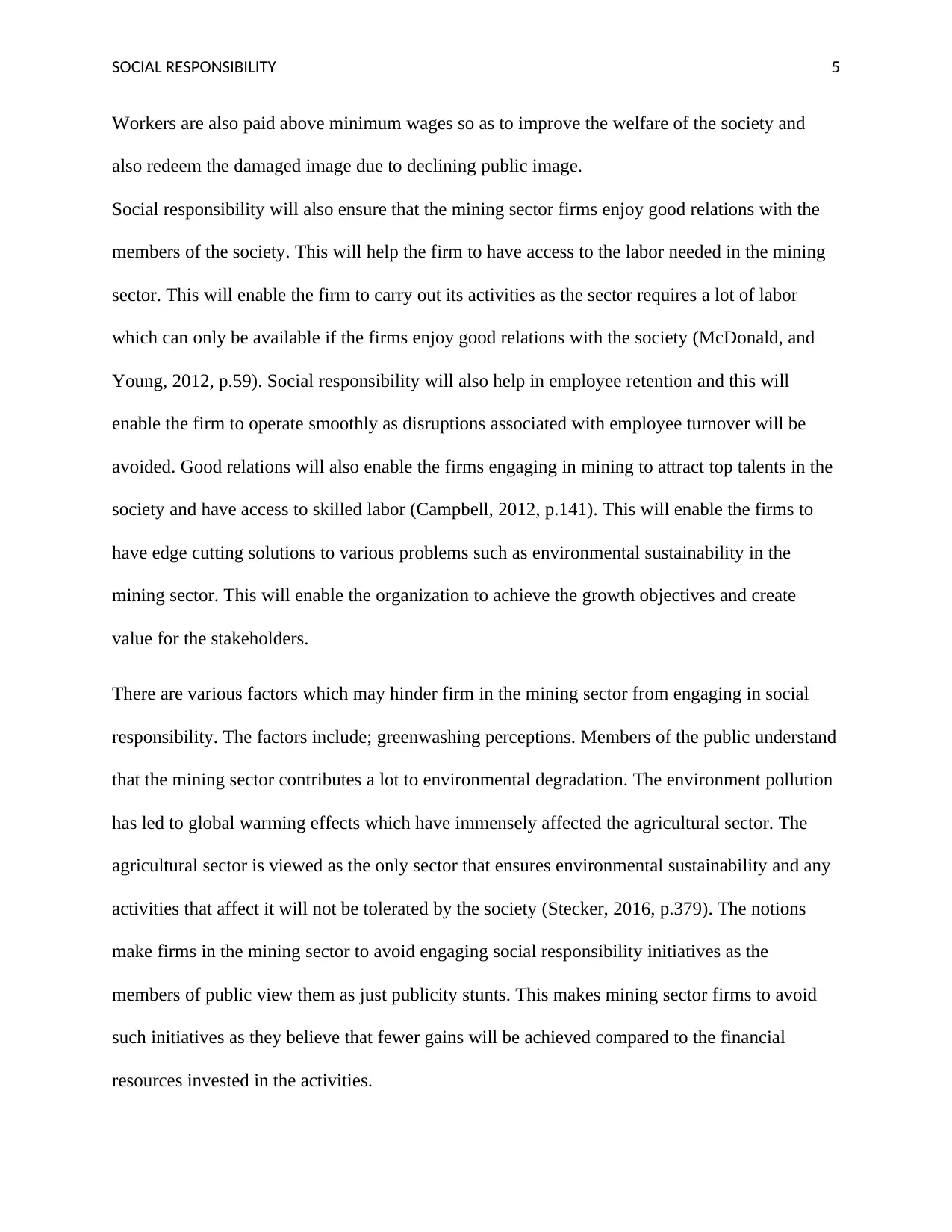
Workers are also paid above minimum wages so as to improve the welfare of the society and
also redeem the damaged image due to declining public image.
Social responsibility will also ensure that the mining sector firms enjoy good relations with the
members of the society. This will help the firm to have access to the labor needed in the mining
sector. This will enable the firm to carry out its activities as the sector requires a lot of labor
which can only be available if the firms enjoy good relations with the society (McDonald, and
Young, 2012, p.59). Social responsibility will also help in employee retention and this will
enable the firm to operate smoothly as disruptions associated with employee turnover will be
avoided. Good relations will also enable the firms engaging in mining to attract top talents in the
society and have access to skilled labor (Campbell, 2012, p.141). This will enable the firms to
have edge cutting solutions to various problems such as environmental sustainability in the
mining sector. This will enable the organization to achieve the growth objectives and create
value for the stakeholders.
There are various factors which may hinder firm in the mining sector from engaging in social
responsibility. The factors include; greenwashing perceptions. Members of the public understand
that the mining sector contributes a lot to environmental degradation. The environment pollution
has led to global warming effects which have immensely affected the agricultural sector. The
agricultural sector is viewed as the only sector that ensures environmental sustainability and any
activities that affect it will not be tolerated by the society (Stecker, 2016, p.379). The notions
make firms in the mining sector to avoid engaging social responsibility initiatives as the
members of public view them as just publicity stunts. This makes mining sector firms to avoid
such initiatives as they believe that fewer gains will be achieved compared to the financial
resources invested in the activities.
Workers are also paid above minimum wages so as to improve the welfare of the society and
also redeem the damaged image due to declining public image.
Social responsibility will also ensure that the mining sector firms enjoy good relations with the
members of the society. This will help the firm to have access to the labor needed in the mining
sector. This will enable the firm to carry out its activities as the sector requires a lot of labor
which can only be available if the firms enjoy good relations with the society (McDonald, and
Young, 2012, p.59). Social responsibility will also help in employee retention and this will
enable the firm to operate smoothly as disruptions associated with employee turnover will be
avoided. Good relations will also enable the firms engaging in mining to attract top talents in the
society and have access to skilled labor (Campbell, 2012, p.141). This will enable the firms to
have edge cutting solutions to various problems such as environmental sustainability in the
mining sector. This will enable the organization to achieve the growth objectives and create
value for the stakeholders.
There are various factors which may hinder firm in the mining sector from engaging in social
responsibility. The factors include; greenwashing perceptions. Members of the public understand
that the mining sector contributes a lot to environmental degradation. The environment pollution
has led to global warming effects which have immensely affected the agricultural sector. The
agricultural sector is viewed as the only sector that ensures environmental sustainability and any
activities that affect it will not be tolerated by the society (Stecker, 2016, p.379). The notions
make firms in the mining sector to avoid engaging social responsibility initiatives as the
members of public view them as just publicity stunts. This makes mining sector firms to avoid
such initiatives as they believe that fewer gains will be achieved compared to the financial
resources invested in the activities.
SOCIAL RESPONSIBILITY 6
Lack of proper laws and regulations to govern social responsibility disclosures when preparing
statements for the members of the public. This enables many companies to avoid in
environmental sustainability as there are no clear regulations that force organizations to account
for all social responsibilities (Littlewood, 2014, p.52). Such loopholes will cause the firm to
neglect environmental conservation measures and this will enable the firm to neglect social
responsibility initiatives that help to improve the welfare of the society.
The managers in the firm can set aside funds that will help in creating awareness to members of
the public that the mining sector plays a critical role in economic growth and it should be helped
in all ways possible. This will help in avoiding the notion that social responsibility initiatives
conducted by mining firms are mere publicity stunts. This will help to restore the reputation of
the firms in the mining sector. The reputation will enable the mining firms to engage in social
responsibility initiatives as the society appreciates the efforts made in trying to conserve the
environment. The firm managers can also ensure that the organization follows all the laws and
regulations guiding social responsibility disclosures so as to avoid penalties and fines imposed
when an organization is found guilty. This will help the organization to embrace social
responsibility initiatives as they have to disclose all the initiatives (Kansal, et al.2014, p.224).
This will force the firm to improve the environmental sustainability measures so as to have good
publicity and improve reputation.
In conclusion, social responsibility plays a critical role in ensuring that organizations in the
mining sector conserve the environment and also improve the welfare of the society. Social
responsibility has economic aspects, legal aspects, philanthropic aspects, and ethical aspects.
Such responsibility forces the firms in the mining sector to act ethically so as to improve the
welfare of the society. Social responsibility has various benefits which include brand recognition,
Lack of proper laws and regulations to govern social responsibility disclosures when preparing
statements for the members of the public. This enables many companies to avoid in
environmental sustainability as there are no clear regulations that force organizations to account
for all social responsibilities (Littlewood, 2014, p.52). Such loopholes will cause the firm to
neglect environmental conservation measures and this will enable the firm to neglect social
responsibility initiatives that help to improve the welfare of the society.
The managers in the firm can set aside funds that will help in creating awareness to members of
the public that the mining sector plays a critical role in economic growth and it should be helped
in all ways possible. This will help in avoiding the notion that social responsibility initiatives
conducted by mining firms are mere publicity stunts. This will help to restore the reputation of
the firms in the mining sector. The reputation will enable the mining firms to engage in social
responsibility initiatives as the society appreciates the efforts made in trying to conserve the
environment. The firm managers can also ensure that the organization follows all the laws and
regulations guiding social responsibility disclosures so as to avoid penalties and fines imposed
when an organization is found guilty. This will help the organization to embrace social
responsibility initiatives as they have to disclose all the initiatives (Kansal, et al.2014, p.224).
This will force the firm to improve the environmental sustainability measures so as to have good
publicity and improve reputation.
In conclusion, social responsibility plays a critical role in ensuring that organizations in the
mining sector conserve the environment and also improve the welfare of the society. Social
responsibility has economic aspects, legal aspects, philanthropic aspects, and ethical aspects.
Such responsibility forces the firms in the mining sector to act ethically so as to improve the
welfare of the society. Social responsibility has various benefits which include brand recognition,
⊘ This is a preview!⊘
Do you want full access?
Subscribe today to unlock all pages.
Trusted by 1+ million students worldwide

SOCIAL RESPONSIBILITY 7
good relations with the society, availability of labor, improved reputations and firm growth.
Green washing perceptions and lack of laws and regulations that govern social responsibility
affect social initiatives of the firm. Managers can use public awareness to help in avoid green
washing perceptions in the society.
good relations with the society, availability of labor, improved reputations and firm growth.
Green washing perceptions and lack of laws and regulations that govern social responsibility
affect social initiatives of the firm. Managers can use public awareness to help in avoid green
washing perceptions in the society.
Paraphrase This Document
Need a fresh take? Get an instant paraphrase of this document with our AI Paraphraser
SOCIAL RESPONSIBILITY 8
References
Aguinis, H. and Glavas, A., 2012. What we know and don’t know about corporate social
responsibility: A review and research agenda. Journal of management, 38(4), pp.932-968.
Campbell, B., 2012. Corporate Social Responsibility and development in Africa: Redefining the
roles and responsibilities of public and private actors in the mining sector. Resources Policy,
37(2), pp.138-143.
Dobele, A.R., Westberg, K., Steel, M. and Flowers, K., 2014. An examination of corporate social
responsibility implementation and stakeholder engagement: A case study in the Australian
mining industry. Business Strategy and the Environment, 23(3), pp.145-159.
Kansal, M., Joshi, M. and Batra, G.S., 2014. Determinants of corporate social responsibility
disclosures: Evidence from India. Advances in Accounting, 30(1), pp.217-229.
Kim, Y., Park, M.S. and Wier, B., 2012. Is earnings quality associated with corporate social
responsibility?. The Accounting Review, 87(3), pp.761-796.
Kitzmueller, M. and Shimshack, J., 2012. Economic perspectives on corporate social
responsibility. Journal of Economic Literature, 50(1), pp.51-84.
Littlewood, D., 2014. ‘Cursed’communities? Corporate social responsibility (CSR), company
towns and the mining industry in Namibia. Journal of business ethics, 120(1), pp.39-63.
McDonald, S. and Young, S., 2012. Cross-sector collaboration shaping corporate social
responsibility best practice within the mining industry. Journal of Cleaner Production, 37,
pp.54-67.
Stecker, M.J., 2016. Awash in a Sea of Confusion: Benefit Corporations, Social Enterprise, and
the Fear of “Greenwashing”. Journal of Economic Issues, 50(2), pp.373-381.
References
Aguinis, H. and Glavas, A., 2012. What we know and don’t know about corporate social
responsibility: A review and research agenda. Journal of management, 38(4), pp.932-968.
Campbell, B., 2012. Corporate Social Responsibility and development in Africa: Redefining the
roles and responsibilities of public and private actors in the mining sector. Resources Policy,
37(2), pp.138-143.
Dobele, A.R., Westberg, K., Steel, M. and Flowers, K., 2014. An examination of corporate social
responsibility implementation and stakeholder engagement: A case study in the Australian
mining industry. Business Strategy and the Environment, 23(3), pp.145-159.
Kansal, M., Joshi, M. and Batra, G.S., 2014. Determinants of corporate social responsibility
disclosures: Evidence from India. Advances in Accounting, 30(1), pp.217-229.
Kim, Y., Park, M.S. and Wier, B., 2012. Is earnings quality associated with corporate social
responsibility?. The Accounting Review, 87(3), pp.761-796.
Kitzmueller, M. and Shimshack, J., 2012. Economic perspectives on corporate social
responsibility. Journal of Economic Literature, 50(1), pp.51-84.
Littlewood, D., 2014. ‘Cursed’communities? Corporate social responsibility (CSR), company
towns and the mining industry in Namibia. Journal of business ethics, 120(1), pp.39-63.
McDonald, S. and Young, S., 2012. Cross-sector collaboration shaping corporate social
responsibility best practice within the mining industry. Journal of Cleaner Production, 37,
pp.54-67.
Stecker, M.J., 2016. Awash in a Sea of Confusion: Benefit Corporations, Social Enterprise, and
the Fear of “Greenwashing”. Journal of Economic Issues, 50(2), pp.373-381.
SOCIAL RESPONSIBILITY 9
Wang, T. and Bansal, P., 2012. Social responsibility in new ventures: profiting from a long‐term
orientation. Strategic Management Journal, 33(10), pp.1135-1153.
Yin, J. and Zhang, Y., 2012. Institutional dynamics and corporate social responsibility (CSR) in
an emerging country context: Evidence from China. Journal of business ethics, 111(2), pp.301-
316.
Zhao, Z.Y., Zhao, X.J., Davidson, K. and Zuo, J., 2012. A corporate social responsibility
indicator system for construction enterprises. Journal of cleaner production, 29, pp.277-289.
Wang, T. and Bansal, P., 2012. Social responsibility in new ventures: profiting from a long‐term
orientation. Strategic Management Journal, 33(10), pp.1135-1153.
Yin, J. and Zhang, Y., 2012. Institutional dynamics and corporate social responsibility (CSR) in
an emerging country context: Evidence from China. Journal of business ethics, 111(2), pp.301-
316.
Zhao, Z.Y., Zhao, X.J., Davidson, K. and Zuo, J., 2012. A corporate social responsibility
indicator system for construction enterprises. Journal of cleaner production, 29, pp.277-289.
⊘ This is a preview!⊘
Do you want full access?
Subscribe today to unlock all pages.
Trusted by 1+ million students worldwide

1 out of 9


Related Documents


Your All-in-One AI-Powered Toolkit for Academic Success.
+13062052269
info@desklib.com
Available 24*7 on WhatsApp / Email
![[object Object]](/_next/static/media/star-bottom.7253800d.svg)
Unlock your academic potential
Copyright © 2020–2026 A2Z Services. All Rights Reserved. Developed and managed by ZUCOL.