Case Management Report: Coordination of Services for Client Needs

Verified

Added on  2022/08/15

|3
|421
|17
Report
AI Summary
This report provides a comprehensive overview of case management in social work, highlighting the importance of coordinating services for clients with complex needs. It emphasizes the critical role of social workers in assessing client needs, facilitating communication, and ensuring the effective delivery of support services. The report stresses the significance of establishing clear coordination functions, including the use of case conferences and regular communication, to minimize confusion and ensure clients receive appropriate care. It also addresses the importance of monitoring client progress, managing resources, and incorporating client feedback to optimize service outcomes. The report also highlights the significance of case management in coordinating services, reinforcing client to provide multiple services, and monitoring the entire progress.
Document Page
Running Head: CASE MANAGEMENT 0
Client Management and Social Works
Student Name:
Student University:
tabler-icon-diamond-filled.svg

Paraphrase This Document

Need a fresh take? Get an instant paraphrase of this document with our AI Paraphraser
Document Page
CASE MANAGEMENT 1
Case management is referred to the process of coordinating between community-based or
social work services by a professional or a team in order to make sure that individuals and
their families receive adequate support. In case multiple support services and resources are
involved, when it comes to a client that has complex needs, coordination between social
workers become crucial (Bitfocus, 2016). This can be achieved through a case management
framework in which social workers establish coordinate functions to determine service
provisions requirement, negotiate collaborative working arrangements, and develop plans for
available services to ensure their appropriateness and time frame in order to achieve expected
outcomes.
While providing the support to clients through multiple services, significance of
identification, implementation and maintenance of duties of care responsibilities becomes
crucial. Proper information should be available for client regarding coordination role and
he/she should be involved while establishing communication requirements. Interpreter should
be arranged as per client’s needs and barrier should be identified that create obstacles for
achieving expected outcomes (Almqvist & Lassinantti, 2018). Client’s needs should be
prioritized and communicated to all service providers through case conference and meetings.
All social workers should work in a coordinated manner to minimize client confusion and
concern. Furthermore, social workers should coordinate in order to monitor clients’ progress
while using multiple resources and support services to avoid their duplications. Clients’
feedback should also be collected to ensure the coordination (Bunger, 2010). Conclusively,
coordination between social workers while providing services to the client with complex
needs can be achieved through establishing coordinate functions, reinforcing client to provide
multiple services and monitoring the entire progress.
Document Page
CASE MANAGEMENT 2
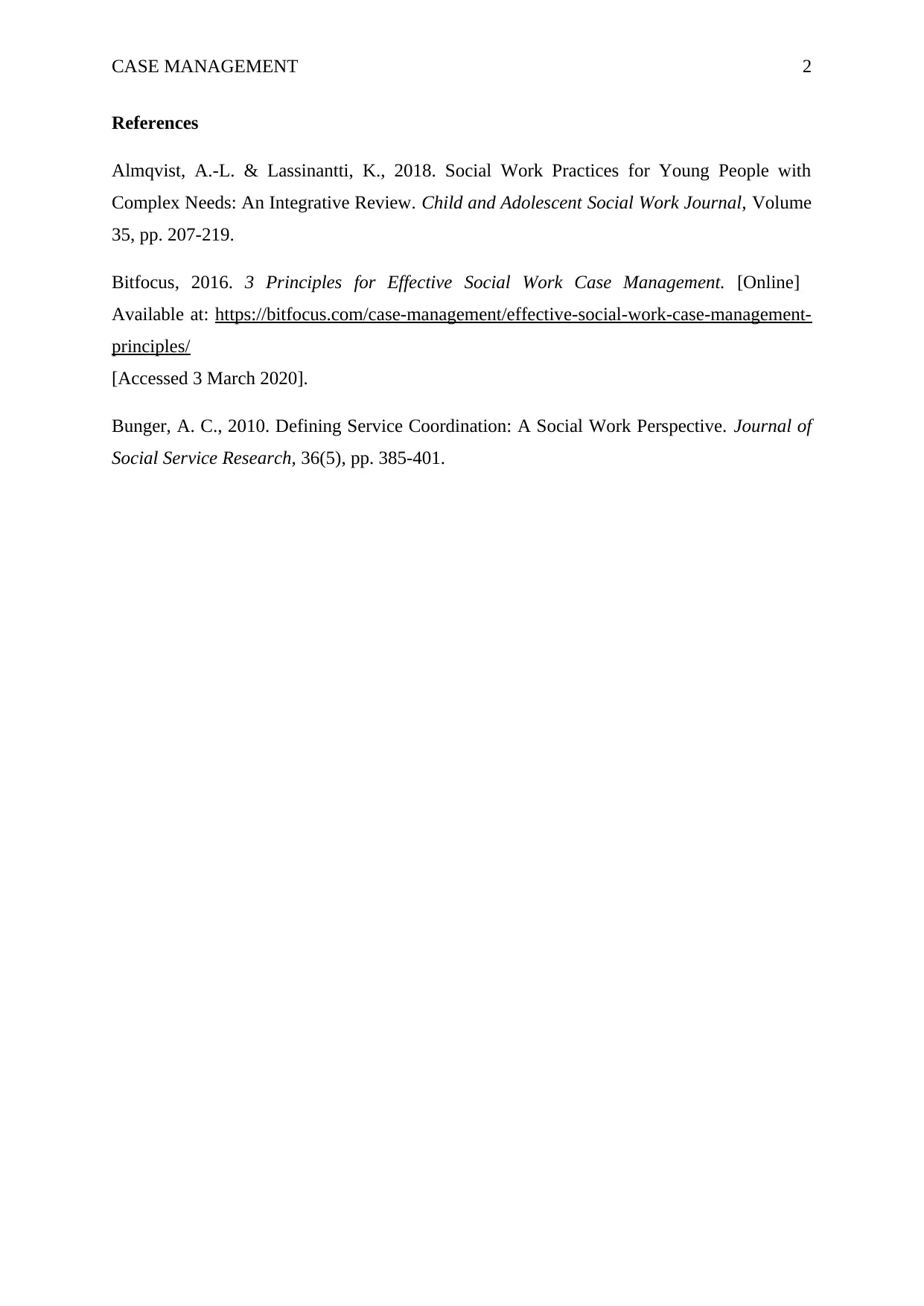
References
Almqvist, A.-L. & Lassinantti, K., 2018. Social Work Practices for Young People with
Complex Needs: An Integrative Review. Child and Adolescent Social Work Journal, Volume
35, pp. 207-219.
Bitfocus, 2016. 3 Principles for Effective Social Work Case Management. [Online]
Available at: https://bitfocus.com/case-management/effective-social-work-case-management-
principles/
[Accessed 3 March 2020].
Bunger, A. C., 2010. Defining Service Coordination: A Social Work Perspective. Journal of
Social Service Research, 36(5), pp. 385-401.
chevron_up_icon
1 out of 3
circle_padding
hide_on_mobile
zoom_out_icon
[object Object]