The Importance of Essential Skills in Social Work Practice
VerifiedAdded on 2021/04/21
|8
|1648
|147
Report
AI Summary
This report delves into the essential skills required for effective social work practice. It highlights the importance of emotional intelligence, communication skills, and active listening. The report emphasizes the need for cultural competence and understanding of socio-political contexts. It discusses trauma-informed practice, empathy, and advocacy skills as crucial components. The report also covers the skills supervisors need to guide social workers. The literature gap identifies the need for clearer boundaries and limitations within the field. The report concludes that lifelong learning and the consistent application of these skills are vital for social workers to support individuals, families, and communities effectively.
Running head: SKILLS FOR SOCIAL WORK
SKILLS FOR SOCIAL WORK
Name of the student:
Name of the university:
Author’s note:
SKILLS FOR SOCIAL WORK
Name of the student:
Name of the university:
Author’s note:
Paraphrase This Document
Need a fresh take? Get an instant paraphrase of this document with our AI Paraphraser

1SKILLS FOR SOCIAL WORK
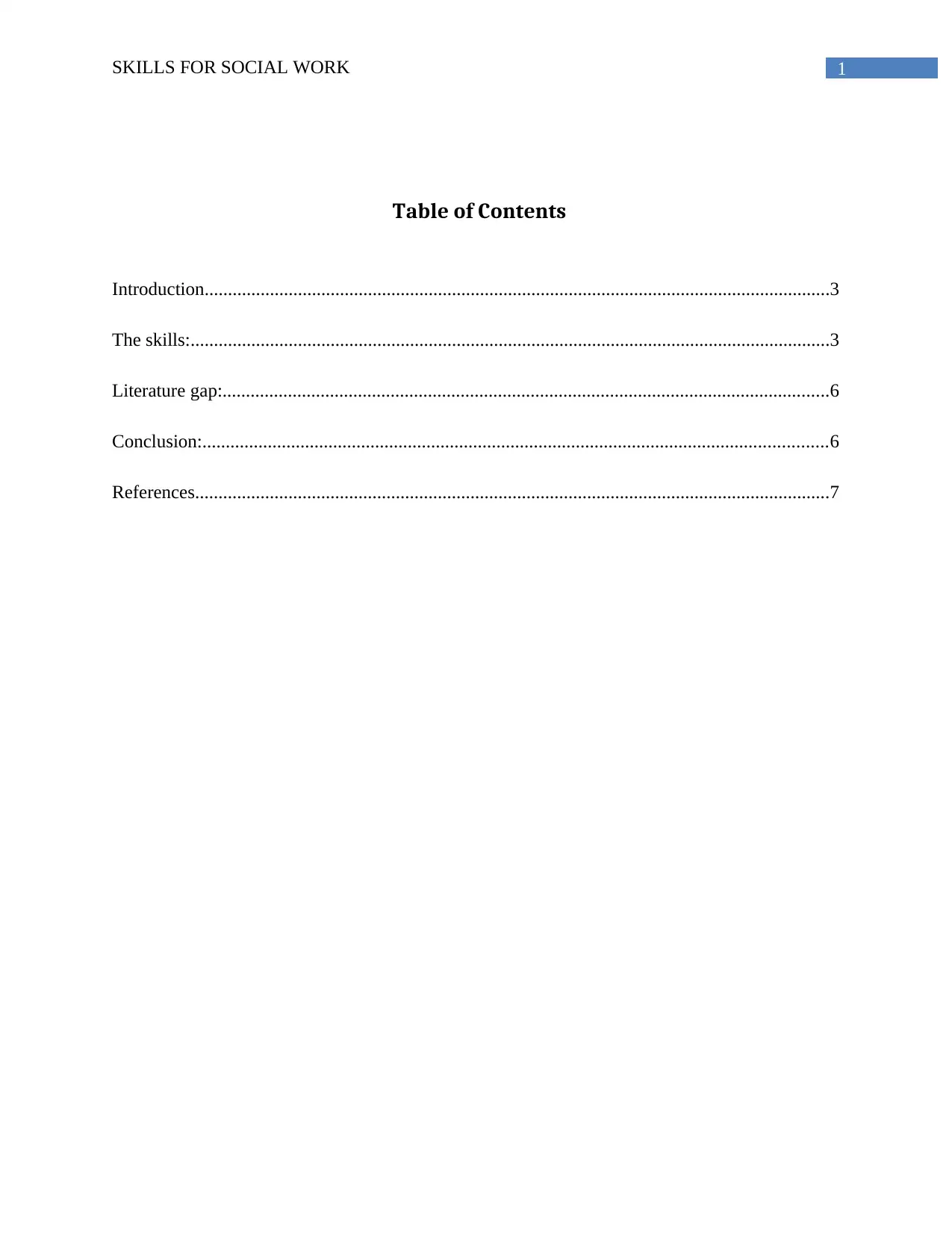
Table of Contents
Introduction......................................................................................................................................3
The skills:.........................................................................................................................................3
Literature gap:..................................................................................................................................6
Conclusion:......................................................................................................................................6
References........................................................................................................................................7
Table of Contents
Introduction......................................................................................................................................3
The skills:.........................................................................................................................................3
Literature gap:..................................................................................................................................6
Conclusion:......................................................................................................................................6
References........................................................................................................................................7

2SKILLS FOR SOCIAL WORK
Introduction
Social work is the professional divisions that deal with helping families, individuals,
different communities and groups in increasing and enhancement of their well being. It helps
people to learn about their rights, developing new skills and using their resources to the fullest.
Social work requires a varied range of skills that are professional, essentially emotional and also
cognitive skills such as high emotional quotient, communications skills, and listening skills.
Social workers can have them naturally but it is important to practice the skills throughout their
career. Lifelong learning is a basic criterion for this profession. There are numbers of literary
works in this context.
The skills:
In the view of Trevithick (2014), emotional dimensions regarding child protection is a
necessity. Manegerialism has neglected the importance of an emotional perspective in human life
and the importance of building relationships which a crucial aspect with respect to child
protection and social work. As mentioned by Sue, Rasheed & Rasheed, (2015), multi cultural
social work is a significant aspect related to skills required for a social worker. It clearly states
that social workers need to develop an understanding about cultural differences and socio
political cultural dimensions
According to Knight, (2015), adults surviving childhood trauma is a challenging group to
handle. Trauma informed practice is a skill essential for practitioners of social work. The purpose
here is to help a range of people who have faced childhood trauma in different ways leading to
addictions, mental health problems and others. Trauma informed practitioners have better
Introduction
Social work is the professional divisions that deal with helping families, individuals,
different communities and groups in increasing and enhancement of their well being. It helps
people to learn about their rights, developing new skills and using their resources to the fullest.
Social work requires a varied range of skills that are professional, essentially emotional and also
cognitive skills such as high emotional quotient, communications skills, and listening skills.
Social workers can have them naturally but it is important to practice the skills throughout their
career. Lifelong learning is a basic criterion for this profession. There are numbers of literary
works in this context.
The skills:
In the view of Trevithick (2014), emotional dimensions regarding child protection is a
necessity. Manegerialism has neglected the importance of an emotional perspective in human life
and the importance of building relationships which a crucial aspect with respect to child
protection and social work. As mentioned by Sue, Rasheed & Rasheed, (2015), multi cultural
social work is a significant aspect related to skills required for a social worker. It clearly states
that social workers need to develop an understanding about cultural differences and socio
political cultural dimensions
According to Knight, (2015), adults surviving childhood trauma is a challenging group to
handle. Trauma informed practice is a skill essential for practitioners of social work. The purpose
here is to help a range of people who have faced childhood trauma in different ways leading to
addictions, mental health problems and others. Trauma informed practitioners have better
⊘ This is a preview!⊘
Do you want full access?
Subscribe today to unlock all pages.

Trusted by 1+ million students worldwide

3SKILLS FOR SOCIAL WORK
understanding or are sensitive to the way of understanding the current difficulties of a client.
They try to normalize the experiences and the pain. The practitioner needs to understand the
effect work has on individuals in order to cure the long term trauma effects. According to
Wagaman, (2015), social workers are at a constant risk at work burnout and traumatic stress.
This comes as a result of the nature of their work and the context of their work. Such difficulties
can be mitigated by providing adequate attention to factors that lead to such challenges. Empathy
is the key to solve the traumatic situations resulting from psychological and cognitive conditions.
In addition to this research suggests that empathy can cure burnouts and stress thereby increasing
work satisfaction. Thus it can be understood that empathy is a crucial skill that needs inclusion
in the training process of a social worker.
According to Schinke, Barth & Blythe (2014), another crucial skill for a social worker is
the skill of advocacy. This does not necessarily mean in the legal term rather is more conceptual.
Workers can practice advocacy as this would enable them to advocate for their clients and for
own professional instances as well. Oral and writing skills are equally important with respect to
advocacy. Student under taking courses on social work learn about oral skills and writing skills
for advocacy. Therefore this can be an added advantage for individuals who would pursue social
work as a career, thereby making the skill of advocacy imperative for a social worker.
Ramsay and Boddy (2017), discusses about a crucial relationship between environment
and social work. There has been an exponential growth in the number of articles integrating
social work and environment. Environment and social work are closely related, as often social
workers are involved in environment conservation activities such as planting trees, preservation
of the flaura and fauna and wildlife. In addition to this International rules guidelines have always
understanding or are sensitive to the way of understanding the current difficulties of a client.
They try to normalize the experiences and the pain. The practitioner needs to understand the
effect work has on individuals in order to cure the long term trauma effects. According to
Wagaman, (2015), social workers are at a constant risk at work burnout and traumatic stress.
This comes as a result of the nature of their work and the context of their work. Such difficulties
can be mitigated by providing adequate attention to factors that lead to such challenges. Empathy
is the key to solve the traumatic situations resulting from psychological and cognitive conditions.
In addition to this research suggests that empathy can cure burnouts and stress thereby increasing
work satisfaction. Thus it can be understood that empathy is a crucial skill that needs inclusion
in the training process of a social worker.
According to Schinke, Barth & Blythe (2014), another crucial skill for a social worker is
the skill of advocacy. This does not necessarily mean in the legal term rather is more conceptual.
Workers can practice advocacy as this would enable them to advocate for their clients and for
own professional instances as well. Oral and writing skills are equally important with respect to
advocacy. Student under taking courses on social work learn about oral skills and writing skills
for advocacy. Therefore this can be an added advantage for individuals who would pursue social
work as a career, thereby making the skill of advocacy imperative for a social worker.
Ramsay and Boddy (2017), discusses about a crucial relationship between environment
and social work. There has been an exponential growth in the number of articles integrating
social work and environment. Environment and social work are closely related, as often social
workers are involved in environment conservation activities such as planting trees, preservation
of the flaura and fauna and wildlife. In addition to this International rules guidelines have always
Paraphrase This Document
Need a fresh take? Get an instant paraphrase of this document with our AI Paraphraser

4SKILLS FOR SOCIAL WORK
advised social workers to consider natural environment for addressing concerns regarding natural
environment crisis. There are a number of skills required for such efforts and they include Team
building skills, cultural competence, management skills, multi-level of assessment skills and
community development skills. The social workers must be more political, they should show
leadership skills for the development of public policy and values. Additionally, Austin et al.
(2018), has suggested that there are two broad aspects of social works such as its micro and
macro concept. Skills like teaching and cross over skill are a must for social workers and others
engaged in this field.
According to Marais & Merwe, (2018), relationship based social work again is a major
aspect. This needs the social workers to opt for intervention based management with their clients
in the way of providing therapeutic relationship. The workers work with the families and their
children in their stressful times. They are expected to provide support, increased wellbeing and
work for empowerment of people. The workers at times have to work with the children directly
since children from rural area remain exposed to alcoholism, marriage problems, inefficient
parental practices and domestic violence. The process requires a major skill such as engaging
clients in the whole working process. They should be able to handle clients such as children as
this particularly involves good communication skills and attentive listening skills through which,
they can easily address the concerns of the client. This is a basic skill required in any social work
initiative. Moreover, dealing with a child needs some particular skills such as building a bond
initially through games or play therapy. The therapy helps the worker to enter the environment
of the child and engage them. In the opinion of Marc, Makai- Dimeny and Osvat (2014)
supervisors also need some crucial skills. There are various competencies and skills that are
needed for the competence job role of supervisors. They should be highly efficient in problem
advised social workers to consider natural environment for addressing concerns regarding natural
environment crisis. There are a number of skills required for such efforts and they include Team
building skills, cultural competence, management skills, multi-level of assessment skills and
community development skills. The social workers must be more political, they should show
leadership skills for the development of public policy and values. Additionally, Austin et al.
(2018), has suggested that there are two broad aspects of social works such as its micro and
macro concept. Skills like teaching and cross over skill are a must for social workers and others
engaged in this field.
According to Marais & Merwe, (2018), relationship based social work again is a major
aspect. This needs the social workers to opt for intervention based management with their clients
in the way of providing therapeutic relationship. The workers work with the families and their
children in their stressful times. They are expected to provide support, increased wellbeing and
work for empowerment of people. The workers at times have to work with the children directly
since children from rural area remain exposed to alcoholism, marriage problems, inefficient
parental practices and domestic violence. The process requires a major skill such as engaging
clients in the whole working process. They should be able to handle clients such as children as
this particularly involves good communication skills and attentive listening skills through which,
they can easily address the concerns of the client. This is a basic skill required in any social work
initiative. Moreover, dealing with a child needs some particular skills such as building a bond
initially through games or play therapy. The therapy helps the worker to enter the environment
of the child and engage them. In the opinion of Marc, Makai- Dimeny and Osvat (2014)
supervisors also need some crucial skills. There are various competencies and skills that are
needed for the competence job role of supervisors. They should be highly efficient in problem

5SKILLS FOR SOCIAL WORK
detection and solving. They also should be able to encourage workers, to provide reflection of
work roles, to work rationally and also emotionally with their juniors and clients. They should
have a positive attitude and should be supportive.
Literature gap:
Literature gap reflects the area which needs more research work. Researchers have said
that there should be some restrictions or limitations within members practicing social work so
that they are not emotionally involved and are away from legal issues. However, proper
boundary depictions have not been shown anywhere. Moreover differences in limitation with
respect to varied social work are again an abstract concept. This part may be called as the
literature gap here.
Conclusion:
Therefore from the above discussion it can be concluded that social work is an important
aspect of the society and number of skills are required for this social work management. Social
work can be categorized into various sub groups like child care, environmental care requiring
varied skills like communication, active listening, ability to work in groups to name a few. Skill
of engagement has been significant skill build through play theory. Along with the information
about basic rights and laws, workers need communication skill for this purpose. Thus social
workers should practice and inculcate such skills throughout their working period.
detection and solving. They also should be able to encourage workers, to provide reflection of
work roles, to work rationally and also emotionally with their juniors and clients. They should
have a positive attitude and should be supportive.
Literature gap:
Literature gap reflects the area which needs more research work. Researchers have said
that there should be some restrictions or limitations within members practicing social work so
that they are not emotionally involved and are away from legal issues. However, proper
boundary depictions have not been shown anywhere. Moreover differences in limitation with
respect to varied social work are again an abstract concept. This part may be called as the
literature gap here.
Conclusion:
Therefore from the above discussion it can be concluded that social work is an important
aspect of the society and number of skills are required for this social work management. Social
work can be categorized into various sub groups like child care, environmental care requiring
varied skills like communication, active listening, ability to work in groups to name a few. Skill
of engagement has been significant skill build through play theory. Along with the information
about basic rights and laws, workers need communication skill for this purpose. Thus social
workers should practice and inculcate such skills throughout their working period.
⊘ This is a preview!⊘
Do you want full access?
Subscribe today to unlock all pages.

Trusted by 1+ million students worldwide

6SKILLS FOR SOCIAL WORK
References
Cecilia Marais & Mariette van der Merwe. (2018). RELATIONSHIP BUILDING DURING THE
INITIAL PHASE OF SOCIAL WORK INTERVENTION WITH CHILD CLIENTS IN A RURAL
AREA. Scielo.org.za. Retrieved 18 March 2018, from
http://www.scielo.org.za/pdf/sw/v52n2/08.pdf
Knight, C. (2015). Trauma-informed social work practice: Practice considerations and
challenges. Clinical Social Work Journal, 43(1), 25-37.
Michael J. Austin, Elizabeth K. Anthony, Ryan Tolleson Knee, & John Mathias.
(2018). Revisiting the Relationship Between Micro and Macro Social Work Practice. Acosa.org.
Retrieved 22 March 2018, from http://www.acosa.org/joomla/pdf/Austin-2016-Families-in-
Society-Revisiting-Micro-Macro.pdf
Schinke, S., Barth, R., & Blythe, B. (2014). Advocacy Skills for Social Work. Journal Of Social
Work Education, 21(2), 27-33. http://dx.doi.org/10.1080/10437797.2014.10671701
Sue, D. W., Rasheed, M. N., & Rasheed, J. M. (2015). Multicultural social work practice: A
competency-based approach to diversity and social justice. John Wiley & Sons.
Sylvia Ramsay & Jennifer Boddy, (2017); Environmental Social Work: A Concept Analysis, The
British Journal of Social Work, Volume 47, Issue 1, 1 January 2017, Pages 68–86,
THE SOCIAL WORK SUPERVISOR: SKILLS, ROLES, RESPONSIBILITIES.
(2018). Webbut.unitbv.ro. Retrieved 22 March 2018, from
References
Cecilia Marais & Mariette van der Merwe. (2018). RELATIONSHIP BUILDING DURING THE
INITIAL PHASE OF SOCIAL WORK INTERVENTION WITH CHILD CLIENTS IN A RURAL
AREA. Scielo.org.za. Retrieved 18 March 2018, from
http://www.scielo.org.za/pdf/sw/v52n2/08.pdf
Knight, C. (2015). Trauma-informed social work practice: Practice considerations and
challenges. Clinical Social Work Journal, 43(1), 25-37.
Michael J. Austin, Elizabeth K. Anthony, Ryan Tolleson Knee, & John Mathias.
(2018). Revisiting the Relationship Between Micro and Macro Social Work Practice. Acosa.org.
Retrieved 22 March 2018, from http://www.acosa.org/joomla/pdf/Austin-2016-Families-in-
Society-Revisiting-Micro-Macro.pdf
Schinke, S., Barth, R., & Blythe, B. (2014). Advocacy Skills for Social Work. Journal Of Social
Work Education, 21(2), 27-33. http://dx.doi.org/10.1080/10437797.2014.10671701
Sue, D. W., Rasheed, M. N., & Rasheed, J. M. (2015). Multicultural social work practice: A
competency-based approach to diversity and social justice. John Wiley & Sons.
Sylvia Ramsay & Jennifer Boddy, (2017); Environmental Social Work: A Concept Analysis, The
British Journal of Social Work, Volume 47, Issue 1, 1 January 2017, Pages 68–86,
THE SOCIAL WORK SUPERVISOR: SKILLS, ROLES, RESPONSIBILITIES.
(2018). Webbut.unitbv.ro. Retrieved 22 March 2018, from
Paraphrase This Document
Need a fresh take? Get an instant paraphrase of this document with our AI Paraphraser

7SKILLS FOR SOCIAL WORK
http://webbut.unitbv.ro/BU2014/Series%20VII/BULETIN%20VII%20PDF/24_MARC,
%20Makai,%20Osvat%201-2014.pdf
Trevithick, P. (2014). Humanising managerialism: Reclaiming emotional reasoning, intuition,
the relationship, and knowledge and skills in social work. Journal of Social Work
Practice, 28(3), 287-311.
Wagaman, M. A., Geiger, J. M., Shockley, C., & Segal, E. A. (2015). The role of empathy in
burnout, compassion satisfaction, and secondary traumatic stress among social workers. Social
work, 60(3), 201-209.
http://webbut.unitbv.ro/BU2014/Series%20VII/BULETIN%20VII%20PDF/24_MARC,
%20Makai,%20Osvat%201-2014.pdf
Trevithick, P. (2014). Humanising managerialism: Reclaiming emotional reasoning, intuition,
the relationship, and knowledge and skills in social work. Journal of Social Work
Practice, 28(3), 287-311.
Wagaman, M. A., Geiger, J. M., Shockley, C., & Segal, E. A. (2015). The role of empathy in
burnout, compassion satisfaction, and secondary traumatic stress among social workers. Social
work, 60(3), 201-209.
1 out of 8
Related Documents
Your All-in-One AI-Powered Toolkit for Academic Success.
+13062052269
info@desklib.com
Available 24*7 on WhatsApp / Email
Unlock your academic potential
Copyright © 2020–2026 A2Z Services. All Rights Reserved. Developed and managed by ZUCOL.