Exploring Sociological Theories and Ethics: Reflective Essay
VerifiedAdded on 2023/06/06
|5
|1159
|274
Essay
AI Summary
This essay provides a reflection on sociological theories, specifically structural functionalism, and their ethical implications, using the same-sex marriage debate in Australia as a case study. It defines structural functionalism as a theory explaining societal operations through the relationships between social institutions like law, government, and religion. The essay argues that the debates surrounding same-sex marriage legislation highlight the tension between traditional social structures and evolving ethical principles. It examines how the 'No' campaign's opposition to same-sex marriage conflicts with ethical principles such as respecting individual decisions and freedoms. The author concludes that societal changes necessitate an evolution in ethical considerations, advocating for a move away from rigid social institutional norms towards a more ethically grounded approach to resolving social issues. The essay references various sources to support its arguments and analysis. Desklib offers similar essays and study resources for students.
T A T A TREFLEC ION ON SOCIOLOGIC L HEORIES ND E HICS 1
REFLECTION ON SOCIOLOGICAL THEORIES AND ETHICS
BY Students Name
Course Name
Professor
University
City and State
Dates
REFLECTION ON SOCIOLOGICAL THEORIES AND ETHICS
BY Students Name
Course Name
Professor
University
City and State
Dates
Paraphrase This Document
Need a fresh take? Get an instant paraphrase of this document with our AI Paraphraser

T A T A TREFLEC ION ON SOCIOLOGIC L HEORIES ND E HICS 2
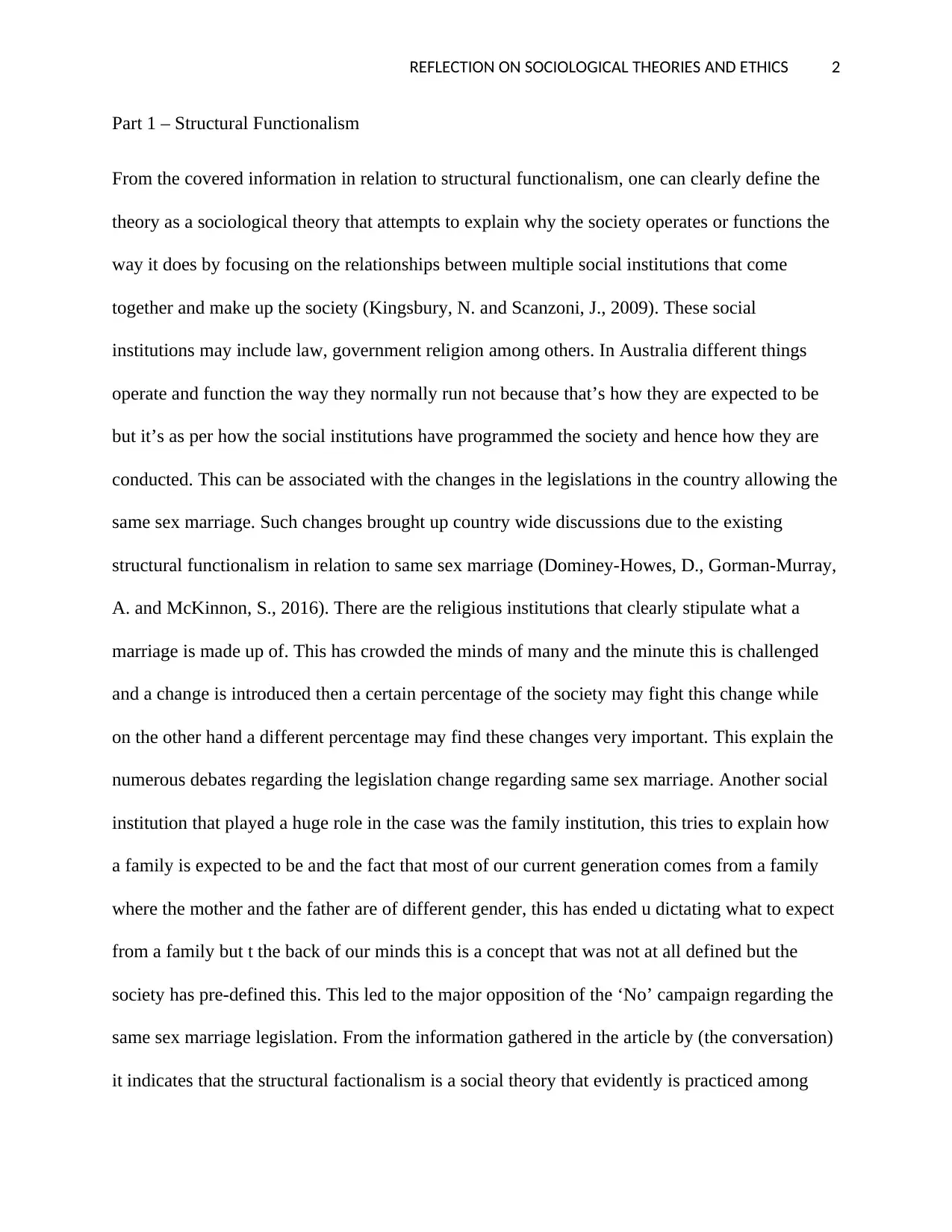
Part 1 – Structural Functionalism
From the covered information in relation to structural functionalism, one can clearly define the
theory as a sociological theory that attempts to explain why the society operates or functions the
way it does by focusing on the relationships between multiple social institutions that come
together and make up the society (Kingsbury, N. and Scanzoni, J., 2009). These social
institutions may include law, government religion among others. In Australia different things
operate and function the way they normally run not because that’s how they are expected to be
but it’s as per how the social institutions have programmed the society and hence how they are
conducted. This can be associated with the changes in the legislations in the country allowing the
same sex marriage. Such changes brought up country wide discussions due to the existing
structural functionalism in relation to same sex marriage (Dominey-Howes, D., Gorman-Murray,
A. and McKinnon, S., 2016). There are the religious institutions that clearly stipulate what a
marriage is made up of. This has crowded the minds of many and the minute this is challenged
and a change is introduced then a certain percentage of the society may fight this change while
on the other hand a different percentage may find these changes very important. This explain the
numerous debates regarding the legislation change regarding same sex marriage. Another social
institution that played a huge role in the case was the family institution, this tries to explain how
a family is expected to be and the fact that most of our current generation comes from a family
where the mother and the father are of different gender, this has ended u dictating what to expect
from a family but t the back of our minds this is a concept that was not at all defined but the
society has pre-defined this. This led to the major opposition of the ‘No’ campaign regarding the
same sex marriage legislation. From the information gathered in the article by (the conversation)
it indicates that the structural factionalism is a social theory that evidently is practiced among
Part 1 – Structural Functionalism
From the covered information in relation to structural functionalism, one can clearly define the
theory as a sociological theory that attempts to explain why the society operates or functions the
way it does by focusing on the relationships between multiple social institutions that come
together and make up the society (Kingsbury, N. and Scanzoni, J., 2009). These social
institutions may include law, government religion among others. In Australia different things
operate and function the way they normally run not because that’s how they are expected to be
but it’s as per how the social institutions have programmed the society and hence how they are
conducted. This can be associated with the changes in the legislations in the country allowing the
same sex marriage. Such changes brought up country wide discussions due to the existing
structural functionalism in relation to same sex marriage (Dominey-Howes, D., Gorman-Murray,
A. and McKinnon, S., 2016). There are the religious institutions that clearly stipulate what a
marriage is made up of. This has crowded the minds of many and the minute this is challenged
and a change is introduced then a certain percentage of the society may fight this change while
on the other hand a different percentage may find these changes very important. This explain the
numerous debates regarding the legislation change regarding same sex marriage. Another social
institution that played a huge role in the case was the family institution, this tries to explain how
a family is expected to be and the fact that most of our current generation comes from a family
where the mother and the father are of different gender, this has ended u dictating what to expect
from a family but t the back of our minds this is a concept that was not at all defined but the
society has pre-defined this. This led to the major opposition of the ‘No’ campaign regarding the
same sex marriage legislation. From the information gathered in the article by (the conversation)
it indicates that the structural factionalism is a social theory that evidently is practiced among

T A T A TREFLEC ION ON SOCIOLOGIC L HEORIES ND E HICS 3
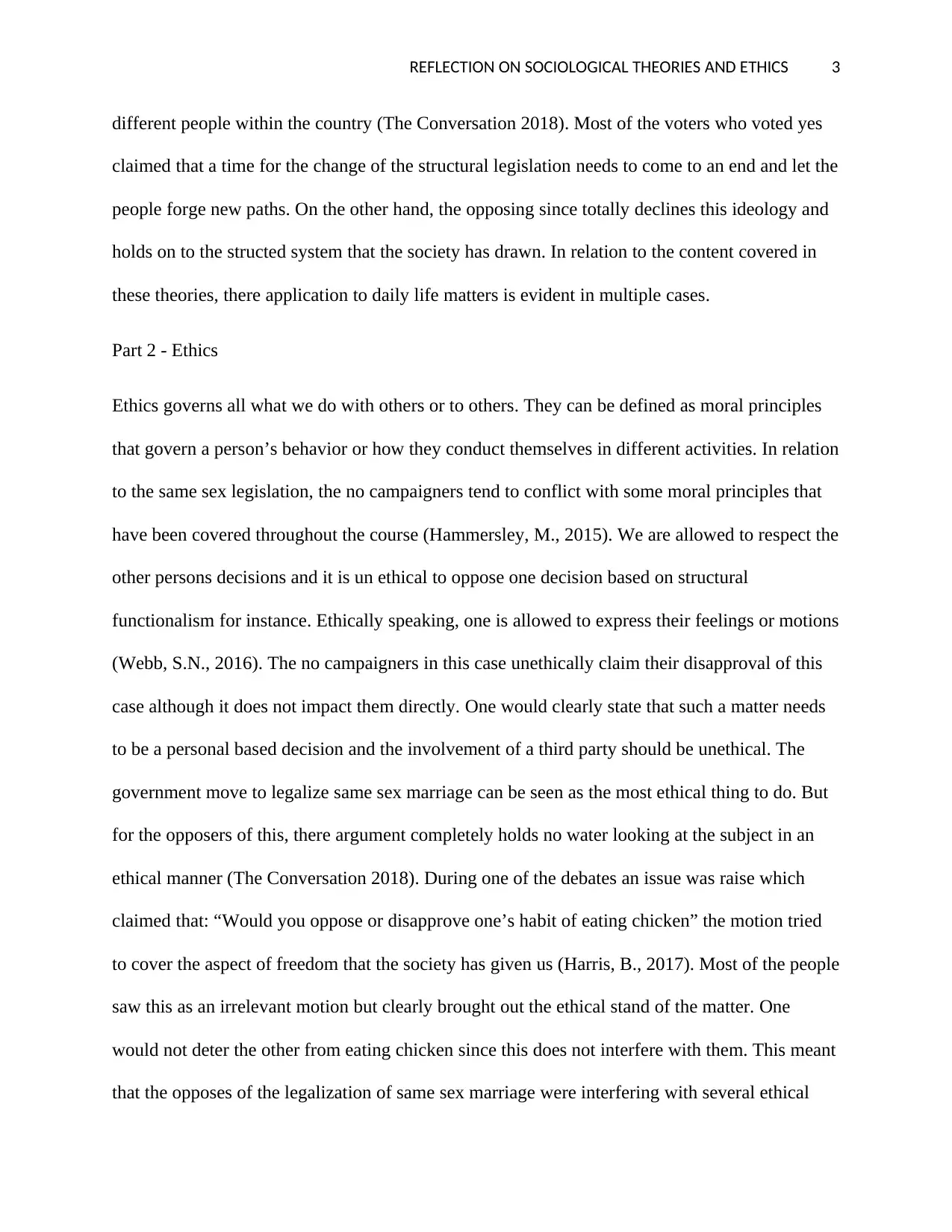
different people within the country (The Conversation 2018). Most of the voters who voted yes
claimed that a time for the change of the structural legislation needs to come to an end and let the
people forge new paths. On the other hand, the opposing since totally declines this ideology and
holds on to the structed system that the society has drawn. In relation to the content covered in
these theories, there application to daily life matters is evident in multiple cases.
Part 2 - Ethics
Ethics governs all what we do with others or to others. They can be defined as moral principles
that govern a person’s behavior or how they conduct themselves in different activities. In relation
to the same sex legislation, the no campaigners tend to conflict with some moral principles that
have been covered throughout the course (Hammersley, M., 2015). We are allowed to respect the
other persons decisions and it is un ethical to oppose one decision based on structural
functionalism for instance. Ethically speaking, one is allowed to express their feelings or motions
(Webb, S.N., 2016). The no campaigners in this case unethically claim their disapproval of this
case although it does not impact them directly. One would clearly state that such a matter needs
to be a personal based decision and the involvement of a third party should be unethical. The
government move to legalize same sex marriage can be seen as the most ethical thing to do. But
for the opposers of this, there argument completely holds no water looking at the subject in an
ethical manner (The Conversation 2018). During one of the debates an issue was raise which
claimed that: “Would you oppose or disapprove one’s habit of eating chicken” the motion tried
to cover the aspect of freedom that the society has given us (Harris, B., 2017). Most of the people
saw this as an irrelevant motion but clearly brought out the ethical stand of the matter. One
would not deter the other from eating chicken since this does not interfere with them. This meant
that the opposes of the legalization of same sex marriage were interfering with several ethical
different people within the country (The Conversation 2018). Most of the voters who voted yes
claimed that a time for the change of the structural legislation needs to come to an end and let the
people forge new paths. On the other hand, the opposing since totally declines this ideology and
holds on to the structed system that the society has drawn. In relation to the content covered in
these theories, there application to daily life matters is evident in multiple cases.
Part 2 - Ethics
Ethics governs all what we do with others or to others. They can be defined as moral principles
that govern a person’s behavior or how they conduct themselves in different activities. In relation
to the same sex legislation, the no campaigners tend to conflict with some moral principles that
have been covered throughout the course (Hammersley, M., 2015). We are allowed to respect the
other persons decisions and it is un ethical to oppose one decision based on structural
functionalism for instance. Ethically speaking, one is allowed to express their feelings or motions
(Webb, S.N., 2016). The no campaigners in this case unethically claim their disapproval of this
case although it does not impact them directly. One would clearly state that such a matter needs
to be a personal based decision and the involvement of a third party should be unethical. The
government move to legalize same sex marriage can be seen as the most ethical thing to do. But
for the opposers of this, there argument completely holds no water looking at the subject in an
ethical manner (The Conversation 2018). During one of the debates an issue was raise which
claimed that: “Would you oppose or disapprove one’s habit of eating chicken” the motion tried
to cover the aspect of freedom that the society has given us (Harris, B., 2017). Most of the people
saw this as an irrelevant motion but clearly brought out the ethical stand of the matter. One
would not deter the other from eating chicken since this does not interfere with them. This meant
that the opposes of the legalization of same sex marriage were interfering with several ethical
⊘ This is a preview!⊘
Do you want full access?
Subscribe today to unlock all pages.

Trusted by 1+ million students worldwide

T A T A TREFLEC ION ON SOCIOLOGIC L HEORIES ND E HICS 4
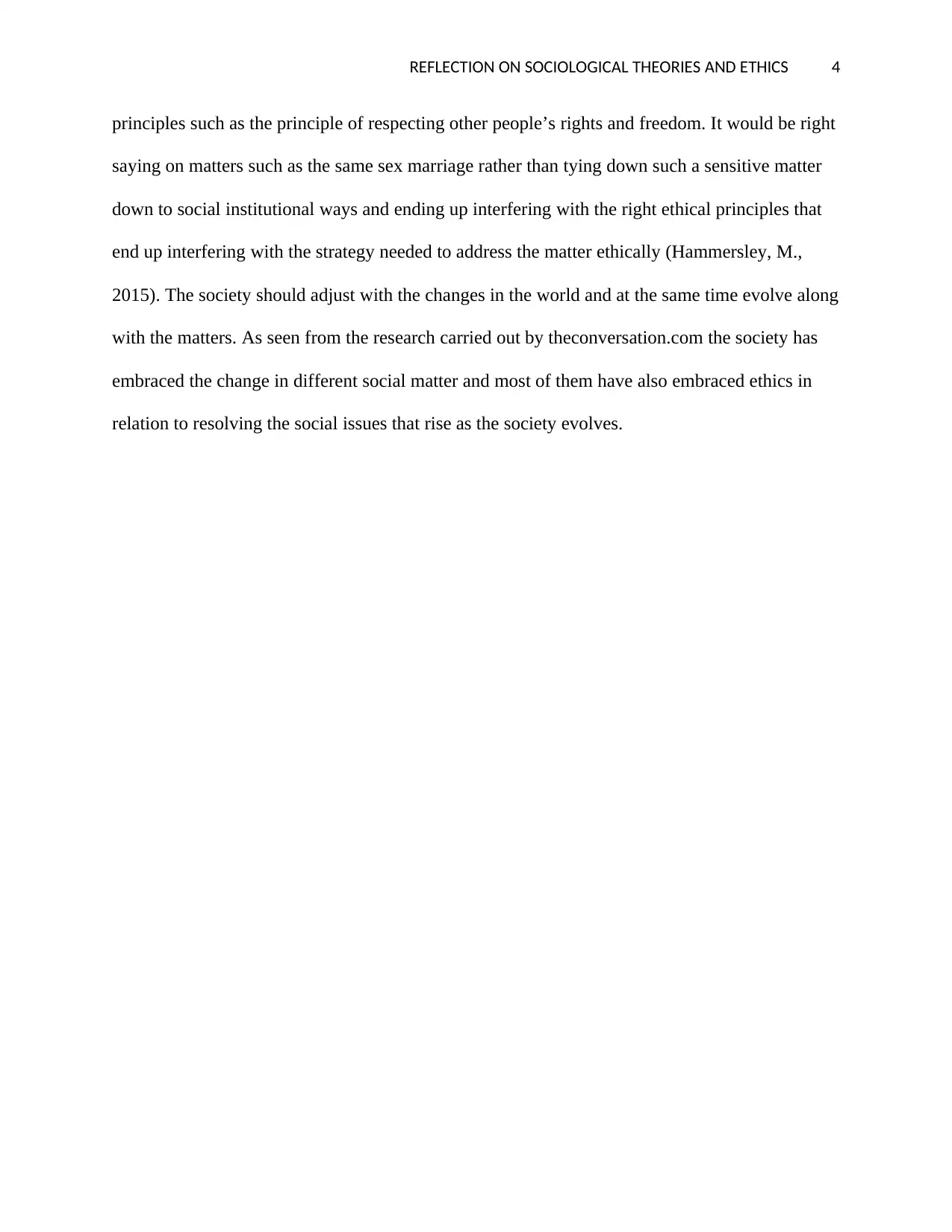
principles such as the principle of respecting other people’s rights and freedom. It would be right
saying on matters such as the same sex marriage rather than tying down such a sensitive matter
down to social institutional ways and ending up interfering with the right ethical principles that
end up interfering with the strategy needed to address the matter ethically (Hammersley, M.,
2015). The society should adjust with the changes in the world and at the same time evolve along
with the matters. As seen from the research carried out by theconversation.com the society has
embraced the change in different social matter and most of them have also embraced ethics in
relation to resolving the social issues that rise as the society evolves.
principles such as the principle of respecting other people’s rights and freedom. It would be right
saying on matters such as the same sex marriage rather than tying down such a sensitive matter
down to social institutional ways and ending up interfering with the right ethical principles that
end up interfering with the strategy needed to address the matter ethically (Hammersley, M.,
2015). The society should adjust with the changes in the world and at the same time evolve along
with the matters. As seen from the research carried out by theconversation.com the society has
embraced the change in different social matter and most of them have also embraced ethics in
relation to resolving the social issues that rise as the society evolves.
Paraphrase This Document
Need a fresh take? Get an instant paraphrase of this document with our AI Paraphraser

T A T A TREFLEC ION ON SOCIOLOGIC L HEORIES ND E HICS 5
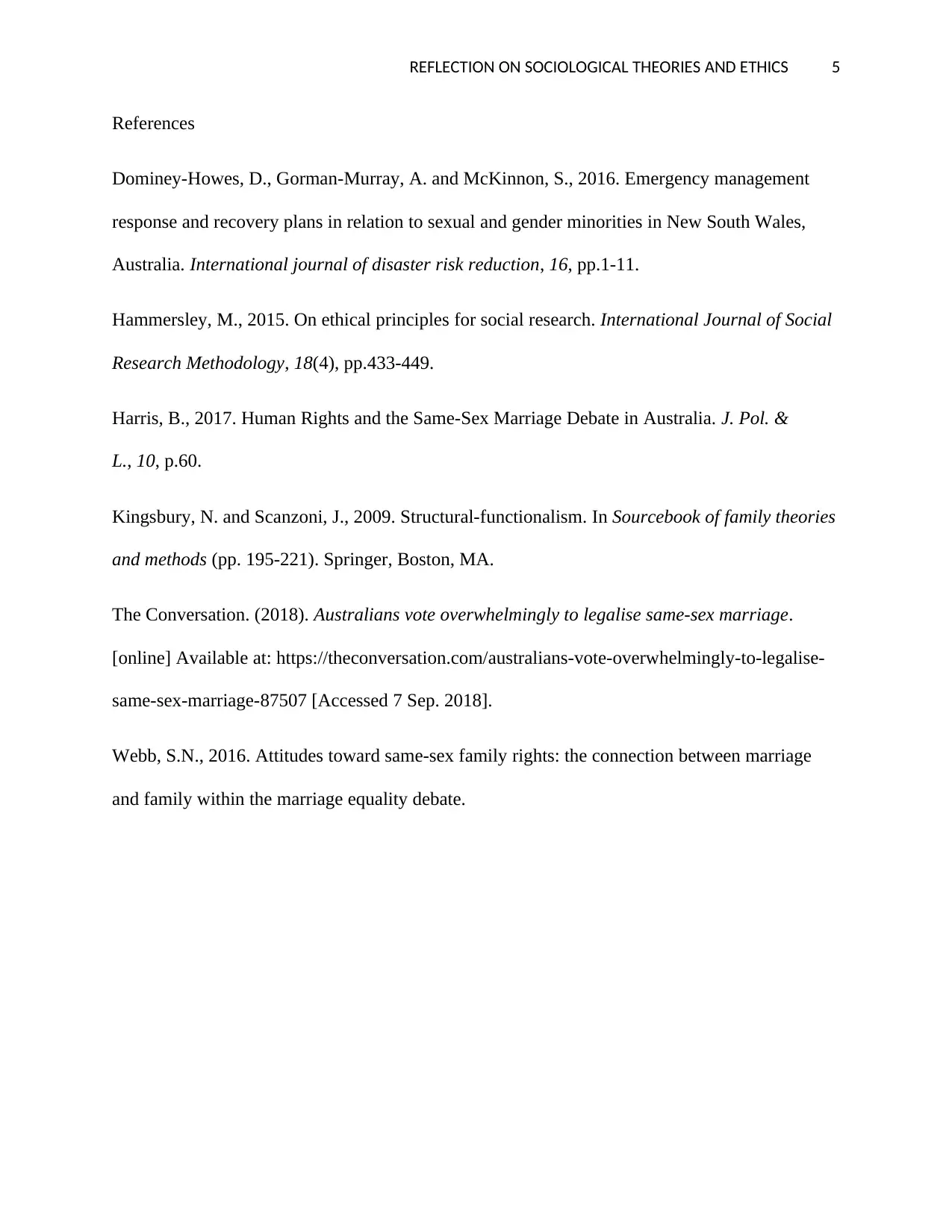
References
Dominey-Howes, D., Gorman-Murray, A. and McKinnon, S., 2016. Emergency management
response and recovery plans in relation to sexual and gender minorities in New South Wales,
Australia. International journal of disaster risk reduction, 16, pp.1-11.
Hammersley, M., 2015. On ethical principles for social research. International Journal of Social
Research Methodology, 18(4), pp.433-449.
Harris, B., 2017. Human Rights and the Same-Sex Marriage Debate in Australia. J. Pol. &
L., 10, p.60.
Kingsbury, N. and Scanzoni, J., 2009. Structural-functionalism. In Sourcebook of family theories
and methods (pp. 195-221). Springer, Boston, MA.
The Conversation. (2018). Australians vote overwhelmingly to legalise same-sex marriage.
[online] Available at: https://theconversation.com/australians-vote-overwhelmingly-to-legalise-
same-sex-marriage-87507 [Accessed 7 Sep. 2018].
Webb, S.N., 2016. Attitudes toward same-sex family rights: the connection between marriage
and family within the marriage equality debate.
References
Dominey-Howes, D., Gorman-Murray, A. and McKinnon, S., 2016. Emergency management
response and recovery plans in relation to sexual and gender minorities in New South Wales,
Australia. International journal of disaster risk reduction, 16, pp.1-11.
Hammersley, M., 2015. On ethical principles for social research. International Journal of Social
Research Methodology, 18(4), pp.433-449.
Harris, B., 2017. Human Rights and the Same-Sex Marriage Debate in Australia. J. Pol. &
L., 10, p.60.
Kingsbury, N. and Scanzoni, J., 2009. Structural-functionalism. In Sourcebook of family theories
and methods (pp. 195-221). Springer, Boston, MA.
The Conversation. (2018). Australians vote overwhelmingly to legalise same-sex marriage.
[online] Available at: https://theconversation.com/australians-vote-overwhelmingly-to-legalise-
same-sex-marriage-87507 [Accessed 7 Sep. 2018].
Webb, S.N., 2016. Attitudes toward same-sex family rights: the connection between marriage
and family within the marriage equality debate.
1 out of 5
Related Documents
Your All-in-One AI-Powered Toolkit for Academic Success.
+13062052269
info@desklib.com
Available 24*7 on WhatsApp / Email
Unlock your academic potential
Copyright © 2020–2026 A2Z Services. All Rights Reserved. Developed and managed by ZUCOL.