Sociology Essay: Black Boys' Experiences of Stop and Search in the UK
VerifiedAdded on 2022/04/29
|9
|2142
|32
Essay
AI Summary
This essay delves into the experiences of Black boys in the UK, focusing on the controversial practice of stop and search. It examines the intersection of race, law, and social justice, drawing upon sociological concepts like double consciousness and critical race theory. The essay analyzes the impact of stop and search on Black boys, exploring issues of racial profiling, and the legal frameworks that govern these practices. It references relevant literature and case studies to provide a comprehensive understanding of the topic, including discussions on the First and Fourteenth Amendments and their relevance to the issue. Furthermore, the essay explores the complexities of identity and how Black boys navigate their experiences within the context of racialized masculinity and societal perceptions. Ultimately, the essay seeks to contribute to a broader understanding of the challenges faced by Black boys and the need for intersectional analyses to address the issue effectively. The study uses information from semi-organised meetings with black mongrels in the UK and US to see how black mongrels organise their work according to race and sexual orientation, particularly in terms of the sense of education.

Running Head: Black Boys
[Name]
[Institution]
[Date]
[Name]
[Institution]
[Date]

Paraphrase This Document
Need a fresh take? Get an instant paraphrase of this document with our AI Paraphraser
2Black Boys
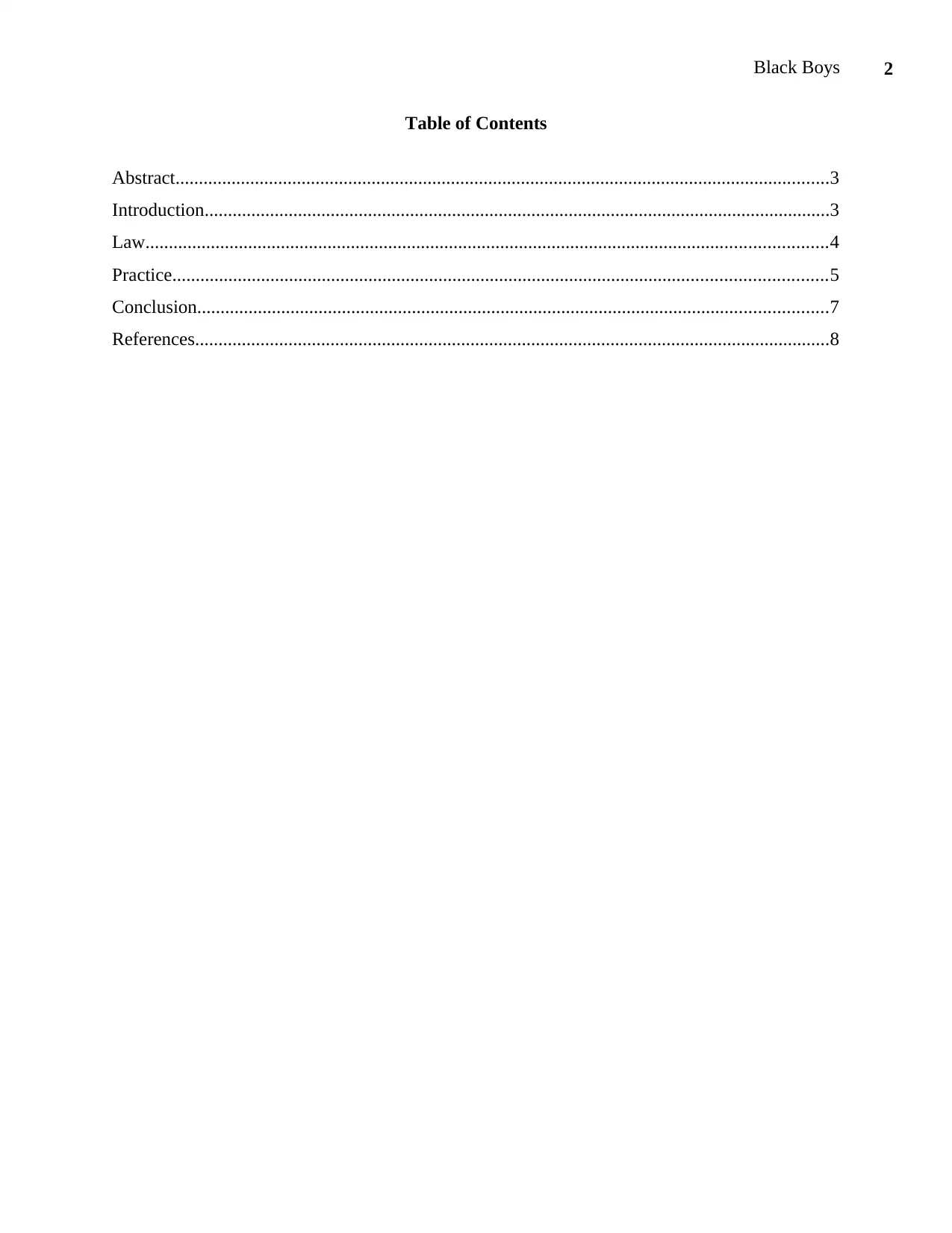
Table of Contents
Abstract............................................................................................................................................3
Introduction......................................................................................................................................3
Law..................................................................................................................................................4
Practice............................................................................................................................................5
Conclusion.......................................................................................................................................7
References........................................................................................................................................8
Table of Contents
Abstract............................................................................................................................................3
Introduction......................................................................................................................................3
Law..................................................................................................................................................4
Practice............................................................................................................................................5
Conclusion.......................................................................................................................................7
References........................................................................................................................................8
3Black Boys
Black Boys with Stops and Search in the UK
Abstract
Studies that tend to "mix" and match people have multiplied in recent years. The rise of
"Mixed Critical Studies" (MCS) as an independent academic field is proof of this. Despite the
rise of the MCS, there is still a lack of funding that takes into account the views of mestizos in a
disaggregated and intersectoral perspective. In those cases, where the CMRS has taken gender
overlap into account, women and goodness in general have been in the foreground (Waddington
and Moran, 2020). In this position, using the feedback method, I use information from semi-
organised meetings with black mongrels in the UK and US to see how black mongrels organise
their work according to race and sexual orientation, particularly in terms of the sense of
education. Based on George Yancy's (2017) Black Monster speculation, I argue that a sense of
double knowledge (and even a different conscience) implies that black mongrel men are fully
aware of how the white eye tests division and elimination. However, rather than being helpless
survivors of extremism, I show that the negative side of the image of the black monster through
hybridisation is something that black hybrids can fight, change and search for their motives
(Athwal and Bourne, 2016).
Introduction
Recently, the number of scholarships for people with mixed and intercultural
backgrounds has risen sharply. This is reflected in the continuation of "Mixed Race Critical
Studies" (CMRS), which is developing as an independent academic field of study. During this
exponential development, there is a lack of scholarships that view the Métis perspectives from a
disaggregated and intersectional perspective (Williams and Clarke, 2018). This also applies to
Black Boys with Stops and Search in the UK
Abstract
Studies that tend to "mix" and match people have multiplied in recent years. The rise of
"Mixed Critical Studies" (MCS) as an independent academic field is proof of this. Despite the
rise of the MCS, there is still a lack of funding that takes into account the views of mestizos in a
disaggregated and intersectoral perspective. In those cases, where the CMRS has taken gender
overlap into account, women and goodness in general have been in the foreground (Waddington
and Moran, 2020). In this position, using the feedback method, I use information from semi-
organised meetings with black mongrels in the UK and US to see how black mongrels organise
their work according to race and sexual orientation, particularly in terms of the sense of
education. Based on George Yancy's (2017) Black Monster speculation, I argue that a sense of
double knowledge (and even a different conscience) implies that black mongrel men are fully
aware of how the white eye tests division and elimination. However, rather than being helpless
survivors of extremism, I show that the negative side of the image of the black monster through
hybridisation is something that black hybrids can fight, change and search for their motives
(Athwal and Bourne, 2016).
Introduction
Recently, the number of scholarships for people with mixed and intercultural
backgrounds has risen sharply. This is reflected in the continuation of "Mixed Race Critical
Studies" (CMRS), which is developing as an independent academic field of study. During this
exponential development, there is a lack of scholarships that view the Métis perspectives from a
disaggregated and intersectional perspective (Williams and Clarke, 2018). This also applies to
⊘ This is a preview!⊘
Do you want full access?
Subscribe today to unlock all pages.

Trusted by 1+ million students worldwide
4Black Boys
Métis girls and/or women for whom scholarships are gender-specific. On the other hand, if the
focus of Critical Research on Men and Masculinities (CSMM) is on black men as a homogenous
race. It is not surprising that there is a lack of literature that deals substantially with métis-men,
although both disciplines make an important contribution to the discipline of sociology and few,
if any, deal directly with the masculinities of black métis-men (Athwal and Bourne, 2016). It is
essential that researchers conduct intersectional analyses to gain an understanding of the
immense heterogeneity and complexity of black and métis communities, which disturbs the
perceived homogeneity of intersectional axes. In other words, while much of the research on
masculinities is intersectional, black as a stable and homogeneous axis is based on a distorted
and occlusive assumption. In this work, to broaden the theoretical field of both disciplines and
sociology in general, I have brought the CMRS into contact with the Critical Studies of Men and
Masculinities (CSMM) (Reeves and de Vries, 2016). I propose that black half-blood men not
only do not allow themselves to be captivated by the mechanisms of dual consciousness and
hybridisation, but that they put themselves in a situation of compromise and renegotiate different
and multiple identities (Attfield, 2017).
Law
A gathering of young coloured and young people, including Mitchell, crowded into a loft
on the evening of 7 October 1989. 480 complex in Kenosha, Wisconsin. A scene from the film
"Mississippi Burning" in which some of the people attended the rally, in which a white man beat
a young brown man who was begging. "Shortly afterwards, across the street from where they
were standing, a young white man ran towards the rally. As the boy walked past, Mitchell said,
"Does everyone have to pick on someone? Here comes a white boy out; get him". Identification,
Métis girls and/or women for whom scholarships are gender-specific. On the other hand, if the
focus of Critical Research on Men and Masculinities (CSMM) is on black men as a homogenous
race. It is not surprising that there is a lack of literature that deals substantially with métis-men,
although both disciplines make an important contribution to the discipline of sociology and few,
if any, deal directly with the masculinities of black métis-men (Athwal and Bourne, 2016). It is
essential that researchers conduct intersectional analyses to gain an understanding of the
immense heterogeneity and complexity of black and métis communities, which disturbs the
perceived homogeneity of intersectional axes. In other words, while much of the research on
masculinities is intersectional, black as a stable and homogeneous axis is based on a distorted
and occlusive assumption. In this work, to broaden the theoretical field of both disciplines and
sociology in general, I have brought the CMRS into contact with the Critical Studies of Men and
Masculinities (CSMM) (Reeves and de Vries, 2016). I propose that black half-blood men not
only do not allow themselves to be captivated by the mechanisms of dual consciousness and
hybridisation, but that they put themselves in a situation of compromise and renegotiate different
and multiple identities (Attfield, 2017).
Law
A gathering of young coloured and young people, including Mitchell, crowded into a loft
on the evening of 7 October 1989. 480 complex in Kenosha, Wisconsin. A scene from the film
"Mississippi Burning" in which some of the people attended the rally, in which a white man beat
a young brown man who was begging. "Shortly afterwards, across the street from where they
were standing, a young white man ran towards the rally. As the boy walked past, Mitchell said,
"Does everyone have to pick on someone? Here comes a white boy out; get him". Identification,
Paraphrase This Document
Need a fresh take? Get an instant paraphrase of this document with our AI Paraphraser
5Black Boys
4-5. Mitchell locked three people in and pointed at the boy. The group approached the boy, hit
him very hard, and took off his shoes. The boy was unconscious and lived in a state of
unconsciousness for four days (Chama, 2017). "Almighty God created the white, black, yellow,
Malay and red race and established them in different landmasses. But there will be no
explanation for this union with the intrusion into His plan. Just as he has isolated the races, he
discovers that he does not want to consolidate them. The two laws in which the complainants
were brought to court and charged proved to be part of a methodical legal system aimed at
restricting inter-racial relations and prosecuting them. The Lovings are alleged to have abused
parts 20 to 58 of the Virginia Act (Drury et al., 2020). "As to the remote possibility that any
white person and any minority person may leave this state for the ultimate purpose of marriage
and in the hope of returning and marrying and then returning and remaining there and living as
man or woman, they shall be found guilty under sections 20-59 and the marriage shall be
controlled by a decision similar to that allegedly made in this San. The way they exist here
together as man and woman is the confirmation of their union (Duggan et al., 2017).
Practice
NELSON S. ROMAN, Federal Judge of the United States Colored Matter, Jerlyne
Calixte, Vanessa Green, Dominique McGregor, Weldon McWilliams IV, and Everett Newton
can file the Amended Complaint ("Amended Complaint", ECF No 28) against the defendants
Town of Clarkstown, Michael Sullivan independently and in his official capacity and Stephen
Cole-Hatchard independently and in his official capacity. The aggrieved parties argue that *318
have the right of appeal under 42 U.S.C. § 1983 for violation of the First and Fourteenth
Amendments by the defendants. Each of the transitions to dismiss the plaintiffs' revised
4-5. Mitchell locked three people in and pointed at the boy. The group approached the boy, hit
him very hard, and took off his shoes. The boy was unconscious and lived in a state of
unconsciousness for four days (Chama, 2017). "Almighty God created the white, black, yellow,
Malay and red race and established them in different landmasses. But there will be no
explanation for this union with the intrusion into His plan. Just as he has isolated the races, he
discovers that he does not want to consolidate them. The two laws in which the complainants
were brought to court and charged proved to be part of a methodical legal system aimed at
restricting inter-racial relations and prosecuting them. The Lovings are alleged to have abused
parts 20 to 58 of the Virginia Act (Drury et al., 2020). "As to the remote possibility that any
white person and any minority person may leave this state for the ultimate purpose of marriage
and in the hope of returning and marrying and then returning and remaining there and living as
man or woman, they shall be found guilty under sections 20-59 and the marriage shall be
controlled by a decision similar to that allegedly made in this San. The way they exist here
together as man and woman is the confirmation of their union (Duggan et al., 2017).
Practice
NELSON S. ROMAN, Federal Judge of the United States Colored Matter, Jerlyne
Calixte, Vanessa Green, Dominique McGregor, Weldon McWilliams IV, and Everett Newton
can file the Amended Complaint ("Amended Complaint", ECF No 28) against the defendants
Town of Clarkstown, Michael Sullivan independently and in his official capacity and Stephen
Cole-Hatchard independently and in his official capacity. The aggrieved parties argue that *318
have the right of appeal under 42 U.S.C. § 1983 for violation of the First and Fourteenth
Amendments by the defendants. Each of the transitions to dismiss the plaintiffs' revised
6Black Boys
complaint under. In making that assessment, the Court would consider all issues relating to the
applications (Goddard, 2018). For control purposes, the movements of the accused are usually
granted and, to a certain extent, denied. The defendants participated in Black Lives Matter to
demand "justice" and racial uniformity, and depend on their conviction that the execution of
ethnic minorities disarmed by law must be stopped". This interest fits well with issues of public
interest, especially when there is a rapidly growing awareness of the atrocity between the
empowerment by law and unarmed ethnic minorities. The premise of a society based on the right
to vote is the establishment of a free society. The imperial state Arranging Agent Alliance
against Rowland. This cornerstone is the First Amendment and the Court has a fundamental
obligation to ensure that the First Amendment is upheld and that the possibility of articulation
and affiliation is guaranteed. In disregard of this established obligation and the translation of the
relevant rule, the Court considers that the injured parties may claim that the defendants have
violated their First Amendment privileges (Harding, 2019).
Second, the Defendants have strongly asserted that the Defendants' activities were
persuaded by the guidance provided by the Plaintiffs. According to the plaintiffs' amended
complaint, the offended parties were introduced to the digital observers and carabinieri in July in
the fight for their role in the Black Lives case. The courts considered similar cases sufficient to
conclude that the defendant's demonstrations were initiated or triggered by the complainant's
activity in defense of his First Amendment rights. denied the defendants an apology because the
plaintiff may have argued that the parties had defended him because of his ability to participate
in the voting cycle for exercising his First Amendment rights (Leonard, 2017). Finally, as is
apparent from the Court's current examination, the plaintiffs' revised complaint could argue that
the defendant's executives cooled their First Amendment admission. See section LW above. The
complaint under. In making that assessment, the Court would consider all issues relating to the
applications (Goddard, 2018). For control purposes, the movements of the accused are usually
granted and, to a certain extent, denied. The defendants participated in Black Lives Matter to
demand "justice" and racial uniformity, and depend on their conviction that the execution of
ethnic minorities disarmed by law must be stopped". This interest fits well with issues of public
interest, especially when there is a rapidly growing awareness of the atrocity between the
empowerment by law and unarmed ethnic minorities. The premise of a society based on the right
to vote is the establishment of a free society. The imperial state Arranging Agent Alliance
against Rowland. This cornerstone is the First Amendment and the Court has a fundamental
obligation to ensure that the First Amendment is upheld and that the possibility of articulation
and affiliation is guaranteed. In disregard of this established obligation and the translation of the
relevant rule, the Court considers that the injured parties may claim that the defendants have
violated their First Amendment privileges (Harding, 2019).
Second, the Defendants have strongly asserted that the Defendants' activities were
persuaded by the guidance provided by the Plaintiffs. According to the plaintiffs' amended
complaint, the offended parties were introduced to the digital observers and carabinieri in July in
the fight for their role in the Black Lives case. The courts considered similar cases sufficient to
conclude that the defendant's demonstrations were initiated or triggered by the complainant's
activity in defense of his First Amendment rights. denied the defendants an apology because the
plaintiff may have argued that the parties had defended him because of his ability to participate
in the voting cycle for exercising his First Amendment rights (Leonard, 2017). Finally, as is
apparent from the Court's current examination, the plaintiffs' revised complaint could argue that
the defendant's executives cooled their First Amendment admission. See section LW above. The
⊘ This is a preview!⊘
Do you want full access?
Subscribe today to unlock all pages.
Trusted by 1+ million students worldwide
7Black Boys
plaintiffs therefore submit sufficient evidence to contribute to a permanent containment of the
First Amendment (Lodge, 2019).
Conclusion
This article increases our growing familiarity with Métis networks and shows that dark
Métis men have unique perspectives on the convergence of race and sexual orientation. The
article alludes to how WSCM perceptions will promote a logical understanding of racialised
masculinity within WSCM by addressing the stable classifications of darkness. At the same time,
the attention that WSCM pays to gender convergence is instructive for WSCM. The humanities
exposition territory is even more advanced in bringing these discussion areas into focus (Slooter,
2019). I have seen that the Dark Men of the Métis are far from being back-seaters, and yet they
are dynamic experts in the treatment and realisation of their personalities. The men are aware of
the white aspect and how they are reduced to the figure of the dark beast, which is regularly
criminal, energetic, unintelligent, and sexually harassing, because their sense of double
consciousness, which I have had, is applied to the methods of the different knowledge. However,
as we have seen, coloured people will fight, change and control the white eye for their reasons
(Tanaka-Gútiez, 2019).
plaintiffs therefore submit sufficient evidence to contribute to a permanent containment of the
First Amendment (Lodge, 2019).
Conclusion
This article increases our growing familiarity with Métis networks and shows that dark
Métis men have unique perspectives on the convergence of race and sexual orientation. The
article alludes to how WSCM perceptions will promote a logical understanding of racialised
masculinity within WSCM by addressing the stable classifications of darkness. At the same time,
the attention that WSCM pays to gender convergence is instructive for WSCM. The humanities
exposition territory is even more advanced in bringing these discussion areas into focus (Slooter,
2019). I have seen that the Dark Men of the Métis are far from being back-seaters, and yet they
are dynamic experts in the treatment and realisation of their personalities. The men are aware of
the white aspect and how they are reduced to the figure of the dark beast, which is regularly
criminal, energetic, unintelligent, and sexually harassing, because their sense of double
consciousness, which I have had, is applied to the methods of the different knowledge. However,
as we have seen, coloured people will fight, change and control the white eye for their reasons
(Tanaka-Gútiez, 2019).
Paraphrase This Document
Need a fresh take? Get an instant paraphrase of this document with our AI Paraphraser
8Black Boys
References
ATHWAL, H. & BOURNE, J. 2016. It has to change: an interview with Martha Osamor. Race &
Class, 58, 85-93.
ATTFIELD, S. 2017. ‘My Manor’s Ill’: How Underground Music Told the Real Story of the UK
Riots. Youth Culture and Social Change. Springer.
CHAMA, B. 2017. Race and crime conflict in news coverage in Britain: The Voice tabloid
newspaper. JOMEC Journal, 11, 54-64.
DRURY, J., STOTT, C., BALL, R., REICHER, S., NEVILLE, F., BELL, L., BIDDLESTONE,
M., CHOUDHURY, S., LOVELL, M. & RYAN, C. 2020. A social identity model of riot
diffusion: From injustice to empowerment in the 2011 London riots. European journal of
social psychology, 50, 646-661.
DUGGAN, M., GODA, G. S. & JACKSON, E. 2017. The effects of the Affordable Care Act on
health insurance coverage and labor market outcomes. National Bureau of Economic
Research.
GODDARD, L. 2018. # BlackLivesMatter: Remembering Mark Duggan and David Oluwale in
Contemporary British Plays. Journal of Contemporary Drama in English, 6, 69.
HARDING, J. 2019. Public feeling: the entanglement of emotion and technology in the 2011
riots. Emotions in late modernity, 209-222.
LEONARD, L. 2017. The Ferguson Shooting, 2014: A Spatial and Media Analysis',
Environmental Criminology (Advances in Sustainability and Environmental Justice,
Volume 20). Emerald Publishing Limited.
LODGE, M. 2019. The 2011 London Riots: Civil Disorder and Government Non-responses.
Societal Security and Crisis Management. Springer.
References
ATHWAL, H. & BOURNE, J. 2016. It has to change: an interview with Martha Osamor. Race &
Class, 58, 85-93.
ATTFIELD, S. 2017. ‘My Manor’s Ill’: How Underground Music Told the Real Story of the UK
Riots. Youth Culture and Social Change. Springer.
CHAMA, B. 2017. Race and crime conflict in news coverage in Britain: The Voice tabloid
newspaper. JOMEC Journal, 11, 54-64.
DRURY, J., STOTT, C., BALL, R., REICHER, S., NEVILLE, F., BELL, L., BIDDLESTONE,
M., CHOUDHURY, S., LOVELL, M. & RYAN, C. 2020. A social identity model of riot
diffusion: From injustice to empowerment in the 2011 London riots. European journal of
social psychology, 50, 646-661.
DUGGAN, M., GODA, G. S. & JACKSON, E. 2017. The effects of the Affordable Care Act on
health insurance coverage and labor market outcomes. National Bureau of Economic
Research.
GODDARD, L. 2018. # BlackLivesMatter: Remembering Mark Duggan and David Oluwale in
Contemporary British Plays. Journal of Contemporary Drama in English, 6, 69.
HARDING, J. 2019. Public feeling: the entanglement of emotion and technology in the 2011
riots. Emotions in late modernity, 209-222.
LEONARD, L. 2017. The Ferguson Shooting, 2014: A Spatial and Media Analysis',
Environmental Criminology (Advances in Sustainability and Environmental Justice,
Volume 20). Emerald Publishing Limited.
LODGE, M. 2019. The 2011 London Riots: Civil Disorder and Government Non-responses.
Societal Security and Crisis Management. Springer.

9Black Boys
REEVES, A. & DE VRIES, R. 2016. Does media coverage influence public attitudes towards
welfare recipients? The impact of the 2011 English riots. The British journal of
sociology, 67, 281-306.
SLOOTER, L. 2019. Urban Uprisings: The Troubled Relationship Between Citizens and Police
in France, the UK, and the USA. Policing: A Journal of Policy and Practice.
TANAKA-GÚTIEZ, Y. X. 2019. We All Came Together That Day. Breaching the Civil Order:
Radicalism and the Civil Sphere, 210.
WADDINGTON, D. & MORAN, M. 2020. Understanding Urban Riots. Oxford Research
Encyclopedia of Politics.
WILLIAMS, P. & CLARKE, B. 2018. Contesting the Single Story: Collective Punishment,
Myth-Making and Racialised Criminalisation. Media, Crime and Racism. Springer.
REEVES, A. & DE VRIES, R. 2016. Does media coverage influence public attitudes towards
welfare recipients? The impact of the 2011 English riots. The British journal of
sociology, 67, 281-306.
SLOOTER, L. 2019. Urban Uprisings: The Troubled Relationship Between Citizens and Police
in France, the UK, and the USA. Policing: A Journal of Policy and Practice.
TANAKA-GÚTIEZ, Y. X. 2019. We All Came Together That Day. Breaching the Civil Order:
Radicalism and the Civil Sphere, 210.
WADDINGTON, D. & MORAN, M. 2020. Understanding Urban Riots. Oxford Research
Encyclopedia of Politics.
WILLIAMS, P. & CLARKE, B. 2018. Contesting the Single Story: Collective Punishment,
Myth-Making and Racialised Criminalisation. Media, Crime and Racism. Springer.
⊘ This is a preview!⊘
Do you want full access?
Subscribe today to unlock all pages.
Trusted by 1+ million students worldwide

1 out of 9


Your All-in-One AI-Powered Toolkit for Academic Success.
+13062052269
info@desklib.com
Available 24*7 on WhatsApp / Email
![[object Object]](/_next/static/media/star-bottom.7253800d.svg)
Unlock your academic potential
Copyright © 2020–2026 A2Z Services. All Rights Reserved. Developed and managed by ZUCOL.