Sociology Case Study: Parenting Scenarios and Cognitive Development

Verified

Added on  2022/09/08

|5
|715
|17
Case Study
AI Summary
This sociology case study analyzes three parenting scenarios, each involving children at different stages of cognitive development. The first scenario involves a 5-year-old daughter at the preoperational stage, where the parent employs authoritative parenting, focusing on helping the child understand the feelings of others and establishing rules to address negative behaviors. The second scenario involves a 13-year-old son at the formal operational stage who has stolen money, and the parent addresses the situation by discussing the risks of vaping, implementing punishment, and emphasizing trust. The third scenario involves a 21-year-old daughter, also at the formal operational stage, where the parent uses reasoning tactics, asking questions to help her critically evaluate her choices and consider potential consequences. The study highlights how parenting strategies should adapt to the child's cognitive development and the specific challenges presented by each scenario.

Document Page
Running Head: SOCIOLOGY
Case Study
Student’s Name:
Student’s ID:
tabler-icon-diamond-filled.svg

Paraphrase This Document

Need a fresh take? Get an instant paraphrase of this document with our AI Paraphraser
Document Page
SOCIOLOGY 1
Table of Contents
Scenario 1........................................................................................................................................2
Scenario 2........................................................................................................................................2
Scenario 3........................................................................................................................................2
References........................................................................................................................................4
Document Page
SOCIOLOGY 2
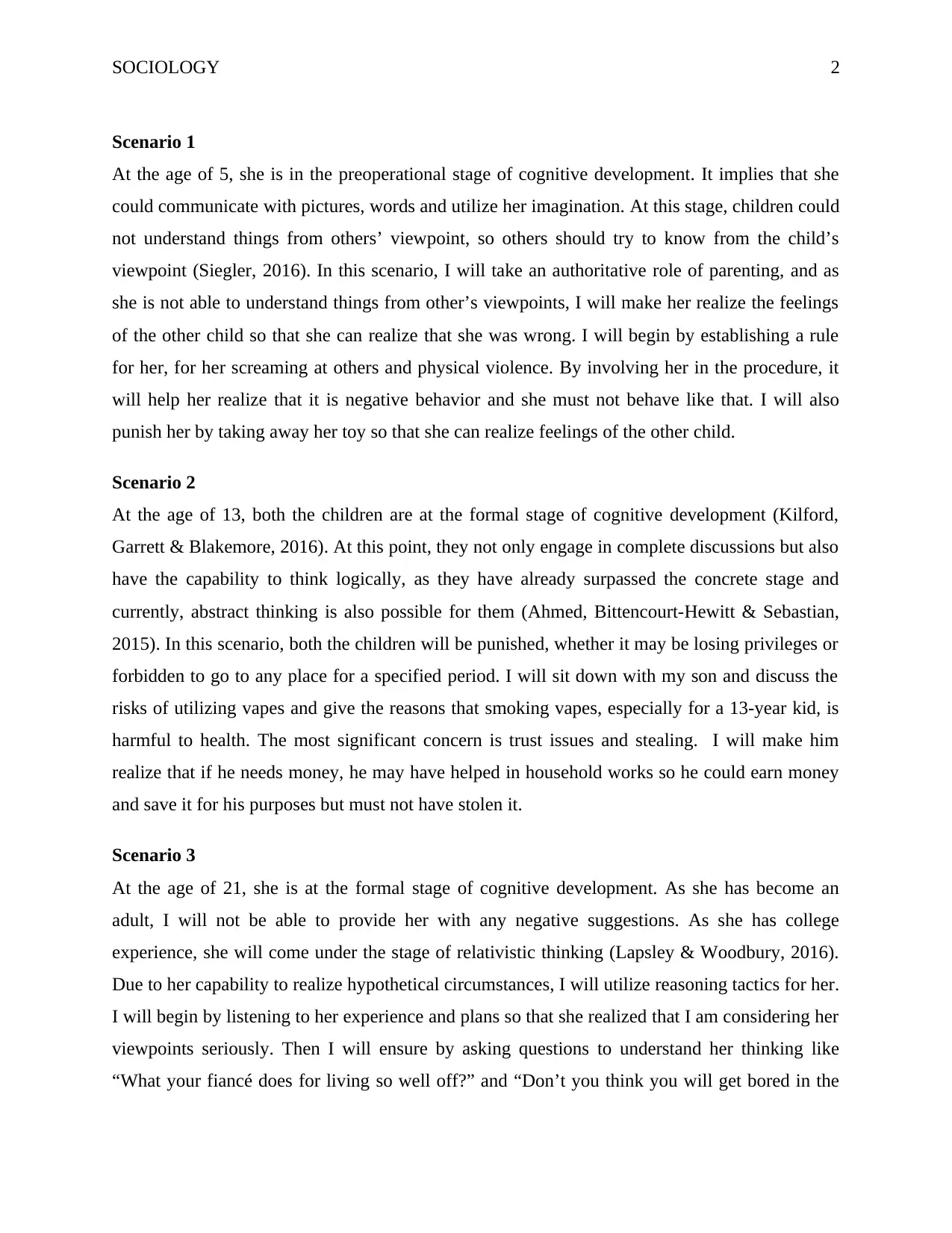
Scenario 1
At the age of 5, she is in the preoperational stage of cognitive development. It implies that she
could communicate with pictures, words and utilize her imagination. At this stage, children could
not understand things from others’ viewpoint, so others should try to know from the child’s
viewpoint (Siegler, 2016). In this scenario, I will take an authoritative role of parenting, and as
she is not able to understand things from other’s viewpoints, I will make her realize the feelings
of the other child so that she can realize that she was wrong. I will begin by establishing a rule
for her, for her screaming at others and physical violence. By involving her in the procedure, it
will help her realize that it is negative behavior and she must not behave like that. I will also
punish her by taking away her toy so that she can realize feelings of the other child.
Scenario 2
At the age of 13, both the children are at the formal stage of cognitive development (Kilford,
Garrett & Blakemore, 2016). At this point, they not only engage in complete discussions but also
have the capability to think logically, as they have already surpassed the concrete stage and
currently, abstract thinking is also possible for them (Ahmed, Bittencourt-Hewitt & Sebastian,
2015). In this scenario, both the children will be punished, whether it may be losing privileges or
forbidden to go to any place for a specified period. I will sit down with my son and discuss the
risks of utilizing vapes and give the reasons that smoking vapes, especially for a 13-year kid, is
harmful to health. The most significant concern is trust issues and stealing. I will make him
realize that if he needs money, he may have helped in household works so he could earn money
and save it for his purposes but must not have stolen it.
Scenario 3
At the age of 21, she is at the formal stage of cognitive development. As she has become an
adult, I will not be able to provide her with any negative suggestions. As she has college
experience, she will come under the stage of relativistic thinking (Lapsley & Woodbury, 2016).
Due to her capability to realize hypothetical circumstances, I will utilize reasoning tactics for her.
I will begin by listening to her experience and plans so that she realized that I am considering her
viewpoints seriously. Then I will ensure by asking questions to understand her thinking like
“What your fiancé does for living so well off?” and “Don’t you think you will get bored in the
Document Page
SOCIOLOGY 3
house while he will be away for work? Asking these questions would make her think about her
fiancé’s money, and hopefully, she will find out if the new guy is truthful about his richness.
tabler-icon-diamond-filled.svg

Paraphrase This Document

Need a fresh take? Get an instant paraphrase of this document with our AI Paraphraser
Document Page
SOCIOLOGY 4
References
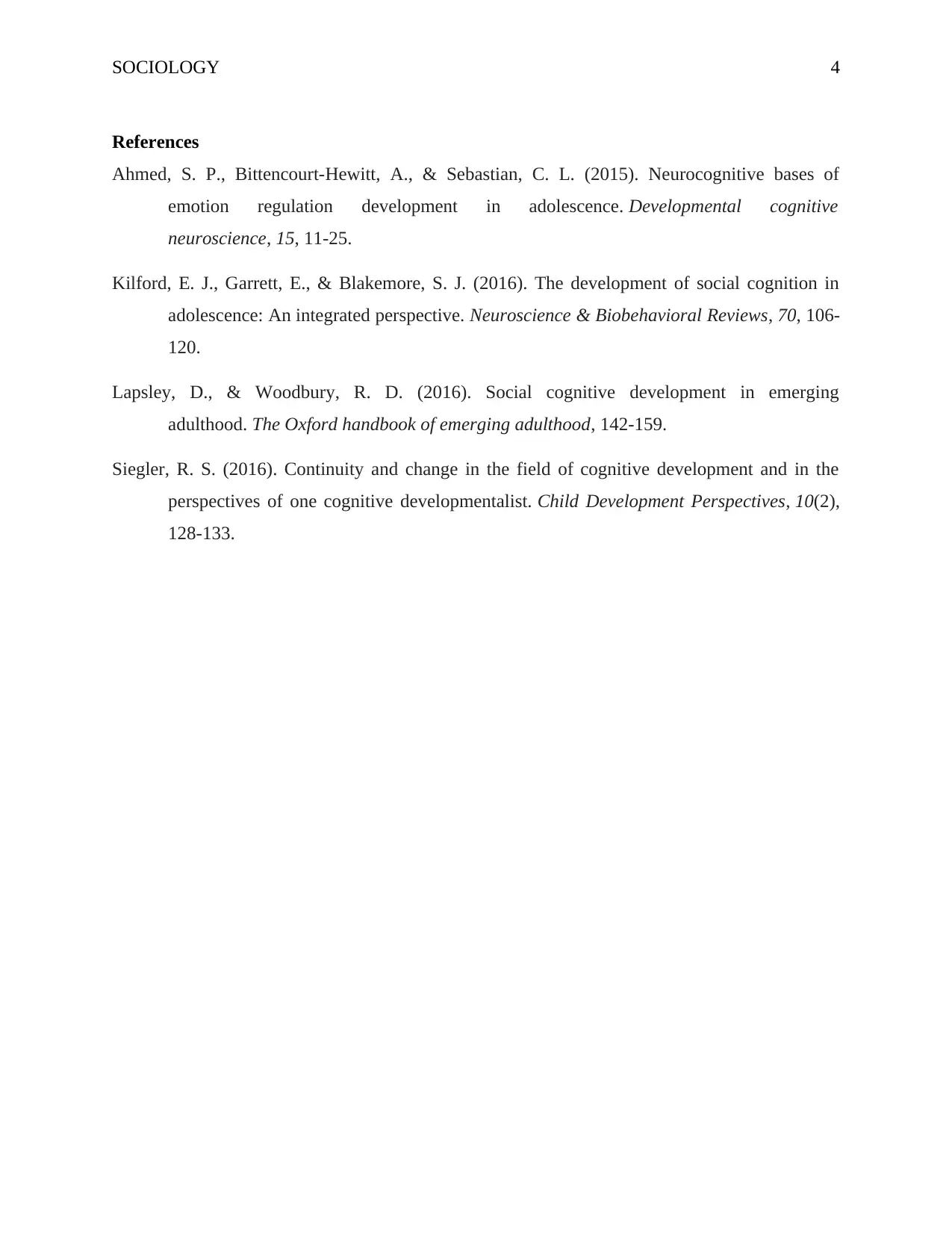
Ahmed, S. P., Bittencourt-Hewitt, A., & Sebastian, C. L. (2015). Neurocognitive bases of
emotion regulation development in adolescence. Developmental cognitive
neuroscience, 15, 11-25.
Kilford, E. J., Garrett, E., & Blakemore, S. J. (2016). The development of social cognition in
adolescence: An integrated perspective. Neuroscience & Biobehavioral Reviews, 70, 106-
120.
Lapsley, D., & Woodbury, R. D. (2016). Social cognitive development in emerging
adulthood. The Oxford handbook of emerging adulthood, 142-159.
Siegler, R. S. (2016). Continuity and change in the field of cognitive development and in the
perspectives of one cognitive developmentalist. Child Development Perspectives, 10(2),
128-133.
chevron_up_icon
1 out of 5
circle_padding
hide_on_mobile
zoom_out_icon
[object Object]