Sociology Discussion: Gender Inequality in Education and Development

Verified

Added on  2023/01/16

|4
|612
|86
Discussion Board Post
AI Summary
This discussion post in sociology addresses the pervasive issue of gender inequality, particularly focusing on its impact on education and development. The author, responding to a classmate's post, highlights the significant disparities in educational access, referencing UNESCO reports that indicate a large percentage of women worldwide lack access to education. The post emphasizes the underrepresentation of women in professional fields, even when they possess advanced qualifications. It discusses the challenges faced by women journalists and the broader societal biases that contribute to gender inequality. The post also acknowledges the importance of awareness campaigns and the role of programs like WID in empowering women. Furthermore, it touches upon the intersectionality of inequality, noting that women of color often face a double disadvantage. The author calls for governmental efforts to address these issues and promote equality. The post references several scholarly sources to support its claims, including works by Fincher, Lindsey, Razavi, and Sharp, providing a comprehensive overview of the subject.
Document Page
Running head: SOCIOLOGY
Education and International Development
Name of the Student:
Name of the university:
Author’s Note:
tabler-icon-diamond-filled.svg

Paraphrase This Document

Need a fresh take? Get an instant paraphrase of this document with our AI Paraphraser
Document Page
2SOCIOLOGY
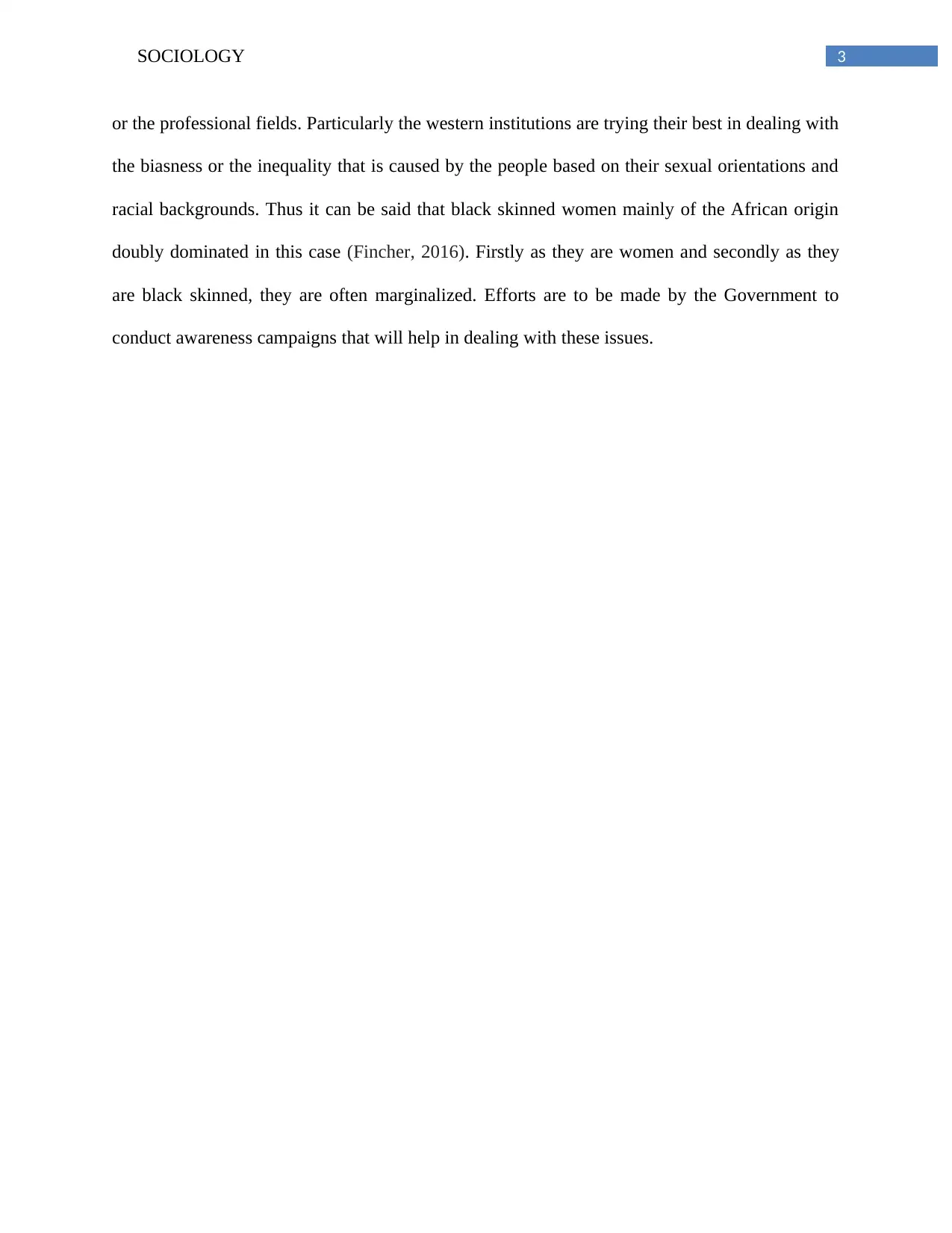
I have gone through the post shared by my classmates Pardeep Kaur. I am really very
happy to have been able to respond to this post as this deals with one of the most important and
interesting topics. I completely agree with the viewpoint that has been presented in this post
regarding gender inequality. I totally agree with the view that has been presented from the
perspective of the UNESCO that 100 Million of the women from over the total of the world have
no access to education. I want to add in this context that women make up about two-thirds of the
total population of the world. Seven hundred fifty million adults have basic literacy skill, but the
recognized and right positions are mainly occupied by men (Razavi, 2016). It is said that only a
mere percentage of about 30mperecnet among the women have been able to get a good formal
education and establish themselves as the researchers.
As per the report provided by the UNESCO, even if women are able to provide
themselves with excellent legal knowledge and found themselves at good well paying job roles,
they are not given proper treatment. A good example will be the women journalist (Lindsey,
2015). UNESCO has forwarded their report that the women journalist has been subjected to
immense insult including mental, physical and sexual assault. This is evident in the fact that
society is not yet advanced enough to accept the females as educated, well organized, self-
dependent individuals (Sharp, 2016).
The opinion that has been shared about the lack of awareness among the parents is also
evident. Families living in remote areas are not capable of understanding the importance of
education. As a result of this, they do not really feel interested in making their children educated.
However, more and more people are being made aware these days. The programs like the WID
or the women in development are mainly helping the women to get educated. This is a good
approach to empowering women. However, gender inequality is also prominent among the work
Document Page
3SOCIOLOGY
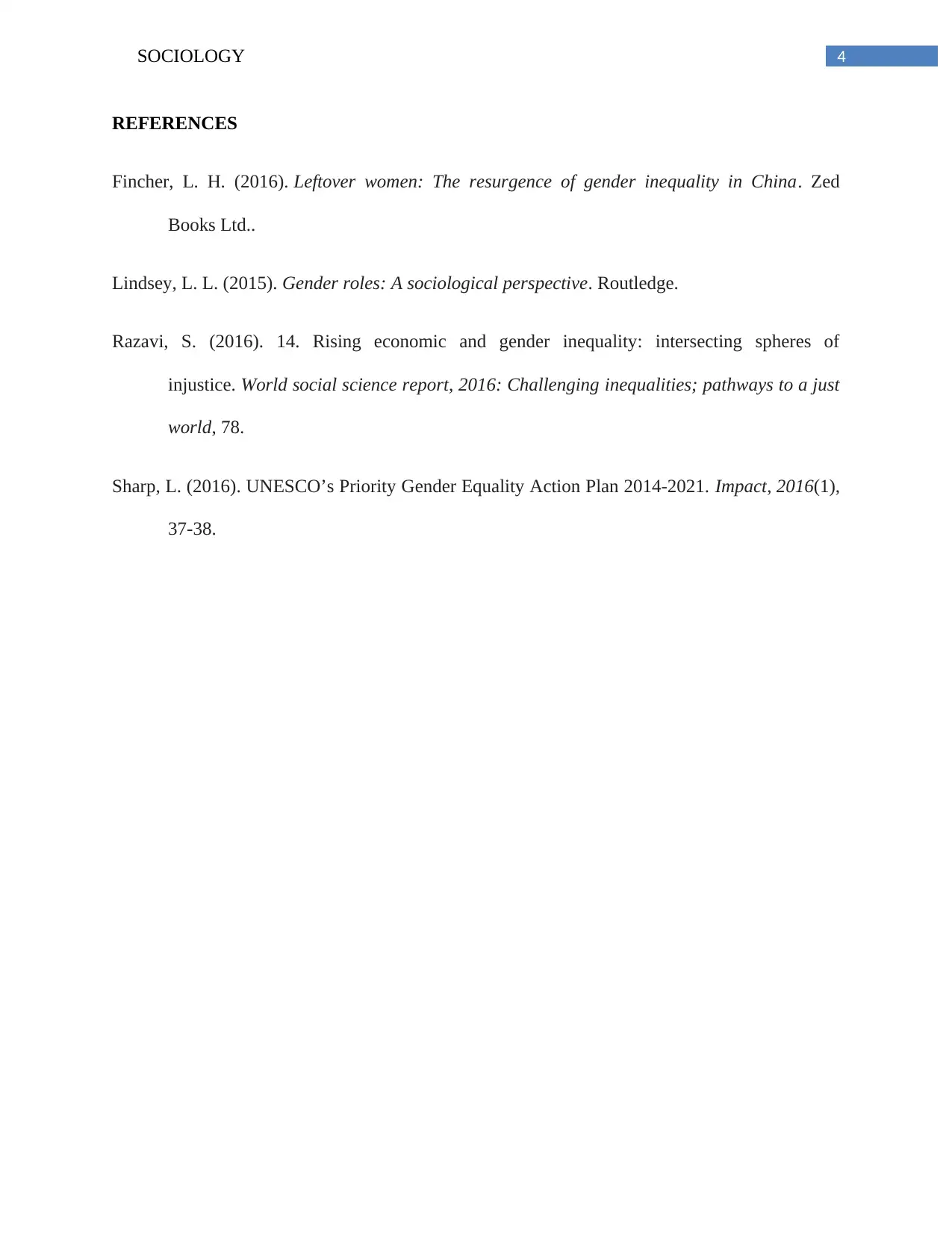
or the professional fields. Particularly the western institutions are trying their best in dealing with
the biasness or the inequality that is caused by the people based on their sexual orientations and
racial backgrounds. Thus it can be said that black skinned women mainly of the African origin
doubly dominated in this case (Fincher, 2016). Firstly as they are women and secondly as they
are black skinned, they are often marginalized. Efforts are to be made by the Government to
conduct awareness campaigns that will help in dealing with these issues.
Document Page
4SOCIOLOGY
REFERENCES
Fincher, L. H. (2016). Leftover women: The resurgence of gender inequality in China. Zed
Books Ltd..
Lindsey, L. L. (2015). Gender roles: A sociological perspective. Routledge.
Razavi, S. (2016). 14. Rising economic and gender inequality: intersecting spheres of
injustice. World social science report, 2016: Challenging inequalities; pathways to a just
world, 78.
Sharp, L. (2016). UNESCO’s Priority Gender Equality Action Plan 2014-2021. Impact, 2016(1),
37-38.
chevron_up_icon
1 out of 4
circle_padding
hide_on_mobile
zoom_out_icon
[object Object]