Sociology Report: Media's Role and Impact in Contemporary Society
VerifiedAdded on 2023/01/05
|10
|2674
|55
Report
AI Summary
This report delves into core sociological concepts, beginning with definitions of qualitative and quantitative research methods, and explores concepts such as alienation, mechanical and organic solidarity, and health and well-being. The report also includes an essay that examines the multifaceted role and impact of media in contemporary society, analyzing its influence on individuals, societal values, and the dissemination of information. The essay discusses how media shapes public opinion, reinforces social norms, and affects different generations, particularly the youth, by influencing their behaviors and perceptions. The report emphasizes the close relationship between media and society, highlighting the significant ways in which media can both strengthen and weaken societal structures.
Making sense of society
understanding the social world
understanding the social world

Paraphrase This Document
Need a fresh take? Get an instant paraphrase of this document with our AI Paraphraser
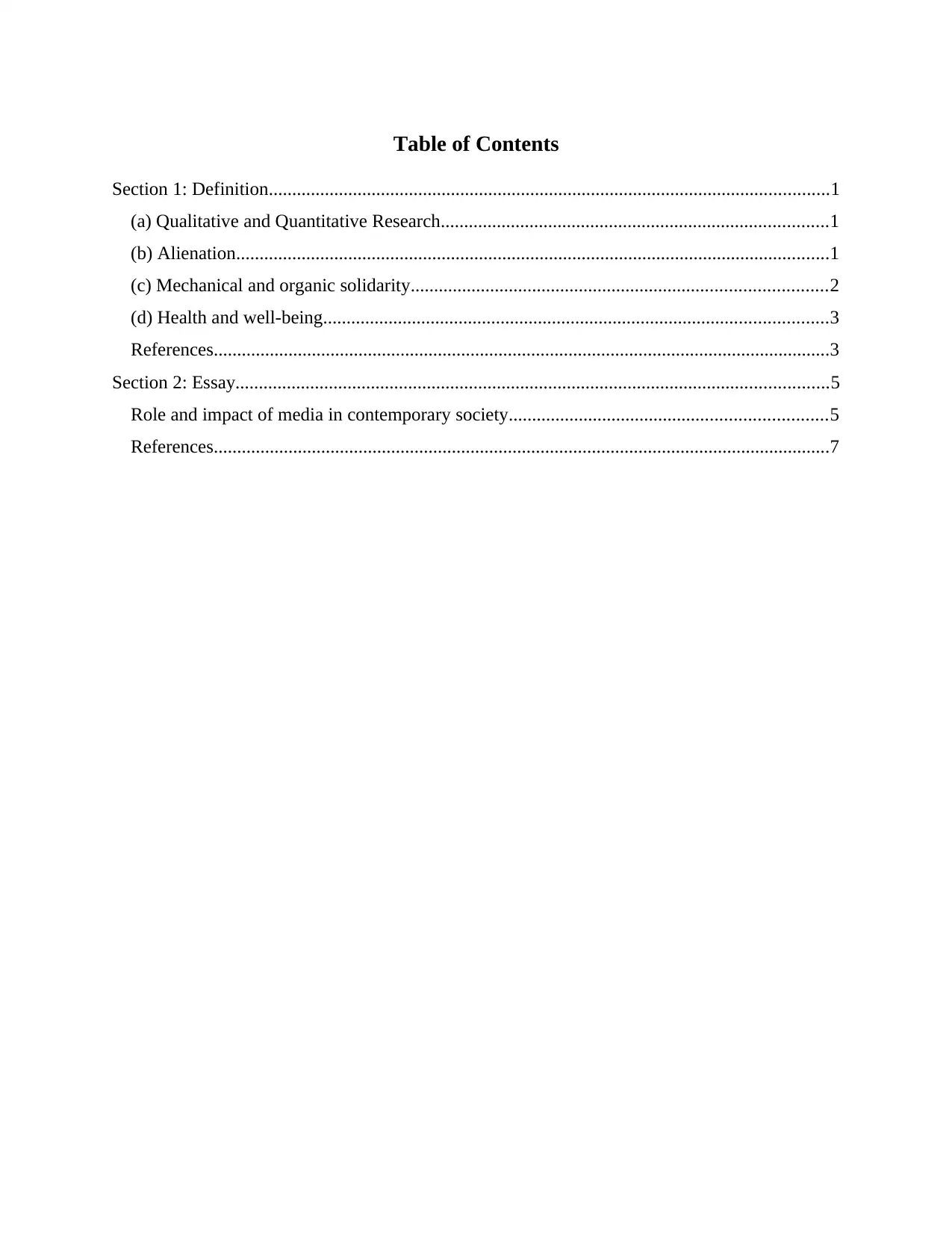
Table of Contents
Section 1: Definition........................................................................................................................1
(a) Qualitative and Quantitative Research...................................................................................1
(b) Alienation...............................................................................................................................1
(c) Mechanical and organic solidarity.........................................................................................2
(d) Health and well-being............................................................................................................3
References....................................................................................................................................3
Section 2: Essay...............................................................................................................................5
Role and impact of media in contemporary society....................................................................5
References....................................................................................................................................7
Section 1: Definition........................................................................................................................1
(a) Qualitative and Quantitative Research...................................................................................1
(b) Alienation...............................................................................................................................1
(c) Mechanical and organic solidarity.........................................................................................2
(d) Health and well-being............................................................................................................3
References....................................................................................................................................3
Section 2: Essay...............................................................................................................................5
Role and impact of media in contemporary society....................................................................5
References....................................................................................................................................7

⊘ This is a preview!⊘
Do you want full access?
Subscribe today to unlock all pages.

Trusted by 1+ million students worldwide
Section 1: Definition
(a) Qualitative and Quantitative Research
Qualitative research can be defined as a process of theoretical inquiry which seeks in-depth
understanding and evaluating the social phenomena within natural settings. This research helps
in generating non-numerical or textual information, where despite of statistical and numerical
measurements it describes the situation by focusing more on the reasoning behind the actions of
societies, individuals and cultures via open ended survey and exploratory questions (Rutberg and
Bouikidis, 2018). The common methods which provides data collection toolkit while gathering
qualitative data, includes focus groups, behavioural observations, individual interviews and
group discussions. All these methods are completely unstructured or semi-structured techniques,
that aid in providing the large amount of information.
On contrast with quantitative research, it explains phenomena of any problem by gathering
numerical data and analysing through statistical or mathematically based computational methods.
In other words, quantitative research methods can be defined as process of statistical,
mathematical or numerical analysis of information collected through polls, online and offline
surveys, questionnaires, and more (Berger, 2018). It provides measurable statistics which work
for quantify the opinions as well as theoretical perspectives of participants. Typically, these
quantitative research methods provide numerical data which can be further visualised into
graphical form as charts, bar graphs and tables for analysing the outcomes. Quantitative research
mainly applies with purpose to objectively test a theory and measure the opinion of target
audience in response to some specific research objective. But this method relatively fails to draw
data from wide variety of sources, therefore, researchers mostly seeks to utilise qualitative
techniques more, to conduct investigation of a specific project.
(b) Alienation
The term alienation defines as withdrawing feeling or separation of an individual’s
affections from an objective, position of the former attachments and more. The act of alienating
causes a person to become hostile or indifferent from others. According to Marx, the process
when worker is made to feel unfamiliar to products of own labour. However, production of
commodities may not lead to alienation and indeed, can be highly satisfying one pours one's
subjectivity within an object (Dunayevskaya, 2018). Here, an individual can even gain
1
(a) Qualitative and Quantitative Research
Qualitative research can be defined as a process of theoretical inquiry which seeks in-depth
understanding and evaluating the social phenomena within natural settings. This research helps
in generating non-numerical or textual information, where despite of statistical and numerical
measurements it describes the situation by focusing more on the reasoning behind the actions of
societies, individuals and cultures via open ended survey and exploratory questions (Rutberg and
Bouikidis, 2018). The common methods which provides data collection toolkit while gathering
qualitative data, includes focus groups, behavioural observations, individual interviews and
group discussions. All these methods are completely unstructured or semi-structured techniques,
that aid in providing the large amount of information.
On contrast with quantitative research, it explains phenomena of any problem by gathering
numerical data and analysing through statistical or mathematically based computational methods.
In other words, quantitative research methods can be defined as process of statistical,
mathematical or numerical analysis of information collected through polls, online and offline
surveys, questionnaires, and more (Berger, 2018). It provides measurable statistics which work
for quantify the opinions as well as theoretical perspectives of participants. Typically, these
quantitative research methods provide numerical data which can be further visualised into
graphical form as charts, bar graphs and tables for analysing the outcomes. Quantitative research
mainly applies with purpose to objectively test a theory and measure the opinion of target
audience in response to some specific research objective. But this method relatively fails to draw
data from wide variety of sources, therefore, researchers mostly seeks to utilise qualitative
techniques more, to conduct investigation of a specific project.
(b) Alienation
The term alienation defines as withdrawing feeling or separation of an individual’s
affections from an objective, position of the former attachments and more. The act of alienating
causes a person to become hostile or indifferent from others. According to Marx, the process
when worker is made to feel unfamiliar to products of own labour. However, production of
commodities may not lead to alienation and indeed, can be highly satisfying one pours one's
subjectivity within an object (Dunayevskaya, 2018). Here, an individual can even gain
1
Paraphrase This Document
Need a fresh take? Get an instant paraphrase of this document with our AI Paraphraser
enjoyment from such fact that in turn, other persons gains enjoyment from their craft. With
regards to capitalism, a worker in so far might get exploited when not willing work to create a
product which will then sells to others, despite o the proletariat works to live and obtain very
means of life, which can achieve only by selling own labour to a capitalist in exchange with
wage (Silver, 2019). The worker therefore, considers as alienated from the creation of own
product precisely because they might no longer owns that product, that now belongs with
capitalist who will purchased the labour power of proletariat for getting exclusive ownership
over the same as well as on all profit accrued via sale of those commodities.
(c) Mechanical and organic solidarity
According to the theory of French Social Scientists Emile Durekheim “Mechanical and
organic solidarity can be defined as social cohesiveness of small and undifferentiated societies or
differentiated in terms of complex labour divisions. Mechanical solidarity refers to socially
integrate the society members, who have possessed with common values and beliefs. Such
common beliefs include “collective conscience” which works internally and cause people to
cooperate with each others. As per Durkheim’s view, the forces which cause members of society
to make cooperation are more likely to have internal energies, which reflect the molecules for
cohering in a solid (Fernandez and Bande, 2018). This fact has drawn upon the physical science
terminology in coining the term known as mechanical solidarity. On contrast with theory of
mechanical solidarity, the concept of organic solidarity includes social integration which arises
out of individual’s need for another’s services. Within a society, which is characterized by
organic solidarity, a greater division of labor is relatively observed, where working profile of
individuals differentiated them from each other. Along with this, society relies under such
condition, less upon imposed of uniform rules on its members but concerns more on regulating
the relations among various groups and persons, via greater use of laws and contracts. In other
words, solidarity which differentiate both terms states that mechanical concept includes with
state of community that bonds traditional societies with each other, as per shared beliefs and
values to perform common activities (Sawant, 2020). While, organic solidarity mainly occurs
when people having a diverse labor division live in a same society, then this forces to depend on
others’ work for their survival.
2
regards to capitalism, a worker in so far might get exploited when not willing work to create a
product which will then sells to others, despite o the proletariat works to live and obtain very
means of life, which can achieve only by selling own labour to a capitalist in exchange with
wage (Silver, 2019). The worker therefore, considers as alienated from the creation of own
product precisely because they might no longer owns that product, that now belongs with
capitalist who will purchased the labour power of proletariat for getting exclusive ownership
over the same as well as on all profit accrued via sale of those commodities.
(c) Mechanical and organic solidarity
According to the theory of French Social Scientists Emile Durekheim “Mechanical and
organic solidarity can be defined as social cohesiveness of small and undifferentiated societies or
differentiated in terms of complex labour divisions. Mechanical solidarity refers to socially
integrate the society members, who have possessed with common values and beliefs. Such
common beliefs include “collective conscience” which works internally and cause people to
cooperate with each others. As per Durkheim’s view, the forces which cause members of society
to make cooperation are more likely to have internal energies, which reflect the molecules for
cohering in a solid (Fernandez and Bande, 2018). This fact has drawn upon the physical science
terminology in coining the term known as mechanical solidarity. On contrast with theory of
mechanical solidarity, the concept of organic solidarity includes social integration which arises
out of individual’s need for another’s services. Within a society, which is characterized by
organic solidarity, a greater division of labor is relatively observed, where working profile of
individuals differentiated them from each other. Along with this, society relies under such
condition, less upon imposed of uniform rules on its members but concerns more on regulating
the relations among various groups and persons, via greater use of laws and contracts. In other
words, solidarity which differentiate both terms states that mechanical concept includes with
state of community that bonds traditional societies with each other, as per shared beliefs and
values to perform common activities (Sawant, 2020). While, organic solidarity mainly occurs
when people having a diverse labor division live in a same society, then this forces to depend on
others’ work for their survival.
2
(d) Health and well-being
The term Health and wellbeing are essential concepts, which help in increasing and
maintaining the proper condition of a body or not merely in absence of any disease. According to
World Health Organisation (WHO) health defines as state of complete physical and emotional
well-being of an individual, where good health consider as centre for dealing with stress and
hypertension. It refers as a resource which support and provides the means for living a longer
life. Similarly, concept of well-being defines as a positive outcome which is meaningful for
people as well as for many sectors of society, as it tells that people perceive their lives within a
good condition (Foley and et. al., 2019). Housing, employment, good economic and living
conditions are considered as fundamental for well-being. Therefore, for public policy and
improvement of living standards of a society, tracking such conditions is most crucial activity.
However, other indicators that are important for measuring living conditions also need to be
included, while defining well-being state of an individual or a society. It includes what people
think and feel about lives, like quality of their relationships, positive emotions, resilience and
realization of potential, etc. which depicts overall satisfaction with own living condition.
Therefore, well-being includes generally the global judgments regarding with life satisfaction
and overall feelings of people that range from depression to joy. Thus, good health and well-
being conditions is a result of combining factors related with physical, emotional, social and
intellectual feelings (Cornet and Holden, 2018). WHO links health explicitly with wellbeing, by
conceptualising health as rights of human which requires physical and social resources for
achievement and maintenance of same. While ‘Wellbeing’ defines as a positive state despite of
neutral which frames health in terms of positive aspiration.
References
Berger, A. A. (2018). Media and communication research methods: An introduction to
qualitative and quantitative approaches. Sage Publications.
Cornet, V. P., & Holden, R. J. (2018). Systematic review of smartphone-based passive sensing
for health and wellbeing. Journal of biomedical informatics, 77, 120-132.
Dunayevskaya, R. (2018). The Theory of Alienation: Marx’s Debt to Hegel. In Marx’s
Philosophy of Revolution in Permanence for Our Day (pp. 31-36). Brill.
Fernandez Jr, G. C., & Bande, M. J. M. (2018). Rainforestation Implementation and Durkheim’s
Notion of Mechanical Solidarity: From the Experiences of the Pioneering Adopters of the
Cienda San Vicente Farmers Association in Baybay City, Leyte. Journal of Agriculture
and Technology Management (JATM), 21(1), 8-16.
Foley, R., Kearns, R., Kistemann, T., & Wheeler, B. (Eds.). (2019). Blue space, health and
wellbeing: Hydrophilia unbounded. Routledge.
3
The term Health and wellbeing are essential concepts, which help in increasing and
maintaining the proper condition of a body or not merely in absence of any disease. According to
World Health Organisation (WHO) health defines as state of complete physical and emotional
well-being of an individual, where good health consider as centre for dealing with stress and
hypertension. It refers as a resource which support and provides the means for living a longer
life. Similarly, concept of well-being defines as a positive outcome which is meaningful for
people as well as for many sectors of society, as it tells that people perceive their lives within a
good condition (Foley and et. al., 2019). Housing, employment, good economic and living
conditions are considered as fundamental for well-being. Therefore, for public policy and
improvement of living standards of a society, tracking such conditions is most crucial activity.
However, other indicators that are important for measuring living conditions also need to be
included, while defining well-being state of an individual or a society. It includes what people
think and feel about lives, like quality of their relationships, positive emotions, resilience and
realization of potential, etc. which depicts overall satisfaction with own living condition.
Therefore, well-being includes generally the global judgments regarding with life satisfaction
and overall feelings of people that range from depression to joy. Thus, good health and well-
being conditions is a result of combining factors related with physical, emotional, social and
intellectual feelings (Cornet and Holden, 2018). WHO links health explicitly with wellbeing, by
conceptualising health as rights of human which requires physical and social resources for
achievement and maintenance of same. While ‘Wellbeing’ defines as a positive state despite of
neutral which frames health in terms of positive aspiration.
References
Berger, A. A. (2018). Media and communication research methods: An introduction to
qualitative and quantitative approaches. Sage Publications.
Cornet, V. P., & Holden, R. J. (2018). Systematic review of smartphone-based passive sensing
for health and wellbeing. Journal of biomedical informatics, 77, 120-132.
Dunayevskaya, R. (2018). The Theory of Alienation: Marx’s Debt to Hegel. In Marx’s
Philosophy of Revolution in Permanence for Our Day (pp. 31-36). Brill.
Fernandez Jr, G. C., & Bande, M. J. M. (2018). Rainforestation Implementation and Durkheim’s
Notion of Mechanical Solidarity: From the Experiences of the Pioneering Adopters of the
Cienda San Vicente Farmers Association in Baybay City, Leyte. Journal of Agriculture
and Technology Management (JATM), 21(1), 8-16.
Foley, R., Kearns, R., Kistemann, T., & Wheeler, B. (Eds.). (2019). Blue space, health and
wellbeing: Hydrophilia unbounded. Routledge.
3
⊘ This is a preview!⊘
Do you want full access?
Subscribe today to unlock all pages.
Trusted by 1+ million students worldwide
Rutberg, S., & Bouikidis, C. D. (2018). Focusing on the fundamentals: A simplistic
differentiation between qualitative and quantitative research. Nephrology Nursing
Journal, 45(2), 209-213.
Sawant, M. (2020). Module 3: Emile Durkheim.
Silver, D. (2019). Alienation in a four factor world. Journal for the Theory of Social
Behaviour, 49(1), 84-105.
4
differentiation between qualitative and quantitative research. Nephrology Nursing
Journal, 45(2), 209-213.
Sawant, M. (2020). Module 3: Emile Durkheim.
Silver, D. (2019). Alienation in a four factor world. Journal for the Theory of Social
Behaviour, 49(1), 84-105.
4
Paraphrase This Document
Need a fresh take? Get an instant paraphrase of this document with our AI Paraphraser
Section 2: Essay
Role and impact of media in contemporary society
Media is the reflection of a society which depicts what and how it works. It is presented in
the form of printed, web or electronic medium, that helps in bringing awareness among people
and keeping them informed about what is going on at both surrounding and global level (Xu,
2019). It covers a wide level of news and knowledge that also aid in providing entertainment to
the public and educate them about current happenings. Today, media has become voice of a
society, where presence of variety of digital platform, aid in stimulating the thoughts of both
young and old generation including other sections more eloquently. It strengthens or weakens the
society, by changing thoughts, values and beliefs of people towards each and every section.
Therefore, media and society are considered as closely related with each other. With an extensive
impact of media on society, it reflects the way people are working and earning their living
conditions. With advancement and more innovations in technological area, beginning from
printing press to smart android phones, there is a large expansion of views and thoughts of
society has been seen (Lim, 2018).
Today, as media become an importance part of everyone’s life, therefore, main purpose of
it is to provide information about current news, latest trends, gossips, gadgets and innovations
etc. held in the marketplace. The role of a media can also measure as one way of trading or
marketing businesses. It also provides geographical knowledge about way people are segmented
on the basis of beliefs, thoughts, labour and more. The media therefore, claimed to be governed
by equity and righteousness for common to rich man (Henderson, Hilton and Green, 2020). It is
a change of entertainment, education, information and correlation of different parts of society.
Therefore, society is highly influenced by ways in which information and other things are
presented to them (The Significance and Impact of the Media in Contemporary Society, 2018).
Along with this, their judgements regarding with what is going right or wrong regarding with
numerous issues, also get timely change. Therefore, keeping update and being informed what is
going in surroundings depicts the positive side of way media is influencing a society.
By analyzing the impact and importance of mass media in contemporary society, it can
define as a term of consonance which aligns to opinion streams. As per Spiral of Silence theory,
this concept describes the phenomenon beginning from dependence of opinion of individuals on
5
Role and impact of media in contemporary society
Media is the reflection of a society which depicts what and how it works. It is presented in
the form of printed, web or electronic medium, that helps in bringing awareness among people
and keeping them informed about what is going on at both surrounding and global level (Xu,
2019). It covers a wide level of news and knowledge that also aid in providing entertainment to
the public and educate them about current happenings. Today, media has become voice of a
society, where presence of variety of digital platform, aid in stimulating the thoughts of both
young and old generation including other sections more eloquently. It strengthens or weakens the
society, by changing thoughts, values and beliefs of people towards each and every section.
Therefore, media and society are considered as closely related with each other. With an extensive
impact of media on society, it reflects the way people are working and earning their living
conditions. With advancement and more innovations in technological area, beginning from
printing press to smart android phones, there is a large expansion of views and thoughts of
society has been seen (Lim, 2018).
Today, as media become an importance part of everyone’s life, therefore, main purpose of
it is to provide information about current news, latest trends, gossips, gadgets and innovations
etc. held in the marketplace. The role of a media can also measure as one way of trading or
marketing businesses. It also provides geographical knowledge about way people are segmented
on the basis of beliefs, thoughts, labour and more. The media therefore, claimed to be governed
by equity and righteousness for common to rich man (Henderson, Hilton and Green, 2020). It is
a change of entertainment, education, information and correlation of different parts of society.
Therefore, society is highly influenced by ways in which information and other things are
presented to them (The Significance and Impact of the Media in Contemporary Society, 2018).
Along with this, their judgements regarding with what is going right or wrong regarding with
numerous issues, also get timely change. Therefore, keeping update and being informed what is
going in surroundings depicts the positive side of way media is influencing a society.
By analyzing the impact and importance of mass media in contemporary society, it can
define as a term of consonance which aligns to opinion streams. As per Spiral of Silence theory,
this concept describes the phenomenon beginning from dependence of opinion of individuals on
5
the dominant opinion which is expressed by the mass media (Xu, 2019). It further states that
society in this regard, threatens the deviant with feeling of isolation, where people are more
afraid of isolation despite of error, with evaluation of both favourable and unfavourable climate
of personal opinion and attitude towards a particular issue. Individuals that share the dominant
point of view used to easily share it, while others who do not share own opinion enclose
themselves in silence, due to fear of isolation. Thus, media expressed public opinion from
various perspectives, publicly without any risk of isolation. Further, secondary function of mass
media, in terms of reinforcing social norms, can be achieved via fact that television exposes
deviation from norms with judgment of public opinion. It also has a massive impact in imposing
fashion feminine or masculine type of beauty, which influences people of all generation. But
changing in fashion trends, movies and entertaining subjects also put a negative impact
especially on young generations (Lim, 2018). It mainly because youth including children and
teenagers, are strongly influenced by media. They are intended to follow those people, who are
famous and recognized by all, through their acts despite of good or bad perspectives. Following
media put negative impact on minds of youth generations, which increase criminal activities as
well. Along with this, getting influenced by media, desires of youth to get something that are
beyond their control also increase, where to achieve the same they move on wrong path. This
indicates how media controls mind of youth, where too much intervention considers as a matter
of concern. Therefore, these in-sights indicate that media today has become a drug to young
generation that changes the way they communicate as well as manner of perceiving information,
both positively and negatively. Updating status and photos on social media sites like Facebook,
Instagram and more, contributes to increase criminal cases also.
From all over discussion, it has been concluded that in today’s world of media, impacts in
both positive and negative manner in a contemporary society. It has a strong influence over
generations of all ages, where fake news on social media sites contributes to increase crimes
(Henderson, Hilton and Green, 2020). Hereby, fake news related with wrong information that
seems to be dangerous and raise a hateful propaganda among society, therefore, it is a big
concern that needs to be resolved for creating a good society. Media communication consists
with full of contradictions, where nevertheless no one can deny its importance social life of
people. The way it has kept people aware and update of both right and wrong things happening
around the world, reflects the impact of mass media within contemporary society.
6
society in this regard, threatens the deviant with feeling of isolation, where people are more
afraid of isolation despite of error, with evaluation of both favourable and unfavourable climate
of personal opinion and attitude towards a particular issue. Individuals that share the dominant
point of view used to easily share it, while others who do not share own opinion enclose
themselves in silence, due to fear of isolation. Thus, media expressed public opinion from
various perspectives, publicly without any risk of isolation. Further, secondary function of mass
media, in terms of reinforcing social norms, can be achieved via fact that television exposes
deviation from norms with judgment of public opinion. It also has a massive impact in imposing
fashion feminine or masculine type of beauty, which influences people of all generation. But
changing in fashion trends, movies and entertaining subjects also put a negative impact
especially on young generations (Lim, 2018). It mainly because youth including children and
teenagers, are strongly influenced by media. They are intended to follow those people, who are
famous and recognized by all, through their acts despite of good or bad perspectives. Following
media put negative impact on minds of youth generations, which increase criminal activities as
well. Along with this, getting influenced by media, desires of youth to get something that are
beyond their control also increase, where to achieve the same they move on wrong path. This
indicates how media controls mind of youth, where too much intervention considers as a matter
of concern. Therefore, these in-sights indicate that media today has become a drug to young
generation that changes the way they communicate as well as manner of perceiving information,
both positively and negatively. Updating status and photos on social media sites like Facebook,
Instagram and more, contributes to increase criminal cases also.
From all over discussion, it has been concluded that in today’s world of media, impacts in
both positive and negative manner in a contemporary society. It has a strong influence over
generations of all ages, where fake news on social media sites contributes to increase crimes
(Henderson, Hilton and Green, 2020). Hereby, fake news related with wrong information that
seems to be dangerous and raise a hateful propaganda among society, therefore, it is a big
concern that needs to be resolved for creating a good society. Media communication consists
with full of contradictions, where nevertheless no one can deny its importance social life of
people. The way it has kept people aware and update of both right and wrong things happening
around the world, reflects the impact of mass media within contemporary society.
6
⊘ This is a preview!⊘
Do you want full access?
Subscribe today to unlock all pages.
Trusted by 1+ million students worldwide
References
Henderson, L., Hilton, S., & Green, J. (Eds.). (2020). Media Analysis and Public Health:
Contemporary Issues in Critical Public Health. Routledge.
Lim, M. (2018). Roots, routes, and routers: Communications and media of contemporary social
movements. Journalism & Communication Monographs, 20(2), 92-136.
The Significance and Impact of the Media in Contemporary Society. (2018). Available from:
https://link.springer.com/chapter/10.1057/978-1-137-60682-2_2>. [accessed Oct 22 2020].
Xu, X. E. (2019). Impacts of mobile use and experience on contemporary society. Information
Science Reference/IGI Global.
7
Henderson, L., Hilton, S., & Green, J. (Eds.). (2020). Media Analysis and Public Health:
Contemporary Issues in Critical Public Health. Routledge.
Lim, M. (2018). Roots, routes, and routers: Communications and media of contemporary social
movements. Journalism & Communication Monographs, 20(2), 92-136.
The Significance and Impact of the Media in Contemporary Society. (2018). Available from:
https://link.springer.com/chapter/10.1057/978-1-137-60682-2_2>. [accessed Oct 22 2020].
Xu, X. E. (2019). Impacts of mobile use and experience on contemporary society. Information
Science Reference/IGI Global.
7

1 out of 10


Related Documents


Your All-in-One AI-Powered Toolkit for Academic Success.
+13062052269
info@desklib.com
Available 24*7 on WhatsApp / Email
![[object Object]](/_next/static/media/star-bottom.7253800d.svg)
Unlock your academic potential
Copyright © 2020–2026 A2Z Services. All Rights Reserved. Developed and managed by ZUCOL.