Sociology Assignment: Ethical Considerations in Negotiations

Verified

Added on  2022/09/21

|4
|653
|22
Homework Assignment
AI Summary
This assignment delves into the ethical considerations of negotiations within a sociological context. It addresses the importance of respect and maintaining good faith even when faced with disrespect from the opposing party. The solution explores the effectiveness of circular questioning, especially when negotiating with individuals in positions of power, providing examples to illustrate its application. Furthermore, the assignment analyzes the role of laws and regulations in upholding truthfulness and fairness in the negotiation process, offering examples to support the argument. The provided solution is based on the course readings from "What's Fair: Ethics for Negotiators" and offers well-reasoned responses to the posed questions, demonstrating a clear understanding of the concepts discussed.
Document Page
SOCIOLOGY 1
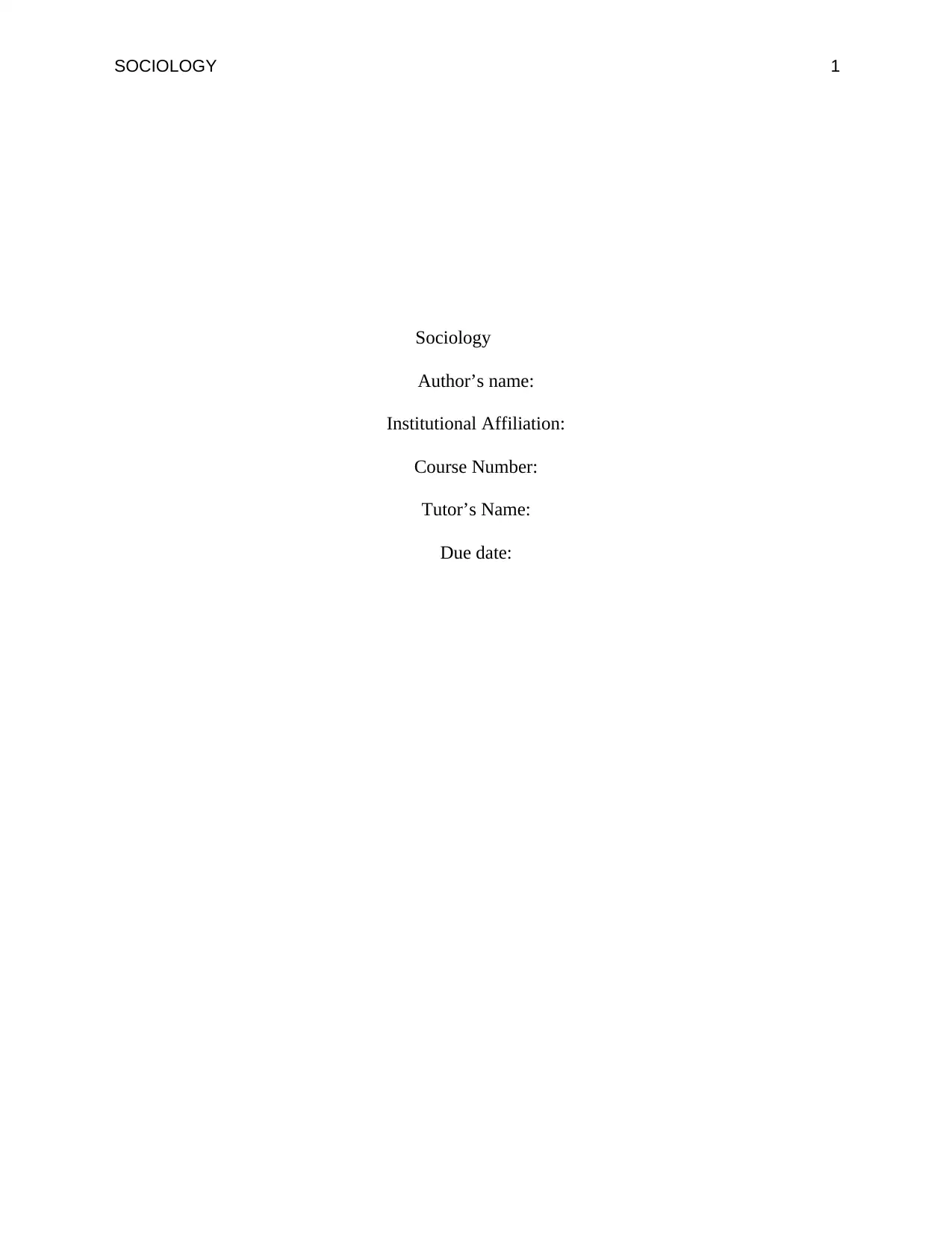
Sociology
Author’s name:
Institutional Affiliation:
Course Number:
Tutor’s Name:
Due date:
tabler-icon-diamond-filled.svg

Paraphrase This Document

Need a fresh take? Get an instant paraphrase of this document with our AI Paraphraser
Document Page
SOCIOLOGY 2
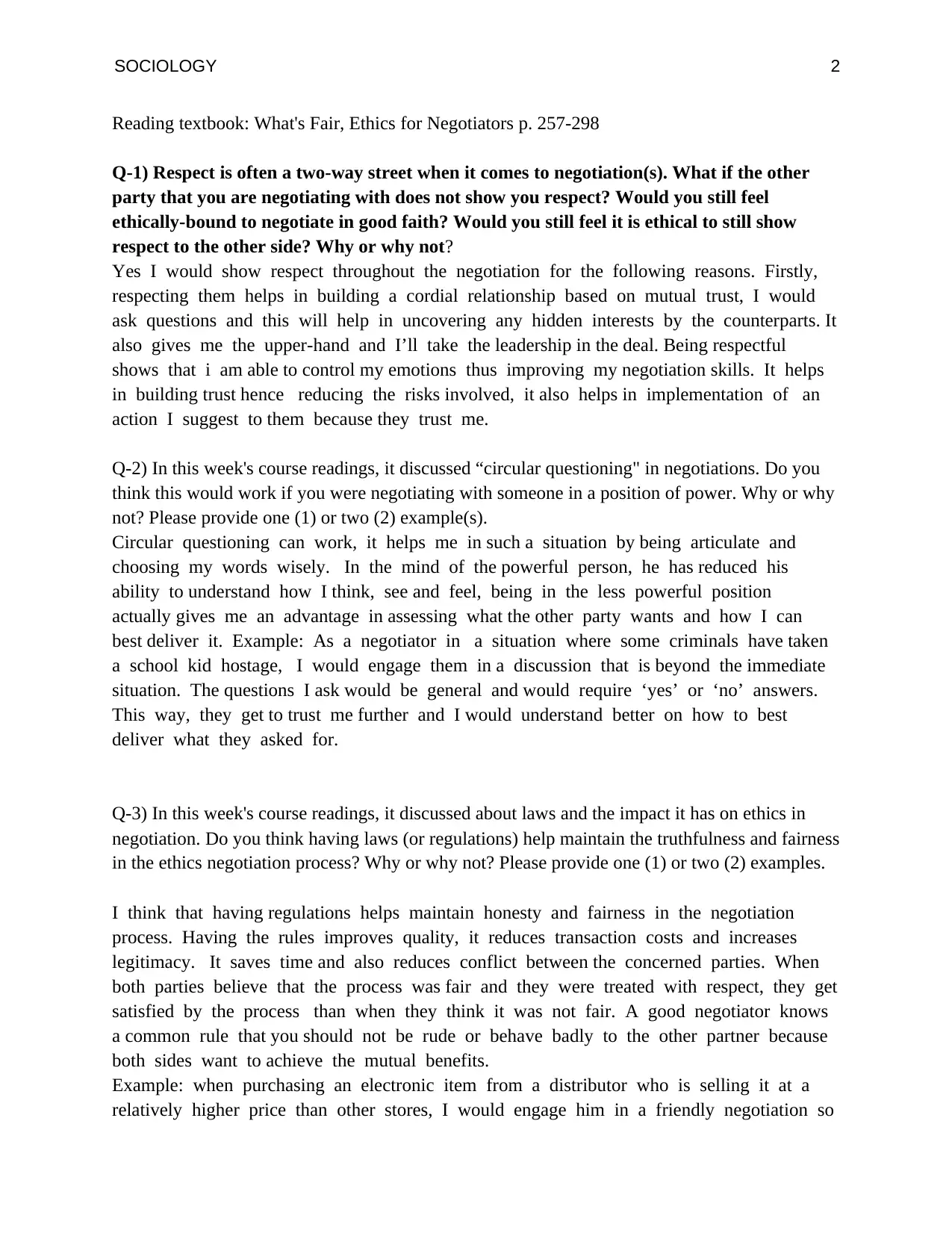
Reading textbook: What's Fair, Ethics for Negotiators p. 257-298
Q-1) Respect is often a two-way street when it comes to negotiation(s). What if the other
party that you are negotiating with does not show you respect? Would you still feel
ethically-bound to negotiate in good faith? Would you still feel it is ethical to still show
respect to the other side? Why or why not?
Yes I would show respect throughout the negotiation for the following reasons. Firstly,
respecting them helps in building a cordial relationship based on mutual trust, I would
ask questions and this will help in uncovering any hidden interests by the counterparts. It
also gives me the upper-hand and I’ll take the leadership in the deal. Being respectful
shows that i am able to control my emotions thus improving my negotiation skills. It helps
in building trust hence reducing the risks involved, it also helps in implementation of an
action I suggest to them because they trust me.
Q-2) In this week's course readings, it discussed “circular questioning" in negotiations. Do you
think this would work if you were negotiating with someone in a position of power. Why or why
not? Please provide one (1) or two (2) example(s).
Circular questioning can work, it helps me in such a situation by being articulate and
choosing my words wisely. In the mind of the powerful person, he has reduced his
ability to understand how I think, see and feel, being in the less powerful position
actually gives me an advantage in assessing what the other party wants and how I can
best deliver it. Example: As a negotiator in a situation where some criminals have taken
a school kid hostage, I would engage them in a discussion that is beyond the immediate
situation. The questions I ask would be general and would require ‘yes’ or ‘no’ answers.
This way, they get to trust me further and I would understand better on how to best
deliver what they asked for.
Q-3) In this week's course readings, it discussed about laws and the impact it has on ethics in
negotiation. Do you think having laws (or regulations) help maintain the truthfulness and fairness
in the ethics negotiation process? Why or why not? Please provide one (1) or two (2) examples.
I think that having regulations helps maintain honesty and fairness in the negotiation
process. Having the rules improves quality, it reduces transaction costs and increases
legitimacy. It saves time and also reduces conflict between the concerned parties. When
both parties believe that the process was fair and they were treated with respect, they get
satisfied by the process than when they think it was not fair. A good negotiator knows
a common rule that you should not be rude or behave badly to the other partner because
both sides want to achieve the mutual benefits.
Example: when purchasing an electronic item from a distributor who is selling it at a
relatively higher price than other stores, I would engage him in a friendly negotiation so
Document Page
SOCIOLOGY 3
as to both enjoy a reduced price and home delivery service too thus saving me time and
even the transportation cost.
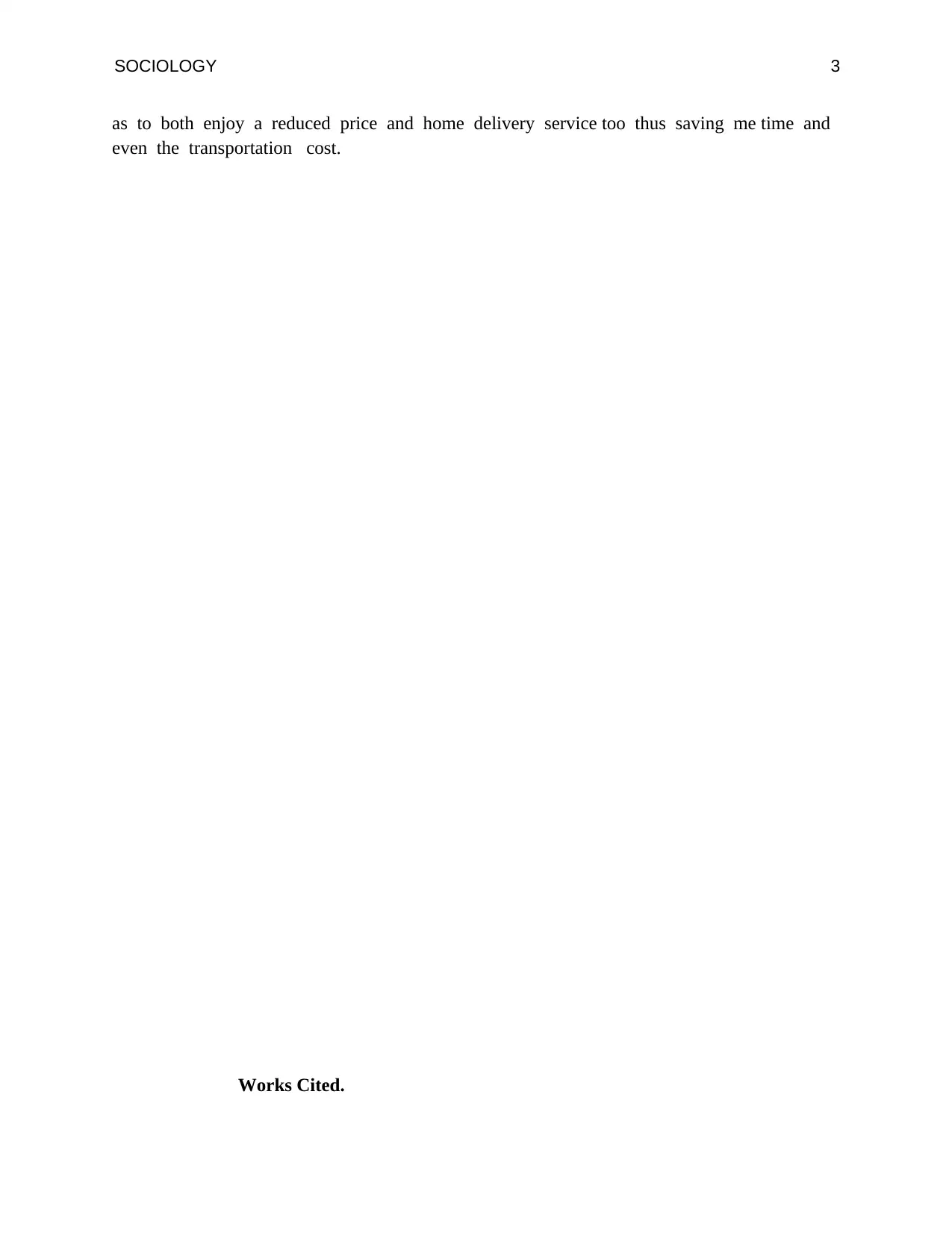
Works Cited.
Document Page
SOCIOLOGY 4
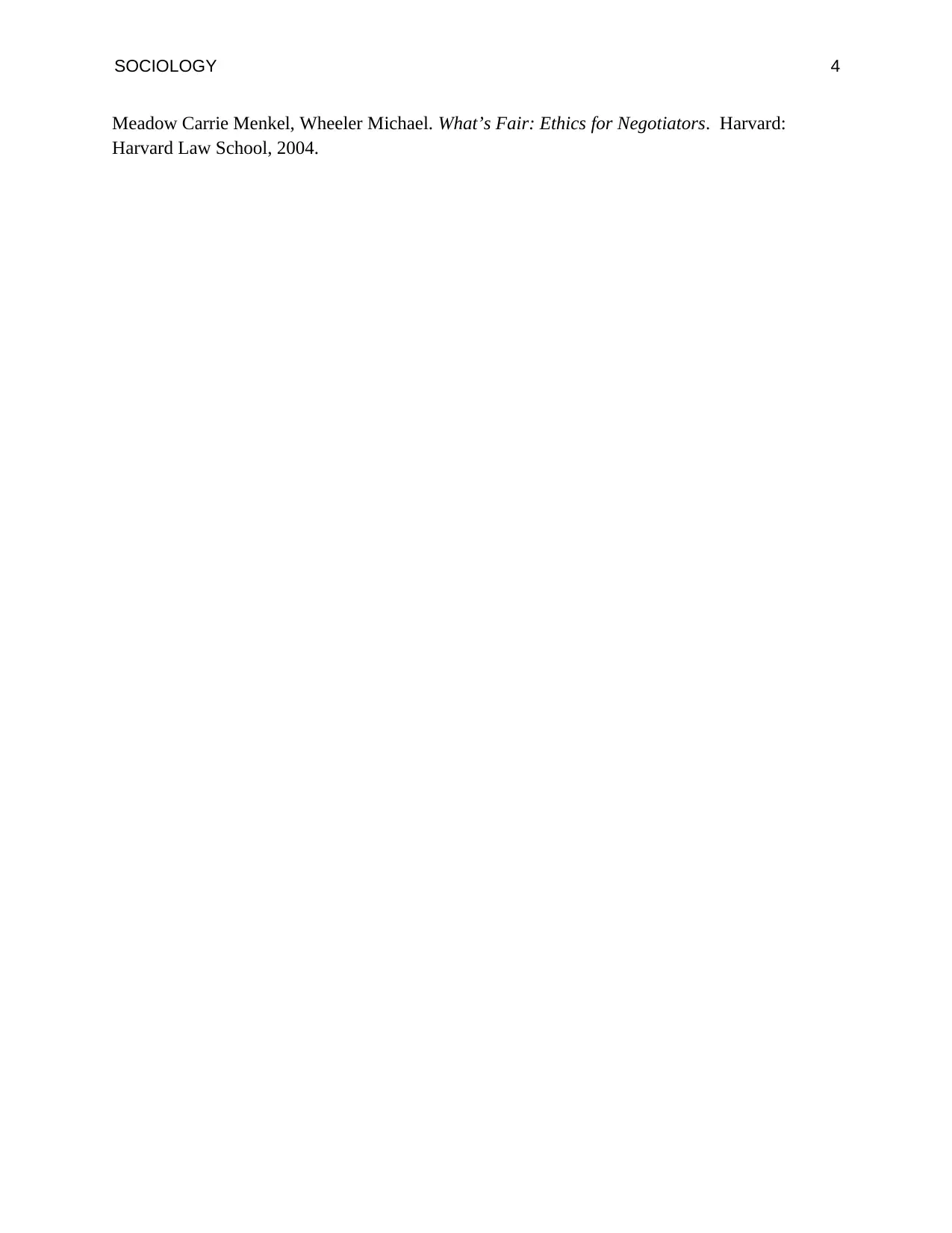
Meadow Carrie Menkel, Wheeler Michael. What’s Fair: Ethics for Negotiators. Harvard:
Harvard Law School, 2004.
chevron_up_icon
1 out of 4
circle_padding
hide_on_mobile
zoom_out_icon
[object Object]