A Comparative Analysis of Sociological Theories: An Essay

Verified

Added on  2019/09/26

|7
|1152
|192
Essay
AI Summary
This paper provides a comprehensive overview of three major sociological theories: structural functionalism, conflict theory, and symbolic interactionism. It begins with a summarization of each theory, detailing their core concepts, key figures, and perspectives on society. Structural functionalism is presented as a framework emphasizing societal stability and harmony through interconnected structures. Conflict theory is explored as a perspective highlighting societal inequalities and power struggles, with Karl Marx as a foundational figure. Symbolic interactionism is examined, focusing on individual interactions, shared meanings, and the use of symbols in social communication. The paper then contrasts and compares these theories, examining their similarities and differences in terms of their level of scrutiny, emphasis, and approach to understanding social phenomena. The essay concludes by emphasizing the unique contributions of each theory to the field of sociology, offering insights into how they collectively shape our understanding of society, social order, and individual interactions. References to relevant literature are included to support the analysis.
Document Page
Essentials of Sociology
tabler-icon-diamond-filled.svg

Paraphrase This Document

Need a fresh take? Get an instant paraphrase of this document with our AI Paraphraser
Document Page
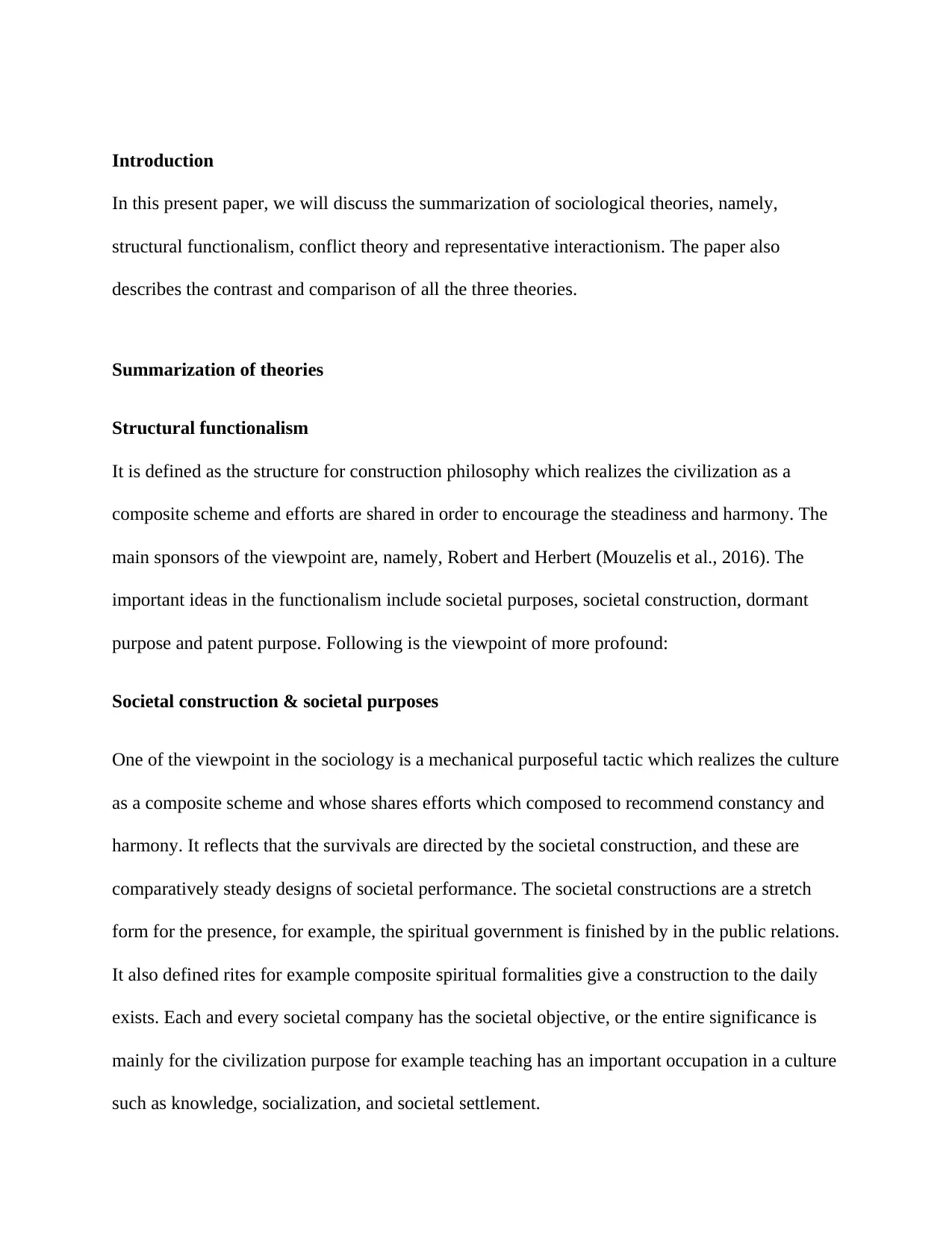
Table of Contents
Introduction......................................................................................................................................2
Summarization of theories...............................................................................................................2
Structural functionalism...............................................................................................................2
Conflict theory.............................................................................................................................3
Representative interactionism......................................................................................................3
Contrast & Comparison...................................................................................................................3
Similarity.........................................................................................................................................5
Conclusion.......................................................................................................................................5
Document Page
Introduction
In this present paper, we will discuss the summarization of sociological theories, namely,
structural functionalism, conflict theory and representative interactionism. The paper also
describes the contrast and comparison of all the three theories.
Summarization of theories
Structural functionalism
It is defined as the structure for construction philosophy which realizes the civilization as a
composite scheme and efforts are shared in order to encourage the steadiness and harmony. The
main sponsors of the viewpoint are, namely, Robert and Herbert (Mouzelis et al., 2016). The
important ideas in the functionalism include societal purposes, societal construction, dormant
purpose and patent purpose. Following is the viewpoint of more profound:
Societal construction & societal purposes
One of the viewpoint in the sociology is a mechanical purposeful tactic which realizes the culture
as a composite scheme and whose shares efforts which composed to recommend constancy and
harmony. It reflects that the survivals are directed by the societal construction, and these are
comparatively steady designs of societal performance. The societal constructions are a stretch
form for the presence, for example, the spiritual government is finished by in the public relations.
It also defined rites for example composite spiritual formalities give a construction to the daily
exists. Each and every societal company has the societal objective, or the entire significance is
mainly for the civilization purpose for example teaching has an important occupation in a culture
such as knowledge, socialization, and societal settlement.
Document Page
Conflict theory
In sociology, the societal fight philosophy is the major concerned because it interprets the culture
as a ground of dissimilarity which produces societal variations and struggle. The main viewpoint
is that the culture is planned to provide profit and insufficient at the expense of the masses and
issues such as masculinity, race, and session which are related to societal dissimilarity. The
societal fight philosopher is mainly related to the leading collection as it is opposed to marginal
assembly relatives. Karl is recognized as the father of societal battle philosophy (Cockerham et
al., 2014). The conflict theory states that the social orders are maintained by the power and
denomination rather than conformity and consensus.
Representative interactionism
The internationalism comes into two forms of theory, namely, social exchange and symbolic
interaction. The symbolic interaction states that the society includes very individual interaction
which shares meanings and symbols (Costello et al., 2013). The theory is used to understand the
individual and improves communication through understanding skills and knowledge which
underlines under the theory. IT emphasize on the signs and linguistics which aids offer for the
lifetime. It notifies that it contributes towards the public connections. The realism is formed by
the societal integrationist as it is recognized. The realism is formed by the opinions, talks, and
thoughts. It is mainly a societal perspective which is mainly important in the social psychology
and micro sociology.
Contrast & Comparison
With respect to societal contact, it is declared by the representative communication philosophy
that the signs are the emotions of the hominid communication. Hence the replies of the person
tabler-icon-diamond-filled.svg

Paraphrase This Document

Need a fresh take? Get an instant paraphrase of this document with our AI Paraphraser
Document Page
are mainly focused by the analysis of signs in the query. The signs clarification is predisposed by
the societal connection with other associates of the culture which grips mismatched explanation
of signs. It is important to note that the signs are not important for them and the allotted sense to
the various signs represents the outcome of the interface with various other persons. The
personal analysis of the signs is then lead by the connections and impacts on the reaction.
The functionalist philosophy states that basis in the culture is inter-reliant. The exclusive part of
every individual part is shown by itself but it is reliant on others, and it requires safeguards the
purpose of the culture optimally. The functionalism and conflict theory are macro-sociological
insight which mainly comprehends the large elements of the society. The functionality
automatically assumes institutions to develop the stability whereas the conflict theory notes
institutions as the religion which is used by the capitalist to manipulate others. The inequality is
also different from symbolic interactionism which supports the individual in believing similar
symbols and meanings.
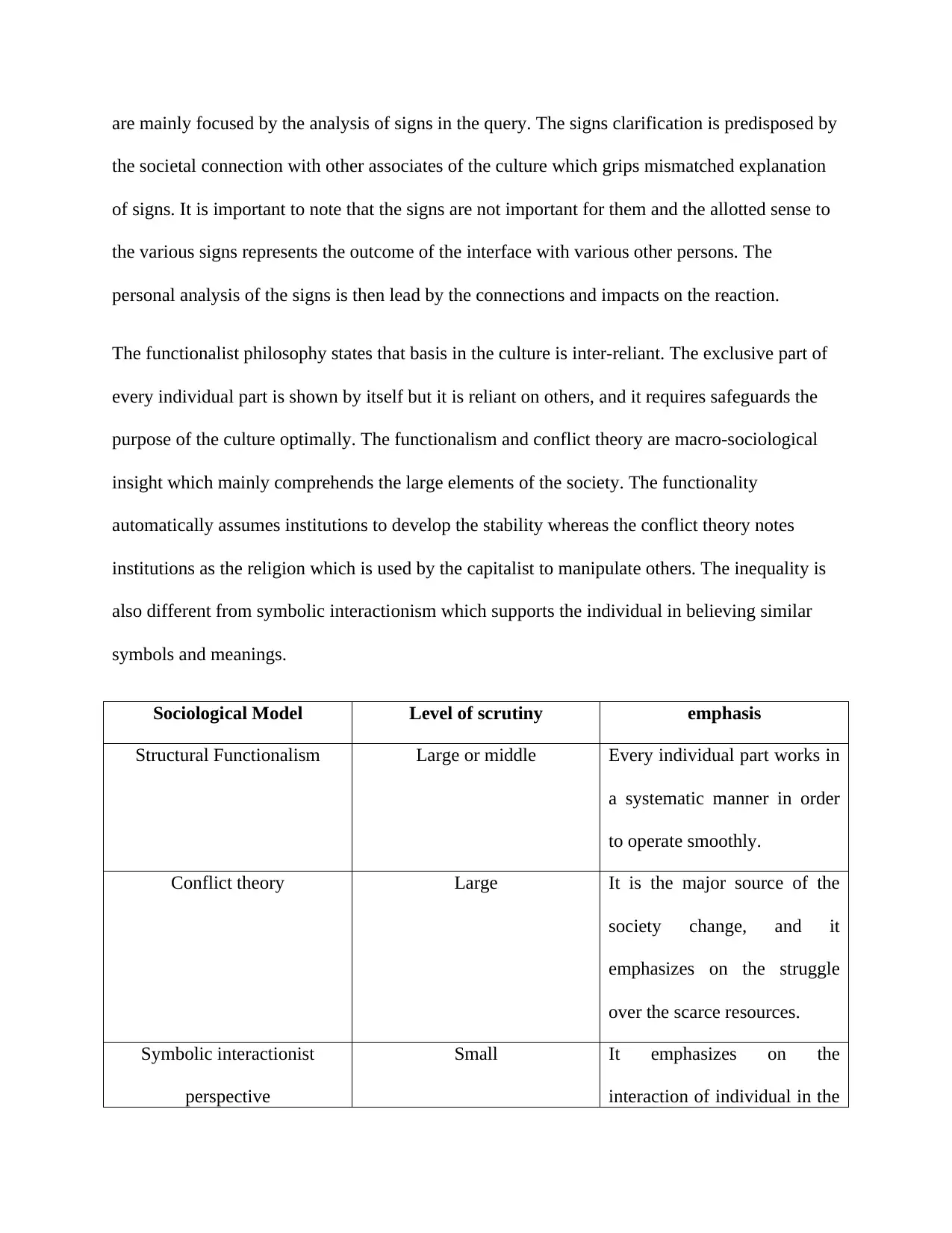
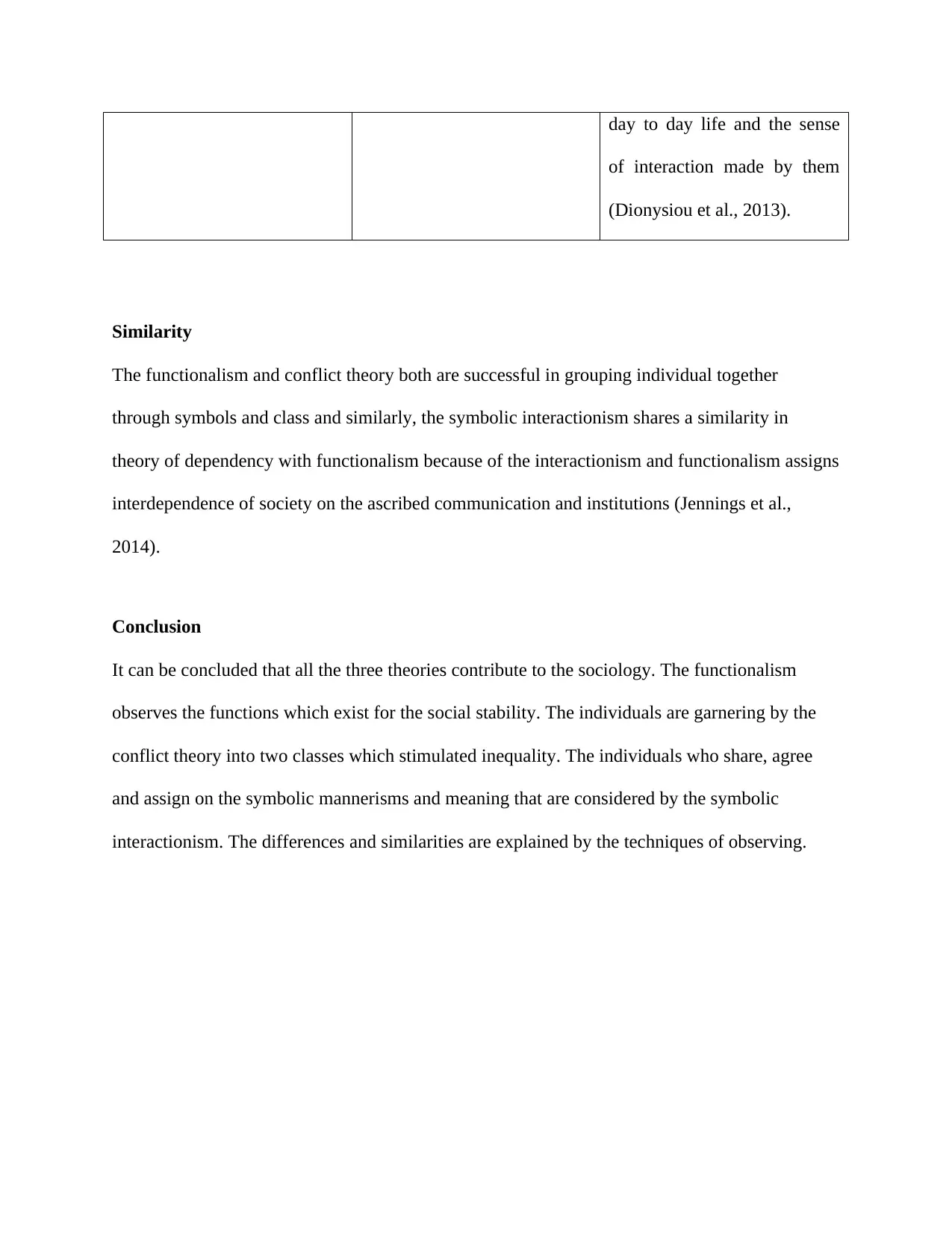
Sociological Model Level of scrutiny emphasis
Structural Functionalism Large or middle Every individual part works in
a systematic manner in order
to operate smoothly.
Conflict theory Large It is the major source of the
society change, and it
emphasizes on the struggle
over the scarce resources.
Symbolic interactionist
perspective
Small It emphasizes on the
interaction of individual in the
Document Page
day to day life and the sense
of interaction made by them
(Dionysiou et al., 2013).
Similarity
The functionalism and conflict theory both are successful in grouping individual together
through symbols and class and similarly, the symbolic interactionism shares a similarity in
theory of dependency with functionalism because of the interactionism and functionalism assigns
interdependence of society on the ascribed communication and institutions (Jennings et al.,
2014).
Conclusion
It can be concluded that all the three theories contribute to the sociology. The functionalism
observes the functions which exist for the social stability. The individuals are garnering by the
conflict theory into two classes which stimulated inequality. The individuals who share, agree
and assign on the symbolic mannerisms and meaning that are considered by the symbolic
interactionism. The differences and similarities are explained by the techniques of observing.
Document Page
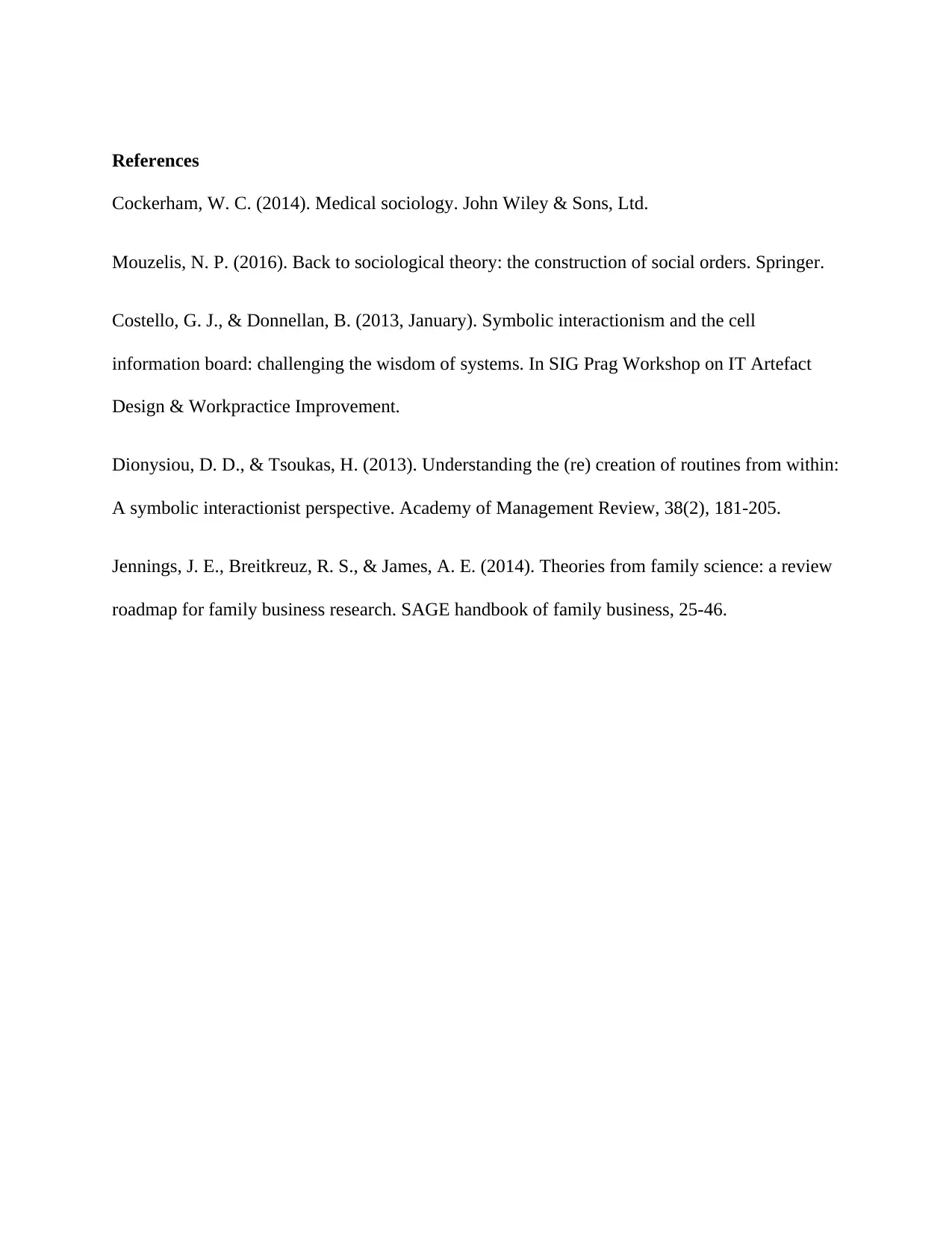
References
Cockerham, W. C. (2014). Medical sociology. John Wiley & Sons, Ltd.
Mouzelis, N. P. (2016). Back to sociological theory: the construction of social orders. Springer.
Costello, G. J., & Donnellan, B. (2013, January). Symbolic interactionism and the cell
information board: challenging the wisdom of systems. In SIG Prag Workshop on IT Artefact
Design & Workpractice Improvement.
Dionysiou, D. D., & Tsoukas, H. (2013). Understanding the (re) creation of routines from within:
A symbolic interactionist perspective. Academy of Management Review, 38(2), 181-205.
Jennings, J. E., Breitkreuz, R. S., & James, A. E. (2014). Theories from family science: a review
roadmap for family business research. SAGE handbook of family business, 25-46.
chevron_up_icon
1 out of 7
circle_padding
hide_on_mobile
zoom_out_icon
[object Object]