Lifespan Nutrition Assignment: Sodium Intake in Children & Adolescents
VerifiedAdded on 2023/06/10
|14
|3171
|387
Report
AI Summary
This report critically evaluates sodium intake among children and adolescents, referencing the Australian National Nutrition and Physical Activity Survey (NNPAS) data. It examines dietary data, comparing it against Nutrient Reference Values, and explores the adverse health outcomes associated with excessive sodium consumption, such as hypertension and cardiovascular risks. The report identifies that Australian children and adolescents often exceed recommended sodium levels due to poor dietary habits, including skipping breakfast and consuming high amounts of processed foods and beverages. The report also proposes evidence-based solutions to improve sodium intake, emphasizing the need for dietary changes and reduced exposure to high-sodium foods from an early age. The methodology includes a systematic literature search using databases like Medline and Cochrane Library, with a focus on randomized control trials. The report concludes by summarizing the key findings and recommendations for promoting healthier sodium consumption habits among young people.
Running Header: SODIUM INTAKE AMONG CHILDREN AND ADOLESCENTS 1
SODIUM INTAKE AMONG CHILDREN AND ADOLESCENTS
Name of Student
Institutional Affiliation
Course Code
Date
SODIUM INTAKE AMONG CHILDREN AND ADOLESCENTS
Name of Student
Institutional Affiliation
Course Code
Date

Paraphrase This Document
Need a fresh take? Get an instant paraphrase of this document with our AI Paraphraser
SODIUM INTAKE AMONG CHILDREN AND ADOLESCENTS
2
Introduction
Children and the adolescents fall under the category of the special population as they are
at the peak of growth. They are growing mentally, physically, developmentally, socio-
emotionally and cognitive functioning. Secondly, their immunity is low therefore they need
special care/protection against disease-causing organisms. They have a special nutrition for the
growth of the above systems 1. One of the components of their foods is salt (sodium chloride). It
is of importance as it primarily regulates body fluid, important in nerve impulses transmission, in
muscle contraction, in cardiac functioning 2. For this benefits to be achieved. The right quantity
should be taken to avoid toxicity when in excess or inadequacy when taken in small amounts. In
excess, it puts the population in danger of developing hypertension which later translates to
cardiovascular illness. It can also cause convulsions which translates to a comma and then death.
This essay will evaluate the following; critique the population (children) dietary
databasing it on the sodium intake as stipulated by the NNPAS. Secondly, an interpretation of
the population dietary data will be evaluated and compared with the Nutrient Reference Value
for Sodium. Thirdly, link the sodium intake and the adverse incomes in their health status.
Fourthly, solutions to their current sodium intake and the changes that one would recommend so
as to improve the sodium intake levels. Lastly, a conclusion summarizing the essay.
Data collection methodology.
2
Introduction
Children and the adolescents fall under the category of the special population as they are
at the peak of growth. They are growing mentally, physically, developmentally, socio-
emotionally and cognitive functioning. Secondly, their immunity is low therefore they need
special care/protection against disease-causing organisms. They have a special nutrition for the
growth of the above systems 1. One of the components of their foods is salt (sodium chloride). It
is of importance as it primarily regulates body fluid, important in nerve impulses transmission, in
muscle contraction, in cardiac functioning 2. For this benefits to be achieved. The right quantity
should be taken to avoid toxicity when in excess or inadequacy when taken in small amounts. In
excess, it puts the population in danger of developing hypertension which later translates to
cardiovascular illness. It can also cause convulsions which translates to a comma and then death.
This essay will evaluate the following; critique the population (children) dietary
databasing it on the sodium intake as stipulated by the NNPAS. Secondly, an interpretation of
the population dietary data will be evaluated and compared with the Nutrient Reference Value
for Sodium. Thirdly, link the sodium intake and the adverse incomes in their health status.
Fourthly, solutions to their current sodium intake and the changes that one would recommend so
as to improve the sodium intake levels. Lastly, a conclusion summarizing the essay.
Data collection methodology.
SODIUM INTAKE AMONG CHILDREN AND ADOLESCENTS
3
Search strategy
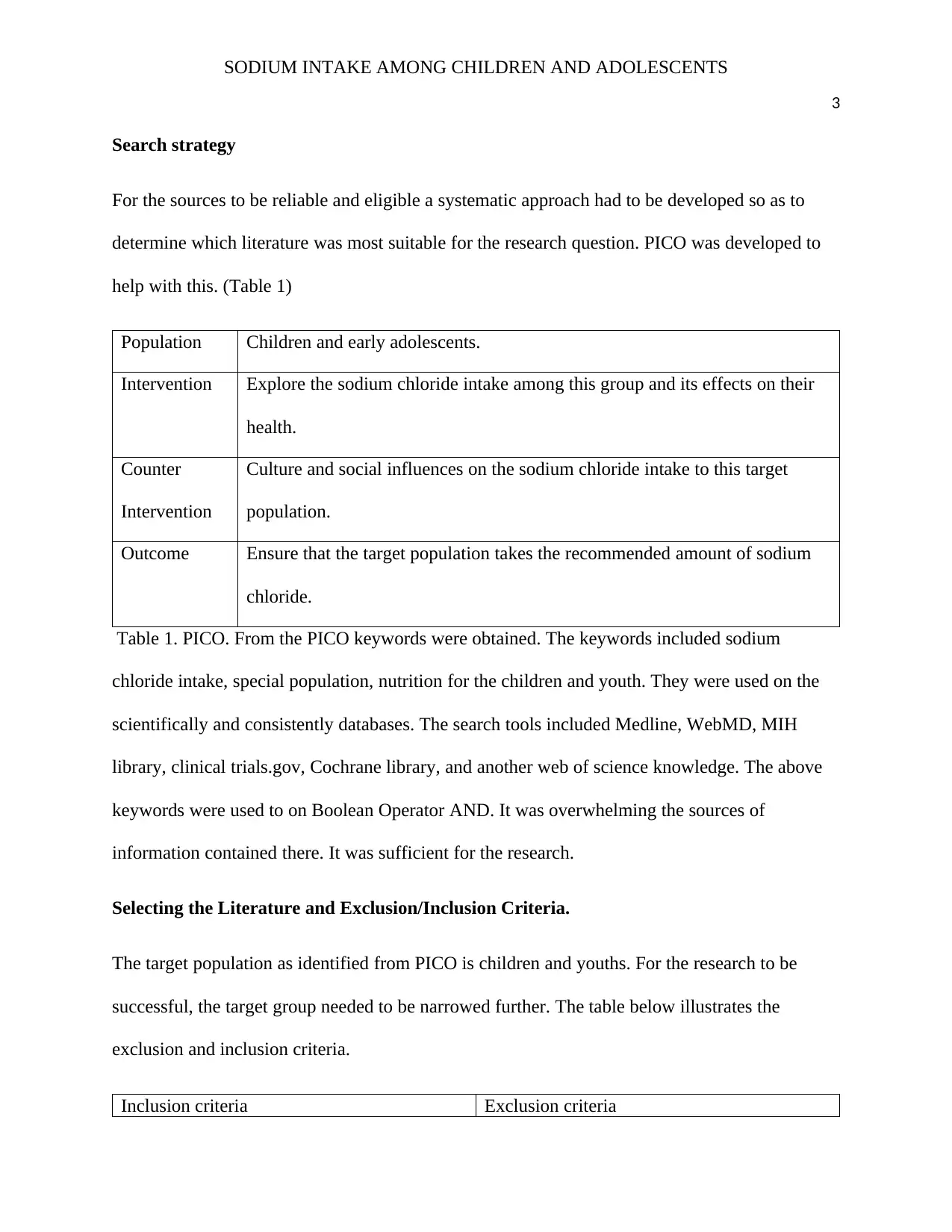
For the sources to be reliable and eligible a systematic approach had to be developed so as to
determine which literature was most suitable for the research question. PICO was developed to
help with this. (Table 1)
Population Children and early adolescents.
Intervention Explore the sodium chloride intake among this group and its effects on their
health.
Counter
Intervention
Culture and social influences on the sodium chloride intake to this target
population.
Outcome Ensure that the target population takes the recommended amount of sodium
chloride.
Table 1. PICO. From the PICO keywords were obtained. The keywords included sodium
chloride intake, special population, nutrition for the children and youth. They were used on the
scientifically and consistently databases. The search tools included Medline, WebMD, MIH
library, clinical trials.gov, Cochrane library, and another web of science knowledge. The above
keywords were used to on Boolean Operator AND. It was overwhelming the sources of
information contained there. It was sufficient for the research.
Selecting the Literature and Exclusion/Inclusion Criteria.
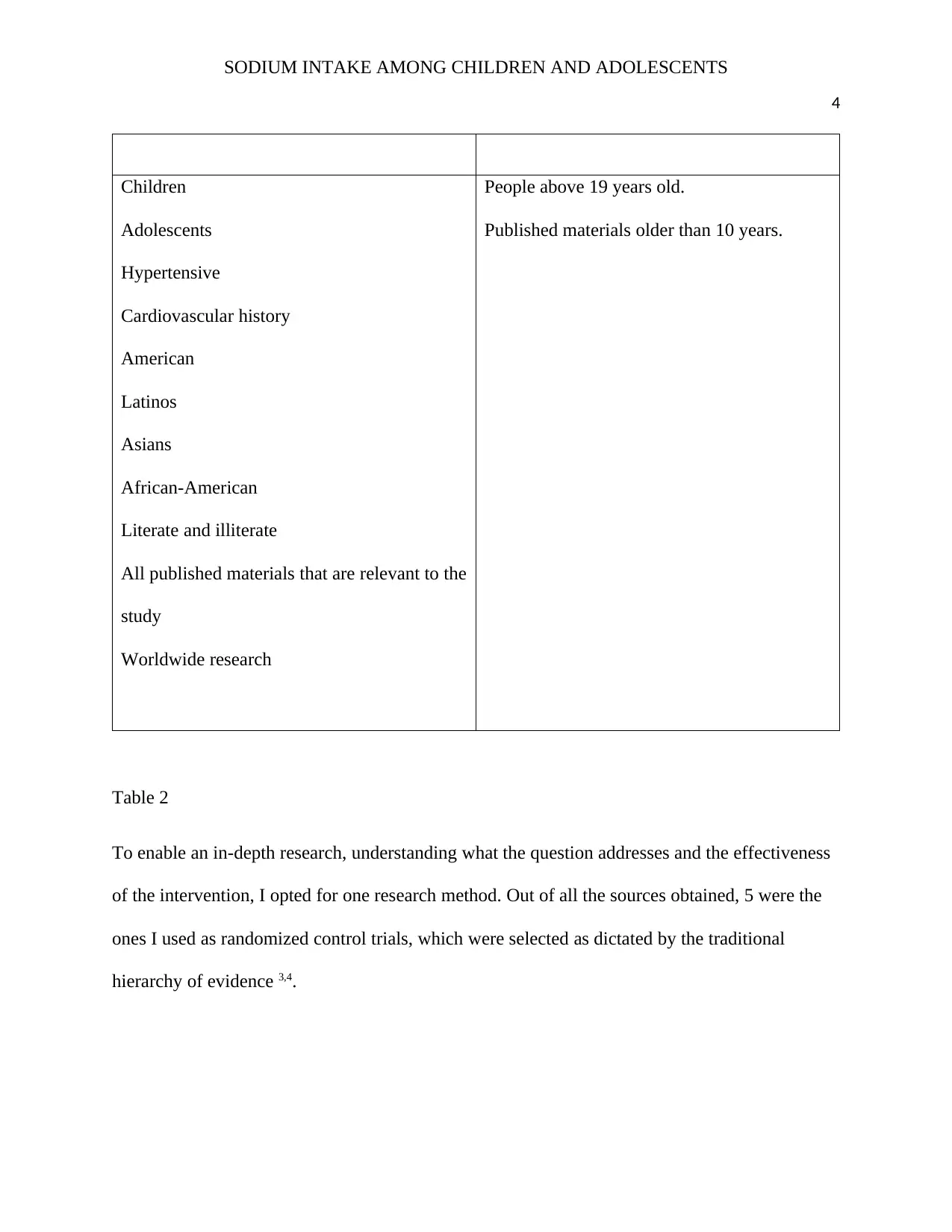
The target population as identified from PICO is children and youths. For the research to be
successful, the target group needed to be narrowed further. The table below illustrates the
exclusion and inclusion criteria.
Inclusion criteria Exclusion criteria
3
Search strategy
For the sources to be reliable and eligible a systematic approach had to be developed so as to
determine which literature was most suitable for the research question. PICO was developed to
help with this. (Table 1)
Population Children and early adolescents.
Intervention Explore the sodium chloride intake among this group and its effects on their
health.
Counter
Intervention
Culture and social influences on the sodium chloride intake to this target
population.
Outcome Ensure that the target population takes the recommended amount of sodium
chloride.
Table 1. PICO. From the PICO keywords were obtained. The keywords included sodium
chloride intake, special population, nutrition for the children and youth. They were used on the
scientifically and consistently databases. The search tools included Medline, WebMD, MIH
library, clinical trials.gov, Cochrane library, and another web of science knowledge. The above
keywords were used to on Boolean Operator AND. It was overwhelming the sources of
information contained there. It was sufficient for the research.
Selecting the Literature and Exclusion/Inclusion Criteria.
The target population as identified from PICO is children and youths. For the research to be
successful, the target group needed to be narrowed further. The table below illustrates the
exclusion and inclusion criteria.
Inclusion criteria Exclusion criteria
⊘ This is a preview!⊘
Do you want full access?
Subscribe today to unlock all pages.

Trusted by 1+ million students worldwide
SODIUM INTAKE AMONG CHILDREN AND ADOLESCENTS
4
Children
Adolescents
Hypertensive
Cardiovascular history
American
Latinos
Asians
African-American
Literate and illiterate
All published materials that are relevant to the
study
Worldwide research
People above 19 years old.
Published materials older than 10 years.
Table 2
To enable an in-depth research, understanding what the question addresses and the effectiveness
of the intervention, I opted for one research method. Out of all the sources obtained, 5 were the
ones I used as randomized control trials, which were selected as dictated by the traditional
hierarchy of evidence 3,4.
4
Children
Adolescents
Hypertensive
Cardiovascular history
American
Latinos
Asians
African-American
Literate and illiterate
All published materials that are relevant to the
study
Worldwide research
People above 19 years old.
Published materials older than 10 years.
Table 2
To enable an in-depth research, understanding what the question addresses and the effectiveness
of the intervention, I opted for one research method. Out of all the sources obtained, 5 were the
ones I used as randomized control trials, which were selected as dictated by the traditional
hierarchy of evidence 3,4.
Paraphrase This Document
Need a fresh take? Get an instant paraphrase of this document with our AI Paraphraser
SODIUM INTAKE AMONG CHILDREN AND ADOLESCENTS
5
After obtaining the articles. They were hand searched on the internet so as to identify the
relevance and eligibility of the articles. They appeared relevant and have been identified
throughout and they have led to the outcome of the research.
Outcome Consideration for Inclusion table 3
No Consideration criteria
1 Nutritional intake by the adolescents and children.
2 Cultural and social influences on sodium chloride intake among this population.
3 Signs and symptoms of sodium chloride sufficiency and toxicity.
4 Ways to ensure the right quantity of sodium chloride is taken by the population.
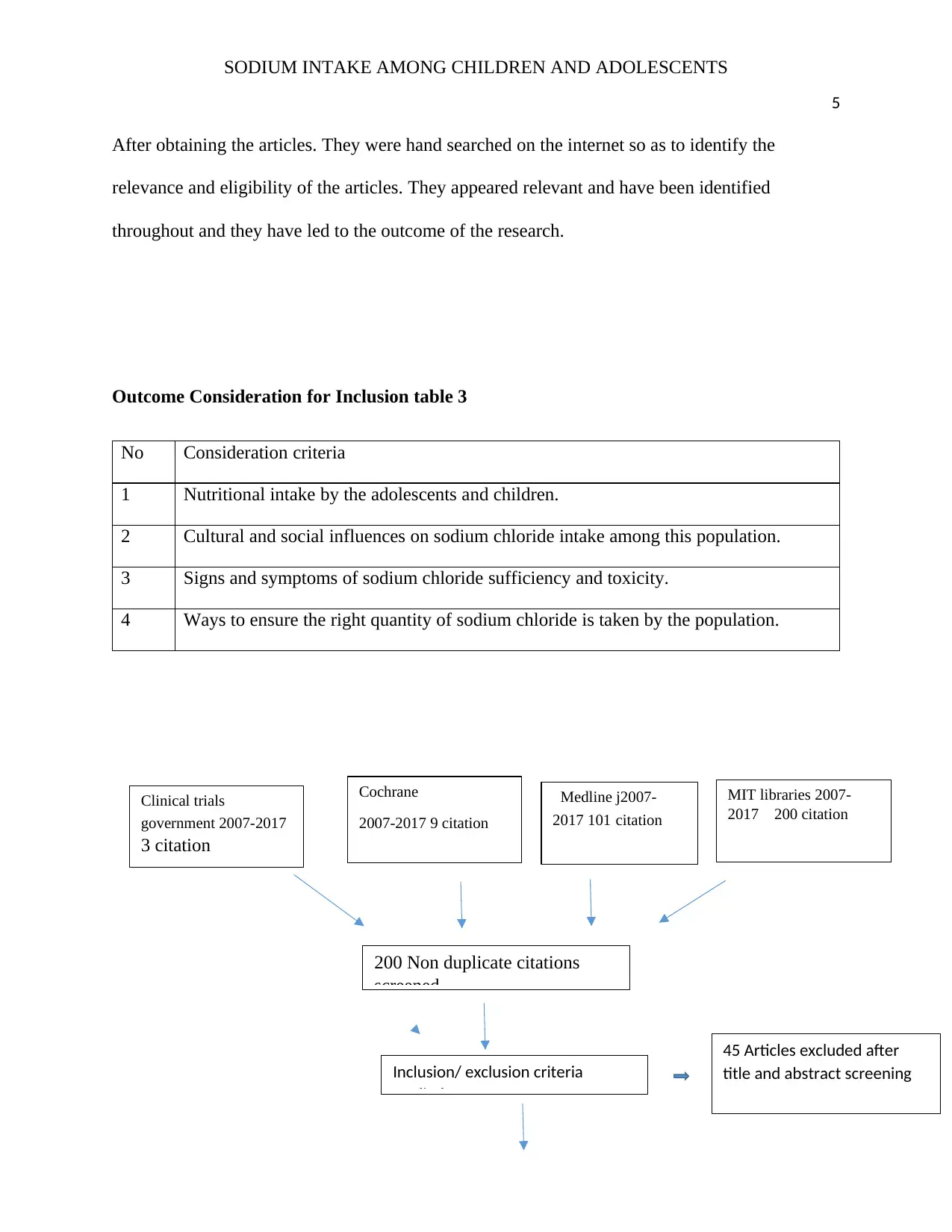
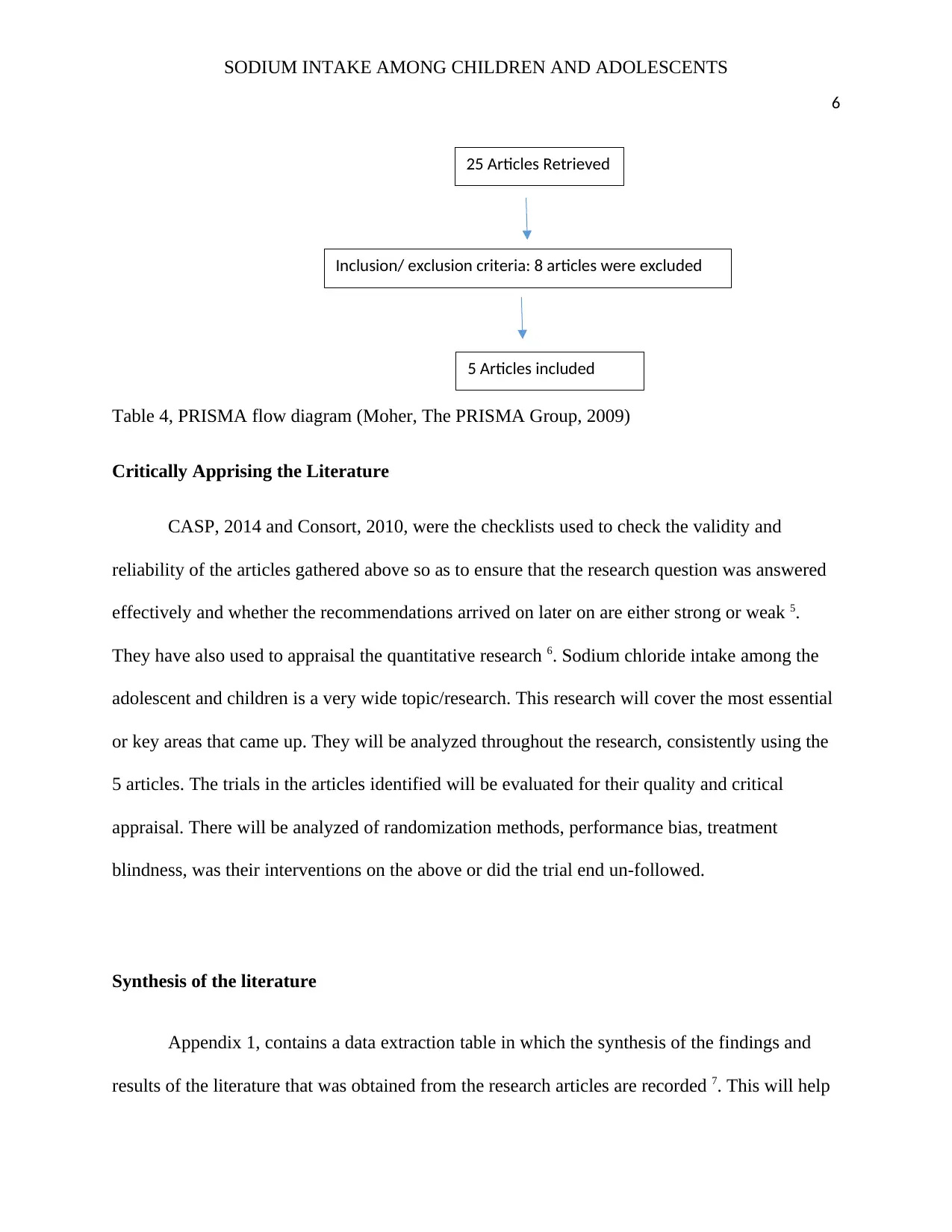
45 Articles excluded after
title and abstract screeningInclusion/ exclusion criteria
applied
200 Non duplicate citations
screened
Clinical trials
government 2007-2017
3 citation
Cochrane
2007-2017 9 citation
MIT libraries 2007-
2017 200 citation
Medline j2007-
2017 101 citation
5
After obtaining the articles. They were hand searched on the internet so as to identify the
relevance and eligibility of the articles. They appeared relevant and have been identified
throughout and they have led to the outcome of the research.
Outcome Consideration for Inclusion table 3
No Consideration criteria
1 Nutritional intake by the adolescents and children.
2 Cultural and social influences on sodium chloride intake among this population.
3 Signs and symptoms of sodium chloride sufficiency and toxicity.
4 Ways to ensure the right quantity of sodium chloride is taken by the population.
45 Articles excluded after
title and abstract screeningInclusion/ exclusion criteria
applied
200 Non duplicate citations
screened
Clinical trials
government 2007-2017
3 citation
Cochrane
2007-2017 9 citation
MIT libraries 2007-
2017 200 citation
Medline j2007-
2017 101 citation
SODIUM INTAKE AMONG CHILDREN AND ADOLESCENTS
6
Table 4, PRISMA flow diagram (Moher, The PRISMA Group, 2009)
Critically Apprising the Literature
CASP, 2014 and Consort, 2010, were the checklists used to check the validity and
reliability of the articles gathered above so as to ensure that the research question was answered
effectively and whether the recommendations arrived on later on are either strong or weak 5.
They have also used to appraisal the quantitative research 6. Sodium chloride intake among the
adolescent and children is a very wide topic/research. This research will cover the most essential
or key areas that came up. They will be analyzed throughout the research, consistently using the
5 articles. The trials in the articles identified will be evaluated for their quality and critical
appraisal. There will be analyzed of randomization methods, performance bias, treatment
blindness, was their interventions on the above or did the trial end un-followed.
Synthesis of the literature
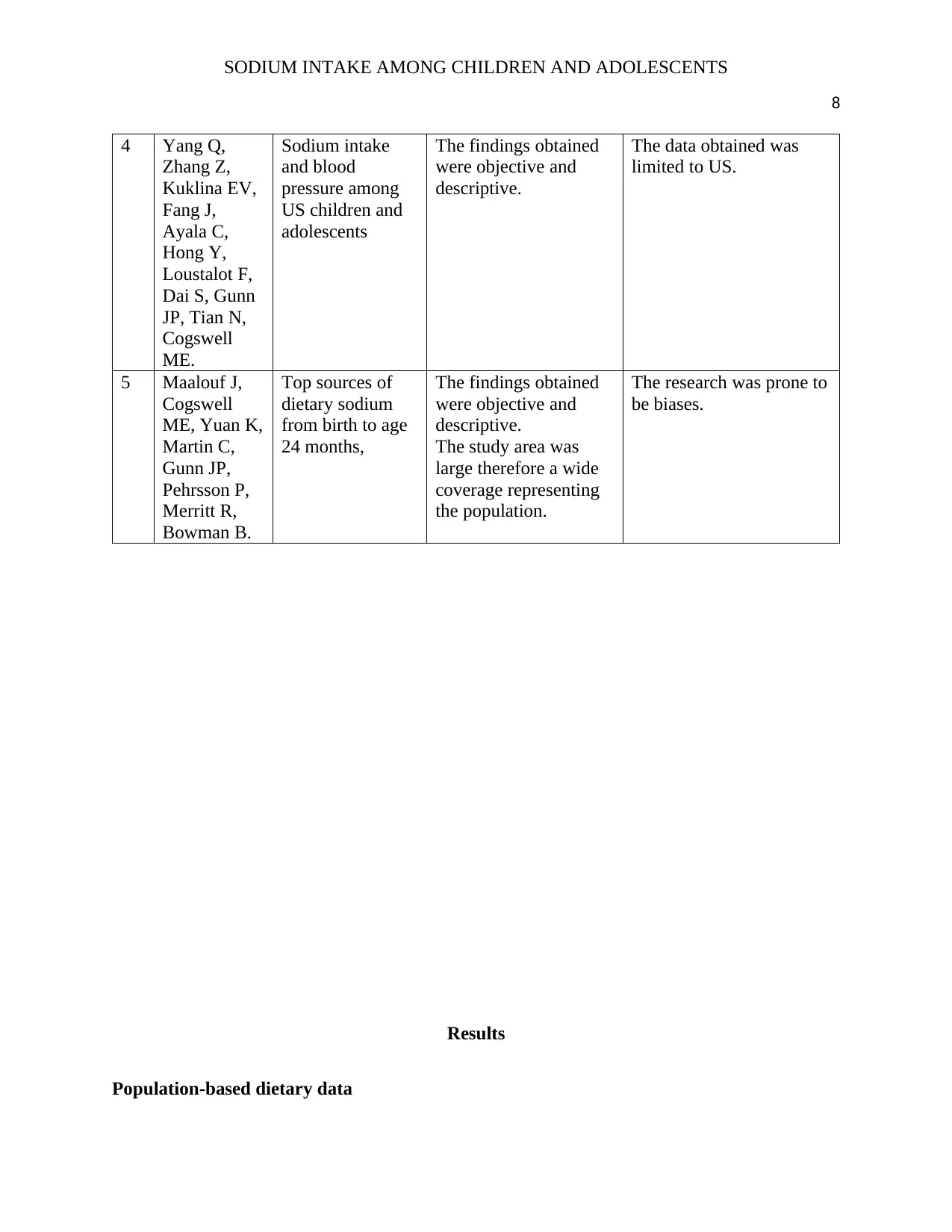
Appendix 1, contains a data extraction table in which the synthesis of the findings and
results of the literature that was obtained from the research articles are recorded 7. This will help
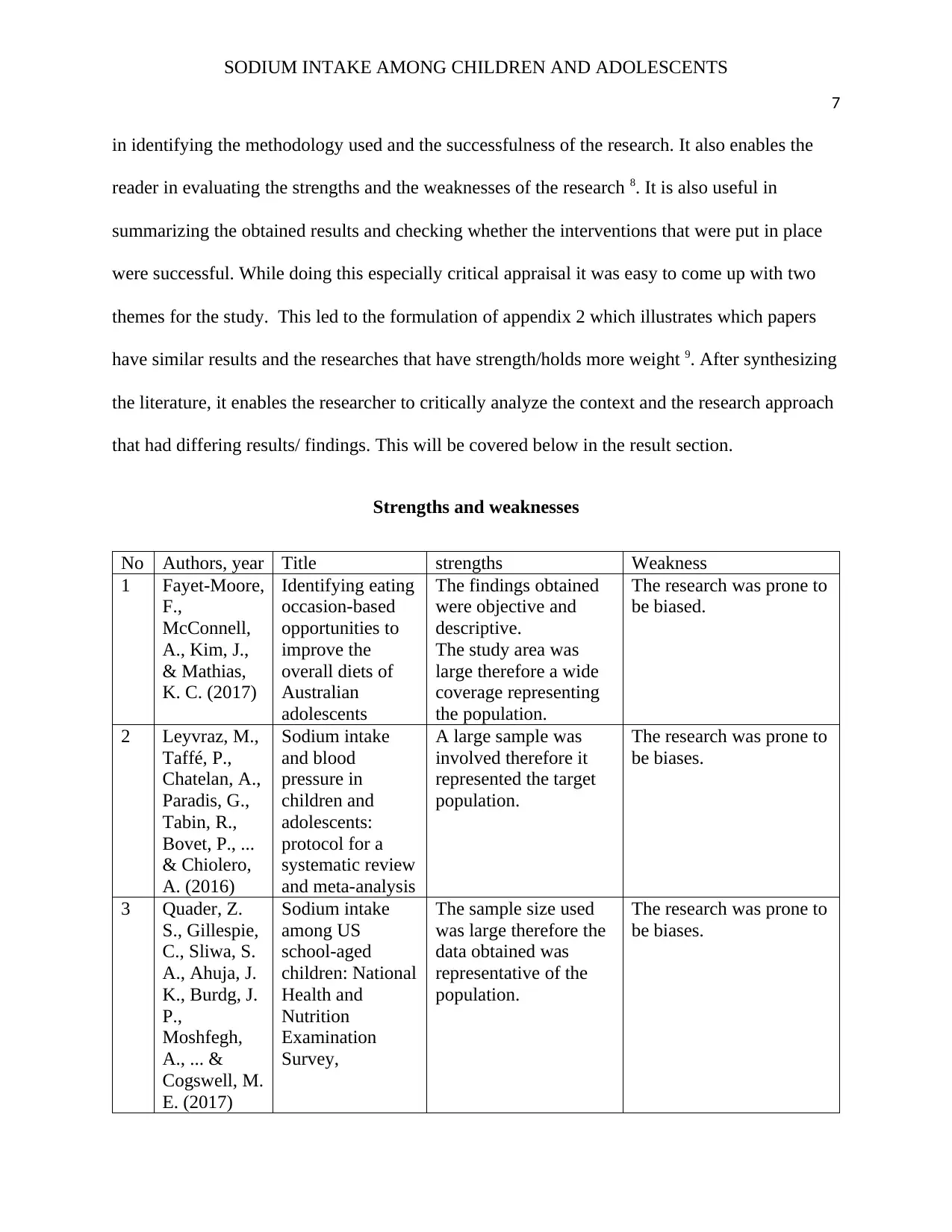
25 Articles Retrieved
Inclusion/ exclusion criteria: 8 articles were excluded
5 Articles included
6
Table 4, PRISMA flow diagram (Moher, The PRISMA Group, 2009)
Critically Apprising the Literature
CASP, 2014 and Consort, 2010, were the checklists used to check the validity and
reliability of the articles gathered above so as to ensure that the research question was answered
effectively and whether the recommendations arrived on later on are either strong or weak 5.
They have also used to appraisal the quantitative research 6. Sodium chloride intake among the
adolescent and children is a very wide topic/research. This research will cover the most essential
or key areas that came up. They will be analyzed throughout the research, consistently using the
5 articles. The trials in the articles identified will be evaluated for their quality and critical
appraisal. There will be analyzed of randomization methods, performance bias, treatment
blindness, was their interventions on the above or did the trial end un-followed.
Synthesis of the literature
Appendix 1, contains a data extraction table in which the synthesis of the findings and
results of the literature that was obtained from the research articles are recorded 7. This will help
25 Articles Retrieved
Inclusion/ exclusion criteria: 8 articles were excluded
5 Articles included
⊘ This is a preview!⊘
Do you want full access?
Subscribe today to unlock all pages.
Trusted by 1+ million students worldwide
SODIUM INTAKE AMONG CHILDREN AND ADOLESCENTS
7
in identifying the methodology used and the successfulness of the research. It also enables the
reader in evaluating the strengths and the weaknesses of the research 8. It is also useful in
summarizing the obtained results and checking whether the interventions that were put in place
were successful. While doing this especially critical appraisal it was easy to come up with two
themes for the study. This led to the formulation of appendix 2 which illustrates which papers
have similar results and the researches that have strength/holds more weight 9. After synthesizing
the literature, it enables the researcher to critically analyze the context and the research approach
that had differing results/ findings. This will be covered below in the result section.
Strengths and weaknesses
No Authors, year Title strengths Weakness
1 Fayet-Moore,
F.,
McConnell,
A., Kim, J.,
& Mathias,
K. C. (2017)
Identifying eating
occasion-based
opportunities to
improve the
overall diets of
Australian
adolescents
The findings obtained
were objective and
descriptive.
The study area was
large therefore a wide
coverage representing
the population.
The research was prone to
be biased.
2 Leyvraz, M.,
Taffé, P.,
Chatelan, A.,
Paradis, G.,
Tabin, R.,
Bovet, P., ...
& Chiolero,
A. (2016)
Sodium intake
and blood
pressure in
children and
adolescents:
protocol for a
systematic review
and meta-analysis
A large sample was
involved therefore it
represented the target
population.
The research was prone to
be biases.
3 Quader, Z.
S., Gillespie,
C., Sliwa, S.
A., Ahuja, J.
K., Burdg, J.
P.,
Moshfegh,
A., ... &
Cogswell, M.
E. (2017)
Sodium intake
among US
school-aged
children: National
Health and
Nutrition
Examination
Survey,
The sample size used
was large therefore the
data obtained was
representative of the
population.
The research was prone to
be biases.
7
in identifying the methodology used and the successfulness of the research. It also enables the
reader in evaluating the strengths and the weaknesses of the research 8. It is also useful in
summarizing the obtained results and checking whether the interventions that were put in place
were successful. While doing this especially critical appraisal it was easy to come up with two
themes for the study. This led to the formulation of appendix 2 which illustrates which papers
have similar results and the researches that have strength/holds more weight 9. After synthesizing
the literature, it enables the researcher to critically analyze the context and the research approach
that had differing results/ findings. This will be covered below in the result section.
Strengths and weaknesses
No Authors, year Title strengths Weakness
1 Fayet-Moore,
F.,
McConnell,
A., Kim, J.,
& Mathias,
K. C. (2017)
Identifying eating
occasion-based
opportunities to
improve the
overall diets of
Australian
adolescents
The findings obtained
were objective and
descriptive.
The study area was
large therefore a wide
coverage representing
the population.
The research was prone to
be biased.
2 Leyvraz, M.,
Taffé, P.,
Chatelan, A.,
Paradis, G.,
Tabin, R.,
Bovet, P., ...
& Chiolero,
A. (2016)
Sodium intake
and blood
pressure in
children and
adolescents:
protocol for a
systematic review
and meta-analysis
A large sample was
involved therefore it
represented the target
population.
The research was prone to
be biases.
3 Quader, Z.
S., Gillespie,
C., Sliwa, S.
A., Ahuja, J.
K., Burdg, J.
P.,
Moshfegh,
A., ... &
Cogswell, M.
E. (2017)
Sodium intake
among US
school-aged
children: National
Health and
Nutrition
Examination
Survey,
The sample size used
was large therefore the
data obtained was
representative of the
population.
The research was prone to
be biases.
Paraphrase This Document
Need a fresh take? Get an instant paraphrase of this document with our AI Paraphraser
SODIUM INTAKE AMONG CHILDREN AND ADOLESCENTS
8
4 Yang Q,
Zhang Z,
Kuklina EV,
Fang J,
Ayala C,
Hong Y,
Loustalot F,
Dai S, Gunn
JP, Tian N,
Cogswell
ME.
Sodium intake
and blood
pressure among
US children and
adolescents
The findings obtained
were objective and
descriptive.
The data obtained was
limited to US.
5 Maalouf J,
Cogswell
ME, Yuan K,
Martin C,
Gunn JP,
Pehrsson P,
Merritt R,
Bowman B.
Top sources of
dietary sodium
from birth to age
24 months,
The findings obtained
were objective and
descriptive.
The study area was
large therefore a wide
coverage representing
the population.
The research was prone to
be biases.
Results
Population-based dietary data
8
4 Yang Q,
Zhang Z,
Kuklina EV,
Fang J,
Ayala C,
Hong Y,
Loustalot F,
Dai S, Gunn
JP, Tian N,
Cogswell
ME.
Sodium intake
and blood
pressure among
US children and
adolescents
The findings obtained
were objective and
descriptive.
The data obtained was
limited to US.
5 Maalouf J,
Cogswell
ME, Yuan K,
Martin C,
Gunn JP,
Pehrsson P,
Merritt R,
Bowman B.
Top sources of
dietary sodium
from birth to age
24 months,
The findings obtained
were objective and
descriptive.
The study area was
large therefore a wide
coverage representing
the population.
The research was prone to
be biases.
Results
Population-based dietary data
SODIUM INTAKE AMONG CHILDREN AND ADOLESCENTS
9
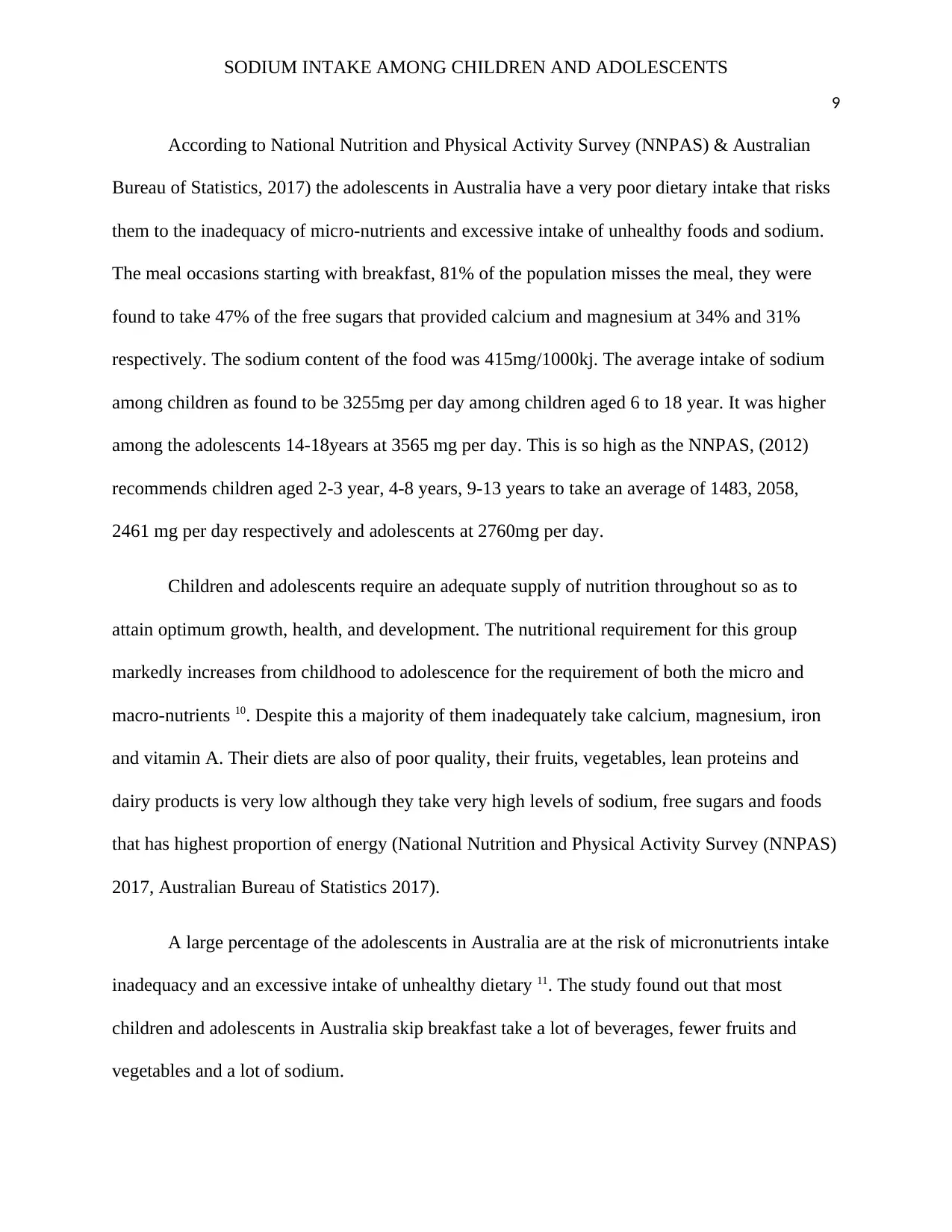
According to National Nutrition and Physical Activity Survey (NNPAS) & Australian
Bureau of Statistics, 2017) the adolescents in Australia have a very poor dietary intake that risks
them to the inadequacy of micro-nutrients and excessive intake of unhealthy foods and sodium.
The meal occasions starting with breakfast, 81% of the population misses the meal, they were
found to take 47% of the free sugars that provided calcium and magnesium at 34% and 31%
respectively. The sodium content of the food was 415mg/1000kj. The average intake of sodium
among children as found to be 3255mg per day among children aged 6 to 18 year. It was higher
among the adolescents 14-18years at 3565 mg per day. This is so high as the NNPAS, (2012)
recommends children aged 2-3 year, 4-8 years, 9-13 years to take an average of 1483, 2058,
2461 mg per day respectively and adolescents at 2760mg per day.
Children and adolescents require an adequate supply of nutrition throughout so as to
attain optimum growth, health, and development. The nutritional requirement for this group
markedly increases from childhood to adolescence for the requirement of both the micro and
macro-nutrients 10. Despite this a majority of them inadequately take calcium, magnesium, iron
and vitamin A. Their diets are also of poor quality, their fruits, vegetables, lean proteins and
dairy products is very low although they take very high levels of sodium, free sugars and foods
that has highest proportion of energy (National Nutrition and Physical Activity Survey (NNPAS)
2017, Australian Bureau of Statistics 2017).
A large percentage of the adolescents in Australia are at the risk of micronutrients intake
inadequacy and an excessive intake of unhealthy dietary 11. The study found out that most
children and adolescents in Australia skip breakfast take a lot of beverages, fewer fruits and
vegetables and a lot of sodium.
9
According to National Nutrition and Physical Activity Survey (NNPAS) & Australian
Bureau of Statistics, 2017) the adolescents in Australia have a very poor dietary intake that risks
them to the inadequacy of micro-nutrients and excessive intake of unhealthy foods and sodium.
The meal occasions starting with breakfast, 81% of the population misses the meal, they were
found to take 47% of the free sugars that provided calcium and magnesium at 34% and 31%
respectively. The sodium content of the food was 415mg/1000kj. The average intake of sodium
among children as found to be 3255mg per day among children aged 6 to 18 year. It was higher
among the adolescents 14-18years at 3565 mg per day. This is so high as the NNPAS, (2012)
recommends children aged 2-3 year, 4-8 years, 9-13 years to take an average of 1483, 2058,
2461 mg per day respectively and adolescents at 2760mg per day.
Children and adolescents require an adequate supply of nutrition throughout so as to
attain optimum growth, health, and development. The nutritional requirement for this group
markedly increases from childhood to adolescence for the requirement of both the micro and
macro-nutrients 10. Despite this a majority of them inadequately take calcium, magnesium, iron
and vitamin A. Their diets are also of poor quality, their fruits, vegetables, lean proteins and
dairy products is very low although they take very high levels of sodium, free sugars and foods
that has highest proportion of energy (National Nutrition and Physical Activity Survey (NNPAS)
2017, Australian Bureau of Statistics 2017).
A large percentage of the adolescents in Australia are at the risk of micronutrients intake
inadequacy and an excessive intake of unhealthy dietary 11. The study found out that most
children and adolescents in Australia skip breakfast take a lot of beverages, fewer fruits and
vegetables and a lot of sodium.
⊘ This is a preview!⊘
Do you want full access?
Subscribe today to unlock all pages.
Trusted by 1+ million students worldwide
SODIUM INTAKE AMONG CHILDREN AND ADOLESCENTS
10
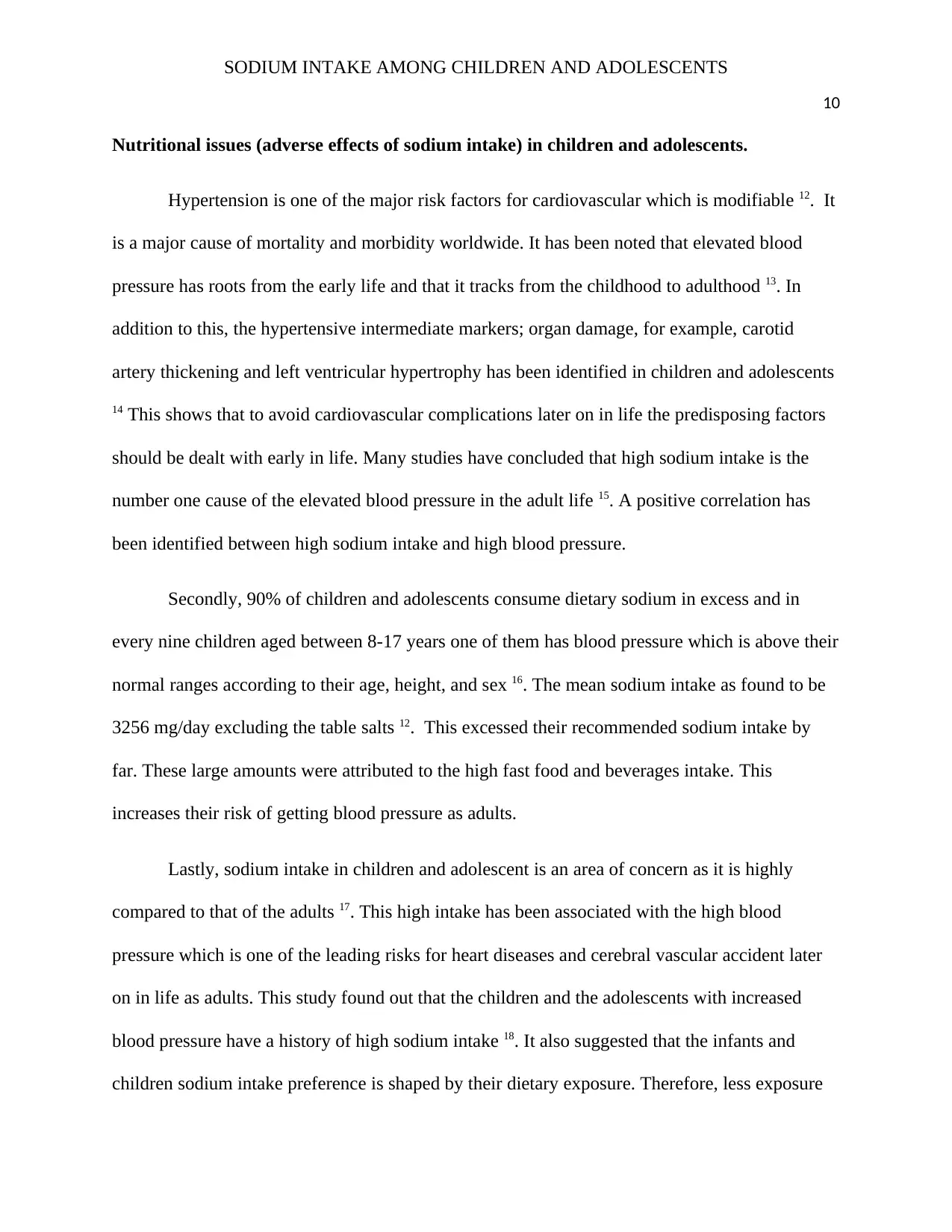
Nutritional issues (adverse effects of sodium intake) in children and adolescents.
Hypertension is one of the major risk factors for cardiovascular which is modifiable 12. It
is a major cause of mortality and morbidity worldwide. It has been noted that elevated blood
pressure has roots from the early life and that it tracks from the childhood to adulthood 13. In
addition to this, the hypertensive intermediate markers; organ damage, for example, carotid
artery thickening and left ventricular hypertrophy has been identified in children and adolescents
14 This shows that to avoid cardiovascular complications later on in life the predisposing factors
should be dealt with early in life. Many studies have concluded that high sodium intake is the
number one cause of the elevated blood pressure in the adult life 15. A positive correlation has
been identified between high sodium intake and high blood pressure.
Secondly, 90% of children and adolescents consume dietary sodium in excess and in
every nine children aged between 8-17 years one of them has blood pressure which is above their
normal ranges according to their age, height, and sex 16. The mean sodium intake as found to be
3256 mg/day excluding the table salts 12. This excessed their recommended sodium intake by
far. These large amounts were attributed to the high fast food and beverages intake. This
increases their risk of getting blood pressure as adults.
Lastly, sodium intake in children and adolescent is an area of concern as it is highly
compared to that of the adults 17. This high intake has been associated with the high blood
pressure which is one of the leading risks for heart diseases and cerebral vascular accident later
on in life as adults. This study found out that the children and the adolescents with increased
blood pressure have a history of high sodium intake 18. It also suggested that the infants and
children sodium intake preference is shaped by their dietary exposure. Therefore, less exposure
10
Nutritional issues (adverse effects of sodium intake) in children and adolescents.
Hypertension is one of the major risk factors for cardiovascular which is modifiable 12. It
is a major cause of mortality and morbidity worldwide. It has been noted that elevated blood
pressure has roots from the early life and that it tracks from the childhood to adulthood 13. In
addition to this, the hypertensive intermediate markers; organ damage, for example, carotid
artery thickening and left ventricular hypertrophy has been identified in children and adolescents
14 This shows that to avoid cardiovascular complications later on in life the predisposing factors
should be dealt with early in life. Many studies have concluded that high sodium intake is the
number one cause of the elevated blood pressure in the adult life 15. A positive correlation has
been identified between high sodium intake and high blood pressure.
Secondly, 90% of children and adolescents consume dietary sodium in excess and in
every nine children aged between 8-17 years one of them has blood pressure which is above their
normal ranges according to their age, height, and sex 16. The mean sodium intake as found to be
3256 mg/day excluding the table salts 12. This excessed their recommended sodium intake by
far. These large amounts were attributed to the high fast food and beverages intake. This
increases their risk of getting blood pressure as adults.
Lastly, sodium intake in children and adolescent is an area of concern as it is highly
compared to that of the adults 17. This high intake has been associated with the high blood
pressure which is one of the leading risks for heart diseases and cerebral vascular accident later
on in life as adults. This study found out that the children and the adolescents with increased
blood pressure have a history of high sodium intake 18. It also suggested that the infants and
children sodium intake preference is shaped by their dietary exposure. Therefore, less exposure
Paraphrase This Document
Need a fresh take? Get an instant paraphrase of this document with our AI Paraphraser
SODIUM INTAKE AMONG CHILDREN AND ADOLESCENTS
11
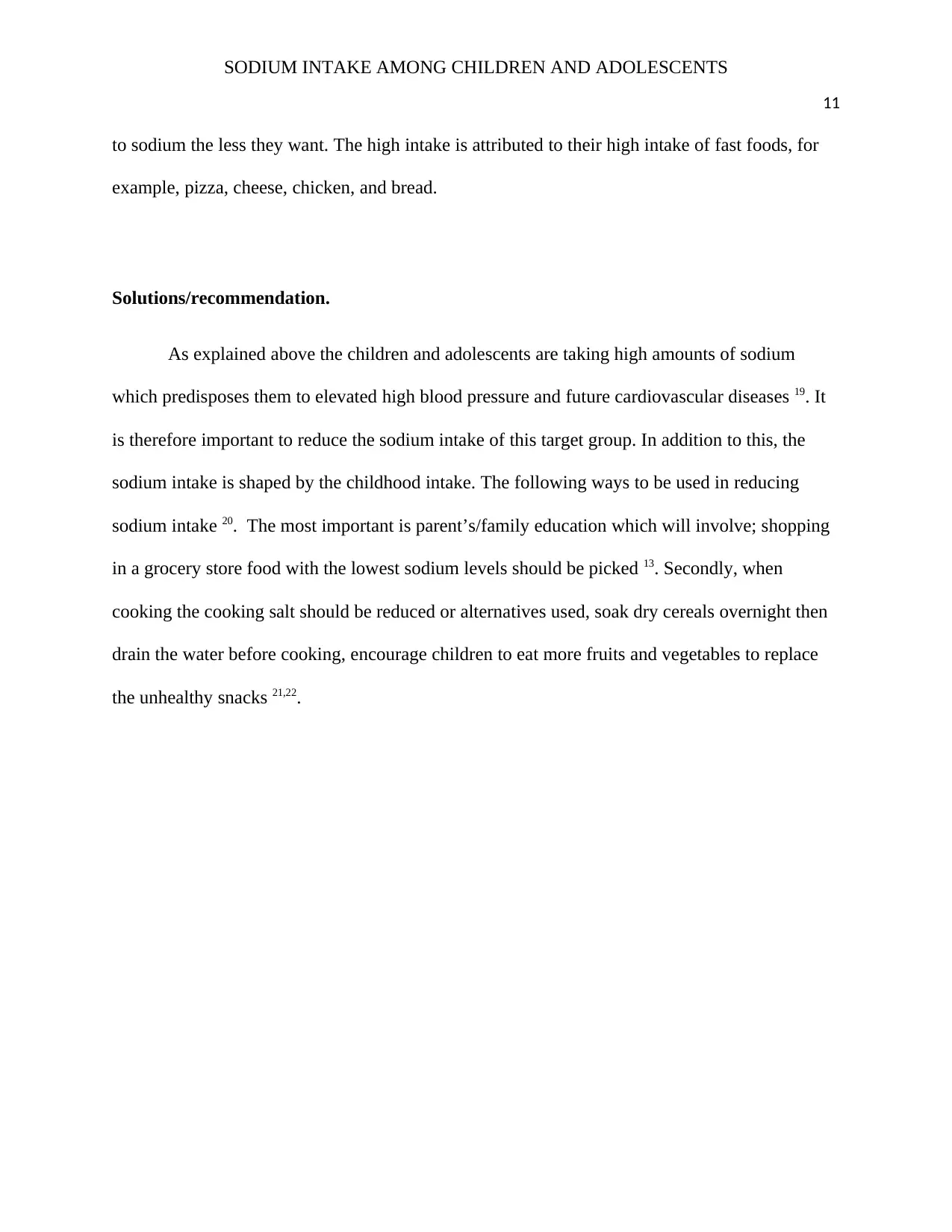
to sodium the less they want. The high intake is attributed to their high intake of fast foods, for
example, pizza, cheese, chicken, and bread.
Solutions/recommendation.
As explained above the children and adolescents are taking high amounts of sodium
which predisposes them to elevated high blood pressure and future cardiovascular diseases 19. It
is therefore important to reduce the sodium intake of this target group. In addition to this, the
sodium intake is shaped by the childhood intake. The following ways to be used in reducing
sodium intake 20. The most important is parent’s/family education which will involve; shopping
in a grocery store food with the lowest sodium levels should be picked 13. Secondly, when
cooking the cooking salt should be reduced or alternatives used, soak dry cereals overnight then
drain the water before cooking, encourage children to eat more fruits and vegetables to replace
the unhealthy snacks 21,22.
11
to sodium the less they want. The high intake is attributed to their high intake of fast foods, for
example, pizza, cheese, chicken, and bread.
Solutions/recommendation.
As explained above the children and adolescents are taking high amounts of sodium
which predisposes them to elevated high blood pressure and future cardiovascular diseases 19. It
is therefore important to reduce the sodium intake of this target group. In addition to this, the
sodium intake is shaped by the childhood intake. The following ways to be used in reducing
sodium intake 20. The most important is parent’s/family education which will involve; shopping
in a grocery store food with the lowest sodium levels should be picked 13. Secondly, when
cooking the cooking salt should be reduced or alternatives used, soak dry cereals overnight then
drain the water before cooking, encourage children to eat more fruits and vegetables to replace
the unhealthy snacks 21,22.
SODIUM INTAKE AMONG CHILDREN AND ADOLESCENTS
12
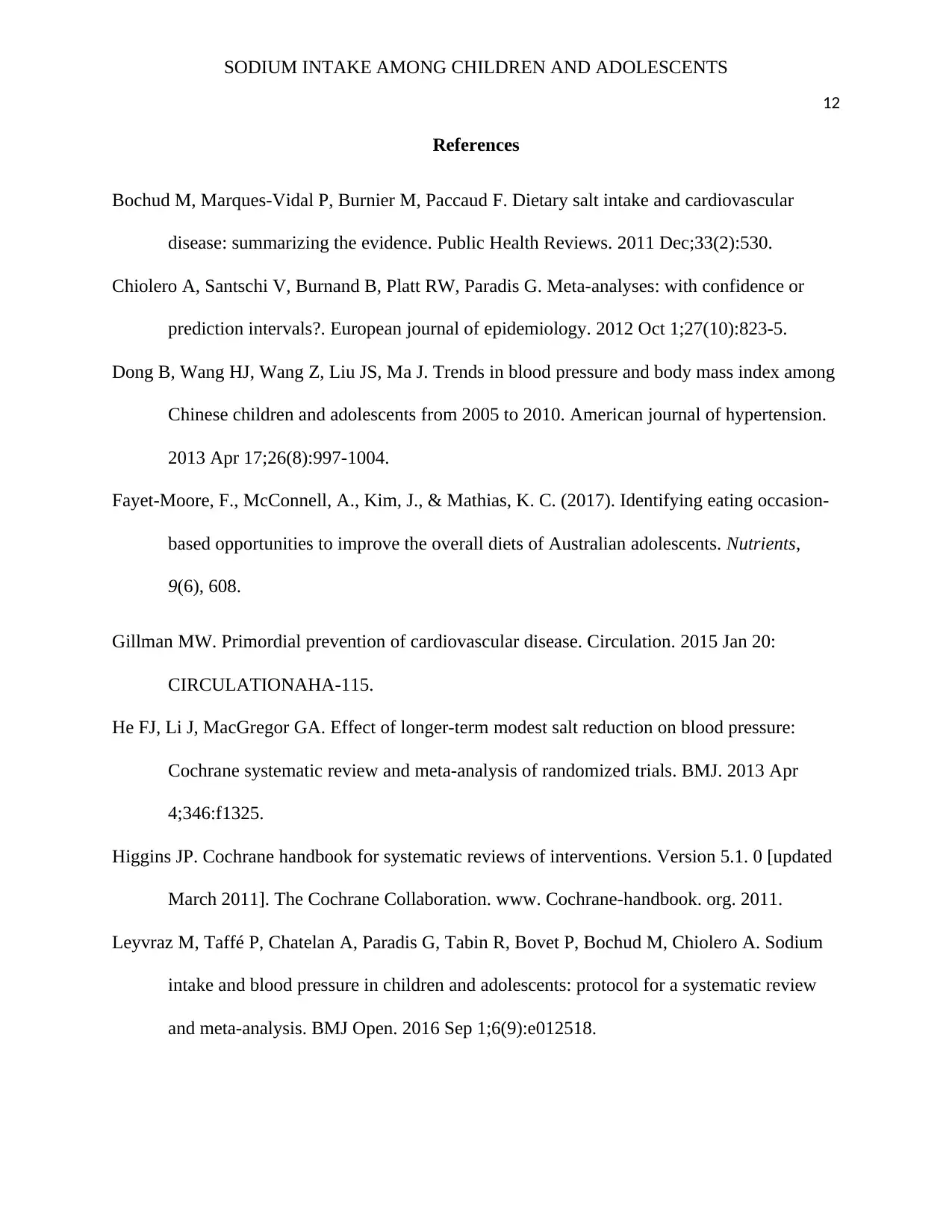
References
Bochud M, Marques-Vidal P, Burnier M, Paccaud F. Dietary salt intake and cardiovascular
disease: summarizing the evidence. Public Health Reviews. 2011 Dec;33(2):530.
Chiolero A, Santschi V, Burnand B, Platt RW, Paradis G. Meta-analyses: with confidence or
prediction intervals?. European journal of epidemiology. 2012 Oct 1;27(10):823-5.
Dong B, Wang HJ, Wang Z, Liu JS, Ma J. Trends in blood pressure and body mass index among
Chinese children and adolescents from 2005 to 2010. American journal of hypertension.
2013 Apr 17;26(8):997-1004.
Fayet-Moore, F., McConnell, A., Kim, J., & Mathias, K. C. (2017). Identifying eating occasion-
based opportunities to improve the overall diets of Australian adolescents. Nutrients,
9(6), 608.
Gillman MW. Primordial prevention of cardiovascular disease. Circulation. 2015 Jan 20:
CIRCULATIONAHA-115.
He FJ, Li J, MacGregor GA. Effect of longer-term modest salt reduction on blood pressure:
Cochrane systematic review and meta-analysis of randomized trials. BMJ. 2013 Apr
4;346:f1325.
Higgins JP. Cochrane handbook for systematic reviews of interventions. Version 5.1. 0 [updated
March 2011]. The Cochrane Collaboration. www. Cochrane-handbook. org. 2011.
Leyvraz M, Taffé P, Chatelan A, Paradis G, Tabin R, Bovet P, Bochud M, Chiolero A. Sodium
intake and blood pressure in children and adolescents: protocol for a systematic review
and meta-analysis. BMJ Open. 2016 Sep 1;6(9):e012518.
12
References
Bochud M, Marques-Vidal P, Burnier M, Paccaud F. Dietary salt intake and cardiovascular
disease: summarizing the evidence. Public Health Reviews. 2011 Dec;33(2):530.
Chiolero A, Santschi V, Burnand B, Platt RW, Paradis G. Meta-analyses: with confidence or
prediction intervals?. European journal of epidemiology. 2012 Oct 1;27(10):823-5.
Dong B, Wang HJ, Wang Z, Liu JS, Ma J. Trends in blood pressure and body mass index among
Chinese children and adolescents from 2005 to 2010. American journal of hypertension.
2013 Apr 17;26(8):997-1004.
Fayet-Moore, F., McConnell, A., Kim, J., & Mathias, K. C. (2017). Identifying eating occasion-
based opportunities to improve the overall diets of Australian adolescents. Nutrients,
9(6), 608.
Gillman MW. Primordial prevention of cardiovascular disease. Circulation. 2015 Jan 20:
CIRCULATIONAHA-115.
He FJ, Li J, MacGregor GA. Effect of longer-term modest salt reduction on blood pressure:
Cochrane systematic review and meta-analysis of randomized trials. BMJ. 2013 Apr
4;346:f1325.
Higgins JP. Cochrane handbook for systematic reviews of interventions. Version 5.1. 0 [updated
March 2011]. The Cochrane Collaboration. www. Cochrane-handbook. org. 2011.
Leyvraz M, Taffé P, Chatelan A, Paradis G, Tabin R, Bovet P, Bochud M, Chiolero A. Sodium
intake and blood pressure in children and adolescents: protocol for a systematic review
and meta-analysis. BMJ Open. 2016 Sep 1;6(9):e012518.
⊘ This is a preview!⊘
Do you want full access?
Subscribe today to unlock all pages.
Trusted by 1+ million students worldwide

1 out of 14


Your All-in-One AI-Powered Toolkit for Academic Success.
+13062052269
info@desklib.com
Available 24*7 on WhatsApp / Email
![[object Object]](/_next/static/media/star-bottom.7253800d.svg)
Unlock your academic potential
Copyright © 2020–2026 A2Z Services. All Rights Reserved. Developed and managed by ZUCOL.