Impact of High Staff Turnover on Organisational Performance: Sofitel
VerifiedAdded on 2021/04/19
|26
|5417
|354
Report
AI Summary
This management research project investigates the impact of high staff turnover on the organizational performance of the Sofitel Hotel in Auckland, New Zealand. The report begins with an abstract and introduction, outlining the problem of high staff turnover in the hospitality industry, which reached 18% in New Zealand in 2017, and its negative effects on organizational performance. The research aims to identify the reasons behind high turnover rates, assess the strategies employed by Sofitel Auckland, and recommend solutions. The study employs a literature review to explore the concepts of staff turnover and organizational performance, including Herzberg's Two-Factor Theory and the Join-Stay-Leave model. A survey was conducted among 35 staff members of Sofitel Hotel to collect primary data. The findings suggest that factors such as high work stress, low pay, and lack of motivation contribute to the turnover. The report concludes with recommendations for improved hiring practices, flexible working hours, enhanced employee benefits, and increased employee engagement to mitigate staff turnover and improve organizational performance.
Running head: MANAGEMENT RESEARCH PROJECT
Management Research Project
Impact of high staff turnover on organisational performance: Study based on Hotel Sofitel
Auckland
The Course name and number:
Student’s name and number:
Name of the university:
The name of the tutor:
Author’s note:
Management Research Project
Impact of high staff turnover on organisational performance: Study based on Hotel Sofitel
Auckland
The Course name and number:
Student’s name and number:
Name of the university:
The name of the tutor:
Author’s note:

Paraphrase This Document
Need a fresh take? Get an instant paraphrase of this document with our AI Paraphraser

1MANAGEMENT RESEARCH PROJECT
Acknowledgement
I am extremely grateful to all the individuals who have been a constant support to complete my
report based on the topic of the impact of high staff turnover on organisational performance. The
subject of the topic is based on hospitality organisation Sofitel hotel in Auckland. I am obliged to
my friends and family who provided me support and help. I also want to acknowledge the help of
my professor who shared us knowledge regarding the subject area. I am extremely grateful to all
the staff who agreed to provide the responses to the survey questionnaire. I am pleased to
complete this report.
Thank you.
Acknowledgement
I am extremely grateful to all the individuals who have been a constant support to complete my
report based on the topic of the impact of high staff turnover on organisational performance. The
subject of the topic is based on hospitality organisation Sofitel hotel in Auckland. I am obliged to
my friends and family who provided me support and help. I also want to acknowledge the help of
my professor who shared us knowledge regarding the subject area. I am extremely grateful to all
the staff who agreed to provide the responses to the survey questionnaire. I am pleased to
complete this report.
Thank you.
2MANAGEMENT RESEARCH PROJECT
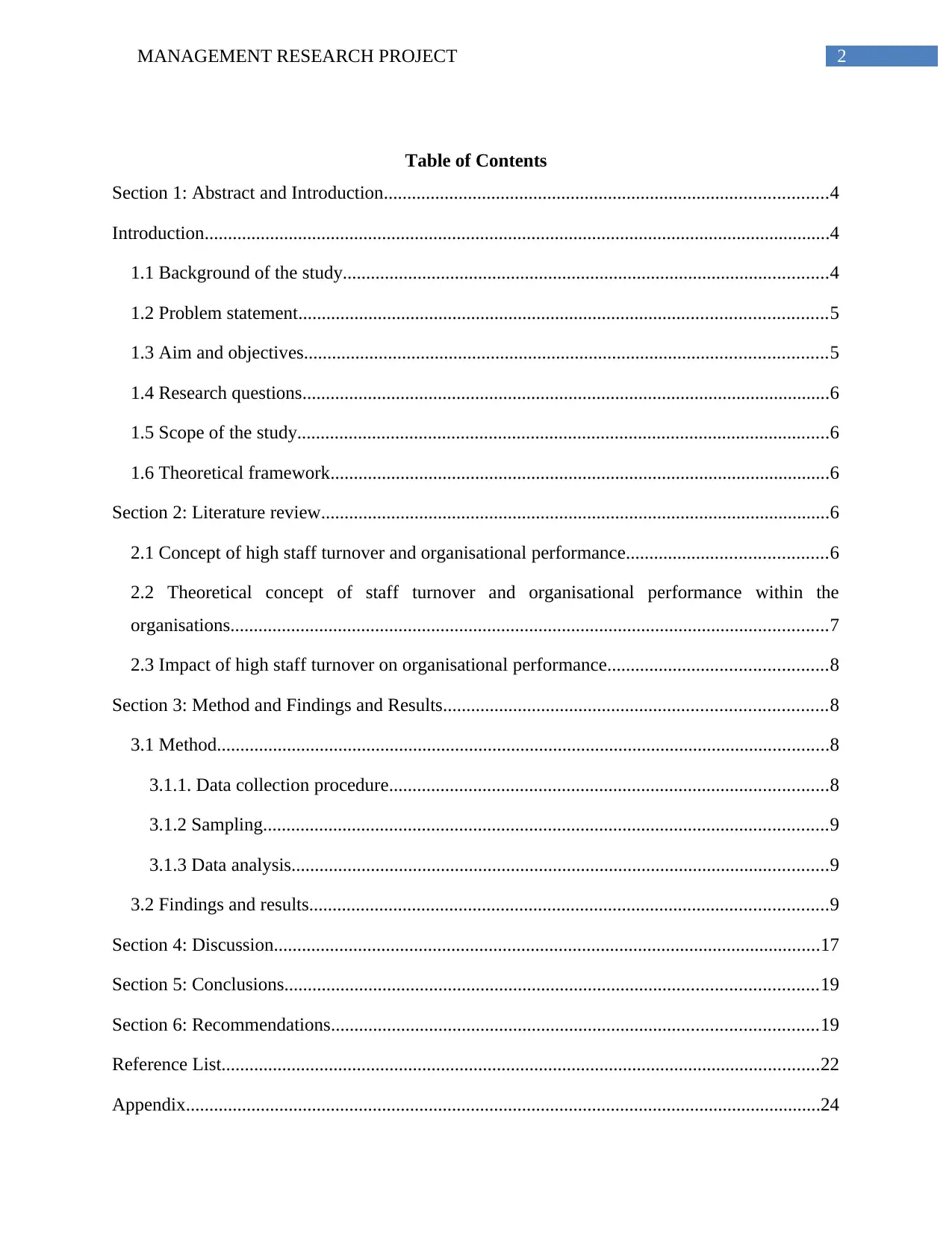
Table of Contents
Section 1: Abstract and Introduction...............................................................................................4
Introduction......................................................................................................................................4
1.1 Background of the study........................................................................................................4
1.2 Problem statement.................................................................................................................5
1.3 Aim and objectives................................................................................................................5
1.4 Research questions.................................................................................................................6
1.5 Scope of the study..................................................................................................................6
1.6 Theoretical framework...........................................................................................................6
Section 2: Literature review.............................................................................................................6
2.1 Concept of high staff turnover and organisational performance...........................................6
2.2 Theoretical concept of staff turnover and organisational performance within the
organisations................................................................................................................................7
2.3 Impact of high staff turnover on organisational performance...............................................8
Section 3: Method and Findings and Results..................................................................................8
3.1 Method...................................................................................................................................8
3.1.1. Data collection procedure..............................................................................................8
3.1.2 Sampling.........................................................................................................................9
3.1.3 Data analysis...................................................................................................................9
3.2 Findings and results...............................................................................................................9
Section 4: Discussion.....................................................................................................................17
Section 5: Conclusions..................................................................................................................19
Section 6: Recommendations........................................................................................................19
Reference List................................................................................................................................22
Appendix........................................................................................................................................24
Table of Contents
Section 1: Abstract and Introduction...............................................................................................4
Introduction......................................................................................................................................4
1.1 Background of the study........................................................................................................4
1.2 Problem statement.................................................................................................................5
1.3 Aim and objectives................................................................................................................5
1.4 Research questions.................................................................................................................6
1.5 Scope of the study..................................................................................................................6
1.6 Theoretical framework...........................................................................................................6
Section 2: Literature review.............................................................................................................6
2.1 Concept of high staff turnover and organisational performance...........................................6
2.2 Theoretical concept of staff turnover and organisational performance within the
organisations................................................................................................................................7
2.3 Impact of high staff turnover on organisational performance...............................................8
Section 3: Method and Findings and Results..................................................................................8
3.1 Method...................................................................................................................................8
3.1.1. Data collection procedure..............................................................................................8
3.1.2 Sampling.........................................................................................................................9
3.1.3 Data analysis...................................................................................................................9
3.2 Findings and results...............................................................................................................9
Section 4: Discussion.....................................................................................................................17
Section 5: Conclusions..................................................................................................................19
Section 6: Recommendations........................................................................................................19
Reference List................................................................................................................................22
Appendix........................................................................................................................................24
⊘ This is a preview!⊘
Do you want full access?
Subscribe today to unlock all pages.

Trusted by 1+ million students worldwide
3MANAGEMENT RESEARCH PROJECT
Section 1: Abstract and Introduction
Abstract
This report highlights the high staff turnover on organisational performance on the
hospitality sector. In New Zealand, the staff turnover touched the figure of 18% in the hospitality
sector. Therefore, the employees in the hospitality industry are leaving the organisation as they
do not feel enough urge to work for a long time. In this report, the main focus has been set on the
Sofitel Hotel and Resorts in Auckland. The theoretical understanding of this staff turnover and
organisational performance has been reviewed in the literature review section. In addition,
Herzberg's Two Factor theory and Join Stay and Leave model of employee turnover have been
discussed. To conduct the research, the researcher has conducted the survey to the staff of Sofitel
hotel. The survey data has been analysed using the quantitative data analysis. It is proved that the
employees do not wish to work in the Sofitel hotel as the work stress is higher and payment, as
well as motivation, is less. Therefore, the recommendations have been made in the hiring
process, flexible working hours, fringe benefits of the employees and employee engagement.
Introduction
1.1 Background of the study
The ultimate result of high staff turnover is disastrous for the organisations and the
performance of the organisation can be affected by the staff turnover. As stated by Au & Tse
(2015), today's organisations mostly focus on the high organisational performance that can meet
the objectives of the organisations in a highly competitive environment. The organisations are
taking the strategies that could improve the performance of the organisations reducing the staff
turnover. Brown, Thomas & Bosselman (2015), supported this by saying staff turnover and
organisational performance are intertwined and it is evident that high staff turnover negatively
impacts on organisational financial performance. The productivity, efficiency and effectiveness
of the firms are influenced by well experienced and competent workforce. In the hospitality
industry, the staff turnover is high as the employees leave the organisations for lack of job
security and job satisfaction (Guilding, Lamminmaki & McManus, 2016). The employees who
Section 1: Abstract and Introduction
Abstract
This report highlights the high staff turnover on organisational performance on the
hospitality sector. In New Zealand, the staff turnover touched the figure of 18% in the hospitality
sector. Therefore, the employees in the hospitality industry are leaving the organisation as they
do not feel enough urge to work for a long time. In this report, the main focus has been set on the
Sofitel Hotel and Resorts in Auckland. The theoretical understanding of this staff turnover and
organisational performance has been reviewed in the literature review section. In addition,
Herzberg's Two Factor theory and Join Stay and Leave model of employee turnover have been
discussed. To conduct the research, the researcher has conducted the survey to the staff of Sofitel
hotel. The survey data has been analysed using the quantitative data analysis. It is proved that the
employees do not wish to work in the Sofitel hotel as the work stress is higher and payment, as
well as motivation, is less. Therefore, the recommendations have been made in the hiring
process, flexible working hours, fringe benefits of the employees and employee engagement.
Introduction
1.1 Background of the study
The ultimate result of high staff turnover is disastrous for the organisations and the
performance of the organisation can be affected by the staff turnover. As stated by Au & Tse
(2015), today's organisations mostly focus on the high organisational performance that can meet
the objectives of the organisations in a highly competitive environment. The organisations are
taking the strategies that could improve the performance of the organisations reducing the staff
turnover. Brown, Thomas & Bosselman (2015), supported this by saying staff turnover and
organisational performance are intertwined and it is evident that high staff turnover negatively
impacts on organisational financial performance. The productivity, efficiency and effectiveness
of the firms are influenced by well experienced and competent workforce. In the hospitality
industry, the staff turnover is high as the employees leave the organisations for lack of job
security and job satisfaction (Guilding, Lamminmaki & McManus, 2016). The employees who
Paraphrase This Document
Need a fresh take? Get an instant paraphrase of this document with our AI Paraphraser
4MANAGEMENT RESEARCH PROJECT
work within the organisation face the low morale and poor performance. Therefore, the
increasing pressure on firms to gain the high levels of performance to meet the changing
consumer needs necessitates special focus on the role played by the human workforce to
facilitate the high performance.
1.2 Problem statement
In New Zealand, hospitality industry gives almost 5% of GDP and in the year 2017,
approximately 3.7 million travellers visited New Zealand (Kelsey, 2017). The hospitality
industry is mainly based on a guest-service industry where the service to the guests is the main
factor. The staffs can play the major role to provide satisfaction to the guests. However, in the
hospitality industry, the employee turnover in New Zealand reached 18% in the year 2017
(Kelsey, 2017). The management has been failing to fill the gap by recruiting new staffs. The
lack of staffs within the Sofitel leads to low employee morale and low customer service. The HR
department of the Sofitel Hotel cannot ensure the employee retention and the management is
facing the issue of high attrition are and turnover of talents (Sofitel.com, 2017).
This research has strived to identify the possible reasons behind the high staff turnover at
Sofitel Auckland and poor organisational performance due to the high staff turnover.
1.3 Aim and objectives
The aim of the research is to explore the impact of high staff turnover on organisational
performance in Sofitel Hotel, Auckland.
The objectives of the research are:
To find out the reasons behind high staff turnover rate in the hospitality industry in New
Zealand
To identify the strategies taken by Sofitel hotel in Auckland to accelerate organisational
performance
To establish a relationship between high staff turnover and organisational performance
To recommend some possible solutions to Sofitel hotel in Auckland to reduce high staff
turnover rate
work within the organisation face the low morale and poor performance. Therefore, the
increasing pressure on firms to gain the high levels of performance to meet the changing
consumer needs necessitates special focus on the role played by the human workforce to
facilitate the high performance.
1.2 Problem statement
In New Zealand, hospitality industry gives almost 5% of GDP and in the year 2017,
approximately 3.7 million travellers visited New Zealand (Kelsey, 2017). The hospitality
industry is mainly based on a guest-service industry where the service to the guests is the main
factor. The staffs can play the major role to provide satisfaction to the guests. However, in the
hospitality industry, the employee turnover in New Zealand reached 18% in the year 2017
(Kelsey, 2017). The management has been failing to fill the gap by recruiting new staffs. The
lack of staffs within the Sofitel leads to low employee morale and low customer service. The HR
department of the Sofitel Hotel cannot ensure the employee retention and the management is
facing the issue of high attrition are and turnover of talents (Sofitel.com, 2017).
This research has strived to identify the possible reasons behind the high staff turnover at
Sofitel Auckland and poor organisational performance due to the high staff turnover.
1.3 Aim and objectives
The aim of the research is to explore the impact of high staff turnover on organisational
performance in Sofitel Hotel, Auckland.
The objectives of the research are:
To find out the reasons behind high staff turnover rate in the hospitality industry in New
Zealand
To identify the strategies taken by Sofitel hotel in Auckland to accelerate organisational
performance
To establish a relationship between high staff turnover and organisational performance
To recommend some possible solutions to Sofitel hotel in Auckland to reduce high staff
turnover rate
5MANAGEMENT RESEARCH PROJECT
1.4 Research questions
Primary research question
What is the impact of high staff turnover on organisational performance in the hospitality
industry in New Zealand?
Secondary research questions
What are the reasons behind high staff turnover rate in the hospitality industry in New
Zealand?
What are the strategies taken by the management of Sofitel hotel in Auckland to
accelerate organisational performance?
What could be the possible recommendations for possible solutions of Sofitel hotel in
Auckland to reduce high staff turnover rate and increase organisational performance?
1.5 Scope of the study
This study would try to highlight the hospitality management practice that can contribute
the staffs’ development and employees’ retention in New Zealand. In the hospitality industry, the
management must identify the employees who like to work in hospitality sector. The research is
based on primary data. The research has highlighted the theoretical framework of the research.
The limitation of the study is to lack of funds to continue the research as credible secondary data
cost high, lack of time and lack of participants in the research.
1.4 Research questions
Primary research question
What is the impact of high staff turnover on organisational performance in the hospitality
industry in New Zealand?
Secondary research questions
What are the reasons behind high staff turnover rate in the hospitality industry in New
Zealand?
What are the strategies taken by the management of Sofitel hotel in Auckland to
accelerate organisational performance?
What could be the possible recommendations for possible solutions of Sofitel hotel in
Auckland to reduce high staff turnover rate and increase organisational performance?
1.5 Scope of the study
This study would try to highlight the hospitality management practice that can contribute
the staffs’ development and employees’ retention in New Zealand. In the hospitality industry, the
management must identify the employees who like to work in hospitality sector. The research is
based on primary data. The research has highlighted the theoretical framework of the research.
The limitation of the study is to lack of funds to continue the research as credible secondary data
cost high, lack of time and lack of participants in the research.
⊘ This is a preview!⊘
Do you want full access?
Subscribe today to unlock all pages.
Trusted by 1+ million students worldwide
6MANAGEMENT RESEARCH PROJECT
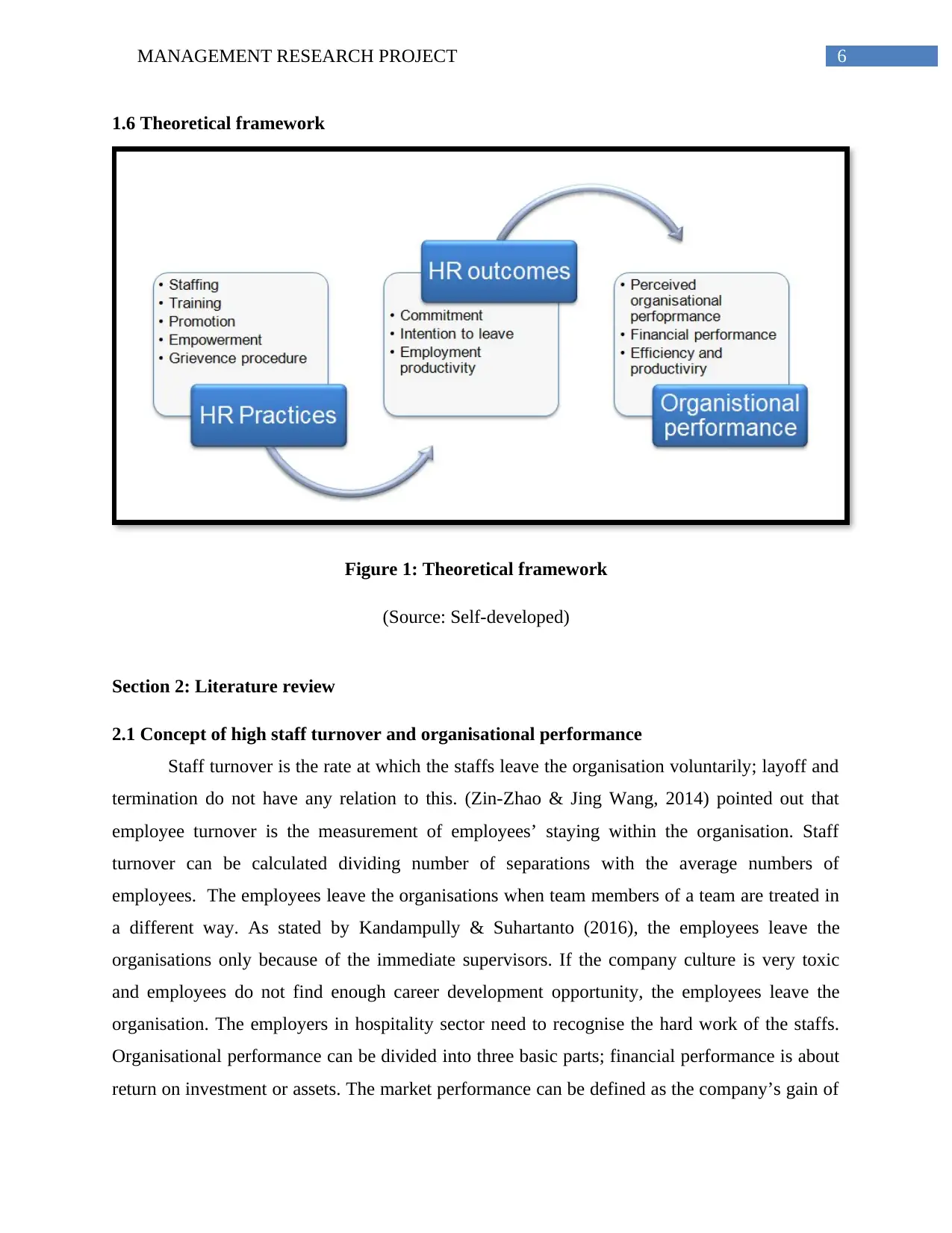
1.6 Theoretical framework
Figure 1: Theoretical framework
(Source: Self-developed)
Section 2: Literature review
2.1 Concept of high staff turnover and organisational performance
Staff turnover is the rate at which the staffs leave the organisation voluntarily; layoff and
termination do not have any relation to this. (Zin-Zhao & Jing Wang, 2014) pointed out that
employee turnover is the measurement of employees’ staying within the organisation. Staff
turnover can be calculated dividing number of separations with the average numbers of
employees. The employees leave the organisations when team members of a team are treated in
a different way. As stated by Kandampully & Suhartanto (2016), the employees leave the
organisations only because of the immediate supervisors. If the company culture is very toxic
and employees do not find enough career development opportunity, the employees leave the
organisation. The employers in hospitality sector need to recognise the hard work of the staffs.
Organisational performance can be divided into three basic parts; financial performance is about
return on investment or assets. The market performance can be defined as the company’s gain of
1.6 Theoretical framework
Figure 1: Theoretical framework
(Source: Self-developed)
Section 2: Literature review
2.1 Concept of high staff turnover and organisational performance
Staff turnover is the rate at which the staffs leave the organisation voluntarily; layoff and
termination do not have any relation to this. (Zin-Zhao & Jing Wang, 2014) pointed out that
employee turnover is the measurement of employees’ staying within the organisation. Staff
turnover can be calculated dividing number of separations with the average numbers of
employees. The employees leave the organisations when team members of a team are treated in
a different way. As stated by Kandampully & Suhartanto (2016), the employees leave the
organisations only because of the immediate supervisors. If the company culture is very toxic
and employees do not find enough career development opportunity, the employees leave the
organisation. The employers in hospitality sector need to recognise the hard work of the staffs.
Organisational performance can be divided into three basic parts; financial performance is about
return on investment or assets. The market performance can be defined as the company’s gain of
Paraphrase This Document
Need a fresh take? Get an instant paraphrase of this document with our AI Paraphraser
7MANAGEMENT RESEARCH PROJECT
market share and lastly, shareholder’s value is about the company’s measurement of the
company’s success. As stated by Guilding, Lamminmaki & McManus (2016), organisational
performance is about effectiveness, efficiency, relevance and financial viability of the
organisation.
2.2 Theoretical concept of staff turnover and organisational performance within the
organisations
Herzberg’s Two Factor Theory:
This theory talks about two important factors of an organisation. First one is motivator
that can motivate; however, a lack of motivators does not cause dissatisfaction. Motivator
factors in the work are recognition, achievement, responsibility, recognition; work itself,
advancement and personal growth (Hur, 2017). Hygiene factors can influence hygiene factors
can cause dissatisfaction but cannot motivate. Hygiene factors in workplace are working
condition, co-worker relations, basic wage, salary and supervisor quality.
Join-Stay and Leave model
The employees join in an organisation as they get attracted to the position and the
employees have their expectations. High performing employees are retained within the
organisation. As stated by Qin et al. (2015), employees participate in the professional life, the
employees participate in the community life and they develop the professional and community
life as well. The relationships help to become more embedded to stay on the job. The employers
need to provide motivation both extrinsic and intrinsic in order to stay within the organisation.
The employees leave the organisation when because of lower job satisfaction. The employees
can leave the organisation because of better pay, better opportunity and better hours. In this
regard, as opined by Kerney (2018), retention diagnostic is a process of benchmarking that can
recognise the costs and uncover the effects of performance, engagement and employee loyalty
process.
2.3 Impact of high staff turnover on organisational performance
The loss of the employees can be very harmful to the firms as it relates the output of the
organisation. The key performance of the organisation can be financial performance and replace
the employees’ costs three times more value for the organisation. When old employees leave,
market share and lastly, shareholder’s value is about the company’s measurement of the
company’s success. As stated by Guilding, Lamminmaki & McManus (2016), organisational
performance is about effectiveness, efficiency, relevance and financial viability of the
organisation.
2.2 Theoretical concept of staff turnover and organisational performance within the
organisations
Herzberg’s Two Factor Theory:
This theory talks about two important factors of an organisation. First one is motivator
that can motivate; however, a lack of motivators does not cause dissatisfaction. Motivator
factors in the work are recognition, achievement, responsibility, recognition; work itself,
advancement and personal growth (Hur, 2017). Hygiene factors can influence hygiene factors
can cause dissatisfaction but cannot motivate. Hygiene factors in workplace are working
condition, co-worker relations, basic wage, salary and supervisor quality.
Join-Stay and Leave model
The employees join in an organisation as they get attracted to the position and the
employees have their expectations. High performing employees are retained within the
organisation. As stated by Qin et al. (2015), employees participate in the professional life, the
employees participate in the community life and they develop the professional and community
life as well. The relationships help to become more embedded to stay on the job. The employers
need to provide motivation both extrinsic and intrinsic in order to stay within the organisation.
The employees leave the organisation when because of lower job satisfaction. The employees
can leave the organisation because of better pay, better opportunity and better hours. In this
regard, as opined by Kerney (2018), retention diagnostic is a process of benchmarking that can
recognise the costs and uncover the effects of performance, engagement and employee loyalty
process.
2.3 Impact of high staff turnover on organisational performance
The loss of the employees can be very harmful to the firms as it relates the output of the
organisation. The key performance of the organisation can be financial performance and replace
the employees’ costs three times more value for the organisation. When old employees leave,
8MANAGEMENT RESEARCH PROJECT
new employees are needed to provide training Limarev et al., 2015). Lower job tenure can
hamper the production goal of the organisation. In the hospitality sector, if the employees leave
at a relatively high rate from an organisation, the organisational performance will eventually
decrease. In theoretical perspective, staffs join in an organisation if they find something enticing
and high-performing employees are motivated to look for better work. Employees stay within an
organisation if the organisation can provide enough motivation. Motivation can come from
extrinsic factors like a bonus, reward and recognition and motivation can also come from
intrinsic factors like interest and job responsibilities. As opined by Selden & Sowa (2015), in the
hospitality organisations quality attributes can play the determining role in customer satisfaction.
Quality can play both tangible and non-tangible for the brand organisation; companies want the
experienced employees’ mutts be retained.
Section 3: Method and Findings and Results
3.1 Method
3.1.1. Data collection procedure
There are mainly two types of data collection procedures, primary data collection and
secondary data collection. Primary data are raw data, on the other side; secondary data are
collected from secondary sources. In this research, the researcher has collected primary data. As
stated by Taylor, Bogdan & DeVault (2015), primary data are helpful to do the research as they
are directly collected from respondents. In order to collect the primary data, the researcher has
conducted a survey. The researcher has prepared 10 close-ended multiple-type questions to ask
the respondents. The questionnaire contained two types of questions, demographic questions and
subjective questions. Some of the questions were also in the form of Likert scale. The researcher
has collected the email ids of the respondents and sent the questionnaire to the respondents.
3.1.2 Sampling
The sample population of the study was the staffs of Sofitel Hotel and Resort in
Auckland. The sample size of the study was 35. In Sofitel Hotel and Resort in Auckland,
numbers of the staffs were more than 75. The researcher has selected the sample size based on
Simple Random Sampling technique. According to Lewis (2015), simple random sampling can
be defined as a subset of the statistical population through which each of the individuals of the
new employees are needed to provide training Limarev et al., 2015). Lower job tenure can
hamper the production goal of the organisation. In the hospitality sector, if the employees leave
at a relatively high rate from an organisation, the organisational performance will eventually
decrease. In theoretical perspective, staffs join in an organisation if they find something enticing
and high-performing employees are motivated to look for better work. Employees stay within an
organisation if the organisation can provide enough motivation. Motivation can come from
extrinsic factors like a bonus, reward and recognition and motivation can also come from
intrinsic factors like interest and job responsibilities. As opined by Selden & Sowa (2015), in the
hospitality organisations quality attributes can play the determining role in customer satisfaction.
Quality can play both tangible and non-tangible for the brand organisation; companies want the
experienced employees’ mutts be retained.
Section 3: Method and Findings and Results
3.1 Method
3.1.1. Data collection procedure
There are mainly two types of data collection procedures, primary data collection and
secondary data collection. Primary data are raw data, on the other side; secondary data are
collected from secondary sources. In this research, the researcher has collected primary data. As
stated by Taylor, Bogdan & DeVault (2015), primary data are helpful to do the research as they
are directly collected from respondents. In order to collect the primary data, the researcher has
conducted a survey. The researcher has prepared 10 close-ended multiple-type questions to ask
the respondents. The questionnaire contained two types of questions, demographic questions and
subjective questions. Some of the questions were also in the form of Likert scale. The researcher
has collected the email ids of the respondents and sent the questionnaire to the respondents.
3.1.2 Sampling
The sample population of the study was the staffs of Sofitel Hotel and Resort in
Auckland. The sample size of the study was 35. In Sofitel Hotel and Resort in Auckland,
numbers of the staffs were more than 75. The researcher has selected the sample size based on
Simple Random Sampling technique. According to Lewis (2015), simple random sampling can
be defined as a subset of the statistical population through which each of the individuals of the
⊘ This is a preview!⊘
Do you want full access?
Subscribe today to unlock all pages.
Trusted by 1+ million students worldwide
9MANAGEMENT RESEARCH PROJECT
subset has the same opportunity of getting selected. The researcher took the permission before
sending the questionnaire to the respondents and ensured that confidentiality would be
maintained. The researcher asked the respondents revert within 7 days of the period.
Sample population Sample size Sampling technique Sample frame
The staff of Sofitel
Hotel and Resort
35 Simple random
sampling
Soft copy of the
questionnaire using
email ids
Table 1: Sampling of the survey
(Source: Self-developed)
3.1.3 Data analysis
In this research report, quantitative data analysis technique has been used. Quantitative
data are numerical data that are collected from the survey (Flick, 2015). The researcher has used
the tables to show the data findings. The researcher has also used Excel software to analyse the
data findings and to present the data findings in a visual way. Data findings have been analysed
linking with the literature review.
3.2 Findings and results
Survey responses findings have been shown as follows:
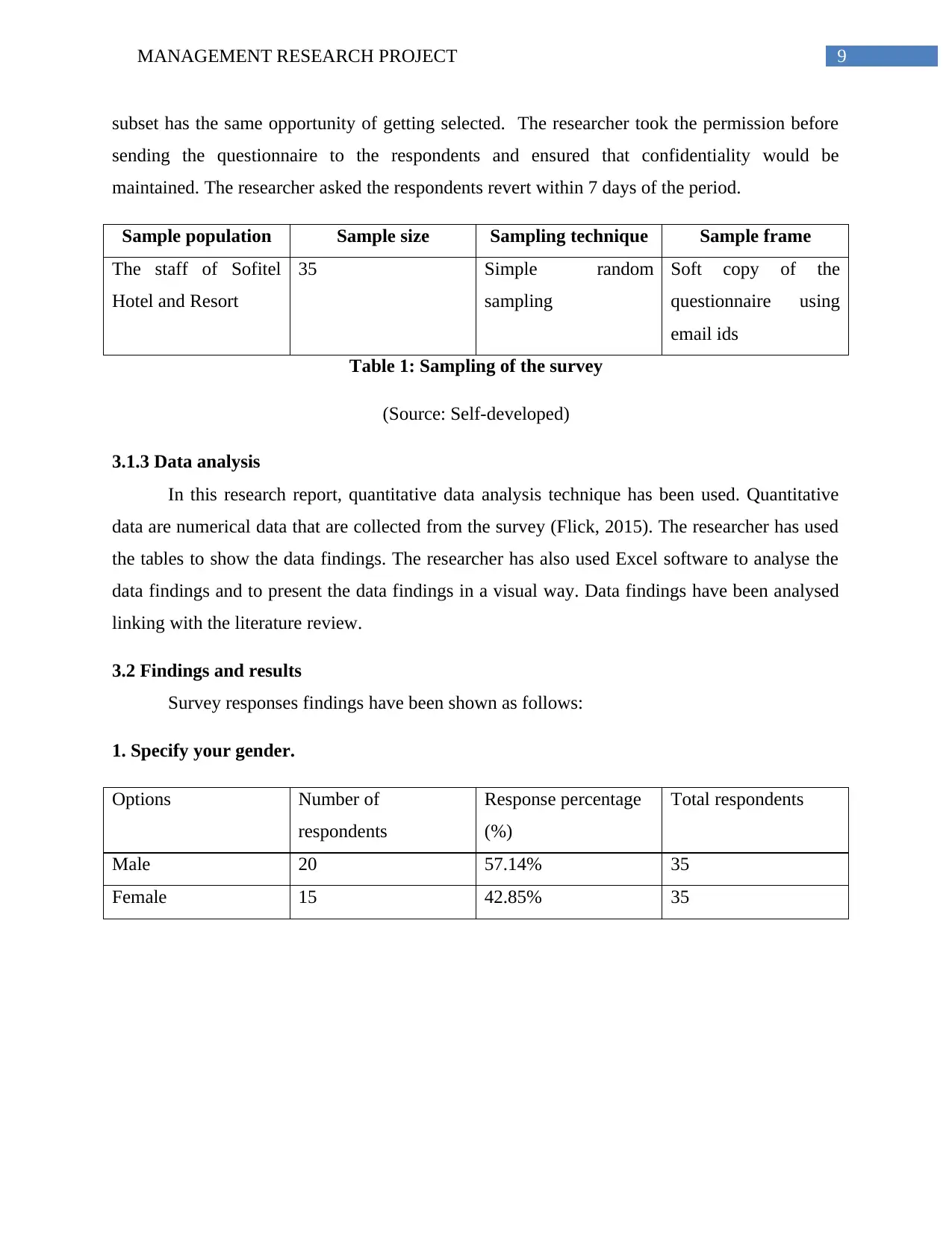
1. Specify your gender.
Options Number of
respondents
Response percentage
(%)
Total respondents
Male 20 57.14% 35
Female 15 42.85% 35
subset has the same opportunity of getting selected. The researcher took the permission before
sending the questionnaire to the respondents and ensured that confidentiality would be
maintained. The researcher asked the respondents revert within 7 days of the period.
Sample population Sample size Sampling technique Sample frame
The staff of Sofitel
Hotel and Resort
35 Simple random
sampling
Soft copy of the
questionnaire using
email ids
Table 1: Sampling of the survey
(Source: Self-developed)
3.1.3 Data analysis
In this research report, quantitative data analysis technique has been used. Quantitative
data are numerical data that are collected from the survey (Flick, 2015). The researcher has used
the tables to show the data findings. The researcher has also used Excel software to analyse the
data findings and to present the data findings in a visual way. Data findings have been analysed
linking with the literature review.
3.2 Findings and results
Survey responses findings have been shown as follows:
1. Specify your gender.
Options Number of
respondents
Response percentage
(%)
Total respondents
Male 20 57.14% 35
Female 15 42.85% 35
Paraphrase This Document
Need a fresh take? Get an instant paraphrase of this document with our AI Paraphraser
10MANAGEMENT RESEARCH PROJECT
Male Female
0.00%
10.00%
20.00%
30.00%
40.00%
50.00%
60.00%
57.14%
42.85%
Gender of the respondents
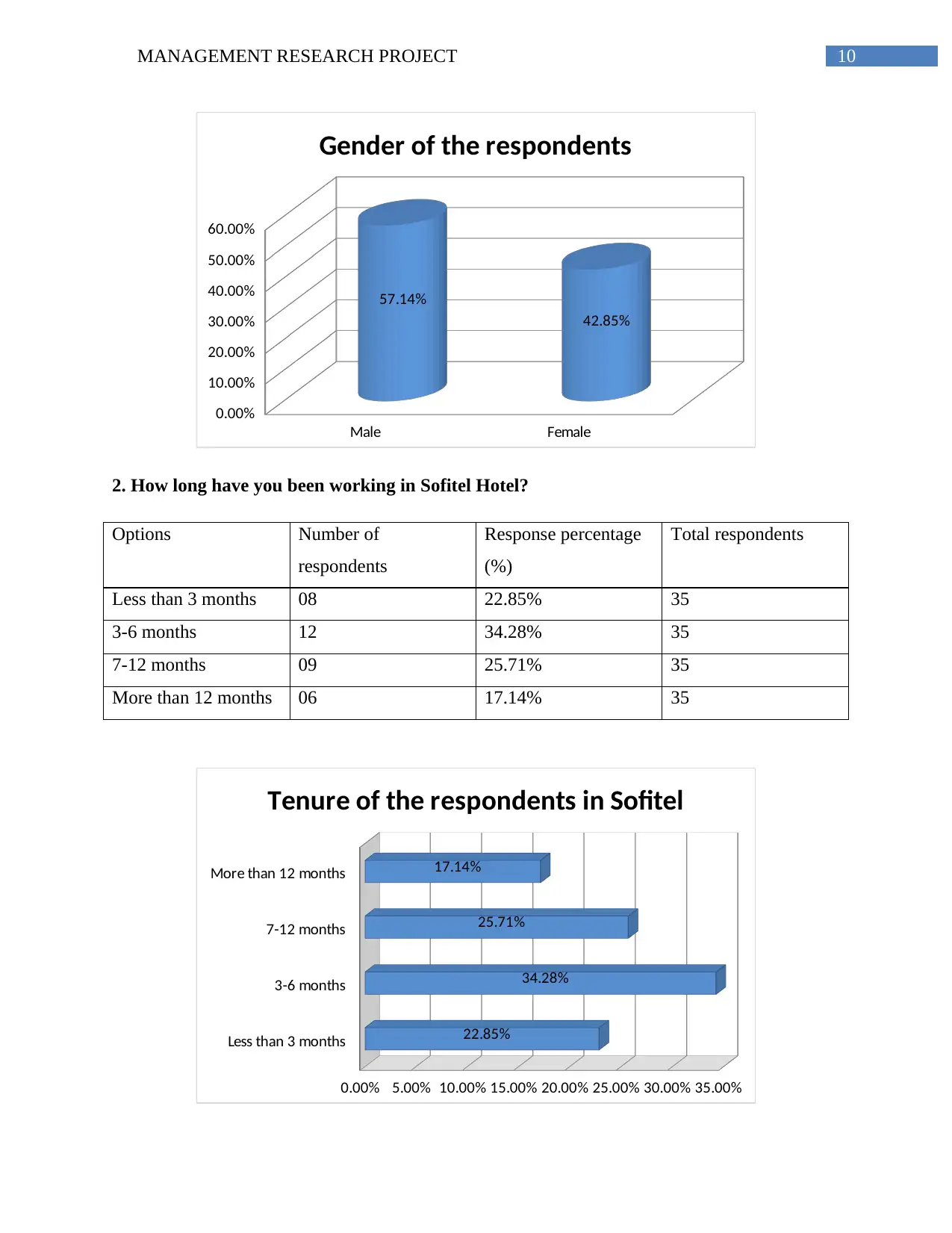
2. How long have you been working in Sofitel Hotel?
Options Number of
respondents
Response percentage
(%)
Total respondents
Less than 3 months 08 22.85% 35
3-6 months 12 34.28% 35
7-12 months 09 25.71% 35
More than 12 months 06 17.14% 35
Less than 3 months
3-6 months
7-12 months
More than 12 months
0.00% 5.00% 10.00% 15.00% 20.00% 25.00% 30.00% 35.00%
22.85%
34.28%
25.71%
17.14%
Tenure of the respondents in Sofitel
Male Female
0.00%
10.00%
20.00%
30.00%
40.00%
50.00%
60.00%
57.14%
42.85%
Gender of the respondents
2. How long have you been working in Sofitel Hotel?
Options Number of
respondents
Response percentage
(%)
Total respondents
Less than 3 months 08 22.85% 35
3-6 months 12 34.28% 35
7-12 months 09 25.71% 35
More than 12 months 06 17.14% 35
Less than 3 months
3-6 months
7-12 months
More than 12 months
0.00% 5.00% 10.00% 15.00% 20.00% 25.00% 30.00% 35.00%
22.85%
34.28%
25.71%
17.14%
Tenure of the respondents in Sofitel
11MANAGEMENT RESEARCH PROJECT
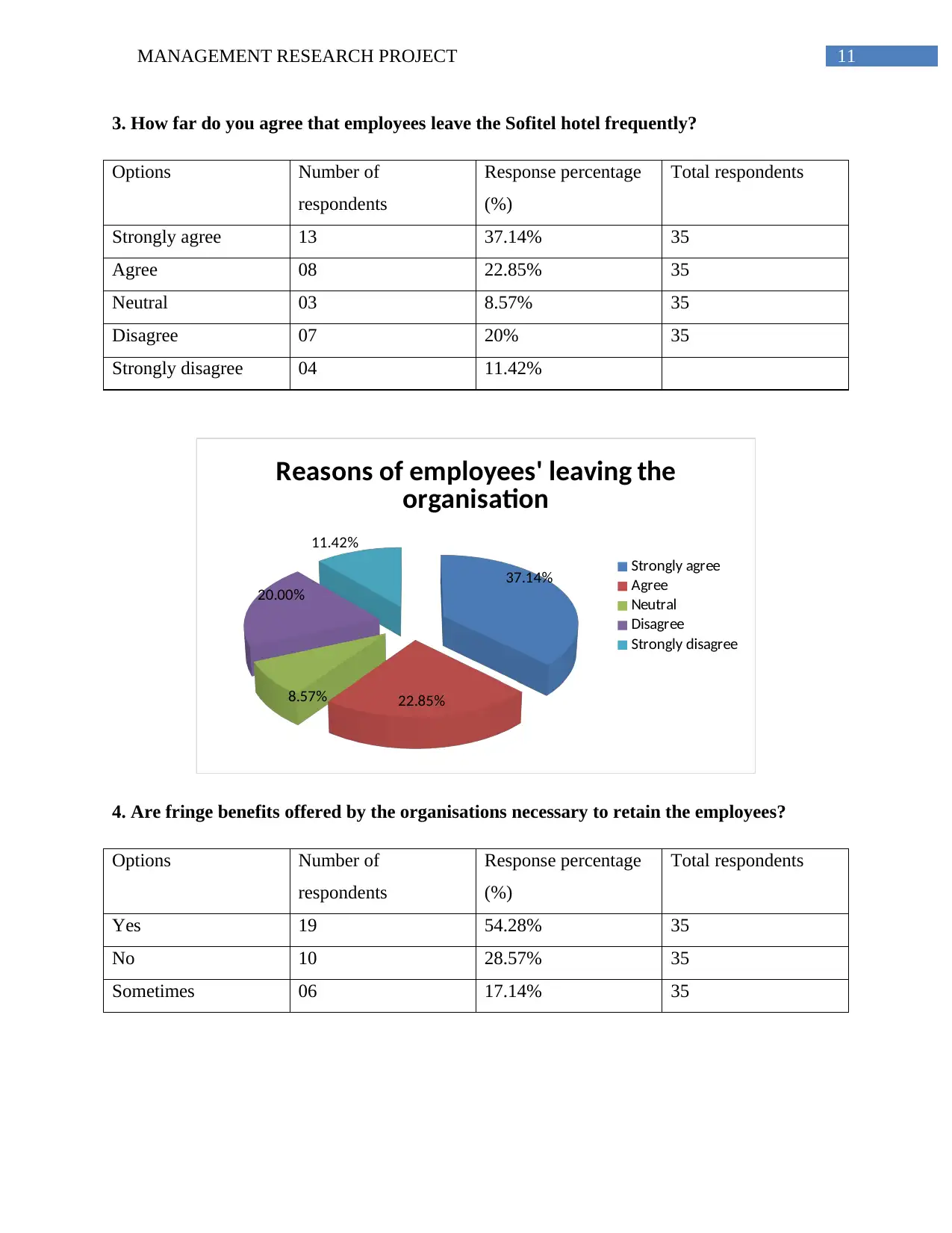
3. How far do you agree that employees leave the Sofitel hotel frequently?
Options Number of
respondents
Response percentage
(%)
Total respondents
Strongly agree 13 37.14% 35
Agree 08 22.85% 35
Neutral 03 8.57% 35
Disagree 07 20% 35
Strongly disagree 04 11.42%
37.14%
22.85%8.57%
20.00%
11.42%
Reasons of employees' leaving the
organisation
Strongly agree
Agree
Neutral
Disagree
Strongly disagree
4. Are fringe benefits offered by the organisations necessary to retain the employees?
Options Number of
respondents
Response percentage
(%)
Total respondents
Yes 19 54.28% 35
No 10 28.57% 35
Sometimes 06 17.14% 35
3. How far do you agree that employees leave the Sofitel hotel frequently?
Options Number of
respondents
Response percentage
(%)
Total respondents
Strongly agree 13 37.14% 35
Agree 08 22.85% 35
Neutral 03 8.57% 35
Disagree 07 20% 35
Strongly disagree 04 11.42%
37.14%
22.85%8.57%
20.00%
11.42%
Reasons of employees' leaving the
organisation
Strongly agree
Agree
Neutral
Disagree
Strongly disagree
4. Are fringe benefits offered by the organisations necessary to retain the employees?
Options Number of
respondents
Response percentage
(%)
Total respondents
Yes 19 54.28% 35
No 10 28.57% 35
Sometimes 06 17.14% 35
⊘ This is a preview!⊘
Do you want full access?
Subscribe today to unlock all pages.
Trusted by 1+ million students worldwide

1 out of 26


Related Documents


Your All-in-One AI-Powered Toolkit for Academic Success.
+13062052269
info@desklib.com
Available 24*7 on WhatsApp / Email
![[object Object]](/_next/static/media/star-bottom.7253800d.svg)
Unlock your academic potential
Copyright © 2020–2026 A2Z Services. All Rights Reserved. Developed and managed by ZUCOL.