Software Methodology - Analysis of ACID Transactions and Code Smells

Verified

Added on  2022/08/14

|4
|449
|24
Homework Assignment
AI Summary
This assignment delves into the core concepts of software methodology, specifically focusing on ACID transaction management in database systems and the identification of code smells. The assignment begins by defining ACID, an acronym representing the four essential properties of database transactions: atomicity, consistency, isolation, and durability. Atomicity ensures that transactions are treated as single operations, either fully completed or entirely rolled back. Consistency guarantees that data remains valid before and after a transaction. Isolation ensures that concurrent transactions do not interfere with each other, and durability ensures that committed transactions are permanently stored, even in the event of system failures. The assignment then shifts to code smells, which are indicators of potential problems in source code. Examples of code smells discussed include redundant and poor comments, dead functions, and functions with excessive arguments. These code smells can indicate underlying design issues and can negatively impact code maintainability and readability. The assignment underscores the importance of these concepts in building robust and reliable software systems.
Document Page
Running head: SOFTWARE METHODOLOGY 1
Software methodology
Student name
Student id
Institution
Date
tabler-icon-diamond-filled.svg

Paraphrase This Document

Need a fresh take? Get an instant paraphrase of this document with our AI Paraphraser
Document Page
SOFTWARE METHODOLOGY 2
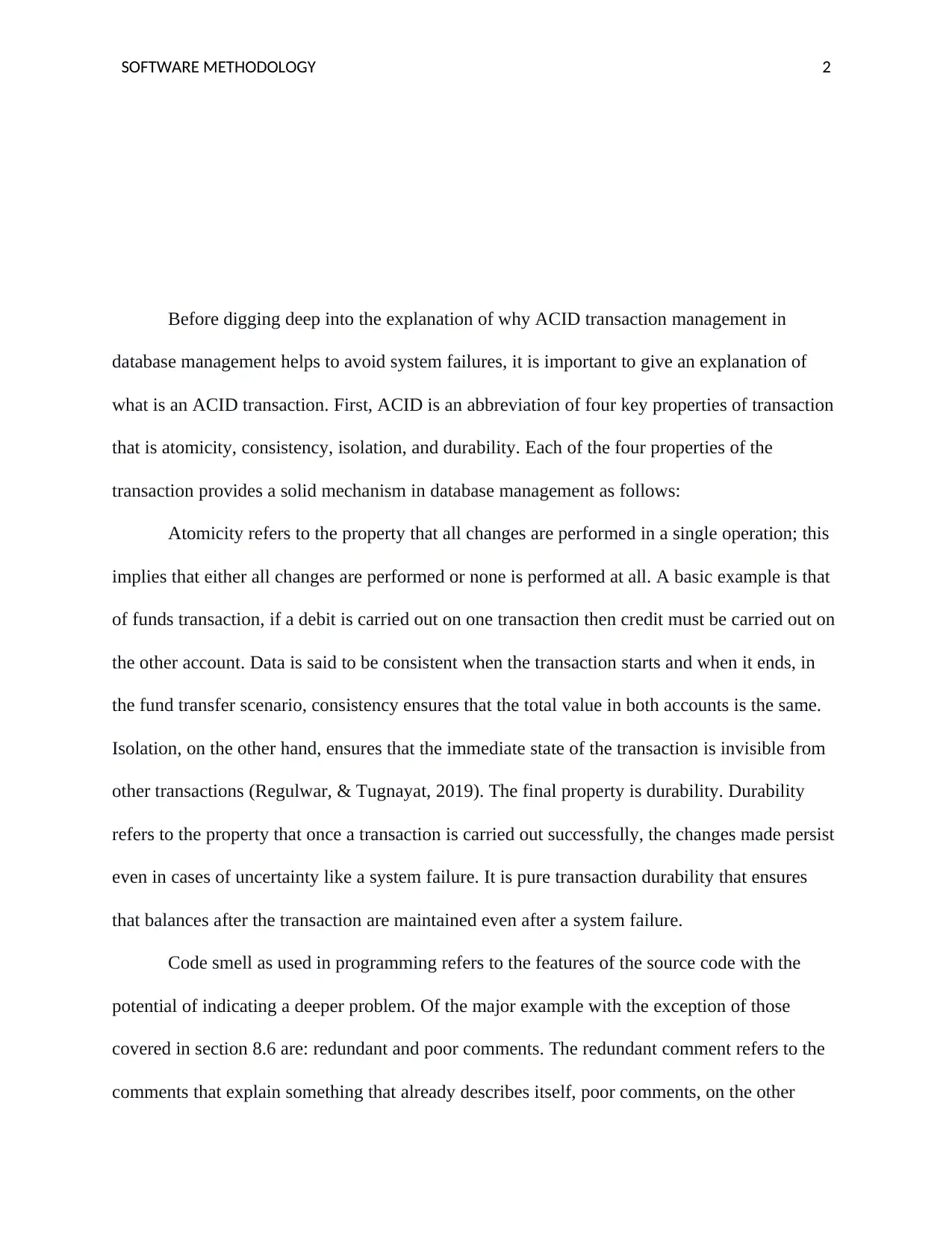
Before digging deep into the explanation of why ACID transaction management in
database management helps to avoid system failures, it is important to give an explanation of
what is an ACID transaction. First, ACID is an abbreviation of four key properties of transaction
that is atomicity, consistency, isolation, and durability. Each of the four properties of the
transaction provides a solid mechanism in database management as follows:
Atomicity refers to the property that all changes are performed in a single operation; this
implies that either all changes are performed or none is performed at all. A basic example is that
of funds transaction, if a debit is carried out on one transaction then credit must be carried out on
the other account. Data is said to be consistent when the transaction starts and when it ends, in
the fund transfer scenario, consistency ensures that the total value in both accounts is the same.
Isolation, on the other hand, ensures that the immediate state of the transaction is invisible from
other transactions (Regulwar, & Tugnayat, 2019). The final property is durability. Durability
refers to the property that once a transaction is carried out successfully, the changes made persist
even in cases of uncertainty like a system failure. It is pure transaction durability that ensures
that balances after the transaction are maintained even after a system failure.
Code smell as used in programming refers to the features of the source code with the
potential of indicating a deeper problem. Of the major example with the exception of those
covered in section 8.6 are: redundant and poor comments. The redundant comment refers to the
comments that explain something that already describes itself, poor comments, on the other
Document Page
SOFTWARE METHODOLOGY 3
hand, refers to comments with incorrect grammar and punctuation or any other mistake (Zak,
2019). Another code smell is a dead function; this refers to the methods that are never called
hence wasteful to maintain it. The last example of code smell is too many arguments on function.
Document Page
SOFTWARE METHODOLOGY 4
References
Regulwar, G. B., & Tugnayat, R. M. (2019). Detection of bad smell code for software
refactoring. In Innovations in Computer Science and Engineering (pp. 143-152).
Springer, Singapore.
Zak, M. (2019). Oracle database integration into Post Mortem system (No. CERN-STUDENTS-
Note-2019-034).
chevron_up_icon
1 out of 4
circle_padding
hide_on_mobile
zoom_out_icon
[object Object]