Case Study: Software Project Management & Organizational Impact
VerifiedAdded on 2023/05/31
|23
|7244
|319
Case Study
AI Summary
This case study explores project management principles and tools in a software development project for a manufacturing company. The project involved modifying an existing software package to manage orders, deliveries, and outstanding payments. Using the PRINCE2 methodology, the project encompassed requirement gathering, vendor selection, module development, testing, and employee training. Key aspects covered include project scope management, communication strategies, risk management, and leadership approaches. The report details the project's objectives, deliverables, requirements, and exclusions, along with a work breakdown structure (WBS) for tracking progress. It also evaluates stakeholder communication, collaborative tools, and risk identification methods. The study concludes with a critical evaluation and self-development plan, offering insights into effective project management practices. Desklib provides access to similar solved assignments and past papers for students.
Software Development Project Case Study
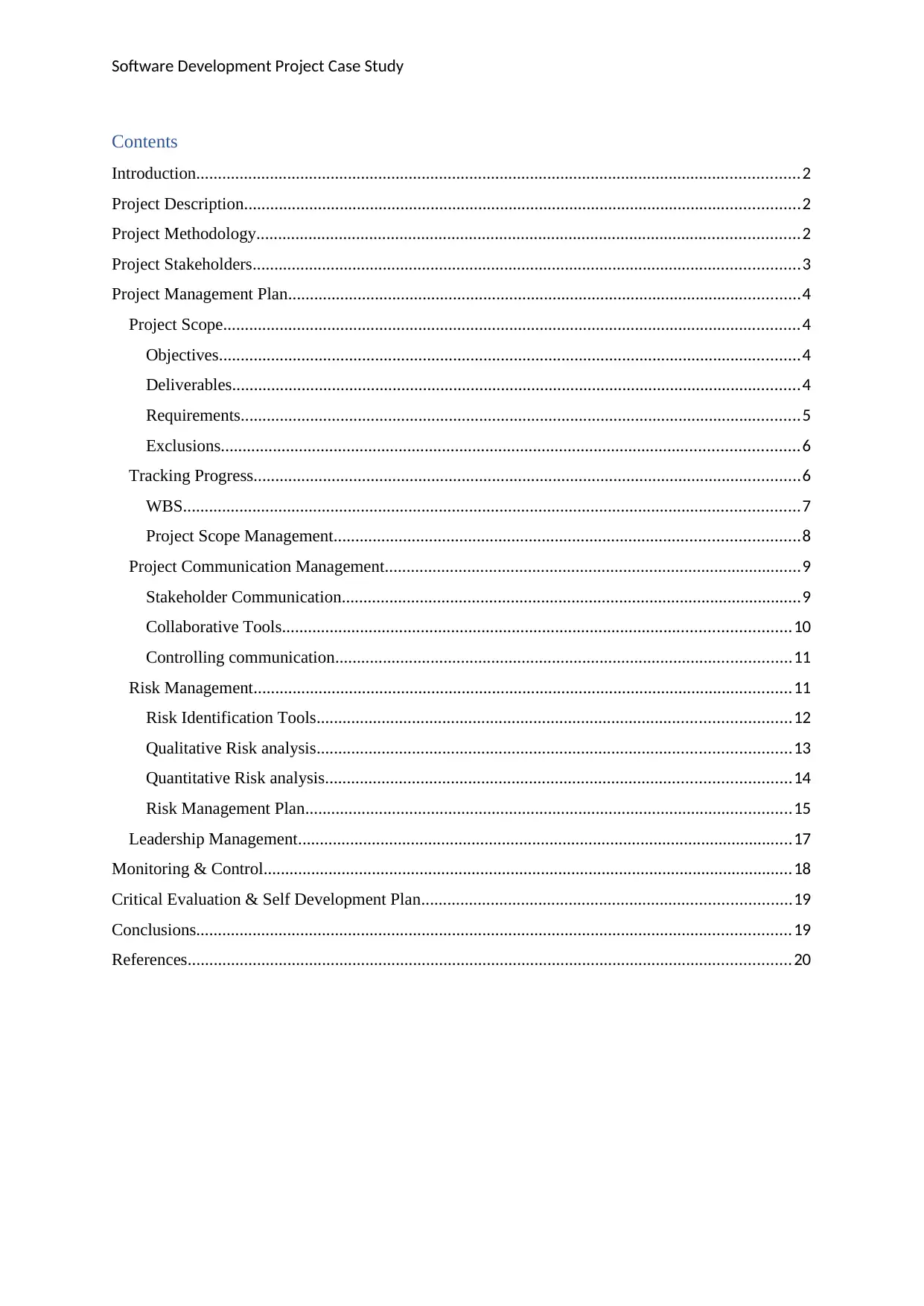
Contents
Introduction...........................................................................................................................................2
Project Description................................................................................................................................2
Project Methodology.............................................................................................................................2
Project Stakeholders..............................................................................................................................3
Project Management Plan......................................................................................................................4
Project Scope.....................................................................................................................................4
Objectives......................................................................................................................................4
Deliverables...................................................................................................................................4
Requirements.................................................................................................................................5
Exclusions.....................................................................................................................................6
Tracking Progress..............................................................................................................................6
WBS..............................................................................................................................................7
Project Scope Management...........................................................................................................8
Project Communication Management................................................................................................9
Stakeholder Communication..........................................................................................................9
Collaborative Tools.....................................................................................................................10
Controlling communication.........................................................................................................11
Risk Management............................................................................................................................11
Risk Identification Tools.............................................................................................................12
Qualitative Risk analysis.............................................................................................................13
Quantitative Risk analysis...........................................................................................................14
Risk Management Plan................................................................................................................15
Leadership Management..................................................................................................................17
Monitoring & Control..........................................................................................................................18
Critical Evaluation & Self Development Plan.....................................................................................19
Conclusions.........................................................................................................................................19
References...........................................................................................................................................20
Contents
Introduction...........................................................................................................................................2
Project Description................................................................................................................................2
Project Methodology.............................................................................................................................2
Project Stakeholders..............................................................................................................................3
Project Management Plan......................................................................................................................4
Project Scope.....................................................................................................................................4
Objectives......................................................................................................................................4
Deliverables...................................................................................................................................4
Requirements.................................................................................................................................5
Exclusions.....................................................................................................................................6
Tracking Progress..............................................................................................................................6
WBS..............................................................................................................................................7
Project Scope Management...........................................................................................................8
Project Communication Management................................................................................................9
Stakeholder Communication..........................................................................................................9
Collaborative Tools.....................................................................................................................10
Controlling communication.........................................................................................................11
Risk Management............................................................................................................................11
Risk Identification Tools.............................................................................................................12
Qualitative Risk analysis.............................................................................................................13
Quantitative Risk analysis...........................................................................................................14
Risk Management Plan................................................................................................................15
Leadership Management..................................................................................................................17
Monitoring & Control..........................................................................................................................18
Critical Evaluation & Self Development Plan.....................................................................................19
Conclusions.........................................................................................................................................19
References...........................................................................................................................................20

Paraphrase This Document
Need a fresh take? Get an instant paraphrase of this document with our AI Paraphraser
Software Development Project Case Study
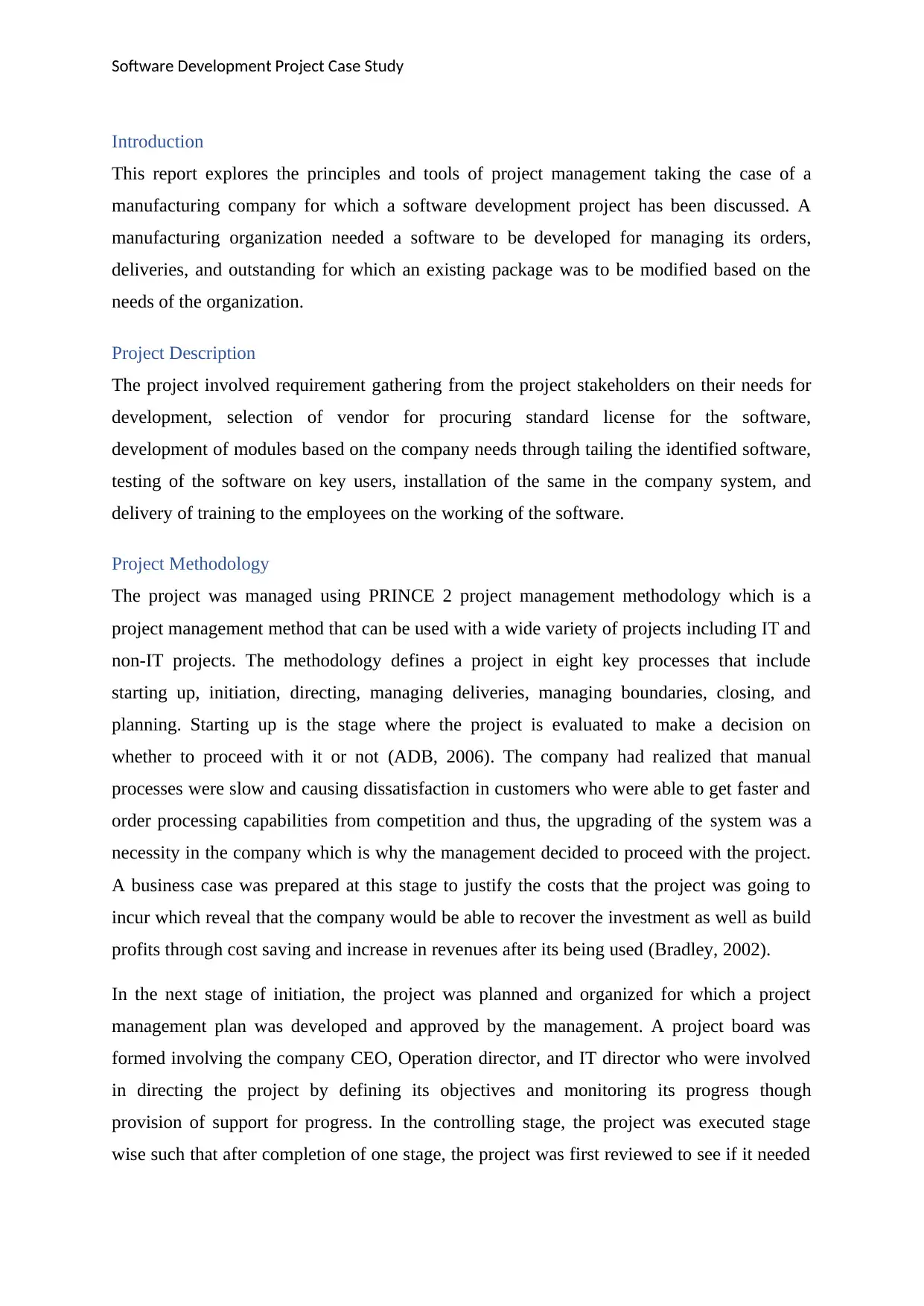
Introduction
This report explores the principles and tools of project management taking the case of a
manufacturing company for which a software development project has been discussed. A
manufacturing organization needed a software to be developed for managing its orders,
deliveries, and outstanding for which an existing package was to be modified based on the
needs of the organization.
Project Description
The project involved requirement gathering from the project stakeholders on their needs for
development, selection of vendor for procuring standard license for the software,
development of modules based on the company needs through tailing the identified software,
testing of the software on key users, installation of the same in the company system, and
delivery of training to the employees on the working of the software.
Project Methodology
The project was managed using PRINCE 2 project management methodology which is a
project management method that can be used with a wide variety of projects including IT and
non-IT projects. The methodology defines a project in eight key processes that include
starting up, initiation, directing, managing deliveries, managing boundaries, closing, and
planning. Starting up is the stage where the project is evaluated to make a decision on
whether to proceed with it or not (ADB, 2006). The company had realized that manual
processes were slow and causing dissatisfaction in customers who were able to get faster and
order processing capabilities from competition and thus, the upgrading of the system was a
necessity in the company which is why the management decided to proceed with the project.
A business case was prepared at this stage to justify the costs that the project was going to
incur which reveal that the company would be able to recover the investment as well as build
profits through cost saving and increase in revenues after its being used (Bradley, 2002).
In the next stage of initiation, the project was planned and organized for which a project
management plan was developed and approved by the management. A project board was
formed involving the company CEO, Operation director, and IT director who were involved
in directing the project by defining its objectives and monitoring its progress though
provision of support for progress. In the controlling stage, the project was executed stage
wise such that after completion of one stage, the project was first reviewed to see if it needed
Introduction
This report explores the principles and tools of project management taking the case of a
manufacturing company for which a software development project has been discussed. A
manufacturing organization needed a software to be developed for managing its orders,
deliveries, and outstanding for which an existing package was to be modified based on the
needs of the organization.
Project Description
The project involved requirement gathering from the project stakeholders on their needs for
development, selection of vendor for procuring standard license for the software,
development of modules based on the company needs through tailing the identified software,
testing of the software on key users, installation of the same in the company system, and
delivery of training to the employees on the working of the software.
Project Methodology
The project was managed using PRINCE 2 project management methodology which is a
project management method that can be used with a wide variety of projects including IT and
non-IT projects. The methodology defines a project in eight key processes that include
starting up, initiation, directing, managing deliveries, managing boundaries, closing, and
planning. Starting up is the stage where the project is evaluated to make a decision on
whether to proceed with it or not (ADB, 2006). The company had realized that manual
processes were slow and causing dissatisfaction in customers who were able to get faster and
order processing capabilities from competition and thus, the upgrading of the system was a
necessity in the company which is why the management decided to proceed with the project.
A business case was prepared at this stage to justify the costs that the project was going to
incur which reveal that the company would be able to recover the investment as well as build
profits through cost saving and increase in revenues after its being used (Bradley, 2002).
In the next stage of initiation, the project was planned and organized for which a project
management plan was developed and approved by the management. A project board was
formed involving the company CEO, Operation director, and IT director who were involved
in directing the project by defining its objectives and monitoring its progress though
provision of support for progress. In the controlling stage, the project was executed stage
wise such that after completion of one stage, the project was first reviewed to see if it needed
Software Development Project Case Study
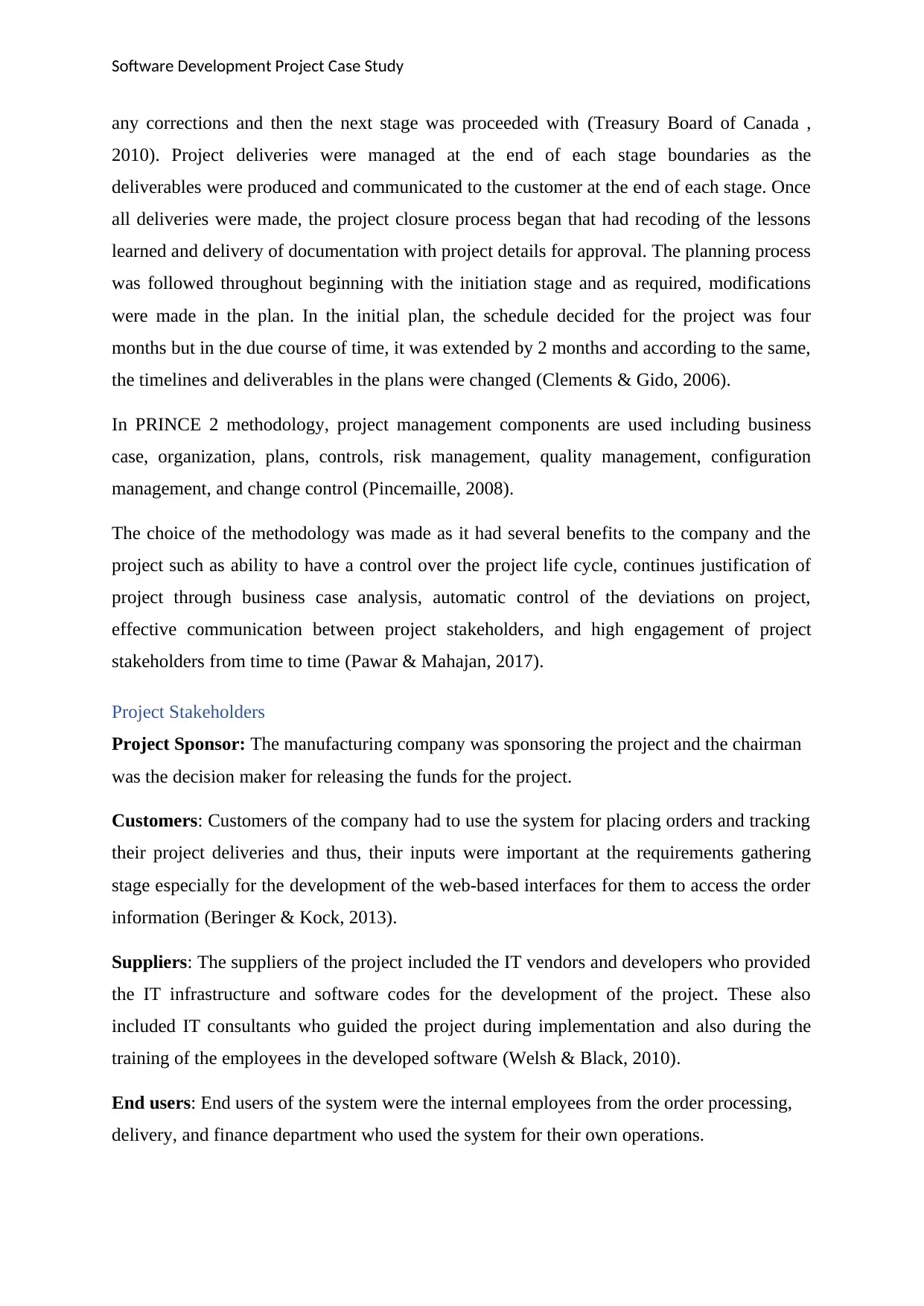
any corrections and then the next stage was proceeded with (Treasury Board of Canada ,
2010). Project deliveries were managed at the end of each stage boundaries as the
deliverables were produced and communicated to the customer at the end of each stage. Once
all deliveries were made, the project closure process began that had recoding of the lessons
learned and delivery of documentation with project details for approval. The planning process
was followed throughout beginning with the initiation stage and as required, modifications
were made in the plan. In the initial plan, the schedule decided for the project was four
months but in the due course of time, it was extended by 2 months and according to the same,
the timelines and deliverables in the plans were changed (Clements & Gido, 2006).
In PRINCE 2 methodology, project management components are used including business
case, organization, plans, controls, risk management, quality management, configuration
management, and change control (Pincemaille, 2008).
The choice of the methodology was made as it had several benefits to the company and the
project such as ability to have a control over the project life cycle, continues justification of
project through business case analysis, automatic control of the deviations on project,
effective communication between project stakeholders, and high engagement of project
stakeholders from time to time (Pawar & Mahajan, 2017).
Project Stakeholders
Project Sponsor: The manufacturing company was sponsoring the project and the chairman
was the decision maker for releasing the funds for the project.
Customers: Customers of the company had to use the system for placing orders and tracking
their project deliveries and thus, their inputs were important at the requirements gathering
stage especially for the development of the web-based interfaces for them to access the order
information (Beringer & Kock, 2013).
Suppliers: The suppliers of the project included the IT vendors and developers who provided
the IT infrastructure and software codes for the development of the project. These also
included IT consultants who guided the project during implementation and also during the
training of the employees in the developed software (Welsh & Black, 2010).
End users: End users of the system were the internal employees from the order processing,
delivery, and finance department who used the system for their own operations.
any corrections and then the next stage was proceeded with (Treasury Board of Canada ,
2010). Project deliveries were managed at the end of each stage boundaries as the
deliverables were produced and communicated to the customer at the end of each stage. Once
all deliveries were made, the project closure process began that had recoding of the lessons
learned and delivery of documentation with project details for approval. The planning process
was followed throughout beginning with the initiation stage and as required, modifications
were made in the plan. In the initial plan, the schedule decided for the project was four
months but in the due course of time, it was extended by 2 months and according to the same,
the timelines and deliverables in the plans were changed (Clements & Gido, 2006).
In PRINCE 2 methodology, project management components are used including business
case, organization, plans, controls, risk management, quality management, configuration
management, and change control (Pincemaille, 2008).
The choice of the methodology was made as it had several benefits to the company and the
project such as ability to have a control over the project life cycle, continues justification of
project through business case analysis, automatic control of the deviations on project,
effective communication between project stakeholders, and high engagement of project
stakeholders from time to time (Pawar & Mahajan, 2017).
Project Stakeholders
Project Sponsor: The manufacturing company was sponsoring the project and the chairman
was the decision maker for releasing the funds for the project.
Customers: Customers of the company had to use the system for placing orders and tracking
their project deliveries and thus, their inputs were important at the requirements gathering
stage especially for the development of the web-based interfaces for them to access the order
information (Beringer & Kock, 2013).
Suppliers: The suppliers of the project included the IT vendors and developers who provided
the IT infrastructure and software codes for the development of the project. These also
included IT consultants who guided the project during implementation and also during the
training of the employees in the developed software (Welsh & Black, 2010).
End users: End users of the system were the internal employees from the order processing,
delivery, and finance department who used the system for their own operations.
⊘ This is a preview!⊘
Do you want full access?
Subscribe today to unlock all pages.

Trusted by 1+ million students worldwide
Software Development Project Case Study
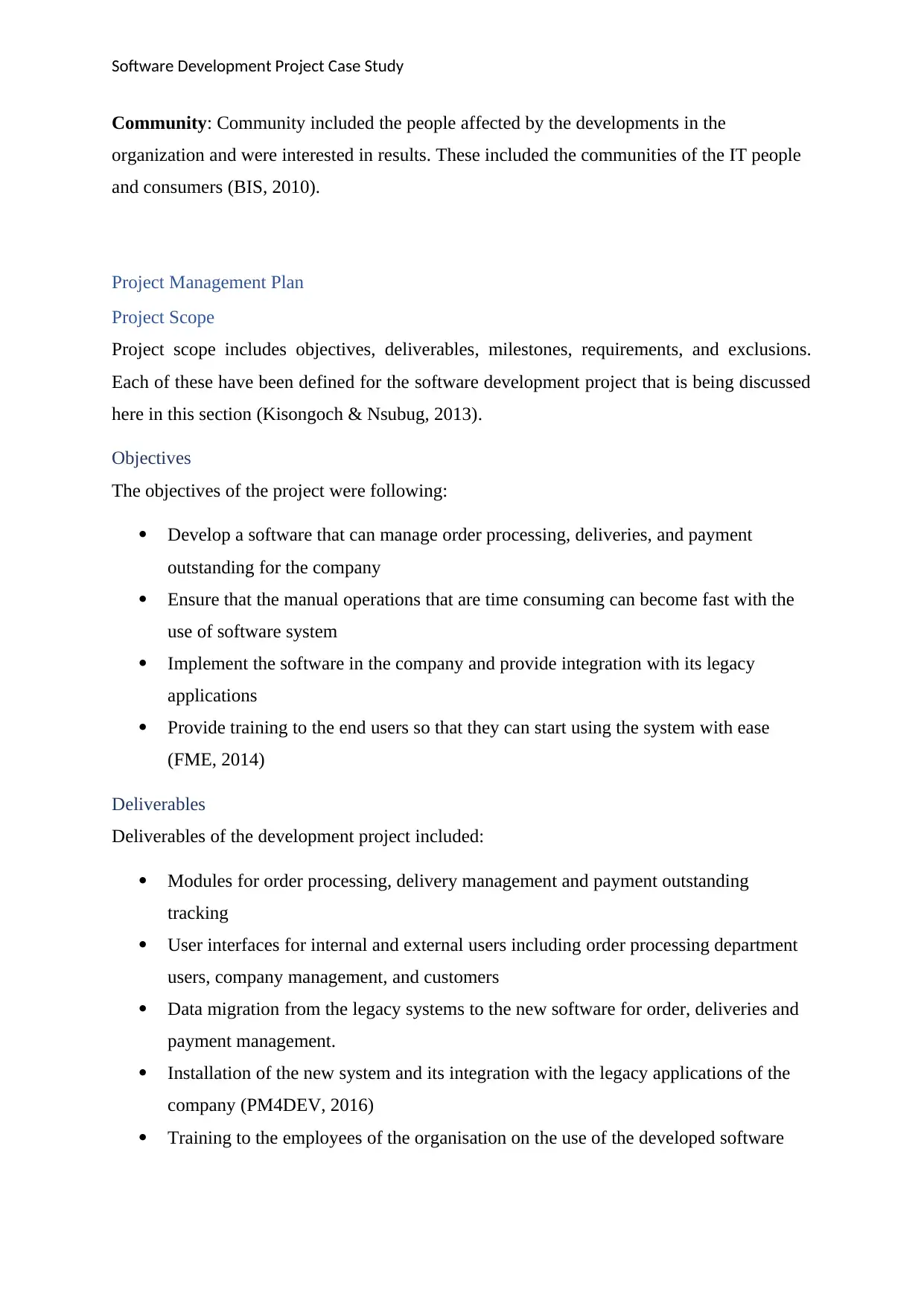
Community: Community included the people affected by the developments in the
organization and were interested in results. These included the communities of the IT people
and consumers (BIS, 2010).
Project Management Plan
Project Scope
Project scope includes objectives, deliverables, milestones, requirements, and exclusions.
Each of these have been defined for the software development project that is being discussed
here in this section (Kisongoch & Nsubug, 2013).
Objectives
The objectives of the project were following:
Develop a software that can manage order processing, deliveries, and payment
outstanding for the company
Ensure that the manual operations that are time consuming can become fast with the
use of software system
Implement the software in the company and provide integration with its legacy
applications
Provide training to the end users so that they can start using the system with ease
(FME, 2014)
Deliverables
Deliverables of the development project included:
Modules for order processing, delivery management and payment outstanding
tracking
User interfaces for internal and external users including order processing department
users, company management, and customers
Data migration from the legacy systems to the new software for order, deliveries and
payment management.
Installation of the new system and its integration with the legacy applications of the
company (PM4DEV, 2016)
Training to the employees of the organisation on the use of the developed software
Community: Community included the people affected by the developments in the
organization and were interested in results. These included the communities of the IT people
and consumers (BIS, 2010).
Project Management Plan
Project Scope
Project scope includes objectives, deliverables, milestones, requirements, and exclusions.
Each of these have been defined for the software development project that is being discussed
here in this section (Kisongoch & Nsubug, 2013).
Objectives
The objectives of the project were following:
Develop a software that can manage order processing, deliveries, and payment
outstanding for the company
Ensure that the manual operations that are time consuming can become fast with the
use of software system
Implement the software in the company and provide integration with its legacy
applications
Provide training to the end users so that they can start using the system with ease
(FME, 2014)
Deliverables
Deliverables of the development project included:
Modules for order processing, delivery management and payment outstanding
tracking
User interfaces for internal and external users including order processing department
users, company management, and customers
Data migration from the legacy systems to the new software for order, deliveries and
payment management.
Installation of the new system and its integration with the legacy applications of the
company (PM4DEV, 2016)
Training to the employees of the organisation on the use of the developed software
Paraphrase This Document
Need a fresh take? Get an instant paraphrase of this document with our AI Paraphraser
Software Development Project Case Study
Requirements
Functional requirements involved technicalities of the implementation. Software
development project has some functional and some non-functional requirements. Its
functional requirements would include administrative functions and user interface
requirements. Administrative functions include:
The software should provide feature for receiving orders and data related to the order
on the product, quantity, price, location, customer, and payment details.
An administrator should be able to have backend access to the data of customers as
well as of the company
An information feature must be prided which admittatur could use to generate reports
from the database
Administrator must have the access to deciding rights for other users as per the
company policies.
User interface requirements include:
The administrative user interface must provide control to all the functionalities needed
by the management including operations, access, and security
A web interface must be providing to the customers for the placement of the order
based on the product availability
A backend user interface would be provided to the company employees to perform
their needed functions which would include multiple logins for multiple departments
such that the features needed by specific department are only accessible to the users of
that department. For instance, the accounting department would have access to the
invoices but would not have access to production data.
Management interface would provide overview on the entire company data for the
purpose of monitoring operations and taking decisions.
Non-functional requirements of the project would include:
Availability: The software must have 99% of the uptime during working hours and even in
the case of upgrading needed, the downtime must remain limited to non-working hours at the
night.
Performance: At these points when the software is working, it should be able to take the
load of 1million users at any point of time allowing customers to order and back end teams
to process the orders.
Requirements
Functional requirements involved technicalities of the implementation. Software
development project has some functional and some non-functional requirements. Its
functional requirements would include administrative functions and user interface
requirements. Administrative functions include:
The software should provide feature for receiving orders and data related to the order
on the product, quantity, price, location, customer, and payment details.
An administrator should be able to have backend access to the data of customers as
well as of the company
An information feature must be prided which admittatur could use to generate reports
from the database
Administrator must have the access to deciding rights for other users as per the
company policies.
User interface requirements include:
The administrative user interface must provide control to all the functionalities needed
by the management including operations, access, and security
A web interface must be providing to the customers for the placement of the order
based on the product availability
A backend user interface would be provided to the company employees to perform
their needed functions which would include multiple logins for multiple departments
such that the features needed by specific department are only accessible to the users of
that department. For instance, the accounting department would have access to the
invoices but would not have access to production data.
Management interface would provide overview on the entire company data for the
purpose of monitoring operations and taking decisions.
Non-functional requirements of the project would include:
Availability: The software must have 99% of the uptime during working hours and even in
the case of upgrading needed, the downtime must remain limited to non-working hours at the
night.
Performance: At these points when the software is working, it should be able to take the
load of 1million users at any point of time allowing customers to order and back end teams
to process the orders.
Software Development Project Case Study
Scalability: The system should be able to accommodate for increasing users of the system in
near future without any major upgrade needed and thus, it made scalable to a million-user
load at any point of time which currently is only half a million.
Usability: The users should be able to use its features for performing all the desired
functions involving order processing, data management, delivery tracking, and payment
outstanding management.
Security: The software should have the inbuilt features that protect it from security treats
and unauthorized attacks so that the data of the customers and the company do not go into
the wrong hands.
Reliability: The data that gets stored into the system through various functions should create
automatic backups in the database and this data should remain intact without any
modification such that it can always be relied on. Any changes happening in the orders must
be automatically reflected on the data for ensuring its reliability.
Exclusions
The project did not include the following in its deliverables –
Training of customers as end users on the software usage
Troubleshooting problems with legacy applications after integration has been done
with the new software
Tracking Progress
The progress of the project was tracked with budget utilization and schedule adherence as per
the deliverables and activities that were to be executed on the project. A work Breakdown
Structure was prepared listing all the activities involved in the development project. For each
activity identified in the WBS, time required would was estimated in days. Activities that
were most critical to the project would were used for the calculation of the minimum duration
of the project. The time that is available to each activity was be recorded in the plan and
while during execution, a comparison was done between the available time planned and the
actual time taken for project activities. Slack time was calculated as the difference of the two
while tracking the progress of the project (SAEO, 2015).
Scalability: The system should be able to accommodate for increasing users of the system in
near future without any major upgrade needed and thus, it made scalable to a million-user
load at any point of time which currently is only half a million.
Usability: The users should be able to use its features for performing all the desired
functions involving order processing, data management, delivery tracking, and payment
outstanding management.
Security: The software should have the inbuilt features that protect it from security treats
and unauthorized attacks so that the data of the customers and the company do not go into
the wrong hands.
Reliability: The data that gets stored into the system through various functions should create
automatic backups in the database and this data should remain intact without any
modification such that it can always be relied on. Any changes happening in the orders must
be automatically reflected on the data for ensuring its reliability.
Exclusions
The project did not include the following in its deliverables –
Training of customers as end users on the software usage
Troubleshooting problems with legacy applications after integration has been done
with the new software
Tracking Progress
The progress of the project was tracked with budget utilization and schedule adherence as per
the deliverables and activities that were to be executed on the project. A work Breakdown
Structure was prepared listing all the activities involved in the development project. For each
activity identified in the WBS, time required would was estimated in days. Activities that
were most critical to the project would were used for the calculation of the minimum duration
of the project. The time that is available to each activity was be recorded in the plan and
while during execution, a comparison was done between the available time planned and the
actual time taken for project activities. Slack time was calculated as the difference of the two
while tracking the progress of the project (SAEO, 2015).
⊘ This is a preview!⊘
Do you want full access?
Subscribe today to unlock all pages.
Trusted by 1+ million students worldwide
Software Development Project Case Study
WBS
1.0 Initiation
1.1 Business Case Analysis
1.2 Budgeting
1.3 Scheduling
2.0 Planning
2.1 Cost Management Plan
2.2 Time Management plan
2.3 Risk Management plan
2.4 Quality Management Plan
2.5 Change management plan
2.6 Scope Management Plan
3.0 Execution
3.1 Requirement gathering
3.1.1 Functional Requirements
3.1.2 Non-functional requirement
3.2 Procurement
3.2.1 Hardware
3.2.2 Software license
3.3 Designing
3.3.1 Administrative interface
3.3.2 User Interface
3.3.3 Web interface
3.4 Development
3.4.1 Order processing module
3.4.2 Delivery tracking module
3.4.3 Outstanding payment management module
3.5 Testing
3.5.1 System testing
3.5.2 Unit testing
4.0 Implementation
4.1 Installation
WBS
1.0 Initiation
1.1 Business Case Analysis
1.2 Budgeting
1.3 Scheduling
2.0 Planning
2.1 Cost Management Plan
2.2 Time Management plan
2.3 Risk Management plan
2.4 Quality Management Plan
2.5 Change management plan
2.6 Scope Management Plan
3.0 Execution
3.1 Requirement gathering
3.1.1 Functional Requirements
3.1.2 Non-functional requirement
3.2 Procurement
3.2.1 Hardware
3.2.2 Software license
3.3 Designing
3.3.1 Administrative interface
3.3.2 User Interface
3.3.3 Web interface
3.4 Development
3.4.1 Order processing module
3.4.2 Delivery tracking module
3.4.3 Outstanding payment management module
3.5 Testing
3.5.1 System testing
3.5.2 Unit testing
4.0 Implementation
4.1 Installation
Paraphrase This Document
Need a fresh take? Get an instant paraphrase of this document with our AI Paraphraser
Software Development Project Case Study
4.2 Integration
4.3 Testing
4.3.1 Integration testing
4.3.2 User Acceptance testing
5.0 Closure
5.1 Lessons learned
5.2 Training
5.3 Closure documentation
5.4 Project Sign off
Project Scope Management
The purpose of project scope management is to ensure that the project is able to deliver the
desired output within the limitations of the constraints of time and cost. It involves execution
of planned activities while avoiding working on those excluded from the scope. A WBS is
used as the base for understanding what activities are required to be performed on a project
(Pennypacker, 2005). The scope was managed on the project through a five step process that
included gathering of functional and non-functional requirements of the software project,
defining of specific elements in the project scope, preparation of the work breakdown
structure to list down activities in detail, verification of scope by involving project
stakeholders through discussions, and controlling of the scope to ensure that only those
activities planned are executed without wasting any time on non-productive activities (CIMA,
2005). Project charter and stakeholder register usually create the inputs to scope management
plan. In the software development project, project charter was prepared at the start-up stage
which formed the basis for the use of scope management tools like interviews, surveys, and
observations. Output to the tools and techniques that are used to obtain information through
this tool could be requirements document or requirement traceability matrix. The company
used requirements document in which both functional and non-functional requirements of the
project were recorded in detail (PMI, 2013).
4.2 Integration
4.3 Testing
4.3.1 Integration testing
4.3.2 User Acceptance testing
5.0 Closure
5.1 Lessons learned
5.2 Training
5.3 Closure documentation
5.4 Project Sign off
Project Scope Management
The purpose of project scope management is to ensure that the project is able to deliver the
desired output within the limitations of the constraints of time and cost. It involves execution
of planned activities while avoiding working on those excluded from the scope. A WBS is
used as the base for understanding what activities are required to be performed on a project
(Pennypacker, 2005). The scope was managed on the project through a five step process that
included gathering of functional and non-functional requirements of the software project,
defining of specific elements in the project scope, preparation of the work breakdown
structure to list down activities in detail, verification of scope by involving project
stakeholders through discussions, and controlling of the scope to ensure that only those
activities planned are executed without wasting any time on non-productive activities (CIMA,
2005). Project charter and stakeholder register usually create the inputs to scope management
plan. In the software development project, project charter was prepared at the start-up stage
which formed the basis for the use of scope management tools like interviews, surveys, and
observations. Output to the tools and techniques that are used to obtain information through
this tool could be requirements document or requirement traceability matrix. The company
used requirements document in which both functional and non-functional requirements of the
project were recorded in detail (PMI, 2013).
Software Development Project Case Study
Project Communication Management
Stakeholder Communication
Stakeholders are the people or entities that are either affected by the project or affect the
project. They can have from low to high level of interest in the project and can carry from
low to high influence. The communication needs of stakeholders are identified by their
interest and influence levels. Stakeholders with low influence by high interests are kept
informed. Stakeholders with high influence but low interest could be communicated just to
keep them satisfied. Those with high influence as well as interest are managed closely
through formal and continuous communication. The modes of communication, frequency of
communication and the communication items would vary with stakeholders. On the software
development project, stakeholder communication was managed in the following ways (LIM,
et al., 2005):
Project Sponsor: The sponsor of the company was interested in ensuring that the project
brought business benefits to the organization and every investment made on it was justified
making project viable. He has high level of influence on the project and also high level of
interest. The project sponsor needs to be communicated formally by the project manager
through the submission of a project charter to get the approval on budget. Once the project
sponsor has approved it, he is only kept informed about how the project is going and
affecting the budget at every major milestone. A face to face meeting would be the mode of
communication during initiation for charter approval while email based communication can
be followed for updating on milestones (PMI, 2011). If the project faces a risk of cost over
run and extra funds are needed then a formal meeting may be needed between project
manager and the sponsor to decide on provision of additional funds. The project sponsor of
the software development project was met first for approval and then the project manager
sent him the project progress report with actual budget versus planned budget highlights
(Clement, 2005).
Customers: Customers of the company were the people who were going to use the web-
based interface for placing orders and thus, their satisfaction was important as they would be
needed to accept the project outcome for it to be successful. However, when considering
project, they carried moderate level of influence but low interest. Thus, they were just kept
informed about the project progress with formal emails sent to them informing them about
the potential changes in the system and how they were going to affect the order management
Project Communication Management
Stakeholder Communication
Stakeholders are the people or entities that are either affected by the project or affect the
project. They can have from low to high level of interest in the project and can carry from
low to high influence. The communication needs of stakeholders are identified by their
interest and influence levels. Stakeholders with low influence by high interests are kept
informed. Stakeholders with high influence but low interest could be communicated just to
keep them satisfied. Those with high influence as well as interest are managed closely
through formal and continuous communication. The modes of communication, frequency of
communication and the communication items would vary with stakeholders. On the software
development project, stakeholder communication was managed in the following ways (LIM,
et al., 2005):
Project Sponsor: The sponsor of the company was interested in ensuring that the project
brought business benefits to the organization and every investment made on it was justified
making project viable. He has high level of influence on the project and also high level of
interest. The project sponsor needs to be communicated formally by the project manager
through the submission of a project charter to get the approval on budget. Once the project
sponsor has approved it, he is only kept informed about how the project is going and
affecting the budget at every major milestone. A face to face meeting would be the mode of
communication during initiation for charter approval while email based communication can
be followed for updating on milestones (PMI, 2011). If the project faces a risk of cost over
run and extra funds are needed then a formal meeting may be needed between project
manager and the sponsor to decide on provision of additional funds. The project sponsor of
the software development project was met first for approval and then the project manager
sent him the project progress report with actual budget versus planned budget highlights
(Clement, 2005).
Customers: Customers of the company were the people who were going to use the web-
based interface for placing orders and thus, their satisfaction was important as they would be
needed to accept the project outcome for it to be successful. However, when considering
project, they carried moderate level of influence but low interest. Thus, they were just kept
informed about the project progress with formal emails sent to them informing them about
the potential changes in the system and how they were going to affect the order management
⊘ This is a preview!⊘
Do you want full access?
Subscribe today to unlock all pages.
Trusted by 1+ million students worldwide
Software Development Project Case Study
process of the company. They were also involved during the requirement gathering stage
through a face to face interview conducted with a few trusted customers (USP, 2000).
Suppliers: The suppliers of the project included the IT vendors and developers who had
moderate level of influence and high interest in the project as their output would determine
the success of the project and the project would earn them profits if successful. Thus,
suppliers were managed closely and involved throughout the progress of the project right
from the starting of the bidding and vendor selection process. These suppliers were interested
in getting desired payments and clarity on the project requirements. Thus, they were formally
involved through contracts that mentioned the details legally and identified terms, conditions,
and responsibilities that they had to follow on the project (Júnior, et al., 2015).
End users: End users of the system were the internal employees from the order processing,
delivery, and finance department. These users would use the actual developed software and
thus, had moderate interest in the project with high influence. They were closely involved in
the project starting from the requirement gathering stage where their inputs were taken and
further, they were involved in review meetings to understand how software outcome was
coming and if it was aligned with the requirements. They were also involved in the testing
stages for project acceptance (MARCONI, 2013).
Community: Community included the people from the IT communities, researchers and
government that were having low interest and low influence on the project and thus, were just
kept informed about when the project started and when it was finished with not much
involvement in the operational details (Jainendrakumar, 2016).
Collaborative Tools
A number of collaborative tools were used while executing the project that included Google
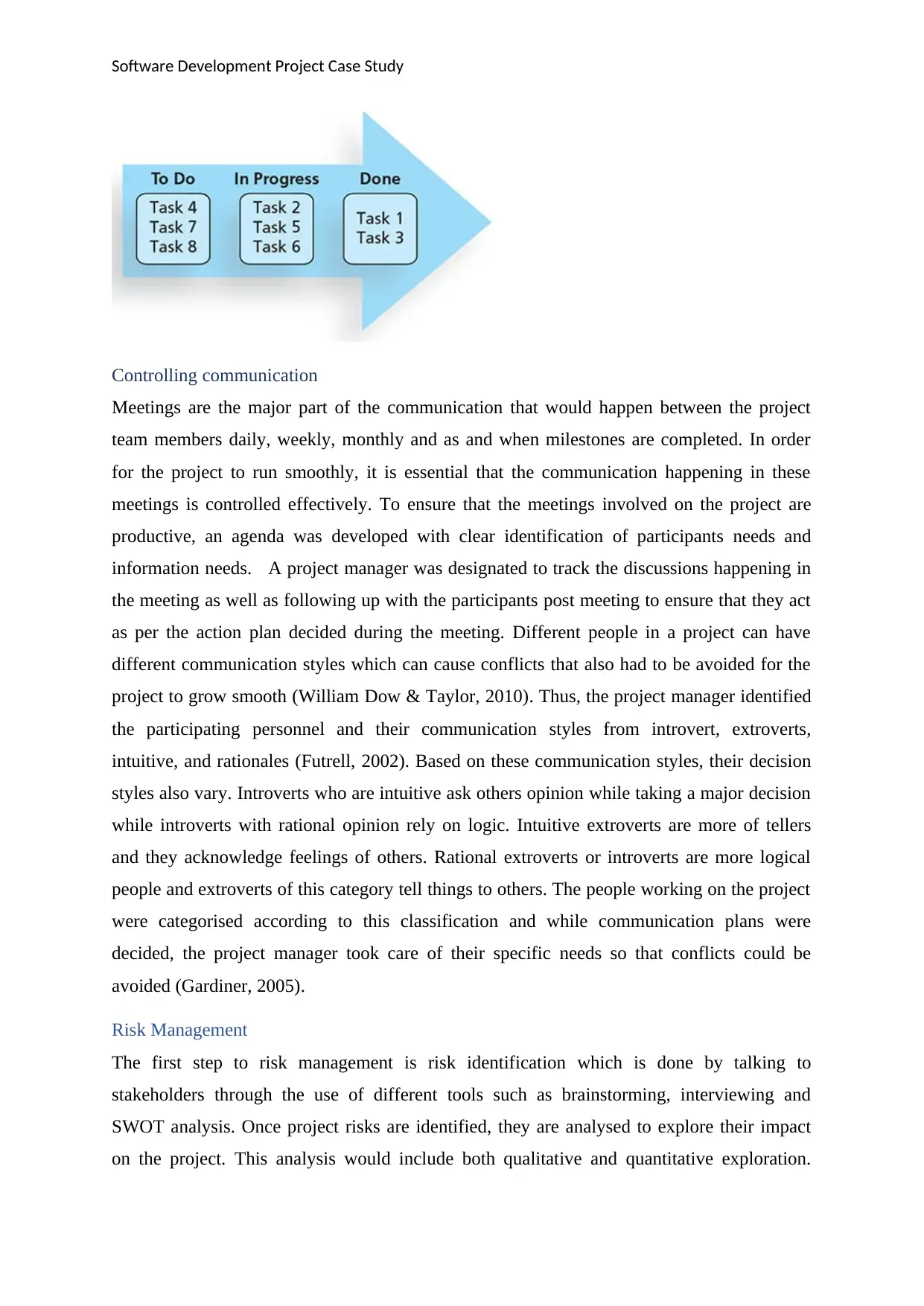
Docs for creating, editing and sharing documents between the team members online. Kanban
boards were used for visual display of the tasks that were completed at each stage or were in
progress for the team to see each day so that they would know how they are progressing
against the plan. Tasks to be done, tasks in progress, and tasks that were done were plotted on
the board which acted as a guide for all the team members to keep progressing in the right
direction as well as have an insight on how the whole project is progressing (Berbec, 2014).
process of the company. They were also involved during the requirement gathering stage
through a face to face interview conducted with a few trusted customers (USP, 2000).
Suppliers: The suppliers of the project included the IT vendors and developers who had
moderate level of influence and high interest in the project as their output would determine
the success of the project and the project would earn them profits if successful. Thus,
suppliers were managed closely and involved throughout the progress of the project right
from the starting of the bidding and vendor selection process. These suppliers were interested
in getting desired payments and clarity on the project requirements. Thus, they were formally
involved through contracts that mentioned the details legally and identified terms, conditions,
and responsibilities that they had to follow on the project (Júnior, et al., 2015).
End users: End users of the system were the internal employees from the order processing,
delivery, and finance department. These users would use the actual developed software and
thus, had moderate interest in the project with high influence. They were closely involved in
the project starting from the requirement gathering stage where their inputs were taken and
further, they were involved in review meetings to understand how software outcome was
coming and if it was aligned with the requirements. They were also involved in the testing
stages for project acceptance (MARCONI, 2013).
Community: Community included the people from the IT communities, researchers and
government that were having low interest and low influence on the project and thus, were just
kept informed about when the project started and when it was finished with not much
involvement in the operational details (Jainendrakumar, 2016).
Collaborative Tools
A number of collaborative tools were used while executing the project that included Google
Docs for creating, editing and sharing documents between the team members online. Kanban
boards were used for visual display of the tasks that were completed at each stage or were in
progress for the team to see each day so that they would know how they are progressing
against the plan. Tasks to be done, tasks in progress, and tasks that were done were plotted on
the board which acted as a guide for all the team members to keep progressing in the right
direction as well as have an insight on how the whole project is progressing (Berbec, 2014).
Paraphrase This Document
Need a fresh take? Get an instant paraphrase of this document with our AI Paraphraser
Software Development Project Case Study
Controlling communication
Meetings are the major part of the communication that would happen between the project
team members daily, weekly, monthly and as and when milestones are completed. In order
for the project to run smoothly, it is essential that the communication happening in these
meetings is controlled effectively. To ensure that the meetings involved on the project are
productive, an agenda was developed with clear identification of participants needs and
information needs. A project manager was designated to track the discussions happening in
the meeting as well as following up with the participants post meeting to ensure that they act
as per the action plan decided during the meeting. Different people in a project can have
different communication styles which can cause conflicts that also had to be avoided for the
project to grow smooth (William Dow & Taylor, 2010). Thus, the project manager identified
the participating personnel and their communication styles from introvert, extroverts,
intuitive, and rationales (Futrell, 2002). Based on these communication styles, their decision
styles also vary. Introverts who are intuitive ask others opinion while taking a major decision
while introverts with rational opinion rely on logic. Intuitive extroverts are more of tellers
and they acknowledge feelings of others. Rational extroverts or introverts are more logical
people and extroverts of this category tell things to others. The people working on the project
were categorised according to this classification and while communication plans were
decided, the project manager took care of their specific needs so that conflicts could be
avoided (Gardiner, 2005).
Risk Management
The first step to risk management is risk identification which is done by talking to
stakeholders through the use of different tools such as brainstorming, interviewing and
SWOT analysis. Once project risks are identified, they are analysed to explore their impact
on the project. This analysis would include both qualitative and quantitative exploration.
Controlling communication
Meetings are the major part of the communication that would happen between the project
team members daily, weekly, monthly and as and when milestones are completed. In order
for the project to run smoothly, it is essential that the communication happening in these
meetings is controlled effectively. To ensure that the meetings involved on the project are
productive, an agenda was developed with clear identification of participants needs and
information needs. A project manager was designated to track the discussions happening in
the meeting as well as following up with the participants post meeting to ensure that they act
as per the action plan decided during the meeting. Different people in a project can have
different communication styles which can cause conflicts that also had to be avoided for the
project to grow smooth (William Dow & Taylor, 2010). Thus, the project manager identified
the participating personnel and their communication styles from introvert, extroverts,
intuitive, and rationales (Futrell, 2002). Based on these communication styles, their decision
styles also vary. Introverts who are intuitive ask others opinion while taking a major decision
while introverts with rational opinion rely on logic. Intuitive extroverts are more of tellers
and they acknowledge feelings of others. Rational extroverts or introverts are more logical
people and extroverts of this category tell things to others. The people working on the project
were categorised according to this classification and while communication plans were
decided, the project manager took care of their specific needs so that conflicts could be
avoided (Gardiner, 2005).
Risk Management
The first step to risk management is risk identification which is done by talking to
stakeholders through the use of different tools such as brainstorming, interviewing and
SWOT analysis. Once project risks are identified, they are analysed to explore their impact
on the project. This analysis would include both qualitative and quantitative exploration.
Software Development Project Case Study
Based on this analysis, an appropriate response plan is created for management of risks. Risks
can be managed using either of the common strategies that include avoiding, transferring,
mitigating impacts or assuming the risks. Based the level of severity which is determined by
understand the probability of their occurrence and the impact on the project, the ideal
response can be determined (Caltrans, 2007).
Risk Identification Tools
Risks can be identified by involving project team and key stakeholders of the project who can
help identify different types of risks. A number of different tools were used at different stages
of the project for identification of risks and these included SWOT analyses of the project that
revealed broad categories of risks that project can face, interview that helped in identifying
risks in each category, and brainstorming that was used to refine the risks identified and
produce a description for them.
SWOT analysis
This involved identification of strengths, weaknesses, opportunities and threats of the project
in which weaknesses and threats are the most important areas to discuss when risks have to
be identified on a project. The weaknesses of the software development project included:
Lack of experience in users of working on the automated systems like the one being
built
Limited human resource that was involved in the project execution
The project has been provided with a limited budget which cannot be exceeded
beyond the utilization of the contingency amount
The threats to the project included:
The software could have the bugs that would affect its functionalities or fall prey to
security threats and thus, lead to the project failure
It could be found later that project could not be completed within the allotted budget
but would need more money which may make the project not feasible
Stakeholders may not be satisfied with the project output and then then would not
accept the final output after its completion
Based on this analysis, an appropriate response plan is created for management of risks. Risks
can be managed using either of the common strategies that include avoiding, transferring,
mitigating impacts or assuming the risks. Based the level of severity which is determined by
understand the probability of their occurrence and the impact on the project, the ideal
response can be determined (Caltrans, 2007).
Risk Identification Tools
Risks can be identified by involving project team and key stakeholders of the project who can
help identify different types of risks. A number of different tools were used at different stages
of the project for identification of risks and these included SWOT analyses of the project that
revealed broad categories of risks that project can face, interview that helped in identifying
risks in each category, and brainstorming that was used to refine the risks identified and
produce a description for them.
SWOT analysis
This involved identification of strengths, weaknesses, opportunities and threats of the project
in which weaknesses and threats are the most important areas to discuss when risks have to
be identified on a project. The weaknesses of the software development project included:
Lack of experience in users of working on the automated systems like the one being
built
Limited human resource that was involved in the project execution
The project has been provided with a limited budget which cannot be exceeded
beyond the utilization of the contingency amount
The threats to the project included:
The software could have the bugs that would affect its functionalities or fall prey to
security threats and thus, lead to the project failure
It could be found later that project could not be completed within the allotted budget
but would need more money which may make the project not feasible
Stakeholders may not be satisfied with the project output and then then would not
accept the final output after its completion
⊘ This is a preview!⊘
Do you want full access?
Subscribe today to unlock all pages.
Trusted by 1+ million students worldwide

1 out of 23


Related Documents


Your All-in-One AI-Powered Toolkit for Academic Success.
+13062052269
info@desklib.com
Available 24*7 on WhatsApp / Email
![[object Object]](/_next/static/media/star-bottom.7253800d.svg)
Unlock your academic potential
Copyright © 2020–2026 A2Z Services. All Rights Reserved. Developed and managed by ZUCOL.