Software Project Management: UML-Based School System Design
VerifiedAdded on 2023/04/25
|20
|2687
|112
Project
AI Summary
This document presents a comprehensive analysis and design of a school management system, focusing on enhancing communication between school staff and parents. It begins with an analysis of client requirements, incorporating assumptions for clarity and precision. The project employs Goal-Oriented Requirements Engineering (RE) to model system goals effectively. Functional and non-functional requirements are elicited, each with a unique ID for traceability. The Rational Unified Process (RUP) elaboration phase guides the development, dividing it into business modeling, analysis and design, implementation, testing, and deployment. UML diagrams, including activity, class, object, sequence, collaboration, state, and deployment diagrams, illustrate the system's architecture and behavior. A subsystem for fees calculation is also detailed. The project aims to provide an accessible online platform for parents to monitor their children's attendance, academic schedule, grades, and school-related information, while also facilitating feedback and notifications.

Running head: SOFTWARE PROCESS MANAGEMENT
SOFTWARE PROCESS MANAGEMENT- SCHOOL MANAGEMENT SYSTEM
Name of the Student
Name of the University
Author Note
SOFTWARE PROCESS MANAGEMENT- SCHOOL MANAGEMENT SYSTEM
Name of the Student
Name of the University
Author Note

Paraphrase This Document
Need a fresh take? Get an instant paraphrase of this document with our AI Paraphraser
1SOFTWARE PROCESS MANAGEMENT
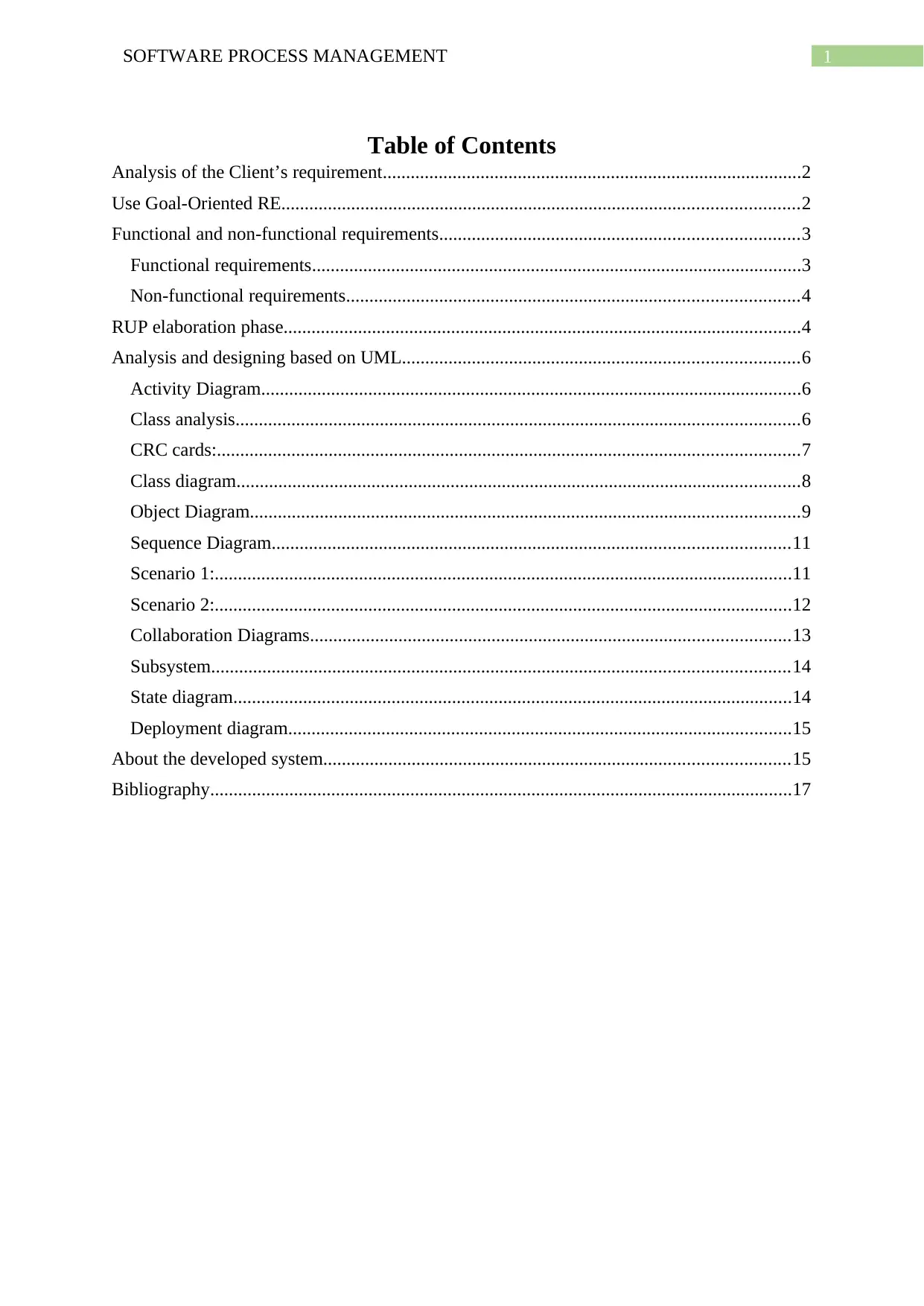
Table of Contents
Analysis of the Client’s requirement..........................................................................................2
Use Goal-Oriented RE...............................................................................................................2
Functional and non-functional requirements.............................................................................3
Functional requirements.........................................................................................................3
Non-functional requirements.................................................................................................4
RUP elaboration phase...............................................................................................................4
Analysis and designing based on UML.....................................................................................6
Activity Diagram....................................................................................................................6
Class analysis.........................................................................................................................6
CRC cards:.............................................................................................................................7
Class diagram.........................................................................................................................8
Object Diagram......................................................................................................................9
Sequence Diagram...............................................................................................................11
Scenario 1:............................................................................................................................11
Scenario 2:............................................................................................................................12
Collaboration Diagrams.......................................................................................................13
Subsystem............................................................................................................................14
State diagram........................................................................................................................14
Deployment diagram............................................................................................................15
About the developed system....................................................................................................15
Bibliography.............................................................................................................................17
Table of Contents
Analysis of the Client’s requirement..........................................................................................2
Use Goal-Oriented RE...............................................................................................................2
Functional and non-functional requirements.............................................................................3
Functional requirements.........................................................................................................3
Non-functional requirements.................................................................................................4
RUP elaboration phase...............................................................................................................4
Analysis and designing based on UML.....................................................................................6
Activity Diagram....................................................................................................................6
Class analysis.........................................................................................................................6
CRC cards:.............................................................................................................................7
Class diagram.........................................................................................................................8
Object Diagram......................................................................................................................9
Sequence Diagram...............................................................................................................11
Scenario 1:............................................................................................................................11
Scenario 2:............................................................................................................................12
Collaboration Diagrams.......................................................................................................13
Subsystem............................................................................................................................14
State diagram........................................................................................................................14
Deployment diagram............................................................................................................15
About the developed system....................................................................................................15
Bibliography.............................................................................................................................17

2SOFTWARE PROCESS MANAGEMENT
Analysis of the Client’s requirement
The aim of the project is to develop a school management system that will enhance
the collaboration between the school and the parents. The developed UML system will
facilitate effective way of communicating and will also facilitate parents to determine all the
details regarding their children. The developed system will be accessible by parents and
school staffs. The school staff will be able to effectively maintain the availability of the
student’s educational information (Rivera et al. 2018). The developed system will allow to
access the following information regarding the student online. This includes attendance of the
student, the academic schedule, midterm grades, the scientific level of student, details
regarding the fees and the school regulations and conditions that are needed to be followed by
the student. In addition to this the system will also send SMS and emails for notifying the
results and parents will be able to share their valuable feedback through this system. The
main requirement of the client is to access the information regarding every student and
conveying the messages to the parents at right time (Laudon and Laudon 2016). The system
will enhance the communication between the parents and school staffs. This will ensure that
the student is able to perform effectively and will enhance their grades.
Use Goal-Oriented RE
Goal oriented requirements engineering is referred to the situations where goals are
used as useful conceptualization and helps in analysing the requirements. The main goal of
the school management system is to develop a system that will enhance communication
between the school staffs and parents. The system will ensure performing tasks online and
will generate messages for notifying parents about the important activities taking place within
the school premises (Lanza and Cooper 2016). The use goal oriented RE will ensure that
Analysis of the Client’s requirement
The aim of the project is to develop a school management system that will enhance
the collaboration between the school and the parents. The developed UML system will
facilitate effective way of communicating and will also facilitate parents to determine all the
details regarding their children. The developed system will be accessible by parents and
school staffs. The school staff will be able to effectively maintain the availability of the
student’s educational information (Rivera et al. 2018). The developed system will allow to
access the following information regarding the student online. This includes attendance of the
student, the academic schedule, midterm grades, the scientific level of student, details
regarding the fees and the school regulations and conditions that are needed to be followed by
the student. In addition to this the system will also send SMS and emails for notifying the
results and parents will be able to share their valuable feedback through this system. The
main requirement of the client is to access the information regarding every student and
conveying the messages to the parents at right time (Laudon and Laudon 2016). The system
will enhance the communication between the parents and school staffs. This will ensure that
the student is able to perform effectively and will enhance their grades.
Use Goal-Oriented RE
Goal oriented requirements engineering is referred to the situations where goals are
used as useful conceptualization and helps in analysing the requirements. The main goal of
the school management system is to develop a system that will enhance communication
between the school staffs and parents. The system will ensure performing tasks online and
will generate messages for notifying parents about the important activities taking place within
the school premises (Lanza and Cooper 2016). The use goal oriented RE will ensure that
⊘ This is a preview!⊘
Do you want full access?
Subscribe today to unlock all pages.

Trusted by 1+ million students worldwide

3SOFTWARE PROCESS MANAGEMENT
proper requirement engineering is done so that the need of the system can be analysed
properly. The requirement engineering will help to address the essential requirement
associated with the system.
Functional and non-functional requirements
Functional requirements
The major functional requirements related to school management system is that it
needs to be done based on network. Functional requirements are referred to those items that
are related mainly with technical functionality of the developed system (Hastarista 2016).
The main aim of the system is to develop a system that will ensure effective way of
communication between the parents and the school system.
FR1- login access: The admin should be able to login properly. In this system the
main admins are the school management staffs and the parents. They should have
their proper login details so that they can access the system at any time (Spanbauer
and Hillman 2014). However every members in the system is allowed to leave the
system whenever they want.
FR2- Activity Alert: The alerts needs to be sent based on the school activity that is
taking place on regular basis.
FR3- Updated based on the need: The system needs to be updated based on the
need of the students and needs to manage all the school activity properly. The marks
of every student needs to be updated on every users profile so that the parents can
check the result of their child.
FR4- Attendance of the Student: In addition to this the system will be able to mark
the attendance and will be able to communicate with the parents.
FR5- Feedback: Parents will be able to send their feedback through this system.
proper requirement engineering is done so that the need of the system can be analysed
properly. The requirement engineering will help to address the essential requirement
associated with the system.
Functional and non-functional requirements
Functional requirements
The major functional requirements related to school management system is that it
needs to be done based on network. Functional requirements are referred to those items that
are related mainly with technical functionality of the developed system (Hastarista 2016).
The main aim of the system is to develop a system that will ensure effective way of
communication between the parents and the school system.
FR1- login access: The admin should be able to login properly. In this system the
main admins are the school management staffs and the parents. They should have
their proper login details so that they can access the system at any time (Spanbauer
and Hillman 2014). However every members in the system is allowed to leave the
system whenever they want.
FR2- Activity Alert: The alerts needs to be sent based on the school activity that is
taking place on regular basis.
FR3- Updated based on the need: The system needs to be updated based on the
need of the students and needs to manage all the school activity properly. The marks
of every student needs to be updated on every users profile so that the parents can
check the result of their child.
FR4- Attendance of the Student: In addition to this the system will be able to mark
the attendance and will be able to communicate with the parents.
FR5- Feedback: Parents will be able to send their feedback through this system.
Paraphrase This Document
Need a fresh take? Get an instant paraphrase of this document with our AI Paraphraser

4SOFTWARE PROCESS MANAGEMENT
FR6- Email notification: The school staff will be able to send emails regarding the
important activity for notifying the parents.
FR7- Scientific level of the Student: the system will be able to determine the
scientific level of the student that will help in understanding the growth of the student
in the academic fields.
The functional requirements prioritised based on the MoSCow criteria are as follows:
M- The system must have FR1, FR4 and FR5 functional requirements
S- The system should have the functional requirements FR3 and FR2
C- The system could have in case it does not affect the other part of the system
that is the functional requirement FR7.
W- The system won’t have the functional requirement biometrics for now but has
the opportunity to be implemented in future.
Non-functional requirements
The non-functional requirements includes the requirements that are used for determining
the function of a system (Tang et al. 2018). Non-functional requirements includes reliability,
performance, scalability, maintainability and usability.
NFR1- reliability: the developed system needs to be reliable so that the staffs and
parents can rely on the system (Dennis, Wixom and Tegarden 2015). Before sharing
any information it becomes important to ensure that reliable data is shared and
everyone associated with the system is alerted about the information.
NFR2- Scalability: scalability ensures that the developed system passes all the
requirement test so that right information is shared to every parents and within the
correct time.
FR6- Email notification: The school staff will be able to send emails regarding the
important activity for notifying the parents.
FR7- Scientific level of the Student: the system will be able to determine the
scientific level of the student that will help in understanding the growth of the student
in the academic fields.
The functional requirements prioritised based on the MoSCow criteria are as follows:
M- The system must have FR1, FR4 and FR5 functional requirements
S- The system should have the functional requirements FR3 and FR2
C- The system could have in case it does not affect the other part of the system
that is the functional requirement FR7.
W- The system won’t have the functional requirement biometrics for now but has
the opportunity to be implemented in future.
Non-functional requirements
The non-functional requirements includes the requirements that are used for determining
the function of a system (Tang et al. 2018). Non-functional requirements includes reliability,
performance, scalability, maintainability and usability.
NFR1- reliability: the developed system needs to be reliable so that the staffs and
parents can rely on the system (Dennis, Wixom and Tegarden 2015). Before sharing
any information it becomes important to ensure that reliable data is shared and
everyone associated with the system is alerted about the information.
NFR2- Scalability: scalability ensures that the developed system passes all the
requirement test so that right information is shared to every parents and within the
correct time.

5SOFTWARE PROCESS MANAGEMENT
NFR3- Maintainability: this ensures the system is updated frequently for better
working. Every data regarding the student needs to be effectively updated within the
system.
NFR4- Usability: the developed system will be easily accessible and will be available
for 24 hours. Whenever there is a need of teacher they will be able to easily access the
system.
Based on the MoSCow criteria the non-functional requirements are prioritised is as
follows:
M- the system must be reliable (NFR1) so that it can ensure better working in future
S- The system should be easy to use and maintain, thus it is important to have the
NFR4 and NFR3 respectively.
C- The system could include the scalability requirement for ensuring better working.
W- The system does not have traceability feature, however it is expected to be
implemented in future.
RUP elaboration phase
Rational unified process is a software development process from rational. This
includes dividing the development process into four specific parts that includes business
modelling, analysing and designing, implementation, testing and deployment (Clegg 2017).
This helps in development of the school management system. The major four phases are as
follows:
Inception: this part includes stating the idea behind project. The school management
system offers a system that will help in improving the communication between
parents and school staffs (Doan and Gogolla 2018). The team behind development of
the system needs to focus on whether the project is worth pursing and the resources
NFR3- Maintainability: this ensures the system is updated frequently for better
working. Every data regarding the student needs to be effectively updated within the
system.
NFR4- Usability: the developed system will be easily accessible and will be available
for 24 hours. Whenever there is a need of teacher they will be able to easily access the
system.
Based on the MoSCow criteria the non-functional requirements are prioritised is as
follows:
M- the system must be reliable (NFR1) so that it can ensure better working in future
S- The system should be easy to use and maintain, thus it is important to have the
NFR4 and NFR3 respectively.
C- The system could include the scalability requirement for ensuring better working.
W- The system does not have traceability feature, however it is expected to be
implemented in future.
RUP elaboration phase
Rational unified process is a software development process from rational. This
includes dividing the development process into four specific parts that includes business
modelling, analysing and designing, implementation, testing and deployment (Clegg 2017).
This helps in development of the school management system. The major four phases are as
follows:
Inception: this part includes stating the idea behind project. The school management
system offers a system that will help in improving the communication between
parents and school staffs (Doan and Gogolla 2018). The team behind development of
the system needs to focus on whether the project is worth pursing and the resources
⊘ This is a preview!⊘
Do you want full access?
Subscribe today to unlock all pages.
Trusted by 1+ million students worldwide

6SOFTWARE PROCESS MANAGEMENT
needed for the betterment of the system. RUP development methodology includes
providing a structured way for companies for creating a software programs.
Elaboration: this is used to elaborate the architecture behind the system developed
for the users and the resources required are further evaluated.
Construction: this phase includes developing the project based on the requirement
and completing it within the time (Torre et al. 2018). The required software is
designed, written and tested in a way so that it can be evaluated properly and
effectively.
Transition: the developed system is released for the use of the school staffs. Once the
system is ready to launch it will require frequent updates and feedback from the end
users.
Analysis and designing based on UML
Activity Diagram
needed for the betterment of the system. RUP development methodology includes
providing a structured way for companies for creating a software programs.
Elaboration: this is used to elaborate the architecture behind the system developed
for the users and the resources required are further evaluated.
Construction: this phase includes developing the project based on the requirement
and completing it within the time (Torre et al. 2018). The required software is
designed, written and tested in a way so that it can be evaluated properly and
effectively.
Transition: the developed system is released for the use of the school staffs. Once the
system is ready to launch it will require frequent updates and feedback from the end
users.
Analysis and designing based on UML
Activity Diagram
Paraphrase This Document
Need a fresh take? Get an instant paraphrase of this document with our AI Paraphraser

7SOFTWARE PROCESS MANAGEMENT
About the use case description
Use case Description
Enter admin details This will ask the admin to enter details. Once they
have admitted correct details than they will be
directed towards the login side.
Login The login will accept the details and will start
calculating.
Check login details Once the user enters the details, the system will check
whether it is a valid id or not.
Submit details After the use enters there details within the system,
this are being submitted to the systems database.
School regulations and
conditions
This will store all the regulations associated with the
school that are needed to be followed by each student.
Student attendance This will ensure proper attendance is marked for each
student.
Academic schedule This will store the schedule associated with each
student and to their respective classes.
Notification for parents This will alert the parents about each activity taking
place within the system.
Class analysis
a. The result of noun/verb analysis could be:
These will include the nouns and the properties where they belong:
System
Student ID
About the use case description
Use case Description
Enter admin details This will ask the admin to enter details. Once they
have admitted correct details than they will be
directed towards the login side.
Login The login will accept the details and will start
calculating.
Check login details Once the user enters the details, the system will check
whether it is a valid id or not.
Submit details After the use enters there details within the system,
this are being submitted to the systems database.
School regulations and
conditions
This will store all the regulations associated with the
school that are needed to be followed by each student.
Student attendance This will ensure proper attendance is marked for each
student.
Academic schedule This will store the schedule associated with each
student and to their respective classes.
Notification for parents This will alert the parents about each activity taking
place within the system.
Class analysis
a. The result of noun/verb analysis could be:
These will include the nouns and the properties where they belong:
System
Student ID
8SOFTWARE PROCESS MANAGEMENT
Teacher
Parents
Attendance
The verbs are as follows:
(Teacher) logins
(Parent’s) login
System calculate attendance
System displays the midterm grades
System calculates the Academic schedule.
Calculating the Scientific level of the student
Generating email for alerting the parents
Calculating the remaining fees
Generates Feedback
Describes School regulation and conditions
However it is important for every user to login with their accounts separately. Every
parent will get a unique ID resemblance to their child.
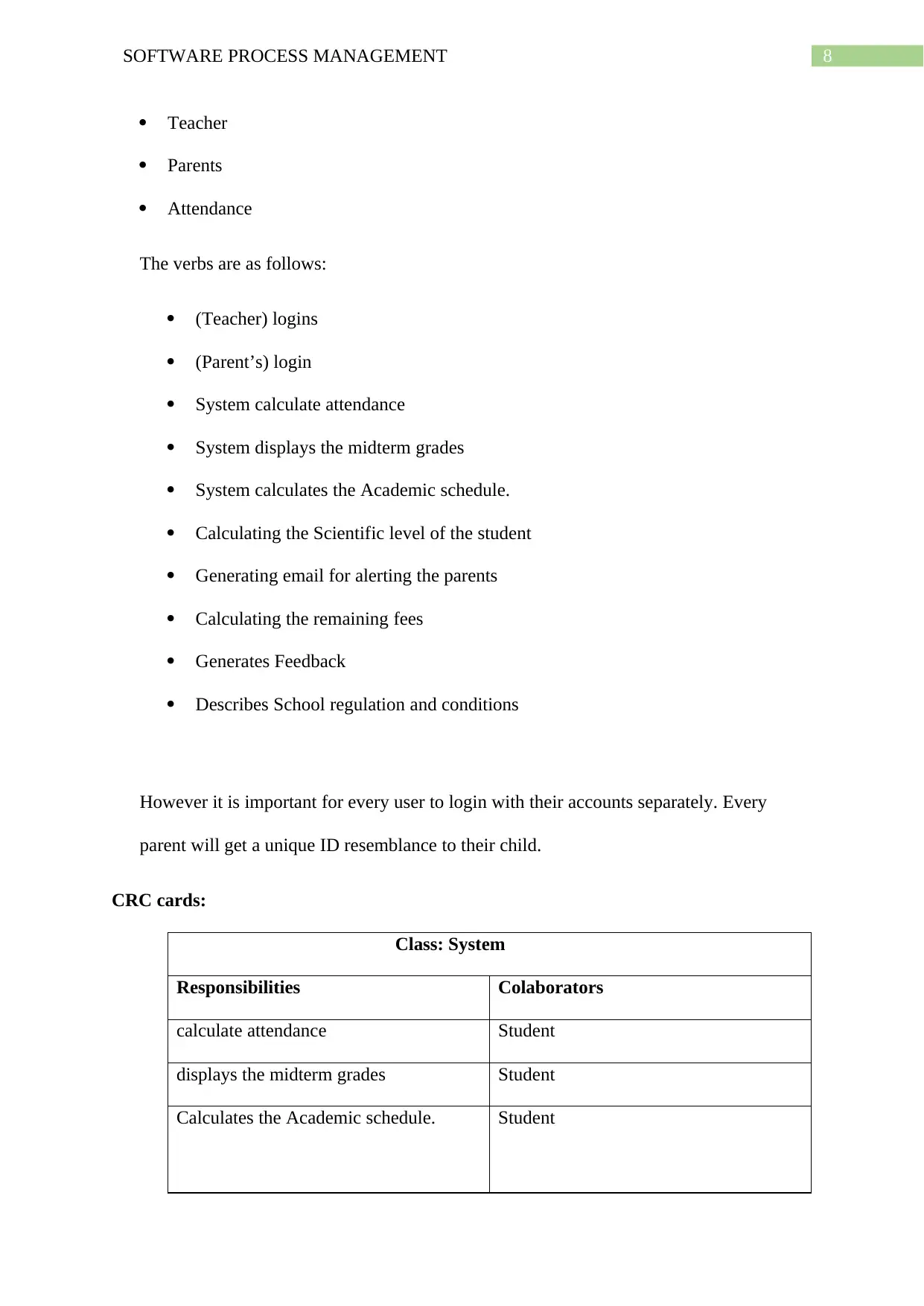
CRC cards:
Class: System
Responsibilities Colaborators
calculate attendance Student
displays the midterm grades Student
Calculates the Academic schedule. Student
Teacher
Parents
Attendance
The verbs are as follows:
(Teacher) logins
(Parent’s) login
System calculate attendance
System displays the midterm grades
System calculates the Academic schedule.
Calculating the Scientific level of the student
Generating email for alerting the parents
Calculating the remaining fees
Generates Feedback
Describes School regulation and conditions
However it is important for every user to login with their accounts separately. Every
parent will get a unique ID resemblance to their child.
CRC cards:
Class: System
Responsibilities Colaborators
calculate attendance Student
displays the midterm grades Student
Calculates the Academic schedule. Student
⊘ This is a preview!⊘
Do you want full access?
Subscribe today to unlock all pages.
Trusted by 1+ million students worldwide

9SOFTWARE PROCESS MANAGEMENT
Calculating the Scientific level of the
student
Student
Describes School regulation and
conditions
School
Calculating the remaining fees Student
Class: Teacher
Responsibilities Colaborators
School regulations and conditions
Class: Parents
Responsibilities Colaborators
Feedback
First Class diagram
Calculating the Scientific level of the
student
Student
Describes School regulation and
conditions
School
Calculating the remaining fees Student
Class: Teacher
Responsibilities Colaborators
School regulations and conditions
Class: Parents
Responsibilities Colaborators
Feedback
First Class diagram
Paraphrase This Document
Need a fresh take? Get an instant paraphrase of this document with our AI Paraphraser

10SOFTWARE PROCESS MANAGEMENT
Object Diagram
Object Diagram

11SOFTWARE PROCESS MANAGEMENT
⊘ This is a preview!⊘
Do you want full access?
Subscribe today to unlock all pages.
Trusted by 1+ million students worldwide

1 out of 20


Related Documents


Your All-in-One AI-Powered Toolkit for Academic Success.
+13062052269
info@desklib.com
Available 24*7 on WhatsApp / Email
![[object Object]](/_next/static/media/star-bottom.7253800d.svg)
Unlock your academic potential
Copyright © 2020–2025 A2Z Services. All Rights Reserved. Developed and managed by ZUCOL.