Comprehensive Soil Mechanics Assignment: Stress, Strain Analysis

Verified

Added on  2023/06/08

|7
|659
|431
Homework Assignment
AI Summary
This assignment solution delves into the principles of soil mechanics, addressing four key questions related to soil behavior under different stress conditions. The first question calculates the values of q, p’, and v at failure using provided parameters like P1200, Γ, M, λ, and N. The second question involves calculating deviatoric stress, volumetric and shear strains, shear modulus, bulk modulus, and elastic modulus based on given dimensions, axial and radial effective stresses, and displacements of a soil specimen. The third question explores undrained test conditions for soil samples, determining pore pressure development under isotropically consolidated conditions. Finally, the fourth question mirrors the first, requiring the calculation of q, p’, and v at failure but with a different set of provided parameters. The solutions demonstrate a thorough understanding of soil mechanics principles and their application in practical calculations. Desklib offers a wealth of similar solved assignments and past papers to aid students in their studies.

Document Page
Soil Mechanics 1
Soil Mechanics
Name:
Class:
Professor:
Institution:
City and State:
Date:
tabler-icon-diamond-filled.svg

Paraphrase This Document

Need a fresh take? Get an instant paraphrase of this document with our AI Paraphraser
Document Page
Soil Mechanics 2
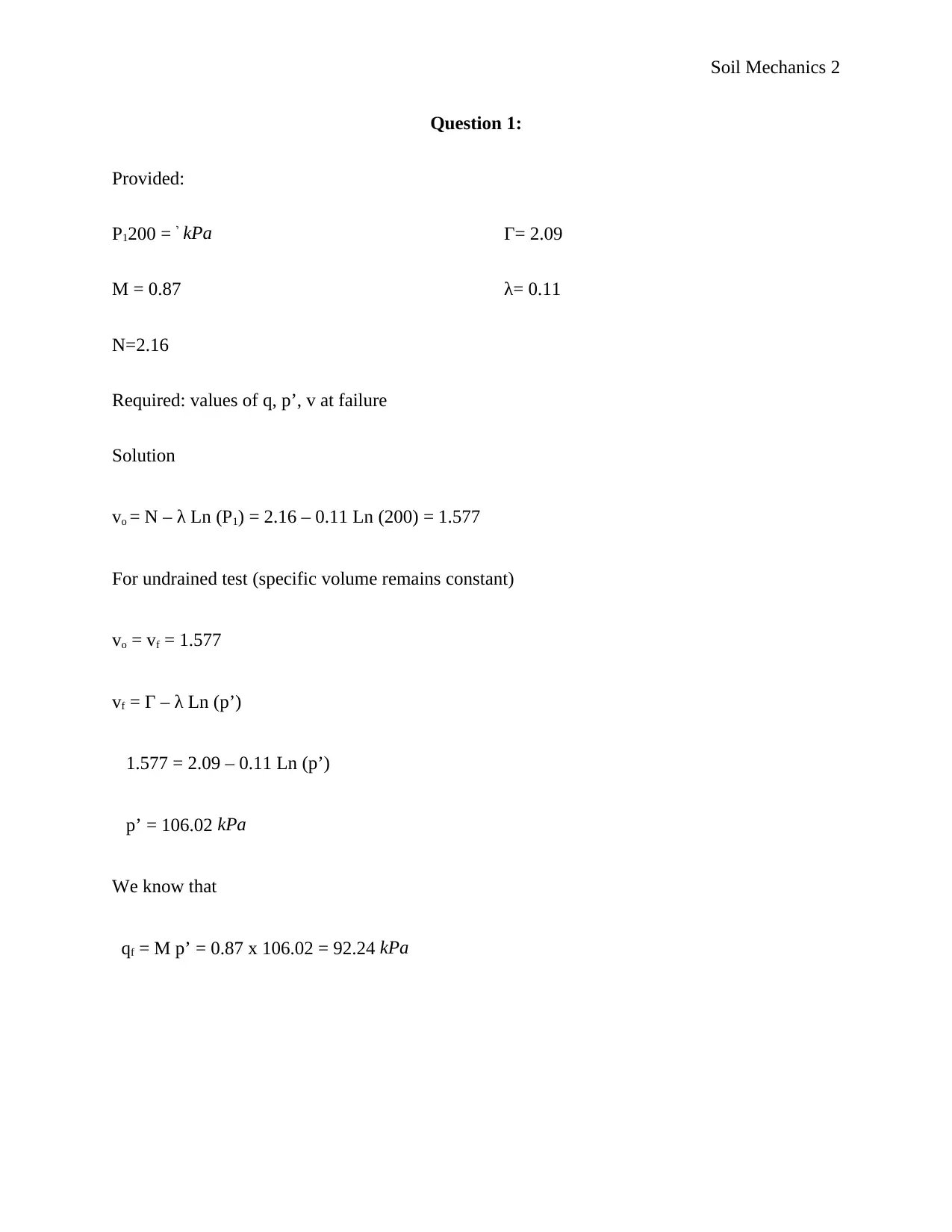
Question 1:
Provided:
P1 י
=200 kPa
M = 0.87
N=2.16
Γ= 2.09
λ= 0.11
Required: values of q, p’, v at failure
Solution
vo = N – λ Ln (P1) = 2.16 – 0.11 Ln (200) = 1.577
For undrained test (specific volume remains constant)
vo = vf = 1.577
vf = Γ – λ Ln (p’)
1.577 = 2.09 – 0.11 Ln (p’)
p’ = 106.02 kPa
We know that
qf = M p’ = 0.87 x 106.02 = 92.24 kPa
Document Page
Soil Mechanics 3
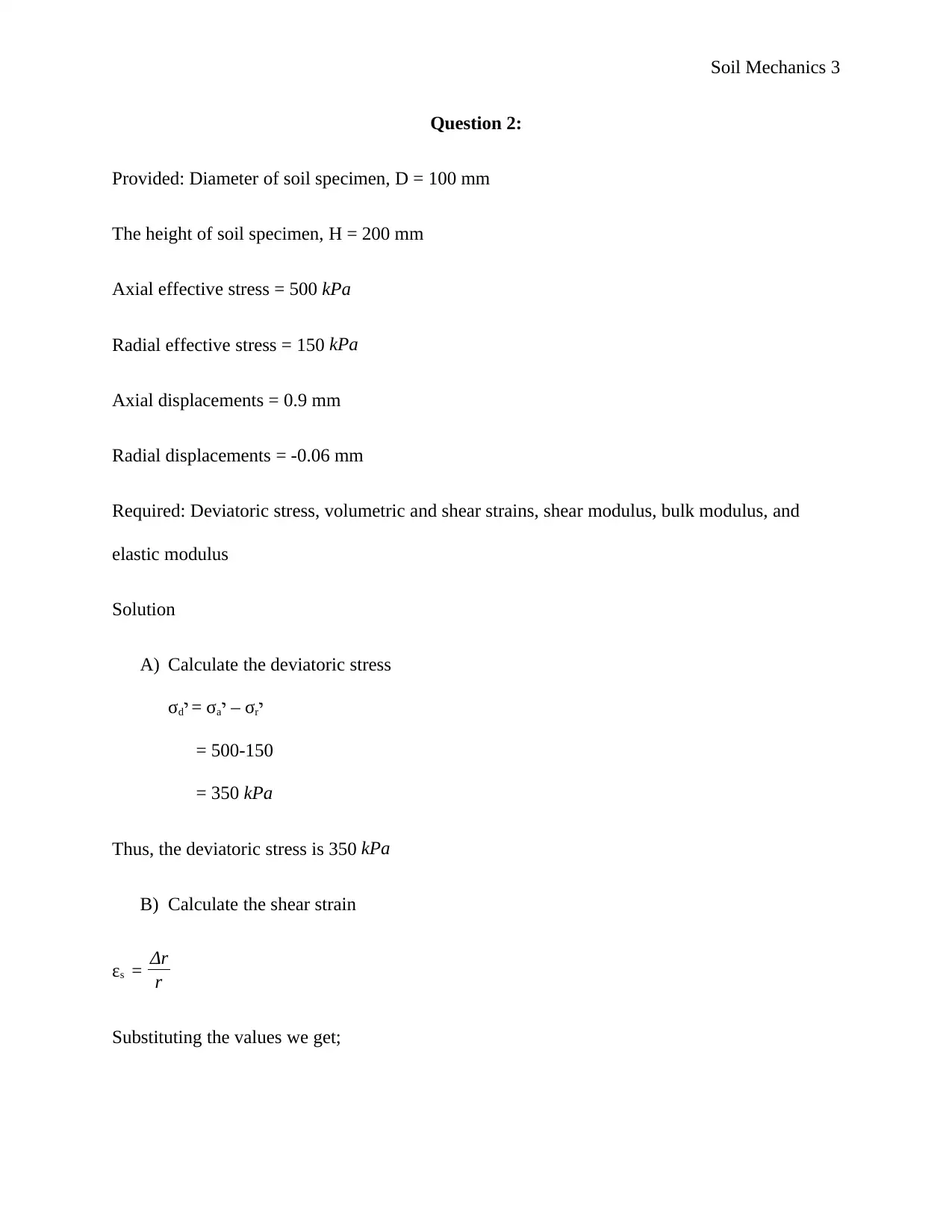
Question 2:
Provided: Diameter of soil specimen, D = 100 mm
The height of soil specimen, H = 200 mm
Axial effective stress = 500 kPa
Radial effective stress = 150 kPa
Axial displacements = 0.9 mm
Radial displacements = -0.06 mm
Required: Deviatoric stress, volumetric and shear strains, shear modulus, bulk modulus, and
elastic modulus
Solution
A) Calculate the deviatoric stress
σdי = σaי σrי
= 500-150
= 350 kPa
Thus, the deviatoric stress is 350 kPa
B) Calculate the shear strain
εs = Δr
r
Substituting the values we get;
Document Page
Soil Mechanics 4
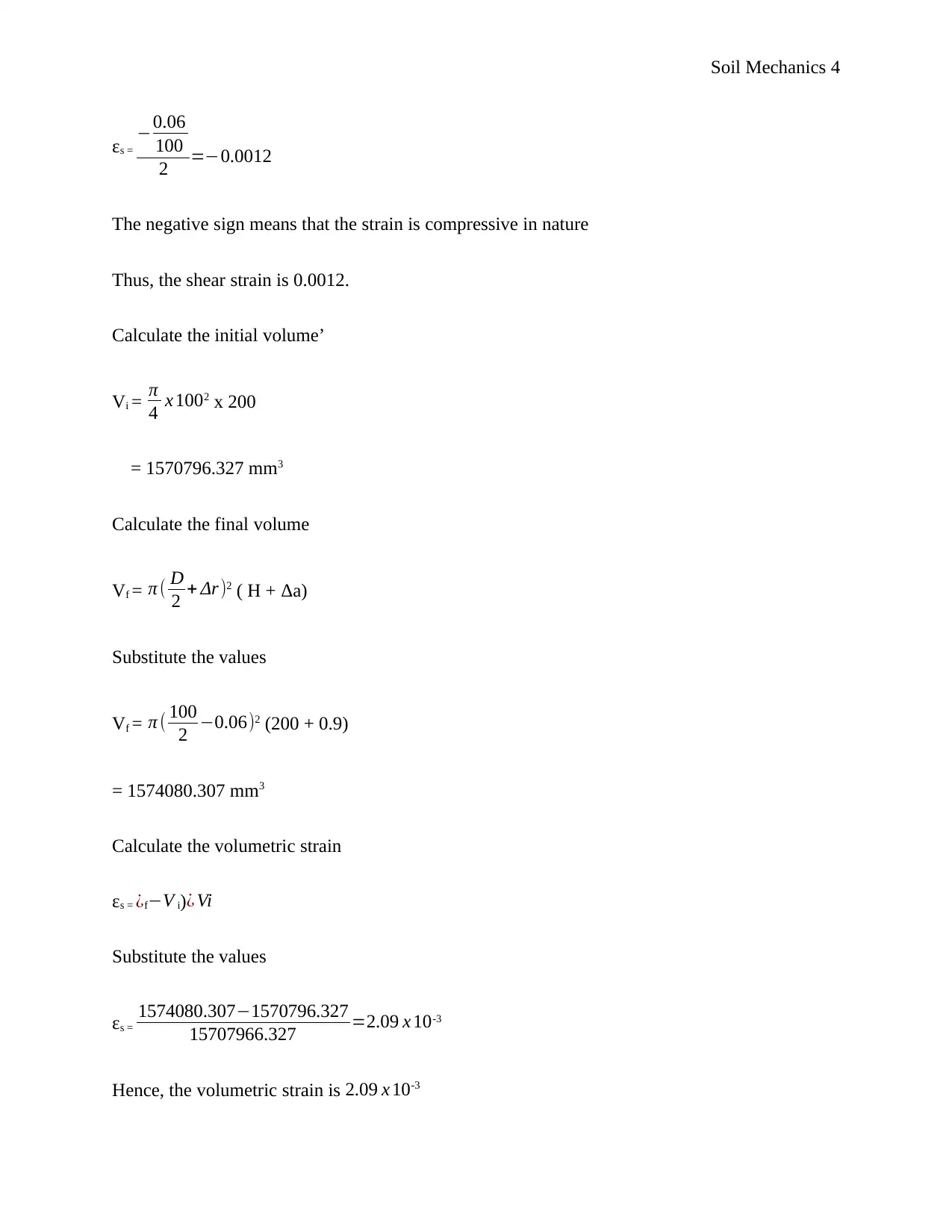
εs =
0.06
100
2 =0.0012
The negative sign means that the strain is compressive in nature
Thus, the shear strain is 0.0012.
Calculate the initial volume’
Vi = π
4 x 1002 x 200
= 1570796.327 mm3
Calculate the final volume
Vf = π ( D
2 + Δr)2 ( H + Δa)
Substitute the values
Vf = π ( 100
2 0.06)2 (200 + 0.9)
= 1574080.307 mm3
Calculate the volumetric strain
εs = ¿fV i)¿ Vi
Substitute the values
εs =
1574080.3071570796.327
15707966.327 =2.09 x 10⁻³
Hence, the volumetric strain is 2.09 x 10⁻³
tabler-icon-diamond-filled.svg

Paraphrase This Document

Need a fresh take? Get an instant paraphrase of this document with our AI Paraphraser
Document Page
Soil Mechanics 5
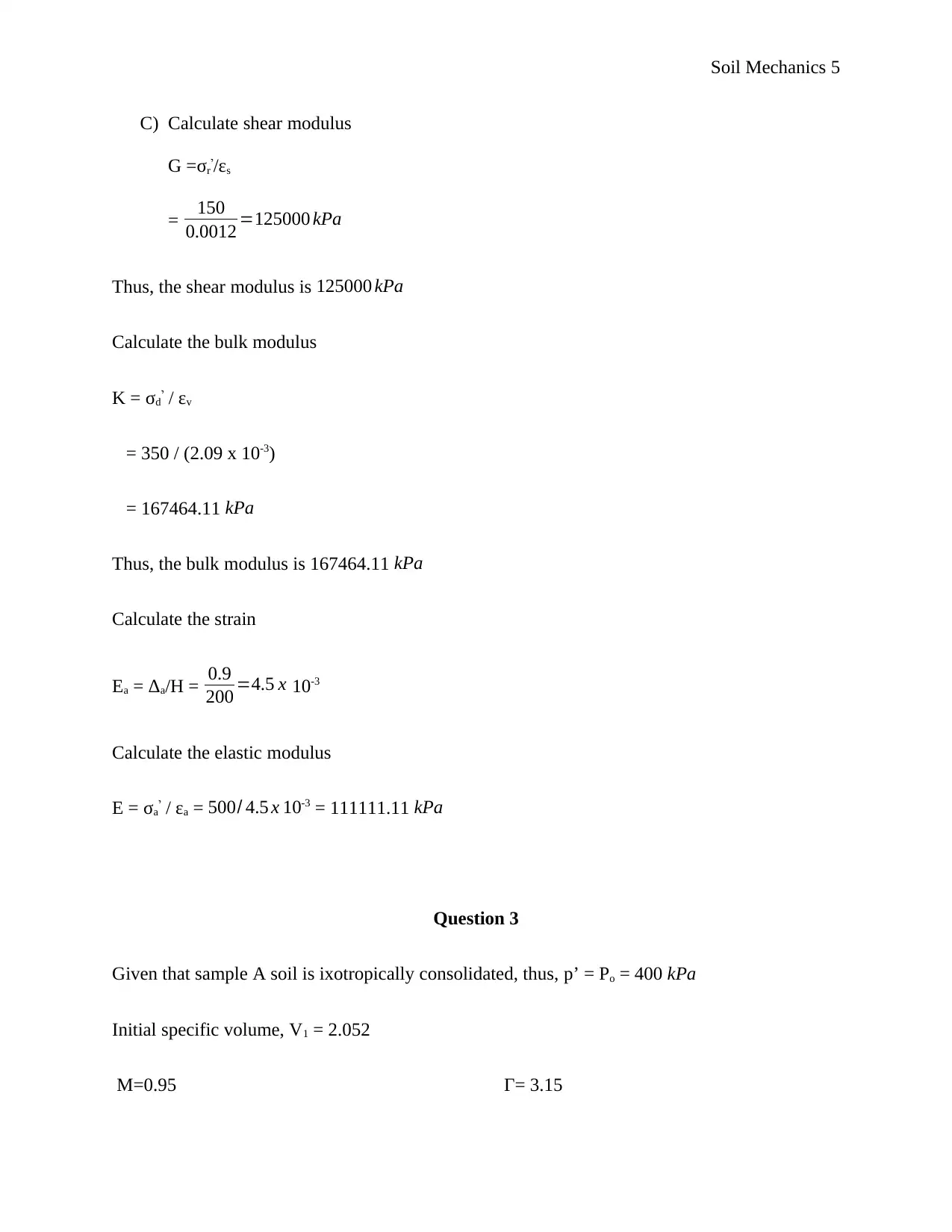
C) Calculate shear modulus
G =σrיs
= 150
0.0012 =125000 kPa
Thus, the shear modulus is 125000 kPa
Calculate the bulk modulus
K = σdי / εv
= 350 / (2.09 x 10⁻³)
= 167464.11 kPa
Thus, the bulk modulus is 167464.11 kPa
Calculate the strain
Εa = Δa/H = 0.9
200 =4.5 x 10⁻³
Calculate the elastic modulus
E = σaי / εa = 500/ 4.5 x 10-3 = 111111.11 kPa
Question 3
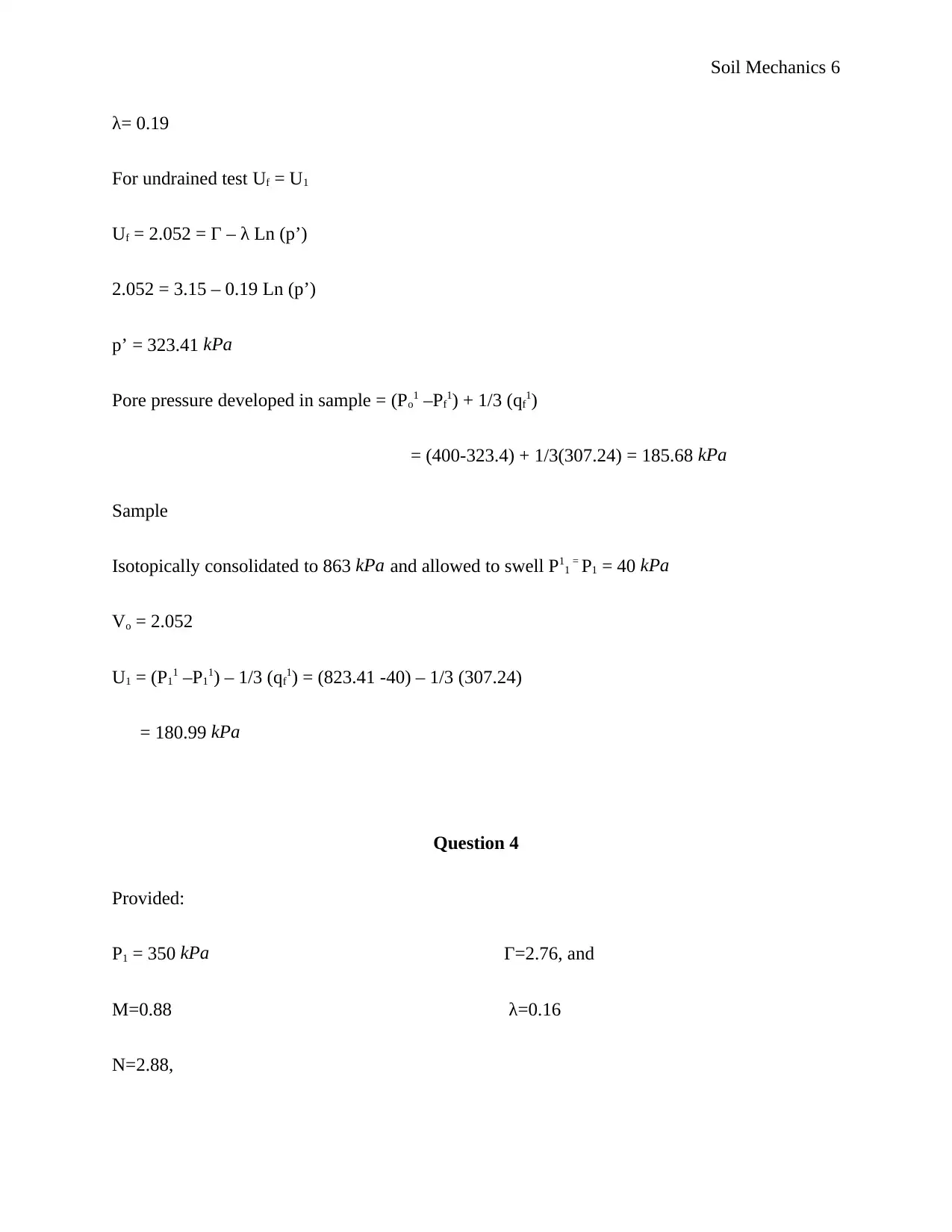
Given that sample A soil is ixotropically consolidated, thus, p’ = Po = 400 kPa
Initial specific volume, V1 = 2.052
M=0.95 Γ= 3.15
Document Page
Soil Mechanics 6
λ= 0.19
For undrained test Uf = U1
Uf = 2.052 = Γ – λ Ln (p’)
2.052 = 3.15 – 0.19 Ln (p’)
p’ = 323.41 kPa
Pore pressure developed in sample = (Po1 –Pf1) + 1/3 (qf1)
= (400-323.4) + 1/3(307.24) = 185.68 kPa
Sample
Isotopically consolidated to 863 kPa and allowed to swell P11 = P1 = 40 kPa
Vo = 2.052
U1 = (P11 –P11) – 1/3 (qf1) = (823.41 -40) – 1/3 (307.24)
= 180.99 kPa
Question 4
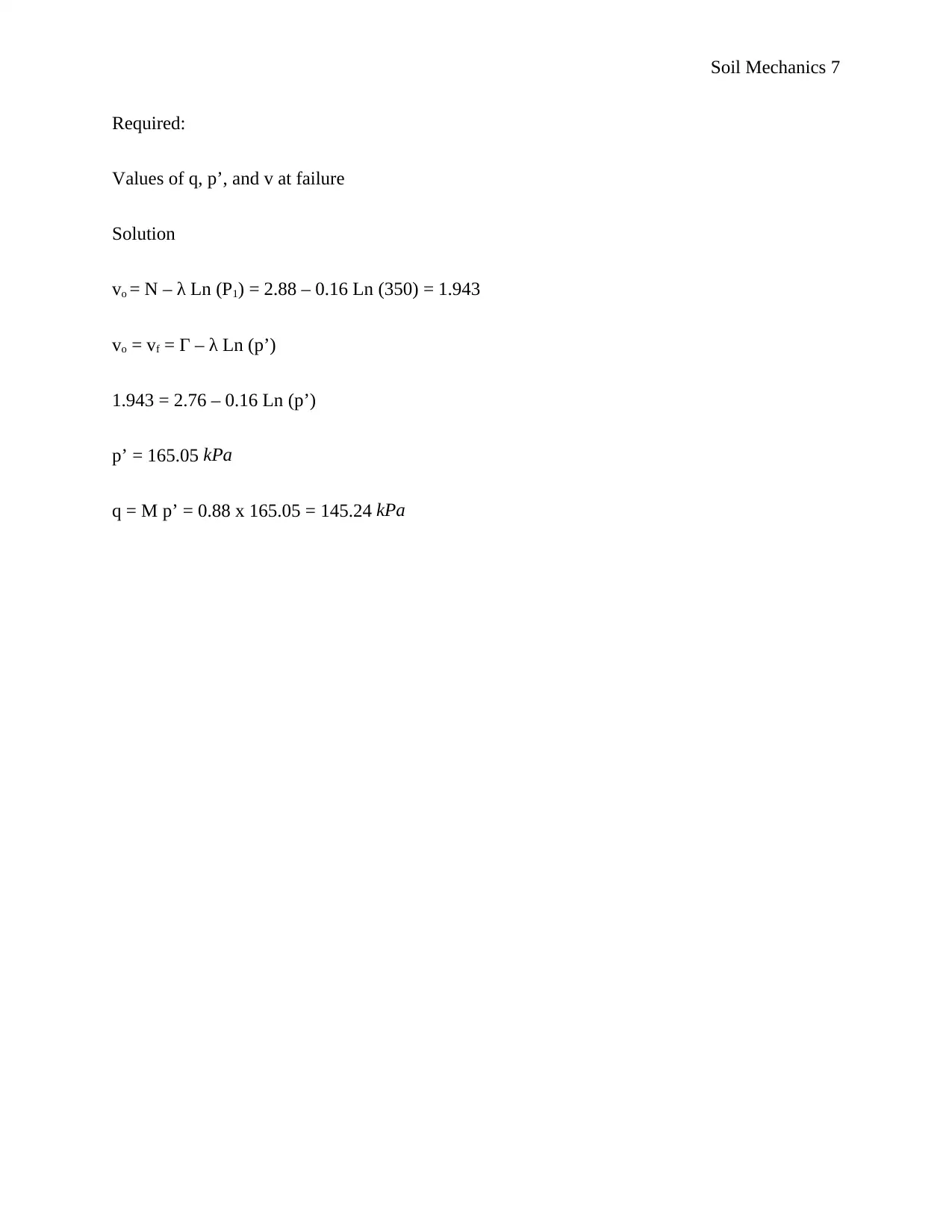
Provided:
P1 = 350 kPa
M=0.88
N=2.88,
Γ=2.76, and
λ=0.16
Document Page
Soil Mechanics 7
Required:
Values of q, p’, and v at failure
Solution
vo = N – λ Ln (P1) = 2.88 – 0.16 Ln (350) = 1.943
vo = vf = Γ – λ Ln (p’)
1.943 = 2.76 – 0.16 Ln (p’)
p’ = 165.05 kPa
q = M p’ = 0.88 x 165.05 = 145.24 kPa
chevron_up_icon
1 out of 7
circle_padding
hide_on_mobile
zoom_out_icon
[object Object]