Mechanical Engineering Project: Solar Flat Plate Collector Design
VerifiedAdded on 2022/10/11
|9
|1471
|48
Project
AI Summary
This project presents the design and construction of a flat plate solar collector, focusing on utilizing recycled materials, specifically radiators, to promote sustainability. The research begins with an introduction to flat plate collectors, explaining their function in converting solar energy into thermal energy for applications like water heating. The project aims to produce guidelines for DIY enthusiasts, generate a literature review, and promote sustainability. The design criteria include the absorber plate, collector insulator, cover, and heat transfer medium (water). The project outlines operational characteristics, installation procedures, and detailed design calculations, including design inputs like overnight temperature drop and daily hot water volume, leading to design outputs like shell volume and tank diameter. The project plan includes resources like radiators, black surfaces, tubes, glazing, and insulation. The project deliverables and milestones cover project planning, design wireframes, analysis, testing, and documentation. Potential risks, such as cost, schedule, and performance risks, are also considered. The project references relevant literature on solar energy and flat plate collector design.

SOLAR FLAT PLATE COLLECTOR 1
Solar Flat Plate Collector Design
Name of Student
Institution Affiliation
Solar Flat Plate Collector Design
Name of Student
Institution Affiliation
Paraphrase This Document
Need a fresh take? Get an instant paraphrase of this document with our AI Paraphraser

SOLAR FLAT PLATE COLLECTOR 2
Table of Contents
Research question............................................................................................................................3
Introduction......................................................................................................................................3
Aim and objectives......................................................................................................................3
Limitations and inclusions...........................................................................................................4
Literature review..............................................................................................................................4
Design criteria..............................................................................................................................4
Operational Characteristics of the Collector................................................................................5
Installation of the flat plate collectors.........................................................................................5
Design calculation.......................................................................................................................6
Design input.................................................................................................................................6
Design output...............................................................................................................................6
Resources and project plan..............................................................................................................6
Project deliverables and milestones.................................................................................................7
Project risks.....................................................................................................................................7
References........................................................................................................................................9
Table of Contents
Research question............................................................................................................................3
Introduction......................................................................................................................................3
Aim and objectives......................................................................................................................3
Limitations and inclusions...........................................................................................................4
Literature review..............................................................................................................................4
Design criteria..............................................................................................................................4
Operational Characteristics of the Collector................................................................................5
Installation of the flat plate collectors.........................................................................................5
Design calculation.......................................................................................................................6
Design input.................................................................................................................................6
Design output...............................................................................................................................6
Resources and project plan..............................................................................................................6
Project deliverables and milestones.................................................................................................7
Project risks.....................................................................................................................................7
References........................................................................................................................................9

SOLAR FLAT PLATE COLLECTOR 3
Research question
How can we design and build a flat plate collector from recycled materials such as radiators to
achieve sustainability
Introduction
A flat plate collector is a heat exchanger which makes use of solar energy by converting
it into heat energy by means of the greenhouse effect. Usually, it has the capability of capturing
the energy and then heating water which can be made use of for various purposes such as
washing, home bathing, cleaning, and hot tubs or can be used in swimming pools. Usually, the
small commercial applications are cheaper as minimal resources are required in their installation
as well as their design seemingly is simple. However, when it comes to applications which are
more advanced and or captures a large amount of area, it becomes a bit tricky in terms of the
costs which are incurred (Pandey & Chaurasiya, 2017).
Further, various materials can be used and customized so as to ensure the design of the
flat plate is made cheaper while achieving the desired purpose. This project basically borrows the
idea of designing a flat plate collector with the help of a radiator. A recycled radiator can be
redesigned so that it works just like the flat plate collector (Mekhilef, Saidur & Safari, 2011).
Aim and objectives
In this research proposal, the main objective of the research is to:
Design and build a flat plate collector from recycled materials
Besides, the aims of the research are to
Produce guideline documents which can be adopted by the DIY enthusiasts
Generate a literature review on various plate collector types
Research question
How can we design and build a flat plate collector from recycled materials such as radiators to
achieve sustainability
Introduction
A flat plate collector is a heat exchanger which makes use of solar energy by converting
it into heat energy by means of the greenhouse effect. Usually, it has the capability of capturing
the energy and then heating water which can be made use of for various purposes such as
washing, home bathing, cleaning, and hot tubs or can be used in swimming pools. Usually, the
small commercial applications are cheaper as minimal resources are required in their installation
as well as their design seemingly is simple. However, when it comes to applications which are
more advanced and or captures a large amount of area, it becomes a bit tricky in terms of the
costs which are incurred (Pandey & Chaurasiya, 2017).
Further, various materials can be used and customized so as to ensure the design of the
flat plate is made cheaper while achieving the desired purpose. This project basically borrows the
idea of designing a flat plate collector with the help of a radiator. A recycled radiator can be
redesigned so that it works just like the flat plate collector (Mekhilef, Saidur & Safari, 2011).
Aim and objectives
In this research proposal, the main objective of the research is to:
Design and build a flat plate collector from recycled materials
Besides, the aims of the research are to
Produce guideline documents which can be adopted by the DIY enthusiasts
Generate a literature review on various plate collector types
⊘ This is a preview!⊘
Do you want full access?
Subscribe today to unlock all pages.

Trusted by 1+ million students worldwide

SOLAR FLAT PLATE COLLECTOR 4
Promote sustainability by recycling equipment to offer optimized performance
Limitations and inclusions
The only limitations which might affect or rather jeopardize the progress of the project are Lack
of the available resources on time
Literature review
The design of the solar water heater will have to take into account some constructional
considerations. These includes:
Absorber Plate or selective surface- this is a surface, either a plastic or metal which
should be appropriately black in color. This will be essential in absorbing and conversion
of the radiations into thermal energy.
Collector insulator- the insulator design has to comprise of a material with a minimal
thermal conductivity. During the installation, it is positioned on the collector sides for the
purposes of minimizing the heat loss (Fan, Luo & Souyri, 2017).
i- this forms the upper side of the collector, which protects the absorber plate. It allows
the penetration of the solar beams hence should be made of either glass or plastic
material.
Heat transfer medium- this is just a medium which will be flowing within the collector
in a bid to transfer heat to the utilization system from the absorber. Usually, the water Is
the one applied (Ab Kadir, Rafeeu & Adam, 2010).
Design criteria
There are various design criteria as well, which needs to be put into account prior to
starting the design of the system. First, there are assumptions which are made. For instance:
Promote sustainability by recycling equipment to offer optimized performance
Limitations and inclusions
The only limitations which might affect or rather jeopardize the progress of the project are Lack
of the available resources on time
Literature review
The design of the solar water heater will have to take into account some constructional
considerations. These includes:
Absorber Plate or selective surface- this is a surface, either a plastic or metal which
should be appropriately black in color. This will be essential in absorbing and conversion
of the radiations into thermal energy.
Collector insulator- the insulator design has to comprise of a material with a minimal
thermal conductivity. During the installation, it is positioned on the collector sides for the
purposes of minimizing the heat loss (Fan, Luo & Souyri, 2017).
i- this forms the upper side of the collector, which protects the absorber plate. It allows
the penetration of the solar beams hence should be made of either glass or plastic
material.
Heat transfer medium- this is just a medium which will be flowing within the collector
in a bid to transfer heat to the utilization system from the absorber. Usually, the water Is
the one applied (Ab Kadir, Rafeeu & Adam, 2010).
Design criteria
There are various design criteria as well, which needs to be put into account prior to
starting the design of the system. First, there are assumptions which are made. For instance:
Paraphrase This Document
Need a fresh take? Get an instant paraphrase of this document with our AI Paraphraser

SOLAR FLAT PLATE COLLECTOR 5
Water consumption will be on a daily basis
The design of the water heater should be on the following parameters as it will be utilized
for general purpose
Ambient temperature (Pandey & Chaurasiya, 2017)
Wind speed
Collector inclination
The fluid of the heat transfer
Operational Characteristics of the Collector
The efficiency of the collector-
The collector thermal capacity
Pressure drop
Stagnant conditions
Incidence Angle Coefficient (kθ)
The cover reflectance (ρc)
Coefficient of cover Emissivity (εc)
Cover Absorptance (αc)
Coefficient of Absorber Emissivity
Installation of the flat plate collectors
The plate collectors are installed in an orientation that faces the equator. For instance, the north
being oriented in the southern hemisphere, while the south on the northern hemisphere. The
angle of the optimal plate tilt should be 15 degrees. However, when the application is meant for
solar cooling, the latitude angle should be -10 degrees to ensure that the solar beam is in the right
direction in the summertime. However, when it is solar heating, it should be +10 degrees.
Water consumption will be on a daily basis
The design of the water heater should be on the following parameters as it will be utilized
for general purpose
Ambient temperature (Pandey & Chaurasiya, 2017)
Wind speed
Collector inclination
The fluid of the heat transfer
Operational Characteristics of the Collector
The efficiency of the collector-
The collector thermal capacity
Pressure drop
Stagnant conditions
Incidence Angle Coefficient (kθ)
The cover reflectance (ρc)
Coefficient of cover Emissivity (εc)
Cover Absorptance (αc)
Coefficient of Absorber Emissivity
Installation of the flat plate collectors
The plate collectors are installed in an orientation that faces the equator. For instance, the north
being oriented in the southern hemisphere, while the south on the northern hemisphere. The
angle of the optimal plate tilt should be 15 degrees. However, when the application is meant for
solar cooling, the latitude angle should be -10 degrees to ensure that the solar beam is in the right
direction in the summertime. However, when it is solar heating, it should be +10 degrees.

SOLAR FLAT PLATE COLLECTOR 6
Design calculation
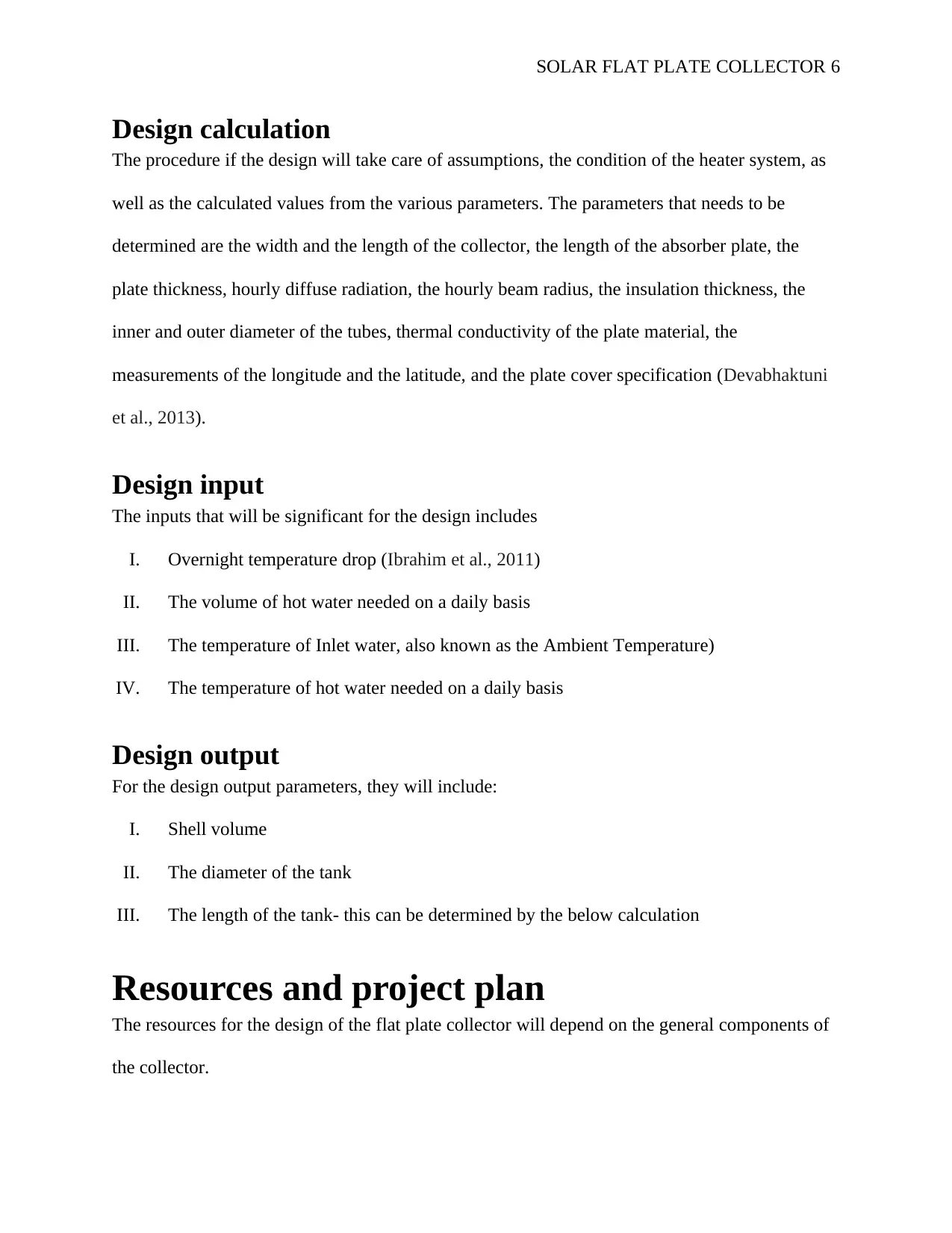
The procedure if the design will take care of assumptions, the condition of the heater system, as
well as the calculated values from the various parameters. The parameters that needs to be
determined are the width and the length of the collector, the length of the absorber plate, the
plate thickness, hourly diffuse radiation, the hourly beam radius, the insulation thickness, the
inner and outer diameter of the tubes, thermal conductivity of the plate material, the
measurements of the longitude and the latitude, and the plate cover specification (Devabhaktuni
et al., 2013).
Design input
The inputs that will be significant for the design includes
I. Overnight temperature drop (Ibrahim et al., 2011)
II. The volume of hot water needed on a daily basis
III. The temperature of Inlet water, also known as the Ambient Temperature)
IV. The temperature of hot water needed on a daily basis
Design output
For the design output parameters, they will include:
I. Shell volume
II. The diameter of the tank
III. The length of the tank- this can be determined by the below calculation
Resources and project plan
The resources for the design of the flat plate collector will depend on the general components of
the collector.
Design calculation
The procedure if the design will take care of assumptions, the condition of the heater system, as
well as the calculated values from the various parameters. The parameters that needs to be
determined are the width and the length of the collector, the length of the absorber plate, the
plate thickness, hourly diffuse radiation, the hourly beam radius, the insulation thickness, the
inner and outer diameter of the tubes, thermal conductivity of the plate material, the
measurements of the longitude and the latitude, and the plate cover specification (Devabhaktuni
et al., 2013).
Design input
The inputs that will be significant for the design includes
I. Overnight temperature drop (Ibrahim et al., 2011)
II. The volume of hot water needed on a daily basis
III. The temperature of Inlet water, also known as the Ambient Temperature)
IV. The temperature of hot water needed on a daily basis
Design output
For the design output parameters, they will include:
I. Shell volume
II. The diameter of the tank
III. The length of the tank- this can be determined by the below calculation
Resources and project plan
The resources for the design of the flat plate collector will depend on the general components of
the collector.
⊘ This is a preview!⊘
Do you want full access?
Subscribe today to unlock all pages.

Trusted by 1+ million students worldwide

SOLAR FLAT PLATE COLLECTOR 7
Resources required for the project
1. Radiator
2. Black surface
3. Tubes having fluid for the transfer of heat
4. Glazing cover
5. Insulating covering the bottom and side of the collector
6. Support structure for holding the components into place
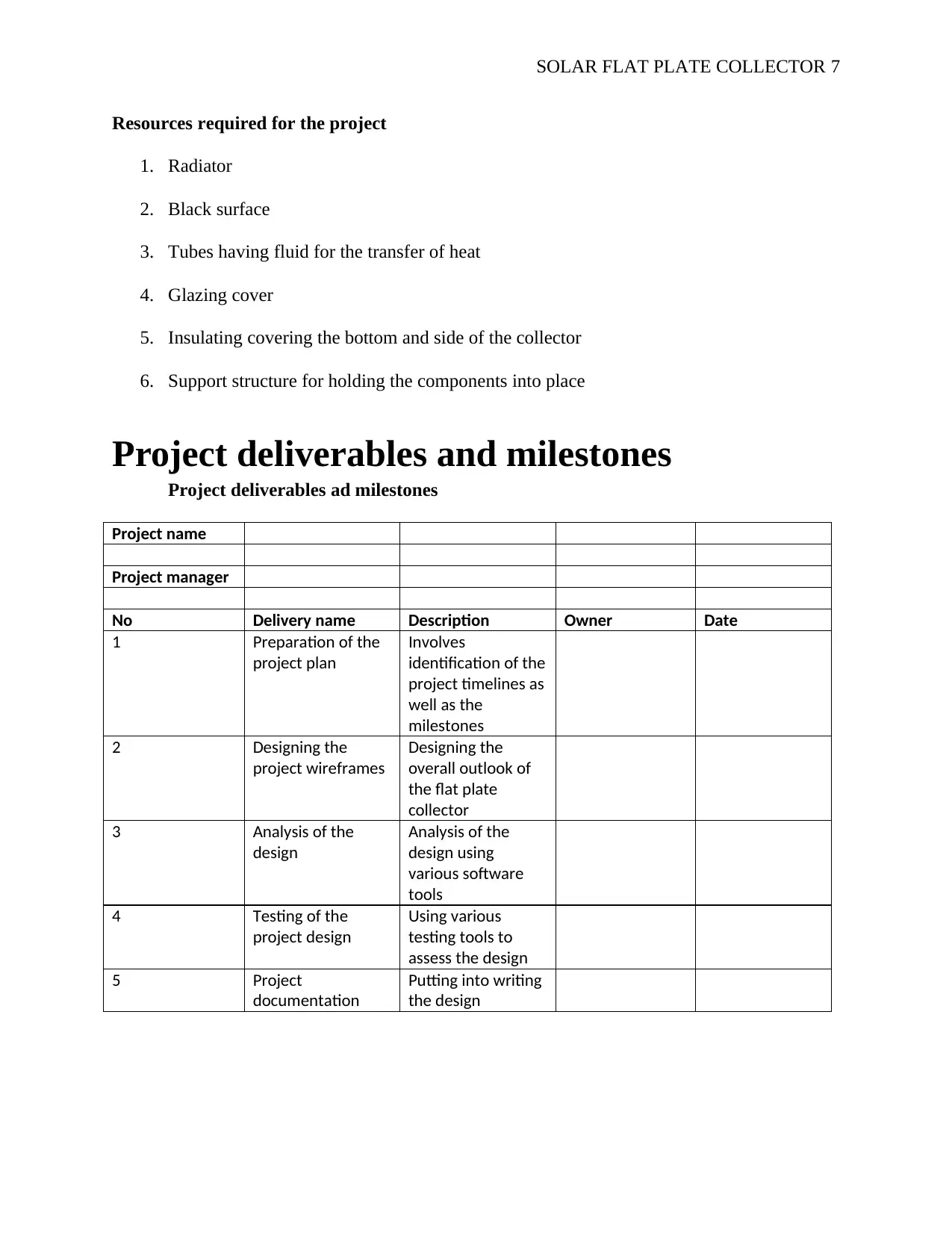
Project deliverables and milestones
Project deliverables ad milestones
Project name
Project manager
No Delivery name Description Owner Date
1 Preparation of the
project plan
Involves
identification of the
project timelines as
well as the
milestones
2 Designing the
project wireframes
Designing the
overall outlook of
the flat plate
collector
3 Analysis of the
design
Analysis of the
design using
various software
tools
4 Testing of the
project design
Using various
testing tools to
assess the design
5 Project
documentation
Putting into writing
the design
Resources required for the project
1. Radiator
2. Black surface
3. Tubes having fluid for the transfer of heat
4. Glazing cover
5. Insulating covering the bottom and side of the collector
6. Support structure for holding the components into place
Project deliverables and milestones
Project deliverables ad milestones
Project name
Project manager
No Delivery name Description Owner Date
1 Preparation of the
project plan
Involves
identification of the
project timelines as
well as the
milestones
2 Designing the
project wireframes
Designing the
overall outlook of
the flat plate
collector
3 Analysis of the
design
Analysis of the
design using
various software
tools
4 Testing of the
project design
Using various
testing tools to
assess the design
5 Project
documentation
Putting into writing
the design
Paraphrase This Document
Need a fresh take? Get an instant paraphrase of this document with our AI Paraphraser

SOLAR FLAT PLATE COLLECTOR 8
Project risks
The various risk which might be associated with the project includes
Cost risk: this may be a result of underestimation or just inaccuracy during the planning
Schedule risk: this might mean that the activities take a long time, which was not anticipated,
hence increasing the costs.
Performance risk: this means that there is also the likeliness that the project might not generate
the exact result as anticipated in the software design.
Project risks
The various risk which might be associated with the project includes
Cost risk: this may be a result of underestimation or just inaccuracy during the planning
Schedule risk: this might mean that the activities take a long time, which was not anticipated,
hence increasing the costs.
Performance risk: this means that there is also the likeliness that the project might not generate
the exact result as anticipated in the software design.

SOLAR FLAT PLATE COLLECTOR 9
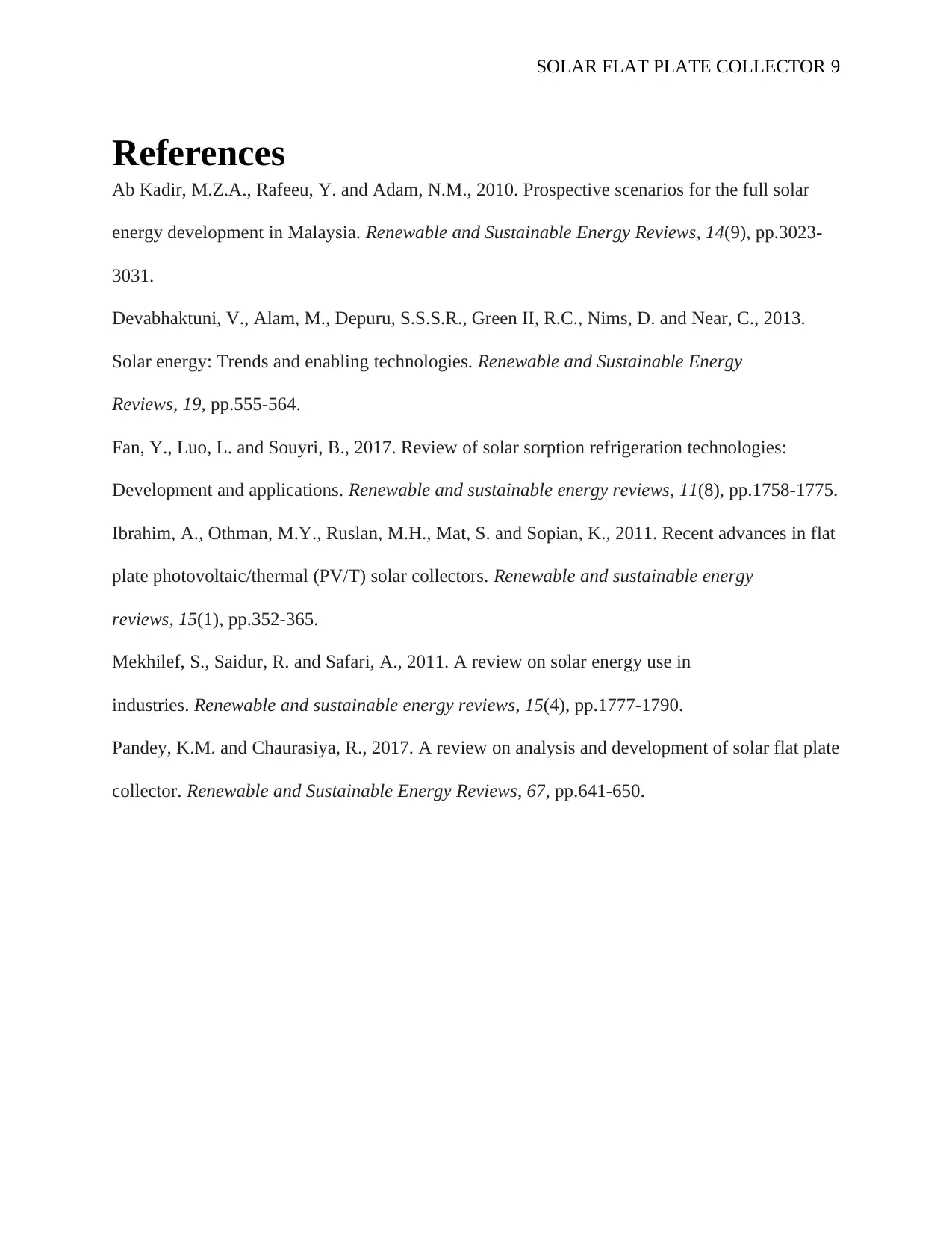
References
Ab Kadir, M.Z.A., Rafeeu, Y. and Adam, N.M., 2010. Prospective scenarios for the full solar
energy development in Malaysia. Renewable and Sustainable Energy Reviews, 14(9), pp.3023-
3031.
Devabhaktuni, V., Alam, M., Depuru, S.S.S.R., Green II, R.C., Nims, D. and Near, C., 2013.
Solar energy: Trends and enabling technologies. Renewable and Sustainable Energy
Reviews, 19, pp.555-564.
Fan, Y., Luo, L. and Souyri, B., 2017. Review of solar sorption refrigeration technologies:
Development and applications. Renewable and sustainable energy reviews, 11(8), pp.1758-1775.
Ibrahim, A., Othman, M.Y., Ruslan, M.H., Mat, S. and Sopian, K., 2011. Recent advances in flat
plate photovoltaic/thermal (PV/T) solar collectors. Renewable and sustainable energy
reviews, 15(1), pp.352-365.
Mekhilef, S., Saidur, R. and Safari, A., 2011. A review on solar energy use in
industries. Renewable and sustainable energy reviews, 15(4), pp.1777-1790.
Pandey, K.M. and Chaurasiya, R., 2017. A review on analysis and development of solar flat plate
collector. Renewable and Sustainable Energy Reviews, 67, pp.641-650.
References
Ab Kadir, M.Z.A., Rafeeu, Y. and Adam, N.M., 2010. Prospective scenarios for the full solar
energy development in Malaysia. Renewable and Sustainable Energy Reviews, 14(9), pp.3023-
3031.
Devabhaktuni, V., Alam, M., Depuru, S.S.S.R., Green II, R.C., Nims, D. and Near, C., 2013.
Solar energy: Trends and enabling technologies. Renewable and Sustainable Energy
Reviews, 19, pp.555-564.
Fan, Y., Luo, L. and Souyri, B., 2017. Review of solar sorption refrigeration technologies:
Development and applications. Renewable and sustainable energy reviews, 11(8), pp.1758-1775.
Ibrahim, A., Othman, M.Y., Ruslan, M.H., Mat, S. and Sopian, K., 2011. Recent advances in flat
plate photovoltaic/thermal (PV/T) solar collectors. Renewable and sustainable energy
reviews, 15(1), pp.352-365.
Mekhilef, S., Saidur, R. and Safari, A., 2011. A review on solar energy use in
industries. Renewable and sustainable energy reviews, 15(4), pp.1777-1790.
Pandey, K.M. and Chaurasiya, R., 2017. A review on analysis and development of solar flat plate
collector. Renewable and Sustainable Energy Reviews, 67, pp.641-650.
⊘ This is a preview!⊘
Do you want full access?
Subscribe today to unlock all pages.

Trusted by 1+ million students worldwide
1 out of 9
Related Documents
Your All-in-One AI-Powered Toolkit for Academic Success.
+13062052269
info@desklib.com
Available 24*7 on WhatsApp / Email
Unlock your academic potential
Copyright © 2020–2026 A2Z Services. All Rights Reserved. Developed and managed by ZUCOL.