Report on Managing and Running a Small Business for Solesmith
VerifiedAdded on 2020/12/10
|16
|4535
|148
Report
AI Summary
This report provides a comprehensive analysis of Solesmith, a UK-based personalized sock retail business, examining key aspects of small business management. The report is structured into four tasks, covering resource planning and allocation, customer relationship management processes, transnational business development with its benefits and drawbacks, and financial analysis including cash flow forecasting, break-even analysis, and interpretation of financial statements. It also explores the implications of key legislation and regulations on small businesses. The report delves into various considerations for Solesmith, such as market research, purpose determination, resource identification, human resource evaluation, and emergency planning. It also explores customer relationship management strategies, including customer portfolio analysis, customer intimacy, network development, value proposition development, and customer lifecycle management. Furthermore, it evaluates the benefits and drawbacks of transnational development for small businesses and provides a detailed cash flow forecast for Solesmith. Finally, the report offers an interpretation of financial statements and discusses the impact of relevant legislation and regulations on the business. This report aims to provide a thorough understanding of the challenges and opportunities in managing and running a small business.
UNIT 29
Managing and Running
a Small Business
Managing and Running
a Small Business

Paraphrase This Document
Need a fresh take? Get an instant paraphrase of this document with our AI Paraphraser
Table of Contents
INTRODUCTION...........................................................................................................................3
TASK 1 ...........................................................................................................................................3
P1: Major Considerations for small business to plans and allocate resources:......................3
TASK 2............................................................................................................................................5
P2: Different processes of customer relationship management: ...........................................5
TASK 3............................................................................................................................................6
P3: Transnationally development of Small business along with its benefits and drawbacks:6
P4: Cash flow forecast .................8
P5: Break even analysis..........................................................................................................9
P6: Interpretation of financial statements of Solesmith:......................................................10
TASK 4..........................................................................................................................................13
P7: Implications on small business or social enterprises of key legislation and regulations: 13
CONCLUSIONS ..........................................................................................................................15
REFERENCES..............................................................................................................................16
.......................................................................................................................................................16
INTRODUCTION...........................................................................................................................3
TASK 1 ...........................................................................................................................................3
P1: Major Considerations for small business to plans and allocate resources:......................3
TASK 2............................................................................................................................................5
P2: Different processes of customer relationship management: ...........................................5
TASK 3............................................................................................................................................6
P3: Transnationally development of Small business along with its benefits and drawbacks:6
P4: Cash flow forecast .................8
P5: Break even analysis..........................................................................................................9
P6: Interpretation of financial statements of Solesmith:......................................................10
TASK 4..........................................................................................................................................13
P7: Implications on small business or social enterprises of key legislation and regulations: 13
CONCLUSIONS ..........................................................................................................................15
REFERENCES..............................................................................................................................16
.......................................................................................................................................................16
INTRODUCTION
For running small business or social enterprises in effective manner, there should be a
understanding of key aspects of various related matters. In this report, Solesmith company is
selected which is a cult personalised sock retail small business and which is based on UK. This
business has also accept order online locally and do work as per customer specifications. An
organisation has tremendous growth opportunity through transnationally develop itself. This
report is divided into four tasks. First task gives information about the requirement of small
business to plan and allocate its resources to achieve its goals. Second one defines the
information about the customer relationship management and defines the process of CRM while
third task tells about the analytical tools used to evaluate company's performance like break even
analysis, budget analysis etc. The last task is about to regulations and legislations which effect
the business of small retail company in UK.
TASK 1
P1: Major Considerations for small business to plans and allocate resources:
Overview of Solesmith:
The company was started in 2014, an overlooked of fashion accessory and gift
opportunity to reduce gap in the market. It is dealing in personalised sock brand they are also
develop more colours and designs slippers, underwear and cosy long wear. They are also
personalized messages like romantic, wistful and inspirational. The current situation of the
company that it is including in top 100 small entrepreneurs (Adisa, Abdulraheem and Mordi,
2014). For achieving its objectives, various considerations need to be full filled which are
discussed in detailed as follows:
Research: For planning and allocation of resources in a small enterprise, there
should be a requirement of research related to its product, its market conditions.
In other words, it is responsibility of operational manager of Solesmith company
to know everything about the business and industry in which company run. For
example, If selected company wants to start business in cloths, firstly they have to
done research about clothing market like, which type of cloths are in trend? for
which age group? and which area is to be targeted? After doing all research
company can start business (Bridge and O'Neill , 2012).
For running small business or social enterprises in effective manner, there should be a
understanding of key aspects of various related matters. In this report, Solesmith company is
selected which is a cult personalised sock retail small business and which is based on UK. This
business has also accept order online locally and do work as per customer specifications. An
organisation has tremendous growth opportunity through transnationally develop itself. This
report is divided into four tasks. First task gives information about the requirement of small
business to plan and allocate its resources to achieve its goals. Second one defines the
information about the customer relationship management and defines the process of CRM while
third task tells about the analytical tools used to evaluate company's performance like break even
analysis, budget analysis etc. The last task is about to regulations and legislations which effect
the business of small retail company in UK.
TASK 1
P1: Major Considerations for small business to plans and allocate resources:
Overview of Solesmith:
The company was started in 2014, an overlooked of fashion accessory and gift
opportunity to reduce gap in the market. It is dealing in personalised sock brand they are also
develop more colours and designs slippers, underwear and cosy long wear. They are also
personalized messages like romantic, wistful and inspirational. The current situation of the
company that it is including in top 100 small entrepreneurs (Adisa, Abdulraheem and Mordi,
2014). For achieving its objectives, various considerations need to be full filled which are
discussed in detailed as follows:
Research: For planning and allocation of resources in a small enterprise, there
should be a requirement of research related to its product, its market conditions.
In other words, it is responsibility of operational manager of Solesmith company
to know everything about the business and industry in which company run. For
example, If selected company wants to start business in cloths, firstly they have to
done research about clothing market like, which type of cloths are in trend? for
which age group? and which area is to be targeted? After doing all research
company can start business (Bridge and O'Neill , 2012).
⊘ This is a preview!⊘
Do you want full access?
Subscribe today to unlock all pages.

Trusted by 1+ million students worldwide
Determine the purpose of plan: A business plan which a Solesmith want to make
& implement for achieving its objectives should be prepared after determining the
purpose of making this. It is necessary to give more emphasis on “what is the
purpose of making plan”, so that a better realistic plan can be made. For
example, If selected company reduce it's product price, it does not mean that they
serve low quality. Purpose of that is to increase sales, because customer want cost
effective product, another purpose is to target large segment of people so it results
automatically lower cost. And it will create customer loyalty.
Identify the resources: After doing planning, it is the responsibility of Solesmith
to identify which resources should be required for allocation in different areas to
do activities as per planned way. For example:- If selected company know that
particular area is best for it's business, then they to maintain good relation with
suppliers and provide best quality product or services to it's customers.
Evaluate the human resources: In this, Solesmith need to do evaluation of the
human resources which are required for target activities and thereafter assign the
duties to these human resources for achieving the objectives of business. For
example:- In selected organisation, employees always play a huge role because
without human force or labour force organisation in not able to move further.
Emergencies: The most important resources in a business project are humans and
they tend to get sick, stress out, leave the organisation or other aspects. Due to
which a company cannot unable to achieve desired objectives which it planned.
For overcoming this problem, company should include a element of emergencies
in planning process and thereafter allocate its resources accordingly (Burns,
2016).
TASK 2
P2: Different processes of customer relationship management:
Customer relationship management is a term that refers to practices, strategies and
technologies that companies use to handle and study customer interactions and data until the end
of the customer lifecycle, with the objective of making better customer service relationships and
& implement for achieving its objectives should be prepared after determining the
purpose of making this. It is necessary to give more emphasis on “what is the
purpose of making plan”, so that a better realistic plan can be made. For
example, If selected company reduce it's product price, it does not mean that they
serve low quality. Purpose of that is to increase sales, because customer want cost
effective product, another purpose is to target large segment of people so it results
automatically lower cost. And it will create customer loyalty.
Identify the resources: After doing planning, it is the responsibility of Solesmith
to identify which resources should be required for allocation in different areas to
do activities as per planned way. For example:- If selected company know that
particular area is best for it's business, then they to maintain good relation with
suppliers and provide best quality product or services to it's customers.
Evaluate the human resources: In this, Solesmith need to do evaluation of the
human resources which are required for target activities and thereafter assign the
duties to these human resources for achieving the objectives of business. For
example:- In selected organisation, employees always play a huge role because
without human force or labour force organisation in not able to move further.
Emergencies: The most important resources in a business project are humans and
they tend to get sick, stress out, leave the organisation or other aspects. Due to
which a company cannot unable to achieve desired objectives which it planned.
For overcoming this problem, company should include a element of emergencies
in planning process and thereafter allocate its resources accordingly (Burns,
2016).
TASK 2
P2: Different processes of customer relationship management:
Customer relationship management is a term that refers to practices, strategies and
technologies that companies use to handle and study customer interactions and data until the end
of the customer lifecycle, with the objective of making better customer service relationships and
Paraphrase This Document
Need a fresh take? Get an instant paraphrase of this document with our AI Paraphraser
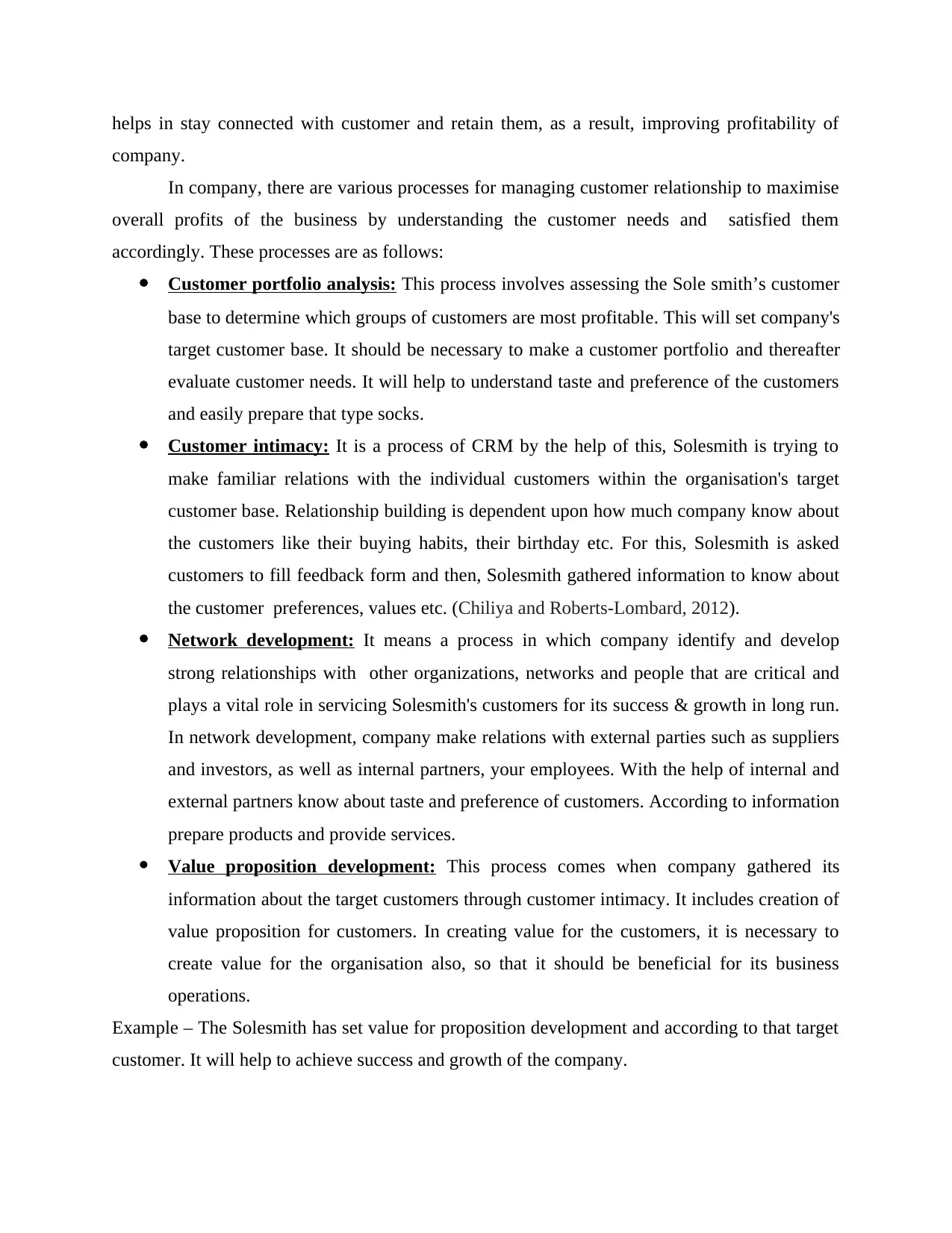
helps in stay connected with customer and retain them, as a result, improving profitability of
company.
In company, there are various processes for managing customer relationship to maximise
overall profits of the business by understanding the customer needs and satisfied them
accordingly. These processes are as follows:
Customer portfolio analysis: This process involves assessing the Sole smith’s customer
base to determine which groups of customers are most profitable. This will set company's
target customer base. It should be necessary to make a customer portfolio and thereafter
evaluate customer needs. It will help to understand taste and preference of the customers
and easily prepare that type socks.
Customer intimacy: It is a process of CRM by the help of this, Solesmith is trying to
make familiar relations with the individual customers within the organisation's target
customer base. Relationship building is dependent upon how much company know about
the customers like their buying habits, their birthday etc. For this, Solesmith is asked
customers to fill feedback form and then, Solesmith gathered information to know about
the customer preferences, values etc. (Chiliya and Roberts-Lombard, 2012).
Network development: It means a process in which company identify and develop
strong relationships with other organizations, networks and people that are critical and
plays a vital role in servicing Solesmith's customers for its success & growth in long run.
In network development, company make relations with external parties such as suppliers
and investors, as well as internal partners, your employees. With the help of internal and
external partners know about taste and preference of customers. According to information
prepare products and provide services.
Value proposition development: This process comes when company gathered its
information about the target customers through customer intimacy. It includes creation of
value proposition for customers. In creating value for the customers, it is necessary to
create value for the organisation also, so that it should be beneficial for its business
operations.
Example – The Solesmith has set value for proposition development and according to that target
customer. It will help to achieve success and growth of the company.
company.
In company, there are various processes for managing customer relationship to maximise
overall profits of the business by understanding the customer needs and satisfied them
accordingly. These processes are as follows:
Customer portfolio analysis: This process involves assessing the Sole smith’s customer
base to determine which groups of customers are most profitable. This will set company's
target customer base. It should be necessary to make a customer portfolio and thereafter
evaluate customer needs. It will help to understand taste and preference of the customers
and easily prepare that type socks.
Customer intimacy: It is a process of CRM by the help of this, Solesmith is trying to
make familiar relations with the individual customers within the organisation's target
customer base. Relationship building is dependent upon how much company know about
the customers like their buying habits, their birthday etc. For this, Solesmith is asked
customers to fill feedback form and then, Solesmith gathered information to know about
the customer preferences, values etc. (Chiliya and Roberts-Lombard, 2012).
Network development: It means a process in which company identify and develop
strong relationships with other organizations, networks and people that are critical and
plays a vital role in servicing Solesmith's customers for its success & growth in long run.
In network development, company make relations with external parties such as suppliers
and investors, as well as internal partners, your employees. With the help of internal and
external partners know about taste and preference of customers. According to information
prepare products and provide services.
Value proposition development: This process comes when company gathered its
information about the target customers through customer intimacy. It includes creation of
value proposition for customers. In creating value for the customers, it is necessary to
create value for the organisation also, so that it should be beneficial for its business
operations.
Example – The Solesmith has set value for proposition development and according to that target
customer. It will help to achieve success and growth of the company.
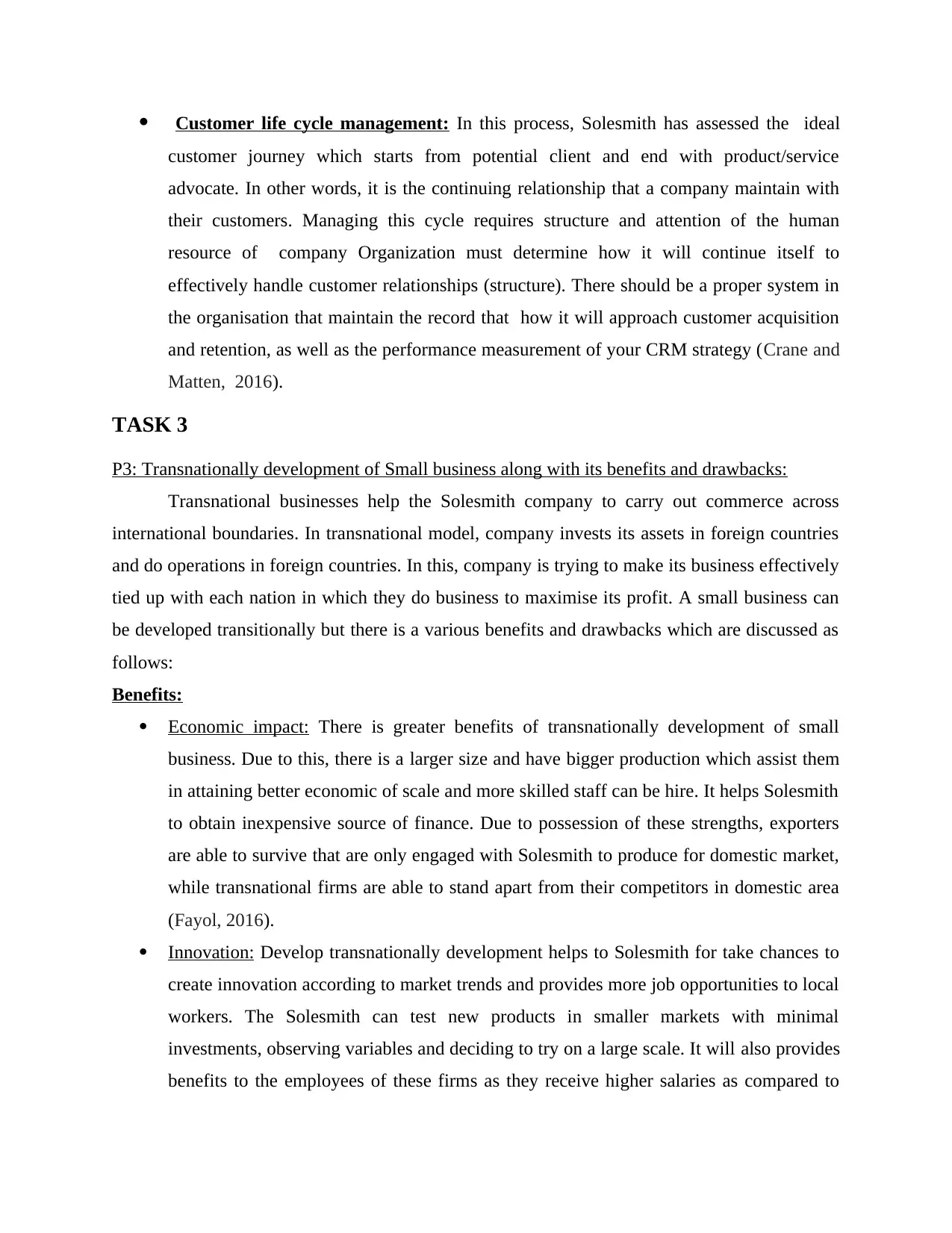
Customer life cycle management: In this process, Solesmith has assessed the ideal
customer journey which starts from potential client and end with product/service
advocate. In other words, it is the continuing relationship that a company maintain with
their customers. Managing this cycle requires structure and attention of the human
resource of company Organization must determine how it will continue itself to
effectively handle customer relationships (structure). There should be a proper system in
the organisation that maintain the record that how it will approach customer acquisition
and retention, as well as the performance measurement of your CRM strategy (Crane and
Matten, 2016).
TASK 3
P3: Transnationally development of Small business along with its benefits and drawbacks:
Transnational businesses help the Solesmith company to carry out commerce across
international boundaries. In transnational model, company invests its assets in foreign countries
and do operations in foreign countries. In this, company is trying to make its business effectively
tied up with each nation in which they do business to maximise its profit. A small business can
be developed transitionally but there is a various benefits and drawbacks which are discussed as
follows:
Benefits:
Economic impact: There is greater benefits of transnationally development of small
business. Due to this, there is a larger size and have bigger production which assist them
in attaining better economic of scale and more skilled staff can be hire. It helps Solesmith
to obtain inexpensive source of finance. Due to possession of these strengths, exporters
are able to survive that are only engaged with Solesmith to produce for domestic market,
while transnational firms are able to stand apart from their competitors in domestic area
(Fayol, 2016).
Innovation: Develop transnationally development helps to Solesmith for take chances to
create innovation according to market trends and provides more job opportunities to local
workers. The Solesmith can test new products in smaller markets with minimal
investments, observing variables and deciding to try on a large scale. It will also provides
benefits to the employees of these firms as they receive higher salaries as compared to
customer journey which starts from potential client and end with product/service
advocate. In other words, it is the continuing relationship that a company maintain with
their customers. Managing this cycle requires structure and attention of the human
resource of company Organization must determine how it will continue itself to
effectively handle customer relationships (structure). There should be a proper system in
the organisation that maintain the record that how it will approach customer acquisition
and retention, as well as the performance measurement of your CRM strategy (Crane and
Matten, 2016).
TASK 3
P3: Transnationally development of Small business along with its benefits and drawbacks:
Transnational businesses help the Solesmith company to carry out commerce across
international boundaries. In transnational model, company invests its assets in foreign countries
and do operations in foreign countries. In this, company is trying to make its business effectively
tied up with each nation in which they do business to maximise its profit. A small business can
be developed transitionally but there is a various benefits and drawbacks which are discussed as
follows:
Benefits:
Economic impact: There is greater benefits of transnationally development of small
business. Due to this, there is a larger size and have bigger production which assist them
in attaining better economic of scale and more skilled staff can be hire. It helps Solesmith
to obtain inexpensive source of finance. Due to possession of these strengths, exporters
are able to survive that are only engaged with Solesmith to produce for domestic market,
while transnational firms are able to stand apart from their competitors in domestic area
(Fayol, 2016).
Innovation: Develop transnationally development helps to Solesmith for take chances to
create innovation according to market trends and provides more job opportunities to local
workers. The Solesmith can test new products in smaller markets with minimal
investments, observing variables and deciding to try on a large scale. It will also provides
benefits to the employees of these firms as they receive higher salaries as compared to
⊘ This is a preview!⊘
Do you want full access?
Subscribe today to unlock all pages.
Trusted by 1+ million students worldwide
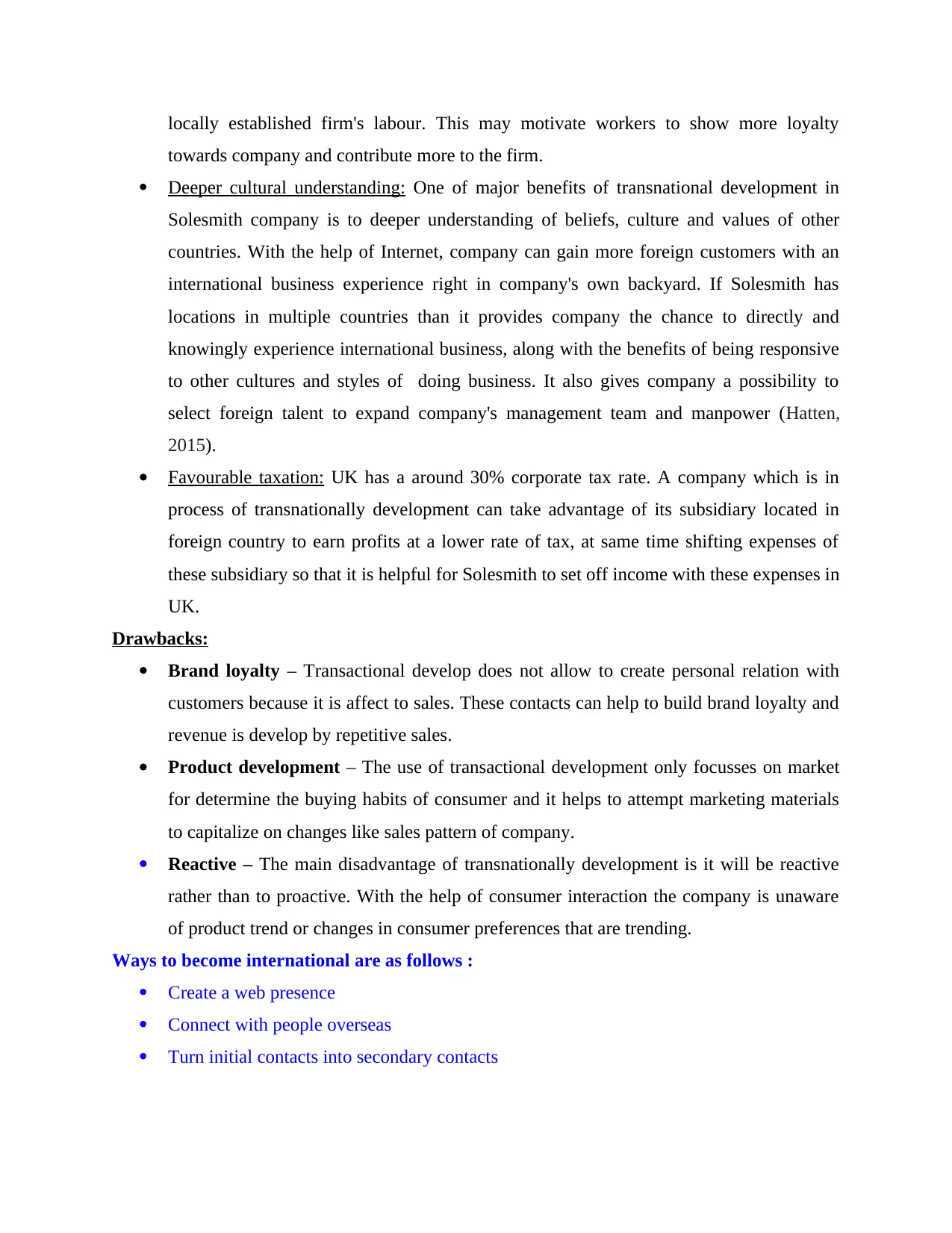
locally established firm's labour. This may motivate workers to show more loyalty
towards company and contribute more to the firm.
Deeper cultural understanding: One of major benefits of transnational development in
Solesmith company is to deeper understanding of beliefs, culture and values of other
countries. With the help of Internet, company can gain more foreign customers with an
international business experience right in company's own backyard. If Solesmith has
locations in multiple countries than it provides company the chance to directly and
knowingly experience international business, along with the benefits of being responsive
to other cultures and styles of doing business. It also gives company a possibility to
select foreign talent to expand company's management team and manpower (Hatten,
2015).
Favourable taxation: UK has a around 30% corporate tax rate. A company which is in
process of transnationally development can take advantage of its subsidiary located in
foreign country to earn profits at a lower rate of tax, at same time shifting expenses of
these subsidiary so that it is helpful for Solesmith to set off income with these expenses in
UK.
Drawbacks:
Brand loyalty – Transactional develop does not allow to create personal relation with
customers because it is affect to sales. These contacts can help to build brand loyalty and
revenue is develop by repetitive sales.
Product development – The use of transactional development only focusses on market
for determine the buying habits of consumer and it helps to attempt marketing materials
to capitalize on changes like sales pattern of company.
Reactive – The main disadvantage of transnationally development is it will be reactive
rather than to proactive. With the help of consumer interaction the company is unaware
of product trend or changes in consumer preferences that are trending.
Ways to become international are as follows :
Create a web presence
Connect with people overseas
Turn initial contacts into secondary contacts
towards company and contribute more to the firm.
Deeper cultural understanding: One of major benefits of transnational development in
Solesmith company is to deeper understanding of beliefs, culture and values of other
countries. With the help of Internet, company can gain more foreign customers with an
international business experience right in company's own backyard. If Solesmith has
locations in multiple countries than it provides company the chance to directly and
knowingly experience international business, along with the benefits of being responsive
to other cultures and styles of doing business. It also gives company a possibility to
select foreign talent to expand company's management team and manpower (Hatten,
2015).
Favourable taxation: UK has a around 30% corporate tax rate. A company which is in
process of transnationally development can take advantage of its subsidiary located in
foreign country to earn profits at a lower rate of tax, at same time shifting expenses of
these subsidiary so that it is helpful for Solesmith to set off income with these expenses in
UK.
Drawbacks:
Brand loyalty – Transactional develop does not allow to create personal relation with
customers because it is affect to sales. These contacts can help to build brand loyalty and
revenue is develop by repetitive sales.
Product development – The use of transactional development only focusses on market
for determine the buying habits of consumer and it helps to attempt marketing materials
to capitalize on changes like sales pattern of company.
Reactive – The main disadvantage of transnationally development is it will be reactive
rather than to proactive. With the help of consumer interaction the company is unaware
of product trend or changes in consumer preferences that are trending.
Ways to become international are as follows :
Create a web presence
Connect with people overseas
Turn initial contacts into secondary contacts
Paraphrase This Document
Need a fresh take? Get an instant paraphrase of this document with our AI Paraphraser
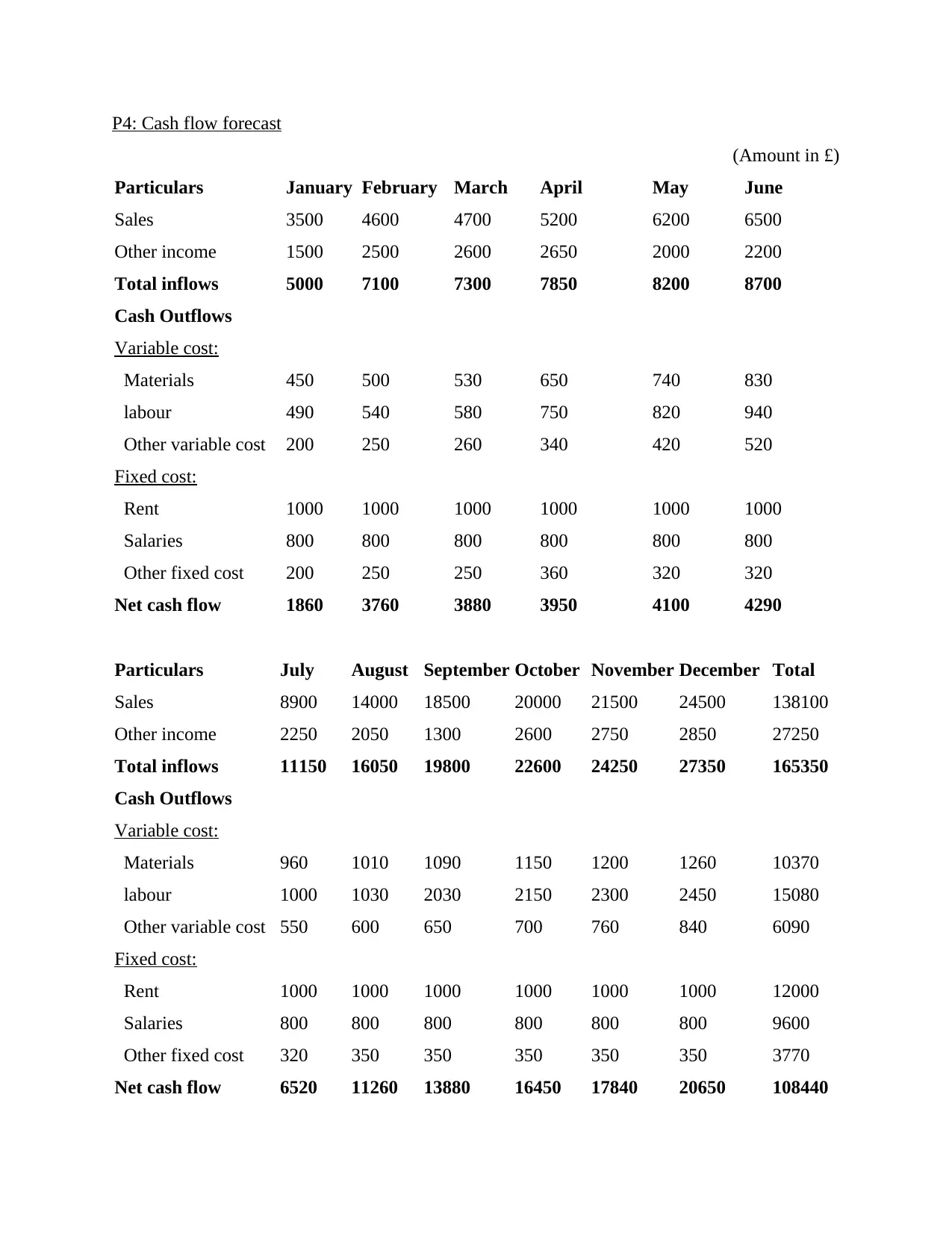
P4: Cash flow forecast
(Amount in £)
Particulars January February March April May June
Sales 3500 4600 4700 5200 6200 6500
Other income 1500 2500 2600 2650 2000 2200
Total inflows 5000 7100 7300 7850 8200 8700
Cash Outflows
Variable cost:
Materials 450 500 530 650 740 830
labour 490 540 580 750 820 940
Other variable cost 200 250 260 340 420 520
Fixed cost:
Rent 1000 1000 1000 1000 1000 1000
Salaries 800 800 800 800 800 800
Other fixed cost 200 250 250 360 320 320
Net cash flow 1860 3760 3880 3950 4100 4290
Particulars July August September October November December Total
Sales 8900 14000 18500 20000 21500 24500 138100
Other income 2250 2050 1300 2600 2750 2850 27250
Total inflows 11150 16050 19800 22600 24250 27350 165350
Cash Outflows
Variable cost:
Materials 960 1010 1090 1150 1200 1260 10370
labour 1000 1030 2030 2150 2300 2450 15080
Other variable cost 550 600 650 700 760 840 6090
Fixed cost:
Rent 1000 1000 1000 1000 1000 1000 12000
Salaries 800 800 800 800 800 800 9600
Other fixed cost 320 350 350 350 350 350 3770
Net cash flow 6520 11260 13880 16450 17840 20650 108440
(Amount in £)
Particulars January February March April May June
Sales 3500 4600 4700 5200 6200 6500
Other income 1500 2500 2600 2650 2000 2200
Total inflows 5000 7100 7300 7850 8200 8700
Cash Outflows
Variable cost:
Materials 450 500 530 650 740 830
labour 490 540 580 750 820 940
Other variable cost 200 250 260 340 420 520
Fixed cost:
Rent 1000 1000 1000 1000 1000 1000
Salaries 800 800 800 800 800 800
Other fixed cost 200 250 250 360 320 320
Net cash flow 1860 3760 3880 3950 4100 4290
Particulars July August September October November December Total
Sales 8900 14000 18500 20000 21500 24500 138100
Other income 2250 2050 1300 2600 2750 2850 27250
Total inflows 11150 16050 19800 22600 24250 27350 165350
Cash Outflows
Variable cost:
Materials 960 1010 1090 1150 1200 1260 10370
labour 1000 1030 2030 2150 2300 2450 15080
Other variable cost 550 600 650 700 760 840 6090
Fixed cost:
Rent 1000 1000 1000 1000 1000 1000 12000
Salaries 800 800 800 800 800 800 9600
Other fixed cost 320 350 350 350 350 350 3770
Net cash flow 6520 11260 13880 16450 17840 20650 108440
Interpretation – From the above table total cash inflows from January to December that are
continued increase due to increase sales. From total cash inflows deduct amount of total out flow
and get net cash flow. From the table it has been forecasted that in upcoming period organisation
will be able to acquire profits of 108440 pound. Total sales for the period of 12 months will be
138100 pound other income for the same period will be 27250 pound. Fixed costs would be
around 25370 pound and variable expenses for the same period will be 31540 pound. It is very
important for the organisation to arrange sufficient funds that can help to face all the costs. Total
cash inflow for the period will be around 165350 pound.
P5: Break even analysis
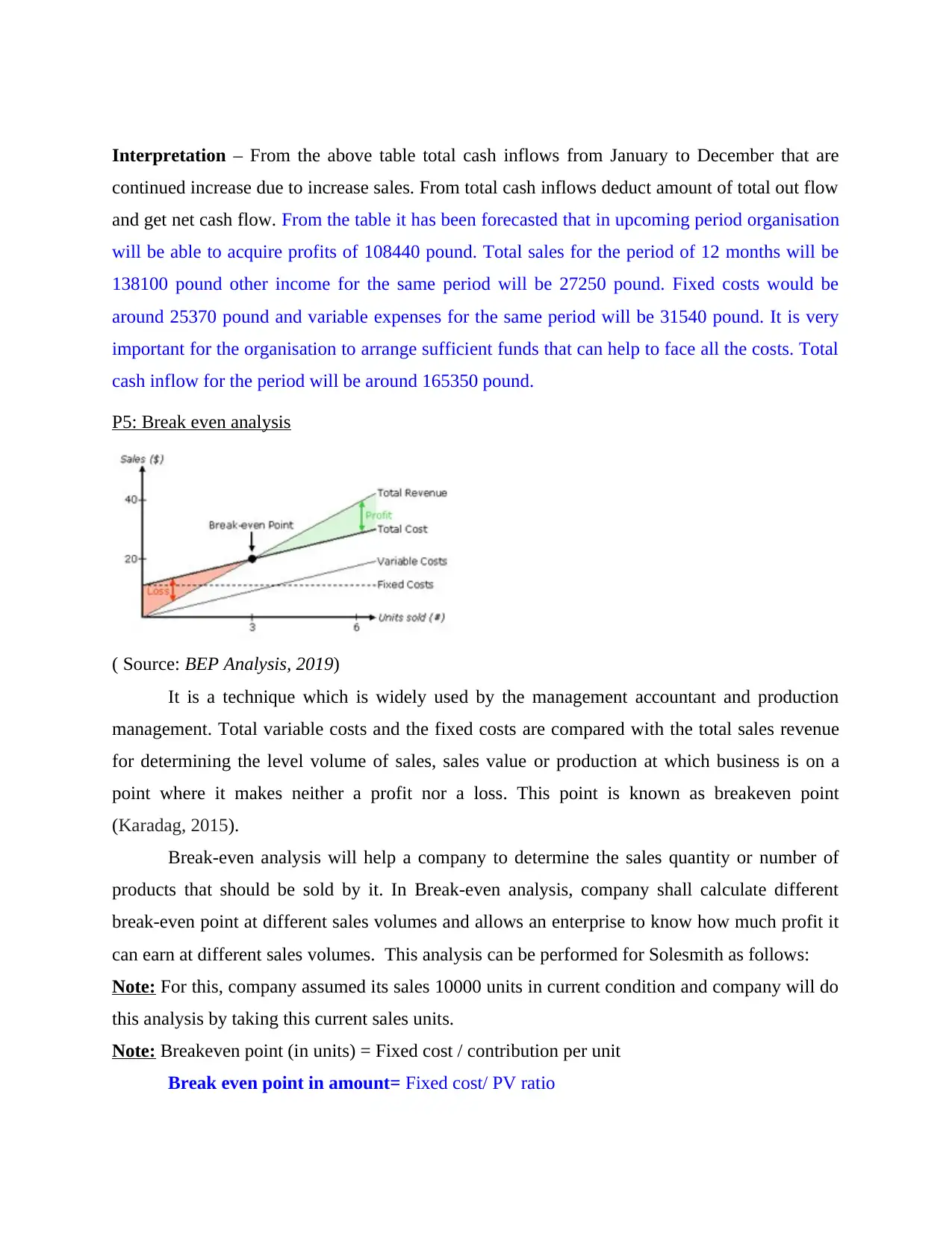
( Source: BEP Analysis, 2019)
It is a technique which is widely used by the management accountant and production
management. Total variable costs and the fixed costs are compared with the total sales revenue
for determining the level volume of sales, sales value or production at which business is on a
point where it makes neither a profit nor a loss. This point is known as breakeven point
(Karadag, 2015).
Break-even analysis will help a company to determine the sales quantity or number of
products that should be sold by it. In Break-even analysis, company shall calculate different
break-even point at different sales volumes and allows an enterprise to know how much profit it
can earn at different sales volumes. This analysis can be performed for Solesmith as follows:
Note: For this, company assumed its sales 10000 units in current condition and company will do
this analysis by taking this current sales units.
Note: Breakeven point (in units) = Fixed cost / contribution per unit
Break even point in amount= Fixed cost/ PV ratio
continued increase due to increase sales. From total cash inflows deduct amount of total out flow
and get net cash flow. From the table it has been forecasted that in upcoming period organisation
will be able to acquire profits of 108440 pound. Total sales for the period of 12 months will be
138100 pound other income for the same period will be 27250 pound. Fixed costs would be
around 25370 pound and variable expenses for the same period will be 31540 pound. It is very
important for the organisation to arrange sufficient funds that can help to face all the costs. Total
cash inflow for the period will be around 165350 pound.
P5: Break even analysis
( Source: BEP Analysis, 2019)
It is a technique which is widely used by the management accountant and production
management. Total variable costs and the fixed costs are compared with the total sales revenue
for determining the level volume of sales, sales value or production at which business is on a
point where it makes neither a profit nor a loss. This point is known as breakeven point
(Karadag, 2015).
Break-even analysis will help a company to determine the sales quantity or number of
products that should be sold by it. In Break-even analysis, company shall calculate different
break-even point at different sales volumes and allows an enterprise to know how much profit it
can earn at different sales volumes. This analysis can be performed for Solesmith as follows:
Note: For this, company assumed its sales 10000 units in current condition and company will do
this analysis by taking this current sales units.
Note: Breakeven point (in units) = Fixed cost / contribution per unit
Break even point in amount= Fixed cost/ PV ratio
⊘ This is a preview!⊘
Do you want full access?
Subscribe today to unlock all pages.
Trusted by 1+ million students worldwide
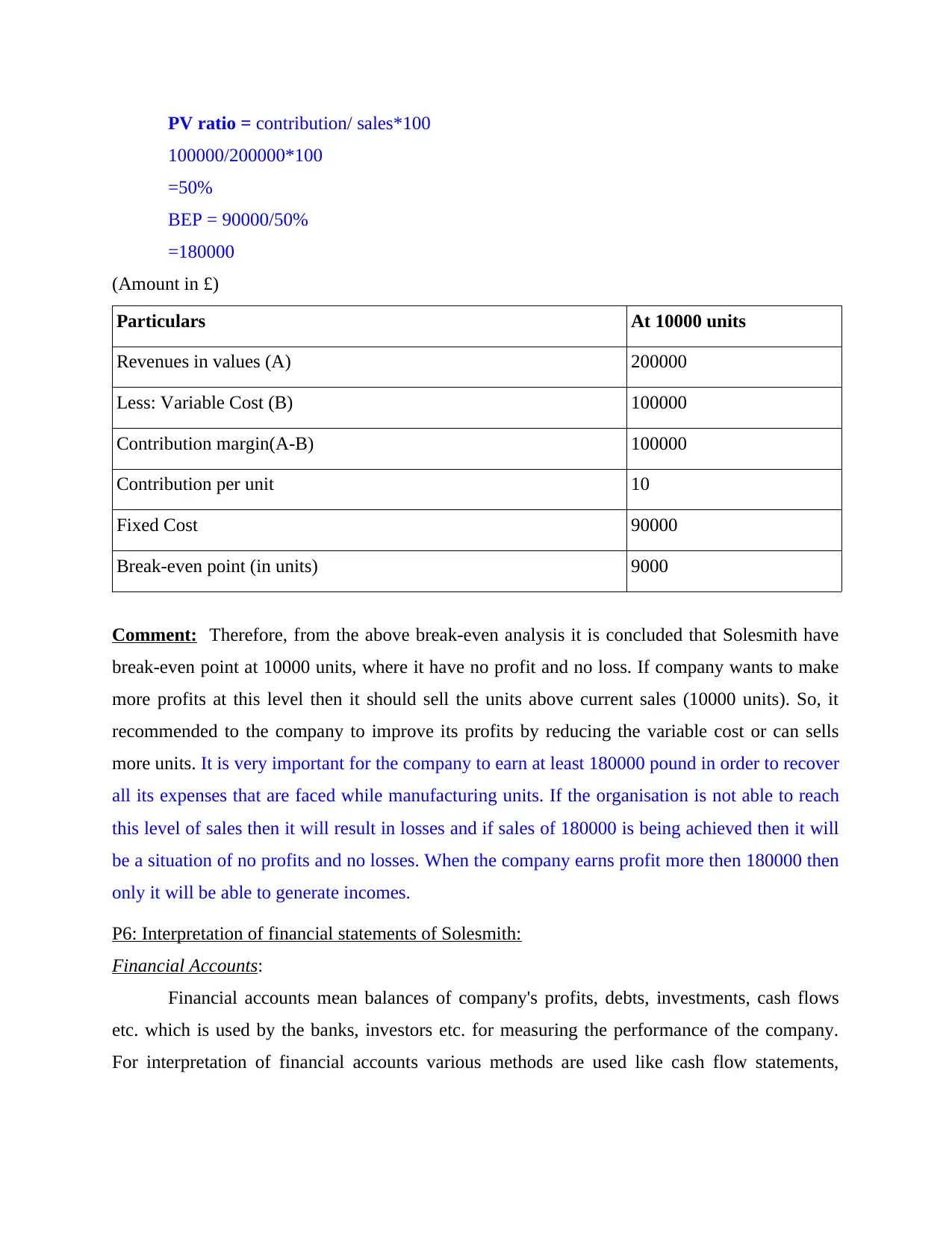
PV ratio = contribution/ sales*100
100000/200000*100
=50%
BEP = 90000/50%
=180000
(Amount in £)
Particulars At 10000 units
Revenues in values (A) 200000
Less: Variable Cost (B) 100000
Contribution margin(A-B) 100000
Contribution per unit 10
Fixed Cost 90000
Break-even point (in units) 9000
Comment: Therefore, from the above break-even analysis it is concluded that Solesmith have
break-even point at 10000 units, where it have no profit and no loss. If company wants to make
more profits at this level then it should sell the units above current sales (10000 units). So, it
recommended to the company to improve its profits by reducing the variable cost or can sells
more units. It is very important for the company to earn at least 180000 pound in order to recover
all its expenses that are faced while manufacturing units. If the organisation is not able to reach
this level of sales then it will result in losses and if sales of 180000 is being achieved then it will
be a situation of no profits and no losses. When the company earns profit more then 180000 then
only it will be able to generate incomes.
P6: Interpretation of financial statements of Solesmith:
Financial Accounts:
Financial accounts mean balances of company's profits, debts, investments, cash flows
etc. which is used by the banks, investors etc. for measuring the performance of the company.
For interpretation of financial accounts various methods are used like cash flow statements,
100000/200000*100
=50%
BEP = 90000/50%
=180000
(Amount in £)
Particulars At 10000 units
Revenues in values (A) 200000
Less: Variable Cost (B) 100000
Contribution margin(A-B) 100000
Contribution per unit 10
Fixed Cost 90000
Break-even point (in units) 9000
Comment: Therefore, from the above break-even analysis it is concluded that Solesmith have
break-even point at 10000 units, where it have no profit and no loss. If company wants to make
more profits at this level then it should sell the units above current sales (10000 units). So, it
recommended to the company to improve its profits by reducing the variable cost or can sells
more units. It is very important for the company to earn at least 180000 pound in order to recover
all its expenses that are faced while manufacturing units. If the organisation is not able to reach
this level of sales then it will result in losses and if sales of 180000 is being achieved then it will
be a situation of no profits and no losses. When the company earns profit more then 180000 then
only it will be able to generate incomes.
P6: Interpretation of financial statements of Solesmith:
Financial Accounts:
Financial accounts mean balances of company's profits, debts, investments, cash flows
etc. which is used by the banks, investors etc. for measuring the performance of the company.
For interpretation of financial accounts various methods are used like cash flow statements,
Paraphrase This Document
Need a fresh take? Get an instant paraphrase of this document with our AI Paraphraser
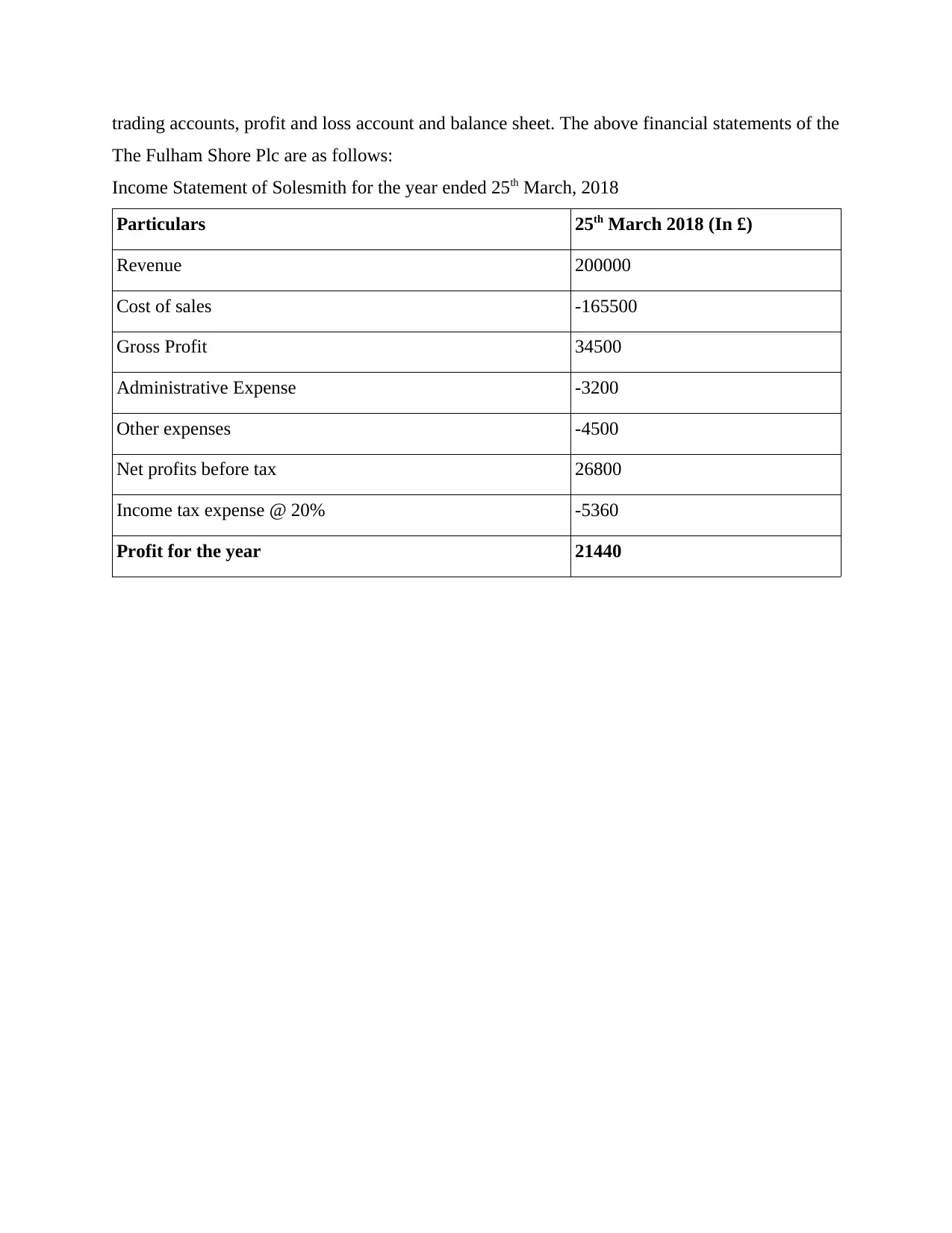
trading accounts, profit and loss account and balance sheet. The above financial statements of the
The Fulham Shore Plc are as follows:
Income Statement of Solesmith for the year ended 25th March, 2018
Particulars 25th March 2018 (In £)
Revenue 200000
Cost of sales -165500
Gross Profit 34500
Administrative Expense -3200
Other expenses -4500
Net profits before tax 26800
Income tax expense @ 20% -5360
Profit for the year 21440
The Fulham Shore Plc are as follows:
Income Statement of Solesmith for the year ended 25th March, 2018
Particulars 25th March 2018 (In £)
Revenue 200000
Cost of sales -165500
Gross Profit 34500
Administrative Expense -3200
Other expenses -4500
Net profits before tax 26800
Income tax expense @ 20% -5360
Profit for the year 21440
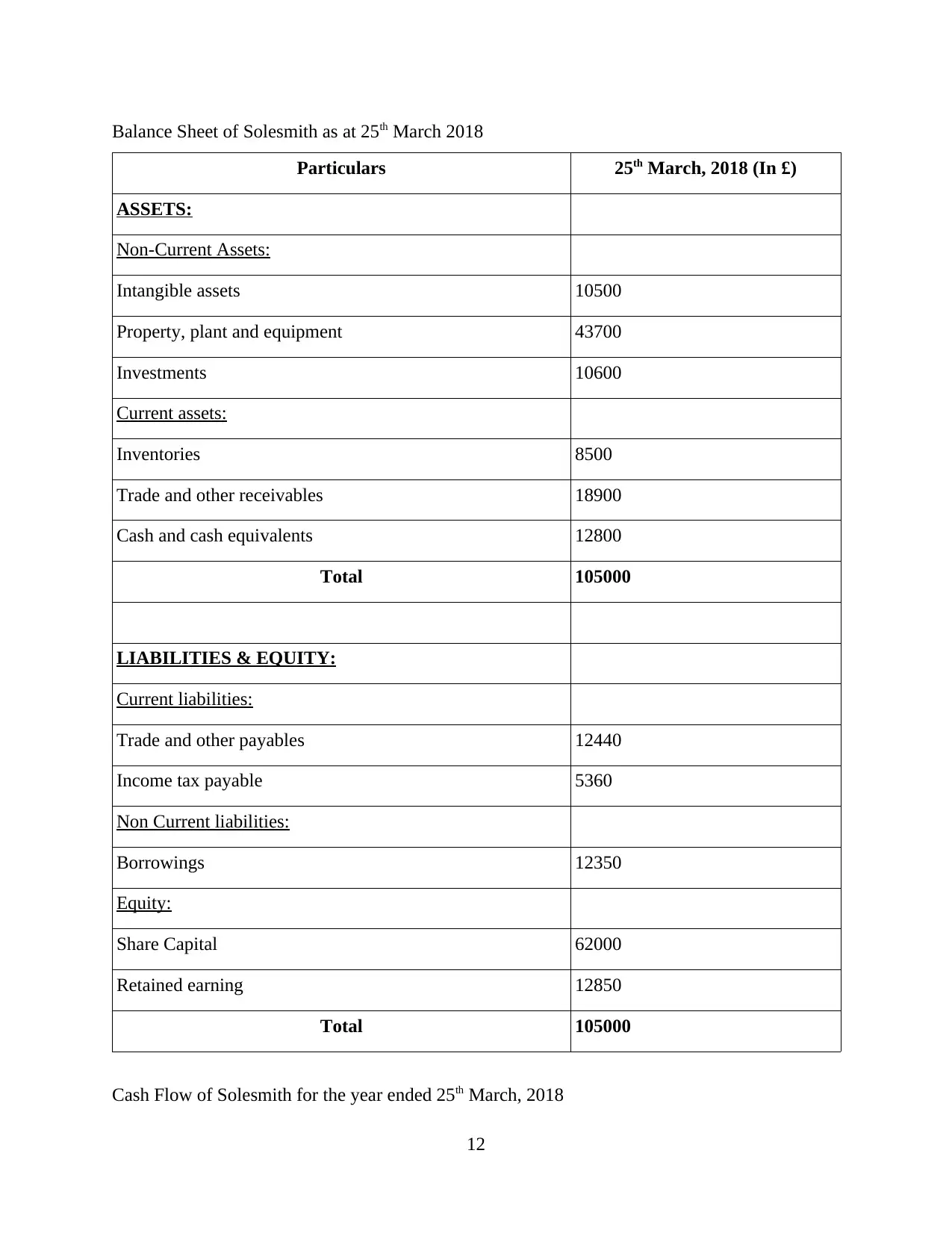
Balance Sheet of Solesmith as at 25th March 2018
Particulars 25th March, 2018 (In £)
ASSETS:
Non-Current Assets:
Intangible assets 10500
Property, plant and equipment 43700
Investments 10600
Current assets:
Inventories 8500
Trade and other receivables 18900
Cash and cash equivalents 12800
Total 105000
LIABILITIES & EQUITY:
Current liabilities:
Trade and other payables 12440
Income tax payable 5360
Non Current liabilities:
Borrowings 12350
Equity:
Share Capital 62000
Retained earning 12850
Total 105000
Cash Flow of Solesmith for the year ended 25th March, 2018
12
Particulars 25th March, 2018 (In £)
ASSETS:
Non-Current Assets:
Intangible assets 10500
Property, plant and equipment 43700
Investments 10600
Current assets:
Inventories 8500
Trade and other receivables 18900
Cash and cash equivalents 12800
Total 105000
LIABILITIES & EQUITY:
Current liabilities:
Trade and other payables 12440
Income tax payable 5360
Non Current liabilities:
Borrowings 12350
Equity:
Share Capital 62000
Retained earning 12850
Total 105000
Cash Flow of Solesmith for the year ended 25th March, 2018
12
⊘ This is a preview!⊘
Do you want full access?
Subscribe today to unlock all pages.
Trusted by 1+ million students worldwide

1 out of 16


Related Documents


Your All-in-One AI-Powered Toolkit for Academic Success.
+13062052269
info@desklib.com
Available 24*7 on WhatsApp / Email
![[object Object]](/_next/static/media/star-bottom.7253800d.svg)
Unlock your academic potential
Copyright © 2020–2026 A2Z Services. All Rights Reserved. Developed and managed by ZUCOL.