Source Credibility Analysis: HRM 101 Week 4 Discussion

Verified

Added on  2023/04/25

|5
|453
|375
Discussion Board Post
AI Summary
This assignment analyzes an article on human resource management and workplace stress using the CRAAP (Currency, Relevance, Authority, Accuracy, Purpose) evaluation model. The analysis examines the article's publication date, relevance to the topic, the author's credentials and publishing body, peer review status, and the article's intended purpose. The evaluation highlights the article's strengths, such as its relevance and the inclusion of expert opinions, while also pointing out weaknesses, like the lack of peer review and the case-specific nature of some examples. The assignment concludes by outlining potential methods to discredit the source, focusing on its limitations in generalizability and peer review status.
Document Page
Running head: HUMAN RESOURCE MANAGEMENT
Human Resource Management
tabler-icon-diamond-filled.svg

Paraphrase This Document

Need a fresh take? Get an instant paraphrase of this document with our AI Paraphraser
Document Page
HUMAN RESOURCE MANAGEMENT 1
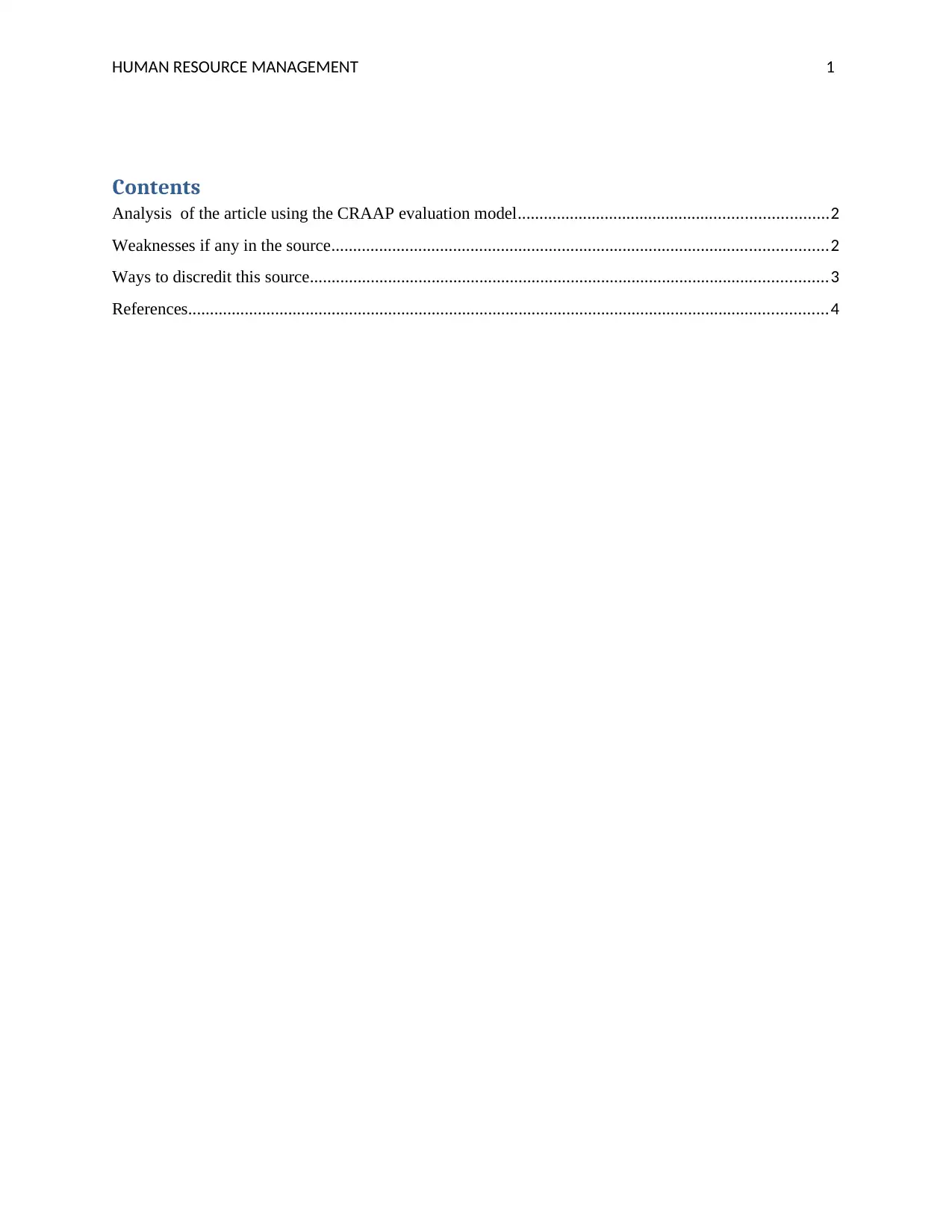
Contents
Analysis of the article using the CRAAP evaluation model.......................................................................2
Weaknesses if any in the source..................................................................................................................2
Ways to discredit this source.......................................................................................................................3
References...................................................................................................................................................4
Document Page
HUMAN RESOURCE MANAGEMENT 2
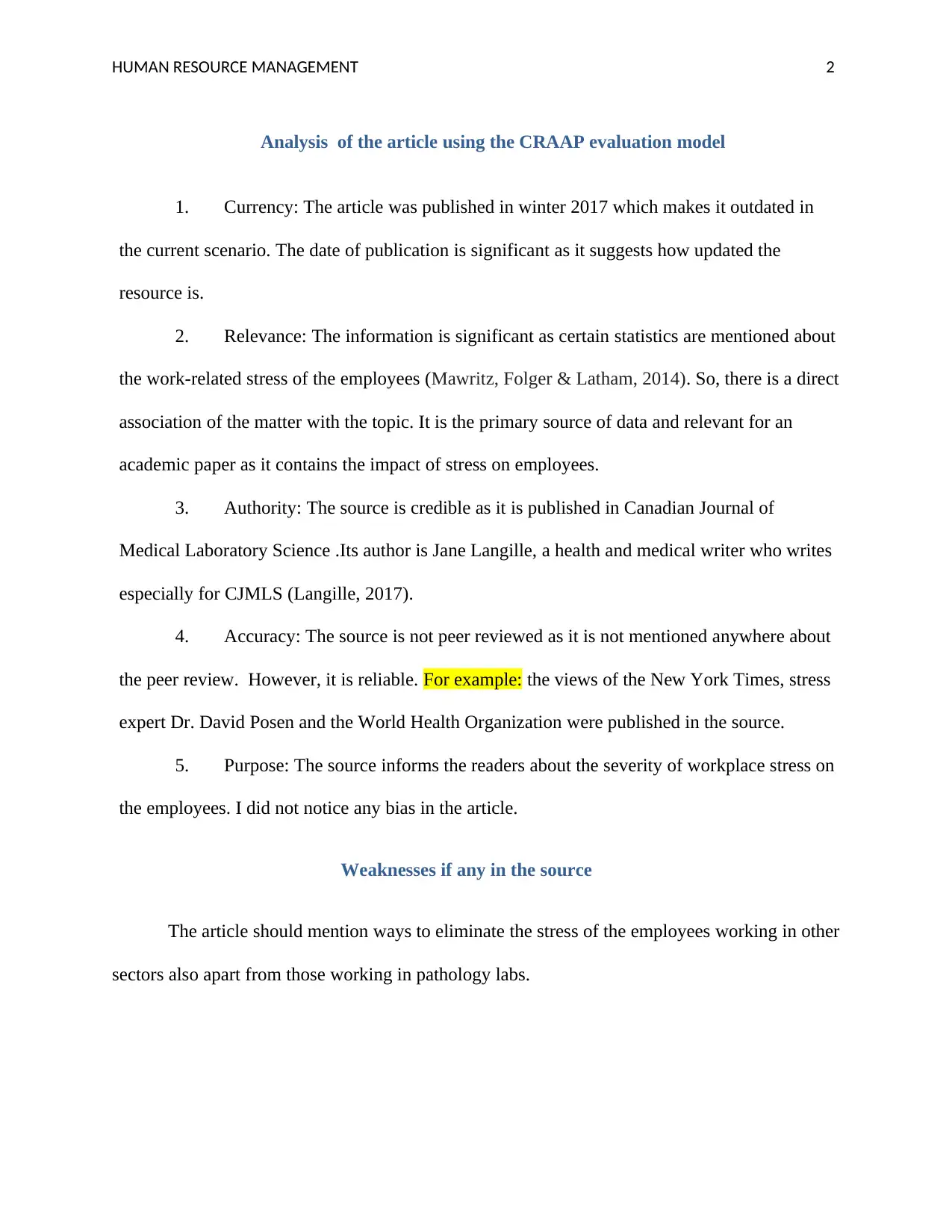
Analysis of the article using the CRAAP evaluation model
1. Currency: The article was published in winter 2017 which makes it outdated in
the current scenario. The date of publication is significant as it suggests how updated the
resource is.
2. Relevance: The information is significant as certain statistics are mentioned about
the work-related stress of the employees (Mawritz, Folger & Latham, 2014). So, there is a direct
association of the matter with the topic. It is the primary source of data and relevant for an
academic paper as it contains the impact of stress on employees.
3. Authority: The source is credible as it is published in Canadian Journal of
Medical Laboratory Science .Its author is Jane Langille, a health and medical writer who writes
especially for CJMLS (Langille, 2017).
4. Accuracy: The source is not peer reviewed as it is not mentioned anywhere about
the peer review. However, it is reliable. For example: the views of the New York Times, stress
expert Dr. David Posen and the World Health Organization were published in the source.
5. Purpose: The source informs the readers about the severity of workplace stress on
the employees. I did not notice any bias in the article.
Weaknesses if any in the source
The article should mention ways to eliminate the stress of the employees working in other
sectors also apart from those working in pathology labs.
Document Page
HUMAN RESOURCE MANAGEMENT 3
Ways to discredit this source
It can be discredited on the fact that it is not a peer-reviewed article. It also mentions the
practices adopted by the lab manager of LifeLabs Inc., which is a case-specific study. So, it can’t
be applied to each and every case.
tabler-icon-diamond-filled.svg

Paraphrase This Document

Need a fresh take? Get an instant paraphrase of this document with our AI Paraphraser
Document Page
HUMAN RESOURCE MANAGEMENT 4
References
Langille, J. (2017). Fight or Flight... or Fix? Canadian Journal of Medical Laboratory
Science.79 (4), 26-29.
Mawritz, M. B., Folger, R. & Latham, G. P. (2014). Supervisors' exceedingly difficult goals and
abusive supervision: The mediating effects of hindrance stress, anger, and
anxiety. Journal of Organizational Behavior, 35(3), 358-372.
chevron_up_icon
1 out of 5
circle_padding
hide_on_mobile
zoom_out_icon
[object Object]