Legal Principles: Sources of Law, Contract Formation, and EU Law
VerifiedAdded on 2019/12/28
|10
|2864
|160
Homework Assignment
AI Summary
This assignment delves into the legal framework of England and Wales, examining the primary sources of law including statutes, case law, EU law, and ECHR law. It differentiates between public and private law, exploring their respective domains and applications. The assignment also addresses the concept of EU law supremacy, outlining its impact on national law and the enforcement of EU regulations. Furthermore, it analyzes contract law principles, focusing on offer and acceptance, intentions to create legal relations, and the essential element of consideration. The assignment applies these concepts to a case study involving a gym leisure center, illustrating the practical application of these legal principles in a real-world scenario. The assignment includes detailed explanations of legal concepts and their application, making it a valuable resource for students studying law.
SECTION 1
Q no 1 Sources of law in England & Wales
In England and Wales, by a mishap of history, the lawful framework has a differed mix of
sources. This is not one of a kind. Most nations have a blend of legal societies. As a case, in
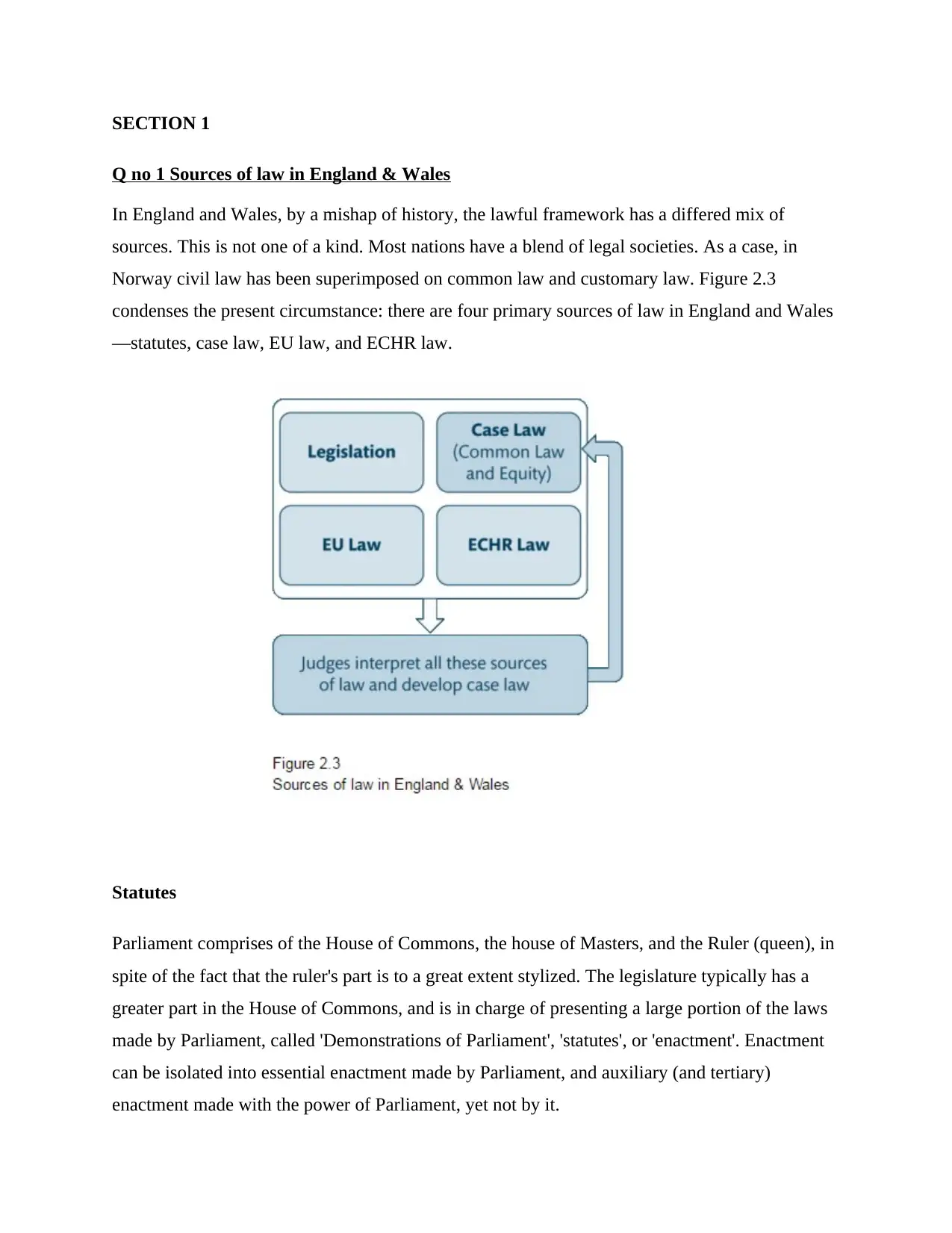
Norway civil law has been superimposed on common law and customary law. Figure 2.3
condenses the present circumstance: there are four primary sources of law in England and Wales
—statutes, case law, EU law, and ECHR law.
Statutes
Parliament comprises of the House of Commons, the house of Masters, and the Ruler (queen), in
spite of the fact that the ruler's part is to a great extent stylized. The legislature typically has a
greater part in the House of Commons, and is in charge of presenting a large portion of the laws
made by Parliament, called 'Demonstrations of Parliament', 'statutes', or 'enactment'. Enactment
can be isolated into essential enactment made by Parliament, and auxiliary (and tertiary)
enactment made with the power of Parliament, yet not by it.
Q no 1 Sources of law in England & Wales
In England and Wales, by a mishap of history, the lawful framework has a differed mix of
sources. This is not one of a kind. Most nations have a blend of legal societies. As a case, in
Norway civil law has been superimposed on common law and customary law. Figure 2.3
condenses the present circumstance: there are four primary sources of law in England and Wales
—statutes, case law, EU law, and ECHR law.
Statutes
Parliament comprises of the House of Commons, the house of Masters, and the Ruler (queen), in
spite of the fact that the ruler's part is to a great extent stylized. The legislature typically has a
greater part in the House of Commons, and is in charge of presenting a large portion of the laws
made by Parliament, called 'Demonstrations of Parliament', 'statutes', or 'enactment'. Enactment
can be isolated into essential enactment made by Parliament, and auxiliary (and tertiary)
enactment made with the power of Parliament, yet not by it.

Paraphrase This Document
Need a fresh take? Get an instant paraphrase of this document with our AI Paraphraser
EU law and ECHR law
In the modern English lawful framework, both Parliament and the courts additionally need to
consider EU law, joined into UK law by the European Communities Act 1972, and the European
Convention on Human Rights (ECHR) (by means of the Human Rights Act 1998).It is important
to understand that EU law and ECHR law are completely separate from each other. Both ranges
of law are having a significant and expanding impact on the English legitimate framework.
Although both territories of law administer relations between states, both additionally make
rights enforceable by people.
Case law
The courts comprise of autonomous, non-elected, judges. By complexity, in a few purviews,
judges have a more political center, the embodiment being in the US, where they are usually
selected by several politicians.
Senior judges make case law by achieving decisions on the cases before them. This is once in a
while alluded to as the 'common law' to recognize it from legislation. Case law additionally
incorporates value, which is a generally isolate group of case law with various authentic starting
points from common law.
Judges have a law-making part: they create law in regions where enactment is inadequate (e.g.
the law of carelessness), and, if vital, fill the crevices in legislation.
In the modern English lawful framework, both Parliament and the courts additionally need to
consider EU law, joined into UK law by the European Communities Act 1972, and the European
Convention on Human Rights (ECHR) (by means of the Human Rights Act 1998).It is important
to understand that EU law and ECHR law are completely separate from each other. Both ranges
of law are having a significant and expanding impact on the English legitimate framework.
Although both territories of law administer relations between states, both additionally make
rights enforceable by people.
Case law
The courts comprise of autonomous, non-elected, judges. By complexity, in a few purviews,
judges have a more political center, the embodiment being in the US, where they are usually
selected by several politicians.
Senior judges make case law by achieving decisions on the cases before them. This is once in a
while alluded to as the 'common law' to recognize it from legislation. Case law additionally
incorporates value, which is a generally isolate group of case law with various authentic starting
points from common law.
Judges have a law-making part: they create law in regions where enactment is inadequate (e.g.
the law of carelessness), and, if vital, fill the crevices in legislation.
Q no 2 Difference between public and private law
There are a few contrasts between public law and private law. The primary distinction is that
public law ensures society all in all and private law administers associations between people or
groups. Public law is ordinarily decided and upheld by government organizations, though the
administration normally expels itself from the implementation of private law.
Public law is partitioned into a few areas managing the cooperation between natives or
companies and the legislature. These areas incorporate constitutional law, administrative law,
and criminal law. Every area of public law administers particular territories of societal
associations and the cures accessible for infringement of those laws.
Constitutional law manages laws as contained in a nation's composed constitution or, now and
again, an unwritten constitution identified with convention and custom. These laws are
frequently alluded to as the "tradition that must be adhered to" and set the point of reference for
different laws and controls. They try to characterize the privileges of natives in connection to the
state furthermore direct the cooperation of different branches of the legislature.
Administrative law is regularly viewed as both public law and private law. In a few viewpoints,
administrative law gives direction to the operation of government elements inside a country and
with respect to international law. Administrative law can likewise be seen as both public law and
private law since it straddles the line and manage a few directions and laws overseeing civil law.
Criminal law is maybe the most understood type of both open law and public law. This branch of
public law manages keeping up a quiet society. Criminal law applies to people and companies,
and laws and controls found all through framework particular infringement and set punishments
for those infringement. Violations managed under criminal law incorporate robbery, savage
wrongdoings, and corporate wrongdoings, for example, extortion.
Maybe the most well-known case of private law is respectful law. This branch of law looks to
help neither parties, where commonly nor is the administration, settle individual question. Basic
common law cases include contract debate, separations and youngster authority. These cases are
attempted without the impedance of the legislature despite the fact that the authoritative branch
There are a few contrasts between public law and private law. The primary distinction is that
public law ensures society all in all and private law administers associations between people or
groups. Public law is ordinarily decided and upheld by government organizations, though the
administration normally expels itself from the implementation of private law.
Public law is partitioned into a few areas managing the cooperation between natives or
companies and the legislature. These areas incorporate constitutional law, administrative law,
and criminal law. Every area of public law administers particular territories of societal
associations and the cures accessible for infringement of those laws.
Constitutional law manages laws as contained in a nation's composed constitution or, now and
again, an unwritten constitution identified with convention and custom. These laws are
frequently alluded to as the "tradition that must be adhered to" and set the point of reference for
different laws and controls. They try to characterize the privileges of natives in connection to the
state furthermore direct the cooperation of different branches of the legislature.
Administrative law is regularly viewed as both public law and private law. In a few viewpoints,
administrative law gives direction to the operation of government elements inside a country and
with respect to international law. Administrative law can likewise be seen as both public law and
private law since it straddles the line and manage a few directions and laws overseeing civil law.
Criminal law is maybe the most understood type of both open law and public law. This branch of
public law manages keeping up a quiet society. Criminal law applies to people and companies,
and laws and controls found all through framework particular infringement and set punishments
for those infringement. Violations managed under criminal law incorporate robbery, savage
wrongdoings, and corporate wrongdoings, for example, extortion.
Maybe the most well-known case of private law is respectful law. This branch of law looks to
help neither parties, where commonly nor is the administration, settle individual question. Basic
common law cases include contract debate, separations and youngster authority. These cases are
attempted without the impedance of the legislature despite the fact that the authoritative branch
⊘ This is a preview!⊘
Do you want full access?
Subscribe today to unlock all pages.

Trusted by 1+ million students worldwide
or legal branch may have played a part in drafting and receiving the laws included. A few nations
may allude to private law as common law.
Q no 3 Concept of Supremacy of EU LAW
The legitimate teaching of supremacy of EU law implies that EU work law overshadows
domestic labor law. The making of another legitimate request of EU law and its supremacy
implies that EU organizations may make rules influencing livelihood and industrial relations,
even where some Part States contradict such guidelines and vote against them in those EU
foundations, gave that a voting strategy taking into account a lion's share decide applies to that
particular field. Where embraced, these tenets must be upheld in national courts, even where this
includes overriding guidelines delivered by local law-production foundations. Throughout time,
national protected courts have acknowledged the standards of supremacy of the EU law
confirmed by the European Court of Equity, however in the meantime they have imagined a
point of confinement to it in the basic standards of every national constitution.
This supremacy is surely understood in specific territories, for example, sex segregation, where
the residential law of numerous Part States has been formed, and, in instances of contention, has
been more than once overridden, by the decisions of the European Court of Equity. Most likely
the best known case of the effect of these decisions in labor law is G. Defrenne v. Sabena, Case
43/75, (1976) ECR 455, where the European Court chose that, 'The rule that ladies and men
ought to get break even with pay, which is set around Article 119 EC [now Article 157 TFEU],
might be depended on before the national courts. These courts have an obligation to guarantee
the assurance of the rights, which that procurement vests in people, specifically on account of
those types of segregation which have their birthplace in authoritative procurements… .'
The more extensive the scope of EU abilities in the field of business and modern relations, the
more the EU law they make will come to supplant progressively wide zones of national work
law. A case is the choice of the European Court in Commission v. Joined Kingdom, Case C-
382/92 and Case C-383/92, [1994]. There the Court required the Unified Kingdom to make an
may allude to private law as common law.
Q no 3 Concept of Supremacy of EU LAW
The legitimate teaching of supremacy of EU law implies that EU work law overshadows
domestic labor law. The making of another legitimate request of EU law and its supremacy
implies that EU organizations may make rules influencing livelihood and industrial relations,
even where some Part States contradict such guidelines and vote against them in those EU
foundations, gave that a voting strategy taking into account a lion's share decide applies to that
particular field. Where embraced, these tenets must be upheld in national courts, even where this
includes overriding guidelines delivered by local law-production foundations. Throughout time,
national protected courts have acknowledged the standards of supremacy of the EU law
confirmed by the European Court of Equity, however in the meantime they have imagined a
point of confinement to it in the basic standards of every national constitution.
This supremacy is surely understood in specific territories, for example, sex segregation, where
the residential law of numerous Part States has been formed, and, in instances of contention, has
been more than once overridden, by the decisions of the European Court of Equity. Most likely
the best known case of the effect of these decisions in labor law is G. Defrenne v. Sabena, Case
43/75, (1976) ECR 455, where the European Court chose that, 'The rule that ladies and men
ought to get break even with pay, which is set around Article 119 EC [now Article 157 TFEU],
might be depended on before the national courts. These courts have an obligation to guarantee
the assurance of the rights, which that procurement vests in people, specifically on account of
those types of segregation which have their birthplace in authoritative procurements… .'
The more extensive the scope of EU abilities in the field of business and modern relations, the
more the EU law they make will come to supplant progressively wide zones of national work
law. A case is the choice of the European Court in Commission v. Joined Kingdom, Case C-
382/92 and Case C-383/92, [1994]. There the Court required the Unified Kingdom to make an
Paraphrase This Document
Need a fresh take? Get an instant paraphrase of this document with our AI Paraphraser
arrangement of specialist representation where none existed. Assignment of laborer delegates
was made obligatory by the Court, because of the results for the privileges of specialists under
two mandates 'which require Part States to take all gauges important to guarantee that laborers
are educated, counseled and in a position to intercede through their agents in the occasion of
aggregate redundancies [or the exchange of an undertaking]' (Case C-383/92, section 23; Case C-
382/92, passage 26). Keeping in mind the end goal to perform adequately the assignments of
data and interview indicated in the orders, Part State laws or practices must guarantee the
assignment of specialist delegates.
Given that it might be connected in national courts, the tenet of supermacylikewise applies to
rules on requirement of work law, including cures and techniques. The ECJ has created
extraordinary systems and standards by which EU work law might be implemented in national
courts. Where EU authorization necessities clash with national methods and cures, once more,
they outweigh everything else and must be connected by national courts overriding residential
tenets. Surprising examples have incorporated the Court's choice in Marshall v. Southampton
and South West Zone Wellbeing Power (No. 2), Case C-271/91, (1993), canceling the points of
confinement on remuneration for sex segregation in the UK enactment.
Through the principle of supremacy, EU law has advanced the Europeanization of occupation
and mechanical relations by guaranteeing that EU law applies in numerous zones falling inside
the skill of the EU, going from fairness amongst ladies and men to specialists' representation.
was made obligatory by the Court, because of the results for the privileges of specialists under
two mandates 'which require Part States to take all gauges important to guarantee that laborers
are educated, counseled and in a position to intercede through their agents in the occasion of
aggregate redundancies [or the exchange of an undertaking]' (Case C-383/92, section 23; Case C-
382/92, passage 26). Keeping in mind the end goal to perform adequately the assignments of
data and interview indicated in the orders, Part State laws or practices must guarantee the
assignment of specialist delegates.
Given that it might be connected in national courts, the tenet of supermacylikewise applies to
rules on requirement of work law, including cures and techniques. The ECJ has created
extraordinary systems and standards by which EU work law might be implemented in national
courts. Where EU authorization necessities clash with national methods and cures, once more,
they outweigh everything else and must be connected by national courts overriding residential
tenets. Surprising examples have incorporated the Court's choice in Marshall v. Southampton
and South West Zone Wellbeing Power (No. 2), Case C-271/91, (1993), canceling the points of
confinement on remuneration for sex segregation in the UK enactment.
Through the principle of supremacy, EU law has advanced the Europeanization of occupation
and mechanical relations by guaranteeing that EU law applies in numerous zones falling inside
the skill of the EU, going from fairness amongst ladies and men to specialists' representation.

SECTION 2
Questions on GYM Leisure Centre Case
Q1: Law related to Offer and Acceptance:
The first essential element in the formation of a binding contract is agreement. This is usually
evidenced by offer and acceptance.
Offer is “An express or implied statement of the terms on which the maker is prepared to be
contractually bound if it is accepted unconditionally.”
The offer may be made to one person, to a class of persons or to the world at large, and only the
person or one of the persons to whom it is made may accept it.A definite offer does not have to
be made to a particular person. It may be made to a class of persons or to the world at large.
Acceptance is defined as “An unqualified agreement to all the terms of the offer”. Acceptance is
generally not effective until communicated to the offeror, except where the 'postal rule' applies.
An offer may only be accepted while it is still open. In the absence of an acceptance, an offer
may be terminated in any of the following ways.
Rejection
Revocation by the offeror
Counter-offer
Failure of a condition to which the offer was subject
Lapse of time
Death of one of the parties
In this Case it is a definite offer as it is made to class of person that is to local residents, offer is
as if local residents join the Gym before said period then they got benefit of having low price that
is 120 pounds and a free sport Bag.
Mary and Hannah accept this offer before termination period (that is Signup on or before 31st
January and pay fee).
Questions on GYM Leisure Centre Case
Q1: Law related to Offer and Acceptance:
The first essential element in the formation of a binding contract is agreement. This is usually
evidenced by offer and acceptance.
Offer is “An express or implied statement of the terms on which the maker is prepared to be
contractually bound if it is accepted unconditionally.”
The offer may be made to one person, to a class of persons or to the world at large, and only the
person or one of the persons to whom it is made may accept it.A definite offer does not have to
be made to a particular person. It may be made to a class of persons or to the world at large.
Acceptance is defined as “An unqualified agreement to all the terms of the offer”. Acceptance is
generally not effective until communicated to the offeror, except where the 'postal rule' applies.
An offer may only be accepted while it is still open. In the absence of an acceptance, an offer
may be terminated in any of the following ways.
Rejection
Revocation by the offeror
Counter-offer
Failure of a condition to which the offer was subject
Lapse of time
Death of one of the parties
In this Case it is a definite offer as it is made to class of person that is to local residents, offer is
as if local residents join the Gym before said period then they got benefit of having low price that
is 120 pounds and a free sport Bag.
Mary and Hannah accept this offer before termination period (that is Signup on or before 31st
January and pay fee).
⊘ This is a preview!⊘
Do you want full access?
Subscribe today to unlock all pages.
Trusted by 1+ million students worldwide
Q2: Intentions to create legal relations:
“An agreement will only become a legally binding contract if the parties intend this to be so.
This will be strongly presumed in the case of business agreements but not presumed if the
agreement is of a friendly, social or domestic nature.”
Where there is no express statement as to whether or not legal relations are intended, the courts
apply one of two rebuttable presumptions to a case:
Social, domestic and family arrangements are not usually intended to be binding.
Commercial agreements are usually intended by the parties involved to be legally
binding.
In this case Leisure Centre offer is purely shown as to create legal relationship as there is
indentation of binding a contract, It means that if someone accept their offer of getting signup
and paid for the fee with in prescribed period of time then they are bound to provide them
services on price which is explained under offer (flyer).
On action taken Mary action clearly shown that she do her part of action to accept offer before it
become terminated, she provide related details and information to legally representative of
Leisure Centre and agree to pay the required amount as she provide required bank information,
clearly shows that she wants to pay as well.
“An agreement will only become a legally binding contract if the parties intend this to be so.
This will be strongly presumed in the case of business agreements but not presumed if the
agreement is of a friendly, social or domestic nature.”
Where there is no express statement as to whether or not legal relations are intended, the courts
apply one of two rebuttable presumptions to a case:
Social, domestic and family arrangements are not usually intended to be binding.
Commercial agreements are usually intended by the parties involved to be legally
binding.
In this case Leisure Centre offer is purely shown as to create legal relationship as there is
indentation of binding a contract, It means that if someone accept their offer of getting signup
and paid for the fee with in prescribed period of time then they are bound to provide them
services on price which is explained under offer (flyer).
On action taken Mary action clearly shown that she do her part of action to accept offer before it
become terminated, she provide related details and information to legally representative of
Leisure Centre and agree to pay the required amount as she provide required bank information,
clearly shows that she wants to pay as well.
Paraphrase This Document
Need a fresh take? Get an instant paraphrase of this document with our AI Paraphraser
Q3: Consideration to contract:
Consideration is an essential part of most contracts. It is what each party brings to the contract.
Consideration has been defined as: “A valuable consideration in the sense of the law may consist
either in some right, interest, profit or benefit accruing to one party, or some forbearance,
detriment, loss or responsibility given, suffered or undertaken by the other.”
A valid Consideration may be executed (an act in return for a promise) or executory (a promise
in return for a promise). It may not be past event.
Adequacy and sufficiency of consideration
The long-established rule is that consideration need not be adequate but it must be sufficient.
(a) Consideration need not be adequate (that is, equal in value to the consideration received in
return). There is no remedy at law for someone who simply makes a poor bargain.
(b) Consideration must be sufficient. It must be capable in law of being regarded as consideration
by the courts.
According to scenario under consideration Mary paid amount is more than the consideration set
under agreement. As she paid 180 Pounds but according to Case she is liable to pay only 120
pounds.
Consideration is an essential part of most contracts. It is what each party brings to the contract.
Consideration has been defined as: “A valuable consideration in the sense of the law may consist
either in some right, interest, profit or benefit accruing to one party, or some forbearance,
detriment, loss or responsibility given, suffered or undertaken by the other.”
A valid Consideration may be executed (an act in return for a promise) or executory (a promise
in return for a promise). It may not be past event.
Adequacy and sufficiency of consideration
The long-established rule is that consideration need not be adequate but it must be sufficient.
(a) Consideration need not be adequate (that is, equal in value to the consideration received in
return). There is no remedy at law for someone who simply makes a poor bargain.
(b) Consideration must be sufficient. It must be capable in law of being regarded as consideration
by the courts.
According to scenario under consideration Mary paid amount is more than the consideration set
under agreement. As she paid 180 Pounds but according to Case she is liable to pay only 120
pounds.
Q4: Remedies on breach of contract:
Damages are a common law remedy intended to restore the party who has suffered loss to the
position he would have been in if the contract had been performed. The two tests applied to a
claim for damages relate to remoteness of damage and measure of damages.
Remoteness of damage is tested by the two limbs of the rule:
• The first part of the rule states that the loss must arise either naturally from the breach or in
a manner which the parties may reasonably be supposed to have contemplated when making the
contract.
• The second part of the rule provides that a loss outside the usual course of events will only
be compensated if the exceptional circumstances which caused it were within the defendant's
actual or constructive knowledge when he made the contract.
The measure of damages is that which will compensate for the loss incurred. It is not intended
that the injured party should profit from a claim. Damages may be awarded for financial and
non-financial loss.
As per Current case Mary fulfill her part and accept the offer on time (before termination of
contract). But Southbank leisure Centre should take 120 pounds instead of 180 and also should
give a sport bag to Mary.
As Leisure Centre did breach of contract as take 180 pounds from Mary account and also didn’t
provide Sport Bag that should be within contract consideration.
Remedies include extra 60 pounds and Sports Bag as per as per remoteness of damage. There
shouldn’t be any remedies as per loss outside the usual course of events as there is no special
remedies fixed as per contract before entering in to contract.
References
Damages are a common law remedy intended to restore the party who has suffered loss to the
position he would have been in if the contract had been performed. The two tests applied to a
claim for damages relate to remoteness of damage and measure of damages.
Remoteness of damage is tested by the two limbs of the rule:
• The first part of the rule states that the loss must arise either naturally from the breach or in
a manner which the parties may reasonably be supposed to have contemplated when making the
contract.
• The second part of the rule provides that a loss outside the usual course of events will only
be compensated if the exceptional circumstances which caused it were within the defendant's
actual or constructive knowledge when he made the contract.
The measure of damages is that which will compensate for the loss incurred. It is not intended
that the injured party should profit from a claim. Damages may be awarded for financial and
non-financial loss.
As per Current case Mary fulfill her part and accept the offer on time (before termination of
contract). But Southbank leisure Centre should take 120 pounds instead of 180 and also should
give a sport bag to Mary.
As Leisure Centre did breach of contract as take 180 pounds from Mary account and also didn’t
provide Sport Bag that should be within contract consideration.
Remedies include extra 60 pounds and Sports Bag as per as per remoteness of damage. There
shouldn’t be any remedies as per loss outside the usual course of events as there is no special
remedies fixed as per contract before entering in to contract.
References
⊘ This is a preview!⊘
Do you want full access?
Subscribe today to unlock all pages.
Trusted by 1+ million students worldwide
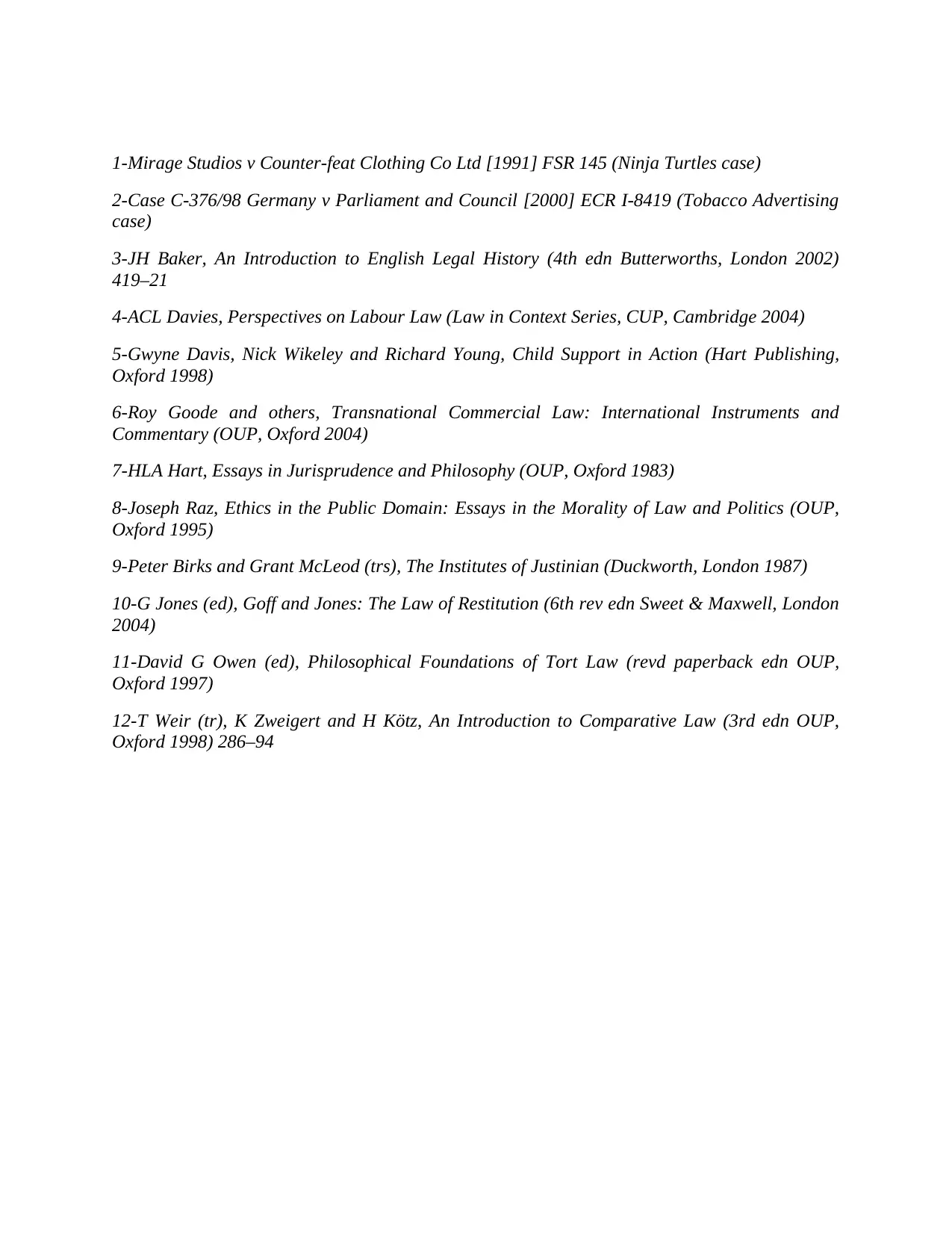
1-Mirage Studios v Counter-feat Clothing Co Ltd [1991] FSR 145 (Ninja Turtles case)
2-Case C-376/98 Germany v Parliament and Council [2000] ECR I-8419 (Tobacco Advertising
case)
3-JH Baker, An Introduction to English Legal History (4th edn Butterworths, London 2002)
419–21
4-ACL Davies, Perspectives on Labour Law (Law in Context Series, CUP, Cambridge 2004)
5-Gwyne Davis, Nick Wikeley and Richard Young, Child Support in Action (Hart Publishing,
Oxford 1998)
6-Roy Goode and others, Transnational Commercial Law: International Instruments and
Commentary (OUP, Oxford 2004)
7-HLA Hart, Essays in Jurisprudence and Philosophy (OUP, Oxford 1983)
8-Joseph Raz, Ethics in the Public Domain: Essays in the Morality of Law and Politics (OUP,
Oxford 1995)
9-Peter Birks and Grant McLeod (trs), The Institutes of Justinian (Duckworth, London 1987)
10-G Jones (ed), Goff and Jones: The Law of Restitution (6th rev edn Sweet & Maxwell, London
2004)
11-David G Owen (ed), Philosophical Foundations of Tort Law (revd paperback edn OUP,
Oxford 1997)
12-T Weir (tr), K Zweigert and H Kötz, An Introduction to Comparative Law (3rd edn OUP,
Oxford 1998) 286–94
2-Case C-376/98 Germany v Parliament and Council [2000] ECR I-8419 (Tobacco Advertising
case)
3-JH Baker, An Introduction to English Legal History (4th edn Butterworths, London 2002)
419–21
4-ACL Davies, Perspectives on Labour Law (Law in Context Series, CUP, Cambridge 2004)
5-Gwyne Davis, Nick Wikeley and Richard Young, Child Support in Action (Hart Publishing,
Oxford 1998)
6-Roy Goode and others, Transnational Commercial Law: International Instruments and
Commentary (OUP, Oxford 2004)
7-HLA Hart, Essays in Jurisprudence and Philosophy (OUP, Oxford 1983)
8-Joseph Raz, Ethics in the Public Domain: Essays in the Morality of Law and Politics (OUP,
Oxford 1995)
9-Peter Birks and Grant McLeod (trs), The Institutes of Justinian (Duckworth, London 1987)
10-G Jones (ed), Goff and Jones: The Law of Restitution (6th rev edn Sweet & Maxwell, London
2004)
11-David G Owen (ed), Philosophical Foundations of Tort Law (revd paperback edn OUP,
Oxford 1997)
12-T Weir (tr), K Zweigert and H Kötz, An Introduction to Comparative Law (3rd edn OUP,
Oxford 1998) 286–94

1 out of 10


Related Documents


Your All-in-One AI-Powered Toolkit for Academic Success.
+13062052269
info@desklib.com
Available 24*7 on WhatsApp / Email
![[object Object]](/_next/static/media/star-bottom.7253800d.svg)
Unlock your academic potential
Copyright © 2020–2026 A2Z Services. All Rights Reserved. Developed and managed by ZUCOL.