Comprehensive Analysis of Long-Term Finance Sources for Businesses

Verified

Added on  2023/06/07

|7
|1239
|435
Report
AI Summary
This report provides an in-depth analysis of long-term finance sources for various business structures, including sole traders, partnerships, private limited companies, and public limited companies. It examines different methods of acquiring long-term funding, such as retained earnings, long-term loans, sales of assets, bank loans, issuing shares, trade credit, overdrafts, government grants, and hire purchase. The report highlights the similarities and differences in long-term finance options based on time period, collateral requirements, and other conditions. It also discusses the specific sources of finance available to each type of business, considering their unique characteristics and needs. The conclusion emphasizes the critical role of finance in business operations and the importance of selecting appropriate funding strategies based on the business's size and nature. The report includes references to academic journals and books to support its findings.

Document Page
Sources of long term
finance
tabler-icon-diamond-filled.svg

Paraphrase This Document

Need a fresh take? Get an instant paraphrase of this document with our AI Paraphraser
Document Page
Contents
Contents...........................................................................................................................................2
INTRODUCTION...........................................................................................................................1
MAIN BODY..................................................................................................................................1
Sources of finance........................................................................................................................1
Similarities in terms of long term finance...................................................................................3
Differences in terms of long term finance...................................................................................3
CONCLUSION................................................................................................................................4
REFERENCES................................................................................................................................5
Document Page
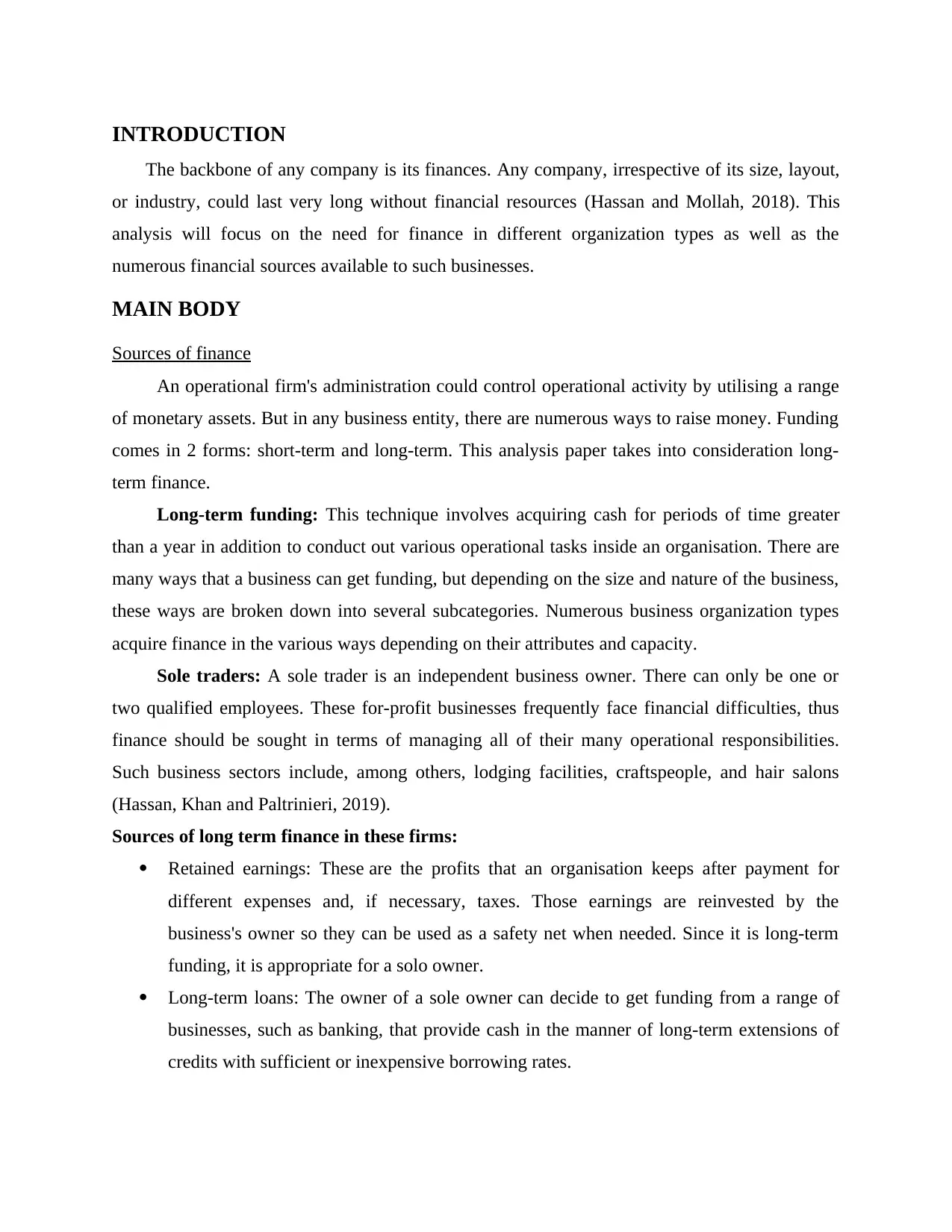
INTRODUCTION
The backbone of any company is its finances. Any company, irrespective of its size, layout,
or industry, could last very long without financial resources (Hassan and Mollah, 2018). This
analysis will focus on the need for finance in different organization types as well as the
numerous financial sources available to such businesses.
MAIN BODY
Sources of finance
An operational firm's administration could control operational activity by utilising a range
of monetary assets. But in any business entity, there are numerous ways to raise money. Funding
comes in 2 forms: short-term and long-term. This analysis paper takes into consideration long-
term finance.
Long-term funding: This technique involves acquiring cash for periods of time greater
than a year in addition to conduct out various operational tasks inside an organisation. There are
many ways that a business can get funding, but depending on the size and nature of the business,
these ways are broken down into several subcategories. Numerous business organization types
acquire finance in the various ways depending on their attributes and capacity.
Sole traders: A sole trader is an independent business owner. There can only be one or
two qualified employees. These for-profit businesses frequently face financial difficulties, thus
finance should be sought in terms of managing all of their many operational responsibilities.
Such business sectors include, among others, lodging facilities, craftspeople, and hair salons
(Hassan, Khan and Paltrinieri, 2019).
Sources of long term finance in these firms:
Retained earnings: These are the profits that an organisation keeps after payment for
different expenses and, if necessary, taxes. Those earnings are reinvested by the
business's owner so they can be used as a safety net when needed. Since it is long-term
funding, it is appropriate for a solo owner.
Long-term loans: The owner of a sole owner can decide to get funding from a range of
businesses, such as banking, that provide cash in the manner of long-term extensions of
credits with sufficient or inexpensive borrowing rates.
Document Page
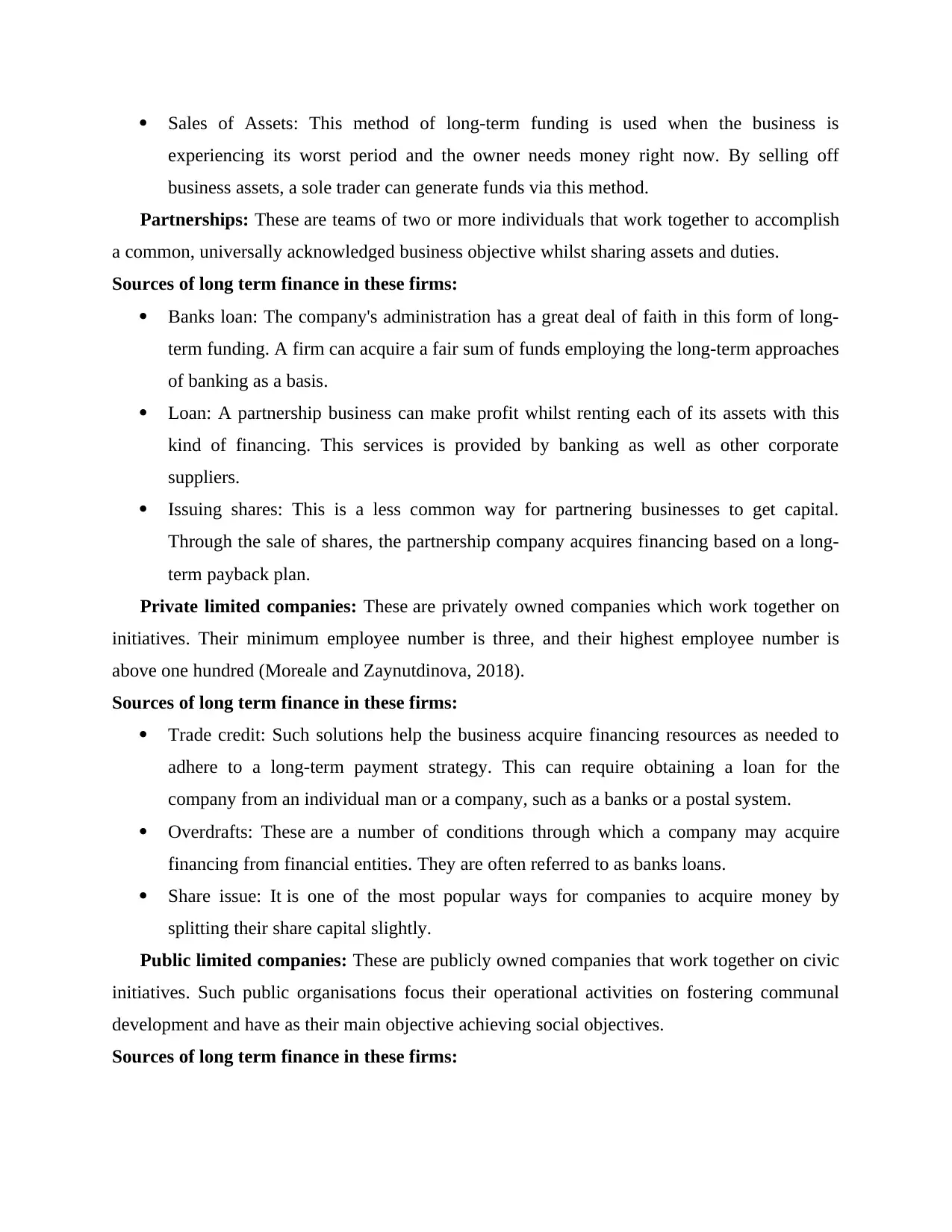
Sales of Assets: This method of long-term funding is used when the business is
experiencing its worst period and the owner needs money right now. By selling off
business assets, a sole trader can generate funds via this method.
Partnerships: These are teams of two or more individuals that work together to accomplish
a common, universally acknowledged business objective whilst sharing assets and duties.
Sources of long term finance in these firms:
Banks loan: The company's administration has a great deal of faith in this form of long-
term funding. A firm can acquire a fair sum of funds employing the long-term approaches
of banking as a basis.
Loan: A partnership business can make profit whilst renting each of its assets with this
kind of financing. This services is provided by banking as well as other corporate
suppliers.
Issuing shares: This is a less common way for partnering businesses to get capital.
Through the sale of shares, the partnership company acquires financing based on a long-
term payback plan.
Private limited companies: These are privately owned companies which work together on
initiatives. Their minimum employee number is three, and their highest employee number is
above one hundred (Moreale and Zaynutdinova, 2018).
Sources of long term finance in these firms:
Trade credit: Such solutions help the business acquire financing resources as needed to
adhere to a long-term payment strategy. This can require obtaining a loan for the
company from an individual man or a company, such as a banks or a postal system.
Overdrafts: These are a number of conditions through which a company may acquire
financing from financial entities. They are often referred to as banks loans.
Share issue: It is one of the most popular ways for companies to acquire money by
splitting their share capital slightly.
Public limited companies: These are publicly owned companies that work together on civic
initiatives. Such public organisations focus their operational activities on fostering communal
development and have as their main objective achieving social objectives.
Sources of long term finance in these firms:
tabler-icon-diamond-filled.svg

Paraphrase This Document

Need a fresh take? Get an instant paraphrase of this document with our AI Paraphraser
Document Page
Government grants: In the setting of a public organisation, a government handout is a
financial reward which is frequently given to various publically funded organisations.
Such financial aid or gifts are given at rates of interest that are considerably lower than
those offered by any other financial entity or corporate vendor.
Hire purchase: In this type of financing, a sizable entity buys the funds which may later
be reimbursed in interest-bearing payments.
Shares issued: Market capitalisation shares are the forms of equities used to generate
money for businesses in the form of assets (Rod Koch and CSCA, 2019).
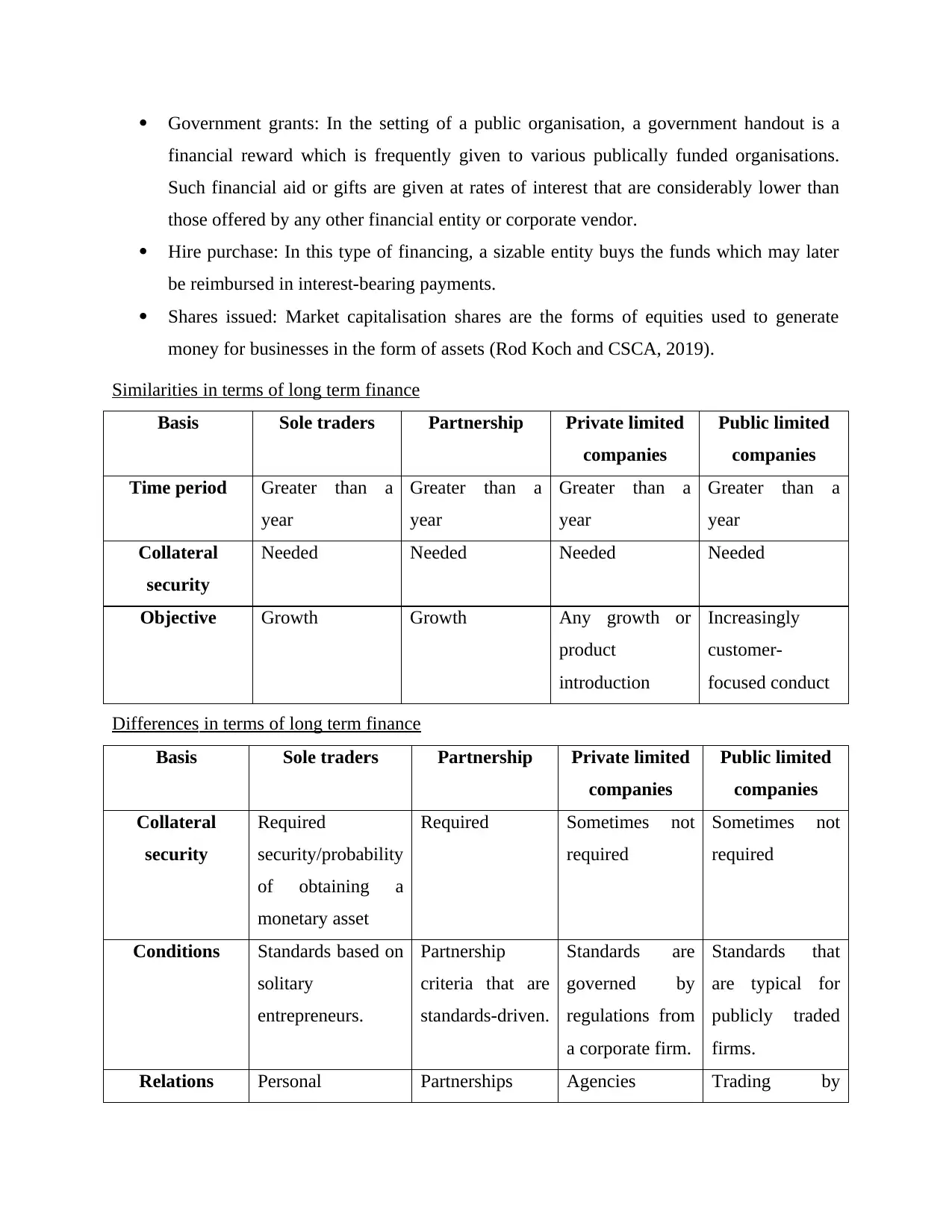
Similarities in terms of long term finance
Basis Sole traders Partnership Private limited
companies
Public limited
companies
Time period Greater than a
year
Greater than a
year
Greater than a
year
Greater than a
year
Collateral
security
Needed Needed Needed Needed
Objective Growth Growth Any growth or
product
introduction
Increasingly
customer-
focused conduct
Differences in terms of long term finance
Basis Sole traders Partnership Private limited
companies
Public limited
companies
Collateral
security
Required
security/probability
of obtaining a
monetary asset
Required Sometimes not
required
Sometimes not
required
Conditions Standards based on
solitary
entrepreneurs.
Partnership
criteria that are
standards-driven.
Standards are
governed by
regulations from
a corporate firm.
Standards that
are typical for
publicly traded
firms.
Relations Personal Partnerships Agencies Trading by
Document Page
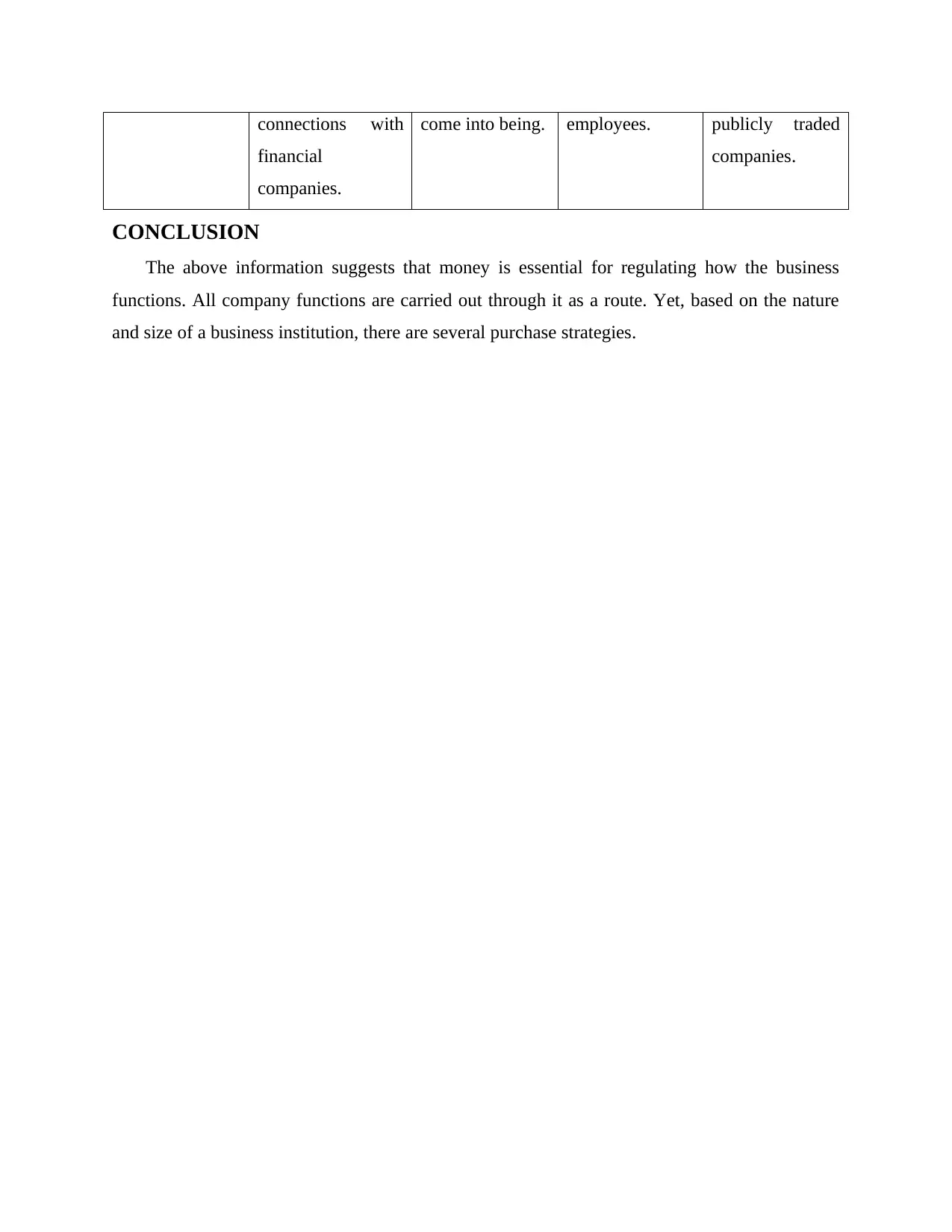
connections with
financial
companies.
come into being. employees. publicly traded
companies.
CONCLUSION
The above information suggests that money is essential for regulating how the business
functions. All company functions are carried out through it as a route. Yet, based on the nature
and size of a business institution, there are several purchase strategies.
Document Page
REFERENCES
Books and journals
Hassan, A. and Mollah, S., 2018. Islamic Finance: A Global Alternative. In Islamic Finance (pp.
19-30). Palgrave Macmillan, Cham.
Hassan, M.K., Khan, A. and Paltrinieri, A., 2019. Liquidity risk, credit risk and stability in
Islamic and conventional banks. Research in International Business and Finance. 48.
17–31.
Moreale, J. and Zaynutdinova, G.R., 2018. A Bloomberg terminal application in an intermediate
finance course. Journal of Financial Education. 44(2). pp.262-283.
Rod Koch, C.M.A. and CSCA, P., 2019. Can RPA Improve Agility?. Strategic Finance. 100(9).
pp.68-69.
chevron_up_icon
1 out of 7
circle_padding
hide_on_mobile
zoom_out_icon
[object Object]