The South African National Day of Protest, 1950: A Detailed Analysis

Verified

Added on  2023/06/12

|13
|1347
|458
Case Study
AI Summary
This case study examines the South African National Day of Protest in 1950, triggered by the implementation of racist laws by the National Party-led government. It analyzes the historical context, including the Unlawful Organizations Bill and the Immorality Amendment Act, leading to the ANC's call for a national stay-at-home protest. The analysis covers the role of the government, the impact of apartheid culture, and the fears of the people affected by discriminatory policies. The study identifies those directly and indirectly affected, such as Black Africans, the ANC, and the South African economy. It further discusses barriers like stereotypes, colonial influence, systemic issues, and language, along with the immediate and long-term repercussions, including imprisonment of ANC members, economic losses, and persistent racial discrimination. The conclusion emphasizes the lasting impact of apartheid and the ongoing challenges of racial inequality in South Africa.
Document Page
THE SOUTH
AFRICAN
NATIONAL DAY
OF PROTEST,
1950
Name of the student:
Name of the University:
tabler-icon-diamond-filled.svg

Paraphrase This Document

Need a fresh take? Get an instant paraphrase of this document with our AI Paraphraser
Document Page
INTRODUCTION
The South African National Day of Protest (1950) is a
historical event where an emergency meeting of the
National Executive of the African National Congress
(ANC) was held on 21st May, 1950. The main purpose
of the presentation is:
To provide historical context about the South African
National Day of Protest and examine the event from
various perspective.
To provide an overview of person who are directly or
indirectly affected by the event and the presence of
several barriers during the event.
Document Page
HISTORICAL CONTEXT OF
THE TOPIC:
The implementation of many Racist law was the main trigger for the
event and the series of events that occurred were as follows:
1948: Implementation of Racist law after the National Party-led
government came to power
1st May, 1950: The Government published the Unlawful Organizations
Bills also known as the Suppression of Communism Act
12th May 1950: The Immorality Amendment Act No 21 1950 is passed
which prohibited adultery between the black and the white people
14th May 1950: The ANC calls an emergency conference to discuss
about the Unlawful Organizations Bill.
15th May 1950: Protest against the Unlawful Organization Bill
occurred at the Cape Town City Hall
21st May 1950: The ANC calls a national one day stay at home protest
on 26th June 1950 against the Unlawful Organizations Bill. Everyone
was asked to stay away from work as sign of protest on 26th June.
26 June 1950: The African National Day of Protest is held
(sahistory.org.za.,2017).
Document Page
ANALYSIS OF THE EVENT FROM
DIFFERENT PERSPECTIVE
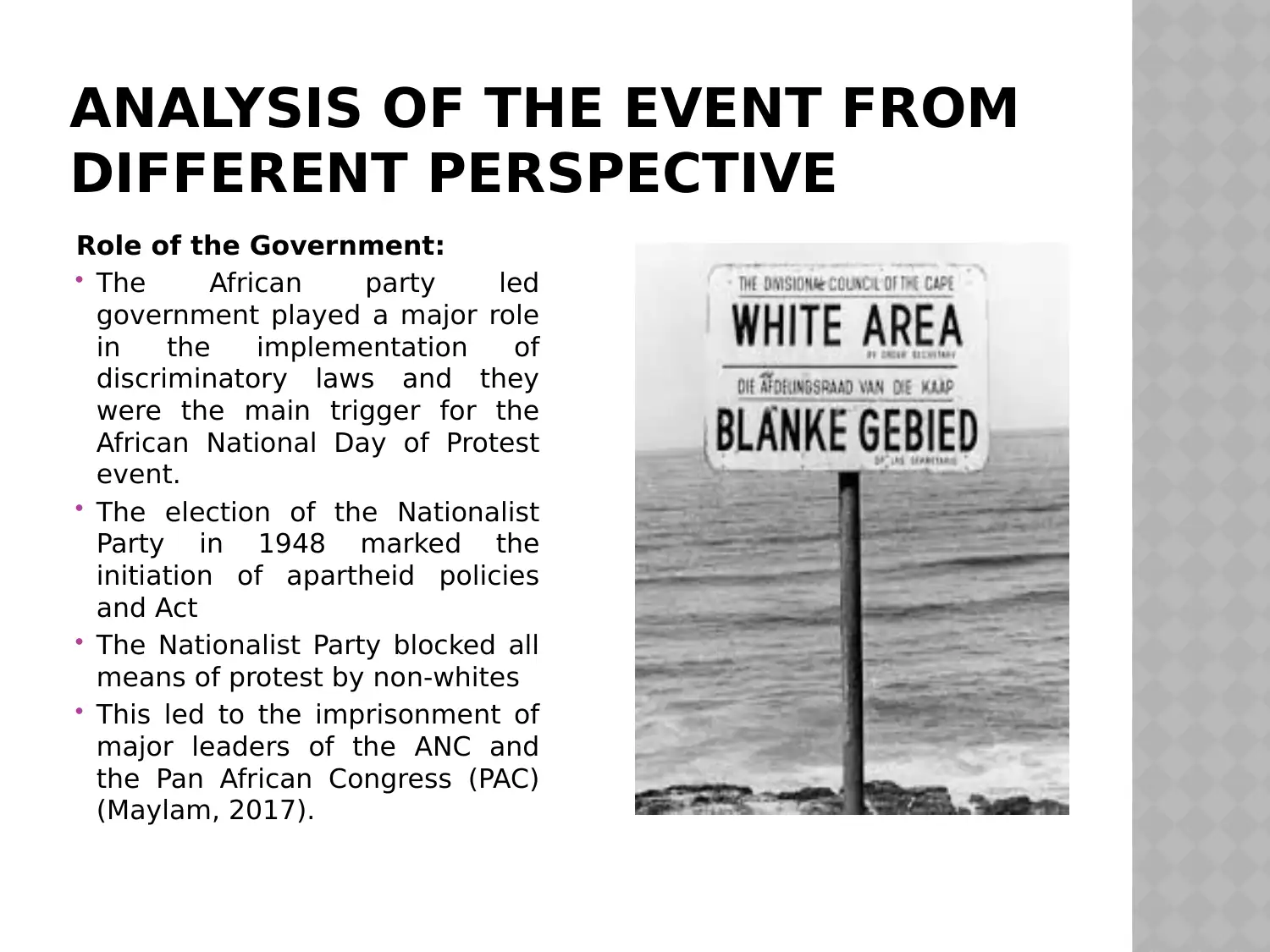
Role of the Government:
The African party led
government played a major role
in the implementation of
discriminatory laws and they
were the main trigger for the
African National Day of Protest
event.
The election of the Nationalist
Party in 1948 marked the
initiation of apartheid policies
and Act
The Nationalist Party blocked all
means of protest by non-whites
This led to the imprisonment of
major leaders of the ANC and
the Pan African Congress (PAC)
(Maylam, 2017).
tabler-icon-diamond-filled.svg

Paraphrase This Document

Need a fresh take? Get an instant paraphrase of this document with our AI Paraphraser
Document Page
ANALYSIS OF THE EVENT FROM
DIFFERENT PERSPECTIVE
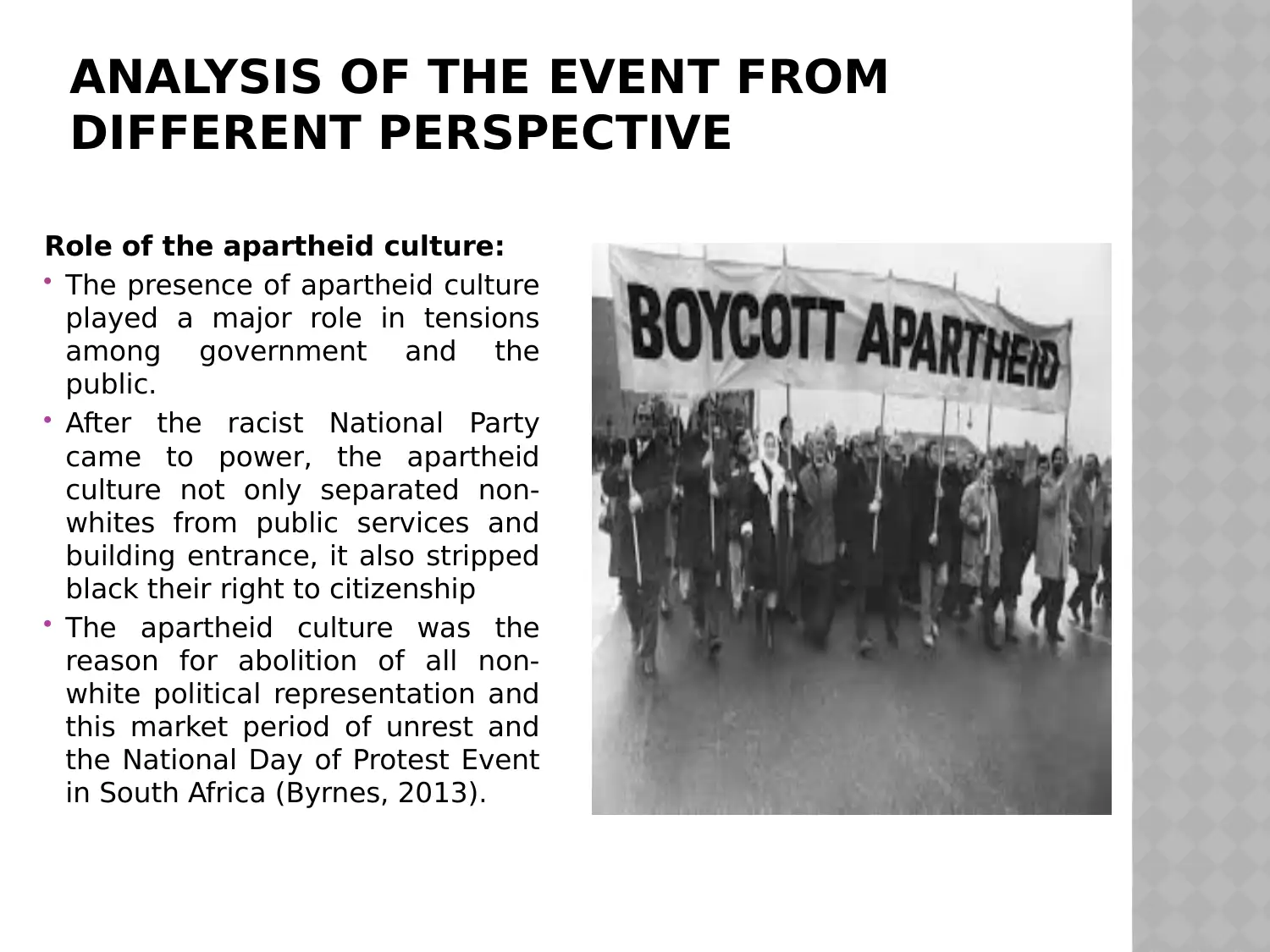
Role of the apartheid culture:
The presence of apartheid culture
played a major role in tensions
among government and the
public.
After the racist National Party
came to power, the apartheid
culture not only separated non-
whites from public services and
building entrance, it also stripped
black their right to citizenship
The apartheid culture was the
reason for abolition of all non-
white political representation and
this market period of unrest and
the National Day of Protest Event
in South Africa (Byrnes, 2013).
Document Page
ANALYSIS OF THE EVENT FROM
DIFFERENT PERSPECTIVE
Fearsome state of people:
As apartheid cruelly and forcible separated people,
the fearsome state of people evoked interest in
protest. It was the time when other countries were
moving away from racial policies. Hence, fear was
eventually seen in people after more rigid racial
policy of apartheid was introduced.
People wandered regarding the reason for such
support of apartheid policy. Racial superiority and
fear was the underlying reason behind such policies.
People were worried that they would lose their job,
culture and language. This explains the state of
people and what people were thinking. This might be
a reason for strong protest by opposing bodies (Clark
& Worger, 2016).
Document Page
PEOPLE DIRECTLY/INDIRECTLY
AFFECTED BY THE EVENT
The Black African or the Africans other than Whites were directly
affected by the event as several apartheid policies were
implemented which discriminated black Africans from Whites in
terms of employment and taking part in other services. The
Apartheid policy was the reason for racial tension and the
exclusion of the black race from many places.
The ANC was directly affected by the Unlaw Organizations law
as it prevented them from engaging in protest. Restrictions
were imposed regarding any person or organization which
threatened safety of the Public. Hence, the members of the ANC
were outlawed in 1960 and many of the leaders ended up in
prison.
Nelson Mandela was one of the political prisoners who fought to
end apartheid
The South African economy was affected by the event as
apartheid laws and discrimination resulted in significant loss of
revenue and security of the country. It lost its reputation and
partnership with international organization (Mamdani,2018).
tabler-icon-diamond-filled.svg

Paraphrase This Document

Need a fresh take? Get an instant paraphrase of this document with our AI Paraphraser
Document Page
CASE STUDY SUMMARY
The presentation looked at the case study of
the National African Day of Protest event in
1950.
The historical overview of the event gave
insight into the action of National Party and
the impact of Unlawful Constitution law as
the trigger behind the event
In response to discriminatory laws, ANC
launched a day of protest and mourning and
encouraged people to stay away from work
Members of ANC were outlawed and
eventually imprisoned.
Document Page
SUMMARY OF BARRIERS
Stereotypes: Stereotyping can be regarded as the main
barrier that prevented unity of the country and divided
South Africa into white and non-white groups.
Strong colonial influence: Colonial influence was the
reason for poor control of the event. The occupation of the
Dutch and British in the Cape colony resulted in the birth of
western orientation. The Blacks were segregated from
western orientation. Hence, richness and diversity of
culture was overlooked and it was reason for many
negative influences.
Systemic barriers: The election of the apartheid
government can be regarded as systematic barriers to the
control of the event.
Language: The failure of the protest can also be attributed
to language barrier. Domination of English and poor
integration of African language created a divide culture.
Document Page
REPURCUSSION
Immediate: Immediate effect of the event
was imprisonment of ANC and loss of
economy and reputation of the country.
Today: South Africa has shifted from the
aparthied to the free political election
process. Racism has different meaning for
the citizens of the country today, however
the attitude and thinking of people has
not changed. People still engage in racial
discrimination in an unconscious manner.
tabler-icon-diamond-filled.svg

Paraphrase This Document

Need a fresh take? Get an instant paraphrase of this document with our AI Paraphraser
Document Page
CONCLUSION
From the review of the case study, the
impact of the aparthied on people, the
country and its economy is seen. The
event in Africa resulted in a period of
racial tension and significant loss to the
reputation and economy of the country.
Currently, the long-term effects of the
event is experienced even today as
attitude of people has not changed
drastically. Issues of discrimination still
come up for some sections of the
population.
Document Page
REFERENCE
ANC. (2017). National Day of Protest, 1950. Retrieved from:
http://www.anc.org.za/content/national-day-protest
Barbarin, O.A. and Richter, L.M., 2013. Mandela's children:
Growing up in post-apartheid South Africa. Routledge.
Byrnes, M. (2013). Life in Apartheid Era- South Africa.
Retrieved from:
https://www.citylab.com/equity/2013/12/life-apartheid-era-so
uth-africa/7821/
Clark, N. L., & Worger, W. H. (2016). South Africa: The rise and
fall of apartheid. Routledge.
Mamdani, M. (2018). Citizen and subject: Contemporary Africa
and the legacy of late colonialism. Princeton University Press.
Maylam, P. (2017). South Africa's racial past: The history and
historiography of racism, segregation, and apartheid.
Routledge.
sahistory.org.za (2017). African National Congress Timeline
1950-1959. Retrieved from:
http://www.sahistory.org.za/topic/african-national-congress-ti
meline-1950-1959
chevron_up_icon
1 out of 13
circle_padding
hide_on_mobile
zoom_out_icon
[object Object]