Challenges and Solutions: Virtual Currency Regulation in SA
VerifiedAdded on 2023/01/05
|10
|2734
|95
Report
AI Summary
This report provides a comprehensive analysis of the regulatory framework governing virtual currency in South Africa. It begins with an introduction to the concept of virtual currency, specifically focusing on Bitcoin and its decentralized nature. The report then outlines the current process for regulating virtual currencies in South Africa, highlighting the roles of the South African Reserve Bank (SARB) and the Intergovernmental Fintech Working Group (IFWG). It details the challenges faced by regulators, including the lack of clear legal definitions, the exclusion of virtual currencies from securities definitions, and a lack of resources for monitoring transactions. The report further explores potential solutions to these challenges, such as reducing differences between virtual currencies, involving business owners in monitoring transactions, registering cryptocurrency providers, and providing training to regulatory officials. The report concludes by emphasizing the importance of government initiatives and research to develop a healthy regulatory framework that protects consumers and fosters the growth of the virtual currency market in South Africa.
REGULATORY FRAMEWORK OF VIRTUAL CURRENCY IN
SOUTH AFRICA
SOUTH AFRICA

Paraphrase This Document
Need a fresh take? Get an instant paraphrase of this document with our AI Paraphraser
Table of Contents
Introduction...................................................................................................................3
Concept of virtual currency...........................................................................................3
Process to regulate virtual currencies in SA.................................................................4
Challenges of regulation related to Virtual Currency in SA..........................................5
Solutions to mitigate challenges of regulating virtual currency....................................7
Conclusion....................................................................................................................8
Bibliography..................................................................................................................9
2
Introduction...................................................................................................................3
Concept of virtual currency...........................................................................................3
Process to regulate virtual currencies in SA.................................................................4
Challenges of regulation related to Virtual Currency in SA..........................................5
Solutions to mitigate challenges of regulating virtual currency....................................7
Conclusion....................................................................................................................8
Bibliography..................................................................................................................9
2
Introduction
Digital transformation is influencing business owners and consumers to think about
innovative approaches of transaction during selling and purchasing. Bitcoin system
has been developed in South Africa (SA) for allowing consumers to transfer virtual
currency from any place of the world. As this process is virtual, no extra cost is
required during the transaction. However, there are legal boundaries to regulate
virtual currency in SA. This essay is focusing on regulatory framework regarding
virtual currency in SA. This study is evaluating different challenges to regulate bitcoin
and appropriate solutions to mitigate the identified challenges. It is important to
understand whether digital currency is accepted by South African legal system or not
at present.
Concept of virtual currency
Rapid rise of technology has brought significant innovation in the way of business
operation. Among the significant innovations in financial technology, virtual or
cryptocurrency is important. A virtual currency like Bitcoin is a digital form of currency
that operates independently with the help of sophisticated technology and processes
such as Blockchain1. There are many differences between cryptocurrency and paper
currency. Virtual or cryptocurrency adopts a digital medium of exchange and
operates in a decentralized way. This means that no such controlling authority is
there to regulate the exchange process. Moreover, virtual currency such as Bitcoin is
generated by a computer. On the other hand, paper currency adopts a physical
medium of exchange and exchange process is centralized. The exchange process of
paper currency is generally monitored by South African Reserve Bank (SARB). This
type of currency is issued by regulatory authority2. Cryptocurrencies like Bitcoin are
used by many business authorities and individuals in this country. However, this
medium of exchange is not recognized by any regulatory authorities like SARB. this
means that the transaction process by using Bitcoin is outside supervision of SARB
and there is no guarantee of convertibility and open market value.
1 Nieman 2015: 1978
2 Greeff 2019: 2
3
Digital transformation is influencing business owners and consumers to think about
innovative approaches of transaction during selling and purchasing. Bitcoin system
has been developed in South Africa (SA) for allowing consumers to transfer virtual
currency from any place of the world. As this process is virtual, no extra cost is
required during the transaction. However, there are legal boundaries to regulate
virtual currency in SA. This essay is focusing on regulatory framework regarding
virtual currency in SA. This study is evaluating different challenges to regulate bitcoin
and appropriate solutions to mitigate the identified challenges. It is important to
understand whether digital currency is accepted by South African legal system or not
at present.
Concept of virtual currency
Rapid rise of technology has brought significant innovation in the way of business
operation. Among the significant innovations in financial technology, virtual or
cryptocurrency is important. A virtual currency like Bitcoin is a digital form of currency
that operates independently with the help of sophisticated technology and processes
such as Blockchain1. There are many differences between cryptocurrency and paper
currency. Virtual or cryptocurrency adopts a digital medium of exchange and
operates in a decentralized way. This means that no such controlling authority is
there to regulate the exchange process. Moreover, virtual currency such as Bitcoin is
generated by a computer. On the other hand, paper currency adopts a physical
medium of exchange and exchange process is centralized. The exchange process of
paper currency is generally monitored by South African Reserve Bank (SARB). This
type of currency is issued by regulatory authority2. Cryptocurrencies like Bitcoin are
used by many business authorities and individuals in this country. However, this
medium of exchange is not recognized by any regulatory authorities like SARB. this
means that the transaction process by using Bitcoin is outside supervision of SARB
and there is no guarantee of convertibility and open market value.
1 Nieman 2015: 1978
2 Greeff 2019: 2
3
⊘ This is a preview!⊘
Do you want full access?
Subscribe today to unlock all pages.

Trusted by 1+ million students worldwide
Process to regulate virtual currencies in SA
Cryptocurrency has become one of the important issues at present and government
of SA is taking initiatives to regulate virtual currency in an appropriate manner. The
government of this country is focusing on developing plans to regulate Bitcoins in
future. As mentioned in the SARB Act 1989, the Reserve bank has the sole power to
issue and manage all kinds of currency in SA in the form of notes and coins.
However, this government authority does not have the right to regulate
cryptocurrency3. This authority is trying to monitor this area with its gradual evolution.
Position of SARB in case of crypto assets has been mentioned clearly in the Position
paper on Virtual Currencies, 2014. This position is considered as relevant and
current.
At present, the industry of cryptocurrency is unregulated. Any merchant is legally
potent to refuse to accept cryptocurrency. This aspect may affect business and
consumers in SA. Due to this reason, local regulators are taking initiatives to develop
a framework for regulating cryptocurrency in SA. For example, Intergovernmental
Fintech Working Group (IFWG) has been established with this same objective of
regulating virtual currency in 2016. This working group has included members from
several government authorities of South African government. Members from
authorities include The Financial Intelligence Centre (FIC), SARB, national treasury
(NT) and the Financial Sector Conduct Authority (FSCA). Main objectives of IFWG
are for promoting fintech evolution that can help them to ensure consumer protection
and financial stability. This working group is involved with other stakeholders from
private and public sector to develop a legal framework that can guide South Africans
to use cryptocurrencies with legal safety.
As mentioned by Mr. Gigaba, the Financial Minister, the government of this country
is unable to regulate virtual currency as this system is unregulated. It means that
virtual currency is not recognized by the legal system of SA. However, SARB has
mentioned a different point of view. They have mentioned that they will test several
potential frameworks related to cryptocurrency and bitcoin in general4. The working
group developed in 2016 is potent enough to monitor developments in private
sectors. The Central Bank independently operates all facts of cryptocurrency and
them alert users regarding changes in the value of cryptocurrency. In 2017, the
3 Robertson 2018
4 Mothokoa 2017
4
Cryptocurrency has become one of the important issues at present and government
of SA is taking initiatives to regulate virtual currency in an appropriate manner. The
government of this country is focusing on developing plans to regulate Bitcoins in
future. As mentioned in the SARB Act 1989, the Reserve bank has the sole power to
issue and manage all kinds of currency in SA in the form of notes and coins.
However, this government authority does not have the right to regulate
cryptocurrency3. This authority is trying to monitor this area with its gradual evolution.
Position of SARB in case of crypto assets has been mentioned clearly in the Position
paper on Virtual Currencies, 2014. This position is considered as relevant and
current.
At present, the industry of cryptocurrency is unregulated. Any merchant is legally
potent to refuse to accept cryptocurrency. This aspect may affect business and
consumers in SA. Due to this reason, local regulators are taking initiatives to develop
a framework for regulating cryptocurrency in SA. For example, Intergovernmental
Fintech Working Group (IFWG) has been established with this same objective of
regulating virtual currency in 2016. This working group has included members from
several government authorities of South African government. Members from
authorities include The Financial Intelligence Centre (FIC), SARB, national treasury
(NT) and the Financial Sector Conduct Authority (FSCA). Main objectives of IFWG
are for promoting fintech evolution that can help them to ensure consumer protection
and financial stability. This working group is involved with other stakeholders from
private and public sector to develop a legal framework that can guide South Africans
to use cryptocurrencies with legal safety.
As mentioned by Mr. Gigaba, the Financial Minister, the government of this country
is unable to regulate virtual currency as this system is unregulated. It means that
virtual currency is not recognized by the legal system of SA. However, SARB has
mentioned a different point of view. They have mentioned that they will test several
potential frameworks related to cryptocurrency and bitcoin in general4. The working
group developed in 2016 is potent enough to monitor developments in private
sectors. The Central Bank independently operates all facts of cryptocurrency and
them alert users regarding changes in the value of cryptocurrency. In 2017, the
3 Robertson 2018
4 Mothokoa 2017
4
Paraphrase This Document
Need a fresh take? Get an instant paraphrase of this document with our AI Paraphraser
Central bank has taken a step forward and they have mentioned that they are going
to conduct a research to assess the feasibility of virtual currency technology in SA.
money and time needs to be invested in this research. Outcome of this research
project may shed light of potential areas related to cryptocurrency that need to be
focused while developing the regulatory framework. The development of the working
group was the first step towards regulating virtual currencies. On the other hand, it
can be stated that the commencement of the research by the Central bank can be
considered as the second step of the process of regulating cryptocurrency5. The third
step of this process is to evaluate the research outcome for understanding different
perspectives of using virtual currency. For regulating the virtual currency of SA, the
members of the working group and other stakeholders need to gather knowledge
regarding possible legal system to protect consumers while using cryptocurrency. On
the other hand, consumers need to support government in developing a healthy
framework. The earnings with cryptocurrency are subject to taxation as per the
taxation regulation of SA. Hence, South Africans are advised to consult with tax
consultants to avoid legal issues regarding taxation on their earnings with
cryptocurrency. Therefore, application of the above-mentioned process may help in
regulating cryptocurrency in SA.
Challenges of regulation related to Virtual Currency in SA
South African Revenue Service does not mention how cryptocurrency transactions
will be managed. Regulators face challenges in evaluating the risks that are linked
with Bitcoin management. Cryptocurrencies like Bitcoin can play an essential role in
economic growth of this country but there is a strong issue of Bitcoin regulation.
Difference in function and nature is the main challenge of regulation that is faced
in this country. This raises complication during regulation of this process of
transaction6. Different virtual currencies are used to accomplish different functions
and nature of each currency is different. Hence, the same regulation for all cannot be
applied that increases confusion among regulators. Transaction through virtual
currencies like Bitcoin and the other is a wide area and it requires much support to
monitor the whole process properly. Different business organizations and individuals
5 Wicht 2016
6 Moyo 2018
5
to conduct a research to assess the feasibility of virtual currency technology in SA.
money and time needs to be invested in this research. Outcome of this research
project may shed light of potential areas related to cryptocurrency that need to be
focused while developing the regulatory framework. The development of the working
group was the first step towards regulating virtual currencies. On the other hand, it
can be stated that the commencement of the research by the Central bank can be
considered as the second step of the process of regulating cryptocurrency5. The third
step of this process is to evaluate the research outcome for understanding different
perspectives of using virtual currency. For regulating the virtual currency of SA, the
members of the working group and other stakeholders need to gather knowledge
regarding possible legal system to protect consumers while using cryptocurrency. On
the other hand, consumers need to support government in developing a healthy
framework. The earnings with cryptocurrency are subject to taxation as per the
taxation regulation of SA. Hence, South Africans are advised to consult with tax
consultants to avoid legal issues regarding taxation on their earnings with
cryptocurrency. Therefore, application of the above-mentioned process may help in
regulating cryptocurrency in SA.
Challenges of regulation related to Virtual Currency in SA
South African Revenue Service does not mention how cryptocurrency transactions
will be managed. Regulators face challenges in evaluating the risks that are linked
with Bitcoin management. Cryptocurrencies like Bitcoin can play an essential role in
economic growth of this country but there is a strong issue of Bitcoin regulation.
Difference in function and nature is the main challenge of regulation that is faced
in this country. This raises complication during regulation of this process of
transaction6. Different virtual currencies are used to accomplish different functions
and nature of each currency is different. Hence, the same regulation for all cannot be
applied that increases confusion among regulators. Transaction through virtual
currencies like Bitcoin and the other is a wide area and it requires much support to
monitor the whole process properly. Different business organizations and individuals
5 Wicht 2016
6 Moyo 2018
5
use different types of virtual currency for different purposes. Tracking the whole
process is a challenging task for regulators in South Africa.
Moreover, the resources required regulating and monitor the process of
transaction of virtual currencies is lacking in South Africa. The regulatory authority
needs proper tools and resources to monitor the process, which can help to
eliminate any sorts of illegal dealing. This is decreasing the security of virtual
currency transaction process. According to Financial markets acts 2012, virtual
currency is excluded from the definition of securities. Hence, traders need to use
Bitcoin and other cryptocurrencies at their own risk. Hence, a lack of legal resources
can also be seen that creates a barrier to regulate the process of bitcoin transaction.
In addition, cryptocurrencies are not included by SARS as currencies for the purpose
of income tax7. Rather, this currency is considered as an asset of intangible nature.
Lack of these legal resources is creating hurdles for SARB to regulate this process. If
virtual currencies like Bitcoin are categorized as a financial instrument and income
tax is incurred on transaction then regulatory framework can impose monitoring rules
in this process. The regulators have to monitor different aspects of cryptocurrencies
for which they require strong laws and policies. At present, there are no such policies
focusing on only virtual currencies, which are creating confusion among them.
Another challenge is confusion about main mandate and knowledge of
regulators. Regulators need to have a proper idea about the way that they will adopt
to monitor the technology. There are different aspects of regulating bitcoin, which
includes securing vulnerable information of businessman, restricting theft or fraud
and eliminating misappropriation of the process. However, at present, they are
confused about the main mandate or aim of regulating the process of virtual currency
transaction8. Consumer protection is the main aim that can be fulfilled by the
regulators to ensure the security of the process. It can be seen that Bitcoin use is a
new concept and used in a mass amount in few African countries that include South
Africa and ghana. South Africa is listed as top African country to use Bitcoin and
other virtual currencies. Regulators have less knowledge about this innovative
technology like Bitcoin and blockchain.
Fewer government initiatives regarding monitoring of cryptocurrency is another
essential challenge. Despite mass usage of these virtual currencies in African
7 Mlambo 2017: 4
8 Ram 2018: 63
6
process is a challenging task for regulators in South Africa.
Moreover, the resources required regulating and monitor the process of
transaction of virtual currencies is lacking in South Africa. The regulatory authority
needs proper tools and resources to monitor the process, which can help to
eliminate any sorts of illegal dealing. This is decreasing the security of virtual
currency transaction process. According to Financial markets acts 2012, virtual
currency is excluded from the definition of securities. Hence, traders need to use
Bitcoin and other cryptocurrencies at their own risk. Hence, a lack of legal resources
can also be seen that creates a barrier to regulate the process of bitcoin transaction.
In addition, cryptocurrencies are not included by SARS as currencies for the purpose
of income tax7. Rather, this currency is considered as an asset of intangible nature.
Lack of these legal resources is creating hurdles for SARB to regulate this process. If
virtual currencies like Bitcoin are categorized as a financial instrument and income
tax is incurred on transaction then regulatory framework can impose monitoring rules
in this process. The regulators have to monitor different aspects of cryptocurrencies
for which they require strong laws and policies. At present, there are no such policies
focusing on only virtual currencies, which are creating confusion among them.
Another challenge is confusion about main mandate and knowledge of
regulators. Regulators need to have a proper idea about the way that they will adopt
to monitor the technology. There are different aspects of regulating bitcoin, which
includes securing vulnerable information of businessman, restricting theft or fraud
and eliminating misappropriation of the process. However, at present, they are
confused about the main mandate or aim of regulating the process of virtual currency
transaction8. Consumer protection is the main aim that can be fulfilled by the
regulators to ensure the security of the process. It can be seen that Bitcoin use is a
new concept and used in a mass amount in few African countries that include South
Africa and ghana. South Africa is listed as top African country to use Bitcoin and
other virtual currencies. Regulators have less knowledge about this innovative
technology like Bitcoin and blockchain.
Fewer government initiatives regarding monitoring of cryptocurrency is another
essential challenge. Despite mass usage of these virtual currencies in African
7 Mlambo 2017: 4
8 Ram 2018: 63
6
⊘ This is a preview!⊘
Do you want full access?
Subscribe today to unlock all pages.
Trusted by 1+ million students worldwide
nations including South Africa, the government has not taken initiatives to frame
policies. Increase of migrational workers, technology use like mobile phones and
business has impacted on the use of this type of currencies9. However, lack of
security and fraud has impacted financially on many users. The government
department regulating fintech and banking industry has not shown any initiative to
regulate the transaction process. This has created barriers for regulators like SARB.
Regulators cannot frame policies and monitor a process until government helps the
organization by providing essential support like resources. However, in 2018,
national treasury's taxation laws amendment bill has proposed amendments in tax
legislation. This can help in changing the way of consideration of cryptocurrency by
government and regulatory authorities.
Solutions to mitigate challenges of regulating virtual currency
Due to different nature of virtual currencies, it has become difficult to bind these
services within single regulation. It is important to reduce differences between
virtual currencies. IFWG needs to take initiative to ensure limited differences in the
nature of digital currencies for regulating these services under a single regulatory
framework10. This approach will help users of virtual currency in easy transactions11.
On the other hand, business owners those are allowing consumers to buy products
or services by using virtual currency, must play an important role in mitigating
challenges to regulating this currency service. They may be asked by the
government of SA to monitor both small and large transactions of their
customers. This approach may help the government to track criminal offenses
incorporated by cryptocurrency. Hence, business owners are important stakeholders
of this approach and their cooperation is strictly required for regulating virtual
currency12. The cryptocurrency providers need to be registered under IFWG and
comply with the rules of financial intelligence center act. This can help to eliminate
any risk of fraud or money laundering. Individuals need to accept Bitcoins from any
9 African institute of financial markets and risk management 2017
10 Dlamini, Scott And Nair 2016
11 Golegal 2018
12 Jankeeparsad And Tewari 2018: 231
7
policies. Increase of migrational workers, technology use like mobile phones and
business has impacted on the use of this type of currencies9. However, lack of
security and fraud has impacted financially on many users. The government
department regulating fintech and banking industry has not shown any initiative to
regulate the transaction process. This has created barriers for regulators like SARB.
Regulators cannot frame policies and monitor a process until government helps the
organization by providing essential support like resources. However, in 2018,
national treasury's taxation laws amendment bill has proposed amendments in tax
legislation. This can help in changing the way of consideration of cryptocurrency by
government and regulatory authorities.
Solutions to mitigate challenges of regulating virtual currency
Due to different nature of virtual currencies, it has become difficult to bind these
services within single regulation. It is important to reduce differences between
virtual currencies. IFWG needs to take initiative to ensure limited differences in the
nature of digital currencies for regulating these services under a single regulatory
framework10. This approach will help users of virtual currency in easy transactions11.
On the other hand, business owners those are allowing consumers to buy products
or services by using virtual currency, must play an important role in mitigating
challenges to regulating this currency service. They may be asked by the
government of SA to monitor both small and large transactions of their
customers. This approach may help the government to track criminal offenses
incorporated by cryptocurrency. Hence, business owners are important stakeholders
of this approach and their cooperation is strictly required for regulating virtual
currency12. The cryptocurrency providers need to be registered under IFWG and
comply with the rules of financial intelligence center act. This can help to eliminate
any risk of fraud or money laundering. Individuals need to accept Bitcoins from any
9 African institute of financial markets and risk management 2017
10 Dlamini, Scott And Nair 2016
11 Golegal 2018
12 Jankeeparsad And Tewari 2018: 231
7
Paraphrase This Document
Need a fresh take? Get an instant paraphrase of this document with our AI Paraphraser
registered provider, which can help to increase the safety of the transaction to a
greater extent.
It is important to make sure that members of IFWG and other stakeholders must
gather all available information related to virtual currency for enriching their
knowledge. Research must be conducted for gathering information13. The Central
Bank is undertaking similar approaches to conducting research. This working group
may merge with the Central bank to take part in this research. Time and cost can be
saved if the working group takes this approach. Training must be provided to all
the regulatory officials those are going to make decisions for developing the
healthy regulatory framework for virtual currency in SA14. More government
initiatives are required to be taken for regulating cryptocurrency for protecting
consumers. It can be stated that this approach may help in maintaining financial
stability.
Conclusion
From the above discussion, it can be concluded that framing rules and regulations
regarding Bitcoin use and virtual transaction can help to increase safety of this
technology. Bitcoin use can help to reduce paper cash transactions and economy of
the country can be improved. However, centralization of the process is essential,
which can be done by incorporating framework by SARB. Moreover, the government
needs to take proper steps like arrangement of training for officials. This can help to
increase knowledge about this new technology. Cryptocurrency transaction should
be done by maintaining compliance with existing financial security legislation.
13 Berger 2016
14 Albaraka.co 2019
8
greater extent.
It is important to make sure that members of IFWG and other stakeholders must
gather all available information related to virtual currency for enriching their
knowledge. Research must be conducted for gathering information13. The Central
Bank is undertaking similar approaches to conducting research. This working group
may merge with the Central bank to take part in this research. Time and cost can be
saved if the working group takes this approach. Training must be provided to all
the regulatory officials those are going to make decisions for developing the
healthy regulatory framework for virtual currency in SA14. More government
initiatives are required to be taken for regulating cryptocurrency for protecting
consumers. It can be stated that this approach may help in maintaining financial
stability.
Conclusion
From the above discussion, it can be concluded that framing rules and regulations
regarding Bitcoin use and virtual transaction can help to increase safety of this
technology. Bitcoin use can help to reduce paper cash transactions and economy of
the country can be improved. However, centralization of the process is essential,
which can be done by incorporating framework by SARB. Moreover, the government
needs to take proper steps like arrangement of training for officials. This can help to
increase knowledge about this new technology. Cryptocurrency transaction should
be done by maintaining compliance with existing financial security legislation.
13 Berger 2016
14 Albaraka.co 2019
8
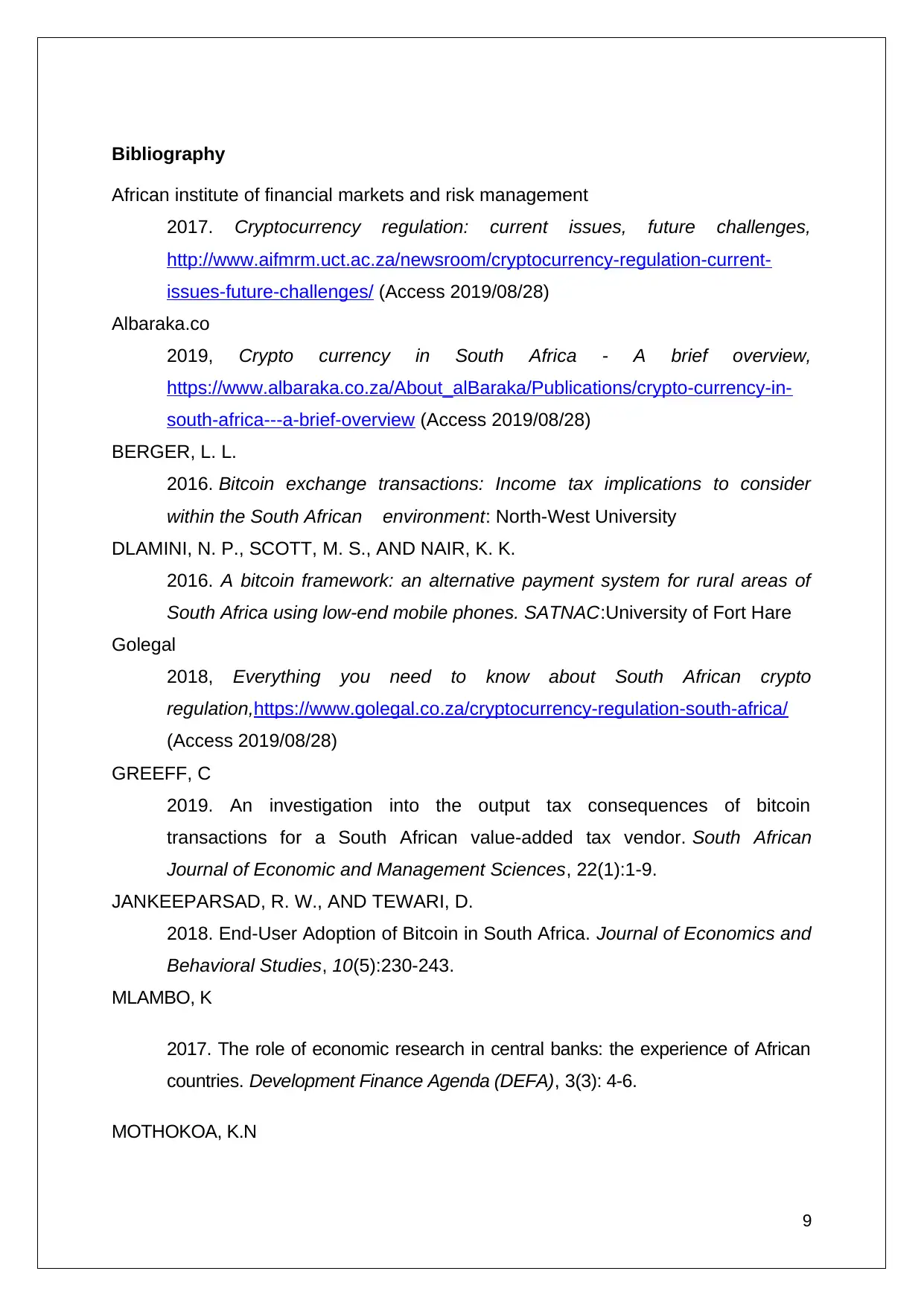
Bibliography
African institute of financial markets and risk management
2017. Cryptocurrency regulation: current issues, future challenges,
http://www.aifmrm.uct.ac.za/newsroom/cryptocurrency-regulation-current-
issues-future-challenges/ (Access 2019/08/28)
Albaraka.co
2019, Crypto currency in South Africa - A brief overview,
https://www.albaraka.co.za/About_alBaraka/Publications/crypto-currency-in-
south-africa---a-brief-overview (Access 2019/08/28)
BERGER, L. L.
2016. Bitcoin exchange transactions: Income tax implications to consider
within the South African environment: North-West University
DLAMINI, N. P., SCOTT, M. S., AND NAIR, K. K.
2016. A bitcoin framework: an alternative payment system for rural areas of
South Africa using low-end mobile phones. SATNAC:University of Fort Hare
Golegal
2018, Everything you need to know about South African crypto
regulation,https://www.golegal.co.za/cryptocurrency-regulation-south-africa/
(Access 2019/08/28)
GREEFF, C
2019. An investigation into the output tax consequences of bitcoin
transactions for a South African value-added tax vendor. South African
Journal of Economic and Management Sciences, 22(1):1-9.
JANKEEPARSAD, R. W., AND TEWARI, D.
2018. End-User Adoption of Bitcoin in South Africa. Journal of Economics and
Behavioral Studies, 10(5):230-243.
MLAMBO, K
2017. The role of economic research in central banks: the experience of African
countries. Development Finance Agenda (DEFA), 3(3): 4-6.
MOTHOKOA, K.N
9
African institute of financial markets and risk management
2017. Cryptocurrency regulation: current issues, future challenges,
http://www.aifmrm.uct.ac.za/newsroom/cryptocurrency-regulation-current-
issues-future-challenges/ (Access 2019/08/28)
Albaraka.co
2019, Crypto currency in South Africa - A brief overview,
https://www.albaraka.co.za/About_alBaraka/Publications/crypto-currency-in-
south-africa---a-brief-overview (Access 2019/08/28)
BERGER, L. L.
2016. Bitcoin exchange transactions: Income tax implications to consider
within the South African environment: North-West University
DLAMINI, N. P., SCOTT, M. S., AND NAIR, K. K.
2016. A bitcoin framework: an alternative payment system for rural areas of
South Africa using low-end mobile phones. SATNAC:University of Fort Hare
Golegal
2018, Everything you need to know about South African crypto
regulation,https://www.golegal.co.za/cryptocurrency-regulation-south-africa/
(Access 2019/08/28)
GREEFF, C
2019. An investigation into the output tax consequences of bitcoin
transactions for a South African value-added tax vendor. South African
Journal of Economic and Management Sciences, 22(1):1-9.
JANKEEPARSAD, R. W., AND TEWARI, D.
2018. End-User Adoption of Bitcoin in South Africa. Journal of Economics and
Behavioral Studies, 10(5):230-243.
MLAMBO, K
2017. The role of economic research in central banks: the experience of African
countries. Development Finance Agenda (DEFA), 3(3): 4-6.
MOTHOKOA, K.N
9
⊘ This is a preview!⊘
Do you want full access?
Subscribe today to unlock all pages.
Trusted by 1+ million students worldwide
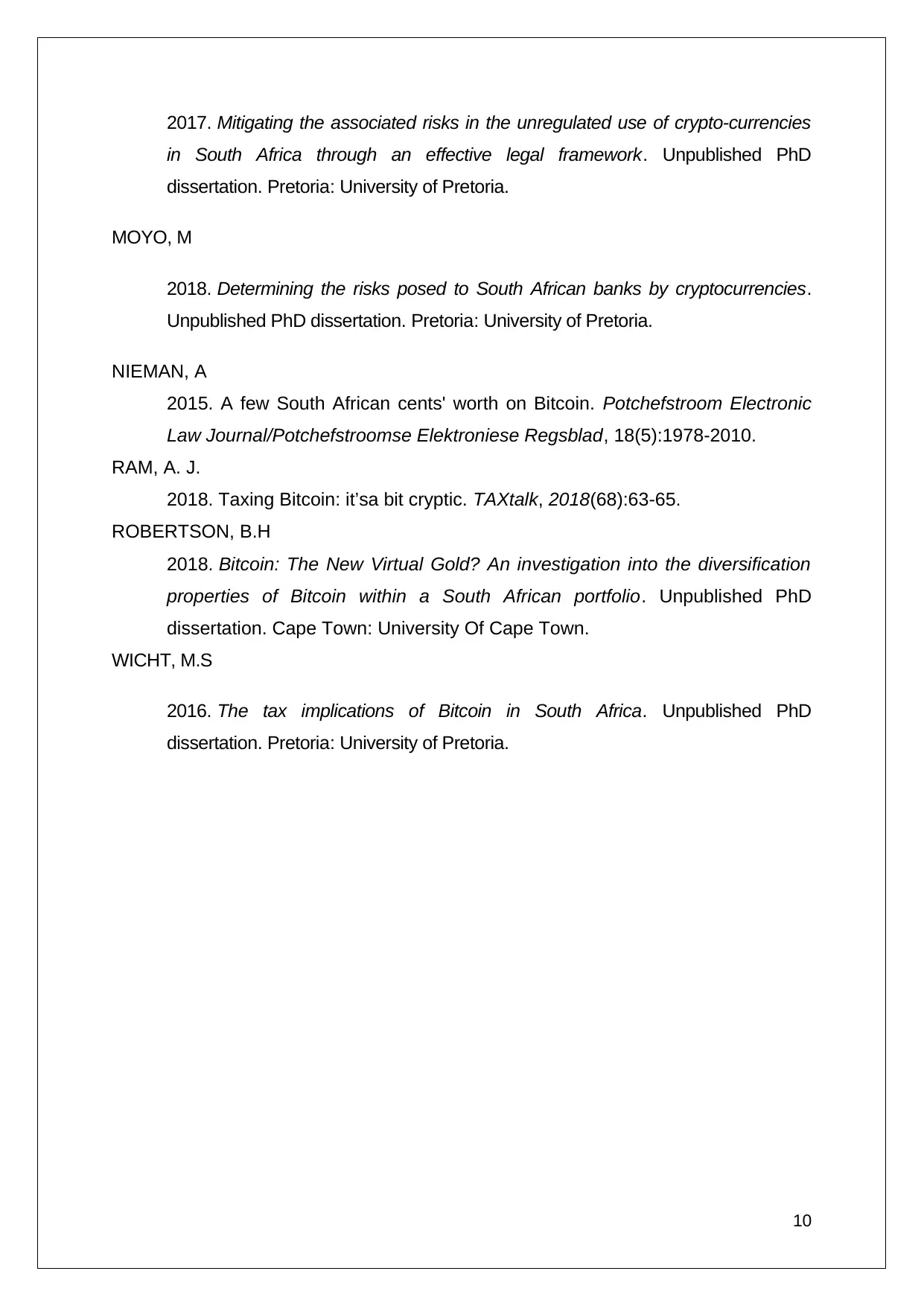
2017. Mitigating the associated risks in the unregulated use of crypto-currencies
in South Africa through an effective legal framework. Unpublished PhD
dissertation. Pretoria: University of Pretoria.
MOYO, M
2018. Determining the risks posed to South African banks by cryptocurrencies.
Unpublished PhD dissertation. Pretoria: University of Pretoria.
NIEMAN, A
2015. A few South African cents' worth on Bitcoin. Potchefstroom Electronic
Law Journal/Potchefstroomse Elektroniese Regsblad, 18(5):1978-2010.
RAM, A. J.
2018. Taxing Bitcoin: it’sa bit cryptic. TAXtalk, 2018(68):63-65.
ROBERTSON, B.H
2018. Bitcoin: The New Virtual Gold? An investigation into the diversification
properties of Bitcoin within a South African portfolio. Unpublished PhD
dissertation. Cape Town: University Of Cape Town.
WICHT, M.S
2016. The tax implications of Bitcoin in South Africa. Unpublished PhD
dissertation. Pretoria: University of Pretoria.
10
in South Africa through an effective legal framework. Unpublished PhD
dissertation. Pretoria: University of Pretoria.
MOYO, M
2018. Determining the risks posed to South African banks by cryptocurrencies.
Unpublished PhD dissertation. Pretoria: University of Pretoria.
NIEMAN, A
2015. A few South African cents' worth on Bitcoin. Potchefstroom Electronic
Law Journal/Potchefstroomse Elektroniese Regsblad, 18(5):1978-2010.
RAM, A. J.
2018. Taxing Bitcoin: it’sa bit cryptic. TAXtalk, 2018(68):63-65.
ROBERTSON, B.H
2018. Bitcoin: The New Virtual Gold? An investigation into the diversification
properties of Bitcoin within a South African portfolio. Unpublished PhD
dissertation. Cape Town: University Of Cape Town.
WICHT, M.S
2016. The tax implications of Bitcoin in South Africa. Unpublished PhD
dissertation. Pretoria: University of Pretoria.
10

1 out of 10


Related Documents


Your All-in-One AI-Powered Toolkit for Academic Success.
+13062052269
info@desklib.com
Available 24*7 on WhatsApp / Email
![[object Object]](/_next/static/media/star-bottom.7253800d.svg)
Unlock your academic potential
Copyright © 2020–2026 A2Z Services. All Rights Reserved. Developed and managed by ZUCOL.