Comprehensive Report on the South African Labour Market Dynamics
VerifiedAdded on 2020/10/16
|31
|12701
|191
Report
AI Summary
This report provides a comprehensive analysis of the South African labour market. It begins with an introduction to the labour market, defining its role and functions within an economy, and then delves into an economic overview of the South African labour market. The report includes graphic analyses of supply and demand, and examines the key features and characteristics of the labour market, highlighting its segmentation and flexibility. It explores current labour market challenges, economic performance post-1994, and employment and unemployment trends. The report also investigates the role of labour market institutions, policies, and employment initiatives, including gaps and misalignments in current programs. The report concludes with an overview of the realities of the labour market, providing a detailed understanding of its complexities and dynamics.
THE SOUTH AFRICAN
LABOUR MARKET
LABOUR MARKET

Paraphrase This Document
Need a fresh take? Get an instant paraphrase of this document with our AI Paraphraser
Table of Contents
THE SOUTH AFRICAN LABOUR MARKET..................................................................i
1. Introduction to Labour Market:.................................................................................ii
2. An Economic Story of the Labor Market:...............................................................iii
3. Graphic analysis of demand and supply for the labour market.......................iv
4) The Functions, Features, Characteristics of the Labour Market.........................iv
5) Labour market issues:..................................................................................................vii
5.1) Current labour market challenges.........................................................................viii
6) Economic Performance and Initiatives post 1994..................................................xii
7) Employment and Unemployment Trends................................................................xiii
7.1) Formal and Informal Sector Employment........................................................xiii
7.2) South African Unemployment.............................................................................xiv
7.3) Characterizing South African Unemployment.................................................xv
7.4) how do the Unemployed Survive?...................................................................xviii
8) The Role of Labour Market Institutions and Policies...........................................xix
8.1) Taking stock of labour costs and flexibility of the South African labour
market....................................................................................................................................xx
9) Realities of Labour Market.........................................................................................xxii
10) Employment Initiatives............................................................................................xxiii
11) Gaps and misalignments in current programmes..............................................xxv
12) Conclusion……………………………………………………………………………………………………XXiX
Bibliography:..................................................................................................................xxx
i
THE SOUTH AFRICAN LABOUR MARKET..................................................................i
1. Introduction to Labour Market:.................................................................................ii
2. An Economic Story of the Labor Market:...............................................................iii
3. Graphic analysis of demand and supply for the labour market.......................iv
4) The Functions, Features, Characteristics of the Labour Market.........................iv
5) Labour market issues:..................................................................................................vii
5.1) Current labour market challenges.........................................................................viii
6) Economic Performance and Initiatives post 1994..................................................xii
7) Employment and Unemployment Trends................................................................xiii
7.1) Formal and Informal Sector Employment........................................................xiii
7.2) South African Unemployment.............................................................................xiv
7.3) Characterizing South African Unemployment.................................................xv
7.4) how do the Unemployed Survive?...................................................................xviii
8) The Role of Labour Market Institutions and Policies...........................................xix
8.1) Taking stock of labour costs and flexibility of the South African labour
market....................................................................................................................................xx
9) Realities of Labour Market.........................................................................................xxii
10) Employment Initiatives............................................................................................xxiii
11) Gaps and misalignments in current programmes..............................................xxv
12) Conclusion……………………………………………………………………………………………………XXiX
Bibliography:..................................................................................................................xxx
i
THE SOUTH AFRICAN LABOUR MARKET
1. Introduction to Labour Market:
An easy definition of the labour market is conveyed by Derek Bosworth,
Peter Dawkins and Thorsten Stromback (1996) UN agency state that the labour
market is that the place wherever provide and demand meet, operating to work
out the worth and amount of the work performed. Michel Didier (1997) defines
the market as a way of communication through that sellers and patrons can
inform one another concerning what they need, what they have and therefore
the costs that they raise or propose, before closing the dealings. This definition
has nice pertinence on the labour market.
The labour market is that the market during which the number of services
that correspond to tasks well established within the verbal description, area unit
offered for a value or remuneration (Boeri, Van Ours, 2013), that is, to exist on
the labour sell is critical for the work be rewarded. The labour market is and
should be regulated. Within the wordbook of labour law (1997), Beligrădeanu
and Stefanescu (1997) outline the labour market as "the confrontation between
the availability and demand of labour in an exceedingly given timeframe and a
geographic region that's sometimes completed through employment (with a
personal employment contract). The employee means that the person exerts
his/her activity supported Associate in Nursing employment agreement in an
exceedingly public or personal company or establishment, receiving in exchange
a payment. On the labour market, corporations act like patrons on the one hand,
however additionally as bidders with reference to payment, operating conditions,
and people act as sellers, rendering offered to employers their information, skills
and knowledge gained. The labour market operates on the principle of
competition, the staff competitory against one another in sight of getting or
holding a grip.
On the opposite hand, employers contend to draw in and maintain among
the organizations, the staff that area unit economical within the development of
the activity and as a result create profit. Steliana irreverent (1990) or Nita
Dobrotă (1997) take into account that the labour market is that the economic
area during which equity holders trade freely, as patrons (the demand), and
therefore the homeowners of the human resource (the supply), as sellers, during
which the worth mechanism of the work, the important wage, the free
competition between economic operators and different specific mechanisms,
alter the labour provide and demand. 1st and foremost, workers do not seem to
be Associate in Nursing abstract production issue, however masses with
ii
1. Introduction to Labour Market:
An easy definition of the labour market is conveyed by Derek Bosworth,
Peter Dawkins and Thorsten Stromback (1996) UN agency state that the labour
market is that the place wherever provide and demand meet, operating to work
out the worth and amount of the work performed. Michel Didier (1997) defines
the market as a way of communication through that sellers and patrons can
inform one another concerning what they need, what they have and therefore
the costs that they raise or propose, before closing the dealings. This definition
has nice pertinence on the labour market.
The labour market is that the market during which the number of services
that correspond to tasks well established within the verbal description, area unit
offered for a value or remuneration (Boeri, Van Ours, 2013), that is, to exist on
the labour sell is critical for the work be rewarded. The labour market is and
should be regulated. Within the wordbook of labour law (1997), Beligrădeanu
and Stefanescu (1997) outline the labour market as "the confrontation between
the availability and demand of labour in an exceedingly given timeframe and a
geographic region that's sometimes completed through employment (with a
personal employment contract). The employee means that the person exerts
his/her activity supported Associate in Nursing employment agreement in an
exceedingly public or personal company or establishment, receiving in exchange
a payment. On the labour market, corporations act like patrons on the one hand,
however additionally as bidders with reference to payment, operating conditions,
and people act as sellers, rendering offered to employers their information, skills
and knowledge gained. The labour market operates on the principle of
competition, the staff competitory against one another in sight of getting or
holding a grip.
On the opposite hand, employers contend to draw in and maintain among
the organizations, the staff that area unit economical within the development of
the activity and as a result create profit. Steliana irreverent (1990) or Nita
Dobrotă (1997) take into account that the labour market is that the economic
area during which equity holders trade freely, as patrons (the demand), and
therefore the homeowners of the human resource (the supply), as sellers, during
which the worth mechanism of the work, the important wage, the free
competition between economic operators and different specific mechanisms,
alter the labour provide and demand. 1st and foremost, workers do not seem to
be Associate in Nursing abstract production issue, however masses with
ii
⊘ This is a preview!⊘
Do you want full access?
Subscribe today to unlock all pages.

Trusted by 1+ million students worldwide
families, wishes and desires and solely then, labour force (ABEDIAN and
STANDISH, 1986).
The labour market is one amongst the most elements of the laissez-faire
economy alongside the products and capital market. From Associate in Nursing
economic perspective the labour market is one amongst the elements of the
assembly forces. The hands were and is that the "living" issue that offers aiming
to the economic life and is that the main part of production factors, by whose
direct or indirect intervention, all economic activities become potential. In applied
mathematics terms, the hands are depicted by the used population (those
operating and people actively seeking work) to that the pink-slipped area unit
additional (Schiller, 1983). The results of the shopping for and mercantilism act
is depicted by the hands and not the work itself. Work is simply a "consequence"
of applying the hands in production that is delivered by the employee and
acquired by the leader. In a laissez-faire economy, the movements of staff the
homeowners of their own workforce relative to jobs area unit mediate by the
marketplace. The marketplace is that the mixture provides and demand for
workforce that gives, through the interaction of these two elements, for the
position of the economically active population among spheres of enterprise
relative to jobs weakened by sectors, territories, demographics, and skilled
qualifications. Relations type within the marketplace between employers and
employed workers that facilitate a mix of workforce with the means that of
production. The necessities of the previous for labor and therefore the latter for
wages area unit thereby glad.
2. An Economic Story of the Labor Market:
Labor economists generally assign motives to the varied "actors" within
the marketplace. We tend to generally read staff, for example, as making an
attempt to seek out the simplest prospective job and assume that companies try
to form cash. Staff and companies, therefore, enter the marketplace with totally
different objectives-workers area unit trying to sell their labor at the best value
and companies try to shop for labor at all-time low value.
The types of economic exchanges which will occur between staff and
companies' area unit restricted by the set of around rules that the govt. has
enacted to control transactions within the marketplace. Changes in these rules
and laws would clearly cause totally different outcomes. for example, a
remuneration law prohibits exchanges that pay but a selected quantity per hour
worked; activity safety laws forbid companies from providing operating
conditions that area unit deemed too risky to the worker's health. The deals that
area unit eventually affected between staff and companies verify the kinds of
jobs that area unit offered, the talents that staff acquire, the number of labor
turnover, the structure of state, and therefore the determined earnings
iii
STANDISH, 1986).
The labour market is one amongst the most elements of the laissez-faire
economy alongside the products and capital market. From Associate in Nursing
economic perspective the labour market is one amongst the elements of the
assembly forces. The hands were and is that the "living" issue that offers aiming
to the economic life and is that the main part of production factors, by whose
direct or indirect intervention, all economic activities become potential. In applied
mathematics terms, the hands are depicted by the used population (those
operating and people actively seeking work) to that the pink-slipped area unit
additional (Schiller, 1983). The results of the shopping for and mercantilism act
is depicted by the hands and not the work itself. Work is simply a "consequence"
of applying the hands in production that is delivered by the employee and
acquired by the leader. In a laissez-faire economy, the movements of staff the
homeowners of their own workforce relative to jobs area unit mediate by the
marketplace. The marketplace is that the mixture provides and demand for
workforce that gives, through the interaction of these two elements, for the
position of the economically active population among spheres of enterprise
relative to jobs weakened by sectors, territories, demographics, and skilled
qualifications. Relations type within the marketplace between employers and
employed workers that facilitate a mix of workforce with the means that of
production. The necessities of the previous for labor and therefore the latter for
wages area unit thereby glad.
2. An Economic Story of the Labor Market:
Labor economists generally assign motives to the varied "actors" within
the marketplace. We tend to generally read staff, for example, as making an
attempt to seek out the simplest prospective job and assume that companies try
to form cash. Staff and companies, therefore, enter the marketplace with totally
different objectives-workers area unit trying to sell their labor at the best value
and companies try to shop for labor at all-time low value.
The types of economic exchanges which will occur between staff and
companies' area unit restricted by the set of around rules that the govt. has
enacted to control transactions within the marketplace. Changes in these rules
and laws would clearly cause totally different outcomes. for example, a
remuneration law prohibits exchanges that pay but a selected quantity per hour
worked; activity safety laws forbid companies from providing operating
conditions that area unit deemed too risky to the worker's health. The deals that
area unit eventually affected between staff and companies verify the kinds of
jobs that area unit offered, the talents that staff acquire, the number of labor
turnover, the structure of state, and therefore the determined earnings
iii
Paraphrase This Document
Need a fresh take? Get an instant paraphrase of this document with our AI Paraphraser
distribution. The story so provides a theory, a framework for understanding,
analyzing, and predicting a good array of marketplace outcomes. The typical
assumptions we tend to create concerning the behavior of staff and companies,
and concerning the bottom rules underneath that the marketplace participants
create their transactions, counsel outcomes typically substantiated by the facts
determined in world labor markets. The study of labor social science, therefore,
helps United States perceive and predict why some marketplace outcomes area
unit additional possible to be determined than others.
Learning the story of however marketplaces work is as necessary as
knowing basic facts concerning the labor market. The study of facts while not
theory is simply as empty because the study of theory while not facts. while not
understanding however labor markets work-that is, while not having a theory of
why staff and companies pursue some employment relationships and avoid
others-we would be laborious ironed to predict the impact on the marketplace of
changes in government policies or changes in the demographic composition of
the labor force.
3. Graphic analysis of demand and supply for the labour market
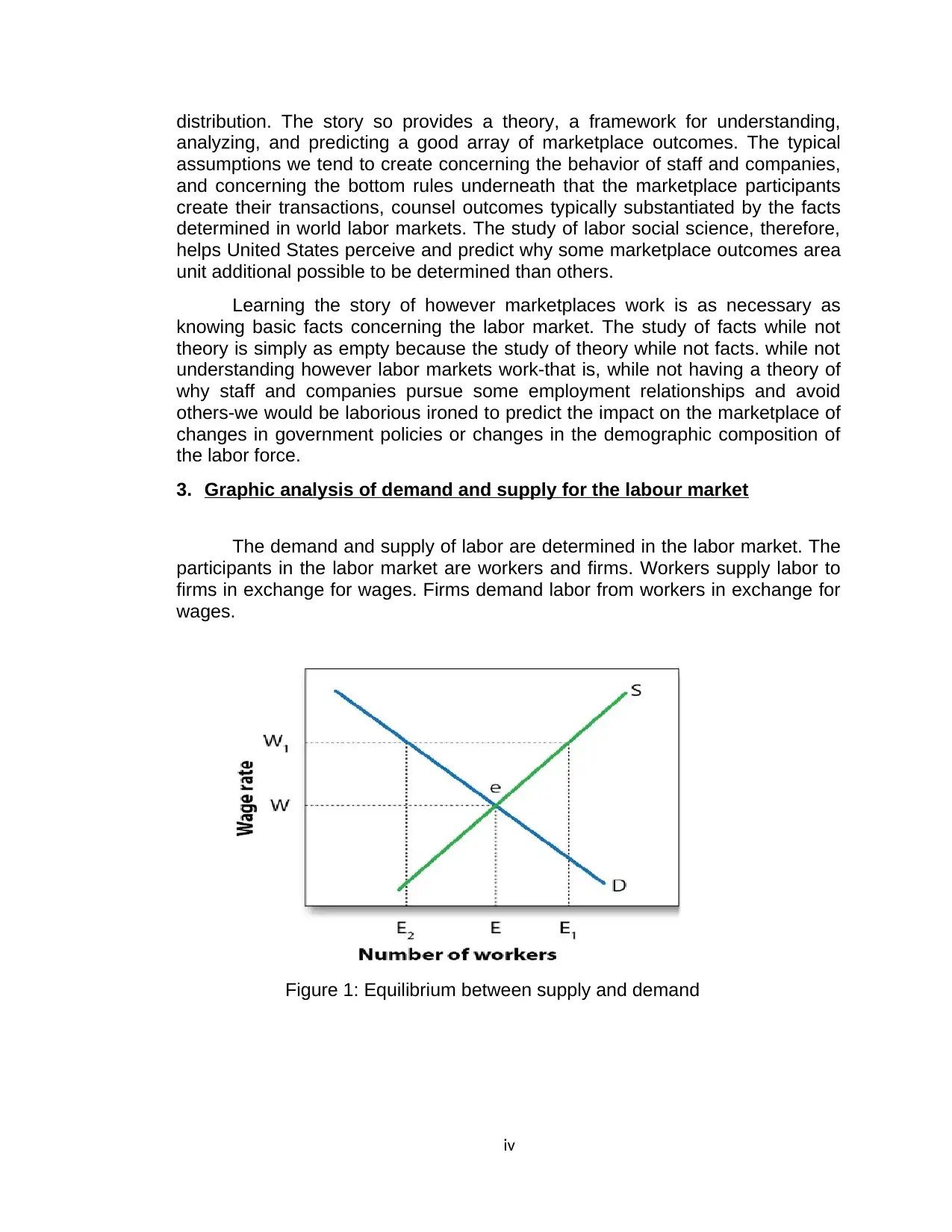
The demand and supply of labor are determined in the labor market. The
participants in the labor market are workers and firms. Workers supply labor to
firms in exchange for wages. Firms demand labor from workers in exchange for
wages.
Figure 1: Equilibrium between supply and demand
iv
analyzing, and predicting a good array of marketplace outcomes. The typical
assumptions we tend to create concerning the behavior of staff and companies,
and concerning the bottom rules underneath that the marketplace participants
create their transactions, counsel outcomes typically substantiated by the facts
determined in world labor markets. The study of labor social science, therefore,
helps United States perceive and predict why some marketplace outcomes area
unit additional possible to be determined than others.
Learning the story of however marketplaces work is as necessary as
knowing basic facts concerning the labor market. The study of facts while not
theory is simply as empty because the study of theory while not facts. while not
understanding however labor markets work-that is, while not having a theory of
why staff and companies pursue some employment relationships and avoid
others-we would be laborious ironed to predict the impact on the marketplace of
changes in government policies or changes in the demographic composition of
the labor force.
3. Graphic analysis of demand and supply for the labour market
The demand and supply of labor are determined in the labor market. The
participants in the labor market are workers and firms. Workers supply labor to
firms in exchange for wages. Firms demand labor from workers in exchange for
wages.
Figure 1: Equilibrium between supply and demand
iv
4) The Functions, Features, Characteristics of the Labour Market
Labour market presents a complex content, highlighted by the functions
that it performs in the market economy, functions of economic, social and
educational nature, consisting of:
Distribution function of employment on sectors, industries, professions,
qualifications, territorial areas in line with volume and structure of the
labour demand.
Training function and revenue sharing of economic operators; through
this function the labour remuneration is achieved.
social function, through the labour market the supply and demand of
labour meet, the improvement of labour conditions, the humanization of
labour, social protection of the unemployed and their retraining are done.
Educational and training function, this feature provides the information
necessary for education, vocational training, retraining and reintegration
of labour, the accumulation of work experience.
Political function, the feature that reinforces social and political stability.
The labour market ensures the balance between the needs for labour
resources of the national economy and the possibilities for their coverage. It
features a self-regulation mechanism, which in principle is the same on all
markets. Common elements of this mechanism are supply, demand and price.
Having as main transaction objective the labour factor, the labour market
by its structure is detached from other markets through specific features.
Segmentation can refer to the characteristics of a firm or an economic
entity, occupation, work components, characteristics of the individual or
combinations between them (Fichtenbaum, 2006). To a lesser extent, labour
market segmentation can be seen both in terms of labour supply and labour
demand. To a lesser extent, labour market segmentation can be seen both in
terms of labour supply and labour demand.
Rigid and inflexible, the labour market rigidity is natural, as a result of
geographical evolution, lifestyle, professional training, as well as by legal and
institutional aspects that are determined by gaps within these systems. The
differences between salaries exist not only between companies / industries
but also between various regions of the country. These rigidities are met
especially where unemployment and inflation are high. The minimum wage
could also be a factor of the rigidity in the labour market because it leaves no
room for a fast adjustment to market conditions (Serban & Aceleanu, 2015).
If the labour market would be a flexible and dynamic one, employees would
be able to change jobs quickly enough, therefore creating high quality
working places, leaving aside the jobs that are not so productive. Moreover,
on such a market, companies would be encouraged to create better paid
v
Labour market presents a complex content, highlighted by the functions
that it performs in the market economy, functions of economic, social and
educational nature, consisting of:
Distribution function of employment on sectors, industries, professions,
qualifications, territorial areas in line with volume and structure of the
labour demand.
Training function and revenue sharing of economic operators; through
this function the labour remuneration is achieved.
social function, through the labour market the supply and demand of
labour meet, the improvement of labour conditions, the humanization of
labour, social protection of the unemployed and their retraining are done.
Educational and training function, this feature provides the information
necessary for education, vocational training, retraining and reintegration
of labour, the accumulation of work experience.
Political function, the feature that reinforces social and political stability.
The labour market ensures the balance between the needs for labour
resources of the national economy and the possibilities for their coverage. It
features a self-regulation mechanism, which in principle is the same on all
markets. Common elements of this mechanism are supply, demand and price.
Having as main transaction objective the labour factor, the labour market
by its structure is detached from other markets through specific features.
Segmentation can refer to the characteristics of a firm or an economic
entity, occupation, work components, characteristics of the individual or
combinations between them (Fichtenbaum, 2006). To a lesser extent, labour
market segmentation can be seen both in terms of labour supply and labour
demand. To a lesser extent, labour market segmentation can be seen both in
terms of labour supply and labour demand.
Rigid and inflexible, the labour market rigidity is natural, as a result of
geographical evolution, lifestyle, professional training, as well as by legal and
institutional aspects that are determined by gaps within these systems. The
differences between salaries exist not only between companies / industries
but also between various regions of the country. These rigidities are met
especially where unemployment and inflation are high. The minimum wage
could also be a factor of the rigidity in the labour market because it leaves no
room for a fast adjustment to market conditions (Serban & Aceleanu, 2015).
If the labour market would be a flexible and dynamic one, employees would
be able to change jobs quickly enough, therefore creating high quality
working places, leaving aside the jobs that are not so productive. Moreover,
on such a market, companies would be encouraged to create better paid
v
⊘ This is a preview!⊘
Do you want full access?
Subscribe today to unlock all pages.
Trusted by 1+ million students worldwide
jobs that would result in a growth of the number of employees. Flexibility
means promoting employment and accepting atypical positions: part-time
jobs (reduced working hours), jobs with variable work schedule, working at
home, self-employment etc., employment with temporary contracts,
occasional contracts, contracts per project or fixed contracts. The need for
flexibility is determined by increasing competition on a national level, but
mostly internationally. Due to the use of flexible labour there is an increase in
the workforce efficiency by reducing labour costs but mostly balancing supply
and demand of labour.
Secondary Market, the labour market is a secondary market from other
markets (capital market, goods and services market), receiving the
influences of both, being constantly linked with them, anticipating trends in
the labour supply and demand, the reaction of economic operators, receiving
and transmitting, in return, medium and long-term signals and determining
effects that are fund in all social-economic sectors. The structure and volume
of the workforce supply are dependent on the demand for labour, just as the
demand for labour is dependent on the demand of goods and services, and
how they are produced.
Regulation, this feature results from the particularity of the workforce as well
as from the requirement to ensure employee protection, control the loyal
competition through trade unions, allowing the grouping of entrepreneurs
who hire wage labour. The labour market legislation must be constantly
improved to fight unemployment and ensure the better management of
population employment.
Administrative market, the labour market is an administrative market
because at this level companies manage their available resources according
to the demand for necessary goods and services that involves the workforce
and considering the personnel wage plan.
Multidimensional character, the labour market has a multidimensional
character given by the geographic, economic, educational and social scale.
The geographical scale is given by the profile of the available workforce,
population on age categories and the working population. The economic
scale refers to the population distribution by areas of activity, professions, the
public participation in the economic process, the costs implied by the
inactivity of the population. The educational scale refers to average duration
of learning, the population level of training, the number of people that are in a
particular form of learning. The social scale refers to the costs of social
protection, reconversion or insertion of employees on the labour market.
vi
means promoting employment and accepting atypical positions: part-time
jobs (reduced working hours), jobs with variable work schedule, working at
home, self-employment etc., employment with temporary contracts,
occasional contracts, contracts per project or fixed contracts. The need for
flexibility is determined by increasing competition on a national level, but
mostly internationally. Due to the use of flexible labour there is an increase in
the workforce efficiency by reducing labour costs but mostly balancing supply
and demand of labour.
Secondary Market, the labour market is a secondary market from other
markets (capital market, goods and services market), receiving the
influences of both, being constantly linked with them, anticipating trends in
the labour supply and demand, the reaction of economic operators, receiving
and transmitting, in return, medium and long-term signals and determining
effects that are fund in all social-economic sectors. The structure and volume
of the workforce supply are dependent on the demand for labour, just as the
demand for labour is dependent on the demand of goods and services, and
how they are produced.
Regulation, this feature results from the particularity of the workforce as well
as from the requirement to ensure employee protection, control the loyal
competition through trade unions, allowing the grouping of entrepreneurs
who hire wage labour. The labour market legislation must be constantly
improved to fight unemployment and ensure the better management of
population employment.
Administrative market, the labour market is an administrative market
because at this level companies manage their available resources according
to the demand for necessary goods and services that involves the workforce
and considering the personnel wage plan.
Multidimensional character, the labour market has a multidimensional
character given by the geographic, economic, educational and social scale.
The geographical scale is given by the profile of the available workforce,
population on age categories and the working population. The economic
scale refers to the population distribution by areas of activity, professions, the
public participation in the economic process, the costs implied by the
inactivity of the population. The educational scale refers to average duration
of learning, the population level of training, the number of people that are in a
particular form of learning. The social scale refers to the costs of social
protection, reconversion or insertion of employees on the labour market.
vi
Paraphrase This Document
Need a fresh take? Get an instant paraphrase of this document with our AI Paraphraser
Inconsistent, the labour market is inconsistent, workers having different
levels of training, education, qualification, coming from different geographical
areas, of different ages, genders, aspirations and standards.
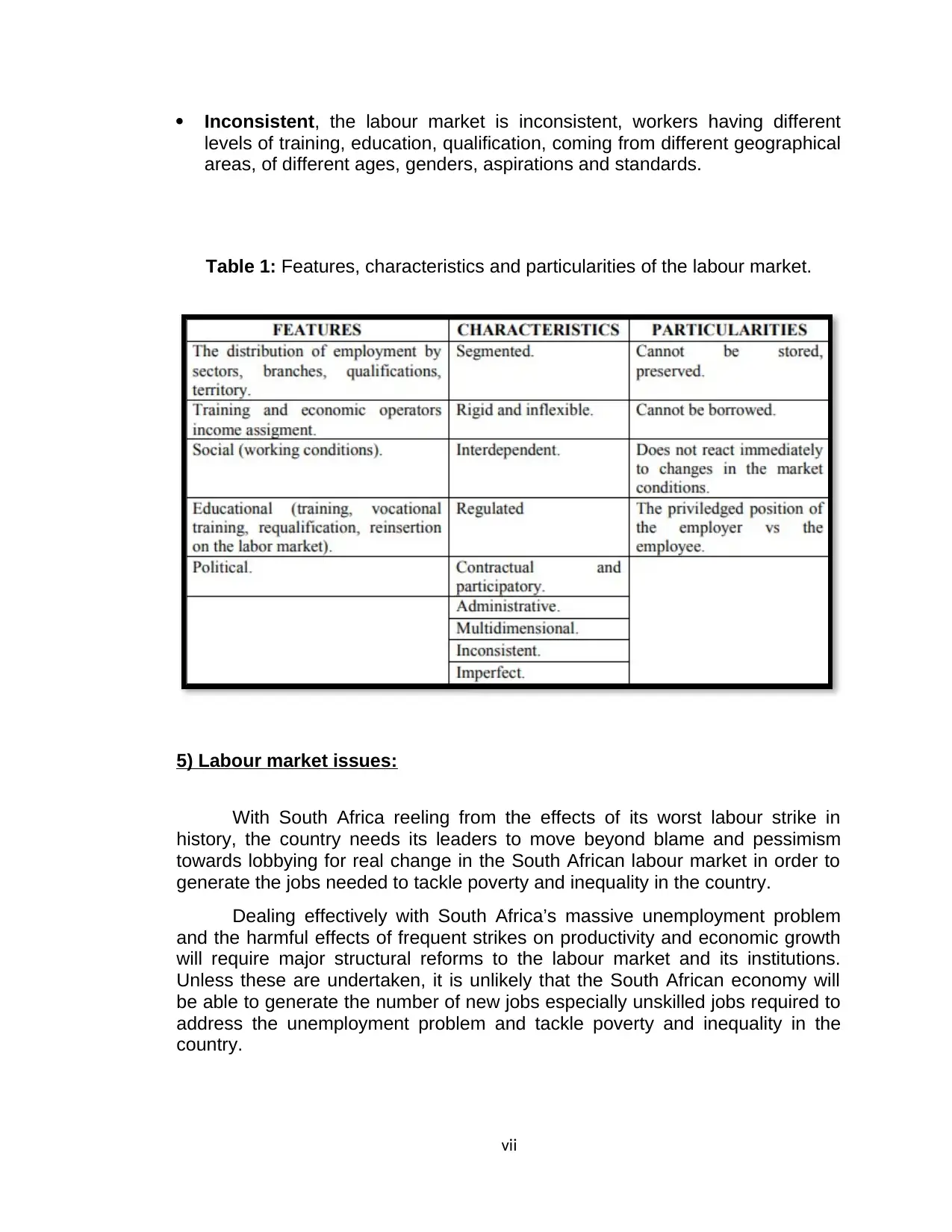
Table 1: Features, characteristics and particularities of the labour market.
5) Labour market issues:
With South Africa reeling from the effects of its worst labour strike in
history, the country needs its leaders to move beyond blame and pessimism
towards lobbying for real change in the South African labour market in order to
generate the jobs needed to tackle poverty and inequality in the country.
Dealing effectively with South Africa’s massive unemployment problem
and the harmful effects of frequent strikes on productivity and economic growth
will require major structural reforms to the labour market and its institutions.
Unless these are undertaken, it is unlikely that the South African economy will
be able to generate the number of new jobs especially unskilled jobs required to
address the unemployment problem and tackle poverty and inequality in the
country.
vii
levels of training, education, qualification, coming from different geographical
areas, of different ages, genders, aspirations and standards.
Table 1: Features, characteristics and particularities of the labour market.
5) Labour market issues:
With South Africa reeling from the effects of its worst labour strike in
history, the country needs its leaders to move beyond blame and pessimism
towards lobbying for real change in the South African labour market in order to
generate the jobs needed to tackle poverty and inequality in the country.
Dealing effectively with South Africa’s massive unemployment problem
and the harmful effects of frequent strikes on productivity and economic growth
will require major structural reforms to the labour market and its institutions.
Unless these are undertaken, it is unlikely that the South African economy will
be able to generate the number of new jobs especially unskilled jobs required to
address the unemployment problem and tackle poverty and inequality in the
country.
vii
South Africa’s unemployment problem is well documented. A major
contributory factor to the unemployment challenge in South Africa is the current
state of the country’s labour market institutions and regulatory environment. In
this regard, a rigid labour market, the ongoing crisis in collective bargaining, the
widespread prevalence of the controversial practice of labour broking, problems
with the determination and implementation of minimum wages, and policies that
actually hamper rather than aid efforts to achieve higher rates of job creation,
are all to blame.
At the same time, the growing prevalence of strikes in key sectors of the
economy, notably mining, threatens to stifle economic growth and much-needed
investment. In the period between 2007 and 2012, 41.9 million ‘man days’ were
lost to strike action, more than four and a half times the equivalent number of
days that were lost between 2001 and 2006. The Department of Labour’s annual
industrial action report for 2012 states that workers lost R6.6 billion in wages as
a result of strikes (up from R1.1 billion in 2011). As of the end of March 2014,
the wage strike in the platinum mining sector had, single-handedly, cost workers
some R4.4 billion in lost wages and employers some R10 billion in lost
production. This cycle of value destruction is a fundamental obstacle to tackling
poverty, inequality and joblessness in South Africa.
5.1) Current labour market challenges
The productivity of the South African labour market is presently
challenged by a number of issues. One fundamental problem from the
economy’s low capacity to attract labour the current employment to population
ratio is just 41.9%. This labour absorption rate is mainly a product of the
mismatch among job openings extremely skilled workers across South
Africa. This problem has been worsened by changes in the composition of
employment in the country, where a change towards a more capital and skill
intensive economy has suggested that new low-skilled jobs are becoming
available. the skills of the workforce and those demanded by industry. Owing to
a lack of training and skills development, a large share of the country’s workers
does not possess the skills required to fill the hundreds of thousands of job
openings requiring highly skilled workers across South Africa. This problem has
been exacerbated by changes in the sectoral composition of employment in the
country, where a shift towards a more capital- and skill-intensive economy has
meant that fewer and fewer new low-skilled jobs are becoming available.
Inadequate vocational skills training and a poor quality education system has
only worsened the skills deficit.
Access to higher education, in particular, remains a problem. The growth
is not sufficient to encounter South Africa’s human resource demands. The
National Plan for Higher Education has set a 20% target participation rate (the
viii
contributory factor to the unemployment challenge in South Africa is the current
state of the country’s labour market institutions and regulatory environment. In
this regard, a rigid labour market, the ongoing crisis in collective bargaining, the
widespread prevalence of the controversial practice of labour broking, problems
with the determination and implementation of minimum wages, and policies that
actually hamper rather than aid efforts to achieve higher rates of job creation,
are all to blame.
At the same time, the growing prevalence of strikes in key sectors of the
economy, notably mining, threatens to stifle economic growth and much-needed
investment. In the period between 2007 and 2012, 41.9 million ‘man days’ were
lost to strike action, more than four and a half times the equivalent number of
days that were lost between 2001 and 2006. The Department of Labour’s annual
industrial action report for 2012 states that workers lost R6.6 billion in wages as
a result of strikes (up from R1.1 billion in 2011). As of the end of March 2014,
the wage strike in the platinum mining sector had, single-handedly, cost workers
some R4.4 billion in lost wages and employers some R10 billion in lost
production. This cycle of value destruction is a fundamental obstacle to tackling
poverty, inequality and joblessness in South Africa.
5.1) Current labour market challenges
The productivity of the South African labour market is presently
challenged by a number of issues. One fundamental problem from the
economy’s low capacity to attract labour the current employment to population
ratio is just 41.9%. This labour absorption rate is mainly a product of the
mismatch among job openings extremely skilled workers across South
Africa. This problem has been worsened by changes in the composition of
employment in the country, where a change towards a more capital and skill
intensive economy has suggested that new low-skilled jobs are becoming
available. the skills of the workforce and those demanded by industry. Owing to
a lack of training and skills development, a large share of the country’s workers
does not possess the skills required to fill the hundreds of thousands of job
openings requiring highly skilled workers across South Africa. This problem has
been exacerbated by changes in the sectoral composition of employment in the
country, where a shift towards a more capital- and skill-intensive economy has
meant that fewer and fewer new low-skilled jobs are becoming available.
Inadequate vocational skills training and a poor quality education system has
only worsened the skills deficit.
Access to higher education, in particular, remains a problem. The growth
is not sufficient to encounter South Africa’s human resource demands. The
National Plan for Higher Education has set a 20% target participation rate (the
viii
⊘ This is a preview!⊘
Do you want full access?
Subscribe today to unlock all pages.
Trusted by 1+ million students worldwide
total enrolment across all ages expressed as a percentage of the 20 to 24-year
old age group in the population) in higher education. The steady growth in the
participation rate in South Africa – from 15% in 2000 to 18% in 2010 suggests
that the 20% target is likely to be met by 2015/16. In line with this, the
Department of Higher Education and Training’s green paper published in 2012
revised the target participation rate to 23% by 2030, but this is still described as
‘modest’ compared to average participation rates in Latin America (34%) and
Central Asia (31%), and well below the rates of between 40% and 50% that are
common in developed nations.
A range of issues are hindering job creation efforts in South Africa.
Certain aspects of labour legislation are highly restrictive by global standards.
Rigidities associated with settlement processes and in policies governing the
hiring and firing of workers serve as barriers in hiring new workers. The
increasing frequency of abuse of the Commission for Conciliation and Arbitration
processes relating to dismissal, has decelerated the arbitration and dispute
resolution system, inhibit businesses from hiring new workers in South Africa.
To be sure, the practice of labour broking is widespread in South Africa,
and has been the source of considerable controversy. While labour broking is an
effective mechanism to assist workers to gain entry into the labour market, it
also makes those employed in this way vulnerable to arbitrary. The national
government’s response to address these issues – which includes the
introduction of the notion of ‘deemed employment’ after a three-month period is
likely to add further cost and complexity to the system and invite legal
contestation. That, in turn, is likely to adversely affect the number of jobs
available, and to increase unemployment.
Apart from these issues, one of the most visible problems in the South
African labour market is the crisis in collective bargaining. The dominance of
centralized bargaining in South Africa – at odds with the move towards
decentralized bargaining arrangements internationally favor large employers,
institutionalizes the power of trade unions and results in better occurrence of
fixed wages around sectors. The main problem with centralized bargaining is
that it does not adequately recognize differences across enterprises and stifles
labour management relationships at the enterprise level. There is a body of
empirical evidence to suggest that centralized bargaining also restrains wage
levels in certain sectors – with financially stronger employers only required to
pay the modest wage increases that can be afforded by smaller or weaker
enterprises, while the weakest enterprises face the prospect of being squeezed
out because they cannot afford the increases in wages that the majority of
enterprises in the sector are prepared to pay.
Furthermore, industry bargaining precludes the option of linking wages to
productivity. A efficiency linked wage system could tackle the problem of a
ix
old age group in the population) in higher education. The steady growth in the
participation rate in South Africa – from 15% in 2000 to 18% in 2010 suggests
that the 20% target is likely to be met by 2015/16. In line with this, the
Department of Higher Education and Training’s green paper published in 2012
revised the target participation rate to 23% by 2030, but this is still described as
‘modest’ compared to average participation rates in Latin America (34%) and
Central Asia (31%), and well below the rates of between 40% and 50% that are
common in developed nations.
A range of issues are hindering job creation efforts in South Africa.
Certain aspects of labour legislation are highly restrictive by global standards.
Rigidities associated with settlement processes and in policies governing the
hiring and firing of workers serve as barriers in hiring new workers. The
increasing frequency of abuse of the Commission for Conciliation and Arbitration
processes relating to dismissal, has decelerated the arbitration and dispute
resolution system, inhibit businesses from hiring new workers in South Africa.
To be sure, the practice of labour broking is widespread in South Africa,
and has been the source of considerable controversy. While labour broking is an
effective mechanism to assist workers to gain entry into the labour market, it
also makes those employed in this way vulnerable to arbitrary. The national
government’s response to address these issues – which includes the
introduction of the notion of ‘deemed employment’ after a three-month period is
likely to add further cost and complexity to the system and invite legal
contestation. That, in turn, is likely to adversely affect the number of jobs
available, and to increase unemployment.
Apart from these issues, one of the most visible problems in the South
African labour market is the crisis in collective bargaining. The dominance of
centralized bargaining in South Africa – at odds with the move towards
decentralized bargaining arrangements internationally favor large employers,
institutionalizes the power of trade unions and results in better occurrence of
fixed wages around sectors. The main problem with centralized bargaining is
that it does not adequately recognize differences across enterprises and stifles
labour management relationships at the enterprise level. There is a body of
empirical evidence to suggest that centralized bargaining also restrains wage
levels in certain sectors – with financially stronger employers only required to
pay the modest wage increases that can be afforded by smaller or weaker
enterprises, while the weakest enterprises face the prospect of being squeezed
out because they cannot afford the increases in wages that the majority of
enterprises in the sector are prepared to pay.
Furthermore, industry bargaining precludes the option of linking wages to
productivity. A efficiency linked wage system could tackle the problem of a
ix
Paraphrase This Document
Need a fresh take? Get an instant paraphrase of this document with our AI Paraphraser
mixture of rising unit labour costs and falling productivity, which warns job
creation and weakens the competitiveness of the South African economy.
The Congress of South African Trade Unions (Cosatu) has strongly
promoted industry bargaining. This has come at the expense of meaningful
engagement at the enterprise level. Consequently, industrial strikes and
deadlock have become the norm rather than the exception. A key source of
unpredictability in the labour market over the past years has been the growing
distance between trade union councils and workers, as well as the absence of a
meaningful social wage. Well-grounded concerns that employers have pursued
high levels of profit for owners, shared with top managers, at the expense of
lower paid workers, have also been a source of much consternation for trade
unions and workers alike.
Moreover, there has been poor leadership from government. The
government’s decision making and labour market policies remain heavily
influenced by the views of trade unions particularly Cosatu and those of big
business; to the detriment of medium-sized and small businesses. The South
African minister of labour has splashed and the African National Congress has
stated various things to different stakeholders, trying to please all but get
something done, little in practice to a way forward away of the crisis. The
government has publicly committed to implementing the National Development
Plan (which means, among other things, improving the social wage and growing
jobs by cutting the cost and complexity of business) but has strapped through
labour law amendments.
5.2) Overview of Labour Market in South Africa
In the pre-democratic regime, the South African labour market was
segmented along racial lines, to the disadvantage of non-whites: the
implementation of the Bantu Education Act of 1953 led to non-whites receiving
relatively inferior quality of education. The Group Areas Act of 1950 and Black
Labour Act of 1964 formed separated areas of residence in urban areas and
limits on the type and circumstances of employment available to Africans,
respectively. The Industrial Conciliation Act of 1924 allowed the establishment of
Industrial Councils, but did not recognize African trade unions or allow African
employees to take part in collective bargaining.
During the post-apartheid period, there have been radical changes in the
labour market legislation, the Basic Conditions of Employment Act of 1997
stipulates the minimum wages for certain sectors and specifies minimum
working conditions for and rights of workers; the Labour Relations Act of 1995
outlines processes on collective bargaining and the resolution of labour
disputes; and the Employment Equity Act of 1998 inspires affirmative action,
which accomplishes the need for retaining more non-white workers in order to
reduce societal inequalities.
x
creation and weakens the competitiveness of the South African economy.
The Congress of South African Trade Unions (Cosatu) has strongly
promoted industry bargaining. This has come at the expense of meaningful
engagement at the enterprise level. Consequently, industrial strikes and
deadlock have become the norm rather than the exception. A key source of
unpredictability in the labour market over the past years has been the growing
distance between trade union councils and workers, as well as the absence of a
meaningful social wage. Well-grounded concerns that employers have pursued
high levels of profit for owners, shared with top managers, at the expense of
lower paid workers, have also been a source of much consternation for trade
unions and workers alike.
Moreover, there has been poor leadership from government. The
government’s decision making and labour market policies remain heavily
influenced by the views of trade unions particularly Cosatu and those of big
business; to the detriment of medium-sized and small businesses. The South
African minister of labour has splashed and the African National Congress has
stated various things to different stakeholders, trying to please all but get
something done, little in practice to a way forward away of the crisis. The
government has publicly committed to implementing the National Development
Plan (which means, among other things, improving the social wage and growing
jobs by cutting the cost and complexity of business) but has strapped through
labour law amendments.
5.2) Overview of Labour Market in South Africa
In the pre-democratic regime, the South African labour market was
segmented along racial lines, to the disadvantage of non-whites: the
implementation of the Bantu Education Act of 1953 led to non-whites receiving
relatively inferior quality of education. The Group Areas Act of 1950 and Black
Labour Act of 1964 formed separated areas of residence in urban areas and
limits on the type and circumstances of employment available to Africans,
respectively. The Industrial Conciliation Act of 1924 allowed the establishment of
Industrial Councils, but did not recognize African trade unions or allow African
employees to take part in collective bargaining.
During the post-apartheid period, there have been radical changes in the
labour market legislation, the Basic Conditions of Employment Act of 1997
stipulates the minimum wages for certain sectors and specifies minimum
working conditions for and rights of workers; the Labour Relations Act of 1995
outlines processes on collective bargaining and the resolution of labour
disputes; and the Employment Equity Act of 1998 inspires affirmative action,
which accomplishes the need for retaining more non-white workers in order to
reduce societal inequalities.
x
Despite the new policies implemented to promote the previously
disadvantaged groups since the advent of democracy, the labour market
currently still suffers from persistent unemployment problems, stemming from
various issues. Therefore, South African education system generates a
continued stream of inadequately educated new work seekers, foremost to the
supply of labour force (LF) participants who may stay unemployable. Moreover,
there has been an emergence of large numbers of unemployed youth. This is
credited to, their lack of experience and high hopes on how they would cope the
labour market. This difference is attributed to the increased cost of hiring and
firing of labour in the formal sector. Moreover, wage rigidity due to legislated
minimum wages in some sectors of the labour market (agriculture, fishing, and
forestry and security sectors) contributes to increased levels of unemployment,
as per Kingdon & Knight (1999) and Bhorat et al. (2012).
Pauw et al. (2006) point graduate unemployment to a skills shortfall
issue. Equally, Oosthuizen & Van der Westhuizen (2008:56) say that ‘the
graduate unemployment challenge in itself is not considerable in pure terms, it
remains a concern as it is an unexpected outcome given skills shortages. They
say that it is suggestive of a dilemma in the training and education system.
Lastly, Van der Berg & Van Broekhuizen (2012) note that since there is no
oversupply of graduates in the South African labour market, graduate
unemployment trends must be indicative of skills mismatch issues.
6) Economic Performance and Initiatives post 1994
Since 1994, the South African economy has experienced important
changes with the government applying various policies, restoring the injustices
of the past, fleshing out the welfare system and enhancing competitiveness as
South Africa becomes ever more integrated into the global economy. These
policies have, squeezed on the labour market and, on the lives of millions of
South Africans. The period, between 1995 and 2002, began with much promise
and many challenges as the economy liberalised and normal trade relations
were resumed with the rest of the world. After the African National Congress
came into power, macro-economic strategy known as “Growth, Employment and
Redistribution” was revealed in 1996. This strategy predicted, amongst other
things, employment growth averaging 270 000 jobs per annum from 1996 to
2000, with the number of new jobs created rising over time from 126 000 in 1996
to 409 000 in 2000(GEAR 1996).
Unfortunately, for a variety of reasons, these projections were not
realised. In fact, in terms of the labour market, the experience of the second half
of the 1990s appears to have fallen short of even the baseline scenario
contained in the GEAR document, which projected a net increase in (non-
agricultural formal) employment of slightly more than 100 000 jobs per annum.
xi
disadvantaged groups since the advent of democracy, the labour market
currently still suffers from persistent unemployment problems, stemming from
various issues. Therefore, South African education system generates a
continued stream of inadequately educated new work seekers, foremost to the
supply of labour force (LF) participants who may stay unemployable. Moreover,
there has been an emergence of large numbers of unemployed youth. This is
credited to, their lack of experience and high hopes on how they would cope the
labour market. This difference is attributed to the increased cost of hiring and
firing of labour in the formal sector. Moreover, wage rigidity due to legislated
minimum wages in some sectors of the labour market (agriculture, fishing, and
forestry and security sectors) contributes to increased levels of unemployment,
as per Kingdon & Knight (1999) and Bhorat et al. (2012).
Pauw et al. (2006) point graduate unemployment to a skills shortfall
issue. Equally, Oosthuizen & Van der Westhuizen (2008:56) say that ‘the
graduate unemployment challenge in itself is not considerable in pure terms, it
remains a concern as it is an unexpected outcome given skills shortages. They
say that it is suggestive of a dilemma in the training and education system.
Lastly, Van der Berg & Van Broekhuizen (2012) note that since there is no
oversupply of graduates in the South African labour market, graduate
unemployment trends must be indicative of skills mismatch issues.
6) Economic Performance and Initiatives post 1994
Since 1994, the South African economy has experienced important
changes with the government applying various policies, restoring the injustices
of the past, fleshing out the welfare system and enhancing competitiveness as
South Africa becomes ever more integrated into the global economy. These
policies have, squeezed on the labour market and, on the lives of millions of
South Africans. The period, between 1995 and 2002, began with much promise
and many challenges as the economy liberalised and normal trade relations
were resumed with the rest of the world. After the African National Congress
came into power, macro-economic strategy known as “Growth, Employment and
Redistribution” was revealed in 1996. This strategy predicted, amongst other
things, employment growth averaging 270 000 jobs per annum from 1996 to
2000, with the number of new jobs created rising over time from 126 000 in 1996
to 409 000 in 2000(GEAR 1996).
Unfortunately, for a variety of reasons, these projections were not
realised. In fact, in terms of the labour market, the experience of the second half
of the 1990s appears to have fallen short of even the baseline scenario
contained in the GEAR document, which projected a net increase in (non-
agricultural formal) employment of slightly more than 100 000 jobs per annum.
xi
⊘ This is a preview!⊘
Do you want full access?
Subscribe today to unlock all pages.
Trusted by 1+ million students worldwide

1 out of 31


Your All-in-One AI-Powered Toolkit for Academic Success.
+13062052269
info@desklib.com
Available 24*7 on WhatsApp / Email
![[object Object]](/_next/static/media/star-bottom.7253800d.svg)
Unlock your academic potential
Copyright © 2020–2026 A2Z Services. All Rights Reserved. Developed and managed by ZUCOL.