Analysis of Interest Rate Impact on US-Korea Trade and Investment
VerifiedAdded on 2020/10/04
|11
|2614
|33
Report
AI Summary
This report examines the significant role of interest rates in assessing a country's financial position, particularly focusing on the relationship between interest rate fluctuations and international trade, with a specific emphasis on the US and South Korea. It explores how low interest rates in the US and Europe have affected South Korea's foreign direct investment, trade balances, and currency values. The report highlights the impact of the US-Korea Free Trade Agreement and analyzes the effects of interest rate changes on investment, inflation, and economic growth, including the 'spillover effect' on South Korea's economy. The analysis concludes that while low interest rates can stimulate domestic investment, they may negatively impact returns on foreign investments and exports, leading to challenges for South Korea in the global market. The report also discusses the depreciation of currency, which has an impact on the trade between the two countries.
In the last ten years, the U.S.
and many European countries
have maintained a low interest
rate envi
and many European countries
have maintained a low interest
rate envi

Paraphrase This Document
Need a fresh take? Get an instant paraphrase of this document with our AI Paraphraser
TABLE OF CONTENTS
INTRODUCTION...........................................................................................................................1
Main Body.......................................................................................................................................1
CONCLUSION................................................................................................................................4
REFERENCES................................................................................................................................5
INTRODUCTION...........................................................................................................................1
Main Body.......................................................................................................................................1
CONCLUSION................................................................................................................................4
REFERENCES................................................................................................................................5
Illustration Index
Illustration 1: Interest deposits in Korea..........................................................................................3
Illustration 2: Interest rates in South Korea.....................................................................................4
Illustration 3: Inflation in different countries...................................................................................5
Illustration 1: Interest deposits in Korea..........................................................................................3
Illustration 2: Interest rates in South Korea.....................................................................................4
Illustration 3: Inflation in different countries...................................................................................5
⊘ This is a preview!⊘
Do you want full access?
Subscribe today to unlock all pages.

Trusted by 1+ million students worldwide
INTRODUCTION
Interest rate is considered as one of the important tool in the monetary policies formed by
the government of a particular country (Bodie, 2013). It helps in assessing various variables such
as, inflation rate, deflation rate, investment and unemployment as well. A significant increase or
decrease in the interest rate have adequate impact on the exchange rates of the currency as well.
A comprehensive discussion will be made discussing the importance of interest rate in assessing
the financial position of the country. Further, it will ponder on the trade agreement between
Korea and US and the statistics of important and exports between the two countries. In the end, a
discussion will be made in brief dotting out the reasons of reduced trade of South Korea with US
and European countries (King and Low, 2014)
Main Body
Interest rate is considered as a vital factor as it helps in assessing the financial condition
of a particular country. It is dependent on demand and supply of credit. An increase in the supply
of credit tends to decrease the interest rates. However, a decrease in supply of credit will result in
increase of the interest rates for a particular country (Burda and Wyplosz, 2013). Conversely, an
increase in demand of credit will increase the interest rates and a decrease in demand will
decrease the interest rates. (Moravcsik, 2012)
The free trade agreement between United States and Korea enforced from March 15,
2012 (Karanikolos and et.al., 2013). Total estimation of goods and services which is traded
between the two countries are estimated to be $144.6 billion where exports of US were $63.8
billion and important happened to be $80.8 billion in 2016. Korea is considered to be 6th largest
trading partner of US where $112.2 billion goods in total were traded in 2016 (US-Korea Free
Trade Agreement, 2017).
The foreign direct investment of United States in Korea was $34.6 billion 2015 where the
increase was 3.3% in comparison to that of 2014. It basically invests in Korean manufacturing,
finance and insurance companies. Further, Korean foreign direct investment in US amounted to
$14 billion in 2014 (US-Korea Free Trade Agreement, 2017). Hence, it can be ascertained that
there is a large exchange of currency between Korea and United States. Positive net exports of a
country help in its economic growth. However, the interest rates have been reduced in the
market, it has a significant impact on foreign trade (Grubel, 2014). High inflation rates
1
Interest rate is considered as one of the important tool in the monetary policies formed by
the government of a particular country (Bodie, 2013). It helps in assessing various variables such
as, inflation rate, deflation rate, investment and unemployment as well. A significant increase or
decrease in the interest rate have adequate impact on the exchange rates of the currency as well.
A comprehensive discussion will be made discussing the importance of interest rate in assessing
the financial position of the country. Further, it will ponder on the trade agreement between
Korea and US and the statistics of important and exports between the two countries. In the end, a
discussion will be made in brief dotting out the reasons of reduced trade of South Korea with US
and European countries (King and Low, 2014)
Main Body
Interest rate is considered as a vital factor as it helps in assessing the financial condition
of a particular country. It is dependent on demand and supply of credit. An increase in the supply
of credit tends to decrease the interest rates. However, a decrease in supply of credit will result in
increase of the interest rates for a particular country (Burda and Wyplosz, 2013). Conversely, an
increase in demand of credit will increase the interest rates and a decrease in demand will
decrease the interest rates. (Moravcsik, 2012)
The free trade agreement between United States and Korea enforced from March 15,
2012 (Karanikolos and et.al., 2013). Total estimation of goods and services which is traded
between the two countries are estimated to be $144.6 billion where exports of US were $63.8
billion and important happened to be $80.8 billion in 2016. Korea is considered to be 6th largest
trading partner of US where $112.2 billion goods in total were traded in 2016 (US-Korea Free
Trade Agreement, 2017).
The foreign direct investment of United States in Korea was $34.6 billion 2015 where the
increase was 3.3% in comparison to that of 2014. It basically invests in Korean manufacturing,
finance and insurance companies. Further, Korean foreign direct investment in US amounted to
$14 billion in 2014 (US-Korea Free Trade Agreement, 2017). Hence, it can be ascertained that
there is a large exchange of currency between Korea and United States. Positive net exports of a
country help in its economic growth. However, the interest rates have been reduced in the
market, it has a significant impact on foreign trade (Grubel, 2014). High inflation rates
1
Paraphrase This Document
Need a fresh take? Get an instant paraphrase of this document with our AI Paraphraser
consequently resulting in high interest rates as well leads to appreciation in the value of currency
against the currency of the country having lower inflation rate and hence interest rates as well
(Ang and Longstaff, 2013). However, a stronger currency of the home country can have adverse
effect on the exports. Hence, a low interest rate in US have helped South Korea to expand its
business there and improve its exports in the country as well.
Foreign Portfolio Investment (FPI) is when the foreigners or the people belonging to
other country deposit their money or the investment in nation's back with the purpose to buy
their shares or bonds. It can be done for speculation purposes as well. In this case, they tend to
assess that what is the prevailing interest rate in the country before making any investment. If the
prevailing interest rate in the country s high then more and more investment head towards the
investment (Ilzetzki, Mendoza and Végh, 2013). However, if the prevailing interest rate in the
country is low, in that case, the investors tend to reduce their Foreign Portfolio Investment (FPI)
in the country and make investment in the nation where the prevailing interest rate is high.
The prevailing low interest rates in US and many other European countries have made
South Korea to reduce its Foreign Portfolio investment and hence the money is laid down ideal
with the nation. Hence, it has diverted its FPI towards other high interest rate countries such as,
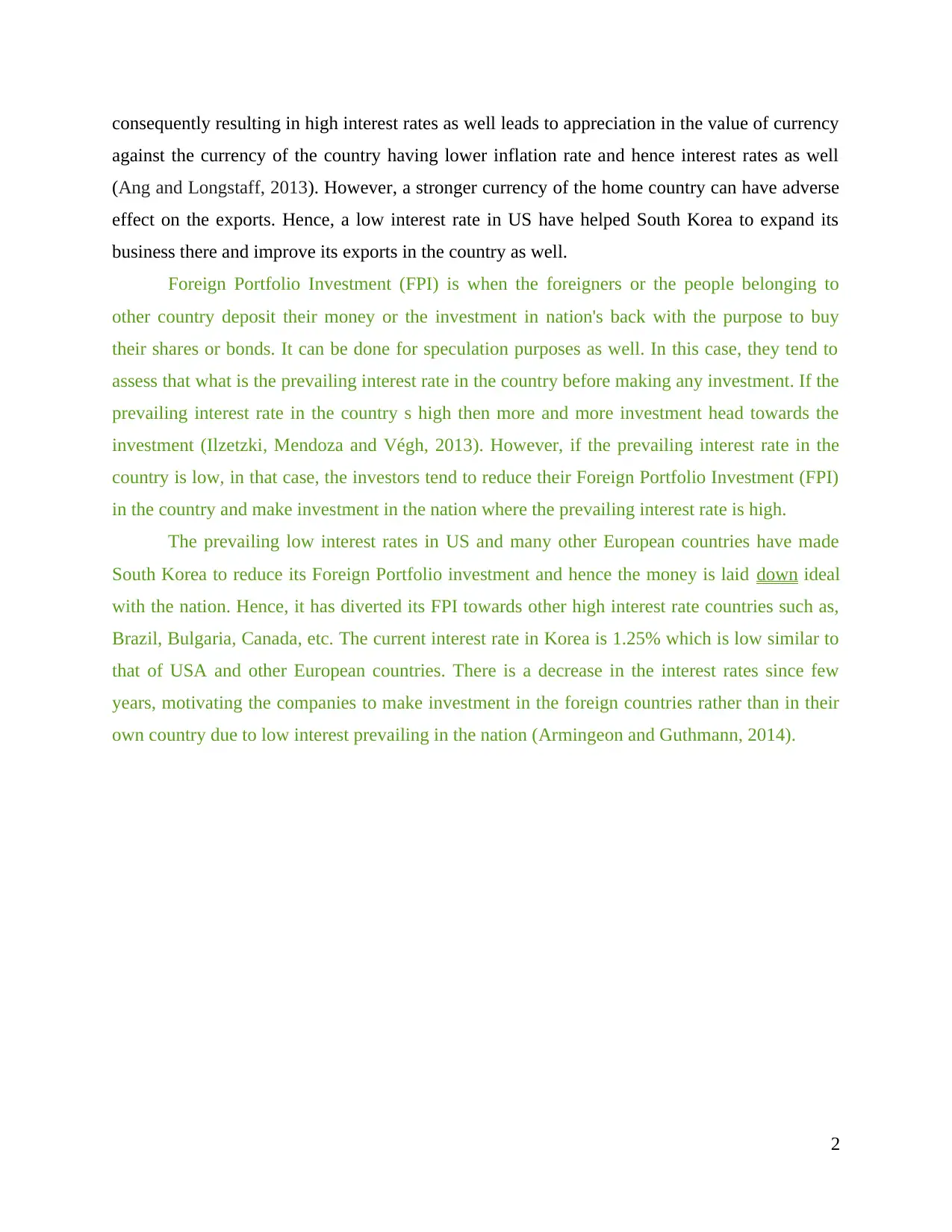
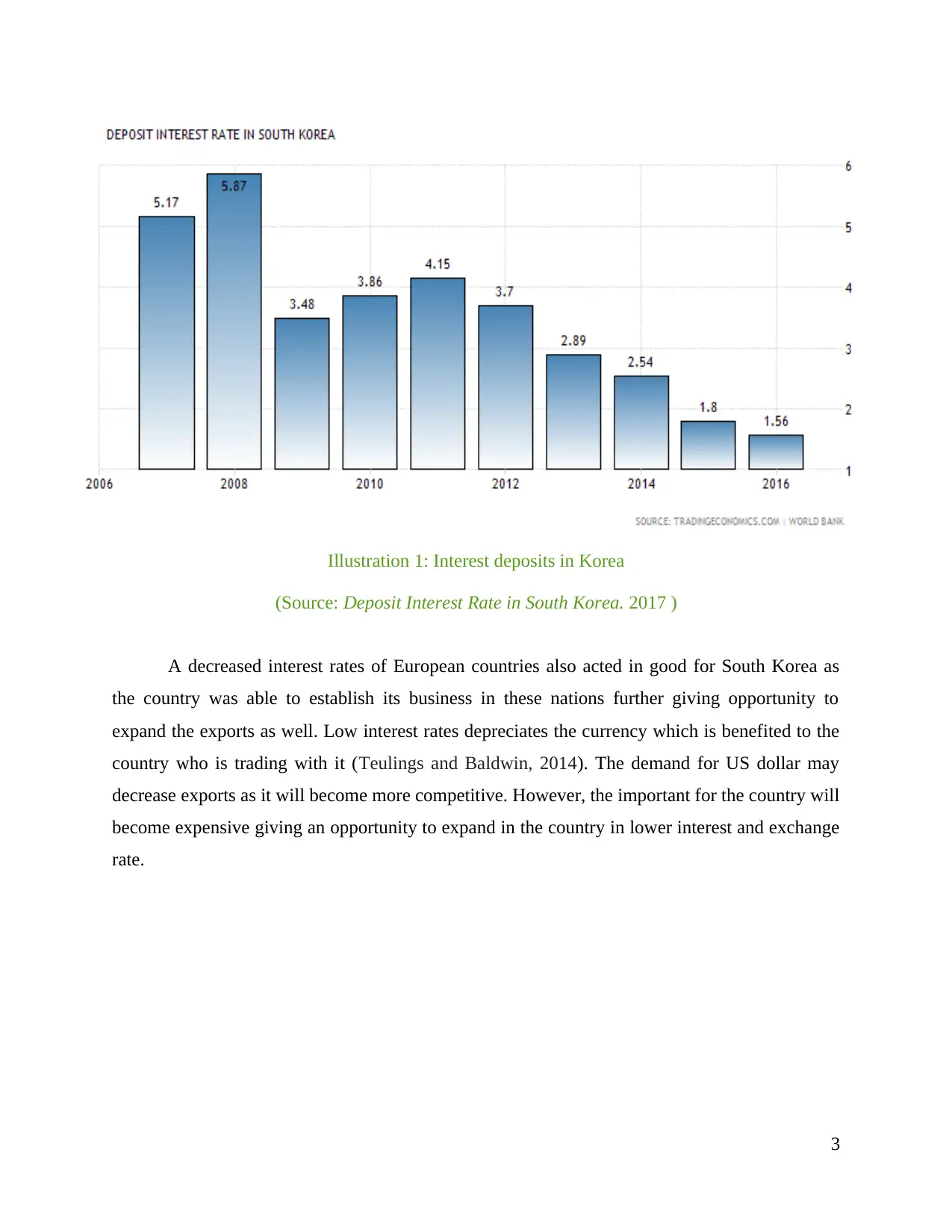
Brazil, Bulgaria, Canada, etc. The current interest rate in Korea is 1.25% which is low similar to
that of USA and other European countries. There is a decrease in the interest rates since few
years, motivating the companies to make investment in the foreign countries rather than in their
own country due to low interest prevailing in the nation (Armingeon and Guthmann, 2014).
2
against the currency of the country having lower inflation rate and hence interest rates as well
(Ang and Longstaff, 2013). However, a stronger currency of the home country can have adverse
effect on the exports. Hence, a low interest rate in US have helped South Korea to expand its
business there and improve its exports in the country as well.
Foreign Portfolio Investment (FPI) is when the foreigners or the people belonging to
other country deposit their money or the investment in nation's back with the purpose to buy
their shares or bonds. It can be done for speculation purposes as well. In this case, they tend to
assess that what is the prevailing interest rate in the country before making any investment. If the
prevailing interest rate in the country s high then more and more investment head towards the
investment (Ilzetzki, Mendoza and Végh, 2013). However, if the prevailing interest rate in the
country is low, in that case, the investors tend to reduce their Foreign Portfolio Investment (FPI)
in the country and make investment in the nation where the prevailing interest rate is high.
The prevailing low interest rates in US and many other European countries have made
South Korea to reduce its Foreign Portfolio investment and hence the money is laid down ideal
with the nation. Hence, it has diverted its FPI towards other high interest rate countries such as,
Brazil, Bulgaria, Canada, etc. The current interest rate in Korea is 1.25% which is low similar to
that of USA and other European countries. There is a decrease in the interest rates since few
years, motivating the companies to make investment in the foreign countries rather than in their
own country due to low interest prevailing in the nation (Armingeon and Guthmann, 2014).
2
A decreased interest rates of European countries also acted in good for South Korea as
the country was able to establish its business in these nations further giving opportunity to
expand the exports as well. Low interest rates depreciates the currency which is benefited to the
country who is trading with it (Teulings and Baldwin, 2014). The demand for US dollar may
decrease exports as it will become more competitive. However, the important for the country will
become expensive giving an opportunity to expand in the country in lower interest and exchange
rate.
3
Illustration 1: Interest deposits in Korea
(Source: Deposit Interest Rate in South Korea. 2017 )
the country was able to establish its business in these nations further giving opportunity to
expand the exports as well. Low interest rates depreciates the currency which is benefited to the
country who is trading with it (Teulings and Baldwin, 2014). The demand for US dollar may
decrease exports as it will become more competitive. However, the important for the country will
become expensive giving an opportunity to expand in the country in lower interest and exchange
rate.
3
Illustration 1: Interest deposits in Korea
(Source: Deposit Interest Rate in South Korea. 2017 )
⊘ This is a preview!⊘
Do you want full access?
Subscribe today to unlock all pages.
Trusted by 1+ million students worldwide
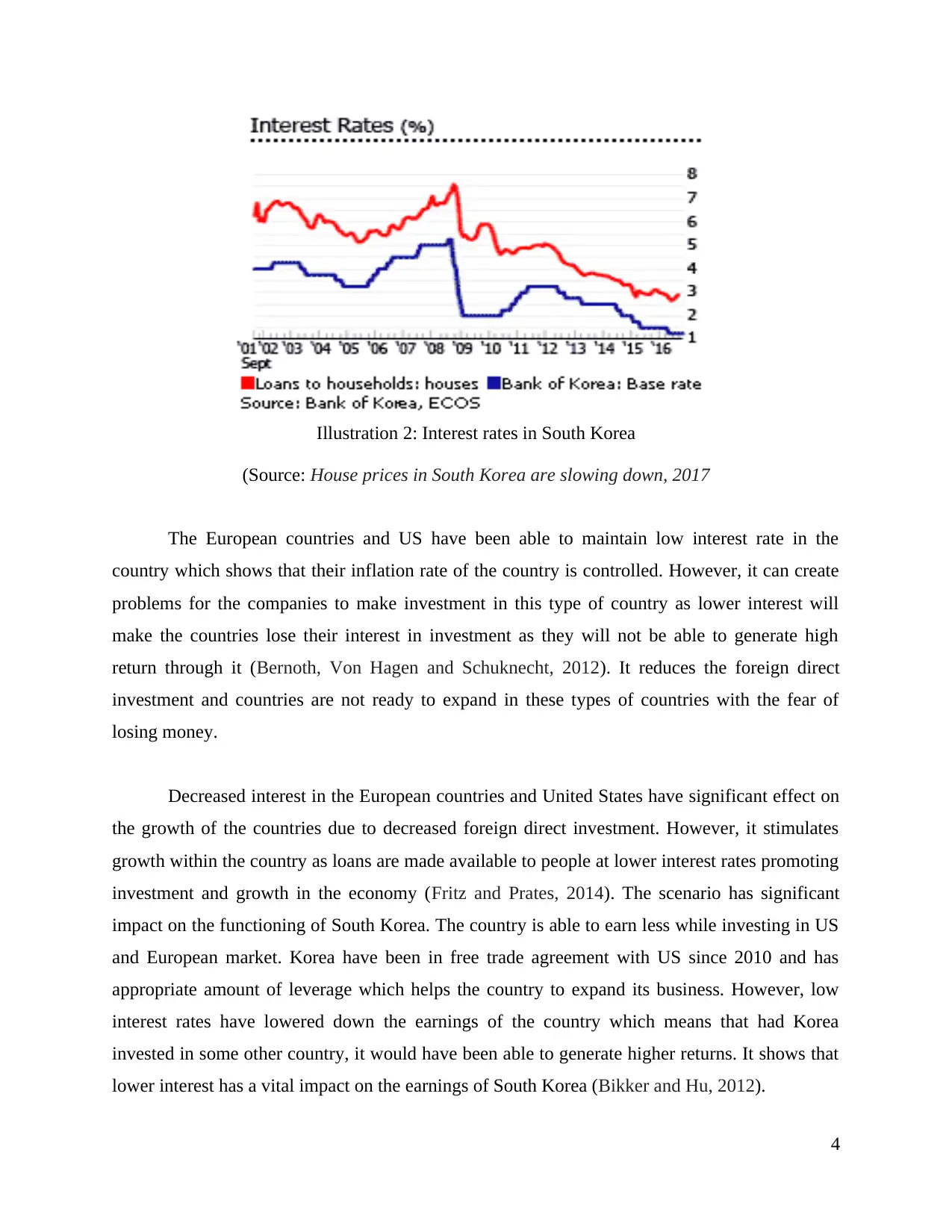
The European countries and US have been able to maintain low interest rate in the
country which shows that their inflation rate of the country is controlled. However, it can create
problems for the companies to make investment in this type of country as lower interest will
make the countries lose their interest in investment as they will not be able to generate high
return through it (Bernoth, Von Hagen and Schuknecht, 2012). It reduces the foreign direct
investment and countries are not ready to expand in these types of countries with the fear of
losing money.
Decreased interest in the European countries and United States have significant effect on
the growth of the countries due to decreased foreign direct investment. However, it stimulates
growth within the country as loans are made available to people at lower interest rates promoting
investment and growth in the economy (Fritz and Prates, 2014). The scenario has significant
impact on the functioning of South Korea. The country is able to earn less while investing in US
and European market. Korea have been in free trade agreement with US since 2010 and has
appropriate amount of leverage which helps the country to expand its business. However, low
interest rates have lowered down the earnings of the country which means that had Korea
invested in some other country, it would have been able to generate higher returns. It shows that
lower interest has a vital impact on the earnings of South Korea (Bikker and Hu, 2012).
4
Illustration 2: Interest rates in South Korea
(Source: House prices in South Korea are slowing down, 2017
country which shows that their inflation rate of the country is controlled. However, it can create
problems for the companies to make investment in this type of country as lower interest will
make the countries lose their interest in investment as they will not be able to generate high
return through it (Bernoth, Von Hagen and Schuknecht, 2012). It reduces the foreign direct
investment and countries are not ready to expand in these types of countries with the fear of
losing money.
Decreased interest in the European countries and United States have significant effect on
the growth of the countries due to decreased foreign direct investment. However, it stimulates
growth within the country as loans are made available to people at lower interest rates promoting
investment and growth in the economy (Fritz and Prates, 2014). The scenario has significant
impact on the functioning of South Korea. The country is able to earn less while investing in US
and European market. Korea have been in free trade agreement with US since 2010 and has
appropriate amount of leverage which helps the country to expand its business. However, low
interest rates have lowered down the earnings of the country which means that had Korea
invested in some other country, it would have been able to generate higher returns. It shows that
lower interest has a vital impact on the earnings of South Korea (Bikker and Hu, 2012).
4
Illustration 2: Interest rates in South Korea
(Source: House prices in South Korea are slowing down, 2017
Paraphrase This Document
Need a fresh take? Get an instant paraphrase of this document with our AI Paraphraser
A change in interest rates brings significant change in federal funds rates as well. It is the
rate used by the banks to lend money to each other. The change can be performed daily as its
movement have impact on the other rates as well. It helps in assessing that whether the rate of
interest of the country is rising or falling (An and Wang, 2012). A significant impact is noticed
on inflation and recession rates as well. It is a little boost to the people to make investment in
their country so that appropriate amount of disposable income can be gathered by the people of
the country. It may not be good for the foreign countries who are investing in the business of the
country (Fan, Titman and Twite, 2012).
Spillover effect refers to the one which happen to take place in the economy. It is due the
activity that is unrelated but have indirect impact to an unrelated context. For instance, any
change in the economical aspects of one country can have non monetary impact on non
participatory countries as well. Low interest rates prevailing in US and European countries can
5
Illustration 3: Inflation in different countries
(Source: The challenge of low real interest rates for monetary policy. 2016)
rate used by the banks to lend money to each other. The change can be performed daily as its
movement have impact on the other rates as well. It helps in assessing that whether the rate of
interest of the country is rising or falling (An and Wang, 2012). A significant impact is noticed
on inflation and recession rates as well. It is a little boost to the people to make investment in
their country so that appropriate amount of disposable income can be gathered by the people of
the country. It may not be good for the foreign countries who are investing in the business of the
country (Fan, Titman and Twite, 2012).
Spillover effect refers to the one which happen to take place in the economy. It is due the
activity that is unrelated but have indirect impact to an unrelated context. For instance, any
change in the economical aspects of one country can have non monetary impact on non
participatory countries as well. Low interest rates prevailing in US and European countries can
5
Illustration 3: Inflation in different countries
(Source: The challenge of low real interest rates for monetary policy. 2016)
have adequate impact on the functioning of South Korea. It leads to disappointing growth in the
country, low inflation rate, volatile inflation rate further slowing down the economic activities of
South Korea. Hence, there is adequate amount of spillover effect on the functioning of the South
Korea due to prevailing low interest in US and European countries.
Further, another important factor that is affecting trade of Korea in US and European
country is lack of income generated through the countries. Depreciation in the exchange rate
where less dollar is generated with the exchange of Korean currency (Shin, 2014). The rise in the
exports in US is due to free trade agreement between the two countries. The ease of doing
business have motivated Korea to expand in the country. The country is considered to be fruitful
to start a new business but not for the purpose of exports as the income of the country gets
reduced. South Korea have been in good trading terms with US have reduced its exports there
due to this issue. The exports through South Korea towards the country will decline due to low
prevailing interest rates in the country further affecting the growth of Korea. Decrease in exports
leads to decline in foreign direct investment of the country as well. It also results in decline of
GDP of the country.
CONCLUSION
Based on the above report, it can be concluded that, interest plays important role in
assessing the financial position of the country. If the interest rates are high, there is a hike in
inflation rates as well and vice versa. It also depicts that personal disposable income of people in
the country is also high. Further, European countries and US have been able to maintain low
interest rates since last 10 years which have badly affected foreign direct investment in the
country (Tsai, 2012). However, it has helped to increase the investment in the country as it has
led to ease of doing business in these types of countries. In the end, it can be concluded that, low
interest rate is not beneficial to the home country but not for the countries who are planning to
invest in it. Hence, it is a bad situation for South Korea to invest in the economy of European
countries and US.
6
country, low inflation rate, volatile inflation rate further slowing down the economic activities of
South Korea. Hence, there is adequate amount of spillover effect on the functioning of the South
Korea due to prevailing low interest in US and European countries.
Further, another important factor that is affecting trade of Korea in US and European
country is lack of income generated through the countries. Depreciation in the exchange rate
where less dollar is generated with the exchange of Korean currency (Shin, 2014). The rise in the
exports in US is due to free trade agreement between the two countries. The ease of doing
business have motivated Korea to expand in the country. The country is considered to be fruitful
to start a new business but not for the purpose of exports as the income of the country gets
reduced. South Korea have been in good trading terms with US have reduced its exports there
due to this issue. The exports through South Korea towards the country will decline due to low
prevailing interest rates in the country further affecting the growth of Korea. Decrease in exports
leads to decline in foreign direct investment of the country as well. It also results in decline of
GDP of the country.
CONCLUSION
Based on the above report, it can be concluded that, interest plays important role in
assessing the financial position of the country. If the interest rates are high, there is a hike in
inflation rates as well and vice versa. It also depicts that personal disposable income of people in
the country is also high. Further, European countries and US have been able to maintain low
interest rates since last 10 years which have badly affected foreign direct investment in the
country (Tsai, 2012). However, it has helped to increase the investment in the country as it has
led to ease of doing business in these types of countries. In the end, it can be concluded that, low
interest rate is not beneficial to the home country but not for the countries who are planning to
invest in it. Hence, it is a bad situation for South Korea to invest in the economy of European
countries and US.
6
⊘ This is a preview!⊘
Do you want full access?
Subscribe today to unlock all pages.
Trusted by 1+ million students worldwide
REFERENCES
Books and journals
An, L. and Wang, J., 2012. Exchange rate pass-through: Evidence based on vector auto
regression with sign restrictions. Open Economies Review. 23(2). pp.359-380.
Ang, A. and Longstaff, F. A., 2013. Systemic sovereign credit risk: Lessons from the US and
Europe. Journal of Monetary Economics. 60(5). pp.493-510.
Armingeon, K. and Guthmann, K., 2014. Democracy in crisis? The declining support for
national democracy in European countries, 2007–2011. European Journal of Political
Research.53(3). pp.423-442.
Bernoth, K., Von Hagen, J. and Schuknecht, L., 2012. Sovereign risk premiums in the European
government bond market. Journal of International Money and Finance. 31(5). pp.975-
995.
Bikker, J. A. and Hu, H., 2012. Cyclical patterns in profits, provisioning and lending of banks
and procyclicality of the new Basel capital requirements. PSL Quarterly
Review. 55(221).
Bodie, Z., 2013. Investments. McGraw-Hill.
Burda, M. and Wyplosz, C., 2013. Macroeconomics: a European text. Oxford university press.
Fan, J. P., Titman, S. and Twite, G., 2012. An international comparison of capital structure and
debt maturity choices. Journal of Financial and quantitative Analysis. 47(1). pp.23-56.
Fritz, B. and Prates, D., 2014. The new IMF approach to capital account management and its
blind spots: lessons from Brazil and South Korea. International Review of Applied
Economics. 28(2). pp.210-239.
Grubel, H. G., 2014. A theory of multinational banking. PSL Quarterly Review. 30(123).
Ilzetzki, E., Mendoza, E. G. and Végh, C. A., 2013. How big (small?) are fiscal
multipliers? Journal of monetary economics.60(2). pp.239-254.
Karanikolos, M. and et.al., 2013. Financial crisis, austerity, and health in Europe. The
Lancet.381(9874). pp.1323-1331.
King, M. and Low, D., 2014. Measuring the''world''real interest rate (No. w19887). National
Bureau of Economic Research.
Moravcsik, A., 2012. Europe after the crisis: How to sustain a common currency. Foreign
Aff. 91. p.54.
Shin, H. S., 2014. The second phase of global liquidity and its impact on emerging economies.
In Volatile Capital Flows in Korea (pp. 247-257). Palgrave Macmillan US.
7
Books and journals
An, L. and Wang, J., 2012. Exchange rate pass-through: Evidence based on vector auto
regression with sign restrictions. Open Economies Review. 23(2). pp.359-380.
Ang, A. and Longstaff, F. A., 2013. Systemic sovereign credit risk: Lessons from the US and
Europe. Journal of Monetary Economics. 60(5). pp.493-510.
Armingeon, K. and Guthmann, K., 2014. Democracy in crisis? The declining support for
national democracy in European countries, 2007–2011. European Journal of Political
Research.53(3). pp.423-442.
Bernoth, K., Von Hagen, J. and Schuknecht, L., 2012. Sovereign risk premiums in the European
government bond market. Journal of International Money and Finance. 31(5). pp.975-
995.
Bikker, J. A. and Hu, H., 2012. Cyclical patterns in profits, provisioning and lending of banks
and procyclicality of the new Basel capital requirements. PSL Quarterly
Review. 55(221).
Bodie, Z., 2013. Investments. McGraw-Hill.
Burda, M. and Wyplosz, C., 2013. Macroeconomics: a European text. Oxford university press.
Fan, J. P., Titman, S. and Twite, G., 2012. An international comparison of capital structure and
debt maturity choices. Journal of Financial and quantitative Analysis. 47(1). pp.23-56.
Fritz, B. and Prates, D., 2014. The new IMF approach to capital account management and its
blind spots: lessons from Brazil and South Korea. International Review of Applied
Economics. 28(2). pp.210-239.
Grubel, H. G., 2014. A theory of multinational banking. PSL Quarterly Review. 30(123).
Ilzetzki, E., Mendoza, E. G. and Végh, C. A., 2013. How big (small?) are fiscal
multipliers? Journal of monetary economics.60(2). pp.239-254.
Karanikolos, M. and et.al., 2013. Financial crisis, austerity, and health in Europe. The
Lancet.381(9874). pp.1323-1331.
King, M. and Low, D., 2014. Measuring the''world''real interest rate (No. w19887). National
Bureau of Economic Research.
Moravcsik, A., 2012. Europe after the crisis: How to sustain a common currency. Foreign
Aff. 91. p.54.
Shin, H. S., 2014. The second phase of global liquidity and its impact on emerging economies.
In Volatile Capital Flows in Korea (pp. 247-257). Palgrave Macmillan US.
7
Paraphrase This Document
Need a fresh take? Get an instant paraphrase of this document with our AI Paraphraser
Teulings, C. and Baldwin, R., 2014. Secular stagnation: Facts, causes, and cures–a new Vox
eBook (Vol. 15). Voxeu.
Tsai, I. C., 2012. The relationship between stock price index and exchange rate in Asian markets:
A quantile regression approach. Journal of International Financial Markets, Institutions
and Money. 22(3). pp.609-621.
Online
House prices in South Korea are slowing down. 2017. [Online]. Available through
<https://www.globalpropertyguide.com/Asia/South-Korea/Price-History>.
US-Korea Free Trade Agreement. 2017. [Online]. Available through <https://ustr.gov/trade-
agreements/free-trade-agreements/korus-fta>.
The challenge of low real interest rates for monetary policy. 2016. [Online]. Available through
<https://www.ecb.europa.eu/press/key/date/2016/html/sp160615.en.html>.
Deposit Interest Rate in South Korea. 2017. [Online]. Available through
<https://tradingeconomics.com/south-korea/deposit-interest-rate>.
8
eBook (Vol. 15). Voxeu.
Tsai, I. C., 2012. The relationship between stock price index and exchange rate in Asian markets:
A quantile regression approach. Journal of International Financial Markets, Institutions
and Money. 22(3). pp.609-621.
Online
House prices in South Korea are slowing down. 2017. [Online]. Available through
<https://www.globalpropertyguide.com/Asia/South-Korea/Price-History>.
US-Korea Free Trade Agreement. 2017. [Online]. Available through <https://ustr.gov/trade-
agreements/free-trade-agreements/korus-fta>.
The challenge of low real interest rates for monetary policy. 2016. [Online]. Available through
<https://www.ecb.europa.eu/press/key/date/2016/html/sp160615.en.html>.
Deposit Interest Rate in South Korea. 2017. [Online]. Available through
<https://tradingeconomics.com/south-korea/deposit-interest-rate>.
8

1 out of 11


Related Documents


Your All-in-One AI-Powered Toolkit for Academic Success.
+13062052269
info@desklib.com
Available 24*7 on WhatsApp / Email
![[object Object]](/_next/static/media/star-bottom.7253800d.svg)
Unlock your academic potential
Copyright © 2020–2026 A2Z Services. All Rights Reserved. Developed and managed by ZUCOL.