Detailed Procedures for Handling and Dispatching Pathology Specimens
VerifiedAdded on 2023/06/18
|11
|2510
|446
Practical Assignment
AI Summary
This assignment provides a comprehensive overview of the procedures involved in receiving, preparing, and dispatching pathology specimens. It covers essential aspects such as checking pathology forms, ensuring specimen suitability, and documenting rejections. The assignment emphasizes infection control and workplace safety procedures, including the use of PPE and proper waste disposal. It also details how specimens and request forms are labeled and registered in laboratory information systems, as well as the administrative documentation required. Furthermore, it explains specimen processing steps like centrifugation and aliquoting, along with sorting and storage protocols, including temperature controls. Finally, it outlines the packaging and labeling requirements for dispatch and the completion of the dispatch process, with Desklib offering additional solved assignments and study tools for students.
Receive, prepare and
dispatch pathology
specimens
dispatch pathology
specimens

Paraphrase This Document
Need a fresh take? Get an instant paraphrase of this document with our AI Paraphraser
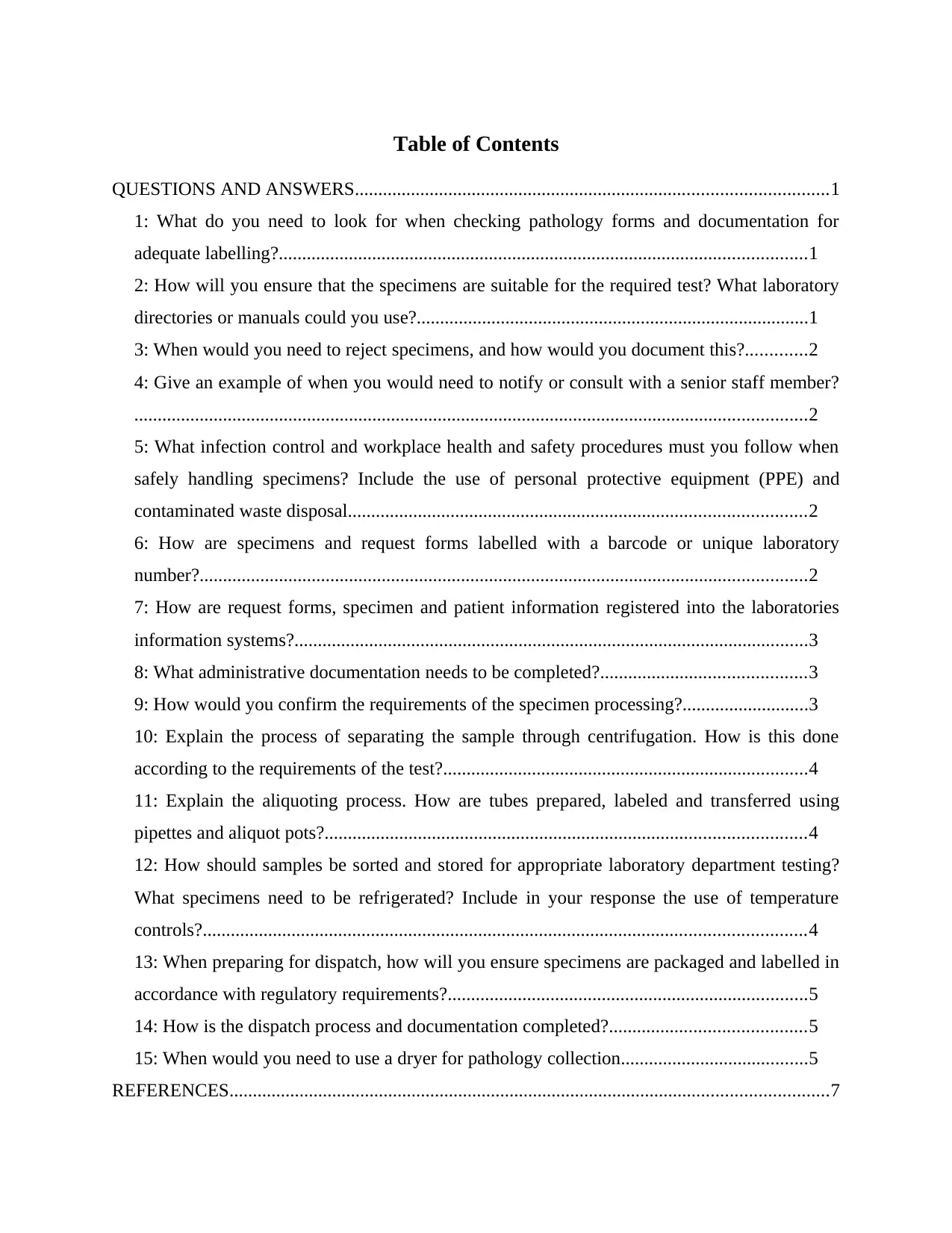
Table of Contents
QUESTIONS AND ANSWERS.....................................................................................................1
1: What do you need to look for when checking pathology forms and documentation for
adequate labelling?.................................................................................................................1
2: How will you ensure that the specimens are suitable for the required test? What laboratory
directories or manuals could you use?....................................................................................1
3: When would you need to reject specimens, and how would you document this?.............2
4: Give an example of when you would need to notify or consult with a senior staff member?
................................................................................................................................................2
5: What infection control and workplace health and safety procedures must you follow when
safely handling specimens? Include the use of personal protective equipment (PPE) and
contaminated waste disposal..................................................................................................2
6: How are specimens and request forms labelled with a barcode or unique laboratory
number?..................................................................................................................................2
7: How are request forms, specimen and patient information registered into the laboratories
information systems?..............................................................................................................3
8: What administrative documentation needs to be completed?............................................3
9: How would you confirm the requirements of the specimen processing?...........................3
10: Explain the process of separating the sample through centrifugation. How is this done
according to the requirements of the test?..............................................................................4
11: Explain the aliquoting process. How are tubes prepared, labeled and transferred using
pipettes and aliquot pots?.......................................................................................................4
12: How should samples be sorted and stored for appropriate laboratory department testing?
What specimens need to be refrigerated? Include in your response the use of temperature
controls?.................................................................................................................................4
13: When preparing for dispatch, how will you ensure specimens are packaged and labelled in
accordance with regulatory requirements?.............................................................................5
14: How is the dispatch process and documentation completed?..........................................5
15: When would you need to use a dryer for pathology collection........................................5
REFERENCES................................................................................................................................7
QUESTIONS AND ANSWERS.....................................................................................................1
1: What do you need to look for when checking pathology forms and documentation for
adequate labelling?.................................................................................................................1
2: How will you ensure that the specimens are suitable for the required test? What laboratory
directories or manuals could you use?....................................................................................1
3: When would you need to reject specimens, and how would you document this?.............2
4: Give an example of when you would need to notify or consult with a senior staff member?
................................................................................................................................................2
5: What infection control and workplace health and safety procedures must you follow when
safely handling specimens? Include the use of personal protective equipment (PPE) and
contaminated waste disposal..................................................................................................2
6: How are specimens and request forms labelled with a barcode or unique laboratory
number?..................................................................................................................................2
7: How are request forms, specimen and patient information registered into the laboratories
information systems?..............................................................................................................3
8: What administrative documentation needs to be completed?............................................3
9: How would you confirm the requirements of the specimen processing?...........................3
10: Explain the process of separating the sample through centrifugation. How is this done
according to the requirements of the test?..............................................................................4
11: Explain the aliquoting process. How are tubes prepared, labeled and transferred using
pipettes and aliquot pots?.......................................................................................................4
12: How should samples be sorted and stored for appropriate laboratory department testing?
What specimens need to be refrigerated? Include in your response the use of temperature
controls?.................................................................................................................................4
13: When preparing for dispatch, how will you ensure specimens are packaged and labelled in
accordance with regulatory requirements?.............................................................................5
14: How is the dispatch process and documentation completed?..........................................5
15: When would you need to use a dryer for pathology collection........................................5
REFERENCES................................................................................................................................7

⊘ This is a preview!⊘
Do you want full access?
Subscribe today to unlock all pages.

Trusted by 1+ million students worldwide
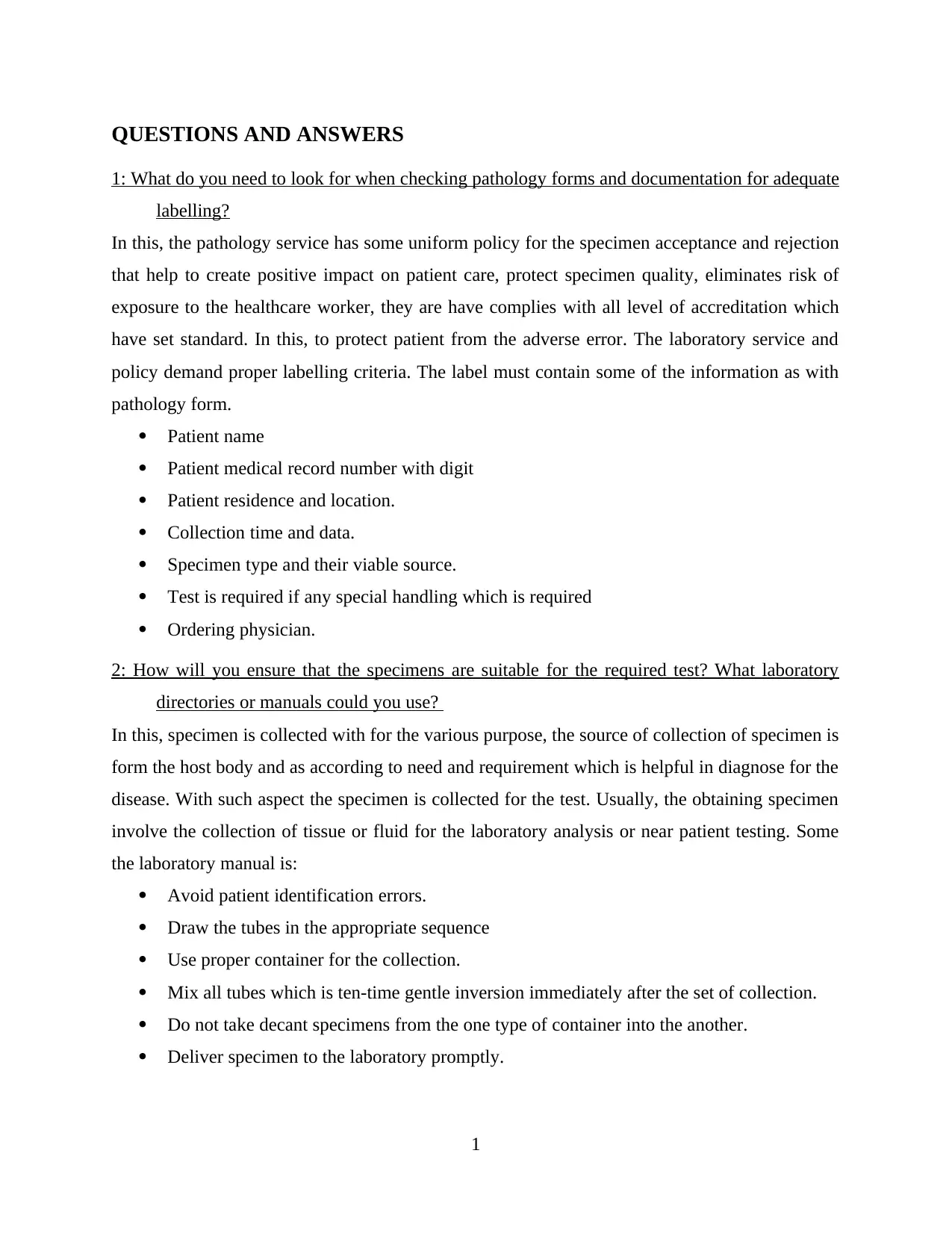
QUESTIONS AND ANSWERS
1: What do you need to look for when checking pathology forms and documentation for adequate
labelling?
In this, the pathology service has some uniform policy for the specimen acceptance and rejection
that help to create positive impact on patient care, protect specimen quality, eliminates risk of
exposure to the healthcare worker, they are have complies with all level of accreditation which
have set standard. In this, to protect patient from the adverse error. The laboratory service and
policy demand proper labelling criteria. The label must contain some of the information as with
pathology form.
Patient name
Patient medical record number with digit
Patient residence and location.
Collection time and data.
Specimen type and their viable source.
Test is required if any special handling which is required
Ordering physician.
2: How will you ensure that the specimens are suitable for the required test? What laboratory
directories or manuals could you use?
In this, specimen is collected with for the various purpose, the source of collection of specimen is
form the host body and as according to need and requirement which is helpful in diagnose for the
disease. With such aspect the specimen is collected for the test. Usually, the obtaining specimen
involve the collection of tissue or fluid for the laboratory analysis or near patient testing. Some
the laboratory manual is:
Avoid patient identification errors.
Draw the tubes in the appropriate sequence
Use proper container for the collection.
Mix all tubes which is ten-time gentle inversion immediately after the set of collection.
Do not take decant specimens from the one type of container into the another.
Deliver specimen to the laboratory promptly.
1
1: What do you need to look for when checking pathology forms and documentation for adequate
labelling?
In this, the pathology service has some uniform policy for the specimen acceptance and rejection
that help to create positive impact on patient care, protect specimen quality, eliminates risk of
exposure to the healthcare worker, they are have complies with all level of accreditation which
have set standard. In this, to protect patient from the adverse error. The laboratory service and
policy demand proper labelling criteria. The label must contain some of the information as with
pathology form.
Patient name
Patient medical record number with digit
Patient residence and location.
Collection time and data.
Specimen type and their viable source.
Test is required if any special handling which is required
Ordering physician.
2: How will you ensure that the specimens are suitable for the required test? What laboratory
directories or manuals could you use?
In this, specimen is collected with for the various purpose, the source of collection of specimen is
form the host body and as according to need and requirement which is helpful in diagnose for the
disease. With such aspect the specimen is collected for the test. Usually, the obtaining specimen
involve the collection of tissue or fluid for the laboratory analysis or near patient testing. Some
the laboratory manual is:
Avoid patient identification errors.
Draw the tubes in the appropriate sequence
Use proper container for the collection.
Mix all tubes which is ten-time gentle inversion immediately after the set of collection.
Do not take decant specimens from the one type of container into the another.
Deliver specimen to the laboratory promptly.
1
Paraphrase This Document
Need a fresh take? Get an instant paraphrase of this document with our AI Paraphraser
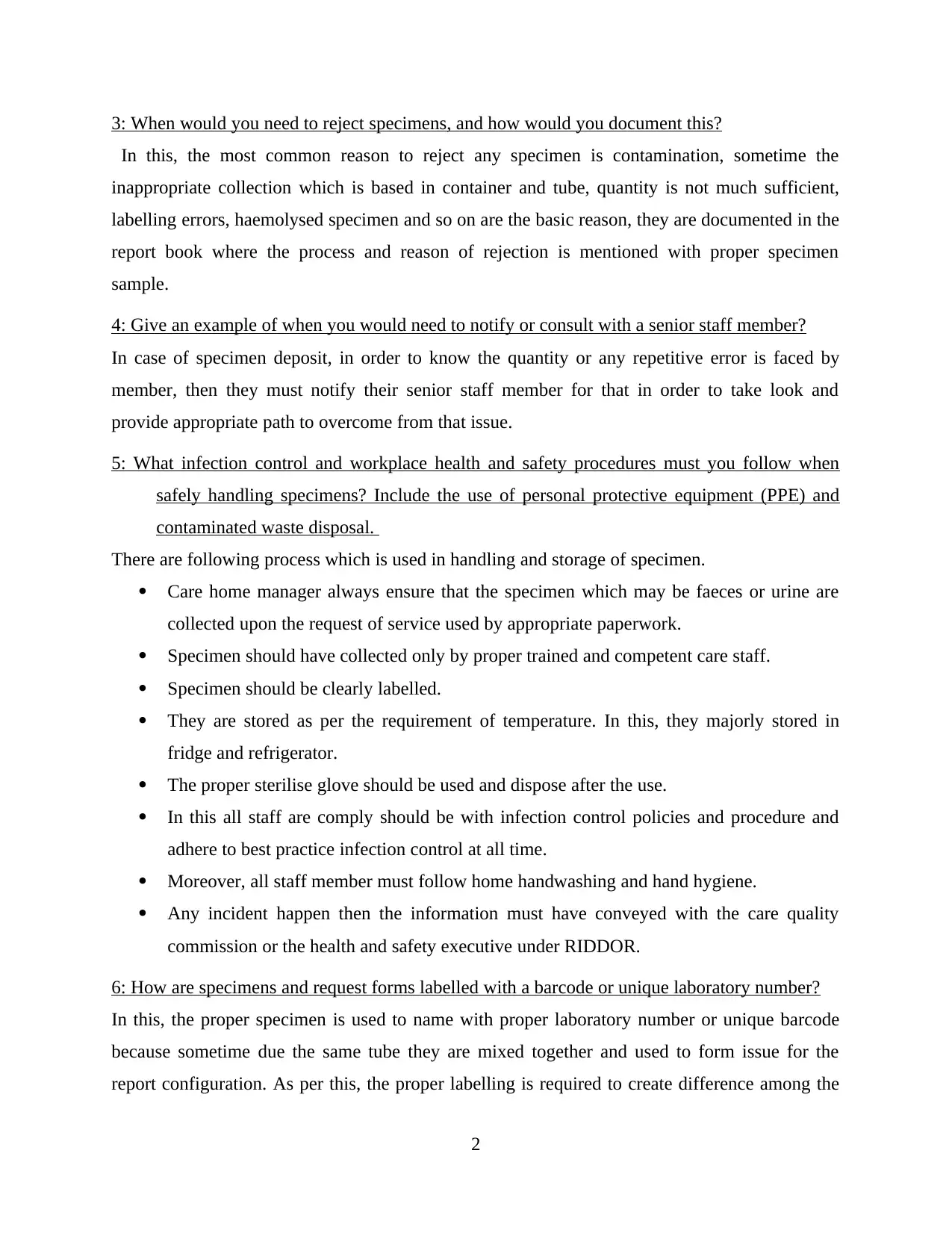
3: When would you need to reject specimens, and how would you document this?
In this, the most common reason to reject any specimen is contamination, sometime the
inappropriate collection which is based in container and tube, quantity is not much sufficient,
labelling errors, haemolysed specimen and so on are the basic reason, they are documented in the
report book where the process and reason of rejection is mentioned with proper specimen
sample.
4: Give an example of when you would need to notify or consult with a senior staff member?
In case of specimen deposit, in order to know the quantity or any repetitive error is faced by
member, then they must notify their senior staff member for that in order to take look and
provide appropriate path to overcome from that issue.
5: What infection control and workplace health and safety procedures must you follow when
safely handling specimens? Include the use of personal protective equipment (PPE) and
contaminated waste disposal.
There are following process which is used in handling and storage of specimen.
Care home manager always ensure that the specimen which may be faeces or urine are
collected upon the request of service used by appropriate paperwork.
Specimen should have collected only by proper trained and competent care staff.
Specimen should be clearly labelled.
They are stored as per the requirement of temperature. In this, they majorly stored in
fridge and refrigerator.
The proper sterilise glove should be used and dispose after the use.
In this all staff are comply should be with infection control policies and procedure and
adhere to best practice infection control at all time.
Moreover, all staff member must follow home handwashing and hand hygiene.
Any incident happen then the information must have conveyed with the care quality
commission or the health and safety executive under RIDDOR.
6: How are specimens and request forms labelled with a barcode or unique laboratory number?
In this, the proper specimen is used to name with proper laboratory number or unique barcode
because sometime due the same tube they are mixed together and used to form issue for the
report configuration. As per this, the proper labelling is required to create difference among the
2
In this, the most common reason to reject any specimen is contamination, sometime the
inappropriate collection which is based in container and tube, quantity is not much sufficient,
labelling errors, haemolysed specimen and so on are the basic reason, they are documented in the
report book where the process and reason of rejection is mentioned with proper specimen
sample.
4: Give an example of when you would need to notify or consult with a senior staff member?
In case of specimen deposit, in order to know the quantity or any repetitive error is faced by
member, then they must notify their senior staff member for that in order to take look and
provide appropriate path to overcome from that issue.
5: What infection control and workplace health and safety procedures must you follow when
safely handling specimens? Include the use of personal protective equipment (PPE) and
contaminated waste disposal.
There are following process which is used in handling and storage of specimen.
Care home manager always ensure that the specimen which may be faeces or urine are
collected upon the request of service used by appropriate paperwork.
Specimen should have collected only by proper trained and competent care staff.
Specimen should be clearly labelled.
They are stored as per the requirement of temperature. In this, they majorly stored in
fridge and refrigerator.
The proper sterilise glove should be used and dispose after the use.
In this all staff are comply should be with infection control policies and procedure and
adhere to best practice infection control at all time.
Moreover, all staff member must follow home handwashing and hand hygiene.
Any incident happen then the information must have conveyed with the care quality
commission or the health and safety executive under RIDDOR.
6: How are specimens and request forms labelled with a barcode or unique laboratory number?
In this, the proper specimen is used to name with proper laboratory number or unique barcode
because sometime due the same tube they are mixed together and used to form issue for the
report configuration. As per this, the proper labelling is required to create difference among the
2
specimen. Specimen need to be properly labelled at the time of collection by using the patient
which is based on identification as per the administering the patient test. However, patient must
be focused on the medication container which is being labelled to ensure it is correct and correct
test.
7: How are request forms, specimen and patient information registered into the laboratories
information systems?
In this, the request form is used to fill, with proper laboratory number to the unique barcode the
patient information is being registered in the laboratories information system. As per this, the
main advantage of laboratories information system is to reduce the clerical work, better
evaluation of workload and also beneficial for the faster communication, in this, the proper
improvement of information which is provided to clinical services.
8: What administrative documentation needs to be completed?
Each of the package has contained line list which have some of the valuable information which is
included with the specimen. Moreover, while taking the documentation for the administration
some of the information must include which is essential for the documentation such as patient
name, ID number, data collected, specimen type, clinical contact name and phone number. This
is primary detail which is needed and required by administrative member. As per this, the
submitter contact name, affiliation, phone number and with the current the email address is also
needed in documentation.
9: How would you confirm the requirements of the specimen processing?
In this, some of the specimen processing step include:
Avoid patient identification error: In this, use at least two patient identifiers while
administering medication, blood or the component of blood. Moreover, label the
container which is used for the blood and other specimens in the occurrence of patient.
Draw the tubes in the proper sequence: As per this, there are multiple of tubes which is
drawn from the single venepuncture by using the evacuated system. In this, the
predominant order of draw is blood culture, coagulation of tube, serum tube with or
without the activator which is associated with clot. Heparin tube is also available with or
without the plasma separator.
Use of proper container for the collection of specimen
3
which is based on identification as per the administering the patient test. However, patient must
be focused on the medication container which is being labelled to ensure it is correct and correct
test.
7: How are request forms, specimen and patient information registered into the laboratories
information systems?
In this, the request form is used to fill, with proper laboratory number to the unique barcode the
patient information is being registered in the laboratories information system. As per this, the
main advantage of laboratories information system is to reduce the clerical work, better
evaluation of workload and also beneficial for the faster communication, in this, the proper
improvement of information which is provided to clinical services.
8: What administrative documentation needs to be completed?
Each of the package has contained line list which have some of the valuable information which is
included with the specimen. Moreover, while taking the documentation for the administration
some of the information must include which is essential for the documentation such as patient
name, ID number, data collected, specimen type, clinical contact name and phone number. This
is primary detail which is needed and required by administrative member. As per this, the
submitter contact name, affiliation, phone number and with the current the email address is also
needed in documentation.
9: How would you confirm the requirements of the specimen processing?
In this, some of the specimen processing step include:
Avoid patient identification error: In this, use at least two patient identifiers while
administering medication, blood or the component of blood. Moreover, label the
container which is used for the blood and other specimens in the occurrence of patient.
Draw the tubes in the proper sequence: As per this, there are multiple of tubes which is
drawn from the single venepuncture by using the evacuated system. In this, the
predominant order of draw is blood culture, coagulation of tube, serum tube with or
without the activator which is associated with clot. Heparin tube is also available with or
without the plasma separator.
Use of proper container for the collection of specimen
3
⊘ This is a preview!⊘
Do you want full access?
Subscribe today to unlock all pages.
Trusted by 1+ million students worldwide
Mix all the tubes which is ten times gentle inversion which is follow up the immediate
after the collection and gathering
Do not decant the specimen from the same type of container into the other container.
In this, with the attention try to deliver the specimen in the laboratory promptly.
10: Explain the process of separating the sample through centrifugation. How is this done
according to the requirements of the test?
A centrifuge usually works by using the principle of the sedimentation which is under the
influence of the gravitational force which is based on the g-force which is based on the various
substance which must separate according to their base of density. In this, different type of
separation is unknown which they are include isopycnic, ultrafiltration, density gradient phase
separation and pelleting. Whereas, the centrifugation is defined as mechanical process which is
basically involve in the use of centrifugal force which has been separated particle from the core
of solution which is based upon the size, shape, density and medium.
11: Explain the aliquoting process. How are tubes prepared, labeled and transferred using
pipettes and aliquot pots?
Aliquoting is defined as the process of removal of serum plasma from the whole blood product.
In this, the tubes are filled with the sample and they are labelled with their quantity and their
barcode if this process is available or the use of frequent laboratory number is also available. As
per this, the pipette which is sterilise is applicable for the removal of the transfer of fluid from
one place to others. In this, the aliquots pots are also beneficial for the transfer of fluid from the
one place to another. This is helpful for the transferring of serum and other material.
12: How should samples be sorted and stored for appropriate laboratory department testing?
What specimens need to be refrigerated? Include in your response the use of temperature
controls?
In this, sample is being sorted on the basis of alphabet or the quantity it depends on the choice of
staff and they stored as according to newest and oldest one on the laboratory. In this, the blood
and other specimen which is not required cold place for the storage is being kept in the
refrigerator. Moreover, most of the clinical material are held for the several hours which is in
refrigerator before the culturing if it is cannot be processes immediately. This is based on the
4
after the collection and gathering
Do not decant the specimen from the same type of container into the other container.
In this, with the attention try to deliver the specimen in the laboratory promptly.
10: Explain the process of separating the sample through centrifugation. How is this done
according to the requirements of the test?
A centrifuge usually works by using the principle of the sedimentation which is under the
influence of the gravitational force which is based on the g-force which is based on the various
substance which must separate according to their base of density. In this, different type of
separation is unknown which they are include isopycnic, ultrafiltration, density gradient phase
separation and pelleting. Whereas, the centrifugation is defined as mechanical process which is
basically involve in the use of centrifugal force which has been separated particle from the core
of solution which is based upon the size, shape, density and medium.
11: Explain the aliquoting process. How are tubes prepared, labeled and transferred using
pipettes and aliquot pots?
Aliquoting is defined as the process of removal of serum plasma from the whole blood product.
In this, the tubes are filled with the sample and they are labelled with their quantity and their
barcode if this process is available or the use of frequent laboratory number is also available. As
per this, the pipette which is sterilise is applicable for the removal of the transfer of fluid from
one place to others. In this, the aliquots pots are also beneficial for the transfer of fluid from the
one place to another. This is helpful for the transferring of serum and other material.
12: How should samples be sorted and stored for appropriate laboratory department testing?
What specimens need to be refrigerated? Include in your response the use of temperature
controls?
In this, sample is being sorted on the basis of alphabet or the quantity it depends on the choice of
staff and they stored as according to newest and oldest one on the laboratory. In this, the blood
and other specimen which is not required cold place for the storage is being kept in the
refrigerator. Moreover, most of the clinical material are held for the several hours which is in
refrigerator before the culturing if it is cannot be processes immediately. This is based on the
4
Paraphrase This Document
Need a fresh take? Get an instant paraphrase of this document with our AI Paraphraser
particular aspect which have various type such as urine, sputum and material on swabs are
especially taken from the variety of source.
13: When preparing for dispatch, how will you ensure specimens are packaged and labelled in
accordance with regulatory requirements?
Packaging: In this, primary container for all the specimens must be a leak proof and must contain
the patients name and medical record number. Each specimen must be placed inside the
secondary container which is for transport. In this, the secondary container is must seal with
some kind of lock which is based on the zip. As per this, the blood and blood component or the
blood product which has been labelled as to their content and have been released for essential
aspect of transfusion and other use which is exempted from the requirement.
Transports:
Use specially padded carriers only.
Do not overload.
Ensure which help to containers and transport bags which is securely sealed.
Ensure that the latch of the carrier is used to securely closed.
Do not use the tube system which is based on the specimen form the patient with
some of the known or the determined with the suspected or other prion disease.
Delivery of the specimen directly to the laboratory.
14: How is the dispatch process and documentation completed?
The dispatch process is defined as that when the specimen on the line in form of ready for
the dispatch. Once the dispatch specimen is received, the order, signed and total name with the
transported factor is notified in the report and then the process is taken. As per this, the chance of
the error in less because they have minimum paperwork because the sample are already
documented.
15: When would you need to use a dryer for pathology collection
Basically the use of dryer in pathology collection is because for doing the specimen low in
temperature and also compress by using the dryer. As per this, it is also helpful to dry the fluid
because as per the requirement of processing some the fluid need in viscus form.
5
especially taken from the variety of source.
13: When preparing for dispatch, how will you ensure specimens are packaged and labelled in
accordance with regulatory requirements?
Packaging: In this, primary container for all the specimens must be a leak proof and must contain
the patients name and medical record number. Each specimen must be placed inside the
secondary container which is for transport. In this, the secondary container is must seal with
some kind of lock which is based on the zip. As per this, the blood and blood component or the
blood product which has been labelled as to their content and have been released for essential
aspect of transfusion and other use which is exempted from the requirement.
Transports:
Use specially padded carriers only.
Do not overload.
Ensure which help to containers and transport bags which is securely sealed.
Ensure that the latch of the carrier is used to securely closed.
Do not use the tube system which is based on the specimen form the patient with
some of the known or the determined with the suspected or other prion disease.
Delivery of the specimen directly to the laboratory.
14: How is the dispatch process and documentation completed?
The dispatch process is defined as that when the specimen on the line in form of ready for
the dispatch. Once the dispatch specimen is received, the order, signed and total name with the
transported factor is notified in the report and then the process is taken. As per this, the chance of
the error in less because they have minimum paperwork because the sample are already
documented.
15: When would you need to use a dryer for pathology collection
Basically the use of dryer in pathology collection is because for doing the specimen low in
temperature and also compress by using the dryer. As per this, it is also helpful to dry the fluid
because as per the requirement of processing some the fluid need in viscus form.
5

6
⊘ This is a preview!⊘
Do you want full access?
Subscribe today to unlock all pages.
Trusted by 1+ million students worldwide
REFERENCES
Books and Journals
Burrows, A Holman, J & Parsons, A, 2017, ‘Chemistry³: Introducing inorganic, organic and
physical chemistry’, 3rd edn, pp.542-581.
Dearden, J 2003, ‘Quantitative structure-property relationships for prediction of boiling point,
vapor pressure, and melting point’, Environmental Toxicology and Chemistry, viewed 9
August 2021
Lewis, B 2015, ‘Intermolecular forces learning objectives: learn to identify and explain the three
types of intermolecular forces: Van der Waals permanent, viewed 11 August
2021,<https://slideplayer.com/slide/6612984/>
Rumble, John (ed.), 2021, CRC Handbook of Chemistry and Physics, 102nd edition (Internet
Version). 102nd edn. CRC Press/Taylor and Francis, Boca Raton USA. Physical
Constants of Organic Compound viewed 6 August 2021.
Struyf, J (ed.), 2011, An analytical approach for relating boiling points of mono functional
organic compounds to intermolecular forces, Journal of Chemical Education, vol. 87. pp.
923-935.
7
Books and Journals
Burrows, A Holman, J & Parsons, A, 2017, ‘Chemistry³: Introducing inorganic, organic and
physical chemistry’, 3rd edn, pp.542-581.
Dearden, J 2003, ‘Quantitative structure-property relationships for prediction of boiling point,
vapor pressure, and melting point’, Environmental Toxicology and Chemistry, viewed 9
August 2021
Lewis, B 2015, ‘Intermolecular forces learning objectives: learn to identify and explain the three
types of intermolecular forces: Van der Waals permanent, viewed 11 August
2021,<https://slideplayer.com/slide/6612984/>
Rumble, John (ed.), 2021, CRC Handbook of Chemistry and Physics, 102nd edition (Internet
Version). 102nd edn. CRC Press/Taylor and Francis, Boca Raton USA. Physical
Constants of Organic Compound viewed 6 August 2021.
Struyf, J (ed.), 2011, An analytical approach for relating boiling points of mono functional
organic compounds to intermolecular forces, Journal of Chemical Education, vol. 87. pp.
923-935.
7
Paraphrase This Document
Need a fresh take? Get an instant paraphrase of this document with our AI Paraphraser

8

1 out of 11


Related Documents


Your All-in-One AI-Powered Toolkit for Academic Success.
+13062052269
info@desklib.com
Available 24*7 on WhatsApp / Email
![[object Object]](/_next/static/media/star-bottom.7253800d.svg)
Unlock your academic potential
Copyright © 2020–2026 A2Z Services. All Rights Reserved. Developed and managed by ZUCOL.