Speculative Architecture: History, Advantages, Disadvantages Analysis
VerifiedAdded on 2023/06/13
|47
|12386
|344
Essay
AI Summary
This essay examines speculative architecture, tracing its history from the 1960s to the present day. It begins by defining speculation in the context of architecture, contrasting it with traditional vernacular and modern architectural practices. The essay highlights key figures and movements, such as Frank Lloyd Wright, Richard Buckminster Fuller, and Archigram, while also discussing examples from film and technology. It explores the shift from viewing architecture as permanent structures to flexible, temporary designs, and analyzes the role of speculative architecture in addressing real-world problems versus serving as expressions of architectural ego. The essay further discusses megastructures, NASA's space colony vision, and alternative design presentations, ultimately questioning whether speculative architecture represents a new utopia or a design practice for the 21st century. The document is contributed by a student to be published on the website Desklib. Desklib is a platform which provides all the necessary AI based study tools for students.
Contents
ABSTRACT..............................................................................................................................................2
INTRODUCTION.....................................................................................................................................3
What is speculation?.........................................................................................................................4
Vernacular Architecture....................................................................................................................4
What is the difference between the Traditional Architecture practice and Speculative
Architecture?.....................................................................................................................................5
CHAPTER1: HISTORY OF SPECULATIVE ARCHITECTURE.........................................................................7
Frank Lloyd Wright-1954...................................................................................................................7
Richard Buckminster-1960.................................................................................................................8
Archigram – 1960-2003.....................................................................................................................8
Victor Gruen-1961.............................................................................................................................9
Sir Clive Sinclair’s electric trike-1983...............................................................................................10
I, Robot (2004).................................................................................................................................10
Where the City Can’t See- Liam Young – 2017.................................................................................11
CHAPTER 2: WHY SHOULD SPECULATIVE ARCHITECTS TELL STORIES?................................................22
Organisational structures:...............................................................................................................25
Megastructures...............................................................................................................................30
NASA’s vision of a Space Colony......................................................................................................36
Speculating through Design: a question instead of an answer........................................................41
`Alternative presentations and speculative futures by Auger..........................................................42
Design Practice for the 21st Century or even a new Utopia?..........................................................43
Conclusion...........................................................................................................................................44
References...........................................................................................................................................46
ABSTRACT..............................................................................................................................................2
INTRODUCTION.....................................................................................................................................3
What is speculation?.........................................................................................................................4
Vernacular Architecture....................................................................................................................4
What is the difference between the Traditional Architecture practice and Speculative
Architecture?.....................................................................................................................................5
CHAPTER1: HISTORY OF SPECULATIVE ARCHITECTURE.........................................................................7
Frank Lloyd Wright-1954...................................................................................................................7
Richard Buckminster-1960.................................................................................................................8
Archigram – 1960-2003.....................................................................................................................8
Victor Gruen-1961.............................................................................................................................9
Sir Clive Sinclair’s electric trike-1983...............................................................................................10
I, Robot (2004).................................................................................................................................10
Where the City Can’t See- Liam Young – 2017.................................................................................11
CHAPTER 2: WHY SHOULD SPECULATIVE ARCHITECTS TELL STORIES?................................................22
Organisational structures:...............................................................................................................25
Megastructures...............................................................................................................................30
NASA’s vision of a Space Colony......................................................................................................36
Speculating through Design: a question instead of an answer........................................................41
`Alternative presentations and speculative futures by Auger..........................................................42
Design Practice for the 21st Century or even a new Utopia?..........................................................43
Conclusion...........................................................................................................................................44
References...........................................................................................................................................46

Paraphrase This Document
Need a fresh take? Get an instant paraphrase of this document with our AI Paraphraser
ABSTRACT
Architecture and design is broadening from the ancient design and building of structures and
buildings to explaining and exploring the reasons for various changes experienced in the
cities. Architects have turned to be storytellers, explaining the various phenomena and their
anticipated impacts. Megastructure is a fundamental notion in speculative architecture and
design. This is in contravention of the traditional architecture which defines massive,
continuous and big buildings. Speculative design which is an aspect of speculative
architecture implores design aligned to the most desirable futures while ignoring those that
are least admirable. This dissertation aims to look at the history of speculative architecture
and the advantages and disadvantages of those unbuilt drawings. It will also focus on what is
speculation today and also discusses the work of some famous speculative architects today
and also the critical thinking on other fields like movies, design fashion design technology.
The additional study might be undertaken to determine various other factors to understand,
the role of speculative in design.
Architecture and design is broadening from the ancient design and building of structures and
buildings to explaining and exploring the reasons for various changes experienced in the
cities. Architects have turned to be storytellers, explaining the various phenomena and their
anticipated impacts. Megastructure is a fundamental notion in speculative architecture and
design. This is in contravention of the traditional architecture which defines massive,
continuous and big buildings. Speculative design which is an aspect of speculative
architecture implores design aligned to the most desirable futures while ignoring those that
are least admirable. This dissertation aims to look at the history of speculative architecture
and the advantages and disadvantages of those unbuilt drawings. It will also focus on what is
speculation today and also discusses the work of some famous speculative architects today
and also the critical thinking on other fields like movies, design fashion design technology.
The additional study might be undertaken to determine various other factors to understand,
the role of speculative in design.
INTRODUCTION
The first time the word Speculative Architecture became a topic of the critic when Bruce
Sterling coined the “Architectural Fiction” in 2006. He was referring of course to Speculative
comes within which Architects uses concepts for the designed atmosphere to specific
themselves in a very manner that analogous to how the story was telling use words, it’s a long
Architectural tradition. Sterling cities the polemic work of the 1960’s British group
Archigram, the canon includes Lebbeus wood's drawing from the two decades that followed
and Greg Lynn’s digital imagining.
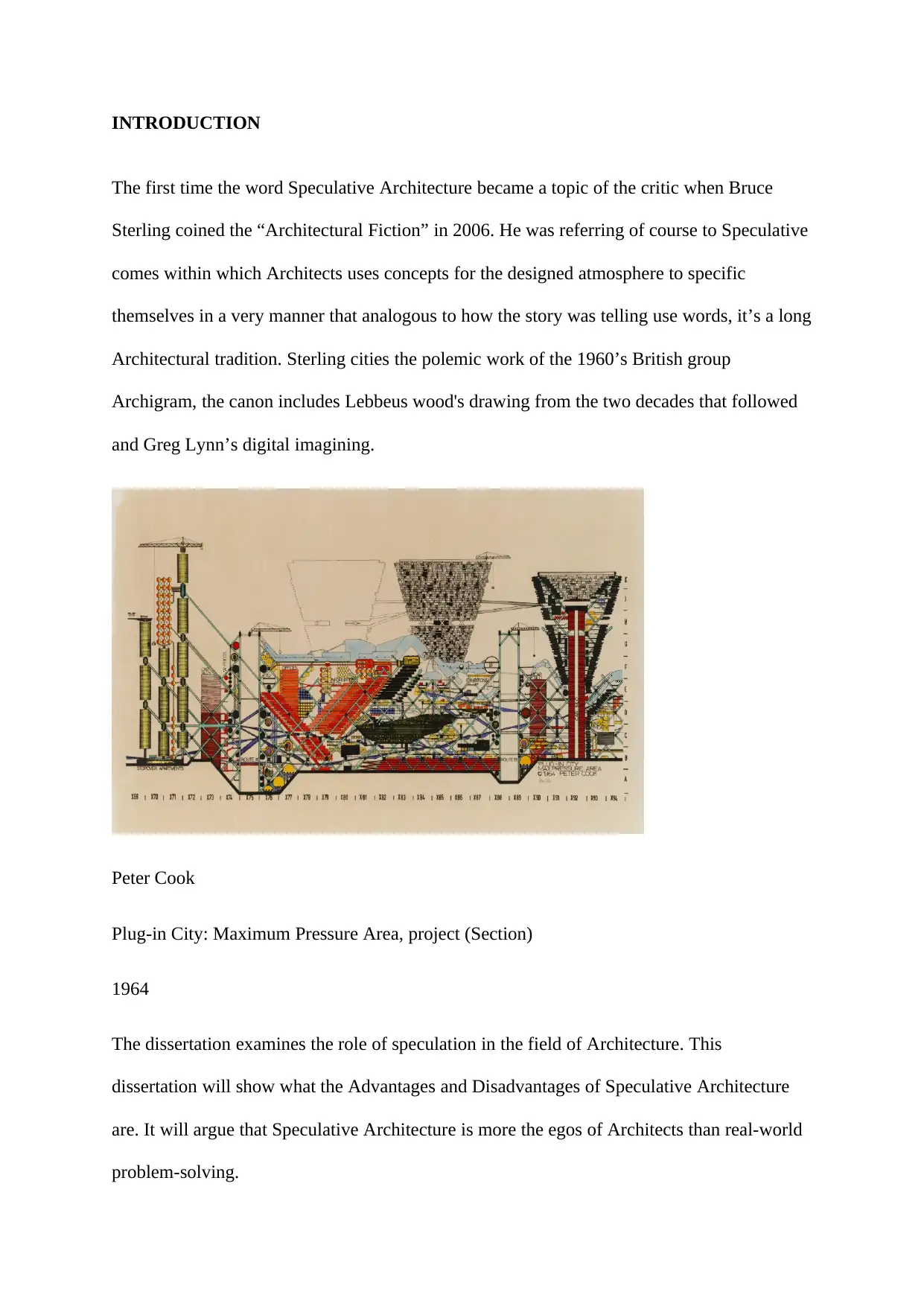
Peter Cook
Plug-in City: Maximum Pressure Area, project (Section)
1964
The dissertation examines the role of speculation in the field of Architecture. This
dissertation will show what the Advantages and Disadvantages of Speculative Architecture
are. It will argue that Speculative Architecture is more the egos of Architects than real-world
problem-solving.
The first time the word Speculative Architecture became a topic of the critic when Bruce
Sterling coined the “Architectural Fiction” in 2006. He was referring of course to Speculative
comes within which Architects uses concepts for the designed atmosphere to specific
themselves in a very manner that analogous to how the story was telling use words, it’s a long
Architectural tradition. Sterling cities the polemic work of the 1960’s British group
Archigram, the canon includes Lebbeus wood's drawing from the two decades that followed
and Greg Lynn’s digital imagining.
Peter Cook
Plug-in City: Maximum Pressure Area, project (Section)
1964
The dissertation examines the role of speculation in the field of Architecture. This
dissertation will show what the Advantages and Disadvantages of Speculative Architecture
are. It will argue that Speculative Architecture is more the egos of Architects than real-world
problem-solving.
⊘ This is a preview!⊘
Do you want full access?
Subscribe today to unlock all pages.

Trusted by 1+ million students worldwide
What is speculation?
The word speculation is contextual and its used changed and dependent on the context with
which it appear for example it is used by Stockbrokers in a certain way as well as a gossiping
place in some other places. Before I discuss speculative Architecture, I would like to see what
Traditional Architecture practice is (Johnson, 2016, p.134).
Traditional architecture practice: Here the traditional architecture practice means the
architecture from vernacular architecture to modern architecture.
Vernacular Architecture
Architecture, this particular term has Associate within nursing big inventive within itself.
After we pick up the term, a photo of actual physical framework flashes within the mind of
ours. Essential to the identity of any land in the design heritage of its, pairing Modern as well
as vernacular Architecture design or maybe item of this blend somewhere between splendid
Modern and Vernacular Architecture.
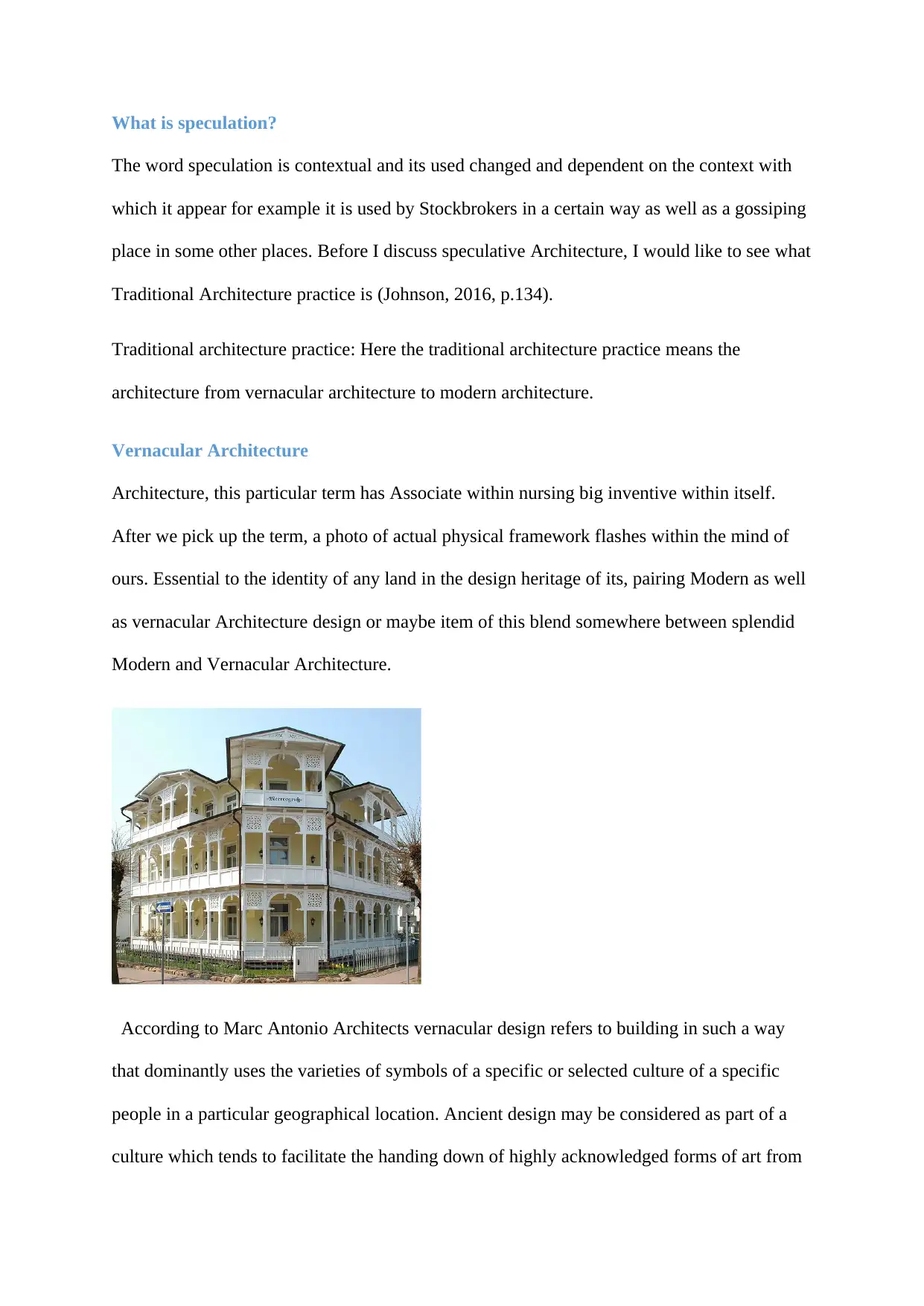
According to Marc Antonio Architects vernacular design refers to building in such a way
that dominantly uses the varieties of symbols of a specific or selected culture of a specific
people in a particular geographical location. Ancient design may be considered as part of a
culture which tends to facilitate the handing down of highly acknowledged forms of art from
The word speculation is contextual and its used changed and dependent on the context with
which it appear for example it is used by Stockbrokers in a certain way as well as a gossiping
place in some other places. Before I discuss speculative Architecture, I would like to see what
Traditional Architecture practice is (Johnson, 2016, p.134).
Traditional architecture practice: Here the traditional architecture practice means the
architecture from vernacular architecture to modern architecture.
Vernacular Architecture
Architecture, this particular term has Associate within nursing big inventive within itself.
After we pick up the term, a photo of actual physical framework flashes within the mind of
ours. Essential to the identity of any land in the design heritage of its, pairing Modern as well
as vernacular Architecture design or maybe item of this blend somewhere between splendid
Modern and Vernacular Architecture.
According to Marc Antonio Architects vernacular design refers to building in such a way
that dominantly uses the varieties of symbols of a specific or selected culture of a specific
people in a particular geographical location. Ancient design may be considered as part of a
culture which tends to facilitate the handing down of highly acknowledged forms of art from
Paraphrase This Document
Need a fresh take? Get an instant paraphrase of this document with our AI Paraphraser
one generation to another (Latham, 2014, p.198). Vernacular design served to be
communicative of the core values of a people as well as their principles through their types
and aesthetics to the future
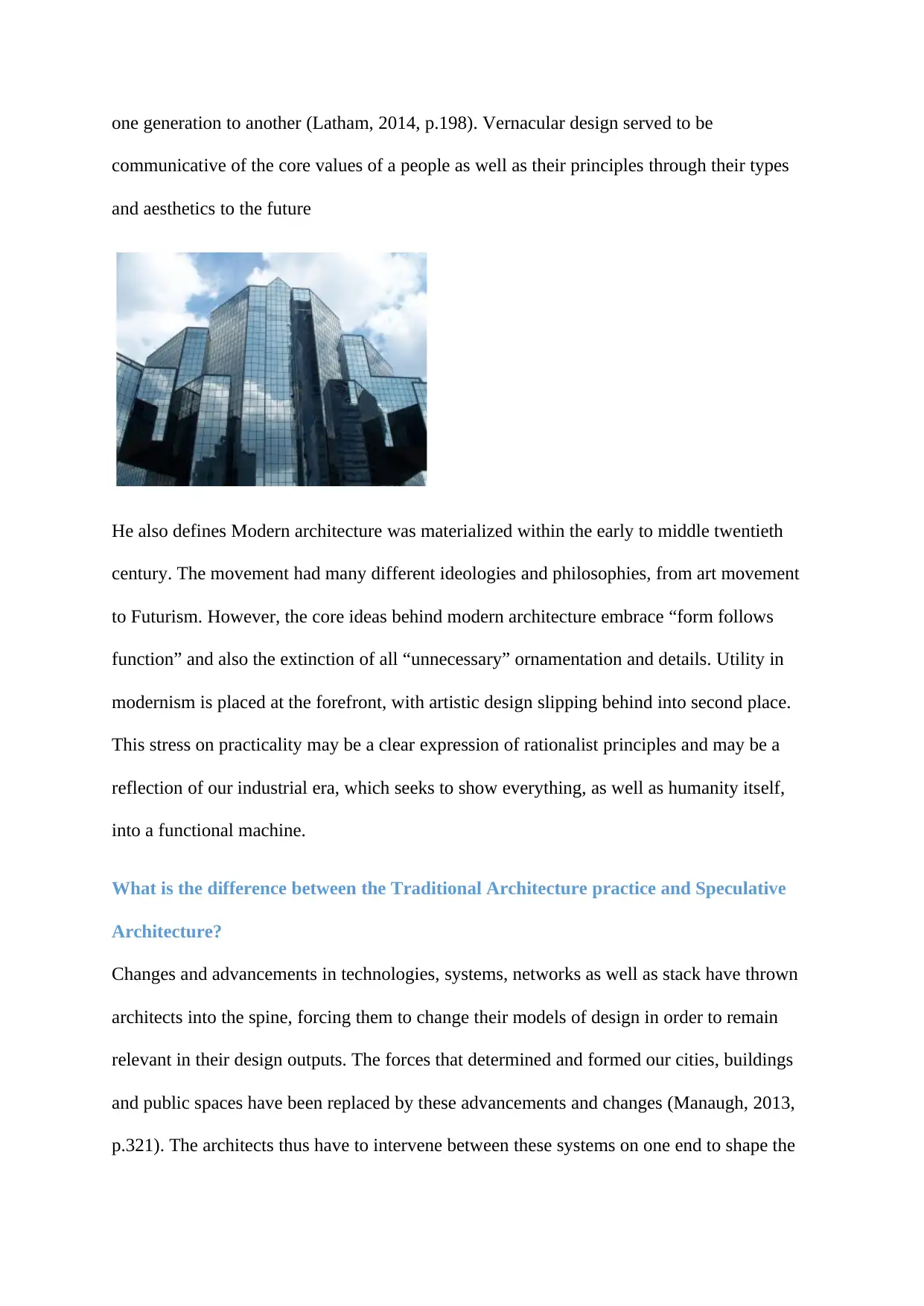
He also defines Modern architecture was materialized within the early to middle twentieth
century. The movement had many different ideologies and philosophies, from art movement
to Futurism. However, the core ideas behind modern architecture embrace “form follows
function” and also the extinction of all “unnecessary” ornamentation and details. Utility in
modernism is placed at the forefront, with artistic design slipping behind into second place.
This stress on practicality may be a clear expression of rationalist principles and may be a
reflection of our industrial era, which seeks to show everything, as well as humanity itself,
into a functional machine.
What is the difference between the Traditional Architecture practice and Speculative
Architecture?
Changes and advancements in technologies, systems, networks as well as stack have thrown
architects into the spine, forcing them to change their models of design in order to remain
relevant in their design outputs. The forces that determined and formed our cities, buildings
and public spaces have been replaced by these advancements and changes (Manaugh, 2013,
p.321). The architects thus have to intervene between these systems on one end to shape the
communicative of the core values of a people as well as their principles through their types
and aesthetics to the future
He also defines Modern architecture was materialized within the early to middle twentieth
century. The movement had many different ideologies and philosophies, from art movement
to Futurism. However, the core ideas behind modern architecture embrace “form follows
function” and also the extinction of all “unnecessary” ornamentation and details. Utility in
modernism is placed at the forefront, with artistic design slipping behind into second place.
This stress on practicality may be a clear expression of rationalist principles and may be a
reflection of our industrial era, which seeks to show everything, as well as humanity itself,
into a functional machine.
What is the difference between the Traditional Architecture practice and Speculative
Architecture?
Changes and advancements in technologies, systems, networks as well as stack have thrown
architects into the spine, forcing them to change their models of design in order to remain
relevant in their design outputs. The forces that determined and formed our cities, buildings
and public spaces have been replaced by these advancements and changes (Manaugh, 2013,
p.321). The architects thus have to intervene between these systems on one end to shape the
physical building. This involves telling stories about buildings and cities as opposed to
making the very buildings and cities. Speculative architecture is about making narrations ion
how cities and buildings operate and speculative architects largely generate stories explaining
how the cities and buildings operate, the new technologies and their influence on the
community, culture and space. They are tasked with locating the places of existence of new
forms of technology within the contexts of the cities which have experienced changes and
transformations due to these developments. These're speculative tasks which haven't been
legitimized within the profession. However, structure entails an extended heritage of unbuilt
comes in case we are likely to carry a look at the timeline of speculative tasks arrives around
the globe.
making the very buildings and cities. Speculative architecture is about making narrations ion
how cities and buildings operate and speculative architects largely generate stories explaining
how the cities and buildings operate, the new technologies and their influence on the
community, culture and space. They are tasked with locating the places of existence of new
forms of technology within the contexts of the cities which have experienced changes and
transformations due to these developments. These're speculative tasks which haven't been
legitimized within the profession. However, structure entails an extended heritage of unbuilt
comes in case we are likely to carry a look at the timeline of speculative tasks arrives around
the globe.
⊘ This is a preview!⊘
Do you want full access?
Subscribe today to unlock all pages.
Trusted by 1+ million students worldwide
CHAPTER1: HISTORY OF SPECULATIVE ARCHITECTURE
Since the 1960s, a variety of irreverent ‘speculative designers’ started Working against the
homogenizing interests of massive business these ‘speculative designers’ have explored the
potential of such emancipated observe. Their activities are unit typified by a liberated
approach to the outcome or product. They are released to use style instead of as an inquiry
tool – a vehicle to unlock new ideas instead of new markets Free from the duty to supply
some commercially viable ‘thing.’
Frank Lloyd Wright-1954
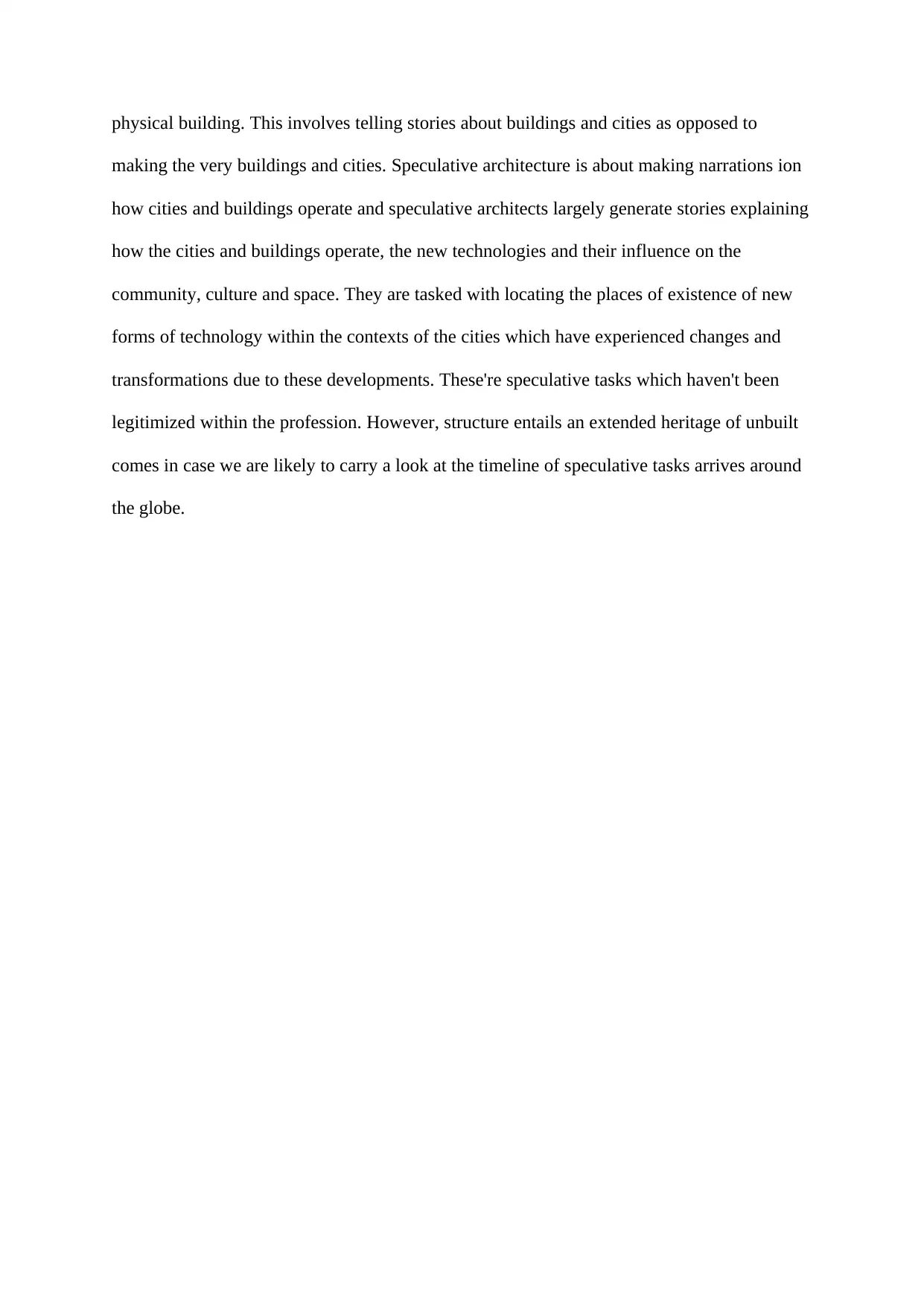
A dream city was one of the final ideas of Lloyd Wright. Ellis Island was a prediction of the
key to freedom as well as an opportunity to respond to numerous little questions that were
desired to make the greatest out of the name of Wright (Trezise, 2014, p.451). Regardless of
the then prevailing challenging circumstances, a declaration was made to construct what is
currently the defunct immigration center by Damon and Doudt firm, a highly self-contained
city of the future which was designed by the late Frank Wright. The construction of the city
was estimated to be $100,000,000 which is about $810,374,172.19 at the current value of the
dollar.
Since the 1960s, a variety of irreverent ‘speculative designers’ started Working against the
homogenizing interests of massive business these ‘speculative designers’ have explored the
potential of such emancipated observe. Their activities are unit typified by a liberated
approach to the outcome or product. They are released to use style instead of as an inquiry
tool – a vehicle to unlock new ideas instead of new markets Free from the duty to supply
some commercially viable ‘thing.’
Frank Lloyd Wright-1954
A dream city was one of the final ideas of Lloyd Wright. Ellis Island was a prediction of the
key to freedom as well as an opportunity to respond to numerous little questions that were
desired to make the greatest out of the name of Wright (Trezise, 2014, p.451). Regardless of
the then prevailing challenging circumstances, a declaration was made to construct what is
currently the defunct immigration center by Damon and Doudt firm, a highly self-contained
city of the future which was designed by the late Frank Wright. The construction of the city
was estimated to be $100,000,000 which is about $810,374,172.19 at the current value of the
dollar.
Paraphrase This Document
Need a fresh take? Get an instant paraphrase of this document with our AI Paraphraser
Richard Buckminster-1960
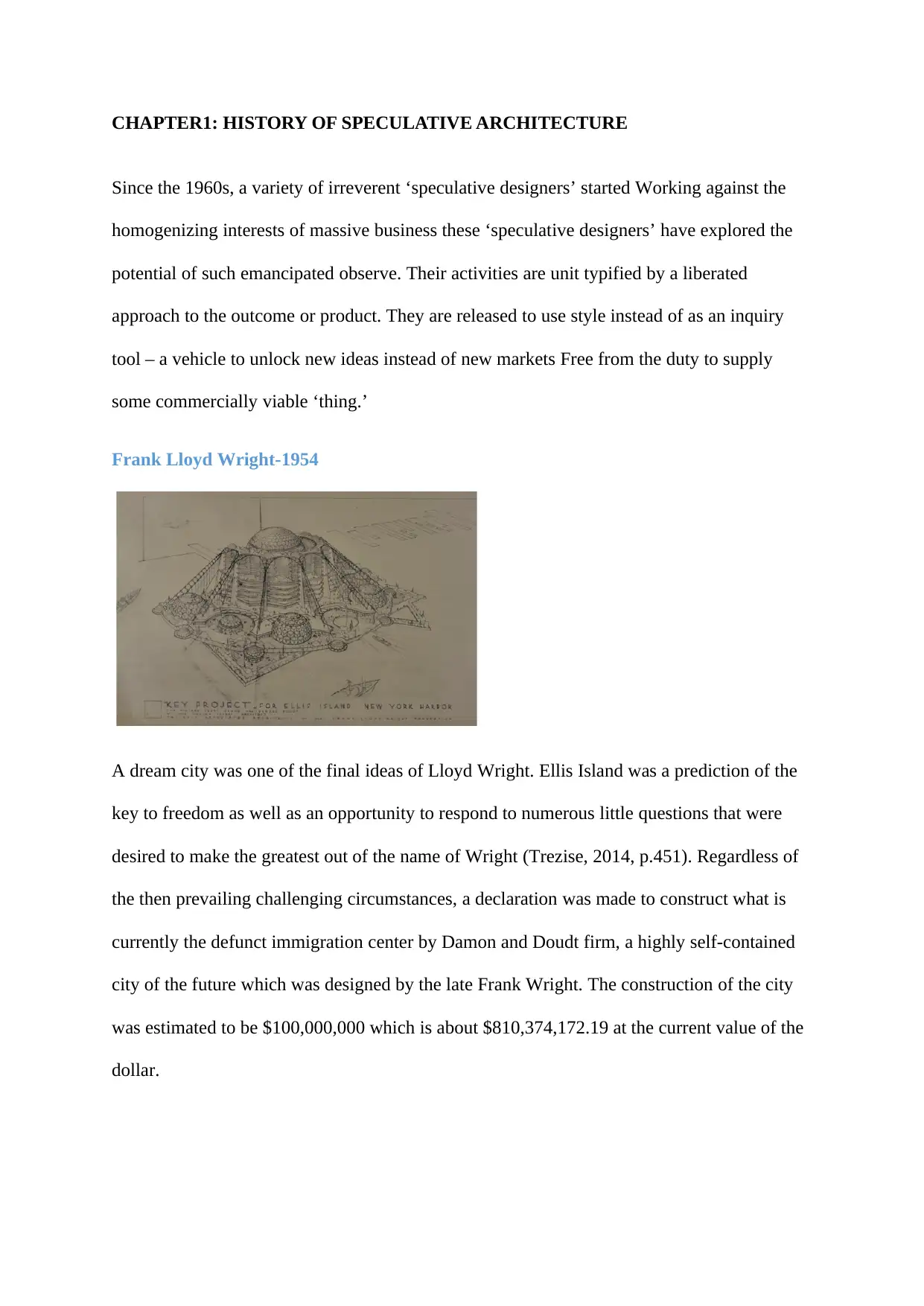
Plans by architect, systems intellect, author, designer and artificer Richard Buckminster
Fuller represented a three-kilometre (1.864-mile) dome spanning Midtown Manhattan It
sounds utterly absurd now, however within the time, engineers and futurists hoped to cover
Midtown Manhattan with a large dome. With the aim of control weather and reducing
pollution, the structure would have stretched from the strait to The Hudson River and from
the twenty-first Street to sixty-fourth Street. Its edges would have enclosed reducing cooling
costs in summer and heating costs within the winter. In fact, buildings would now not want
separate heating or cooling because the dome would regulate the temperature.
Archigram – 1960-2003
Plans by architect, systems intellect, author, designer and artificer Richard Buckminster
Fuller represented a three-kilometre (1.864-mile) dome spanning Midtown Manhattan It
sounds utterly absurd now, however within the time, engineers and futurists hoped to cover
Midtown Manhattan with a large dome. With the aim of control weather and reducing
pollution, the structure would have stretched from the strait to The Hudson River and from
the twenty-first Street to sixty-fourth Street. Its edges would have enclosed reducing cooling
costs in summer and heating costs within the winter. In fact, buildings would now not want
separate heating or cooling because the dome would regulate the temperature.
Archigram – 1960-2003
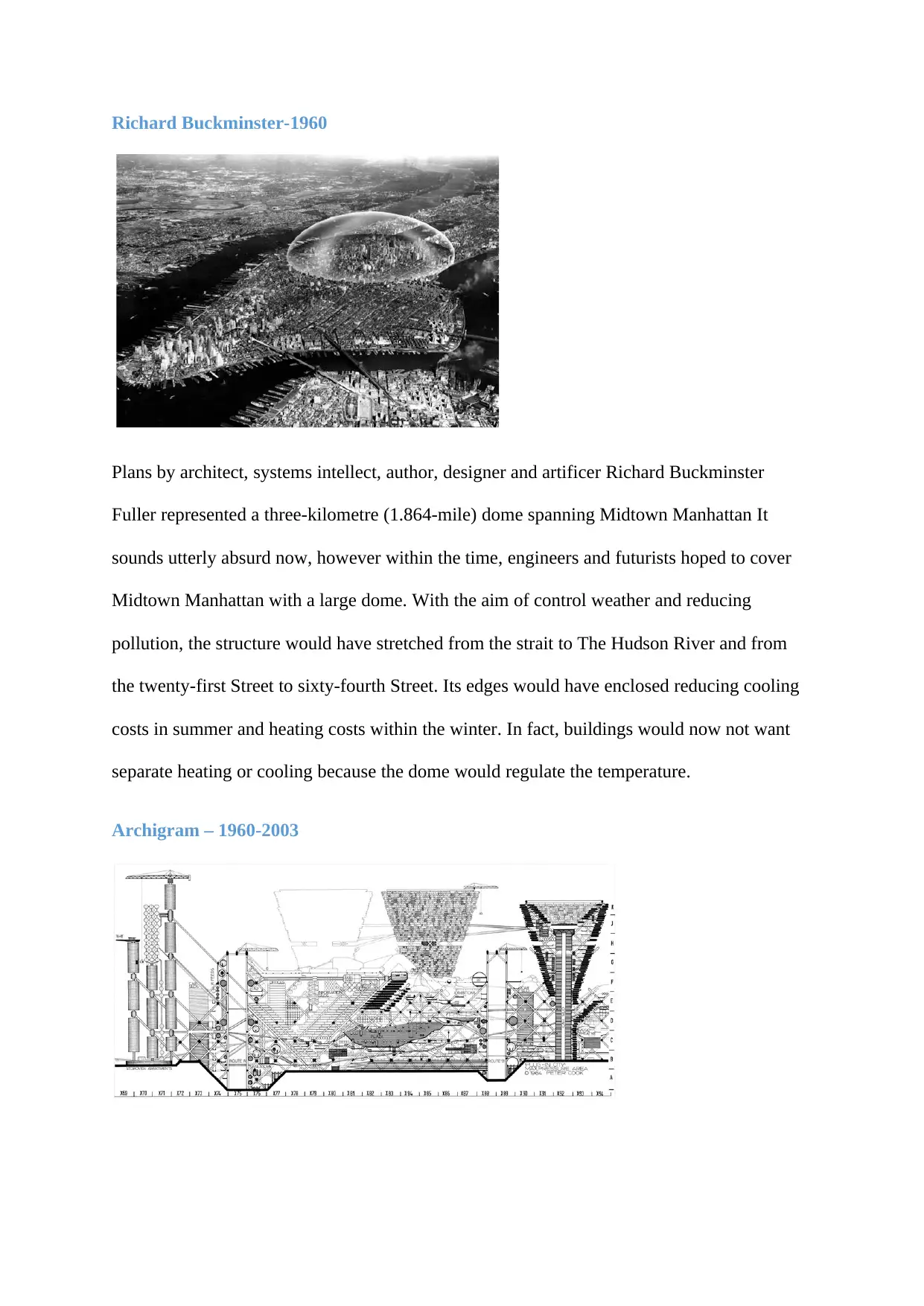
"Archigram" had made all of its nine issues and the Archigram Group: Warren Chalk, Peter
Cook, Dennis Crompton, David author, West Chadic Herron and electro-acoustic transducer
Webb, had been printed throughout the planetPlug-In town is one amongst the primary
megastructures planned by Archigram. The project incorporates notions 1st developed in City
Interchange concerning channelling traffic, info, and support systems, however inside
Associate in Nursing urban setting where people live and work (Johnson, 2016, p.365). Plug-
In town consists of a network of access ways in which to transportation and essential
services, like electricity, plumbing, and heating, upon that housing and industrial modules are
connected via a system of service cranes. The structure is hollow and multi-layered,
supported the archetypical medieval town wall.
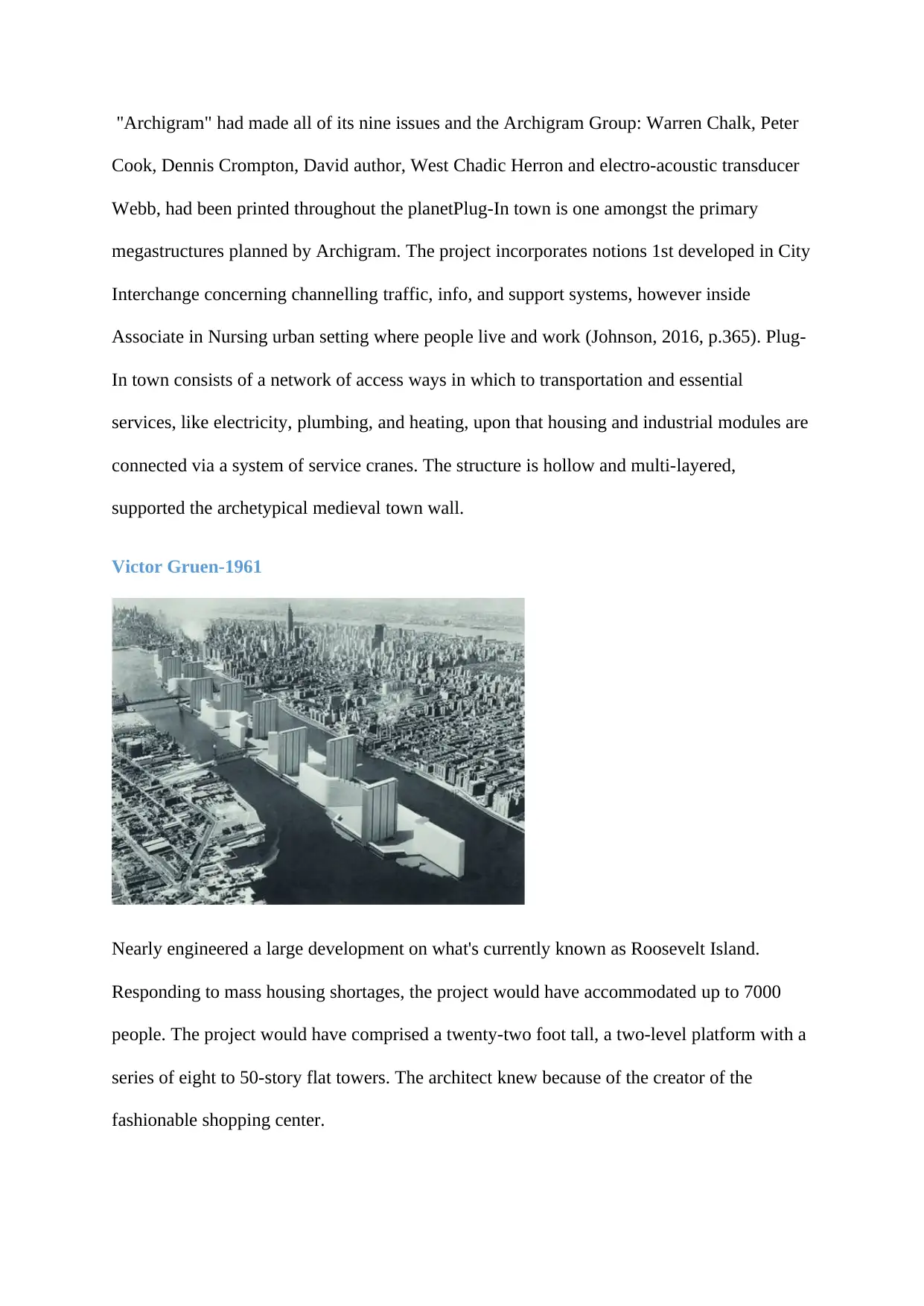
Victor Gruen-1961
Nearly engineered a large development on what's currently known as Roosevelt Island.
Responding to mass housing shortages, the project would have accommodated up to 7000
people. The project would have comprised a twenty-two foot tall, a two-level platform with a
series of eight to 50-story flat towers. The architect knew because of the creator of the
fashionable shopping center.
Cook, Dennis Crompton, David author, West Chadic Herron and electro-acoustic transducer
Webb, had been printed throughout the planetPlug-In town is one amongst the primary
megastructures planned by Archigram. The project incorporates notions 1st developed in City
Interchange concerning channelling traffic, info, and support systems, however inside
Associate in Nursing urban setting where people live and work (Johnson, 2016, p.365). Plug-
In town consists of a network of access ways in which to transportation and essential
services, like electricity, plumbing, and heating, upon that housing and industrial modules are
connected via a system of service cranes. The structure is hollow and multi-layered,
supported the archetypical medieval town wall.
Victor Gruen-1961
Nearly engineered a large development on what's currently known as Roosevelt Island.
Responding to mass housing shortages, the project would have accommodated up to 7000
people. The project would have comprised a twenty-two foot tall, a two-level platform with a
series of eight to 50-story flat towers. The architect knew because of the creator of the
fashionable shopping center.
⊘ This is a preview!⊘
Do you want full access?
Subscribe today to unlock all pages.
Trusted by 1+ million students worldwide
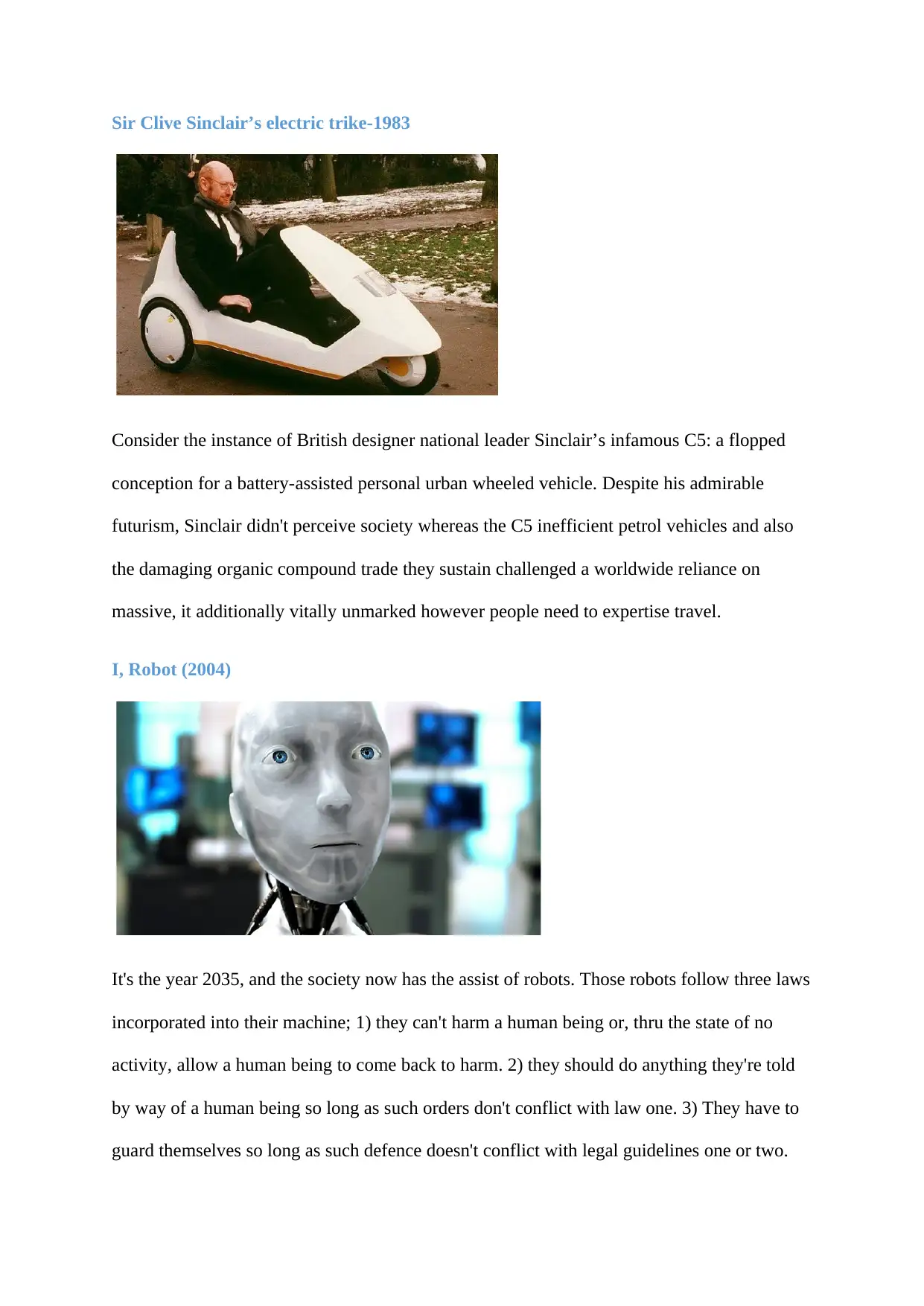
Sir Clive Sinclair’s electric trike-1983
Consider the instance of British designer national leader Sinclair’s infamous C5: a flopped
conception for a battery-assisted personal urban wheeled vehicle. Despite his admirable
futurism, Sinclair didn't perceive society whereas the C5 inefficient petrol vehicles and also
the damaging organic compound trade they sustain challenged a worldwide reliance on
massive, it additionally vitally unmarked however people need to expertise travel.
I, Robot (2004)
It's the year 2035, and the society now has the assist of robots. Those robots follow three laws
incorporated into their machine; 1) they can't harm a human being or, thru the state of no
activity, allow a human being to come back to harm. 2) they should do anything they're told
by way of a human being so long as such orders don't conflict with law one. 3) They have to
guard themselves so long as such defence doesn't conflict with legal guidelines one or two.
Consider the instance of British designer national leader Sinclair’s infamous C5: a flopped
conception for a battery-assisted personal urban wheeled vehicle. Despite his admirable
futurism, Sinclair didn't perceive society whereas the C5 inefficient petrol vehicles and also
the damaging organic compound trade they sustain challenged a worldwide reliance on
massive, it additionally vitally unmarked however people need to expertise travel.
I, Robot (2004)
It's the year 2035, and the society now has the assist of robots. Those robots follow three laws
incorporated into their machine; 1) they can't harm a human being or, thru the state of no
activity, allow a human being to come back to harm. 2) they should do anything they're told
by way of a human being so long as such orders don't conflict with law one. 3) They have to
guard themselves so long as such defence doesn't conflict with legal guidelines one or two.
Paraphrase This Document
Need a fresh take? Get an instant paraphrase of this document with our AI Paraphraser
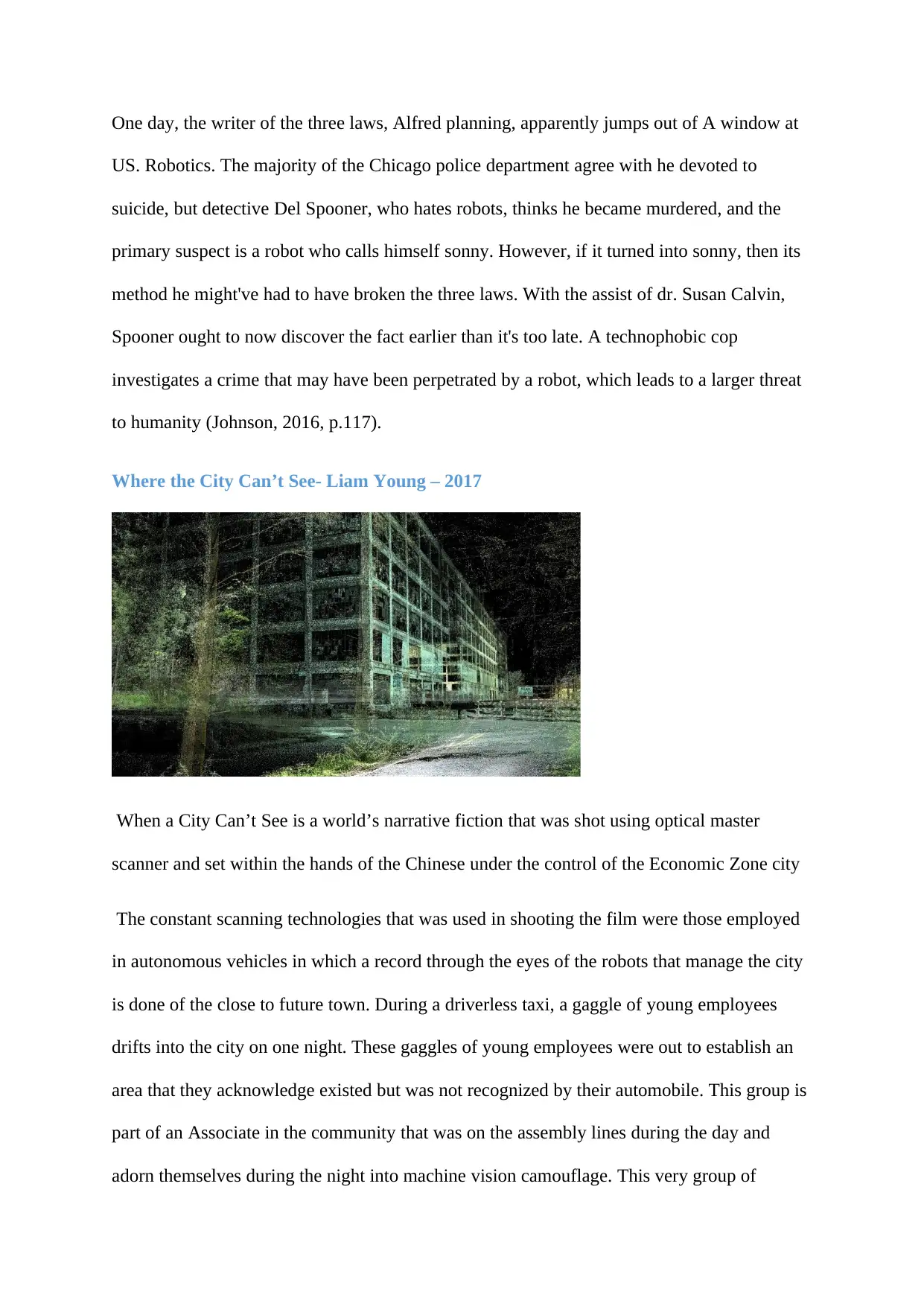
One day, the writer of the three laws, Alfred planning, apparently jumps out of A window at
US. Robotics. The majority of the Chicago police department agree with he devoted to
suicide, but detective Del Spooner, who hates robots, thinks he became murdered, and the
primary suspect is a robot who calls himself sonny. However, if it turned into sonny, then its
method he might've had to have broken the three laws. With the assist of dr. Susan Calvin,
Spooner ought to now discover the fact earlier than it's too late. A technophobic cop
investigates a crime that may have been perpetrated by a robot, which leads to a larger threat
to humanity (Johnson, 2016, p.117).
Where the City Can’t See- Liam Young – 2017
When a City Can’t See is a world’s narrative fiction that was shot using optical master
scanner and set within the hands of the Chinese under the control of the Economic Zone city
The constant scanning technologies that was used in shooting the film were those employed
in autonomous vehicles in which a record through the eyes of the robots that manage the city
is done of the close to future town. During a driverless taxi, a gaggle of young employees
drifts into the city on one night. These gaggles of young employees were out to establish an
area that they acknowledge existed but was not recognized by their automobile. This group is
part of an Associate in the community that was on the assembly lines during the day and
adorn themselves during the night into machine vision camouflage. This very group of
US. Robotics. The majority of the Chicago police department agree with he devoted to
suicide, but detective Del Spooner, who hates robots, thinks he became murdered, and the
primary suspect is a robot who calls himself sonny. However, if it turned into sonny, then its
method he might've had to have broken the three laws. With the assist of dr. Susan Calvin,
Spooner ought to now discover the fact earlier than it's too late. A technophobic cop
investigates a crime that may have been perpetrated by a robot, which leads to a larger threat
to humanity (Johnson, 2016, p.117).
Where the City Can’t See- Liam Young – 2017
When a City Can’t See is a world’s narrative fiction that was shot using optical master
scanner and set within the hands of the Chinese under the control of the Economic Zone city
The constant scanning technologies that was used in shooting the film were those employed
in autonomous vehicles in which a record through the eyes of the robots that manage the city
is done of the close to future town. During a driverless taxi, a gaggle of young employees
drifts into the city on one night. These gaggles of young employees were out to establish an
area that they acknowledge existed but was not recognized by their automobile. This group is
part of an Associate in the community that was on the assembly lines during the day and
adorn themselves during the night into machine vision camouflage. This very group of
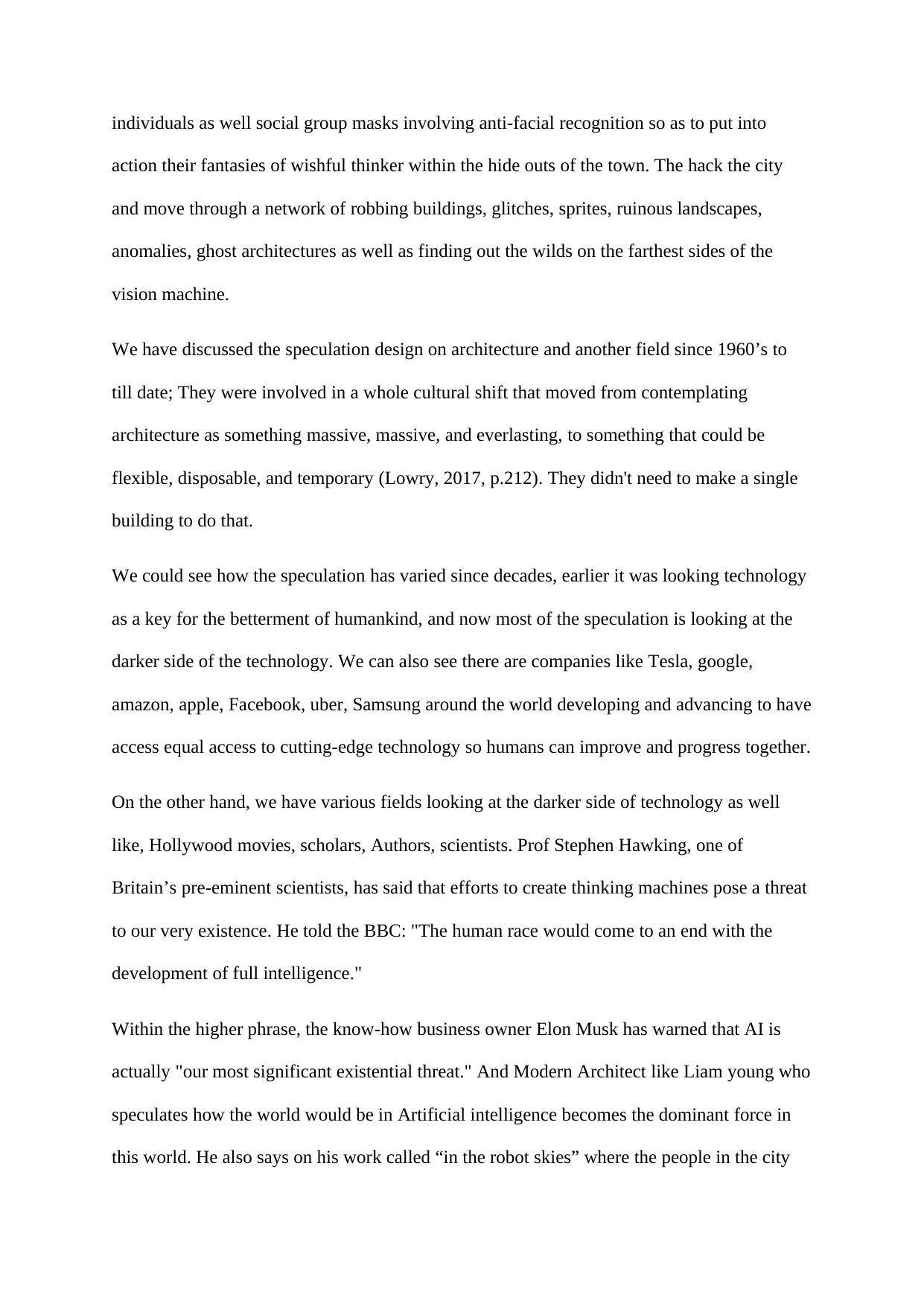
individuals as well social group masks involving anti-facial recognition so as to put into
action their fantasies of wishful thinker within the hide outs of the town. The hack the city
and move through a network of robbing buildings, glitches, sprites, ruinous landscapes,
anomalies, ghost architectures as well as finding out the wilds on the farthest sides of the
vision machine.
We have discussed the speculation design on architecture and another field since 1960’s to
till date; They were involved in a whole cultural shift that moved from contemplating
architecture as something massive, massive, and everlasting, to something that could be
flexible, disposable, and temporary (Lowry, 2017, p.212). They didn't need to make a single
building to do that.
We could see how the speculation has varied since decades, earlier it was looking technology
as a key for the betterment of humankind, and now most of the speculation is looking at the
darker side of the technology. We can also see there are companies like Tesla, google,
amazon, apple, Facebook, uber, Samsung around the world developing and advancing to have
access equal access to cutting-edge technology so humans can improve and progress together.
On the other hand, we have various fields looking at the darker side of technology as well
like, Hollywood movies, scholars, Authors, scientists. Prof Stephen Hawking, one of
Britain’s pre-eminent scientists, has said that efforts to create thinking machines pose a threat
to our very existence. He told the BBC: "The human race would come to an end with the
development of full intelligence."
Within the higher phrase, the know-how business owner Elon Musk has warned that AI is
actually "our most significant existential threat." And Modern Architect like Liam young who
speculates how the world would be in Artificial intelligence becomes the dominant force in
this world. He also says on his work called “in the robot skies” where the people in the city
action their fantasies of wishful thinker within the hide outs of the town. The hack the city
and move through a network of robbing buildings, glitches, sprites, ruinous landscapes,
anomalies, ghost architectures as well as finding out the wilds on the farthest sides of the
vision machine.
We have discussed the speculation design on architecture and another field since 1960’s to
till date; They were involved in a whole cultural shift that moved from contemplating
architecture as something massive, massive, and everlasting, to something that could be
flexible, disposable, and temporary (Lowry, 2017, p.212). They didn't need to make a single
building to do that.
We could see how the speculation has varied since decades, earlier it was looking technology
as a key for the betterment of humankind, and now most of the speculation is looking at the
darker side of the technology. We can also see there are companies like Tesla, google,
amazon, apple, Facebook, uber, Samsung around the world developing and advancing to have
access equal access to cutting-edge technology so humans can improve and progress together.
On the other hand, we have various fields looking at the darker side of technology as well
like, Hollywood movies, scholars, Authors, scientists. Prof Stephen Hawking, one of
Britain’s pre-eminent scientists, has said that efforts to create thinking machines pose a threat
to our very existence. He told the BBC: "The human race would come to an end with the
development of full intelligence."
Within the higher phrase, the know-how business owner Elon Musk has warned that AI is
actually "our most significant existential threat." And Modern Architect like Liam young who
speculates how the world would be in Artificial intelligence becomes the dominant force in
this world. He also says on his work called “in the robot skies” where the people in the city
⊘ This is a preview!⊘
Do you want full access?
Subscribe today to unlock all pages.
Trusted by 1+ million students worldwide

1 out of 47


Your All-in-One AI-Powered Toolkit for Academic Success.
+13062052269
info@desklib.com
Available 24*7 on WhatsApp / Email
![[object Object]](/_next/static/media/star-bottom.7253800d.svg)
Unlock your academic potential
Copyright © 2020–2025 A2Z Services. All Rights Reserved. Developed and managed by ZUCOL.