Sport Policy and Development: Australian Sport Analysis and Strategy
VerifiedAdded on 2023/06/08
|21
|5112
|462
Report
AI Summary
This report provides a comprehensive analysis of sport policy and development, focusing on the Australian context. It begins by exploring the relevance of sport development policies and practices, discussing the sports policy process, policy changes, and various development frameworks, including the advocacy coalition framework and the framework of changing trajectories for elite development. The report then delves into a case study of swimming in Australia, examining the mission, vision, and strategic plans of Swimming Australia, key sport development programs, and the sports development pathway. A comparison with New Zealand's approach is also included. The final part assesses the effectiveness of development strategies, alignment with national policies, and provides recommendations. The report draws upon academic literature and government sources to provide a detailed overview of the subject.
SPORT POLICY AND DEVELOPMENT

Paraphrase This Document
Need a fresh take? Get an instant paraphrase of this document with our AI Paraphraser
SPORT POLICY AND DEVELOPMENT
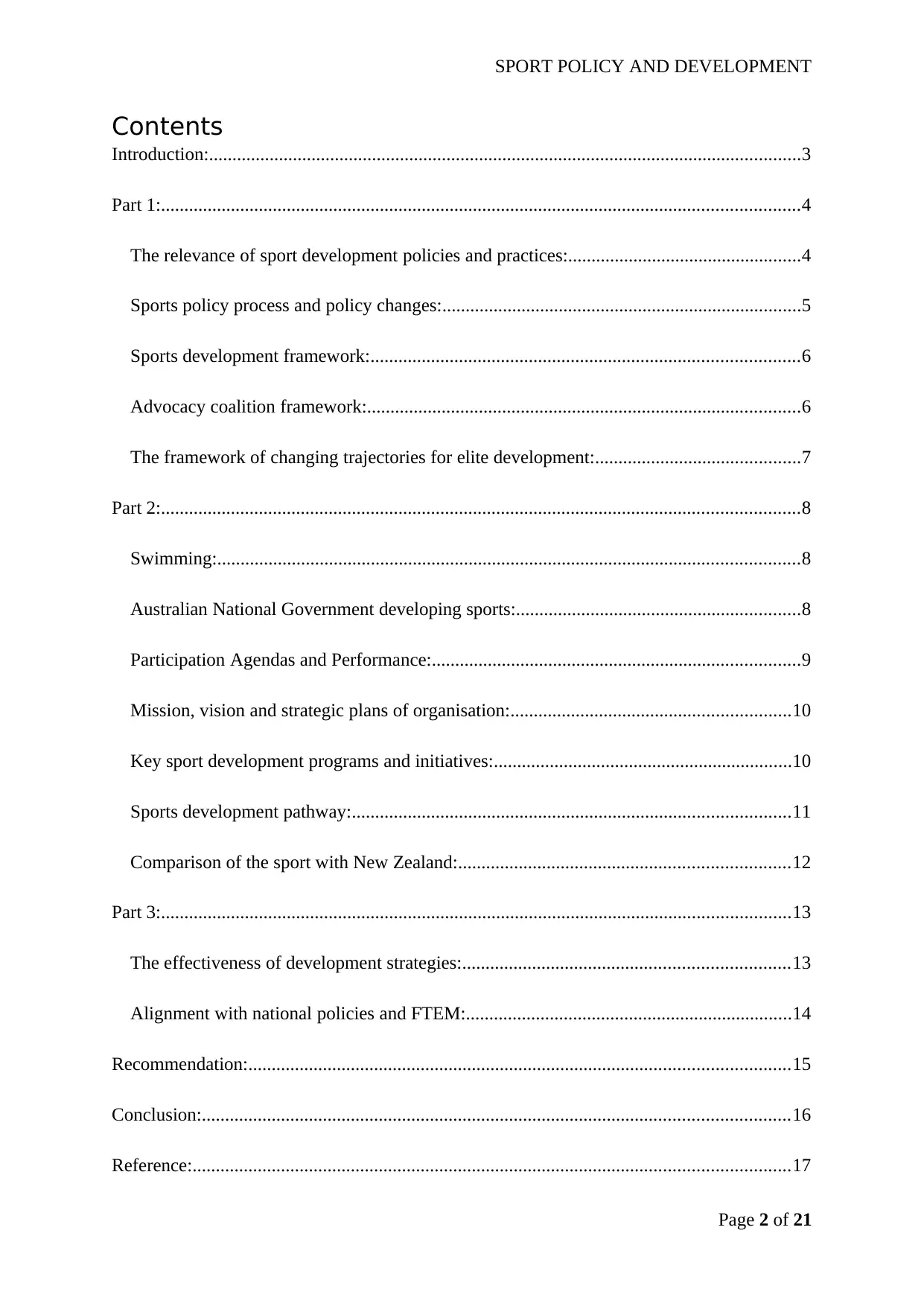
Contents
Introduction:...............................................................................................................................3
Part 1:.........................................................................................................................................4
The relevance of sport development policies and practices:..................................................4
Sports policy process and policy changes:.............................................................................5
Sports development framework:............................................................................................6
Advocacy coalition framework:.............................................................................................6
The framework of changing trajectories for elite development:............................................7
Part 2:.........................................................................................................................................8
Swimming:.............................................................................................................................8
Australian National Government developing sports:.............................................................8
Participation Agendas and Performance:...............................................................................9
Mission, vision and strategic plans of organisation:............................................................10
Key sport development programs and initiatives:................................................................10
Sports development pathway:..............................................................................................11
Comparison of the sport with New Zealand:.......................................................................12
Part 3:.......................................................................................................................................13
The effectiveness of development strategies:......................................................................13
Alignment with national policies and FTEM:......................................................................14
Recommendation:....................................................................................................................15
Conclusion:..............................................................................................................................16
Reference:................................................................................................................................17
Page 2 of 21
Contents
Introduction:...............................................................................................................................3
Part 1:.........................................................................................................................................4
The relevance of sport development policies and practices:..................................................4
Sports policy process and policy changes:.............................................................................5
Sports development framework:............................................................................................6
Advocacy coalition framework:.............................................................................................6
The framework of changing trajectories for elite development:............................................7
Part 2:.........................................................................................................................................8
Swimming:.............................................................................................................................8
Australian National Government developing sports:.............................................................8
Participation Agendas and Performance:...............................................................................9
Mission, vision and strategic plans of organisation:............................................................10
Key sport development programs and initiatives:................................................................10
Sports development pathway:..............................................................................................11
Comparison of the sport with New Zealand:.......................................................................12
Part 3:.......................................................................................................................................13
The effectiveness of development strategies:......................................................................13
Alignment with national policies and FTEM:......................................................................14
Recommendation:....................................................................................................................15
Conclusion:..............................................................................................................................16
Reference:................................................................................................................................17
Page 2 of 21
SPORT POLICY AND DEVELOPMENT
Introduction:
The state and the central government converged for drawing out the terms of the policies of
the sport. The main aim and objective behind the precise planning of the sports policy were
pursuing the objectives that are twins. They include the basing of sports in broad and the
achievement of excellence at the different levels of national as well as international sports.
The activities of sport in which the distinct countries have par excellence, potential strengths
and advantages related to competitiveness are very necessary to be promoted in the world.
Showcasing of the talents related to sports in the world sports forum allows the country to
hold a place that is recognisable and excel with much brighter visions and perspectives
towards the fulfilment of the goals of the nations through sports.
Page 3 of 21
Introduction:
The state and the central government converged for drawing out the terms of the policies of
the sport. The main aim and objective behind the precise planning of the sports policy were
pursuing the objectives that are twins. They include the basing of sports in broad and the
achievement of excellence at the different levels of national as well as international sports.
The activities of sport in which the distinct countries have par excellence, potential strengths
and advantages related to competitiveness are very necessary to be promoted in the world.
Showcasing of the talents related to sports in the world sports forum allows the country to
hold a place that is recognisable and excel with much brighter visions and perspectives
towards the fulfilment of the goals of the nations through sports.
Page 3 of 21
⊘ This is a preview!⊘
Do you want full access?
Subscribe today to unlock all pages.

Trusted by 1+ million students worldwide
SPORT POLICY AND DEVELOPMENT
Part 1:
The relevance of sport development policies and practices:
Physical education and the sports facilities are to have more integration in an efficient and
particular way with the curriculum of education. According to Houlihan and Green (2007),
the basing of sports activities abroad has been a responsibility of the State governments and
the union governments of the concerned countries. They are needed to provide supplementary
efforts towards and for embracing this direction along with the taping of the newly
recognised or very latest talents, belonging to both rural as well as the areas under different
tribes. The judiciary body are trying to implement and focus on the various objectives and
standards that can be adopted and be beneficial in the path of achieving the excellence at par
at different national levels as well as in international levels of sports. The sports federation
focuses mainly on the required components that are essential for activities that relate to the
development of physical education and sports.
According to Green (2007, p. 921), they include- developing human resources, promotion
and development of good health, the spirits of friendly and helpful cooperation among
different levels which include both national and international sports, development and
evolution of the personalities of the generation of youth who are concerned with the sports
activities. These factors are collectively responsible and have an impact that is very positive
in the overall categories concerned with sport. The excellence and shinned skills achieved
through sports provide the youth with a feeling of achievement, pride for the nation they
belong to along with patriotism. Sports activities are also beneficial for the purpose of
recreation, it helps in improving the level of productivity and plays a very important role in
fostering discipline all across and harmony amongst the socials.
Page 4 of 21
Part 1:
The relevance of sport development policies and practices:
Physical education and the sports facilities are to have more integration in an efficient and
particular way with the curriculum of education. According to Houlihan and Green (2007),
the basing of sports activities abroad has been a responsibility of the State governments and
the union governments of the concerned countries. They are needed to provide supplementary
efforts towards and for embracing this direction along with the taping of the newly
recognised or very latest talents, belonging to both rural as well as the areas under different
tribes. The judiciary body are trying to implement and focus on the various objectives and
standards that can be adopted and be beneficial in the path of achieving the excellence at par
at different national levels as well as in international levels of sports. The sports federation
focuses mainly on the required components that are essential for activities that relate to the
development of physical education and sports.
According to Green (2007, p. 921), they include- developing human resources, promotion
and development of good health, the spirits of friendly and helpful cooperation among
different levels which include both national and international sports, development and
evolution of the personalities of the generation of youth who are concerned with the sports
activities. These factors are collectively responsible and have an impact that is very positive
in the overall categories concerned with sport. The excellence and shinned skills achieved
through sports provide the youth with a feeling of achievement, pride for the nation they
belong to along with patriotism. Sports activities are also beneficial for the purpose of
recreation, it helps in improving the level of productivity and plays a very important role in
fostering discipline all across and harmony amongst the socials.
Page 4 of 21
Paraphrase This Document
Need a fresh take? Get an instant paraphrase of this document with our AI Paraphraser
SPORT POLICY AND DEVELOPMENT
Sports policy process and policy changes:
According to Beutler (2008, p. 359), there has been a substantial increase in the awareness
regarding the success of sports among the various governments which has been witnessed in
the past forty years. The elite success has been a very valuable resource due to its capacity
and the malleability to help in the achievement of a broad array of non-sporting objectives. In
the recent times, the success of international sporting has been diversely valued for the
national factors that are to be feeling good about getting generated. As they have a capacity
of delivering some economic benefits through hosting bigger events related to the sports and
for the utility that is diplomatic to the general crowd, the governments have identified that if
they are willing to expand or maximise some of these benefits they will be completely liable
for guaranteeing squads of athletes who belong to an elite class and are very much capable of
winning trophies and medals for their respective countries.
According to Giulianotti (2011, p. 207), since a few years, it was still possible to be sure
about the major structure of the prospering economy, and the demographic ratios would be
enough to ensure success through medals in the Olympic games. As per the illustrations of
Holt (2016) that success of the countries which is variable is dependent and can be explained
by three variables which include –the size of the population, the duration or span of the
membership in the International Olympic Committee, which indicates the depth of the
tradition of sport and the quantum and the level of the development of the economy. There
has been a gradual rise in the percentages of achieving medals and winning recognition from
ten per cent of the countries over the years, and it is observed that after the games of the Salt
Lake City the figure has risen to 67 per cent which previously varied between 47 to 50 per
cent.
Page 5 of 21
Sports policy process and policy changes:
According to Beutler (2008, p. 359), there has been a substantial increase in the awareness
regarding the success of sports among the various governments which has been witnessed in
the past forty years. The elite success has been a very valuable resource due to its capacity
and the malleability to help in the achievement of a broad array of non-sporting objectives. In
the recent times, the success of international sporting has been diversely valued for the
national factors that are to be feeling good about getting generated. As they have a capacity
of delivering some economic benefits through hosting bigger events related to the sports and
for the utility that is diplomatic to the general crowd, the governments have identified that if
they are willing to expand or maximise some of these benefits they will be completely liable
for guaranteeing squads of athletes who belong to an elite class and are very much capable of
winning trophies and medals for their respective countries.
According to Giulianotti (2011, p. 207), since a few years, it was still possible to be sure
about the major structure of the prospering economy, and the demographic ratios would be
enough to ensure success through medals in the Olympic games. As per the illustrations of
Holt (2016) that success of the countries which is variable is dependent and can be explained
by three variables which include –the size of the population, the duration or span of the
membership in the International Olympic Committee, which indicates the depth of the
tradition of sport and the quantum and the level of the development of the economy. There
has been a gradual rise in the percentages of achieving medals and winning recognition from
ten per cent of the countries over the years, and it is observed that after the games of the Salt
Lake City the figure has risen to 67 per cent which previously varied between 47 to 50 per
cent.
Page 5 of 21
SPORT POLICY AND DEVELOPMENT
As opined by Houlihan and Malcolm (2015), in spite of the relative consistencies by the help
of which the countries are continuing to achieve medals and accolades there is a regular need
for the governments to make sure that there is the availability of resources for the athletes.
The quality and the number of athletes in a definite country, however, affect their possibilities
to have a competitive advantage over the other countries in the same line and is also
beneficial for hosting the games in their home country.
Sports development framework:
As opined by Schulenkorf (2017, p. 243), the main point that is to be noted down is sports
have become a cultural institution, and in the current phase of the evolutionary world, it is
one of the major and significant contributors towards the vitalities, the vibrancies and
international profiles of the concerned nations. The basic purpose is focussing on the
developments of policies that contribute towards achieving the international position,
especially the Olympic and the success in sporting for leading countries like Australia,
Canada and the United Kingdom. A very recent analysis in the Australian sports policy has
made a moulding to the cultural practices of sport which has inversely affected the desire of
the nation regarding success in sports and for the path which it has carved towards the
achievements of the goals.
Advocacy coalition framework:
According to Burnett (2015, p. 385), this framework offers connectivity between the
formation of the coalition in the subsystems of the policy and the variant ideas. The
subsystems of this policy are generally comprised of two to four coalitions which compete for
influencing although one amongst them might be a dominant coalition. There are certain deep
core beliefs which refer to certain basic values related to the gender relations and the sports
Page 6 of 21
As opined by Houlihan and Malcolm (2015), in spite of the relative consistencies by the help
of which the countries are continuing to achieve medals and accolades there is a regular need
for the governments to make sure that there is the availability of resources for the athletes.
The quality and the number of athletes in a definite country, however, affect their possibilities
to have a competitive advantage over the other countries in the same line and is also
beneficial for hosting the games in their home country.
Sports development framework:
As opined by Schulenkorf (2017, p. 243), the main point that is to be noted down is sports
have become a cultural institution, and in the current phase of the evolutionary world, it is
one of the major and significant contributors towards the vitalities, the vibrancies and
international profiles of the concerned nations. The basic purpose is focussing on the
developments of policies that contribute towards achieving the international position,
especially the Olympic and the success in sporting for leading countries like Australia,
Canada and the United Kingdom. A very recent analysis in the Australian sports policy has
made a moulding to the cultural practices of sport which has inversely affected the desire of
the nation regarding success in sports and for the path which it has carved towards the
achievements of the goals.
Advocacy coalition framework:
According to Burnett (2015, p. 385), this framework offers connectivity between the
formation of the coalition in the subsystems of the policy and the variant ideas. The
subsystems of this policy are generally comprised of two to four coalitions which compete for
influencing although one amongst them might be a dominant coalition. There are certain deep
core beliefs which refer to certain basic values related to the gender relations and the sports
Page 6 of 21
⊘ This is a preview!⊘
Do you want full access?
Subscribe today to unlock all pages.
Trusted by 1+ million students worldwide
SPORT POLICY AND DEVELOPMENT
that are considered to be perfect for girls or boys. Apart from this, the core policy beliefs
include the basic commitments that are normative under the subsystem.
The framework of changing trajectories for elite development:
According to Stewartet al. (2018), the Australian Institute of sports, AIS added zeal to the
determination of the government to improve the performances in international sports. They
have planned for a centralised organisation which is increasing. Otherwise, they won't be able
to meet the success of the communist nations and much more professional and scientific
approach for the production of world-class athletes.
Page 7 of 21
that are considered to be perfect for girls or boys. Apart from this, the core policy beliefs
include the basic commitments that are normative under the subsystem.
The framework of changing trajectories for elite development:
According to Stewartet al. (2018), the Australian Institute of sports, AIS added zeal to the
determination of the government to improve the performances in international sports. They
have planned for a centralised organisation which is increasing. Otherwise, they won't be able
to meet the success of the communist nations and much more professional and scientific
approach for the production of world-class athletes.
Page 7 of 21
Paraphrase This Document
Need a fresh take? Get an instant paraphrase of this document with our AI Paraphraser
SPORT POLICY AND DEVELOPMENT
Part 2:
Mission, vision and strategic plans of organisation:
According to Fahlén et al. (2015, p. 391), Swimming Australia has acknowledged this facility
and elements within the 2014-2020. Strategic plan also identifies sports community and
commercial continuity in this regard they have a number of missions and viewpoints
(Swimming Australia, 2018).
Mission:
They are passionate that they will engage and communicate with their stakeholders with
passion and purpose. The individual rights and responsibilities will be respected by them.
Whatever they say or do they will operate it will integrity and honesty.
Vision:
With full dedication, they ensure the highest quality of swimming teaching and water safety
and will also ensure the prevention of lives from drowning.
Strategic plan:
They will operate transparently and build trust in mutually beneficial relationships and to
excellent performance in every part of their service.
Swimming Australia:
On October 1, 2004 Australian Swimming became a limited company and thus changed its
name to Swimming Australia Ltd. Glenn Tasker as its CEO until June 2008. Its headquarter
is located at Unit 12, 7 Beissel Street, Belconnen. In 2013, Mark Anderson was appointed as
its CEO. In 2014 Australian swim team rebranded its name to The Australian Dolphins
Swimming Team (Swimming Australia, 2018). It supports and runs centre namely
Page 8 of 21
Part 2:
Mission, vision and strategic plans of organisation:
According to Fahlén et al. (2015, p. 391), Swimming Australia has acknowledged this facility
and elements within the 2014-2020. Strategic plan also identifies sports community and
commercial continuity in this regard they have a number of missions and viewpoints
(Swimming Australia, 2018).
Mission:
They are passionate that they will engage and communicate with their stakeholders with
passion and purpose. The individual rights and responsibilities will be respected by them.
Whatever they say or do they will operate it will integrity and honesty.
Vision:
With full dedication, they ensure the highest quality of swimming teaching and water safety
and will also ensure the prevention of lives from drowning.
Strategic plan:
They will operate transparently and build trust in mutually beneficial relationships and to
excellent performance in every part of their service.
Swimming Australia:
On October 1, 2004 Australian Swimming became a limited company and thus changed its
name to Swimming Australia Ltd. Glenn Tasker as its CEO until June 2008. Its headquarter
is located at Unit 12, 7 Beissel Street, Belconnen. In 2013, Mark Anderson was appointed as
its CEO. In 2014 Australian swim team rebranded its name to The Australian Dolphins
Swimming Team (Swimming Australia, 2018). It supports and runs centre namely
Page 8 of 21
SPORT POLICY AND DEVELOPMENT
Swimming Australia national Training Centre at Australian Institute of Sport in Canberra.
Swimming Australia is a well renowned governing body of competitive swimming in
Australia. It has 100,000 registered members nationally and 1100 clubs all over the country
including swimmers, coaches, officials, administrators and volunteers. The management and
sport development from the national team is looked after by the body at the elite level.
Through to grass root participation, the conduct of national and international events is also
managed. Its main aim is to become Australia's leading sport through increased participation,
continuing outstanding performance and commercial excellence. Some of the organisations
associated with Swimming Australia are Australian Water polo Association Inc, Australian
Synchronised Swimming etc.
Australian National Government developing sports:
According to Rowe (2015, p. 43), a sincere government along with focusing on immediate
problems based on current issues should also focus on long terms issues like sports for
achieving an overall development goal. Since "Sports" play a major role in our life by
keeping us healthy, wealthy and active. As we know from the common-sense view that we
can have a healthy mind if we have a healthy body and none other than sports can help us in a
best possible way to meet such purpose leading to a healthy body and a happy mind on a
large scale leading to a healthy country. Among a number of popular sports including
Cricket, Football, Tennis which brings a lot of prestige to the country and Australia has a
number of Sports Agencies for the upliftment of new talents. In regards to swimming
Australia have a number of national agencies "Swimming Australia" being one of them. It
encourages participation of all ages and abilities and helps them enjoy the experience of
swimming and help them keep themselves fit and active physically as well as mentally for
great social and competitive reasoning. Their regular practice training helps to enforce the
confidence, physical, social and cognitive development. They even look after the water safety
Page 9 of 21
Swimming Australia national Training Centre at Australian Institute of Sport in Canberra.
Swimming Australia is a well renowned governing body of competitive swimming in
Australia. It has 100,000 registered members nationally and 1100 clubs all over the country
including swimmers, coaches, officials, administrators and volunteers. The management and
sport development from the national team is looked after by the body at the elite level.
Through to grass root participation, the conduct of national and international events is also
managed. Its main aim is to become Australia's leading sport through increased participation,
continuing outstanding performance and commercial excellence. Some of the organisations
associated with Swimming Australia are Australian Water polo Association Inc, Australian
Synchronised Swimming etc.
Australian National Government developing sports:
According to Rowe (2015, p. 43), a sincere government along with focusing on immediate
problems based on current issues should also focus on long terms issues like sports for
achieving an overall development goal. Since "Sports" play a major role in our life by
keeping us healthy, wealthy and active. As we know from the common-sense view that we
can have a healthy mind if we have a healthy body and none other than sports can help us in a
best possible way to meet such purpose leading to a healthy body and a happy mind on a
large scale leading to a healthy country. Among a number of popular sports including
Cricket, Football, Tennis which brings a lot of prestige to the country and Australia has a
number of Sports Agencies for the upliftment of new talents. In regards to swimming
Australia have a number of national agencies "Swimming Australia" being one of them. It
encourages participation of all ages and abilities and helps them enjoy the experience of
swimming and help them keep themselves fit and active physically as well as mentally for
great social and competitive reasoning. Their regular practice training helps to enforce the
confidence, physical, social and cognitive development. They even look after the water safety
Page 9 of 21
⊘ This is a preview!⊘
Do you want full access?
Subscribe today to unlock all pages.
Trusted by 1+ million students worldwide
SPORT POLICY AND DEVELOPMENT
training to avoid any unwanted accidents. This agency is extremely proud to announce its
partnership with the Australian Sports Commission (ASC). Australian Government has
delivered 200 million dollars so that more and more children can play more sports.
The Australian sports are globally recognised because the nation has strong teams in sports
for example the country has great cricket team, swimmers, football team, hockey team and
many other sports. In 2009 the Australia has spent for more than $49 million for the Australia
sports reach programme. The sports development authority has made some rules for the
athletes and those rules are as follows:
All the athlete should participate in all kind of physical activity and exercise because the
physical activity will reduce the risk of developing non-communicable disease. Disease like
diabetes and other form dieses can prevented by the exercise.
Sports is one of the biggest platforms in Australia and all over the world to make people
aware of the health and dieses. This helps the common people to join the sports for being fit.
Participation Agendas and Performance:
According to Millar and Doherty (2016, p. 365), in order to prepare agendas of participation,
information has been set to assist clubs and faculty owners and operators for further
enhancing the relationships and support the provision and access the water space. Swimming
Australia has also valued the role of teachers in the classroom as well as in the yard. They
believe that coaches are a wonderful influence on children since coaches are the one who r
responsible for delivering skills, fun and enjoyment they give special efforts to introduce
efficient coaches. In terms of performance, its goal is "to underpin the growth and
enhancement of the sport through facility and water space access". Thus, they have an
inclusive role in planning facilities and ensure the continuation of pool designing and
Page 10 of 21
training to avoid any unwanted accidents. This agency is extremely proud to announce its
partnership with the Australian Sports Commission (ASC). Australian Government has
delivered 200 million dollars so that more and more children can play more sports.
The Australian sports are globally recognised because the nation has strong teams in sports
for example the country has great cricket team, swimmers, football team, hockey team and
many other sports. In 2009 the Australia has spent for more than $49 million for the Australia
sports reach programme. The sports development authority has made some rules for the
athletes and those rules are as follows:
All the athlete should participate in all kind of physical activity and exercise because the
physical activity will reduce the risk of developing non-communicable disease. Disease like
diabetes and other form dieses can prevented by the exercise.
Sports is one of the biggest platforms in Australia and all over the world to make people
aware of the health and dieses. This helps the common people to join the sports for being fit.
Participation Agendas and Performance:
According to Millar and Doherty (2016, p. 365), in order to prepare agendas of participation,
information has been set to assist clubs and faculty owners and operators for further
enhancing the relationships and support the provision and access the water space. Swimming
Australia has also valued the role of teachers in the classroom as well as in the yard. They
believe that coaches are a wonderful influence on children since coaches are the one who r
responsible for delivering skills, fun and enjoyment they give special efforts to introduce
efficient coaches. In terms of performance, its goal is "to underpin the growth and
enhancement of the sport through facility and water space access". Thus, they have an
inclusive role in planning facilities and ensure the continuation of pool designing and
Page 10 of 21
Paraphrase This Document
Need a fresh take? Get an instant paraphrase of this document with our AI Paraphraser
SPORT POLICY AND DEVELOPMENT
consider competitions and needs for training. They also influence the mechanism of the
market which delivers water space access to clubs and other swimming programs. They also
look after the safety measures (Gabbettet al. 2016).
Key sport development programs and initiatives:
As analysed on Swimming Australia (2018), the Australian swimming department has
launched a scholarship program for the students who are eligible and good in swimming but
has the poor financial condition to afford the sport. For those students, the swimming
department will issue scholarship. There are some procedures by which the student will get
their scholarship. At first, they have the participate in a competitive swimming competition
and has to perform by which the swimming department can easily issue the scholarship.
Swimming is one of the flourishing sports in Australia along with cricket. It is because many
Australian swimmers have flourished in the Olympics and Paralympics which has created a
huge craze among the citizen. According to Raysmith and Drew (2016, p. 778), apart from
these health experts and physician has suggested that swimming is the best exercise for the
human body. Thus, due to health-concerned many people has taken swimming as their fitness
and hobby and some has taken as passion or career. The Australian swimming clubs have
hired many professional swimmers like Menzies who has coached Ian Thorpe who has won
several Olympic gold medals. This shoes the opportunity and development of the swimmers
of Australia. The coaches give proper training with upgraded technology to the students and
make them long-term swimmers for prospective future in the swimming.
Sports development pathway:
The Government pays heed to the devotion of significant sums of money controlled by the
public or the government, that is, the national lotteries for the maintenance and the
improvement of the elite classes of sporting. According to Gabbettet al. (2016), the United
Page 11 of 21
consider competitions and needs for training. They also influence the mechanism of the
market which delivers water space access to clubs and other swimming programs. They also
look after the safety measures (Gabbettet al. 2016).
Key sport development programs and initiatives:
As analysed on Swimming Australia (2018), the Australian swimming department has
launched a scholarship program for the students who are eligible and good in swimming but
has the poor financial condition to afford the sport. For those students, the swimming
department will issue scholarship. There are some procedures by which the student will get
their scholarship. At first, they have the participate in a competitive swimming competition
and has to perform by which the swimming department can easily issue the scholarship.
Swimming is one of the flourishing sports in Australia along with cricket. It is because many
Australian swimmers have flourished in the Olympics and Paralympics which has created a
huge craze among the citizen. According to Raysmith and Drew (2016, p. 778), apart from
these health experts and physician has suggested that swimming is the best exercise for the
human body. Thus, due to health-concerned many people has taken swimming as their fitness
and hobby and some has taken as passion or career. The Australian swimming clubs have
hired many professional swimmers like Menzies who has coached Ian Thorpe who has won
several Olympic gold medals. This shoes the opportunity and development of the swimmers
of Australia. The coaches give proper training with upgraded technology to the students and
make them long-term swimmers for prospective future in the swimming.
Sports development pathway:
The Government pays heed to the devotion of significant sums of money controlled by the
public or the government, that is, the national lotteries for the maintenance and the
improvement of the elite classes of sporting. According to Gabbettet al. (2016), the United
Page 11 of 21
SPORT POLICY AND DEVELOPMENT
Kingdom spends around one hundred and twenty million pounds for establishing regional
networks and institutions for the development and growth of the sports classes and they also
spend an extra sum of one hundred million pounds prior to the Sydney Olympics, for the
purpose of supporting around six hundred athletes. The sports commission of Australia has
laid down clear manifestations about what the country desires for shoving their heads into the
international sports competitions. The new emergences in the current years are the very
planned, systematic and very highly scientific approaches which are very much beneficial for
the development of the countries elite class athletes. For the development of the skills of the
very talented athletes in the condominium the government has set down targets and has
initiated funding for the smooth functioning of the sports configurations.
According to SportAus (2017), there is an emphasis on the change of the Canadian sports
policy and the legislation being subsequent. It is very much evident due to the continuous
debates and conflicts regarding the value systems and the beliefs which are registered for the
countries pinning delivery system based on sports. In Canada, there are traces from which it
is understandable that there is a shift in the direction of policy and more emphasis is being
paid towards the federation level.
Comparison of the sport in New Zealand:
Like Australia, their neighbouring country New Zealand also has a good swimming
development programmes and structures. Swimming New Zealand is the national swimming
club who trains swimmers for the national senior swimming side. They have lots of
programmes, and those programmes and development include kids and senior team member.
According to Cornelissen (2017), the Swimming New Zealand arranges huge competition
both for the junior and senior team because they believe that due to the high competition level
the swimmers will give their best. They give huge Importance to the junior team also because
Page 12 of 21
Kingdom spends around one hundred and twenty million pounds for establishing regional
networks and institutions for the development and growth of the sports classes and they also
spend an extra sum of one hundred million pounds prior to the Sydney Olympics, for the
purpose of supporting around six hundred athletes. The sports commission of Australia has
laid down clear manifestations about what the country desires for shoving their heads into the
international sports competitions. The new emergences in the current years are the very
planned, systematic and very highly scientific approaches which are very much beneficial for
the development of the countries elite class athletes. For the development of the skills of the
very talented athletes in the condominium the government has set down targets and has
initiated funding for the smooth functioning of the sports configurations.
According to SportAus (2017), there is an emphasis on the change of the Canadian sports
policy and the legislation being subsequent. It is very much evident due to the continuous
debates and conflicts regarding the value systems and the beliefs which are registered for the
countries pinning delivery system based on sports. In Canada, there are traces from which it
is understandable that there is a shift in the direction of policy and more emphasis is being
paid towards the federation level.
Comparison of the sport in New Zealand:
Like Australia, their neighbouring country New Zealand also has a good swimming
development programmes and structures. Swimming New Zealand is the national swimming
club who trains swimmers for the national senior swimming side. They have lots of
programmes, and those programmes and development include kids and senior team member.
According to Cornelissen (2017), the Swimming New Zealand arranges huge competition
both for the junior and senior team because they believe that due to the high competition level
the swimmers will give their best. They give huge Importance to the junior team also because
Page 12 of 21
⊘ This is a preview!⊘
Do you want full access?
Subscribe today to unlock all pages.
Trusted by 1+ million students worldwide

1 out of 21


Related Documents


Your All-in-One AI-Powered Toolkit for Academic Success.
+13062052269
info@desklib.com
Available 24*7 on WhatsApp / Email
![[object Object]](/_next/static/media/star-bottom.7253800d.svg)
Unlock your academic potential
Copyright © 2020–2026 A2Z Services. All Rights Reserved. Developed and managed by ZUCOL.