Marketing Strategies and Trigger Analysis: Spotify Case Study

Verified

Added on  2022/08/01

|7
|1283
|19
Report
AI Summary
This report provides a comprehensive analysis of Spotify's marketing strategies, focusing on its application of the Hook Model (Trigger, Action, Reward, and Investment) to build user habits. It examines both internal and external triggers, including paid advertising, earned media, relationship marketing, and owned triggers such as push notifications. The report highlights how Spotify targets its audience, primarily young people, through various channels and partnerships. It also explores the user-friendly design of the app, the rewards offered (new music discovery and personalized recommendations), and how users invest in the platform through playlist creation and music library development. The analysis concludes that Spotify effectively couples external triggers with internal triggers, creating a habit-forming product that addresses user needs and provides a competitive advantage in the music streaming market. The report references various sources to support its findings and provide a detailed overview of Spotify's marketing approach.

Document Page
M TRUNNING HEAD: ARKE ING
0
Mar etingk
tabler-icon-diamond-filled.svg

Paraphrase This Document

Need a fresh take? Get an instant paraphrase of this document with our AI Paraphraser
Document Page
Mar etingk
1
Introduction
Many strategies are used by marketers to attract the target audience and to position products and
services in the market. It is difficult to get people to buy something. There are so many things
that impact on purchasing decisions of buyers. In order to understand the concept analysis and
research on Spotify App is done. Spotify is a platform that offers music streaming services, and
the company is based on Sweden (Spotify). The company allows users to listen to music, search
and get recommendations on the basis of their previous listened and discover what music other
love and listen to that is trending music (Kjus, 130). The below section highlights the smart
marketing of Spotify and using Triggers (Hook Model) analysis is done.
Smart Marketing
There are two types of triggers external trigger and internal triggers. Furthermore, external
triggers include “paid triggers, earned triggers, relationship triggers, and owned triggers”. On the
other side, when service or product becomes tightly coupled with an emotion, a thought, and
existing routine is termed as an internal trigger (Eyal and Hoover).
Spotify is a music platform and the mission of the company is to “give people access to all the
music they want all the time in a completely legal and accessible way”. As considering this
mission, Spotify has 100 million users that are active and from that 30 million people have a
subscription (Spotify).
Document Page
Mar etingk
2
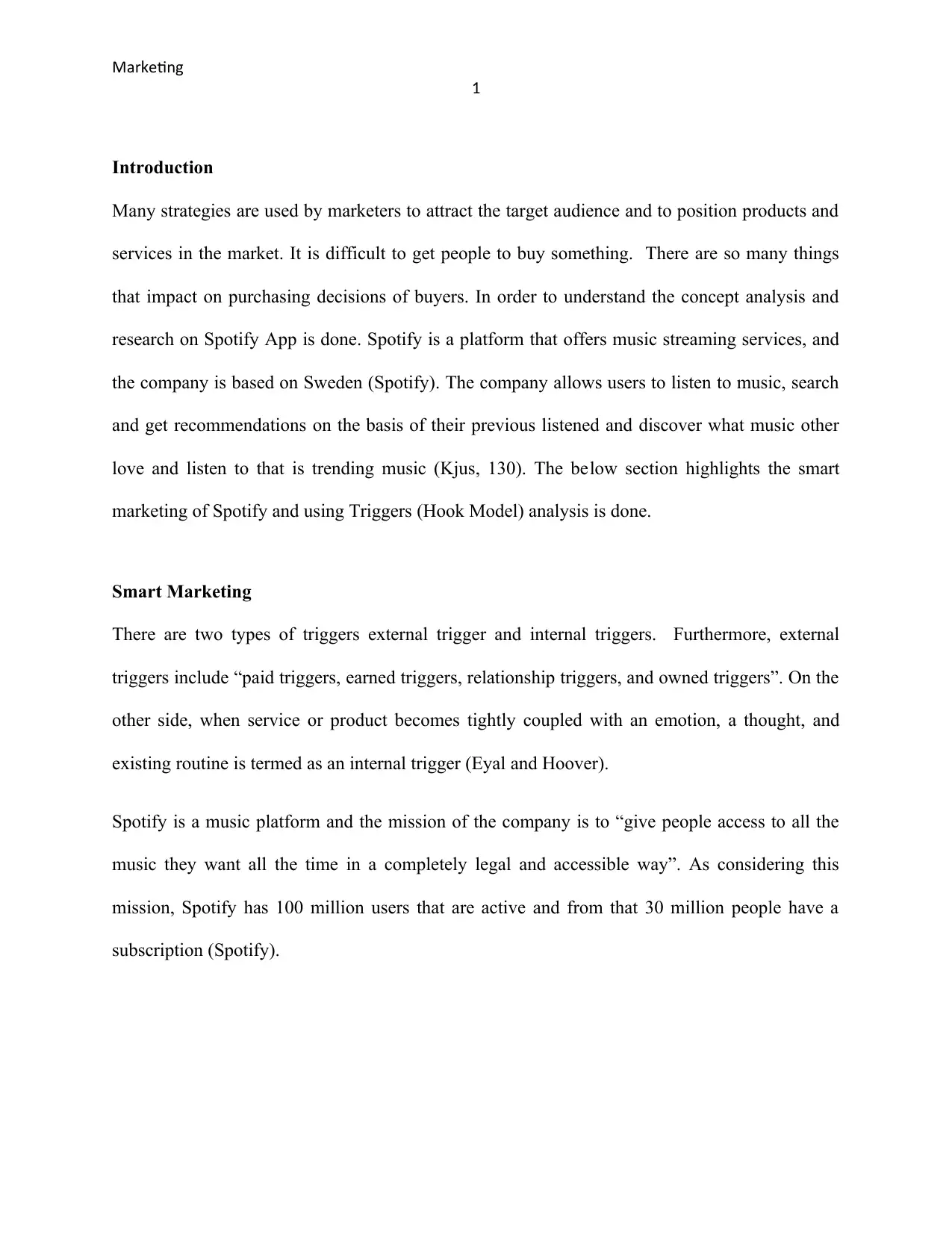
Figure 1: Spotify price and features
Source: (Spotify)
The target audiences of the company are young people, audiences who love to socialize, and
who love outdoor activities with friends. The advertisement strategies used by Spotify is all
related to targeting young people. The company uses demographic targeting to reach people who
use mobile phones, connected devices and desktop (Chodos).
Figure 2: Spotify Targets Young People
Source: (Spotify)
Document Page
Mar etingk
3
Spotify, in order to build stronger relationships with its customers, formed different partnerships
and with that, the company can provide easy access to music to its customers that result in higher
engagement. The company generated this application to replace the idea of using radio in cars
(Kjus). The company aims to offer music to its target audience in a manner so that they can
access it from any platform anywhere.
In the long run, the idea of Spotify is to form new habits amongst the people that is when people
drive the car they remember Spotify for music, not radio. In order to understand how Spotify
positioned itself and start forming this habit, “Nir Eyal’s Hook Model (Trigger, Action, Reward,
and Investment)” has been used (Sterne and Davenport).
Trigger
From the analysis it is known that the two triggers in case of Spotify are:
Internal Trigger: “Wish to listen to music in Car”
External Trigger: Paid Advertisement, using word of mouth, social media marketing campaigns
The success secret of using triggers is “to couple external trigger with the internal trigger as
closer as much as possible”. Some of the tactics of Spotify is to send push notifications when:
Firstly, changing geolocation as per the speed of a car and sending users to push notification
before several minutes probable start of the drive (Spotify).
Action
tabler-icon-diamond-filled.svg

Paraphrase This Document

Need a fresh take? Get an instant paraphrase of this document with our AI Paraphraser
Document Page
Mar etingk
4
Spotify is a user-friendly app and can be used by any age group and target audience and also
friendly in terms of action. As users take 2-3 actions to play music on Spotify and with that the
company is able to provide user-friendly services.
Reward
Rewards that the company offers to its users and to attract new users are; discovery of new tracks
to users through recommendations and discovering weekly genres and mood.
Investment
Users of Spotify mainly invest in developing own music library and building playlists. The more
users invest in Spotify, the more services they can enjoy and use. On the other side, the more
tracks they listen, save and add in the playlist, the better they discover weekly experience.
The users of Spotify use the application because of boredom, loneliness, and frustration. Further,
the positive emotions that lead to users to use the application are desire to be entertained and
engage socially with friends (Kjus). By using the Hooked Model, the analysis of the idea of the
Spotify application is done. From the analysis, it is identified that the target audience of the
company is young people. Further, in order to attract customers, the company uses different
marketing activities and pricing tactics.
Spotify is able to achieve its goal of producing a habit-forming product for its users that help “to
solve user pain by creating a product that becomes a source of relief for users. Hence, Spotify
smart marketing tactics are useful for attracting more customers and for developing a
competitive advantage in the market. Furthermore, Spotify advertisement strategies or external
Document Page
Mar etingk
5
triggers are appropriately coupled with the internal triggers that prove to be beneficial for the
company to attract the right customers with the right pricing strategies.
Conclusion
It is concluded from the analysis of Spotify that external triggers that the company is using are
paid trigger that includes advertisement of application on other platforms such as YouTube,
earned triggers include app store ranking as Spotify is high rated application of music on Google
store. Further, it is also analyzed that the brand also growing because of word of mouth as users
of Spotify recommend this application to their friends and groups that is the better way or non-
paid way of advertising a product or service in the market. An owned trigger in Spotify includes
a push notification that users get when they installed application and set up an account using
email or phone number with that for a repeated engagement until a habit is formed Spotify send
push notifications to remind the user. Hence, Spotify offers the best features and services and
reward with minimum action and investment to its users and coupled its external and internal
triggers effectively.
Document Page
Mar etingk
6
References
Chodos, Asher Tobin. "What Does Music Mean to Spotify? An Essay on Musical Significance in
the Era of Digital Curation." INSEAM Journal of Contemporary Music, Art, and Technology 1.2
(2019): 36-64.
Cialdini, R. B., and R. B. Cialdini. "Influence: The psychology of persuasion (pp. 173-
174)." New York: Collins (2007).
Eyal, Nir., and Hoover. Hooked: how to build habit-forming products. New York: Penguin
Business. (2019).
Kjus, Yngvar. "Musical exploration via streaming services: The Norwegian experience." Popular
Communication 14.3 (2016): 127-136.
Spotify. About us. Accessed From: https://newsroom.spotify.com/company-info/
Sterne, Jim, and Davenport, T. H. Artificial intelligence for marketing: practical applications.
Hoboken, NJ: John Wiley & Sons, Inc., (2017).
chevron_up_icon
1 out of 7
circle_padding
hide_on_mobile
zoom_out_icon
[object Object]