Effectiveness of Diabetes Treatment: An SPSS Analysis Report
VerifiedAdded on 2019/12/04
|27
|4209
|94
Report
AI Summary
This report presents a comprehensive SPSS analysis of a 6-week longitudinal study examining the effectiveness of intervention and control groups in treating diabetes. The study employed both quantitative and qualitative methods, with participants randomly assigned to either an intervention group receiving a new therapy or a control group receiving regular care. Data collected included test scores, quality of life ratings, gender, age, self-image scores, weight, self-referral status, and relapse occurrences across three time points (pre-intervention, post-intervention, and follow-up). Statistical analyses, including independent sample t-tests, partial correlation, descriptive statistics, post-hoc tests, chi-square tests, and Wilcoxon signed-rank tests, were conducted to assess significant differences between groups, correlations between variables, and the impact of treatment on various outcomes such as relapses and self-image. The findings reveal insights into the efficacy of different treatment approaches and their influence on patient outcomes. The report includes detailed analysis of the statistical findings, including t-test results, correlation coefficients, descriptive statistics, and post-hoc test results. The analysis also includes graphical representations of the data, which provides further insights into the study's findings. The study's findings are discussed in detail, and the report provides an interpretation of the results.

SPSS
Paraphrase This Document
Need a fresh take? Get an instant paraphrase of this document with our AI Paraphraser

TABLE OF CONTENTS
Chapter 1 Introduction.....................................................................................................................1
Background of the research.........................................................................................................1
Rationale of the research.............................................................................................................1
Aim and Objectives.........................................................................................................................2
Chapter 2 - Methodology.................................................................................................................1
FINDINGS.......................................................................................................................................1
Chapter 3 Results.............................................................................................................................1
Analysis 1 Independent Sample T-Tests.....................................................................................1
Analysis 2 Partial Correlation......................................................................................................2
Analysis 3 Descriptive statistics..................................................................................................4
Analysis 4 Post Hoc Tests...........................................................................................................9
Analysis 5 Chi-square Tests........................................................................................................9
Range and skewness....................................................................................................................9
Wilcoxon Signed Ranks Test.....................................................................................................11
Interpretation..............................................................................................................................12
Analysis from the generated findings........................................................................................12
Chapter 4 Discussion.......................................................................................................................1
REFERENCES................................................................................................................................3
APPENDIX......................................................................................................................................4
Chapter 1 Introduction.....................................................................................................................1
Background of the research.........................................................................................................1
Rationale of the research.............................................................................................................1
Aim and Objectives.........................................................................................................................2
Chapter 2 - Methodology.................................................................................................................1
FINDINGS.......................................................................................................................................1
Chapter 3 Results.............................................................................................................................1
Analysis 1 Independent Sample T-Tests.....................................................................................1
Analysis 2 Partial Correlation......................................................................................................2
Analysis 3 Descriptive statistics..................................................................................................4
Analysis 4 Post Hoc Tests...........................................................................................................9
Analysis 5 Chi-square Tests........................................................................................................9
Range and skewness....................................................................................................................9
Wilcoxon Signed Ranks Test.....................................................................................................11
Interpretation..............................................................................................................................12
Analysis from the generated findings........................................................................................12
Chapter 4 Discussion.......................................................................................................................1
REFERENCES................................................................................................................................3
APPENDIX......................................................................................................................................4

Chapter 1 Introduction
Background of the research
The medical term for diabetes is Diabetes Mellitus. It is a group of metabolic diseases in
which there are high blood sugar levels over a prolonged period (Hancock, 2011). It is a kind of
defect in the human body’ ability to convert glucose to energy. It is evident that glucose is the
main source of fuel for the body (Cunha, 2015). When the food is digested it changes into facts,
protein and carbohydrates. Foods which has an impact on blood sugars are called carbohydrates.
The carbohydrates on become digested transforms into glucose. Glucose is transmitted to the
blood and it is used by the cells for the purpose of energy. Diabetes develop when the pancreas
fails to produce sufficient quantities of insulin (Martin, 2014).
There are 3.9 million people fighting with diabetes in UK and that is more than one in 16
people in UK who has diabetes. The figure has been doubled since 1996 when there were 1.4
million. According to the reports, it is estimated that by the end of 2025, five million people will
have diabetes in UK (Stretch, 2015). Many individuals have blood sugar level above the normal
range but not adequate enough to be diagnosed as having diabetes. It is important that diabetes to
be diagnosed as early as possible because it get worsened with the passage of time.
Rationale of the research
The purpose of this research study is to measure the effectiveness of intervention and
control group on the treatment of diabetes among the patients. It means this research stated how
intervention and control can assists in the treatment of disease like diabetes. The test score are
being measured at three different time points which are as follows
Time 1: pre-intervention – It is the time before the treatment of the diabetes disease
Time 2: Post intervention – It is the time during the treatment of the diabetes disease
Time 3: Follow Up – It is the time after the treatment of the diabetes disease
It is evident that with the changing environment, people are becoming more concerned
about their health. In the desire to remain fit and healthy it is important that people should know
about different types of health diseases which might occur to them. The main purpose of
performing this research is to enhance the knowledge of the readers about the diabetes. It will
measure the effectiveness of control and intervention on the treatment of diabetes.
1
Background of the research
The medical term for diabetes is Diabetes Mellitus. It is a group of metabolic diseases in
which there are high blood sugar levels over a prolonged period (Hancock, 2011). It is a kind of
defect in the human body’ ability to convert glucose to energy. It is evident that glucose is the
main source of fuel for the body (Cunha, 2015). When the food is digested it changes into facts,
protein and carbohydrates. Foods which has an impact on blood sugars are called carbohydrates.
The carbohydrates on become digested transforms into glucose. Glucose is transmitted to the
blood and it is used by the cells for the purpose of energy. Diabetes develop when the pancreas
fails to produce sufficient quantities of insulin (Martin, 2014).
There are 3.9 million people fighting with diabetes in UK and that is more than one in 16
people in UK who has diabetes. The figure has been doubled since 1996 when there were 1.4
million. According to the reports, it is estimated that by the end of 2025, five million people will
have diabetes in UK (Stretch, 2015). Many individuals have blood sugar level above the normal
range but not adequate enough to be diagnosed as having diabetes. It is important that diabetes to
be diagnosed as early as possible because it get worsened with the passage of time.
Rationale of the research
The purpose of this research study is to measure the effectiveness of intervention and
control group on the treatment of diabetes among the patients. It means this research stated how
intervention and control can assists in the treatment of disease like diabetes. The test score are
being measured at three different time points which are as follows
Time 1: pre-intervention – It is the time before the treatment of the diabetes disease
Time 2: Post intervention – It is the time during the treatment of the diabetes disease
Time 3: Follow Up – It is the time after the treatment of the diabetes disease
It is evident that with the changing environment, people are becoming more concerned
about their health. In the desire to remain fit and healthy it is important that people should know
about different types of health diseases which might occur to them. The main purpose of
performing this research is to enhance the knowledge of the readers about the diabetes. It will
measure the effectiveness of control and intervention on the treatment of diabetes.
1
⊘ This is a preview!⊘
Do you want full access?
Subscribe today to unlock all pages.

Trusted by 1+ million students worldwide

Aim and Objectives
The major aim of the research is to evaluate the effectiveness of intervention and control
group on the treatment of diabetes among the patients. Following objectives have been laid
down:
To assess significant difference between intervention and control strategies of treatment
procedure of diabetes
To examine the impact of treatment procedure on the occurrence of relapses
To examine the effect of diagnosis on self-image index
To assess the relationship between weight time and different scales of time during the
treatment procedures of diabetes
2
The major aim of the research is to evaluate the effectiveness of intervention and control
group on the treatment of diabetes among the patients. Following objectives have been laid
down:
To assess significant difference between intervention and control strategies of treatment
procedure of diabetes
To examine the impact of treatment procedure on the occurrence of relapses
To examine the effect of diagnosis on self-image index
To assess the relationship between weight time and different scales of time during the
treatment procedures of diabetes
2
Paraphrase This Document
Need a fresh take? Get an instant paraphrase of this document with our AI Paraphraser

Chapter 2 - Methodology
Longitudinal design has been kept for the research. It is a randomized study performed
over 6 weeks. It was also a mixture of both quantitative and qualitative methods. The participants
were randomly selected and were segmented into two groups. First group is of intervention
group and other one is control group. The given data is made up from the intervention study on
adults. Test scores and quality of life ratings have been collected over three time points: pre-
intervention, post-intervention and follow up. Half of the group have been randomly assigned to
receive a brand new therapy/intervention. The other half is a control group receiving regular
care.
Following variables have been used for the study:
Gender and age of participants
Whether the client is in the intervention or control group
Test scores over 3 time points. The data is entered as percentile scores for age
Self-image at 3 time points (possible scale range is 0-15)
Weight at time 1 only
Whether patients were self-referred or not
Number of relapses experienced
Diagnosis
The test score are being measured at three different time points which are as follows
Time 1: pre-intervention – It is the time before the treatment of the diabetes
Time 2: Post intervention – It is the time during the treatment of the diabetes
Time 3: Follow Up – It is the time after the treatment of the diabetes
1
Longitudinal design has been kept for the research. It is a randomized study performed
over 6 weeks. It was also a mixture of both quantitative and qualitative methods. The participants
were randomly selected and were segmented into two groups. First group is of intervention
group and other one is control group. The given data is made up from the intervention study on
adults. Test scores and quality of life ratings have been collected over three time points: pre-
intervention, post-intervention and follow up. Half of the group have been randomly assigned to
receive a brand new therapy/intervention. The other half is a control group receiving regular
care.
Following variables have been used for the study:
Gender and age of participants
Whether the client is in the intervention or control group
Test scores over 3 time points. The data is entered as percentile scores for age
Self-image at 3 time points (possible scale range is 0-15)
Weight at time 1 only
Whether patients were self-referred or not
Number of relapses experienced
Diagnosis
The test score are being measured at three different time points which are as follows
Time 1: pre-intervention – It is the time before the treatment of the diabetes
Time 2: Post intervention – It is the time during the treatment of the diabetes
Time 3: Follow Up – It is the time after the treatment of the diabetes
1

FINDINGS
In Appendix
1
In Appendix
1
⊘ This is a preview!⊘
Do you want full access?
Subscribe today to unlock all pages.

Trusted by 1+ million students worldwide

Chapter 3 Results
Analysis 1 Independent Sample T-Tests
Appendix 1
Research question – Is there any significant difference between intervention group and
control groups at each time point
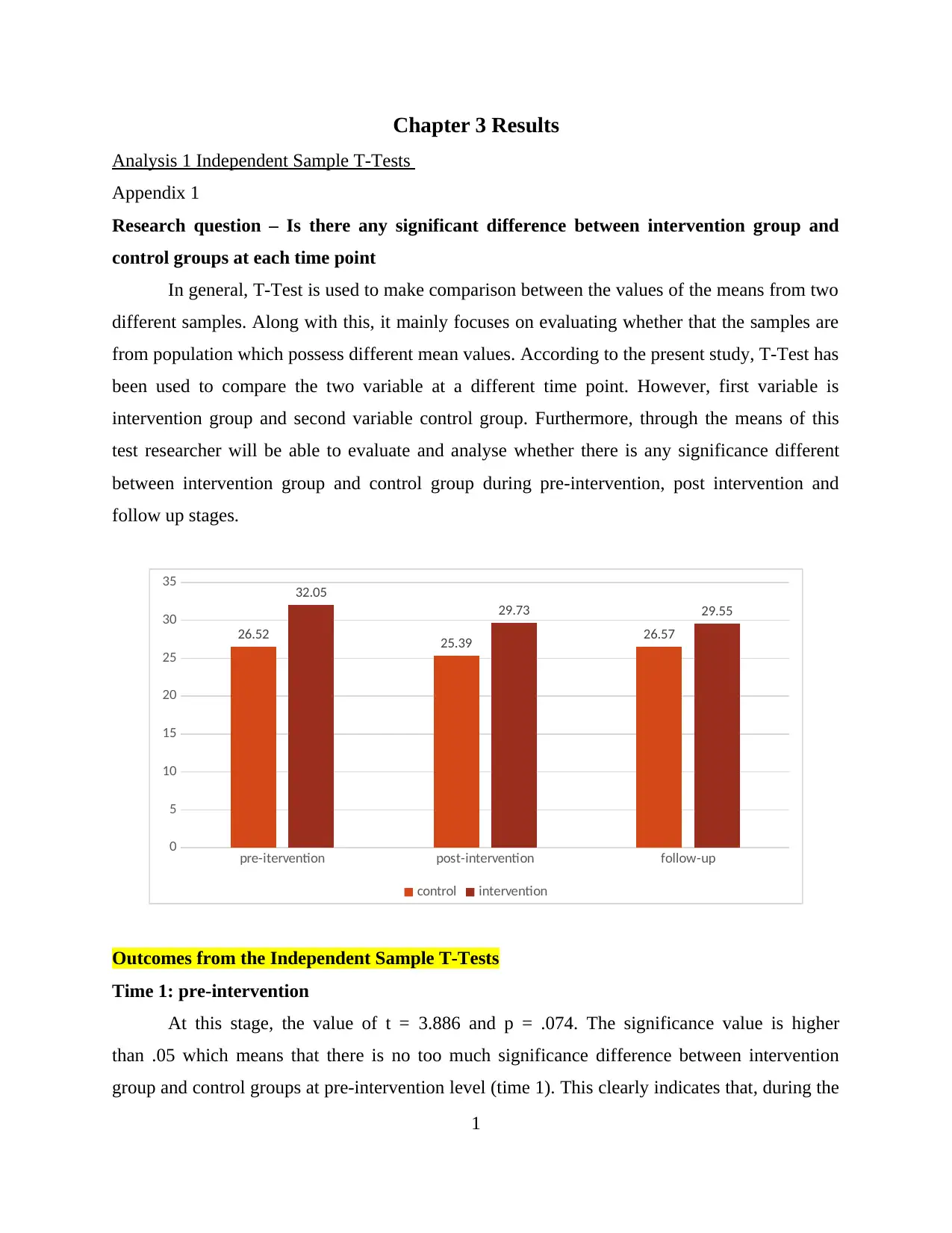
In general, T-Test is used to make comparison between the values of the means from two
different samples. Along with this, it mainly focuses on evaluating whether that the samples are
from population which possess different mean values. According to the present study, T-Test has
been used to compare the two variable at a different time point. However, first variable is
intervention group and second variable control group. Furthermore, through the means of this
test researcher will be able to evaluate and analyse whether there is any significance different
between intervention group and control group during pre-intervention, post intervention and
follow up stages.
pre-itervention post-intervention follow-up
0
5
10
15
20
25
30
35
26.52 25.39 26.57
32.05
29.73 29.55
control intervention
Outcomes from the Independent Sample T-Tests
Time 1: pre-intervention
At this stage, the value of t = 3.886 and p = .074. The significance value is higher
than .05 which means that there is no too much significance difference between intervention
group and control groups at pre-intervention level (time 1). This clearly indicates that, during the
1
Analysis 1 Independent Sample T-Tests
Appendix 1
Research question – Is there any significant difference between intervention group and
control groups at each time point
In general, T-Test is used to make comparison between the values of the means from two
different samples. Along with this, it mainly focuses on evaluating whether that the samples are
from population which possess different mean values. According to the present study, T-Test has
been used to compare the two variable at a different time point. However, first variable is
intervention group and second variable control group. Furthermore, through the means of this
test researcher will be able to evaluate and analyse whether there is any significance different
between intervention group and control group during pre-intervention, post intervention and
follow up stages.
pre-itervention post-intervention follow-up
0
5
10
15
20
25
30
35
26.52 25.39 26.57
32.05
29.73 29.55
control intervention
Outcomes from the Independent Sample T-Tests
Time 1: pre-intervention
At this stage, the value of t = 3.886 and p = .074. The significance value is higher
than .05 which means that there is no too much significance difference between intervention
group and control groups at pre-intervention level (time 1). This clearly indicates that, during the
1
Paraphrase This Document
Need a fresh take? Get an instant paraphrase of this document with our AI Paraphraser

treatment in pre-intervention stage, both category get equal treatment due to which there is no
such significance difference for the patients of diabetes.
Time 2: Post intervention
The results are showing that value of t = 3.236 and p = .017. The significance value in
this case is less than .05 which shows that there is high significance difference between
intervention group and control groups at follow up level (time 2).This clearly illustrates that, the
patients which are getting new treatments are different from the traditional treatment users.
Time 3: Follow Up
The results are showing that value of t = 2.496 and p =.100. The significance value in this
case is greater than .05 which means that there is no too much significance difference between
intervention group and control groups at follow up level (time 3). Herein, it can be said that,
during the follow up stage patients of both category intervention and control group acquire
similar type of treatments due to which there is not significance difference between them.
Analysis 2 Partial Correlation
Appendix 2
Research question: Is there any correlation between weight time and test score over 3 time
points during the treatment process of diabetes
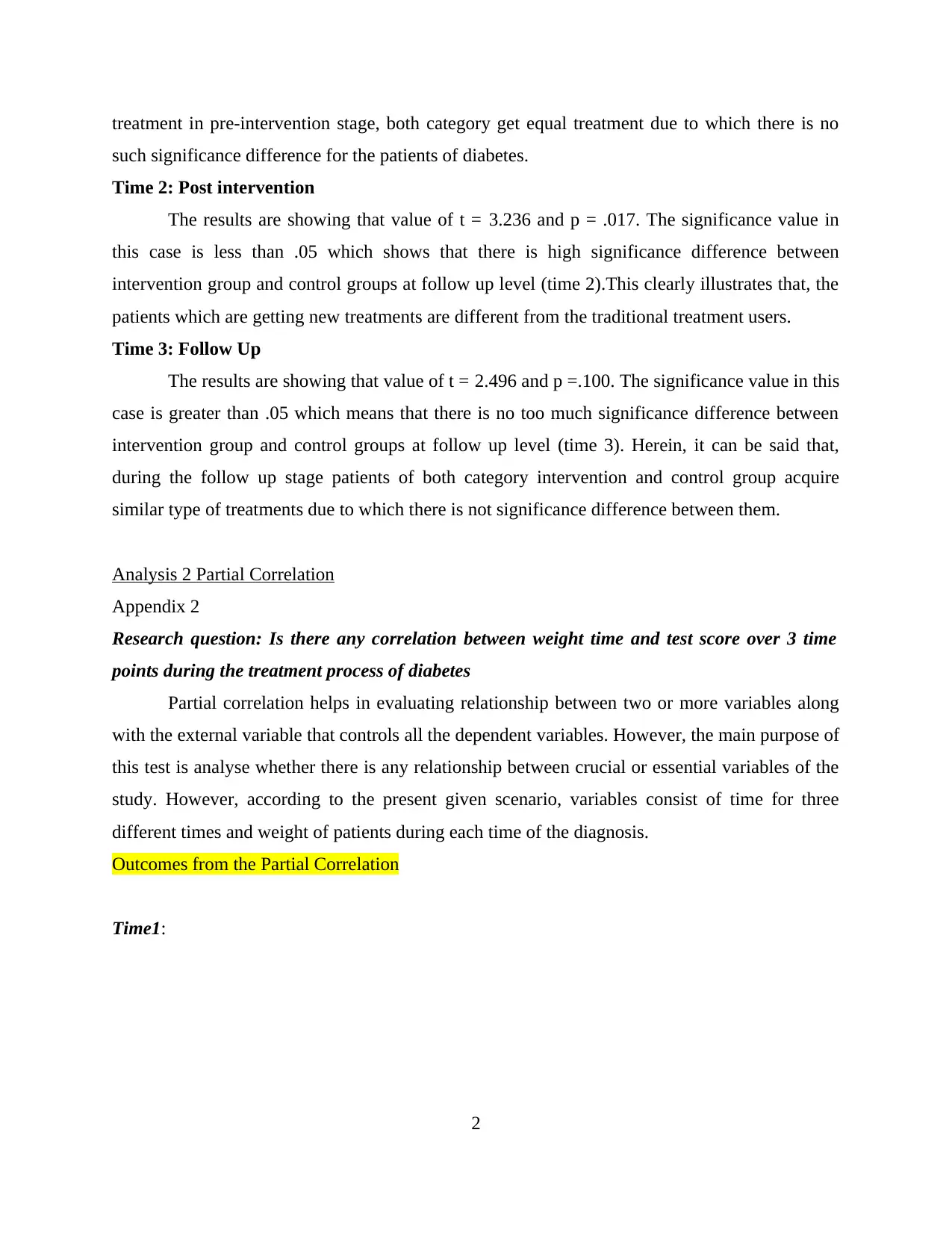
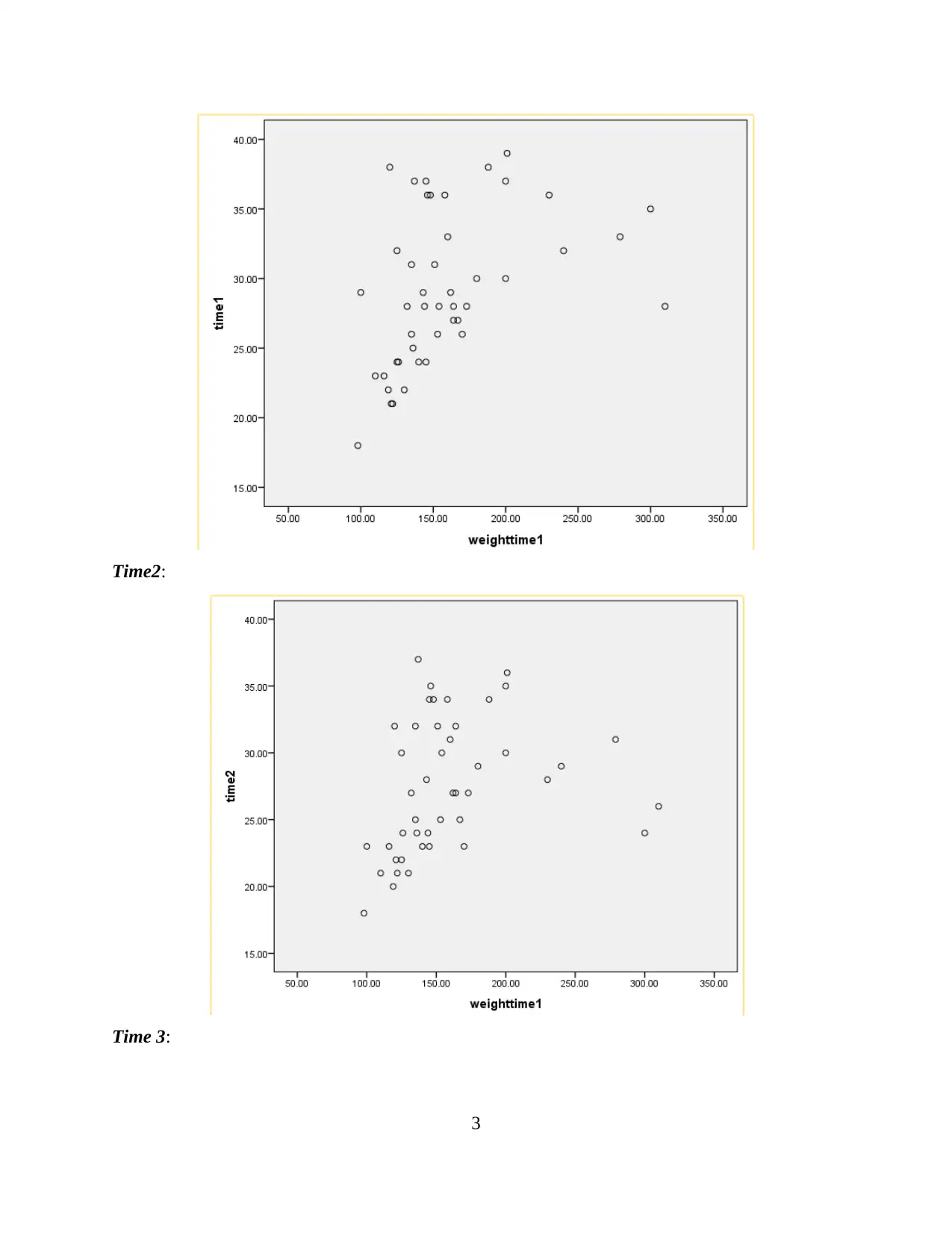
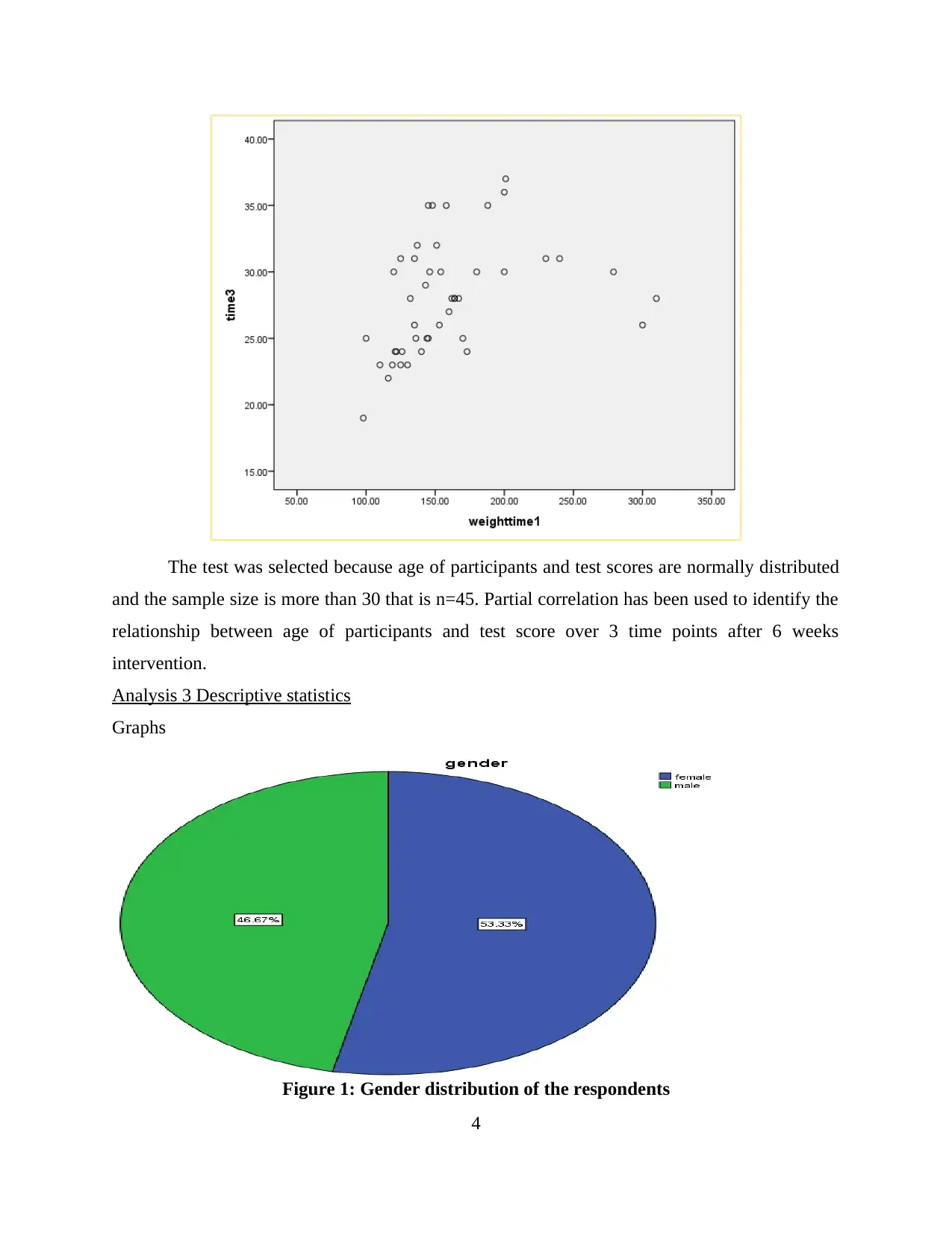
Partial correlation helps in evaluating relationship between two or more variables along
with the external variable that controls all the dependent variables. However, the main purpose of
this test is analyse whether there is any relationship between crucial or essential variables of the
study. However, according to the present given scenario, variables consist of time for three
different times and weight of patients during each time of the diagnosis.
Outcomes from the Partial Correlation
Time1:
2
such significance difference for the patients of diabetes.
Time 2: Post intervention
The results are showing that value of t = 3.236 and p = .017. The significance value in
this case is less than .05 which shows that there is high significance difference between
intervention group and control groups at follow up level (time 2).This clearly illustrates that, the
patients which are getting new treatments are different from the traditional treatment users.
Time 3: Follow Up
The results are showing that value of t = 2.496 and p =.100. The significance value in this
case is greater than .05 which means that there is no too much significance difference between
intervention group and control groups at follow up level (time 3). Herein, it can be said that,
during the follow up stage patients of both category intervention and control group acquire
similar type of treatments due to which there is not significance difference between them.
Analysis 2 Partial Correlation
Appendix 2
Research question: Is there any correlation between weight time and test score over 3 time
points during the treatment process of diabetes
Partial correlation helps in evaluating relationship between two or more variables along
with the external variable that controls all the dependent variables. However, the main purpose of
this test is analyse whether there is any relationship between crucial or essential variables of the
study. However, according to the present given scenario, variables consist of time for three
different times and weight of patients during each time of the diagnosis.
Outcomes from the Partial Correlation
Time1:
2

Time2:
Time 3:
3
Time 3:
3
⊘ This is a preview!⊘
Do you want full access?
Subscribe today to unlock all pages.

Trusted by 1+ million students worldwide

The test was selected because age of participants and test scores are normally distributed
and the sample size is more than 30 that is n=45. Partial correlation has been used to identify the
relationship between age of participants and test score over 3 time points after 6 weeks
intervention.
Analysis 3 Descriptive statistics
Graphs
Figure 1: Gender distribution of the respondents
4
and the sample size is more than 30 that is n=45. Partial correlation has been used to identify the
relationship between age of participants and test score over 3 time points after 6 weeks
intervention.
Analysis 3 Descriptive statistics
Graphs
Figure 1: Gender distribution of the respondents
4
Paraphrase This Document
Need a fresh take? Get an instant paraphrase of this document with our AI Paraphraser

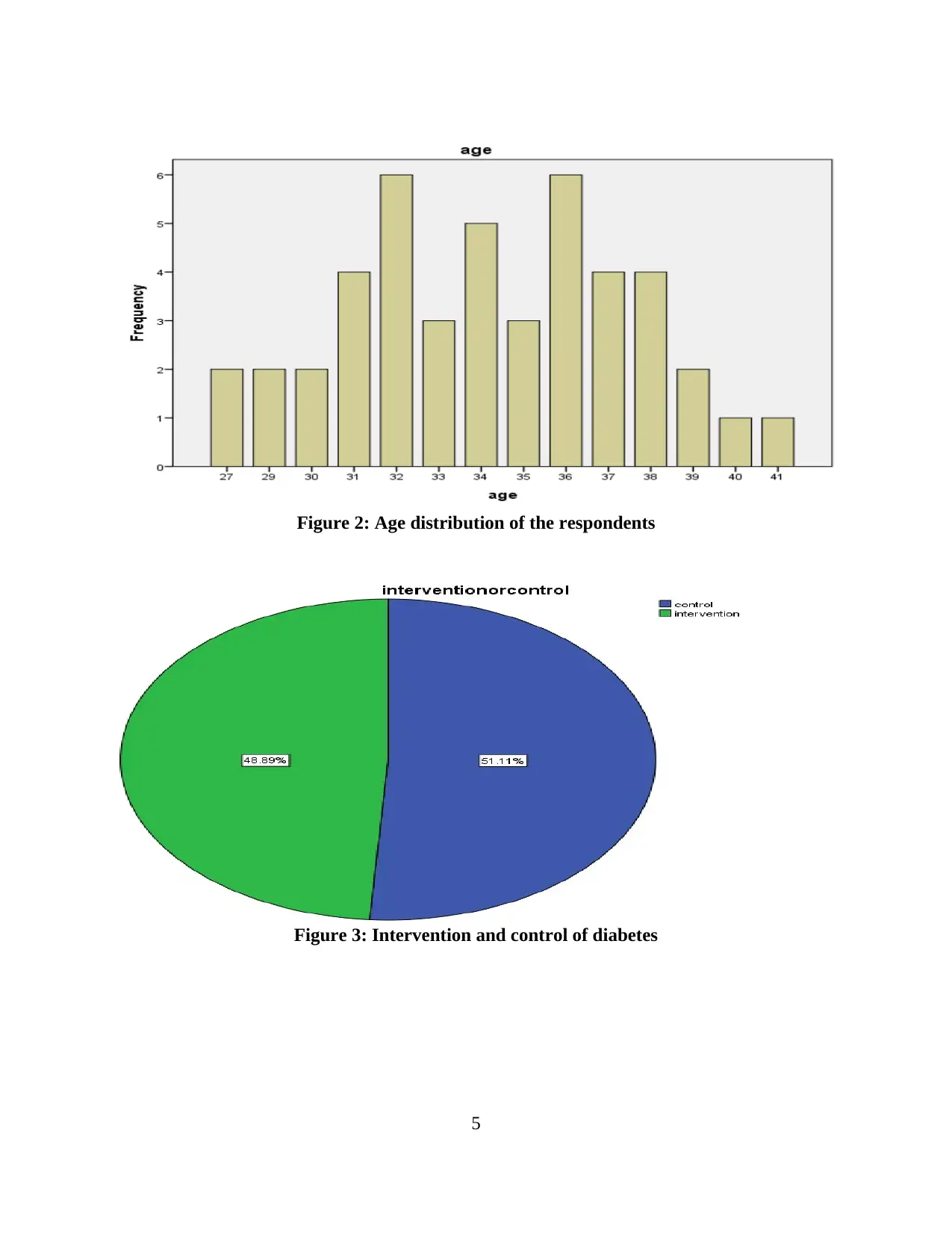
Figure 2: Age distribution of the respondents
Figure 3: Intervention and control of diabetes
5
Figure 3: Intervention and control of diabetes
5

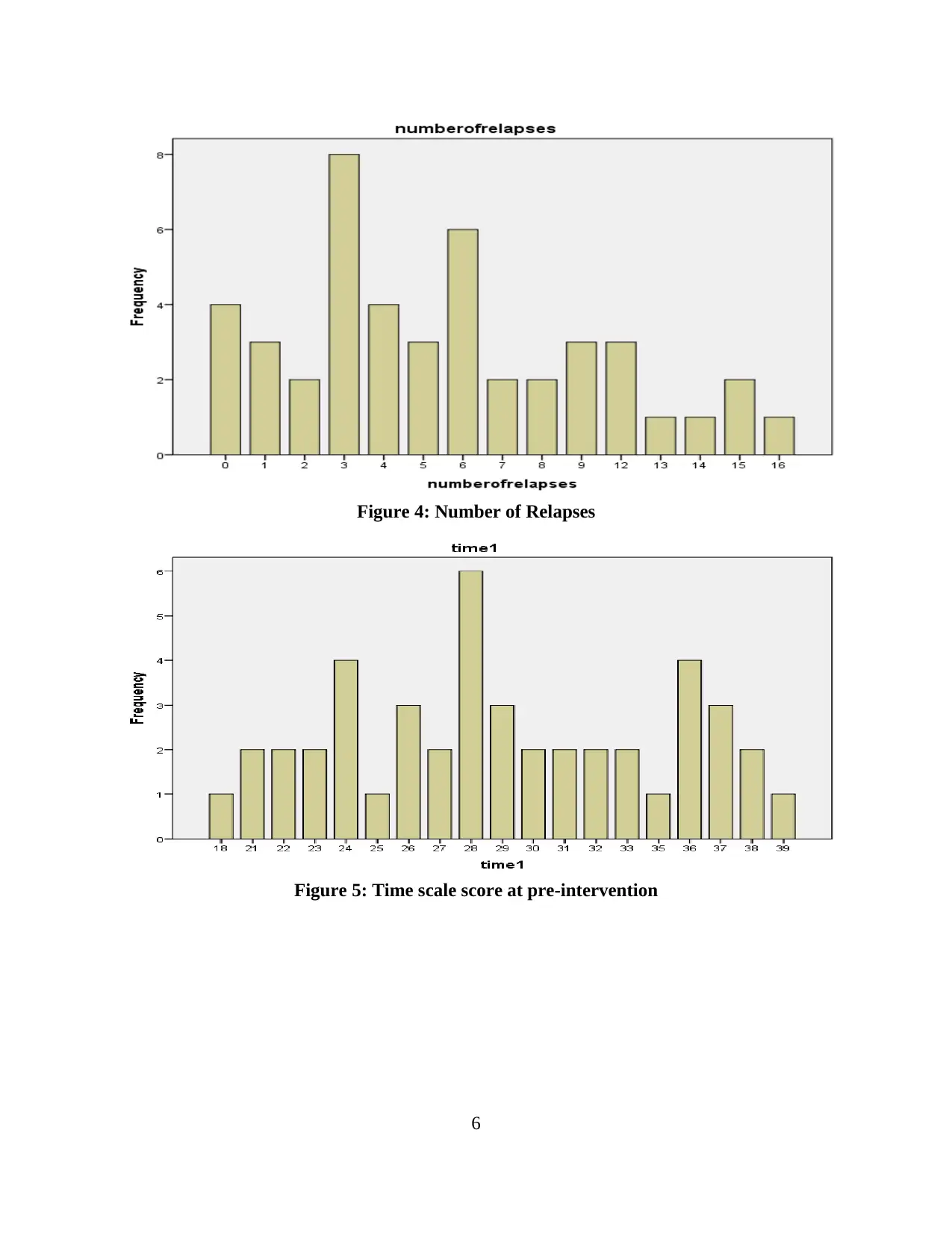
Figure 4: Number of Relapses
Figure 5: Time scale score at pre-intervention
6
Figure 5: Time scale score at pre-intervention
6
⊘ This is a preview!⊘
Do you want full access?
Subscribe today to unlock all pages.

Trusted by 1+ million students worldwide
1 out of 27
Related Documents
Your All-in-One AI-Powered Toolkit for Academic Success.
+13062052269
info@desklib.com
Available 24*7 on WhatsApp / Email
Unlock your academic potential
Copyright © 2020–2026 A2Z Services. All Rights Reserved. Developed and managed by ZUCOL.