MATHS 101 - Square of Opposition: Analysis of Statements

Verified

Added on  2023/04/23

|5
|708
|286
Homework Assignment
AI Summary
This assignment delves into the Square of Opposition, a fundamental concept in classical logic. It begins with an introduction to categorical logic, defining it as a set of statements asserting relationships between subjects and predicates, and highlighting the Square of Opposition's role in inferring the truth value of propositions. The assignment outlines the key features of the Square of Opposition including contraries, subcontraries, sub-alternations, contradictories, and super-alternations, and explains how statements are translated into standard-form claims (A, E, I, and O) to depict logical relationships. The paper further identifies the components of these claims: universal affirmative (A), universal negative (E), particular affirmative (I), and particular negative (O). An original example is provided, translating the statement "Most Africans are literate" into corresponding A, E, I, and O claims. The relationships between these claims and their truth values are then analyzed using the Square of Opposition. The conclusion emphasizes the usefulness of the Square of Opposition in quickly identifying truth values and analyzing qualitative data by offering insightful inferences.
Document Page
Running head: MATHS
1
The square of opposition
Student’s Name
Institutional Affiliation
Date
tabler-icon-diamond-filled.svg

Paraphrase This Document

Need a fresh take? Get an instant paraphrase of this document with our AI Paraphraser
Document Page
MATHS
2
The square of opposition
Introduction
The technique concisely is a square-shaped chart used among the classical logic to depict
the associations that are logical between various prepositions. It can also be viewed as a square
figure upon which the logical connections can be demonstrated concerning the contraries,
subcontraries, sub-alternations, contradictories, super-alternations. The discussion of the square
of opposition is outlined below.
Discussion
Categorical logic is a set of statements that assert a partial or whole association between
the subject and the predicate terms of the accounts. Peterson (2018) ascertained that there are
four forms of categorical logic, which include universal affirmative, universal negative,
particular affirmative, and particular negative. However, the purpose of the square of opposition
is to enable us for inferring to the true value of a proposition based upon the categorical
propositions that can give insightful meaning on quantity or quality in a statement. On the other
hand, the features of the square of opposition as discussed before are the contraries,
subcontraries, sub-alternations, contradictories, super-alternations. The statements can be
translated into standard form claims and their corresponding standard form claims using the
square of oppositions to describe the relationships that are depicted within the squares (Demey
and Smessaert, 2018). Firstly, we begin with a true claim on the top of the square, in essence, A
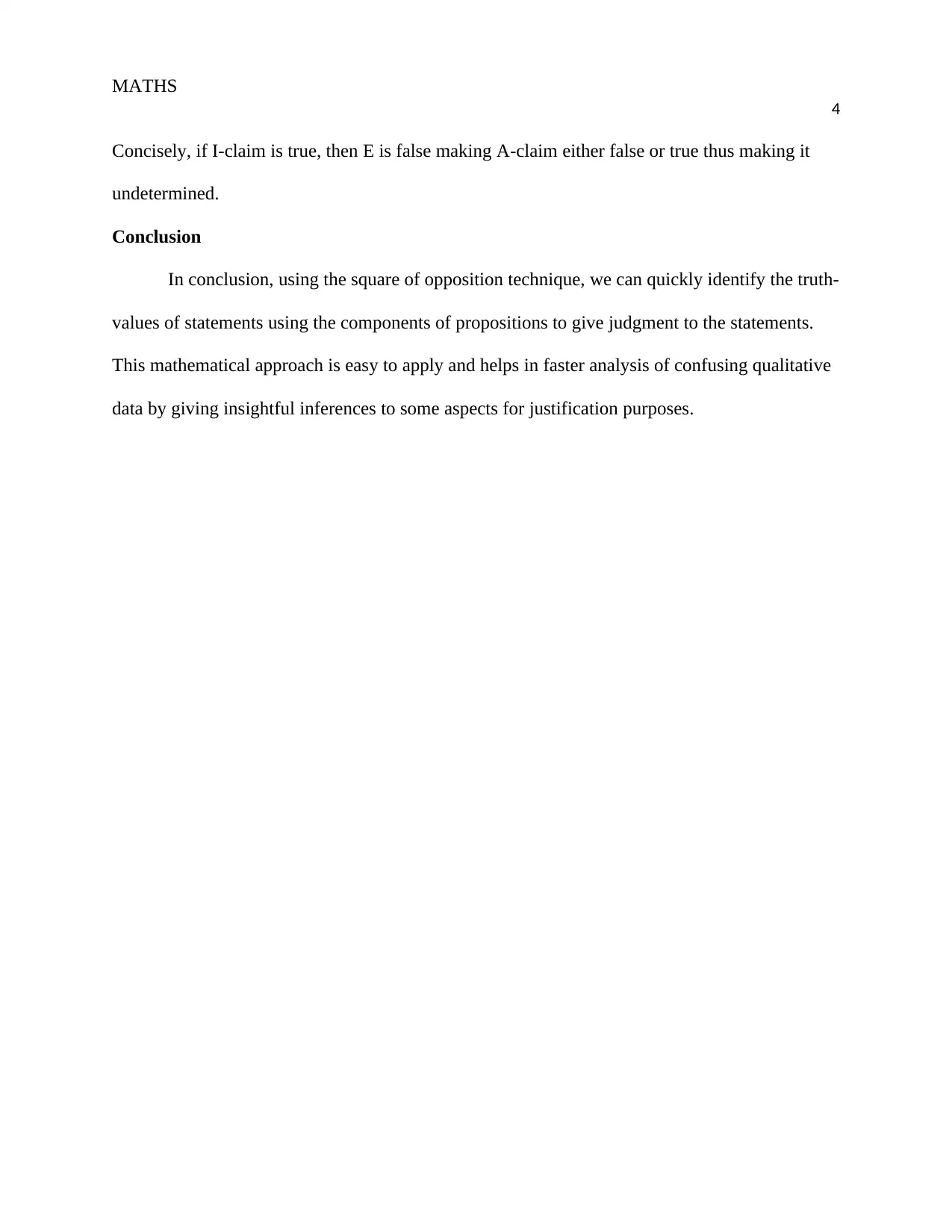
or E, or a false statement at the bottom of the square, in essence, I or O (as shown in figure 1).
For instance, knowing that claim A is true, we can depict that E is false; thus, O is also false
while I is true. Concisely, we can begin at the bottom with I or O claim as false and deduce the
truth values of the other three claims.
Document Page
MATHS
3
The components of prepositions (A, E, I, and O) as recognized in classical logic are given
as; A prepositions also known as universal affirmatives (All S are P). E is the universal negations
(No S are P). However, I prepositions also depicted as particular affirmatives (Some S are P)
whereas O prepositions or particular negations (Some S are not P) respectively. These
components of prepositions can be represented as shown below.
Figure 1: components of prepositions
An example of an original example using an ordinary statement.
Statement: Most Africans are literate.
Translation (I-claim): Some Africans are literate people. (True)
Corresponding A-claim: All Africans are literate people. (Undetermined)
Corresponding E-claim: No Africans are literate people. (False)
Corresponding O-claim: Some Africans are not literate people. (Undetermined)
Starting from the bottom of the square, we can deduce that the I-claim is true thus; O-claim can
be either true or false thus making it undermined since both sub-contraries can only be both true.
Document Page
MATHS
4
Concisely, if I-claim is true, then E is false making A-claim either false or true thus making it
undetermined.
Conclusion
In conclusion, using the square of opposition technique, we can quickly identify the truth-
values of statements using the components of propositions to give judgment to the statements.
This mathematical approach is easy to apply and helps in faster analysis of confusing qualitative
data by giving insightful inferences to some aspects for justification purposes.
tabler-icon-diamond-filled.svg

Paraphrase This Document

Need a fresh take? Get an instant paraphrase of this document with our AI Paraphraser
Document Page
MATHS
5
References
Demey, L., & Smessaert, H. (2018). Aristotelian and duality relations beyond the square of
opposition. In International Conference on Theory and Application of Diagrams (pp.
640-656). Springer, Cham.
Peterson, P. L. (2018). Intermediate Quantities: Logic, Linguistics and Aristotelian Semantics:
Logic, Linguistics and Aristotelian Semantics. London: Routledge.
chevron_up_icon
1 out of 5
circle_padding
hide_on_mobile
zoom_out_icon
[object Object]