Stakeholder Analysis Report: Coles Group - Semester 1, University

Verified

Added on  2021/04/21

|6
|773
|395
Report
AI Summary
This report presents a stakeholder analysis of the Coles Group, a major Australian supermarket chain. It begins with an introduction to stakeholder theory, defining stakeholders as individuals or groups affected by an organization's decisions and actions, according to Freeman (2010). The report then provides background information on Coles Group, including its history and ownership structure. The core of the analysis involves identifying both internal stakeholders (e.g., managers, employees) and external stakeholders (e.g., customers, government, suppliers). The report utilizes Freeman's framework and a stakeholder typology to categorize stakeholders based on their power, legitimacy, and urgency, as described by Mitchell, Agle & Wood (1997). The analysis highlights the importance of considering all stakeholders and managing relationships effectively. The report suggests that while customers are considered dependent, the company should prioritize understanding their needs, emphasizing the need to enhance the company's image and focus on consumer requirements. References include Freeman (2010), Mitchell, Agle & Wood (1997), and the Coles.com.au website.
Document Page
Running head: STAKEHOLDER ANALYSIS
Stakeholder Analysis
Name of the Student
Name of the University
Author’s note
tabler-icon-diamond-filled.svg

Paraphrase This Document

Need a fresh take? Get an instant paraphrase of this document with our AI Paraphraser
Document Page
1STAKEHOLDER ANALYSIS
Introduction
According to Freeman (2010), a stakeholder is a person or a group of people or an
organisation who are either positively or negatively affected by the decisions, policies and the
actions of the organisation they are associated with. The process of identifying the stakeholders
of an organisation and analyzing the intensity of their influence on the company and its operation
is stakeholder analysis. It is essential for the company to analyze the stakeholders as it helps the
company to manage the relationship with the stakeholders.
About the organisation
Coles group was founded in 1914, the company ceased its operation independently on
2007 and was taken under the parent organisation Wesfarmers. After the company was formed
under Wesfarmers’ ownership, there was a completely new management team. This team
devised a six-point plan to restore the pride and image of the company. This time the
management of Coles was focusing on the consumers as the most important stakeholders they
were convinced to provide the consumers a shop that would deliver quality, value and service of
high quality (Coles.com.au, 2018).
Document Page
2STAKEHOLDER ANALYSIS
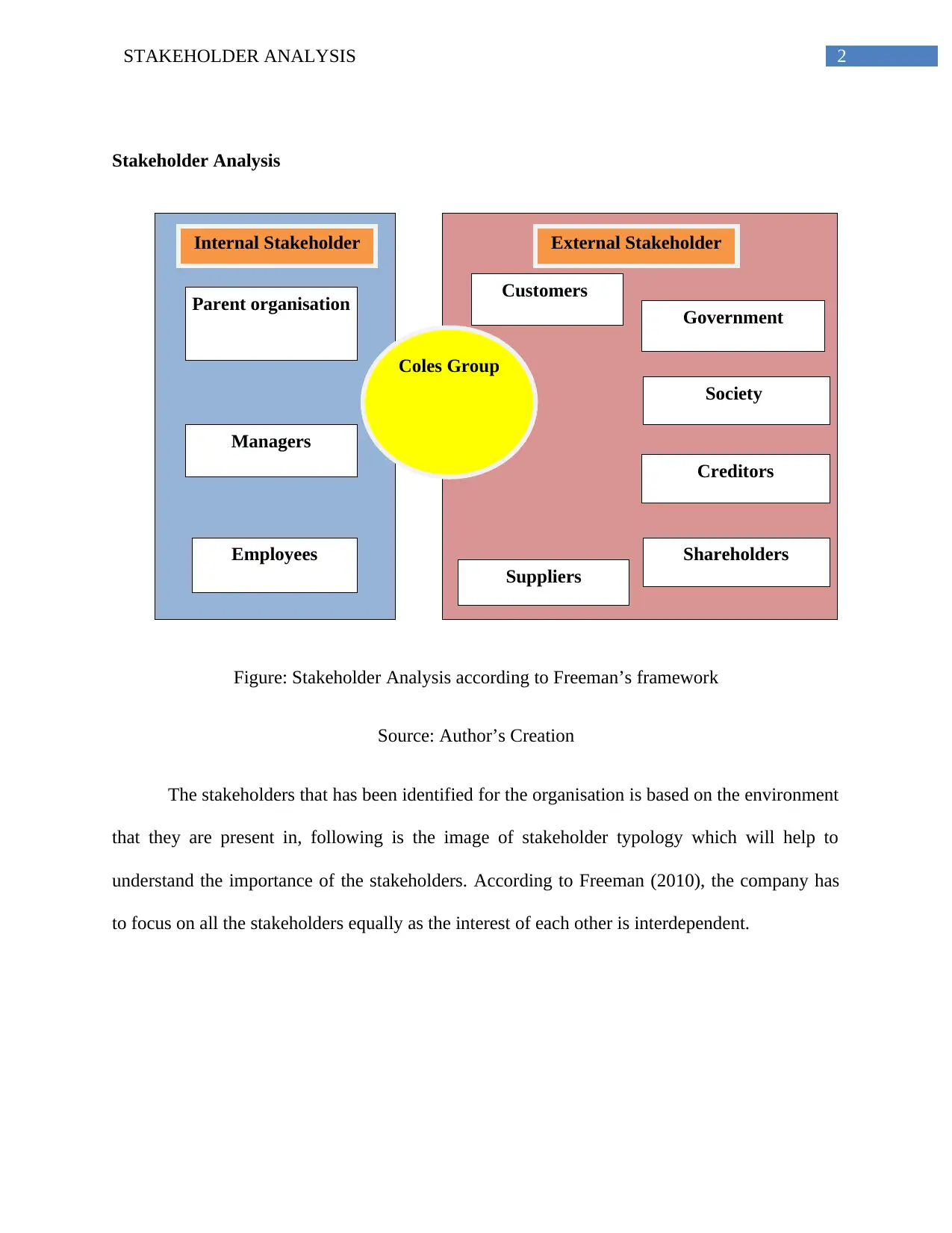
Coles Group
Internal Stakeholder External Stakeholder
Parent organisation
Managers
Employees
Customers
Government
Society
Creditors
Shareholders
Suppliers
Stakeholder Analysis
Figure: Stakeholder Analysis according to Freeman’s framework
Source: Author’s Creation
The stakeholders that has been identified for the organisation is based on the environment
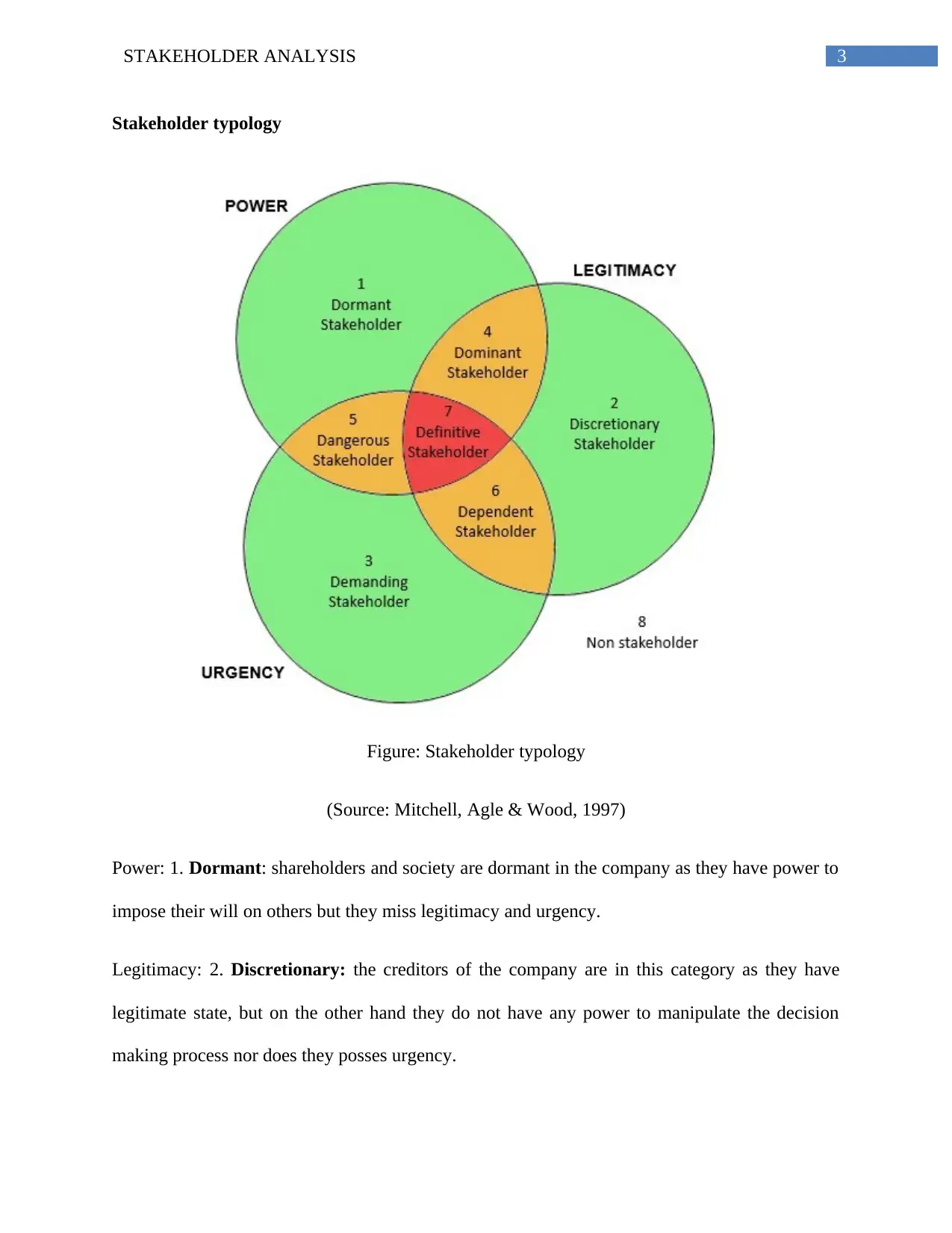
that they are present in, following is the image of stakeholder typology which will help to
understand the importance of the stakeholders. According to Freeman (2010), the company has
to focus on all the stakeholders equally as the interest of each other is interdependent.
Document Page
3STAKEHOLDER ANALYSIS
Stakeholder typology
Figure: Stakeholder typology
(Source: Mitchell, Agle & Wood, 1997)
Power: 1. Dormant: shareholders and society are dormant in the company as they have power to
impose their will on others but they miss legitimacy and urgency.
Legitimacy: 2. Discretionary: the creditors of the company are in this category as they have
legitimate state, but on the other hand they do not have any power to manipulate the decision
making process nor does they posses urgency.
tabler-icon-diamond-filled.svg

Paraphrase This Document

Need a fresh take? Get an instant paraphrase of this document with our AI Paraphraser
Document Page
4STAKEHOLDER ANALYSIS
Urgency: 3: Demanding: The employees of the company are in this segment as they their claims
are urgent in nature but they do not have power or legitimacy. The suppliers in this company are
in the demanding position as they are mostly from the parent company.
4. Dominant: the mangers are dominant stakeholders as they have power in the organisation and
also have legitimacy in their claims.
5. Dangerous: The government can be deemed as dangerous in this case as they have power to
influence the decisions of the company as well as have claims of urgency.
6. Dependent: The customers are dependent as they do not posses power but they have
legitimacy and urgency in their claims.
7. Definite stakeholders of the company is the parent organisation Wesfarmers, the management
of Wesfarmers have to be communicated and informed all the time regarding the proceeds of the
operation (Mitchell, Agle & Wood, 1997).
The management of Coles that is appointed by the parent organisation Wesfarmers, and
the position of the management in the Stakeholder typology have been observed in the dominant
position. On the other hand, the customers are provided the dependent position by the company,
but they should be in the dominant category and the company should invest in understanding the
requirements and needs accordingly develop or improve their products or services. This will help
the company focus more on the image of the company as well as on the requirement of the
consumers.
Document Page
5STAKEHOLDER ANALYSIS
Reference list:
Freeman, R. E. (2010). Strategic management: A stakeholder approach. Cambridge university
press.
Mitchell, R. K., Agle, B. R., & Wood, D. J. (1997). Toward a theory of stakeholder identification
and salience: Defining the principle of who and what really counts. Academy of
management review, 22(4), 853-886.
Coles.com.au. (2018). About Us. coles.com.au. Retrieved 17 March 2018, from
https://www.coles.com.au/about-coles
chevron_up_icon
1 out of 6
circle_padding
hide_on_mobile
zoom_out_icon
[object Object]