Detailed Stakeholder Analysis Report: Music Festival Event
VerifiedAdded on 2020/03/02
|11
|2437
|2344
Report
AI Summary
This report delves into the crucial aspect of stakeholder analysis within the context of music festival events. It emphasizes the significance of stakeholder management for the success of such events, highlighting the need to identify, categorize, and prioritize stakeholders. The report outlines key stakeholders, including media, artists, public authorities, sponsors, and attendees, and categorizes them as primary or secondary based on their influence and importance. It explores strategies for stakeholder engagement, such as collaboration, involvement, defensive, and monitoring approaches. Furthermore, it provides a detailed analysis of stakeholder power and interest, assessing their influence on event organization. The report also examines the risks associated with neglecting stakeholder analysis, such as potential event failure and inability to make informed decisions. It concludes with recommendations for building and maintaining strong stakeholder relationships, including regular communication and involvement in event planning. The document is a valuable resource for understanding stakeholder dynamics in the context of event management.
Running Head: Stakeholder Analysis of Music Festival Event1
Stakeholder Analysis of Music Festival Event
Student’s Name
Professor’s Name
Course Name
Stakeholder Analysis of Music Festival Event
Student’s Name
Professor’s Name
Course Name

Paraphrase This Document
Need a fresh take? Get an instant paraphrase of this document with our AI Paraphraser
Running Head: Stakeholder Analysis of Music Festival Event 2
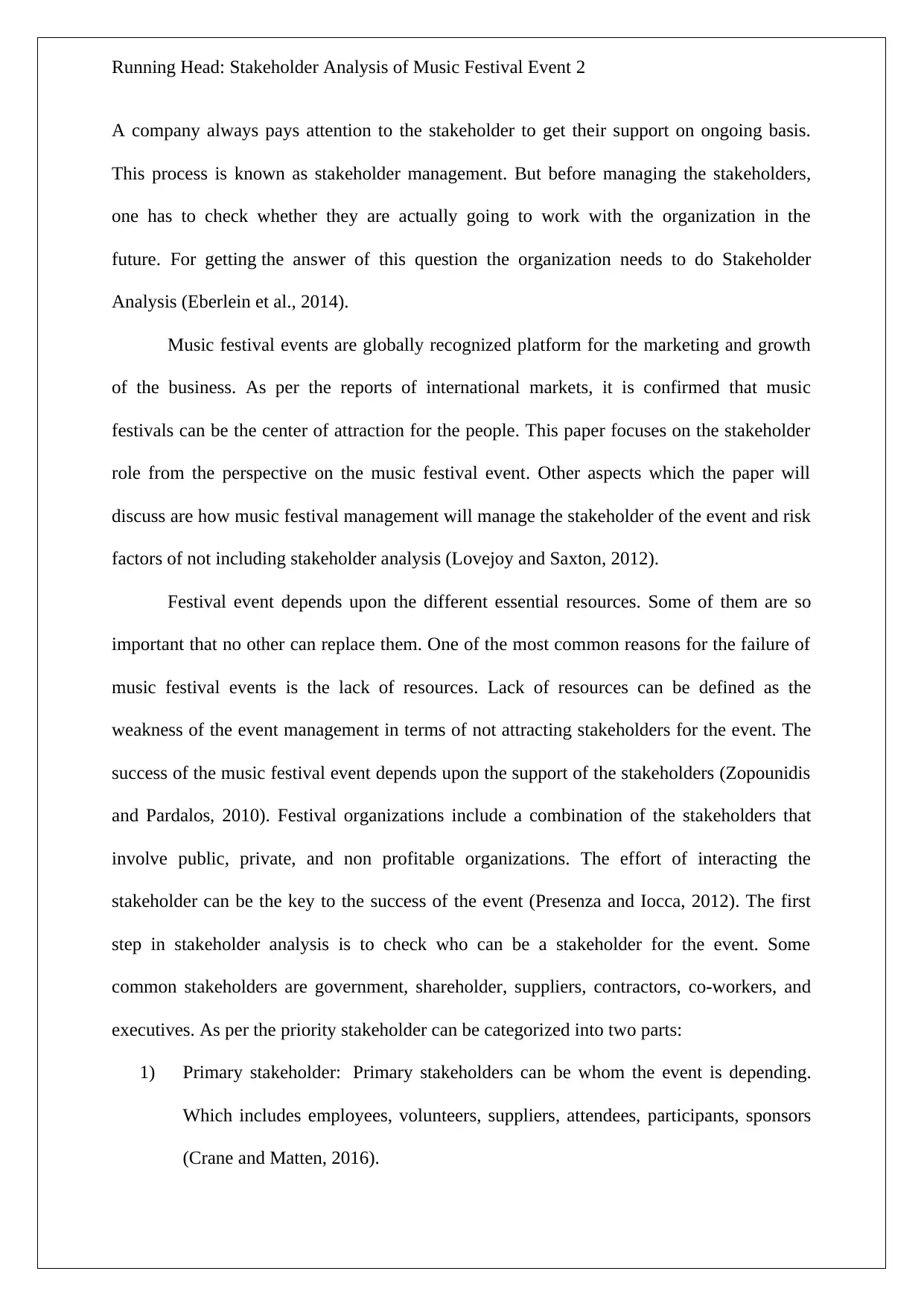
A company always pays attention to the stakeholder to get their support on ongoing basis.
This process is known as stakeholder management. But before managing the stakeholders,
one has to check whether they are actually going to work with the organization in the
future. For getting the answer of this question the organization needs to do Stakeholder
Analysis (Eberlein et al., 2014).
Music festival events are globally recognized platform for the marketing and growth
of the business. As per the reports of international markets, it is confirmed that music
festivals can be the center of attraction for the people. This paper focuses on the stakeholder
role from the perspective on the music festival event. Other aspects which the paper will
discuss are how music festival management will manage the stakeholder of the event and risk
factors of not including stakeholder analysis (Lovejoy and Saxton, 2012).
Festival event depends upon the different essential resources. Some of them are so
important that no other can replace them. One of the most common reasons for the failure of
music festival events is the lack of resources. Lack of resources can be defined as the
weakness of the event management in terms of not attracting stakeholders for the event. The
success of the music festival event depends upon the support of the stakeholders (Zopounidis
and Pardalos, 2010). Festival organizations include a combination of the stakeholders that
involve public, private, and non profitable organizations. The effort of interacting the
stakeholder can be the key to the success of the event (Presenza and Iocca, 2012). The first
step in stakeholder analysis is to check who can be a stakeholder for the event. Some
common stakeholders are government, shareholder, suppliers, contractors, co-workers, and
executives. As per the priority stakeholder can be categorized into two parts:
1) Primary stakeholder: Primary stakeholders can be whom the event is depending.
Which includes employees, volunteers, suppliers, attendees, participants, sponsors
(Crane and Matten, 2016).
A company always pays attention to the stakeholder to get their support on ongoing basis.
This process is known as stakeholder management. But before managing the stakeholders,
one has to check whether they are actually going to work with the organization in the
future. For getting the answer of this question the organization needs to do Stakeholder
Analysis (Eberlein et al., 2014).
Music festival events are globally recognized platform for the marketing and growth
of the business. As per the reports of international markets, it is confirmed that music
festivals can be the center of attraction for the people. This paper focuses on the stakeholder
role from the perspective on the music festival event. Other aspects which the paper will
discuss are how music festival management will manage the stakeholder of the event and risk
factors of not including stakeholder analysis (Lovejoy and Saxton, 2012).
Festival event depends upon the different essential resources. Some of them are so
important that no other can replace them. One of the most common reasons for the failure of
music festival events is the lack of resources. Lack of resources can be defined as the
weakness of the event management in terms of not attracting stakeholders for the event. The
success of the music festival event depends upon the support of the stakeholders (Zopounidis
and Pardalos, 2010). Festival organizations include a combination of the stakeholders that
involve public, private, and non profitable organizations. The effort of interacting the
stakeholder can be the key to the success of the event (Presenza and Iocca, 2012). The first
step in stakeholder analysis is to check who can be a stakeholder for the event. Some
common stakeholders are government, shareholder, suppliers, contractors, co-workers, and
executives. As per the priority stakeholder can be categorized into two parts:
1) Primary stakeholder: Primary stakeholders can be whom the event is depending.
Which includes employees, volunteers, suppliers, attendees, participants, sponsors
(Crane and Matten, 2016).
Running Head: Stakeholder Analysis of Music Festival Event 3
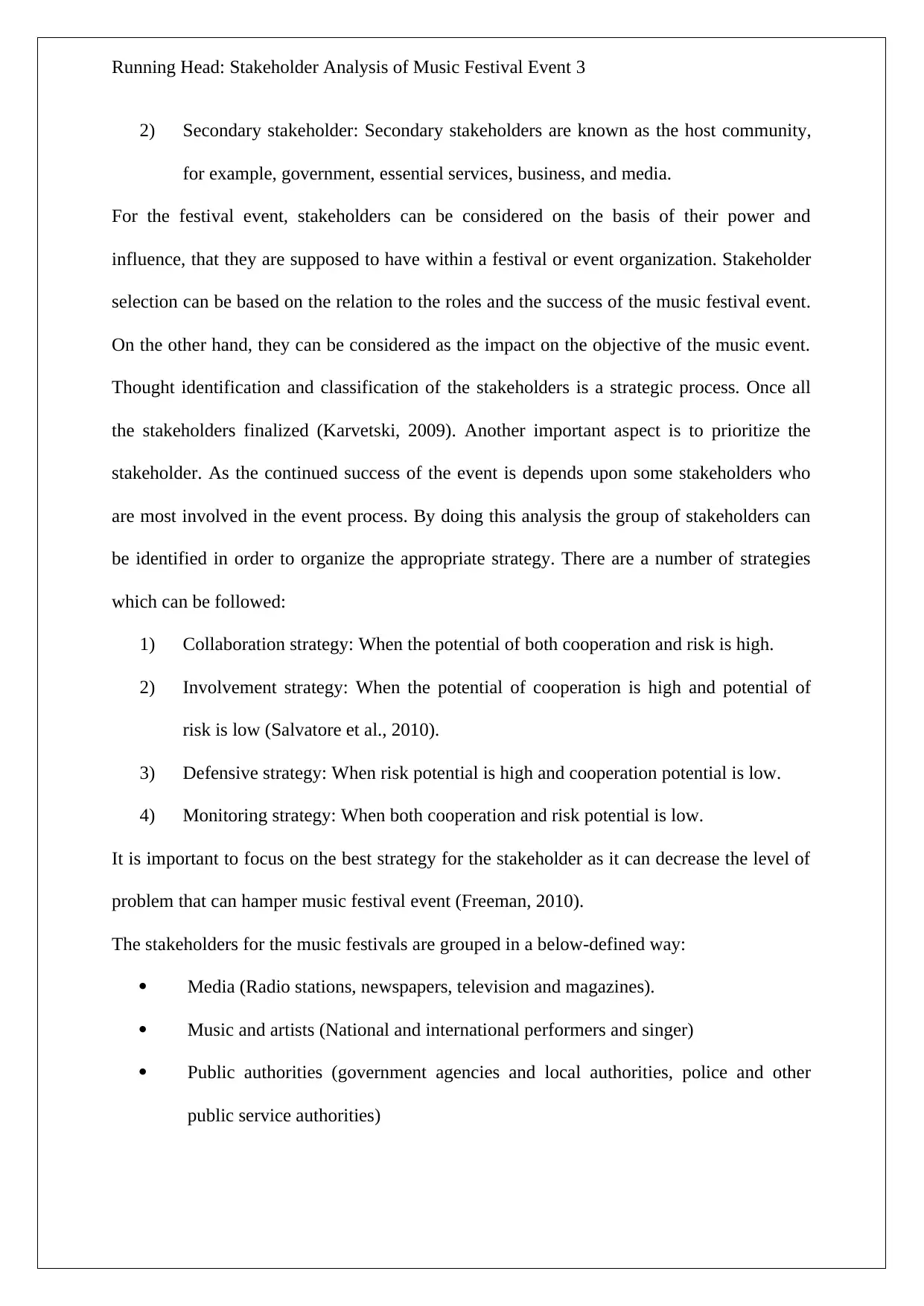
2) Secondary stakeholder: Secondary stakeholders are known as the host community,
for example, government, essential services, business, and media.
For the festival event, stakeholders can be considered on the basis of their power and
influence, that they are supposed to have within a festival or event organization. Stakeholder
selection can be based on the relation to the roles and the success of the music festival event.
On the other hand, they can be considered as the impact on the objective of the music event.
Thought identification and classification of the stakeholders is a strategic process. Once all
the stakeholders finalized (Karvetski, 2009). Another important aspect is to prioritize the
stakeholder. As the continued success of the event is depends upon some stakeholders who
are most involved in the event process. By doing this analysis the group of stakeholders can
be identified in order to organize the appropriate strategy. There are a number of strategies
which can be followed:
1) Collaboration strategy: When the potential of both cooperation and risk is high.
2) Involvement strategy: When the potential of cooperation is high and potential of
risk is low (Salvatore et al., 2010).
3) Defensive strategy: When risk potential is high and cooperation potential is low.
4) Monitoring strategy: When both cooperation and risk potential is low.
It is important to focus on the best strategy for the stakeholder as it can decrease the level of
problem that can hamper music festival event (Freeman, 2010).
The stakeholders for the music festivals are grouped in a below-defined way:
Media (Radio stations, newspapers, television and magazines).
Music and artists (National and international performers and singer)
Public authorities (government agencies and local authorities, police and other
public service authorities)
2) Secondary stakeholder: Secondary stakeholders are known as the host community,
for example, government, essential services, business, and media.
For the festival event, stakeholders can be considered on the basis of their power and
influence, that they are supposed to have within a festival or event organization. Stakeholder
selection can be based on the relation to the roles and the success of the music festival event.
On the other hand, they can be considered as the impact on the objective of the music event.
Thought identification and classification of the stakeholders is a strategic process. Once all
the stakeholders finalized (Karvetski, 2009). Another important aspect is to prioritize the
stakeholder. As the continued success of the event is depends upon some stakeholders who
are most involved in the event process. By doing this analysis the group of stakeholders can
be identified in order to organize the appropriate strategy. There are a number of strategies
which can be followed:
1) Collaboration strategy: When the potential of both cooperation and risk is high.
2) Involvement strategy: When the potential of cooperation is high and potential of
risk is low (Salvatore et al., 2010).
3) Defensive strategy: When risk potential is high and cooperation potential is low.
4) Monitoring strategy: When both cooperation and risk potential is low.
It is important to focus on the best strategy for the stakeholder as it can decrease the level of
problem that can hamper music festival event (Freeman, 2010).
The stakeholders for the music festivals are grouped in a below-defined way:
Media (Radio stations, newspapers, television and magazines).
Music and artists (National and international performers and singer)
Public authorities (government agencies and local authorities, police and other
public service authorities)
⊘ This is a preview!⊘
Do you want full access?
Subscribe today to unlock all pages.

Trusted by 1+ million students worldwide
Running Head: Stakeholder Analysis of Music Festival Event 4
Sponsors(Small and big organizations that use the festival as a marketing tool for
their products).
Suppliers(all food and beverage suppliers)
Visitors(Trading intermediates) (Andriof, 2017).
Tourism traders (Hotel and restaurant associations)
Non profitable Independent organizations (Working towards to promote and
organize the festival)
Prioritize stakeholders: After getting the list of stakeholders second important task is to find
out major stakeholders, those are really interested in the event and have to ignore those who
do not care at all (Darnall et al., 2010). Some of these might be having power and can block
and enhance your event activities. Even with limited resource information on most important
stakeholder can be generated. Steps to find out valued stakeholders:
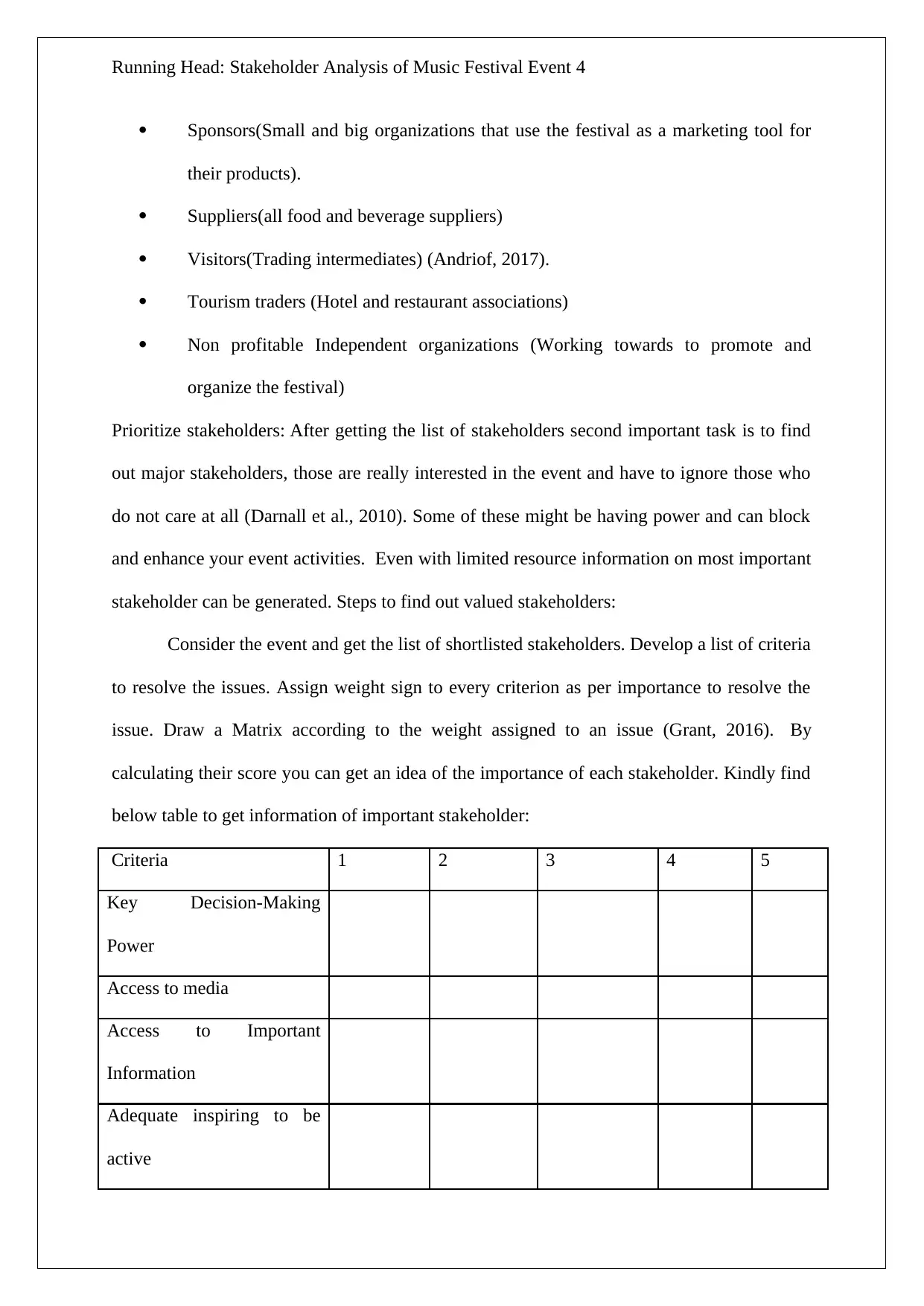
Consider the event and get the list of shortlisted stakeholders. Develop a list of criteria
to resolve the issues. Assign weight sign to every criterion as per importance to resolve the
issue. Draw a Matrix according to the weight assigned to an issue (Grant, 2016). By
calculating their score you can get an idea of the importance of each stakeholder. Kindly find
below table to get information of important stakeholder:
Criteria 1 2 3 4 5
Key Decision-Making
Power
Access to media
Access to Important
Information
Adequate inspiring to be
active
Sponsors(Small and big organizations that use the festival as a marketing tool for
their products).
Suppliers(all food and beverage suppliers)
Visitors(Trading intermediates) (Andriof, 2017).
Tourism traders (Hotel and restaurant associations)
Non profitable Independent organizations (Working towards to promote and
organize the festival)
Prioritize stakeholders: After getting the list of stakeholders second important task is to find
out major stakeholders, those are really interested in the event and have to ignore those who
do not care at all (Darnall et al., 2010). Some of these might be having power and can block
and enhance your event activities. Even with limited resource information on most important
stakeholder can be generated. Steps to find out valued stakeholders:
Consider the event and get the list of shortlisted stakeholders. Develop a list of criteria
to resolve the issues. Assign weight sign to every criterion as per importance to resolve the
issue. Draw a Matrix according to the weight assigned to an issue (Grant, 2016). By
calculating their score you can get an idea of the importance of each stakeholder. Kindly find
below table to get information of important stakeholder:
Criteria 1 2 3 4 5
Key Decision-Making
Power
Access to media
Access to Important
Information
Adequate inspiring to be
active
Paraphrase This Document
Need a fresh take? Get an instant paraphrase of this document with our AI Paraphraser
Running Head: Stakeholder Analysis of Music Festival Event 5
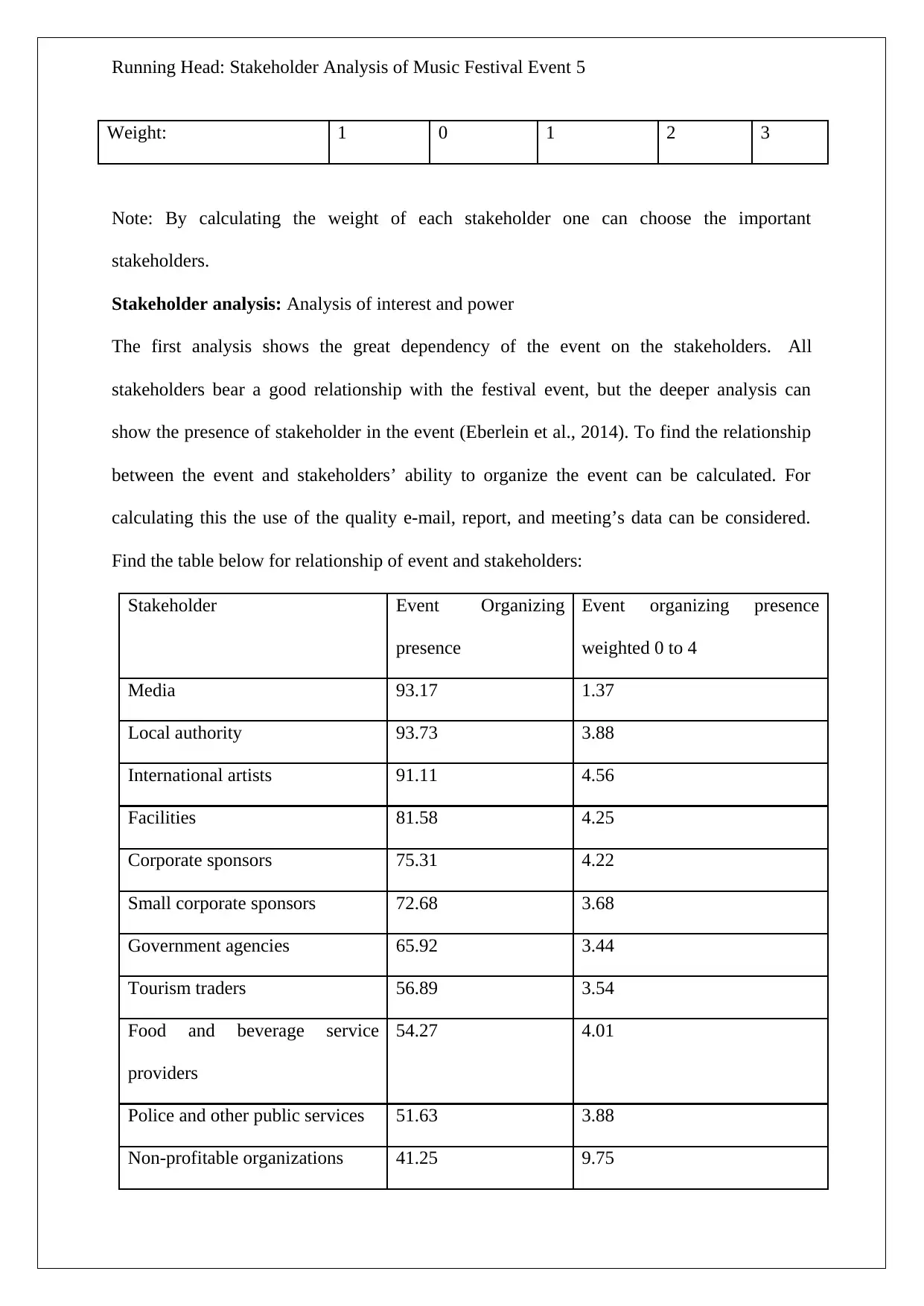
Weight: 1 0 1 2 3
Note: By calculating the weight of each stakeholder one can choose the important
stakeholders.
Stakeholder analysis: Analysis of interest and power
The first analysis shows the great dependency of the event on the stakeholders. All
stakeholders bear a good relationship with the festival event, but the deeper analysis can
show the presence of stakeholder in the event (Eberlein et al., 2014). To find the relationship
between the event and stakeholders’ ability to organize the event can be calculated. For
calculating this the use of the quality e-mail, report, and meeting’s data can be considered.
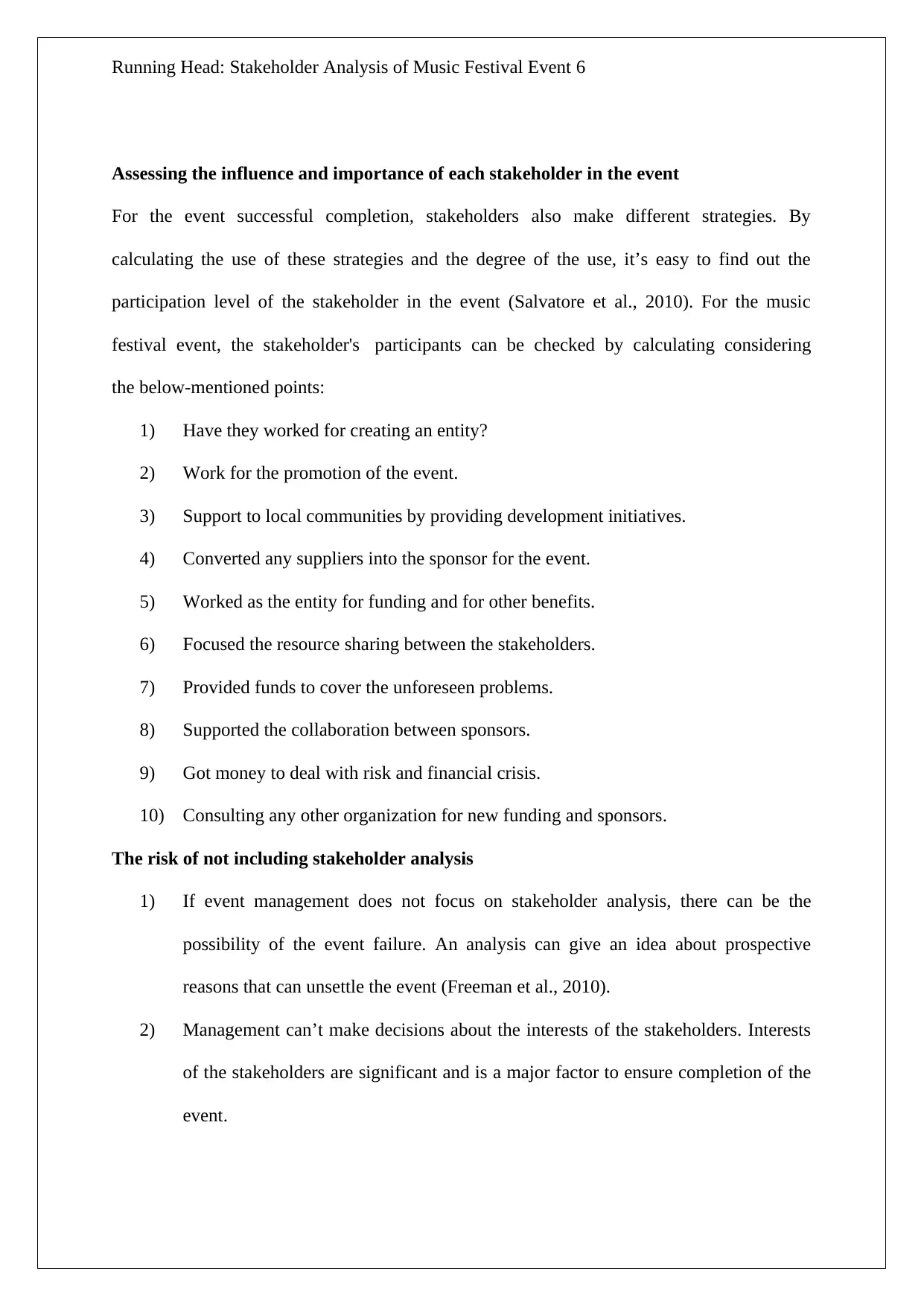
Find the table below for relationship of event and stakeholders:
Stakeholder Event Organizing
presence
Event organizing presence
weighted 0 to 4
Media 93.17 1.37
Local authority 93.73 3.88
International artists 91.11 4.56
Facilities 81.58 4.25
Corporate sponsors 75.31 4.22
Small corporate sponsors 72.68 3.68
Government agencies 65.92 3.44
Tourism traders 56.89 3.54
Food and beverage service
providers
54.27 4.01
Police and other public services 51.63 3.88
Non-profitable organizations 41.25 9.75
Weight: 1 0 1 2 3
Note: By calculating the weight of each stakeholder one can choose the important
stakeholders.
Stakeholder analysis: Analysis of interest and power
The first analysis shows the great dependency of the event on the stakeholders. All
stakeholders bear a good relationship with the festival event, but the deeper analysis can
show the presence of stakeholder in the event (Eberlein et al., 2014). To find the relationship
between the event and stakeholders’ ability to organize the event can be calculated. For
calculating this the use of the quality e-mail, report, and meeting’s data can be considered.
Find the table below for relationship of event and stakeholders:
Stakeholder Event Organizing
presence
Event organizing presence
weighted 0 to 4
Media 93.17 1.37
Local authority 93.73 3.88
International artists 91.11 4.56
Facilities 81.58 4.25
Corporate sponsors 75.31 4.22
Small corporate sponsors 72.68 3.68
Government agencies 65.92 3.44
Tourism traders 56.89 3.54
Food and beverage service
providers
54.27 4.01
Police and other public services 51.63 3.88
Non-profitable organizations 41.25 9.75
Running Head: Stakeholder Analysis of Music Festival Event 6
Assessing the influence and importance of each stakeholder in the event
For the event successful completion, stakeholders also make different strategies. By
calculating the use of these strategies and the degree of the use, it’s easy to find out the
participation level of the stakeholder in the event (Salvatore et al., 2010). For the music
festival event, the stakeholder's participants can be checked by calculating considering
the below-mentioned points:
1) Have they worked for creating an entity?
2) Work for the promotion of the event.
3) Support to local communities by providing development initiatives.
4) Converted any suppliers into the sponsor for the event.
5) Worked as the entity for funding and for other benefits.
6) Focused the resource sharing between the stakeholders.
7) Provided funds to cover the unforeseen problems.
8) Supported the collaboration between sponsors.
9) Got money to deal with risk and financial crisis.
10) Consulting any other organization for new funding and sponsors.
The risk of not including stakeholder analysis
1) If event management does not focus on stakeholder analysis, there can be the
possibility of the event failure. An analysis can give an idea about prospective
reasons that can unsettle the event (Freeman et al., 2010).
2) Management can’t make decisions about the interests of the stakeholders. Interests
of the stakeholders are significant and is a major factor to ensure completion of the
event.
Assessing the influence and importance of each stakeholder in the event
For the event successful completion, stakeholders also make different strategies. By
calculating the use of these strategies and the degree of the use, it’s easy to find out the
participation level of the stakeholder in the event (Salvatore et al., 2010). For the music
festival event, the stakeholder's participants can be checked by calculating considering
the below-mentioned points:
1) Have they worked for creating an entity?
2) Work for the promotion of the event.
3) Support to local communities by providing development initiatives.
4) Converted any suppliers into the sponsor for the event.
5) Worked as the entity for funding and for other benefits.
6) Focused the resource sharing between the stakeholders.
7) Provided funds to cover the unforeseen problems.
8) Supported the collaboration between sponsors.
9) Got money to deal with risk and financial crisis.
10) Consulting any other organization for new funding and sponsors.
The risk of not including stakeholder analysis
1) If event management does not focus on stakeholder analysis, there can be the
possibility of the event failure. An analysis can give an idea about prospective
reasons that can unsettle the event (Freeman et al., 2010).
2) Management can’t make decisions about the interests of the stakeholders. Interests
of the stakeholders are significant and is a major factor to ensure completion of the
event.
⊘ This is a preview!⊘
Do you want full access?
Subscribe today to unlock all pages.
Trusted by 1+ million students worldwide
Running Head: Stakeholder Analysis of Music Festival Event 7
3) An event management may not able to find the group of stakeholders that might
become the part of different stages of the event.
4) Stakeholder analysis helps the management to discover negative impacts or
negative stakeholders.
5) Key people are important to every event. To find out a special team to perform
specified tasks, one can take help from stakeholder analysis. In the absence of
analysis that would become a tedious task.
6) Stakeholders can help to build communication and management strategies during
the planning phase of the event else event can be the biggest failure
7) If the event management does not focus on the analysis of stakeholders then they
never can access effective risk issues in advance and can work with them to prevent
from disapproval.
Stakeholders are always defined in two groups; one group consists of persons who are the
permanent part of the event and another group consists of the persons who are not a
permanent part of the event but still play an important role in the successful completion of the
event. At the starting of the event, it is important to find out important stakeholders and
assess individuals to make relationship long-lasting. Once the organization have approached
key issues to engage them in their event, it can lead to more successful plans. Below are some
points can help to retain the trust of stakeholders:
1) Always aim for strong bonding. Involve them in shaping and training strategies.
Organizations should share their vision with them and try to make them an essential
part of the event.
2) Seek advice and tell them to assist in between the event. Tell them to give
suggestions if anyone is not managing things properly.
3) Regular meeting with the stakeholders to keep abreast of all developments.
3) An event management may not able to find the group of stakeholders that might
become the part of different stages of the event.
4) Stakeholder analysis helps the management to discover negative impacts or
negative stakeholders.
5) Key people are important to every event. To find out a special team to perform
specified tasks, one can take help from stakeholder analysis. In the absence of
analysis that would become a tedious task.
6) Stakeholders can help to build communication and management strategies during
the planning phase of the event else event can be the biggest failure
7) If the event management does not focus on the analysis of stakeholders then they
never can access effective risk issues in advance and can work with them to prevent
from disapproval.
Stakeholders are always defined in two groups; one group consists of persons who are the
permanent part of the event and another group consists of the persons who are not a
permanent part of the event but still play an important role in the successful completion of the
event. At the starting of the event, it is important to find out important stakeholders and
assess individuals to make relationship long-lasting. Once the organization have approached
key issues to engage them in their event, it can lead to more successful plans. Below are some
points can help to retain the trust of stakeholders:
1) Always aim for strong bonding. Involve them in shaping and training strategies.
Organizations should share their vision with them and try to make them an essential
part of the event.
2) Seek advice and tell them to assist in between the event. Tell them to give
suggestions if anyone is not managing things properly.
3) Regular meeting with the stakeholders to keep abreast of all developments.
Paraphrase This Document
Need a fresh take? Get an instant paraphrase of this document with our AI Paraphraser
Running Head: Stakeholder Analysis of Music Festival Event 8
4) Organizations should keep their communication simple and effective and always
focus on key points by giving them an overview of success achieved.
5) Organization needs to share their event plan with them so that they built confidence
in you.
6) Develop a number of risk handling process proactively in advance so that they have
an idea about the solution not about the problem.
Reference
Darnall N., Henriques I., Sadorsky P. (2010). Adopting Proactive Environmental Strategy:
The Influence of Stakeholders and Firm Size. Journal of Management Studies
Volume 47, Issue 6, pages 1072–1094. Retrieved from:
http://onlinelibrary.wiley.com/doi/10.1111/j.1467- 6486.2009.00873.x/epdf?
r3_referer=wol&tracking_action=preview_click&show_checkout=1&purchase_referrer=onli
nelibrary.wiley.com&purchase_site_license=LICENSE_DENIED
Lovejoy K., Saxton G. (2012). Information, Community, and Action: How Nonprofit
Organizations Use Social Media. Journal of computer mediated communication, Volume 17,
Issue3,April2012 Pages337–353.Retrieved from:
http://onlinelibrary.wiley.com/doi/10.1111/j.1083-6101.2012.01576.x/full
Eberlein B., Abbott K., Black J., Meidinger E., Wood S. (2014). Transnational business
governance interactions: Conceptualization and framework for analysis. Strategic
management journal, Volume 8, Issue 1
4) Organizations should keep their communication simple and effective and always
focus on key points by giving them an overview of success achieved.
5) Organization needs to share their event plan with them so that they built confidence
in you.
6) Develop a number of risk handling process proactively in advance so that they have
an idea about the solution not about the problem.
Reference
Darnall N., Henriques I., Sadorsky P. (2010). Adopting Proactive Environmental Strategy:
The Influence of Stakeholders and Firm Size. Journal of Management Studies
Volume 47, Issue 6, pages 1072–1094. Retrieved from:
http://onlinelibrary.wiley.com/doi/10.1111/j.1467- 6486.2009.00873.x/epdf?
r3_referer=wol&tracking_action=preview_click&show_checkout=1&purchase_referrer=onli
nelibrary.wiley.com&purchase_site_license=LICENSE_DENIED
Lovejoy K., Saxton G. (2012). Information, Community, and Action: How Nonprofit
Organizations Use Social Media. Journal of computer mediated communication, Volume 17,
Issue3,April2012 Pages337–353.Retrieved from:
http://onlinelibrary.wiley.com/doi/10.1111/j.1083-6101.2012.01576.x/full
Eberlein B., Abbott K., Black J., Meidinger E., Wood S. (2014). Transnational business
governance interactions: Conceptualization and framework for analysis. Strategic
management journal, Volume 8, Issue 1
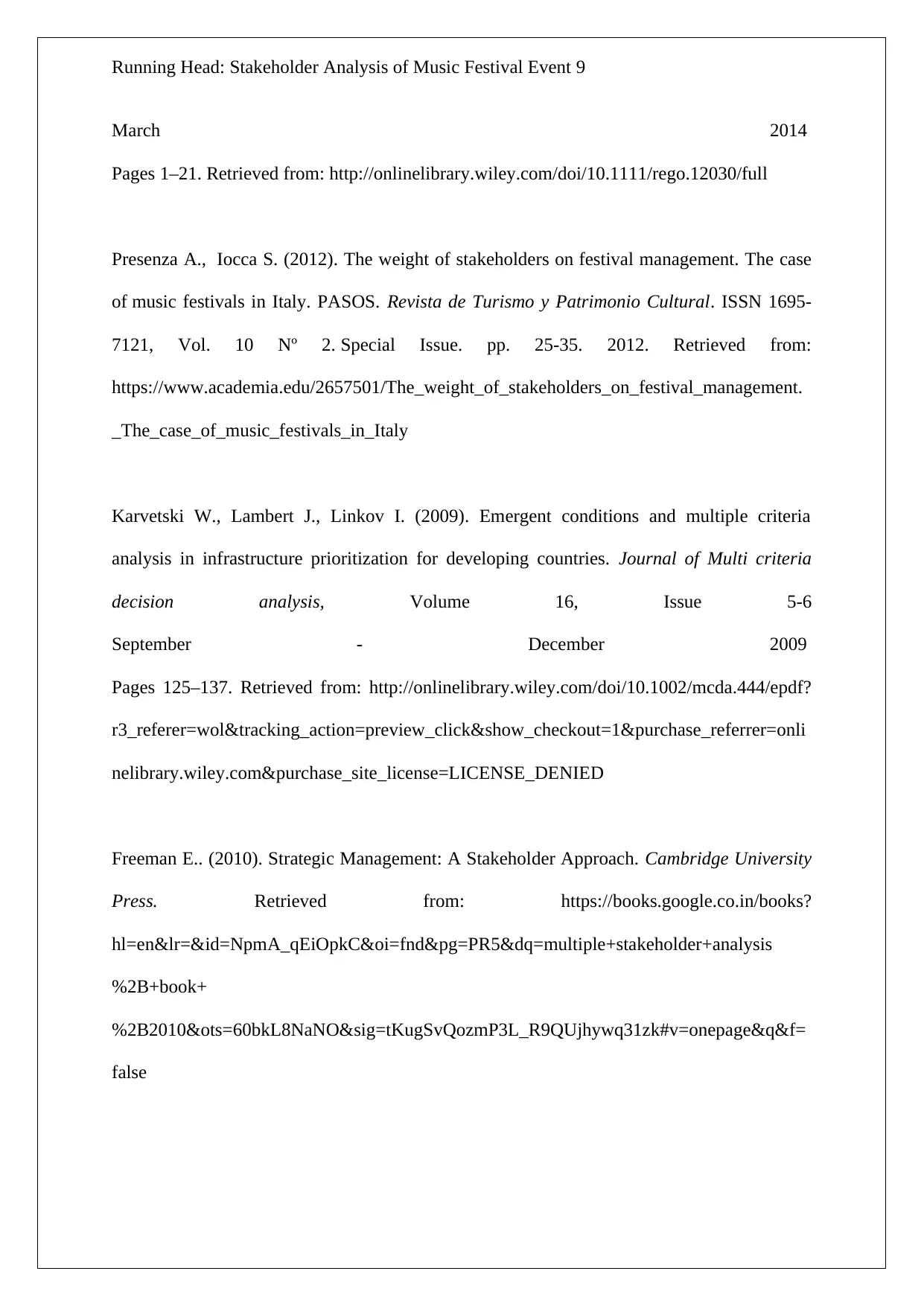
Running Head: Stakeholder Analysis of Music Festival Event 9
March 2014
Pages 1–21. Retrieved from: http://onlinelibrary.wiley.com/doi/10.1111/rego.12030/full
Presenza A., Iocca S. (2012). The weight of stakeholders on festival management. The case
of music festivals in Italy. PASOS. Revista de Turismo y Patrimonio Cultural. ISSN 1695-
7121, Vol. 10 Nº 2. Special Issue. pp. 25-35. 2012. Retrieved from:
https://www.academia.edu/2657501/The_weight_of_stakeholders_on_festival_management.
_The_case_of_music_festivals_in_Italy
Karvetski W., Lambert J., Linkov I. (2009). Emergent conditions and multiple criteria
analysis in infrastructure prioritization for developing countries. Journal of Multi criteria
decision analysis, Volume 16, Issue 5-6
September - December 2009
Pages 125–137. Retrieved from: http://onlinelibrary.wiley.com/doi/10.1002/mcda.444/epdf?
r3_referer=wol&tracking_action=preview_click&show_checkout=1&purchase_referrer=onli
nelibrary.wiley.com&purchase_site_license=LICENSE_DENIED
Freeman E.. (2010). Strategic Management: A Stakeholder Approach. Cambridge University
Press. Retrieved from: https://books.google.co.in/books?
hl=en&lr=&id=NpmA_qEiOpkC&oi=fnd&pg=PR5&dq=multiple+stakeholder+analysis
%2B+book+
%2B2010&ots=60bkL8NaNO&sig=tKugSvQozmP3L_R9QUjhywq31zk#v=onepage&q&f=
false
March 2014
Pages 1–21. Retrieved from: http://onlinelibrary.wiley.com/doi/10.1111/rego.12030/full
Presenza A., Iocca S. (2012). The weight of stakeholders on festival management. The case
of music festivals in Italy. PASOS. Revista de Turismo y Patrimonio Cultural. ISSN 1695-
7121, Vol. 10 Nº 2. Special Issue. pp. 25-35. 2012. Retrieved from:
https://www.academia.edu/2657501/The_weight_of_stakeholders_on_festival_management.
_The_case_of_music_festivals_in_Italy
Karvetski W., Lambert J., Linkov I. (2009). Emergent conditions and multiple criteria
analysis in infrastructure prioritization for developing countries. Journal of Multi criteria
decision analysis, Volume 16, Issue 5-6
September - December 2009
Pages 125–137. Retrieved from: http://onlinelibrary.wiley.com/doi/10.1002/mcda.444/epdf?
r3_referer=wol&tracking_action=preview_click&show_checkout=1&purchase_referrer=onli
nelibrary.wiley.com&purchase_site_license=LICENSE_DENIED
Freeman E.. (2010). Strategic Management: A Stakeholder Approach. Cambridge University
Press. Retrieved from: https://books.google.co.in/books?
hl=en&lr=&id=NpmA_qEiOpkC&oi=fnd&pg=PR5&dq=multiple+stakeholder+analysis
%2B+book+
%2B2010&ots=60bkL8NaNO&sig=tKugSvQozmP3L_R9QUjhywq31zk#v=onepage&q&f=
false
⊘ This is a preview!⊘
Do you want full access?
Subscribe today to unlock all pages.
Trusted by 1+ million students worldwide
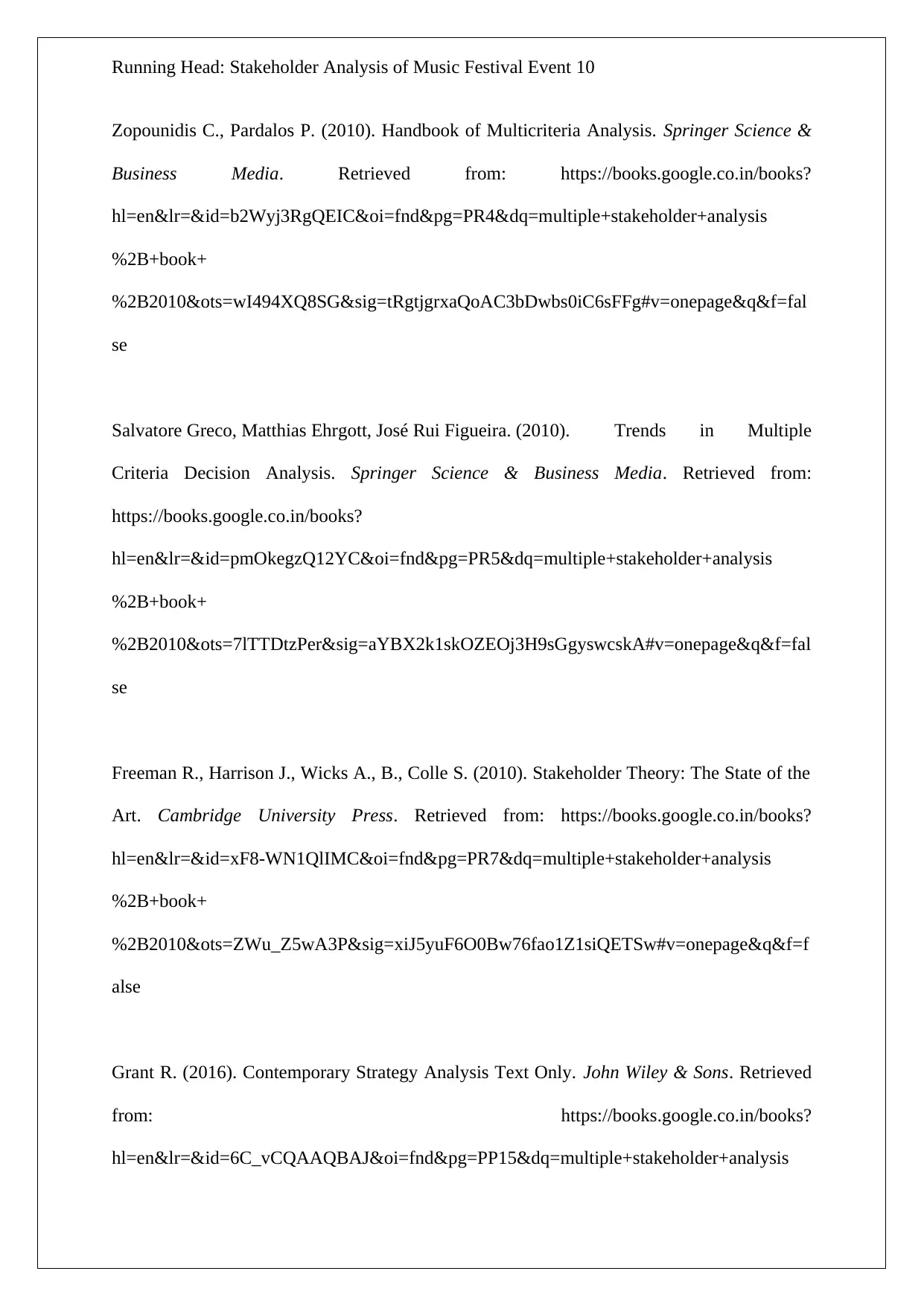
Running Head: Stakeholder Analysis of Music Festival Event 10
Zopounidis C., Pardalos P. (2010). Handbook of Multicriteria Analysis. Springer Science &
Business Media. Retrieved from: https://books.google.co.in/books?
hl=en&lr=&id=b2Wyj3RgQEIC&oi=fnd&pg=PR4&dq=multiple+stakeholder+analysis
%2B+book+
%2B2010&ots=wI494XQ8SG&sig=tRgtjgrxaQoAC3bDwbs0iC6sFFg#v=onepage&q&f=fal
se
Salvatore Greco, Matthias Ehrgott, José Rui Figueira. (2010). Trends in Multiple
Criteria Decision Analysis. Springer Science & Business Media. Retrieved from:
https://books.google.co.in/books?
hl=en&lr=&id=pmOkegzQ12YC&oi=fnd&pg=PR5&dq=multiple+stakeholder+analysis
%2B+book+
%2B2010&ots=7lTTDtzPer&sig=aYBX2k1skOZEOj3H9sGgyswcskA#v=onepage&q&f=fal
se
Freeman R., Harrison J., Wicks A., B., Colle S. (2010). Stakeholder Theory: The State of the
Art. Cambridge University Press. Retrieved from: https://books.google.co.in/books?
hl=en&lr=&id=xF8-WN1QlIMC&oi=fnd&pg=PR7&dq=multiple+stakeholder+analysis
%2B+book+
%2B2010&ots=ZWu_Z5wA3P&sig=xiJ5yuF6O0Bw76fao1Z1siQETSw#v=onepage&q&f=f
alse
Grant R. (2016). Contemporary Strategy Analysis Text Only. John Wiley & Sons. Retrieved
from: https://books.google.co.in/books?
hl=en&lr=&id=6C_vCQAAQBAJ&oi=fnd&pg=PP15&dq=multiple+stakeholder+analysis
Zopounidis C., Pardalos P. (2010). Handbook of Multicriteria Analysis. Springer Science &
Business Media. Retrieved from: https://books.google.co.in/books?
hl=en&lr=&id=b2Wyj3RgQEIC&oi=fnd&pg=PR4&dq=multiple+stakeholder+analysis
%2B+book+
%2B2010&ots=wI494XQ8SG&sig=tRgtjgrxaQoAC3bDwbs0iC6sFFg#v=onepage&q&f=fal
se
Salvatore Greco, Matthias Ehrgott, José Rui Figueira. (2010). Trends in Multiple
Criteria Decision Analysis. Springer Science & Business Media. Retrieved from:
https://books.google.co.in/books?
hl=en&lr=&id=pmOkegzQ12YC&oi=fnd&pg=PR5&dq=multiple+stakeholder+analysis
%2B+book+
%2B2010&ots=7lTTDtzPer&sig=aYBX2k1skOZEOj3H9sGgyswcskA#v=onepage&q&f=fal
se
Freeman R., Harrison J., Wicks A., B., Colle S. (2010). Stakeholder Theory: The State of the
Art. Cambridge University Press. Retrieved from: https://books.google.co.in/books?
hl=en&lr=&id=xF8-WN1QlIMC&oi=fnd&pg=PR7&dq=multiple+stakeholder+analysis
%2B+book+
%2B2010&ots=ZWu_Z5wA3P&sig=xiJ5yuF6O0Bw76fao1Z1siQETSw#v=onepage&q&f=f
alse
Grant R. (2016). Contemporary Strategy Analysis Text Only. John Wiley & Sons. Retrieved
from: https://books.google.co.in/books?
hl=en&lr=&id=6C_vCQAAQBAJ&oi=fnd&pg=PP15&dq=multiple+stakeholder+analysis
Paraphrase This Document
Need a fresh take? Get an instant paraphrase of this document with our AI Paraphraser
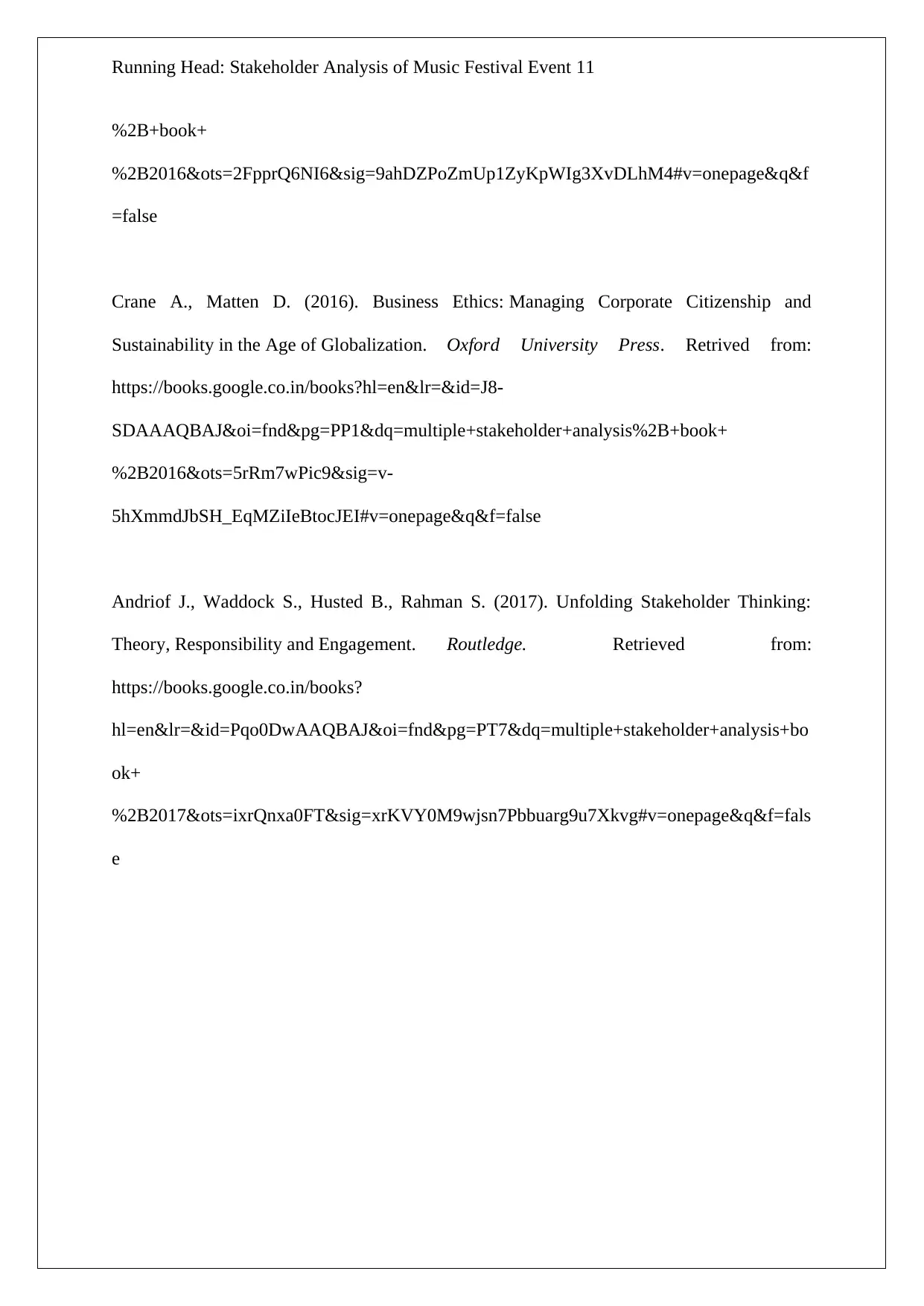
Running Head: Stakeholder Analysis of Music Festival Event 11
%2B+book+
%2B2016&ots=2FpprQ6NI6&sig=9ahDZPoZmUp1ZyKpWIg3XvDLhM4#v=onepage&q&f
=false
Crane A., Matten D. (2016). Business Ethics: Managing Corporate Citizenship and
Sustainability in the Age of Globalization. Oxford University Press. Retrived from:
https://books.google.co.in/books?hl=en&lr=&id=J8-
SDAAAQBAJ&oi=fnd&pg=PP1&dq=multiple+stakeholder+analysis%2B+book+
%2B2016&ots=5rRm7wPic9&sig=v-
5hXmmdJbSH_EqMZiIeBtocJEI#v=onepage&q&f=false
Andriof J., Waddock S., Husted B., Rahman S. (2017). Unfolding Stakeholder Thinking:
Theory, Responsibility and Engagement. Routledge. Retrieved from:
https://books.google.co.in/books?
hl=en&lr=&id=Pqo0DwAAQBAJ&oi=fnd&pg=PT7&dq=multiple+stakeholder+analysis+bo
ok+
%2B2017&ots=ixrQnxa0FT&sig=xrKVY0M9wjsn7Pbbuarg9u7Xkvg#v=onepage&q&f=fals
e
%2B+book+
%2B2016&ots=2FpprQ6NI6&sig=9ahDZPoZmUp1ZyKpWIg3XvDLhM4#v=onepage&q&f
=false
Crane A., Matten D. (2016). Business Ethics: Managing Corporate Citizenship and
Sustainability in the Age of Globalization. Oxford University Press. Retrived from:
https://books.google.co.in/books?hl=en&lr=&id=J8-
SDAAAQBAJ&oi=fnd&pg=PP1&dq=multiple+stakeholder+analysis%2B+book+
%2B2016&ots=5rRm7wPic9&sig=v-
5hXmmdJbSH_EqMZiIeBtocJEI#v=onepage&q&f=false
Andriof J., Waddock S., Husted B., Rahman S. (2017). Unfolding Stakeholder Thinking:
Theory, Responsibility and Engagement. Routledge. Retrieved from:
https://books.google.co.in/books?
hl=en&lr=&id=Pqo0DwAAQBAJ&oi=fnd&pg=PT7&dq=multiple+stakeholder+analysis+bo
ok+
%2B2017&ots=ixrQnxa0FT&sig=xrKVY0M9wjsn7Pbbuarg9u7Xkvg#v=onepage&q&f=fals
e

1 out of 11


Related Documents


Your All-in-One AI-Powered Toolkit for Academic Success.
+13062052269
info@desklib.com
Available 24*7 on WhatsApp / Email
![[object Object]](/_next/static/media/star-bottom.7253800d.svg)
Unlock your academic potential
Copyright © 2020–2026 A2Z Services. All Rights Reserved. Developed and managed by ZUCOL.