Analyzing Stakeholder Strategies in Construction Projects: Case Study
VerifiedAdded on 2023/06/05
|22
|5889
|449
Case Study
AI Summary
This assignment presents a comprehensive analysis of stakeholder management in the construction industry through a series of case studies. The first case examines public participation in construction projects in China, revealing the importance of both micro and macro-level engagement. The second case explores strategic sourcing in construction and electronics manufacturing firms in the UK and Germany, highlighting critical success factors and potential misalignments between sourcing strategies and execution. The third case identifies conflicting interests of stakeholders in the construction industry. The fourth case identifies critical success factors for stakeholder management through a questionnaire survey of construction professionals. The fifth case study provides an overview of previous studies in the field of stakeholder management. The overall objective is to provide insights into effective stakeholder management practices and strategic sourcing approaches within the construction sector. Desklib provides students with access to a wealth of resources, including solved assignments and past papers, to support their academic endeavors.
Chapter 4: Results and Discussion
4.1 Introduction
This chapter reviews the findings of primary and secondary data sources. This chapter
covers several case studies on construction companies acting as a piece of evidence for this
research. Depending on the information collected across the literature review, the data is
analysed. Further, this chapter also entails the data collected and perceived through the interview
process. The goal of this chapter is to interpret and explain the results obtained through survey.
The research question shall be answered and justified through a critical discussion.
4.2 Results
Case Study 1
According to Xie et al. (2017), the research conducted aims to formulate a public
participation performance index (PPPI) for measuring the performance systematically and
promoting development of public construction projects (PCPs). It is argued that the PCPs in
China have been on a rise for rapid urbanization and economic development. However, the
development came at a cost and several negative effects such as environment degradation, urban
transportation issues and social imbalance. The author states that public participation may be a
solution for the issue.
A case study was developed for explaining the use of integrated performance index. The
case study was developed for the largest event hosted in Guangzhou City. There were eight
venues for the games that were constructed and 62 were renovated. The construction and
renovation costs were borne by the government. The government also invested in improving the
4.1 Introduction
This chapter reviews the findings of primary and secondary data sources. This chapter
covers several case studies on construction companies acting as a piece of evidence for this
research. Depending on the information collected across the literature review, the data is
analysed. Further, this chapter also entails the data collected and perceived through the interview
process. The goal of this chapter is to interpret and explain the results obtained through survey.
The research question shall be answered and justified through a critical discussion.
4.2 Results
Case Study 1
According to Xie et al. (2017), the research conducted aims to formulate a public
participation performance index (PPPI) for measuring the performance systematically and
promoting development of public construction projects (PCPs). It is argued that the PCPs in
China have been on a rise for rapid urbanization and economic development. However, the
development came at a cost and several negative effects such as environment degradation, urban
transportation issues and social imbalance. The author states that public participation may be a
solution for the issue.
A case study was developed for explaining the use of integrated performance index. The
case study was developed for the largest event hosted in Guangzhou City. There were eight
venues for the games that were constructed and 62 were renovated. The construction and
renovation costs were borne by the government. The government also invested in improving the

Paraphrase This Document
Need a fresh take? Get an instant paraphrase of this document with our AI Paraphraser
environment quality. For collecting opinion on project decision making and construction, public
votes were gathered online. The data collection tool used in the research design was
questionnaire survey. 9 participants agreed to participate in the survey. The PPPI was calculated
as 4.40 which is lower than 5.00. It indicates that participation performance failed to achieve
acceptable performance level.
This case study revealed 15 KPIs for evaluating effectiveness of public participation in
public construction projects. The performance of public participation in public construction
projects have been classified into two categories- micro and macro level. The authors define
micro as the immediate and direct impact of public participation at a small level. However,
macro is defined as the development and decision making process at a macro-level from political
and social effects.
According to the case study, the case project had less macro-level participation. The
argument is supported by studies conducted by Li et al. (2012) through archives, interviews and
case studies. The findings by Li et al. (2012) revealed that there was improvement in democracy,
provision of job opportunities, improvement in public confidence on government, greater
profitability and better infrastructure. Therefore, public participation is considered as a feasible
approach in China. Regarding the results of micro-level participation performance, it is observed
that there are positive results in public participation. In comparison with the western countries,
the results indicate that the socio-economic benefits obtained from public participation activities
facilitate acceptance of PCPs.
votes were gathered online. The data collection tool used in the research design was
questionnaire survey. 9 participants agreed to participate in the survey. The PPPI was calculated
as 4.40 which is lower than 5.00. It indicates that participation performance failed to achieve
acceptable performance level.
This case study revealed 15 KPIs for evaluating effectiveness of public participation in
public construction projects. The performance of public participation in public construction
projects have been classified into two categories- micro and macro level. The authors define
micro as the immediate and direct impact of public participation at a small level. However,
macro is defined as the development and decision making process at a macro-level from political
and social effects.
According to the case study, the case project had less macro-level participation. The
argument is supported by studies conducted by Li et al. (2012) through archives, interviews and
case studies. The findings by Li et al. (2012) revealed that there was improvement in democracy,
provision of job opportunities, improvement in public confidence on government, greater
profitability and better infrastructure. Therefore, public participation is considered as a feasible
approach in China. Regarding the results of micro-level participation performance, it is observed
that there are positive results in public participation. In comparison with the western countries,
the results indicate that the socio-economic benefits obtained from public participation activities
facilitate acceptance of PCPs.
The results of the case study by Xie et al. (2017) indicate that public participation in
China is at the emerging phase. It is analyzed that the Chinese government must try other forms
of participation in macro-projects so that there is better collaborative governance.
Case Study 2
According to Kotula et al. (2015), strategic sourcing plays a crucial role in the
construction organizations. To prove the importance of strategic sourcing, the authors have
studied twenty organizations from UK and Germany. The organizations studied in the research
study belong to two main sectors- construction and electronics manufacturing. The case study
intends to answer the following research questions- what is the extent of strategic sourcing
adoption in the organizations; what are the success factors that are critical in enhancing
competitive advantage; does there exist any alignment between organizational sourcing strategies
and execution.
For answering these research questions, Kotula et al. (2015) undertook multiple case
study that was affected by financial crisis and supply shortage. According to the case study,
interviews were conducted with open-ended questions. Regarding the role of strategic sourcing,
the results suggested that nine organizations have an administered sourcing department. The
interview revealed that strategic sourcing gained greater importance in the recent years.
According to the case study, a few critical success factors have been accounted for. For the
industries in UK, the critical success factors are continuous improvement, quality, delivery
dependency, profit, product cost, supplier relationship management and sourcing strategy
alignment with corporate goals. However, while conducting research for German construction
and electronics manufacturing industry, the critical success factors such as quality, employee
training, and supplier relationship management was identified.
China is at the emerging phase. It is analyzed that the Chinese government must try other forms
of participation in macro-projects so that there is better collaborative governance.
Case Study 2
According to Kotula et al. (2015), strategic sourcing plays a crucial role in the
construction organizations. To prove the importance of strategic sourcing, the authors have
studied twenty organizations from UK and Germany. The organizations studied in the research
study belong to two main sectors- construction and electronics manufacturing. The case study
intends to answer the following research questions- what is the extent of strategic sourcing
adoption in the organizations; what are the success factors that are critical in enhancing
competitive advantage; does there exist any alignment between organizational sourcing strategies
and execution.
For answering these research questions, Kotula et al. (2015) undertook multiple case
study that was affected by financial crisis and supply shortage. According to the case study,
interviews were conducted with open-ended questions. Regarding the role of strategic sourcing,
the results suggested that nine organizations have an administered sourcing department. The
interview revealed that strategic sourcing gained greater importance in the recent years.
According to the case study, a few critical success factors have been accounted for. For the
industries in UK, the critical success factors are continuous improvement, quality, delivery
dependency, profit, product cost, supplier relationship management and sourcing strategy
alignment with corporate goals. However, while conducting research for German construction
and electronics manufacturing industry, the critical success factors such as quality, employee
training, and supplier relationship management was identified.
⊘ This is a preview!⊘
Do you want full access?
Subscribe today to unlock all pages.

Trusted by 1+ million students worldwide
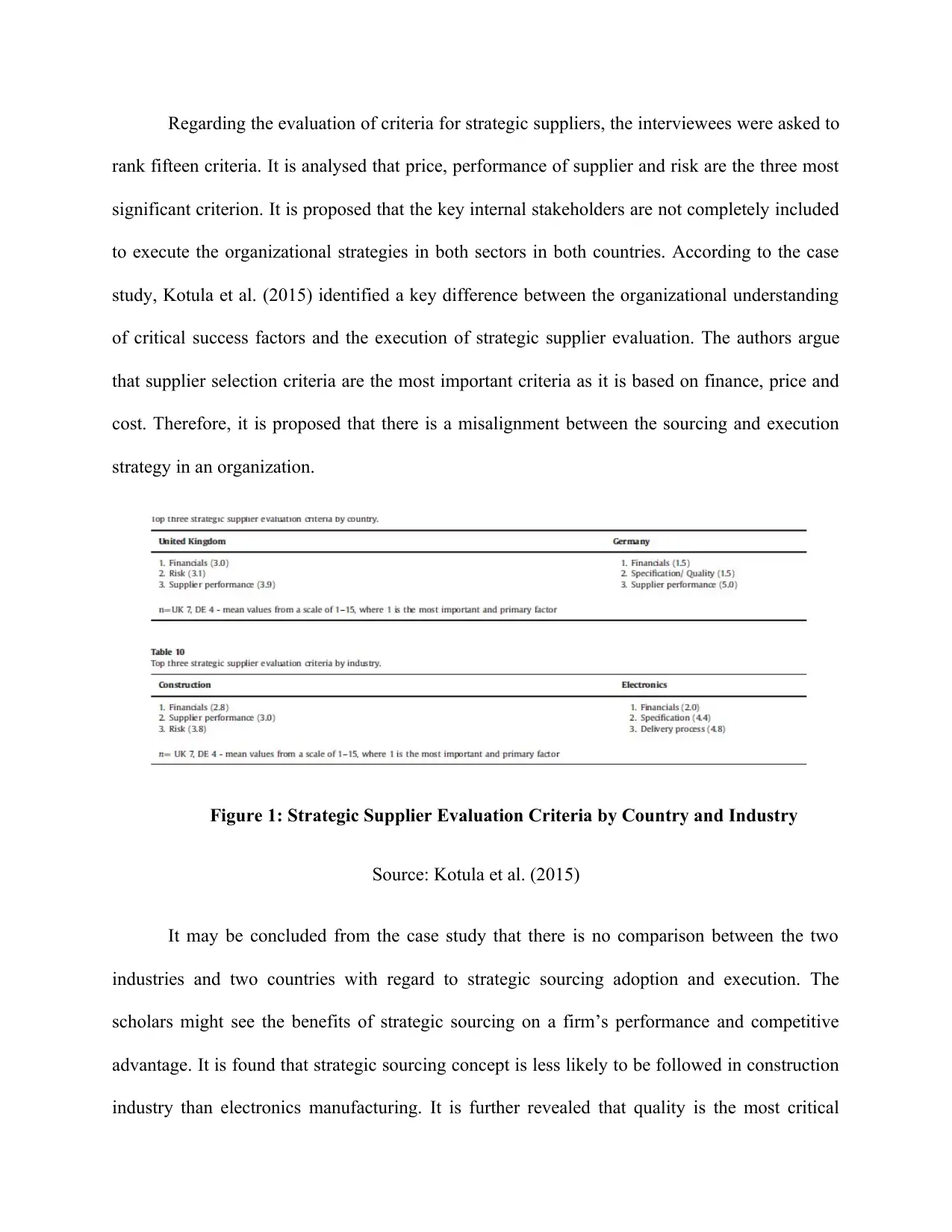
Regarding the evaluation of criteria for strategic suppliers, the interviewees were asked to
rank fifteen criteria. It is analysed that price, performance of supplier and risk are the three most
significant criterion. It is proposed that the key internal stakeholders are not completely included
to execute the organizational strategies in both sectors in both countries. According to the case
study, Kotula et al. (2015) identified a key difference between the organizational understanding
of critical success factors and the execution of strategic supplier evaluation. The authors argue
that supplier selection criteria are the most important criteria as it is based on finance, price and
cost. Therefore, it is proposed that there is a misalignment between the sourcing and execution
strategy in an organization.
Figure 1: Strategic Supplier Evaluation Criteria by Country and Industry
Source: Kotula et al. (2015)
It may be concluded from the case study that there is no comparison between the two
industries and two countries with regard to strategic sourcing adoption and execution. The
scholars might see the benefits of strategic sourcing on a firm’s performance and competitive
advantage. It is found that strategic sourcing concept is less likely to be followed in construction
industry than electronics manufacturing. It is further revealed that quality is the most critical
rank fifteen criteria. It is analysed that price, performance of supplier and risk are the three most
significant criterion. It is proposed that the key internal stakeholders are not completely included
to execute the organizational strategies in both sectors in both countries. According to the case
study, Kotula et al. (2015) identified a key difference between the organizational understanding
of critical success factors and the execution of strategic supplier evaluation. The authors argue
that supplier selection criteria are the most important criteria as it is based on finance, price and
cost. Therefore, it is proposed that there is a misalignment between the sourcing and execution
strategy in an organization.
Figure 1: Strategic Supplier Evaluation Criteria by Country and Industry
Source: Kotula et al. (2015)
It may be concluded from the case study that there is no comparison between the two
industries and two countries with regard to strategic sourcing adoption and execution. The
scholars might see the benefits of strategic sourcing on a firm’s performance and competitive
advantage. It is found that strategic sourcing concept is less likely to be followed in construction
industry than electronics manufacturing. It is further revealed that quality is the most critical
Paraphrase This Document
Need a fresh take? Get an instant paraphrase of this document with our AI Paraphraser
success factor in the construction as well as electronics manufacturing industry. Majority of the
case study organizations focus upon financial metrics which shows misalignment with the
strategic intent. Research and development and engineering are considered of primary
importance in the sourcing process. The case study is of importance to practitioners who are
looking to adopt strategic sourcing in the construction and electronic manufacturing industry.
Case Study 3
The case study conducted by Mok, Shen and Yang (2017) identifies the conflicting
interests of shareholders in the construction industry. The authors recognize the importance of
stakeholder management in the construction industry. The authors have provided a network
perspective for analysing stakeholder issues and interrelationships. In the case study, stakeholder
issues have been defined as the concerns or welfare of stakeholders in a project such as time,
quality, ethical, social, environmental and economical. It is argued that a large construction
project has various stakeholder issues of high diversity and complexity. The complexities are
higher as the construction projects are highly dependent on individual stakeholder behaviour and
attributes.
Mok, Shen and Yang (2017) apply NetMiner which is a network analysis program. This
program is beneficial for identifying and investigating the fundamental network of stakeholder
issues in big production projects. This case study undertakes a large building development in
Hong Kong worth US$645 million. Previous studies have been reviewed where stakeholder
concerns have been addressed. It is found that network perspective can be used to recognize the
source of stakeholder issues and interdependencies between stakeholder issues.
case study organizations focus upon financial metrics which shows misalignment with the
strategic intent. Research and development and engineering are considered of primary
importance in the sourcing process. The case study is of importance to practitioners who are
looking to adopt strategic sourcing in the construction and electronic manufacturing industry.
Case Study 3
The case study conducted by Mok, Shen and Yang (2017) identifies the conflicting
interests of shareholders in the construction industry. The authors recognize the importance of
stakeholder management in the construction industry. The authors have provided a network
perspective for analysing stakeholder issues and interrelationships. In the case study, stakeholder
issues have been defined as the concerns or welfare of stakeholders in a project such as time,
quality, ethical, social, environmental and economical. It is argued that a large construction
project has various stakeholder issues of high diversity and complexity. The complexities are
higher as the construction projects are highly dependent on individual stakeholder behaviour and
attributes.
Mok, Shen and Yang (2017) apply NetMiner which is a network analysis program. This
program is beneficial for identifying and investigating the fundamental network of stakeholder
issues in big production projects. This case study undertakes a large building development in
Hong Kong worth US$645 million. Previous studies have been reviewed where stakeholder
concerns have been addressed. It is found that network perspective can be used to recognize the
source of stakeholder issues and interdependencies between stakeholder issues.
This research study by Mok, Shen and Yang (2017) has used a network perspective for
analysing stakeholder issues and communications between them in big construction projects.
There are two main aspects of network analysis. Firstly, social network investigation and second
is interconnected non-human objects as nodes. The case study reviews the case of Linert et al.
(2013) and Park et al. (2011) who integrated network analysis with classical stakeholder
analysis. Zhang et al. (2015) and Fang et al. (2012) investigated the detailed network in big
construction projects.
The case study categorizes stakeholder issues into different manners like- environmental,
social, technical, economical, institutional and financial. The stakeholder issues are classified
into ten groups- cost, economic, ethical, reputational, environmental, political, governance,
technical, time and project management. It is to be noted that there are several network indicators
for assessing the stakeholder issue network. Six indicators have been identified in the case study-
network density, nodal degree, network cohesion, status centrality, brokerage, and betweenness
centrality.
For investigating stakeholder issues, case study and network analysis are used as the main
research methods. The study also uses semi-structured interviews were conducted with the
multiple stakeholder groups. The findings from the case study reveal that government is the most
powerful stakeholder in the construction projects in Hong Kong. Contractors are a part of the
supply chain and a source of various important links. It is found that public controversies and
political interference in large construction projects. The case study revealed that the government
pushes technological advancement for better outcomes of the project. Therefore, the above case
study revealed a few meaningful findings for managing issues among stakeholders in
construction project. Communication and coordination between the government and contractor is
analysing stakeholder issues and communications between them in big construction projects.
There are two main aspects of network analysis. Firstly, social network investigation and second
is interconnected non-human objects as nodes. The case study reviews the case of Linert et al.
(2013) and Park et al. (2011) who integrated network analysis with classical stakeholder
analysis. Zhang et al. (2015) and Fang et al. (2012) investigated the detailed network in big
construction projects.
The case study categorizes stakeholder issues into different manners like- environmental,
social, technical, economical, institutional and financial. The stakeholder issues are classified
into ten groups- cost, economic, ethical, reputational, environmental, political, governance,
technical, time and project management. It is to be noted that there are several network indicators
for assessing the stakeholder issue network. Six indicators have been identified in the case study-
network density, nodal degree, network cohesion, status centrality, brokerage, and betweenness
centrality.
For investigating stakeholder issues, case study and network analysis are used as the main
research methods. The study also uses semi-structured interviews were conducted with the
multiple stakeholder groups. The findings from the case study reveal that government is the most
powerful stakeholder in the construction projects in Hong Kong. Contractors are a part of the
supply chain and a source of various important links. It is found that public controversies and
political interference in large construction projects. The case study revealed that the government
pushes technological advancement for better outcomes of the project. Therefore, the above case
study revealed a few meaningful findings for managing issues among stakeholders in
construction project. Communication and coordination between the government and contractor is
⊘ This is a preview!⊘
Do you want full access?
Subscribe today to unlock all pages.
Trusted by 1+ million students worldwide
considered the most crucial. Public engagement and participation shall reduce potential
resistance in the construction projects.
Case Study 4
According to the study conducted by Yang et al. (2010), identification of critical success
factors (CSFs) are essential for stakeholder management in the construction projects. The case
study reviews previous studies by scholars and practitioners for investigation on CSFs for
managing project stakeholders. This case study focuses on comparative analysis of construction
practitioners through a questionnaire survey. This study was conducted in Hong Kong in 2008
with six construction professionals.
Based on the extensive literature reviewed by the authors Yang et al.(2010), a list of 15
CSFs were deduced:
1. Identification of stakeholders
2. Undertaking social responsibilities
3. Identification of stakeholder interest areas
4. Exploring stakeholders’ needs
5. Defining project missions
6. Predicting stakeholder influence
7. Assessment of stakeholder behaviours
8. Strategizing
9. Boosting a positive relationship with stakeholders
10. Effective communication
11. Analysis of stakeholder change
resistance in the construction projects.
Case Study 4
According to the study conducted by Yang et al. (2010), identification of critical success
factors (CSFs) are essential for stakeholder management in the construction projects. The case
study reviews previous studies by scholars and practitioners for investigation on CSFs for
managing project stakeholders. This case study focuses on comparative analysis of construction
practitioners through a questionnaire survey. This study was conducted in Hong Kong in 2008
with six construction professionals.
Based on the extensive literature reviewed by the authors Yang et al.(2010), a list of 15
CSFs were deduced:
1. Identification of stakeholders
2. Undertaking social responsibilities
3. Identification of stakeholder interest areas
4. Exploring stakeholders’ needs
5. Defining project missions
6. Predicting stakeholder influence
7. Assessment of stakeholder behaviours
8. Strategizing
9. Boosting a positive relationship with stakeholders
10. Effective communication
11. Analysis of stakeholder change
Paraphrase This Document
Need a fresh take? Get an instant paraphrase of this document with our AI Paraphraser
12. Compromising conflicts
13. Analysis of conflicts and coalition
14. Predicting reaction of stakeholders
15. Predicting influence of stakeholders
This case study throws light upon the ranking of the CSFs in every project type. Among
the list of above mentioned CSFs, managing stakeholders with social responsibilities is ranked
the highest. As stakeholders are often associated with corporate social responsibility, this factor
is ranked the highest. Identification of stakeholders is ranked higher as well indicating the
importance of stakeholder management. The low ranked factors are prediction of stakeholders
reaction and assessment of their behaviours. According to the views of the respondents, every
CSF has been ranked in a different way by diverse respondents. It is argued that Spearman’s rank
correlation test indicates that there is general consent on the overall rankings of CSFs. CSFs do
not have strong correlations. The results of the nonparametric test indicate that respondents in
this survey consider the relative importance of only two factors, namely, “Assessing
stakeholders’ behaviors” and “Assessing attributes power, urgency, and proximityof
stakeholders,” do not vary with the different types of projects, nor with the types of respondents.
These findings are useful for the construction practitioners for engaging with multiple
stakeholders.
Case Study 5
The study conducted by Yang, Shen and Ho (2009) provides an overview of the previous
studies in the field of stakeholder management. Yang, Shen and Ho (2009) define stakeholder as
an individual or a group who are affected by the achievement of organizational objectives.
However, the case study states that the stakeholder management process is still being researched.
13. Analysis of conflicts and coalition
14. Predicting reaction of stakeholders
15. Predicting influence of stakeholders
This case study throws light upon the ranking of the CSFs in every project type. Among
the list of above mentioned CSFs, managing stakeholders with social responsibilities is ranked
the highest. As stakeholders are often associated with corporate social responsibility, this factor
is ranked the highest. Identification of stakeholders is ranked higher as well indicating the
importance of stakeholder management. The low ranked factors are prediction of stakeholders
reaction and assessment of their behaviours. According to the views of the respondents, every
CSF has been ranked in a different way by diverse respondents. It is argued that Spearman’s rank
correlation test indicates that there is general consent on the overall rankings of CSFs. CSFs do
not have strong correlations. The results of the nonparametric test indicate that respondents in
this survey consider the relative importance of only two factors, namely, “Assessing
stakeholders’ behaviors” and “Assessing attributes power, urgency, and proximityof
stakeholders,” do not vary with the different types of projects, nor with the types of respondents.
These findings are useful for the construction practitioners for engaging with multiple
stakeholders.
Case Study 5
The study conducted by Yang, Shen and Ho (2009) provides an overview of the previous
studies in the field of stakeholder management. Yang, Shen and Ho (2009) define stakeholder as
an individual or a group who are affected by the achievement of organizational objectives.
However, the case study states that the stakeholder management process is still being researched.
The previous tools and methods of stakeholder management in construction projects are yet to be
applied properly. This research study raises the main question as to why a project manager needs
to adopt a stakeholder management approach. Managing stakeholders is given due importance by
Yang, Shen and Ho (2009) in a construction project as they have a chain of multifaceted
activities. Different stakeholders have different level of interest and investments involved in a
project that may be influenced by success or failure. For effective project delivery, there must be
an adequate balance between the stakeholder interests. It is argued that a negative attitude by the
stakeholders obstructs or causes hindrance in the project.
From the case study, it can be found that stakeholder management is significant in the
construction projects. Firstly, it is because there are multiple parties and processes involved.
Secondly, different stakeholders invest different amount and the project director must converse
with all parties to persuade their needs. Thirdly, associations among stakeholders in the
construction projects are momentary due to their contractual nature. Fourthly, every stakeholder
must be aware of his duties and roles in the project. Lastly, there can be cost overrun and time
delays if there is poor stakeholder management.
This research study applies descriptive approach to explain the process of stakeholder
management process. The previous studies show that there is increasing trend and interest of
stakeholder management. The reasons are twofold in nature- number of stakeholders and heir
relationships have increased. Secondly, effective stakeholder management shall lead in
achievement of project objectives. One of the most interesting models analysed in the case study
is ‘power, legitimacy and urgency’. These are the three relationship attributes possessed by
different types of stakeholders. Power is defined as the capability of letting another stakeholder
to act. Legitimacy is defined as the acceptability in terms of social ethics and law in stakeholder
applied properly. This research study raises the main question as to why a project manager needs
to adopt a stakeholder management approach. Managing stakeholders is given due importance by
Yang, Shen and Ho (2009) in a construction project as they have a chain of multifaceted
activities. Different stakeholders have different level of interest and investments involved in a
project that may be influenced by success or failure. For effective project delivery, there must be
an adequate balance between the stakeholder interests. It is argued that a negative attitude by the
stakeholders obstructs or causes hindrance in the project.
From the case study, it can be found that stakeholder management is significant in the
construction projects. Firstly, it is because there are multiple parties and processes involved.
Secondly, different stakeholders invest different amount and the project director must converse
with all parties to persuade their needs. Thirdly, associations among stakeholders in the
construction projects are momentary due to their contractual nature. Fourthly, every stakeholder
must be aware of his duties and roles in the project. Lastly, there can be cost overrun and time
delays if there is poor stakeholder management.
This research study applies descriptive approach to explain the process of stakeholder
management process. The previous studies show that there is increasing trend and interest of
stakeholder management. The reasons are twofold in nature- number of stakeholders and heir
relationships have increased. Secondly, effective stakeholder management shall lead in
achievement of project objectives. One of the most interesting models analysed in the case study
is ‘power, legitimacy and urgency’. These are the three relationship attributes possessed by
different types of stakeholders. Power is defined as the capability of letting another stakeholder
to act. Legitimacy is defined as the acceptability in terms of social ethics and law in stakeholder
⊘ This is a preview!⊘
Do you want full access?
Subscribe today to unlock all pages.
Trusted by 1+ million students worldwide
behaviour. Urgency may be defined as the degree to which stakeholder claims require urgent
attention.
SNT or Social Network theory helps in focusing on relationships rather than individuals.
It views a project as an environment backed by different relationships. There have been instances
where SNT has been used effectively. The purpose of SNT is to study how relationship
structures impact behaviour. It investigates interpersonal relationships in times of crisis. The
stakeholder attributes Social network analysis is a method for mapping different relationships
between multiple stakeholders.
According to Yang, Shen and Ho (2009), an effective framework must be developed for
identification, classification, management and execution of stakeholder management in the
construction project. It is argued that the framework must be detailed enough so that it surely
maintains good relationship with the stakeholders. The framework shall also take different stages
of project life cycle into consideration. Lastly, different clientele and projects must have
distinguished methods for effective stakeholder management. It may be concluded from the case
study that there are very few methods of identifying stakeholders. The studies for addressing
changes in stakeholder relationships are quite limited.
Case Study 6
According to Xue et al. (2018), stakeholder collaborative management and off-site
construction (OSC) are related to each other. There have been various obstacles in OSC such as
lack of standards, high cost, poor quality, and extra dependence on traditional on-site mode. It is
argued that high cost is the biggest obstacle. Therefore, cost-saving strategy is one of the vital
concerns in OSC development. The objective of this case study is to combine network
attention.
SNT or Social Network theory helps in focusing on relationships rather than individuals.
It views a project as an environment backed by different relationships. There have been instances
where SNT has been used effectively. The purpose of SNT is to study how relationship
structures impact behaviour. It investigates interpersonal relationships in times of crisis. The
stakeholder attributes Social network analysis is a method for mapping different relationships
between multiple stakeholders.
According to Yang, Shen and Ho (2009), an effective framework must be developed for
identification, classification, management and execution of stakeholder management in the
construction project. It is argued that the framework must be detailed enough so that it surely
maintains good relationship with the stakeholders. The framework shall also take different stages
of project life cycle into consideration. Lastly, different clientele and projects must have
distinguished methods for effective stakeholder management. It may be concluded from the case
study that there are very few methods of identifying stakeholders. The studies for addressing
changes in stakeholder relationships are quite limited.
Case Study 6
According to Xue et al. (2018), stakeholder collaborative management and off-site
construction (OSC) are related to each other. There have been various obstacles in OSC such as
lack of standards, high cost, poor quality, and extra dependence on traditional on-site mode. It is
argued that high cost is the biggest obstacle. Therefore, cost-saving strategy is one of the vital
concerns in OSC development. The objective of this case study is to combine network
Paraphrase This Document
Need a fresh take? Get an instant paraphrase of this document with our AI Paraphraser
associations with stakeholder collaborative management. It also aims to explore the relationship
between cost performance of OSC and collaborative management.
The case study states that multiple studies have been conducted in promoting OSC
development. It was found that lack of design standardization, low turnover ratio and cultural
barrier affects OSC negatively. However, it is found that collaboration and communication
between stakeholders can improve standardization and decrease cost. Therefore, cost
management of OSC can be done. Further, the case study elaborates the role of network
relationship in project management. It is argued that the stakeholders must make cooperative
endeavour for a common goal. It was further found that contractors, subcontractors, owners and
suppliers collaborated for delivering a project to a client. The previous studies have revealed that
stakeholders must set up a network, whether temporary or permanent in nature for strengthening
communication, facilitating information exchange and sharing resources. The study aims to
examine the ways in which network relationship with stakeholder management can be combined.
According to the case study, stakeholders can be seen as a temporary party for project
management in OSC. As far as information sharing is concerned, they act as opportunities for
sharing, transferring and enjoying scale economies. Based on the findings, it is revealed that
collaboration among stakeholders increases resource and information sharing.
It is argued that majority of the clients refuse to implement OSC method as it is costly in
nature. However, stakeholder collaboration can help in achieving economies of scale. The PC
manufacturers play a vital role in OSC cost management. The research study reveals that
differential strategies may be helpful in promoting OSC development. There were certain PCs
that were easy to manufacture through mass production technique. The professional association
between cost performance of OSC and collaborative management.
The case study states that multiple studies have been conducted in promoting OSC
development. It was found that lack of design standardization, low turnover ratio and cultural
barrier affects OSC negatively. However, it is found that collaboration and communication
between stakeholders can improve standardization and decrease cost. Therefore, cost
management of OSC can be done. Further, the case study elaborates the role of network
relationship in project management. It is argued that the stakeholders must make cooperative
endeavour for a common goal. It was further found that contractors, subcontractors, owners and
suppliers collaborated for delivering a project to a client. The previous studies have revealed that
stakeholders must set up a network, whether temporary or permanent in nature for strengthening
communication, facilitating information exchange and sharing resources. The study aims to
examine the ways in which network relationship with stakeholder management can be combined.
According to the case study, stakeholders can be seen as a temporary party for project
management in OSC. As far as information sharing is concerned, they act as opportunities for
sharing, transferring and enjoying scale economies. Based on the findings, it is revealed that
collaboration among stakeholders increases resource and information sharing.
It is argued that majority of the clients refuse to implement OSC method as it is costly in
nature. However, stakeholder collaboration can help in achieving economies of scale. The PC
manufacturers play a vital role in OSC cost management. The research study reveals that
differential strategies may be helpful in promoting OSC development. There were certain PCs
that were easy to manufacture through mass production technique. The professional association
and government played a crucial role in implementing mass production. Therefore, OSC may be
implemented in managing construction project stakeholders.
Case Study 7
Yang and Shen (2015) presented a generic and systematic framework for stakeholder
management in the construction industry. In the recent years, several scholars and practitioners
have given importance to the stakeholder management concept in the construction industry. It is
analysed that construction industry is still bothered by poor stakeholder management as there is
no routine planning, strategies, processes and methods. However, significant contributions and
initiatives have been taken for improving the stakeholder management scenario. This study
focuses on the research question: what are the key components in stakeholder management?
What is the interrelationship in a systematic stakeholder management framework for
construction projects? This case study focuses in two main objectives- firstly, to develop a
systematic framework for stakeholder management; secondly, to implement the developed
framework for stakeholder management in construction projects.
According to the previous literature, stakeholder theory can be classified into four
different fields- systems theory, corporate social responsibility, corporate planning and
organization theory. Yang, Shen and Ho (2009) define stakeholder as an individual or a group
who are affected by the achievement of organizational objectives. The authors proposed two
models by Mitchell and Rowley. According to Mitchel et al. (1997), classes of stakeholders
could be identified by the possession, or the attributed possession, of one or more of three
relationship attributes: power, legitimacy, and urgency. However, Rowley does not focus on
stakeholder attributes but on stakeholder relationships. He argued that stakeholder relations are
dynamic and not static. Several theories and empirical studies have been studied in this case
implemented in managing construction project stakeholders.
Case Study 7
Yang and Shen (2015) presented a generic and systematic framework for stakeholder
management in the construction industry. In the recent years, several scholars and practitioners
have given importance to the stakeholder management concept in the construction industry. It is
analysed that construction industry is still bothered by poor stakeholder management as there is
no routine planning, strategies, processes and methods. However, significant contributions and
initiatives have been taken for improving the stakeholder management scenario. This study
focuses on the research question: what are the key components in stakeholder management?
What is the interrelationship in a systematic stakeholder management framework for
construction projects? This case study focuses in two main objectives- firstly, to develop a
systematic framework for stakeholder management; secondly, to implement the developed
framework for stakeholder management in construction projects.
According to the previous literature, stakeholder theory can be classified into four
different fields- systems theory, corporate social responsibility, corporate planning and
organization theory. Yang, Shen and Ho (2009) define stakeholder as an individual or a group
who are affected by the achievement of organizational objectives. The authors proposed two
models by Mitchell and Rowley. According to Mitchel et al. (1997), classes of stakeholders
could be identified by the possession, or the attributed possession, of one or more of three
relationship attributes: power, legitimacy, and urgency. However, Rowley does not focus on
stakeholder attributes but on stakeholder relationships. He argued that stakeholder relations are
dynamic and not static. Several theories and empirical studies have been studied in this case
⊘ This is a preview!⊘
Do you want full access?
Subscribe today to unlock all pages.
Trusted by 1+ million students worldwide

1 out of 22


Related Documents


Your All-in-One AI-Powered Toolkit for Academic Success.
+13062052269
info@desklib.com
Available 24*7 on WhatsApp / Email
![[object Object]](/_next/static/media/star-bottom.7253800d.svg)
Unlock your academic potential
Copyright © 2020–2026 A2Z Services. All Rights Reserved. Developed and managed by ZUCOL.