Managerial Accounting - Standard Costing: A Detailed Analysis
VerifiedAdded on 2023/06/05
|15
|3922
|431
Report
AI Summary
This report delves into the concept of standard costing within managerial accounting, exploring its application and impact on organizational performance. The analysis begins with a definition and explanation of standard costing, highlighting its role in cost control, variance analysis, and profitability enhancement. Two research articles are examined: one focusing on the effects of standard costing on telecommunication companies' profitability and another on its role in lean manufacturing enterprises. The report compares and contrasts the findings of these studies, revealing similarities and differences in their conclusions regarding the effectiveness and application of standard costing. Key outcomes and lessons learned from each article are presented, with a focus on how these findings can inform the practices of management accountants. The report concludes with a summary of the key takeaways, emphasizing the significance of standard costing as a tool for improving profitability, cost control, and decision-making within various business contexts, including telecommunications and lean manufacturing. The report underscores the importance of standard costing in assessing performance, forecasting, and addressing internal issues related to cost management.
Managerial Accounting 1
MANAGERIAL ACCOUNTING
Author
Student’s Number
Course Title
Professor
Date
MANAGERIAL ACCOUNTING
Author
Student’s Number
Course Title
Professor
Date

Paraphrase This Document
Need a fresh take? Get an instant paraphrase of this document with our AI Paraphraser
Managerial Accounting 2
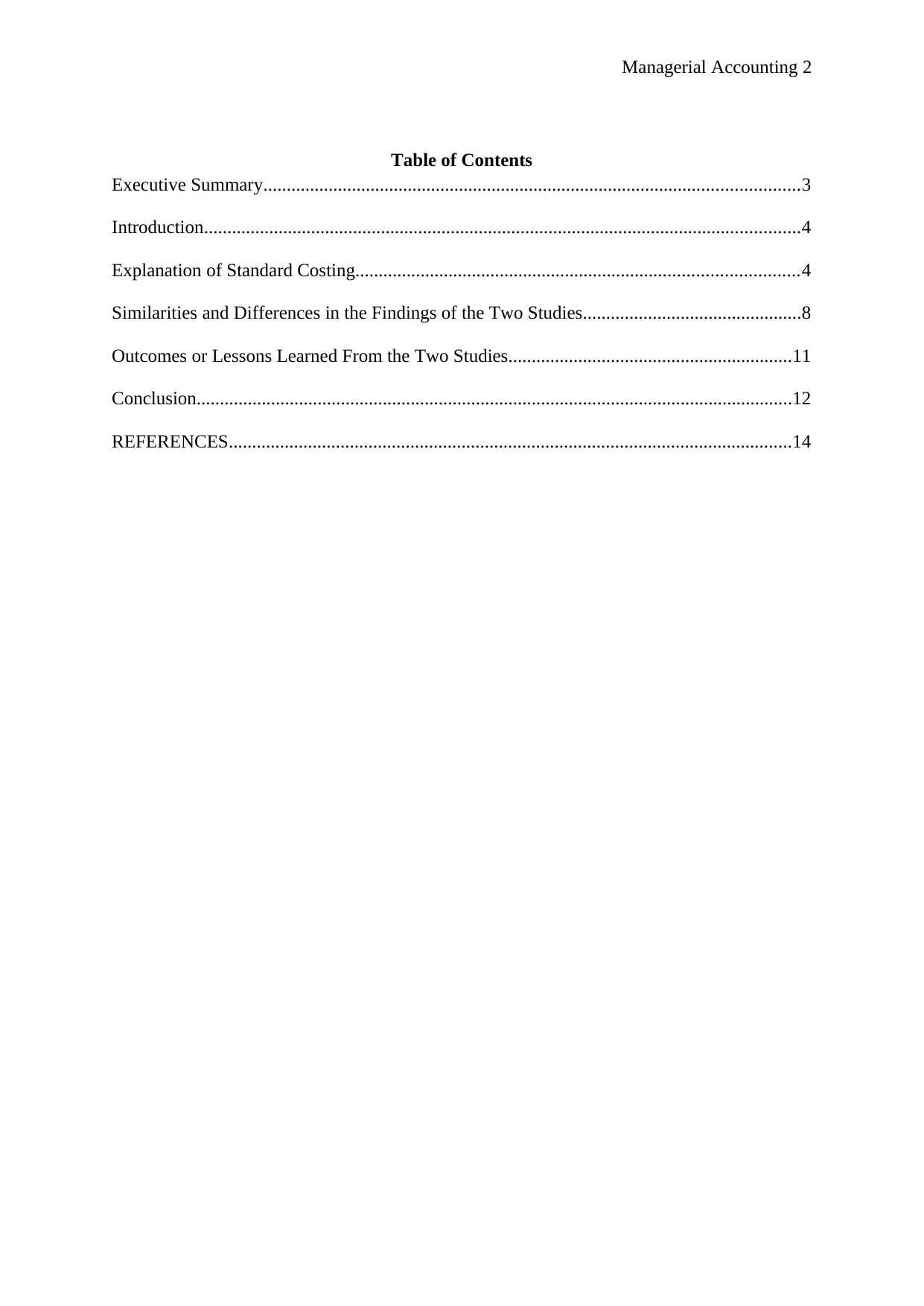
Table of Contents
Executive Summary...................................................................................................................3
Introduction................................................................................................................................4
Explanation of Standard Costing...............................................................................................4
Similarities and Differences in the Findings of the Two Studies...............................................8
Outcomes or Lessons Learned From the Two Studies.............................................................11
Conclusion................................................................................................................................12
REFERENCES.........................................................................................................................14
Table of Contents
Executive Summary...................................................................................................................3
Introduction................................................................................................................................4
Explanation of Standard Costing...............................................................................................4
Similarities and Differences in the Findings of the Two Studies...............................................8
Outcomes or Lessons Learned From the Two Studies.............................................................11
Conclusion................................................................................................................................12
REFERENCES.........................................................................................................................14
Managerial Accounting 3
Executive Summary
The management topic selected under this study is standard costing. The study aims to
present applicability of standard costing and explore its impacts on performance of various
firms. It was found out that standard costing is highly adopted by various manufacturing
firms across the globe. Furthermore, it was found out that effective application of the
standard costing could have significant impact on organization’s performance. It was also
revealed that organization benefits significantly from use of the standard costing particularly
in improvement of its profits. It was also established that standard costing helps in
elimination of the unprofitable products, cost control and in provision of the cost information.
Executive Summary
The management topic selected under this study is standard costing. The study aims to
present applicability of standard costing and explore its impacts on performance of various
firms. It was found out that standard costing is highly adopted by various manufacturing
firms across the globe. Furthermore, it was found out that effective application of the
standard costing could have significant impact on organization’s performance. It was also
revealed that organization benefits significantly from use of the standard costing particularly
in improvement of its profits. It was also established that standard costing helps in
elimination of the unprofitable products, cost control and in provision of the cost information.
⊘ This is a preview!⊘
Do you want full access?
Subscribe today to unlock all pages.

Trusted by 1+ million students worldwide
Managerial Accounting 4
Introduction
Management accounting and cost accounting combines in providing relevant accounting
information to assist organization’s management run their operations in an effective manner.
Besides, at the heart of economic success and financial performance stability of a particular
firm, that in itself displays quality of the decisions made by the managements, there is need to
enhance better management accounting approaches (Abdullahj, Oni, Ahmed & Shakur 2015).
Further, in spite of inadequacy of detailed research in accounting records, as well as how the
resources were utilized in informing the decision-making, a conventional wisdom has
developed directed at inadequacy of the costing information for the decision-making, non-
adoption by the company of the best practices and failures of the management accountants in
providing lead in construction of a better costing systems (DeZoysa & Siriyama Kanthi
Herath 2007). Basically, utilization of the management accounting assists in application of
principles of the scientific management in the business operations liked with adoption of the
budgetary control and standard costing (brahim 2007). As such the paper aims to present
analysis of one of the key topic in management accounting; that is, standard costing. It begins
with explanation and description of the standard costing. This is followed by selection of two
research journals on the study topic; that is, standard costing, highlighting their purposes and
the research questions guiding them. The paper also presents similarities and differences
between the two studies followed with analysis of two main outcomes or lessons learned
from each article presented and their impact on the management accountants working in
Australian firms. It wrap with concluding statements explaining what was established
regarding the topic.
Explanation of Standard Costing
Introduction
Management accounting and cost accounting combines in providing relevant accounting
information to assist organization’s management run their operations in an effective manner.
Besides, at the heart of economic success and financial performance stability of a particular
firm, that in itself displays quality of the decisions made by the managements, there is need to
enhance better management accounting approaches (Abdullahj, Oni, Ahmed & Shakur 2015).
Further, in spite of inadequacy of detailed research in accounting records, as well as how the
resources were utilized in informing the decision-making, a conventional wisdom has
developed directed at inadequacy of the costing information for the decision-making, non-
adoption by the company of the best practices and failures of the management accountants in
providing lead in construction of a better costing systems (DeZoysa & Siriyama Kanthi
Herath 2007). Basically, utilization of the management accounting assists in application of
principles of the scientific management in the business operations liked with adoption of the
budgetary control and standard costing (brahim 2007). As such the paper aims to present
analysis of one of the key topic in management accounting; that is, standard costing. It begins
with explanation and description of the standard costing. This is followed by selection of two
research journals on the study topic; that is, standard costing, highlighting their purposes and
the research questions guiding them. The paper also presents similarities and differences
between the two studies followed with analysis of two main outcomes or lessons learned
from each article presented and their impact on the management accountants working in
Australian firms. It wrap with concluding statements explaining what was established
regarding the topic.
Explanation of Standard Costing
Paraphrase This Document
Need a fresh take? Get an instant paraphrase of this document with our AI Paraphraser
Managerial Accounting 5
Standard costs usually reveal objectives, spur some actions and offers controls and check
such that some exceptional income oriented objective performance could be accomplished
and consequently, enough punishment could be exercised for any bad performance (Rao &
Bargerstock 2011). In essence, standard costs result in appraised being made over the
production facilities and from the management capabilities and intention and is considered as
the first step in weakness and strength appraisal. Standard costing is the management
accounting tool for either improving profitability or managerial effectiveness of an
organization or not (Mărginean 2013). Unlike other tools, the system deals with calculation
of significant information regarding an organization. In other words, standard costing as one
of the longest established concept is considered as the management function of control and
planning. It is the process of that is used in estimating cost of a product per unit (Edwards,
Boyns & Matthews 2002).
Further, standard costing is usually the management accounting tool which some
manufacturers utilizes in identifying variances and differences between actual costs of goods
produced and cost which ought to be incurred in producing these goods (DeZoysa &
Siriyama Kanthi Herath 2007). Cost occurring for actual product output is the standard cost.
It is usually integrated with the manufacturer’s budget for accounting period and comprises
of product costs, overheads and direct materials. With the standard costing, accounts for the
inventories as well as for COGs comprises of standard costs of input which ought to have
been utilized in producing actual product output (Rao & Bargerstock 2011). Further, standard
costing is the routine assessment approach utilized in comparing the real enactment of a
specific firm against its standard for the entire section of its operations (brahim 2007). In this
case, whenever actual performance happens, actual data or information is compared with the
standard ones and in case of the difference, this difference is usually analysed in order to
establish the main reason thereof. Difference of the actual value from the standard one is
Standard costs usually reveal objectives, spur some actions and offers controls and check
such that some exceptional income oriented objective performance could be accomplished
and consequently, enough punishment could be exercised for any bad performance (Rao &
Bargerstock 2011). In essence, standard costs result in appraised being made over the
production facilities and from the management capabilities and intention and is considered as
the first step in weakness and strength appraisal. Standard costing is the management
accounting tool for either improving profitability or managerial effectiveness of an
organization or not (Mărginean 2013). Unlike other tools, the system deals with calculation
of significant information regarding an organization. In other words, standard costing as one
of the longest established concept is considered as the management function of control and
planning. It is the process of that is used in estimating cost of a product per unit (Edwards,
Boyns & Matthews 2002).
Further, standard costing is usually the management accounting tool which some
manufacturers utilizes in identifying variances and differences between actual costs of goods
produced and cost which ought to be incurred in producing these goods (DeZoysa &
Siriyama Kanthi Herath 2007). Cost occurring for actual product output is the standard cost.
It is usually integrated with the manufacturer’s budget for accounting period and comprises
of product costs, overheads and direct materials. With the standard costing, accounts for the
inventories as well as for COGs comprises of standard costs of input which ought to have
been utilized in producing actual product output (Rao & Bargerstock 2011). Further, standard
costing is the routine assessment approach utilized in comparing the real enactment of a
specific firm against its standard for the entire section of its operations (brahim 2007). In this
case, whenever actual performance happens, actual data or information is compared with the
standard ones and in case of the difference, this difference is usually analysed in order to
establish the main reason thereof. Difference of the actual value from the standard one is
Managerial Accounting 6
referred to as the variance (Abdullahj, Oni, Ahmed & Shakur 2015). This variance might be
adverse or favoured. Standard costing entails provision of clear information or explanation
on what amount of cost ought to be incurred, the actual amount of the cost incurred, variance
between the amounts that ought to be and amount incurred, reason and remedial action that
ought to be undertaken in ensuring actual occurrences are in line with planned ones. Besides,
standard costing is the degree of association for qualitative and quantitative ideals. It is the
regular allusion level for re-evaluation of an organization’s concert (Edwards, Boyns &
Matthews 2002). Besides, it is viewed as preparation and utilization of the standard cost as
well as measurement at a point of incidence. The system is usually concerned with evaluation
of organization efficiency, describing how organization’s managers could have significant
management over procurement and utilization of the capitals in manufacturing specific class
of the yield (Abdullahj, Oni, Ahmed & Shakur 2015).
According DeZoysa and Siriyama Kanthi Herath (2007) to standard costing is viewed as the
system of management accounting that utilizes prearranged costs in involving every
component of the cost arrangement, overhead and materials for every line of the lendered
services or produced product. It therefore represent integral portion of the management
accounting control approach that would also include responsibility accounting statement and
budgeting system. To be more specific, standard costing is considered as predetermined
calculation of amount of cost that ought to be placed under particular working conditions
(Abdullahj, Oni, Ahmed & Shakur 2015). This is built from evaluation of value of the cost
component and relates approach specifications as well as quantification of the labor, material
as well as other charges to the prices projected or estimated to relate within the date that
standard costs were projected to be utilized. According to Rao and Bargerstock (2011),
standard costing might either be considered from viewpoint of the marginal costing viewpoint
or on absorption costing viewpoint. Concerning the standard costing approach with the
referred to as the variance (Abdullahj, Oni, Ahmed & Shakur 2015). This variance might be
adverse or favoured. Standard costing entails provision of clear information or explanation
on what amount of cost ought to be incurred, the actual amount of the cost incurred, variance
between the amounts that ought to be and amount incurred, reason and remedial action that
ought to be undertaken in ensuring actual occurrences are in line with planned ones. Besides,
standard costing is the degree of association for qualitative and quantitative ideals. It is the
regular allusion level for re-evaluation of an organization’s concert (Edwards, Boyns &
Matthews 2002). Besides, it is viewed as preparation and utilization of the standard cost as
well as measurement at a point of incidence. The system is usually concerned with evaluation
of organization efficiency, describing how organization’s managers could have significant
management over procurement and utilization of the capitals in manufacturing specific class
of the yield (Abdullahj, Oni, Ahmed & Shakur 2015).
According DeZoysa and Siriyama Kanthi Herath (2007) to standard costing is viewed as the
system of management accounting that utilizes prearranged costs in involving every
component of the cost arrangement, overhead and materials for every line of the lendered
services or produced product. It therefore represent integral portion of the management
accounting control approach that would also include responsibility accounting statement and
budgeting system. To be more specific, standard costing is considered as predetermined
calculation of amount of cost that ought to be placed under particular working conditions
(Abdullahj, Oni, Ahmed & Shakur 2015). This is built from evaluation of value of the cost
component and relates approach specifications as well as quantification of the labor, material
as well as other charges to the prices projected or estimated to relate within the date that
standard costs were projected to be utilized. According to Rao and Bargerstock (2011),
standard costing might either be considered from viewpoint of the marginal costing viewpoint
or on absorption costing viewpoint. Concerning the standard costing approach with the
⊘ This is a preview!⊘
Do you want full access?
Subscribe today to unlock all pages.
Trusted by 1+ million students worldwide
Managerial Accounting 7
marginal costing, variances would be unveiled on total pertinent cost of the products
eliminating the fixed overheads. Though if observed in perspective or viewpoint of the
absorption costing, the amount of variance would entail total costs of the products (Radu
Mărginean 2013).
Standard costing is believed to assists organization management in planning for the future
operations (Edwards, Boyns & Matthews 2002). Standard costing acts as the yardstick since
it offers basis whereby the performance of an organization might be evaluated based on what
product should be produced, quantity to be used as well as the projected level of the
activities. Standard costing offers basis for regular checks on the amount of expenditure
incurred during production (Marie & Rao 2010). In essence, it provides basis for regular
controls and checks of material, labor costs, overhead expenses and price usage. It offers
readily available and fast report for the management decisions. Further, standard costing
enhances cost reduction and cost control. In this sense, by comparing the standard cost with
the actual ones, cost could be reduced and controlled via constant monitoring measures and
comparing the outcomes (Mărginean 2013). It is a recognizable technique of appraising and
monitoring performance via variance analysis, improving procedures and method for future
and analysing the causes of the shortfall. Standard costing also offer the basis for forecasting
and budgeting and assists in tackling the internal issues with a lot of emphasis being provided
to probable price variation (Bowhill & Lee 2002). It is also the most suitable management
accounting systems in resolving internal issues arising from the inflation.
Purpose of the Two Studies
The article “Effects of Standard Costing on the Profitability of Telecommunication
Companies” by Abdullahj et al. (2015) on standard costing and its influence on profitability
of the telecommunication companies with the main focus on MTN Telecommunication
marginal costing, variances would be unveiled on total pertinent cost of the products
eliminating the fixed overheads. Though if observed in perspective or viewpoint of the
absorption costing, the amount of variance would entail total costs of the products (Radu
Mărginean 2013).
Standard costing is believed to assists organization management in planning for the future
operations (Edwards, Boyns & Matthews 2002). Standard costing acts as the yardstick since
it offers basis whereby the performance of an organization might be evaluated based on what
product should be produced, quantity to be used as well as the projected level of the
activities. Standard costing offers basis for regular checks on the amount of expenditure
incurred during production (Marie & Rao 2010). In essence, it provides basis for regular
controls and checks of material, labor costs, overhead expenses and price usage. It offers
readily available and fast report for the management decisions. Further, standard costing
enhances cost reduction and cost control. In this sense, by comparing the standard cost with
the actual ones, cost could be reduced and controlled via constant monitoring measures and
comparing the outcomes (Mărginean 2013). It is a recognizable technique of appraising and
monitoring performance via variance analysis, improving procedures and method for future
and analysing the causes of the shortfall. Standard costing also offer the basis for forecasting
and budgeting and assists in tackling the internal issues with a lot of emphasis being provided
to probable price variation (Bowhill & Lee 2002). It is also the most suitable management
accounting systems in resolving internal issues arising from the inflation.
Purpose of the Two Studies
The article “Effects of Standard Costing on the Profitability of Telecommunication
Companies” by Abdullahj et al. (2015) on standard costing and its influence on profitability
of the telecommunication companies with the main focus on MTN Telecommunication
Paraphrase This Document
Need a fresh take? Get an instant paraphrase of this document with our AI Paraphraser
Managerial Accounting 8
Company in Nigeria. Its main purpose was to assessing impacts of the standard costing
approach on MTN telecommunication firms’ profitability in realizing or ascertaining whether
its applicability have any impact on the profitability, in exploring relationship between
profitability and standard costing of the telecommunication firms and ascertaining whether
the standard costs and the values being practiced and adopted by the MTN Kona
telecommunication company. It also aimed at exploring profitability trend within the sector
tin inform the decision making by policy makers and investors.
On the other hand, “Exploring the role of standard costing in lean manufacturing enterprises:
a structuration theory approach” by Rao & Bargerstock (2011), is a journal trying to evaluate
Or explore role of the standard costing in the lean manufacturing organization. Though
manufacturing firms across the globe are moving swiftly to adoption of the lean
manufacturing technique, there is some evidence that some continue using the traditional
standard costing systems despite the argument that the systems higher the lean execution.
Nonetheless, it is known that there has never been any study examining or determining
whether the lean accounting matches with standard costing. As such the purpose of this study
was to examining how mature the lean manufacturers’ utilization of the standard costing is
compared to the lean accounting theories. The paper also purposes to determine the reason
why the mature lean manufacturing might continue using standard costing. This was in
anticipation that the study would result in better comprehension of the main reasons the lean
manufacturers tend to retain the standard costing and facilitating aspects which permits some
firms in discarding the standard costing as their control systems for their operations.
Similarities and Differences in the Findings of the Two Studies
In an article by Rao & Bargerstock (2011) it was found out that the standard costing produce
comprehensive scheme of the accounting for reporting all transactions within a lean
Company in Nigeria. Its main purpose was to assessing impacts of the standard costing
approach on MTN telecommunication firms’ profitability in realizing or ascertaining whether
its applicability have any impact on the profitability, in exploring relationship between
profitability and standard costing of the telecommunication firms and ascertaining whether
the standard costs and the values being practiced and adopted by the MTN Kona
telecommunication company. It also aimed at exploring profitability trend within the sector
tin inform the decision making by policy makers and investors.
On the other hand, “Exploring the role of standard costing in lean manufacturing enterprises:
a structuration theory approach” by Rao & Bargerstock (2011), is a journal trying to evaluate
Or explore role of the standard costing in the lean manufacturing organization. Though
manufacturing firms across the globe are moving swiftly to adoption of the lean
manufacturing technique, there is some evidence that some continue using the traditional
standard costing systems despite the argument that the systems higher the lean execution.
Nonetheless, it is known that there has never been any study examining or determining
whether the lean accounting matches with standard costing. As such the purpose of this study
was to examining how mature the lean manufacturers’ utilization of the standard costing is
compared to the lean accounting theories. The paper also purposes to determine the reason
why the mature lean manufacturing might continue using standard costing. This was in
anticipation that the study would result in better comprehension of the main reasons the lean
manufacturers tend to retain the standard costing and facilitating aspects which permits some
firms in discarding the standard costing as their control systems for their operations.
Similarities and Differences in the Findings of the Two Studies
In an article by Rao & Bargerstock (2011) it was found out that the standard costing produce
comprehensive scheme of the accounting for reporting all transactions within a lean
Managerial Accounting 9
manufacturing process to hint flow of every course through diverse levels of production.
Besides, it was found out that in single-product, standard costing would be relatively easy for
maintaining and producing meaningful information for control. Furthermore, the authors in
this study established that in multiproduct lean manufacturing setting, where every process is
expected to produce wide range of products, and maintaining detailed accounts of the
products is both cumbersome and wasteful. Hence, the use of the standard costing in this
setting is revealed to produce volume of the variances report which might not just be hectic to
analyse but also not offer meaningful info in exercising control. Further, Rao & Bargerstock
(2011) found out that in a lean manufacturing process, possibility of utilizing standard costing
in controlling purposes would be relatively high. Further, it was established that in the lean
manufacturing organization where little support is offered from the top management,
probability of using standard costing for control would also be relatively high. Nonetheless,
in a lean manufacturing process where management are preparing specialized reports in
capturing financial effect, possibility of retaining the standard cost would be very low.
Abdullahj et al. (2015) in their study found out that standard costing had a significant impact
on profitability of telecommunication firms. In fact, they revealed that standard costing was
significant in each and all telecommunication firms operating in Nigeria. In fact, they
established that in case, practice and principles of the standard costing were practiced and
adopted in the MTN Kano Company, this could serves as the management accounting
approach for upgrading of its productivity. This was based on their arguments that standard
costing augments effectual planning, decision-making and control within the firm. On
overall, the authors of the study supported general overview that standard costing helps in
upgrading profitability levels within the manufacturing firms.
manufacturing process to hint flow of every course through diverse levels of production.
Besides, it was found out that in single-product, standard costing would be relatively easy for
maintaining and producing meaningful information for control. Furthermore, the authors in
this study established that in multiproduct lean manufacturing setting, where every process is
expected to produce wide range of products, and maintaining detailed accounts of the
products is both cumbersome and wasteful. Hence, the use of the standard costing in this
setting is revealed to produce volume of the variances report which might not just be hectic to
analyse but also not offer meaningful info in exercising control. Further, Rao & Bargerstock
(2011) found out that in a lean manufacturing process, possibility of utilizing standard costing
in controlling purposes would be relatively high. Further, it was established that in the lean
manufacturing organization where little support is offered from the top management,
probability of using standard costing for control would also be relatively high. Nonetheless,
in a lean manufacturing process where management are preparing specialized reports in
capturing financial effect, possibility of retaining the standard cost would be very low.
Abdullahj et al. (2015) in their study found out that standard costing had a significant impact
on profitability of telecommunication firms. In fact, they revealed that standard costing was
significant in each and all telecommunication firms operating in Nigeria. In fact, they
established that in case, practice and principles of the standard costing were practiced and
adopted in the MTN Kano Company, this could serves as the management accounting
approach for upgrading of its productivity. This was based on their arguments that standard
costing augments effectual planning, decision-making and control within the firm. On
overall, the authors of the study supported general overview that standard costing helps in
upgrading profitability levels within the manufacturing firms.
⊘ This is a preview!⊘
Do you want full access?
Subscribe today to unlock all pages.
Trusted by 1+ million students worldwide
Managerial Accounting 10
The two articles were similar at some point especially in their findings. For instance, both
articles support the general conclusion about standard costing indicating that the system helps
in improving profitability within any manufacturing organization. Besides, in both studies,
standard costs were found to have been developed in suiting needs of the mass
manufacturers. This is based on the notion that the gains of economic scale, the high fixed
outlay expense are usually outlined across sizes of the units being created. Furthermore, the
two standards were similar in that their findings regarding standard costing was relatively
same. For instance, in both studies, standard costing is established as a expedient means of
the costing outputs within the bulk manufacturing settings. The authors in both studies argued
that standard costs helps in estimating costs of output on unit basis which are then compared
with the actual costs in order to determine amount of variance. Both studies also established
that standard costing create detailed systems of the management accounting for reporting all
transactions in order to hint movement of the procedures all through diverse levels of
manufacture. Additionally, in both studies, in single-product environment, the systems is said
to be relatively easy to uphold and could produce some expressive reports for the controls.
There is no meaningful difference between the two studies except that they had varying few
in regard to a lean manufacturing setting where Rao & Bargerstock (2011) established that in
multiproduct lean manufacturing setting use of the standard costing to produce volume of the
variances report which might not just be hectic to analyse but also not offer meaningful info
in exercising control. There is also a different in their views where Rao & Bargerstock (2011)
which was analysing applicability of standard costing in a lean manufacturing environment
The two articles were similar at some point especially in their findings. For instance, both
articles support the general conclusion about standard costing indicating that the system helps
in improving profitability within any manufacturing organization. Besides, in both studies,
standard costs were found to have been developed in suiting needs of the mass
manufacturers. This is based on the notion that the gains of economic scale, the high fixed
outlay expense are usually outlined across sizes of the units being created. Furthermore, the
two standards were similar in that their findings regarding standard costing was relatively
same. For instance, in both studies, standard costing is established as a expedient means of
the costing outputs within the bulk manufacturing settings. The authors in both studies argued
that standard costs helps in estimating costs of output on unit basis which are then compared
with the actual costs in order to determine amount of variance. Both studies also established
that standard costing create detailed systems of the management accounting for reporting all
transactions in order to hint movement of the procedures all through diverse levels of
manufacture. Additionally, in both studies, in single-product environment, the systems is said
to be relatively easy to uphold and could produce some expressive reports for the controls.
There is no meaningful difference between the two studies except that they had varying few
in regard to a lean manufacturing setting where Rao & Bargerstock (2011) established that in
multiproduct lean manufacturing setting use of the standard costing to produce volume of the
variances report which might not just be hectic to analyse but also not offer meaningful info
in exercising control. There is also a different in their views where Rao & Bargerstock (2011)
which was analysing applicability of standard costing in a lean manufacturing environment
Paraphrase This Document
Need a fresh take? Get an instant paraphrase of this document with our AI Paraphraser
Managerial Accounting 11
established that in such a situation where the management fails to offer support, applicability
of the standard costing might be relatively low and a bit costly for the firm.
Outcomes or Lessons Learned From the Two Studies
The outcomes of the two studies would be discussed separately starting with outcomes or
lessons learned from a study by Abdullahj et al. (2015) followed by outcomes or lessons
learned from Rao & Bargerstock (2011). Basically, two outcomes or lessons learned from
each study and their impacts on the management accountants professionals working in
Australia are discussed in this section brings into a total of four main outcomes.
In a study by Abdullahj et al. (2015), it can be learnt that standard costing is widely or
broadly utilized within Nigerian Manufacturing firms and was found to enhance adequate
planning, decision-making and control processes within an organization. This is a good
lesson for management accountants working in Australia as they prepare catch up with the
every growing development in management accounting techniques. Basically, this lesson is
of greater help to management accountants since they would be very keen while using the
standard costing in their planning, control and decision-making. In fact, it would enable them
to act very smart in ensuring that the standard costing is fully implemented in their operations
and that everything that is required to ensure its successful operations is put in place.
Through a study by Abdullahj et al. (2015) it can be noted that standard costing helps in
elimination of the unprofitable products, cost control and in provision of the cost information.
The outcome is of greater importance in my studies and in management accounting
professionals working in Australia. This is based on the fact that knowing very well that
standard costing helps in elimination of the unprofitable products and in controlling costs of
production, the management accountants would be strive in highlighting such benefits to their
organizations’ executives which would in turn work towards implementation of the systems.
established that in such a situation where the management fails to offer support, applicability
of the standard costing might be relatively low and a bit costly for the firm.
Outcomes or Lessons Learned From the Two Studies
The outcomes of the two studies would be discussed separately starting with outcomes or
lessons learned from a study by Abdullahj et al. (2015) followed by outcomes or lessons
learned from Rao & Bargerstock (2011). Basically, two outcomes or lessons learned from
each study and their impacts on the management accountants professionals working in
Australia are discussed in this section brings into a total of four main outcomes.
In a study by Abdullahj et al. (2015), it can be learnt that standard costing is widely or
broadly utilized within Nigerian Manufacturing firms and was found to enhance adequate
planning, decision-making and control processes within an organization. This is a good
lesson for management accountants working in Australia as they prepare catch up with the
every growing development in management accounting techniques. Basically, this lesson is
of greater help to management accountants since they would be very keen while using the
standard costing in their planning, control and decision-making. In fact, it would enable them
to act very smart in ensuring that the standard costing is fully implemented in their operations
and that everything that is required to ensure its successful operations is put in place.
Through a study by Abdullahj et al. (2015) it can be noted that standard costing helps in
elimination of the unprofitable products, cost control and in provision of the cost information.
The outcome is of greater importance in my studies and in management accounting
professionals working in Australia. This is based on the fact that knowing very well that
standard costing helps in elimination of the unprofitable products and in controlling costs of
production, the management accountants would be strive in highlighting such benefits to their
organizations’ executives which would in turn work towards implementation of the systems.
Managerial Accounting 12
Besides, with such lesson, the management accountant would not be reluctant in
implementing this system in their organization in order to be able to control any cost
associated with their production and to cut or remove any unprofitable products in their
production.
In a study by Rao & Bargerstock (2011), it can be learnt that due to its affordability,
flexibility and simplicity, standard costs is one of the most favourite management accounting
technique amount the finance and accounting professionals both in service and industrial
sectors. Such lesson is of greater sense to every management accountant working in
Australia. This is because it would enable them understand that in spite of the benefits
highlighted regarding standard costing, there is need to be very cautious while using this
system since if caution is not practices or observed they might end up making bad decisions.
Furthermore, they would be very eager to practice management accounting in all levels of
their production since through the study, they understand the flexibility nature and simplicity
nature of the standard costing.
Further, in a study by Rao & Bargerstock (2011) it can be learned that standard costing in
lean manufacturing setting possibility is high. This is based on the fact that in multiproduct
lean manufacturing setting use of the standard costing to produce volume of the variances
report which might not just be hectic to analyse but also not offer meaningful info in
exercising control. Such lesson is good and would influence the management accountants
working in Australia to be very keen to understand a scenario of lean manufacturing and
probable measures to ensure successful outcomes through the use of standard costing.
Conclusion
In conclusion, standard costing is widely or broadly utilized within manufacturing firms. It
can also be stated that the system enhance adequate planning, decision-making and control
Besides, with such lesson, the management accountant would not be reluctant in
implementing this system in their organization in order to be able to control any cost
associated with their production and to cut or remove any unprofitable products in their
production.
In a study by Rao & Bargerstock (2011), it can be learnt that due to its affordability,
flexibility and simplicity, standard costs is one of the most favourite management accounting
technique amount the finance and accounting professionals both in service and industrial
sectors. Such lesson is of greater sense to every management accountant working in
Australia. This is because it would enable them understand that in spite of the benefits
highlighted regarding standard costing, there is need to be very cautious while using this
system since if caution is not practices or observed they might end up making bad decisions.
Furthermore, they would be very eager to practice management accounting in all levels of
their production since through the study, they understand the flexibility nature and simplicity
nature of the standard costing.
Further, in a study by Rao & Bargerstock (2011) it can be learned that standard costing in
lean manufacturing setting possibility is high. This is based on the fact that in multiproduct
lean manufacturing setting use of the standard costing to produce volume of the variances
report which might not just be hectic to analyse but also not offer meaningful info in
exercising control. Such lesson is good and would influence the management accountants
working in Australia to be very keen to understand a scenario of lean manufacturing and
probable measures to ensure successful outcomes through the use of standard costing.
Conclusion
In conclusion, standard costing is widely or broadly utilized within manufacturing firms. It
can also be stated that the system enhance adequate planning, decision-making and control
⊘ This is a preview!⊘
Do you want full access?
Subscribe today to unlock all pages.
Trusted by 1+ million students worldwide

1 out of 15


Related Documents


Your All-in-One AI-Powered Toolkit for Academic Success.
+13062052269
info@desklib.com
Available 24*7 on WhatsApp / Email
![[object Object]](/_next/static/media/star-bottom.7253800d.svg)
Unlock your academic potential
Copyright © 2020–2026 A2Z Services. All Rights Reserved. Developed and managed by ZUCOL.