Analysis of Standard Costing in Management Accounting Practices
VerifiedAdded on 2023/06/03
|16
|3918
|70
Report
AI Summary
This report provides a comprehensive analysis of standard costing as a key topic in management accounting. It examines two journal articles based on real-world scenarios, evaluating their similarities and differences in findings, and discusses lessons learned. The analysis reveals that standard costing is widely used for budgeting, stock valuation, cost reduction, and cost control. It serves as a benchmark for assessing qualitative and quantitative ideals and for re-evaluating an organization's financial performance. Standard costing also plays a significant role in cost control by assessing the efficiency of management in controlling the acquisition and utilization of capital in manufacturing output. The report further explores the purpose of the studies, including the impact of standard costing on profitability in telecommunication firms and its application in Japanese organizations, highlighting its continued relevance despite technological advancements and potential internal issues.
Management Accounting 1
Management Accounting
Author
Course
Professor
City
Date
Management Accounting
Author
Course
Professor
City
Date

Paraphrase This Document
Need a fresh take? Get an instant paraphrase of this document with our AI Paraphraser
Management Accounting 2
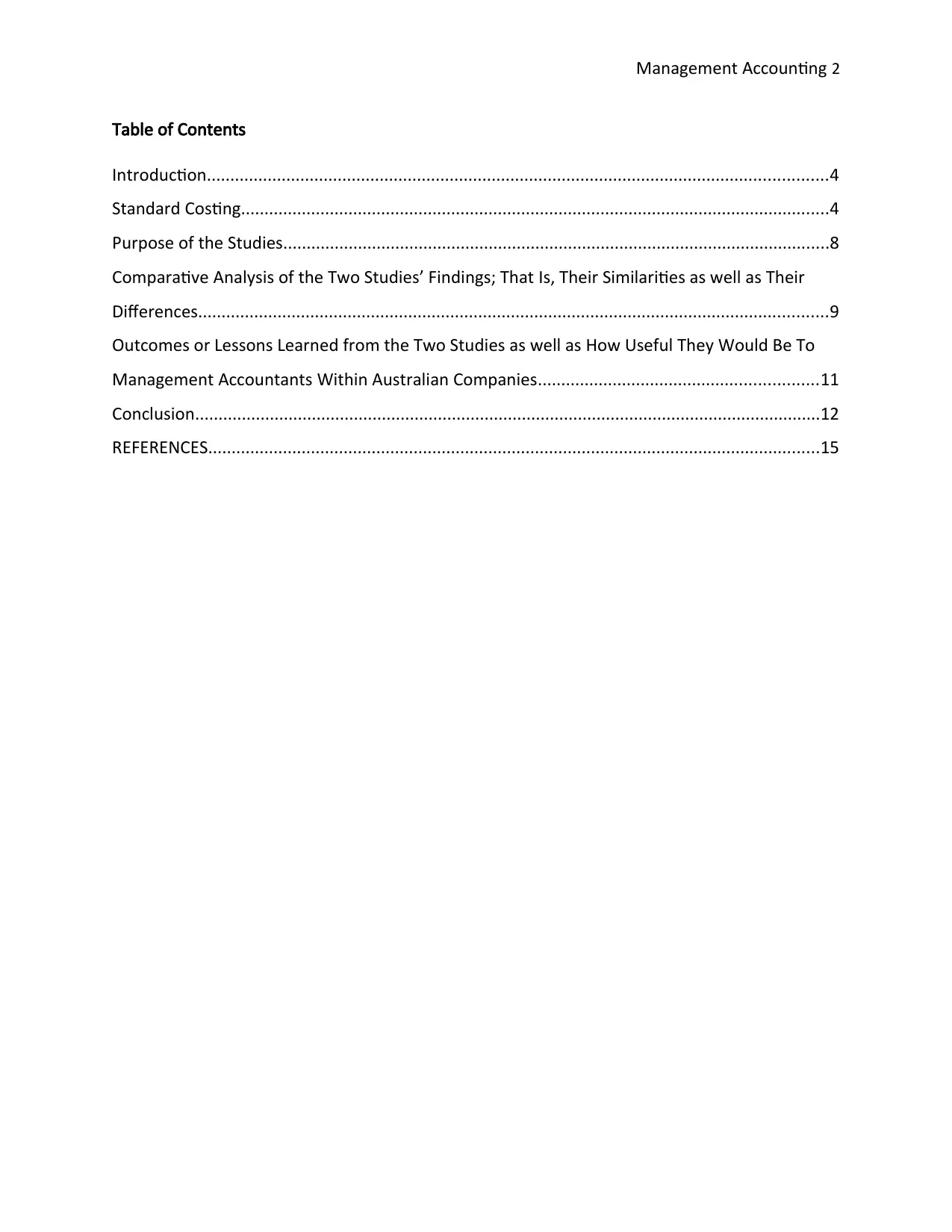
Table of Contents
Introduction.....................................................................................................................................4
Standard Costing..............................................................................................................................4
Purpose of the Studies.....................................................................................................................8
Comparative Analysis of the Two Studies’ Findings; That Is, Their Similarities as well as Their
Differences.......................................................................................................................................9
Outcomes or Lessons Learned from the Two Studies as well as How Useful They Would Be To
Management Accountants Within Australian Companies............................................................11
Conclusion......................................................................................................................................12
REFERENCES...................................................................................................................................15
Table of Contents
Introduction.....................................................................................................................................4
Standard Costing..............................................................................................................................4
Purpose of the Studies.....................................................................................................................8
Comparative Analysis of the Two Studies’ Findings; That Is, Their Similarities as well as Their
Differences.......................................................................................................................................9
Outcomes or Lessons Learned from the Two Studies as well as How Useful They Would Be To
Management Accountants Within Australian Companies............................................................11
Conclusion......................................................................................................................................12
REFERENCES...................................................................................................................................15
Management Accounting 3
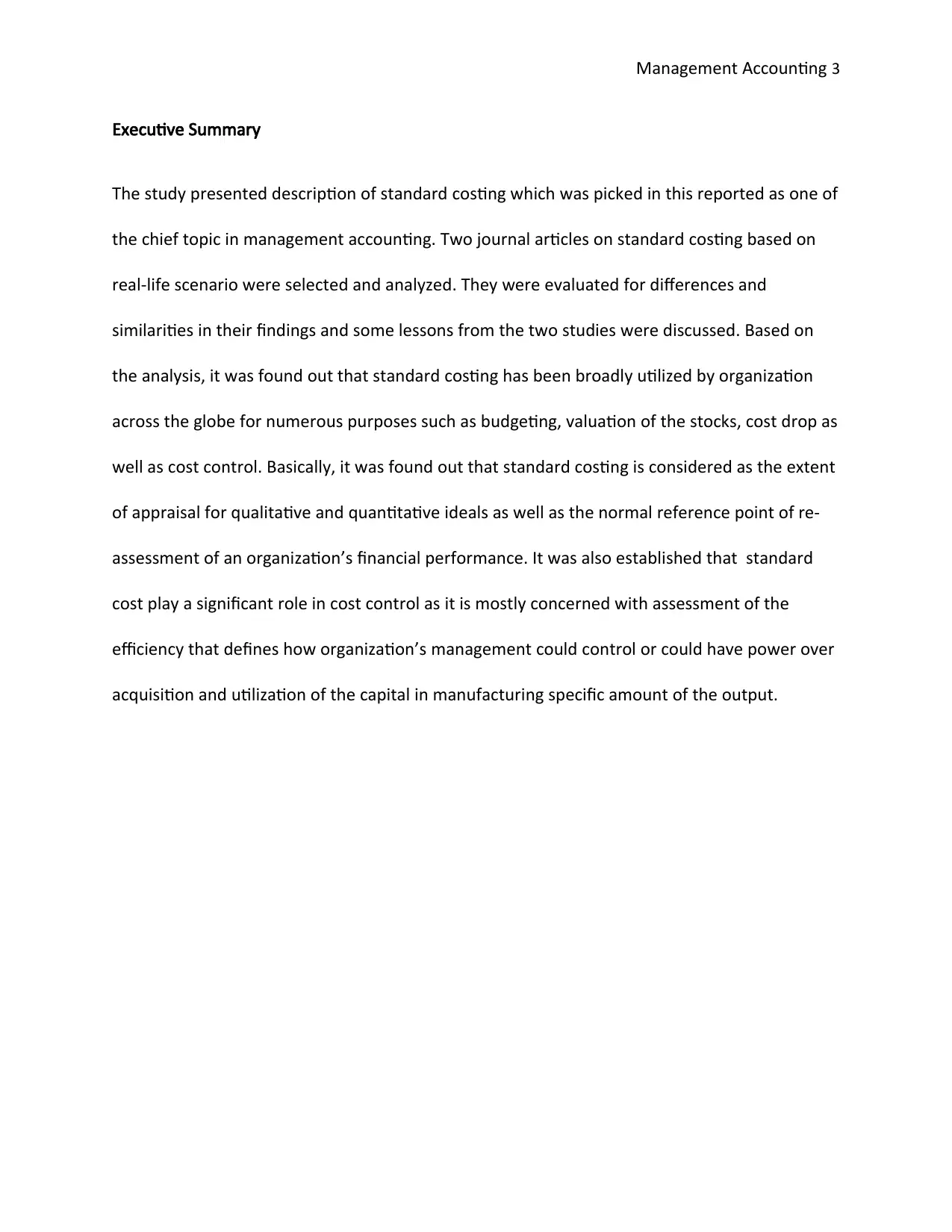
Executive Summary
The study presented description of standard costing which was picked in this reported as one of
the chief topic in management accounting. Two journal articles on standard costing based on
real-life scenario were selected and analyzed. They were evaluated for differences and
similarities in their findings and some lessons from the two studies were discussed. Based on
the analysis, it was found out that standard costing has been broadly utilized by organization
across the globe for numerous purposes such as budgeting, valuation of the stocks, cost drop as
well as cost control. Basically, it was found out that standard costing is considered as the extent
of appraisal for qualitative and quantitative ideals as well as the normal reference point of re-
assessment of an organization’s financial performance. It was also established that standard
cost play a significant role in cost control as it is mostly concerned with assessment of the
efficiency that defines how organization’s management could control or could have power over
acquisition and utilization of the capital in manufacturing specific amount of the output.
Executive Summary
The study presented description of standard costing which was picked in this reported as one of
the chief topic in management accounting. Two journal articles on standard costing based on
real-life scenario were selected and analyzed. They were evaluated for differences and
similarities in their findings and some lessons from the two studies were discussed. Based on
the analysis, it was found out that standard costing has been broadly utilized by organization
across the globe for numerous purposes such as budgeting, valuation of the stocks, cost drop as
well as cost control. Basically, it was found out that standard costing is considered as the extent
of appraisal for qualitative and quantitative ideals as well as the normal reference point of re-
assessment of an organization’s financial performance. It was also established that standard
cost play a significant role in cost control as it is mostly concerned with assessment of the
efficiency that defines how organization’s management could control or could have power over
acquisition and utilization of the capital in manufacturing specific amount of the output.
⊘ This is a preview!⊘
Do you want full access?
Subscribe today to unlock all pages.

Trusted by 1+ million students worldwide
Management Accounting 4
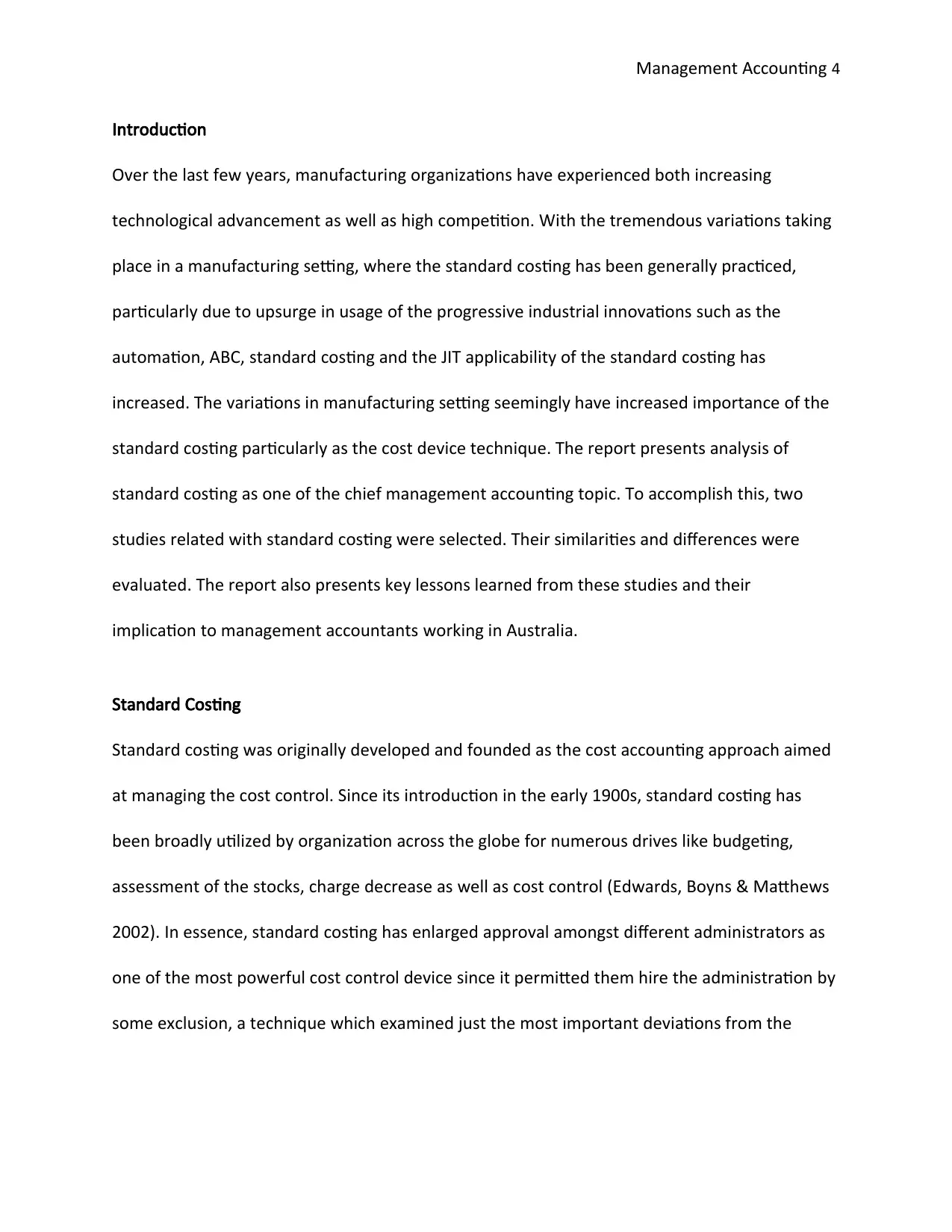
Introduction
Over the last few years, manufacturing organizations have experienced both increasing
technological advancement as well as high competition. With the tremendous variations taking
place in a manufacturing setting, where the standard costing has been generally practiced,
particularly due to upsurge in usage of the progressive industrial innovations such as the
automation, ABC, standard costing and the JIT applicability of the standard costing has
increased. The variations in manufacturing setting seemingly have increased importance of the
standard costing particularly as the cost device technique. The report presents analysis of
standard costing as one of the chief management accounting topic. To accomplish this, two
studies related with standard costing were selected. Their similarities and differences were
evaluated. The report also presents key lessons learned from these studies and their
implication to management accountants working in Australia.
Standard Costing
Standard costing was originally developed and founded as the cost accounting approach aimed
at managing the cost control. Since its introduction in the early 1900s, standard costing has
been broadly utilized by organization across the globe for numerous drives like budgeting,
assessment of the stocks, charge decrease as well as cost control (Edwards, Boyns & Matthews
2002). In essence, standard costing has enlarged approval amongst different administrators as
one of the most powerful cost control device since it permitted them hire the administration by
some exclusion, a technique which examined just the most important deviations from the
Introduction
Over the last few years, manufacturing organizations have experienced both increasing
technological advancement as well as high competition. With the tremendous variations taking
place in a manufacturing setting, where the standard costing has been generally practiced,
particularly due to upsurge in usage of the progressive industrial innovations such as the
automation, ABC, standard costing and the JIT applicability of the standard costing has
increased. The variations in manufacturing setting seemingly have increased importance of the
standard costing particularly as the cost device technique. The report presents analysis of
standard costing as one of the chief management accounting topic. To accomplish this, two
studies related with standard costing were selected. Their similarities and differences were
evaluated. The report also presents key lessons learned from these studies and their
implication to management accountants working in Australia.
Standard Costing
Standard costing was originally developed and founded as the cost accounting approach aimed
at managing the cost control. Since its introduction in the early 1900s, standard costing has
been broadly utilized by organization across the globe for numerous drives like budgeting,
assessment of the stocks, charge decrease as well as cost control (Edwards, Boyns & Matthews
2002). In essence, standard costing has enlarged approval amongst different administrators as
one of the most powerful cost control device since it permitted them hire the administration by
some exclusion, a technique which examined just the most important deviations from the
Paraphrase This Document
Need a fresh take? Get an instant paraphrase of this document with our AI Paraphraser
Management Accounting 5
prearranged stages of the presentation and allotting their energies to areas which deemed
beneficial (Holmes, & Hurley 2003).
Standard costing is also viewed as a management accounting tool used in enhancing capacity of
an organization better meet its strategic goals and enable the company to compete worldwide
(Bowhill & Lee 2002). Basically, standard costing is usually a performance review approach
utilized in comparing the actual financial performance of an entity against standard
performance for all levels of its operations. Such is accomplished through a comprehensive
discussion with numerous departmental heads within an organization. Whenever the actual
financial performance happens, actual financial information are then compared with the
standard ones, and in case there is any difference in between the variables, such difference is
usually evaluated in order to establish the reason for the variation (Sulaiman, Nik Nazli &
Norhayati 2005).
Basically, this deviation is usually referred to as the variance and such variance might either be
adverse or favorable. In other words, controlling of the costs comprises of provision of concise
cut info or evidence on what cost ought to be incurred, the cost incurred and actual variance
reported and what ought to have been reported, the reason and remedial action that ought to
be taken in ensuring that actual activities are in line with planned activities (Bowhill & Lee
2002). As such standard costing is considered as the measure of the comparison for qualitative
and quantitative values and is considered as the normal reference point of re-assessment of an
organization’s financial performance. In other words, standard costing has been viewed as use
and preparation of the standard cost as well as measurements at points of the incidence
prearranged stages of the presentation and allotting their energies to areas which deemed
beneficial (Holmes, & Hurley 2003).
Standard costing is also viewed as a management accounting tool used in enhancing capacity of
an organization better meet its strategic goals and enable the company to compete worldwide
(Bowhill & Lee 2002). Basically, standard costing is usually a performance review approach
utilized in comparing the actual financial performance of an entity against standard
performance for all levels of its operations. Such is accomplished through a comprehensive
discussion with numerous departmental heads within an organization. Whenever the actual
financial performance happens, actual financial information are then compared with the
standard ones, and in case there is any difference in between the variables, such difference is
usually evaluated in order to establish the reason for the variation (Sulaiman, Nik Nazli &
Norhayati 2005).
Basically, this deviation is usually referred to as the variance and such variance might either be
adverse or favorable. In other words, controlling of the costs comprises of provision of concise
cut info or evidence on what cost ought to be incurred, the cost incurred and actual variance
reported and what ought to have been reported, the reason and remedial action that ought to
be taken in ensuring that actual activities are in line with planned activities (Bowhill & Lee
2002). As such standard costing is considered as the measure of the comparison for qualitative
and quantitative values and is considered as the normal reference point of re-assessment of an
organization’s financial performance. In other words, standard costing has been viewed as use
and preparation of the standard cost as well as measurements at points of the incidence
Management Accounting 6
(Holmes, & Hurley 2003). It is concerned mostly with assessment of the efficiency that defines
how organization’s management could control or could have power over acquisition and
utilization of the capital in manufacturing specific amount of the output.
Standard costing is the system of the management accounting that utilizes or deploys the
concept of the predetermined costs relations to every component of the cost layout, overhead
and materials for every line of its production. It therefore signifies integral portion of the
management accounting control tool that would also entail responsibility accounting
statements as well as the budgeting system (Holmes, & Hurley 2003). It is also referred to as
the predetermined computation on how much costs ought to be under particular working
conditions. In essence, the standard costing is built from evaluation of values of the costs
component and correlates the procedural stipulations and quantification of labor, materials and
overhead costs to wages and prices projected to apply within the period in which standard
costs are anticipated to be utilized. In another study by Marie and Rao (2010), standard costing
was highlighted as a crucial portion of the management accounting control that includes
responsibility accounting and budgeting. According to the author standard costing might either
be viewed from marginal costing approach viewpoint or from absorption costing viewpoint.
Standard costing is relatively less expensive compared to a normal or actual costing system.
Besides, it has been broadly deployed for both product costing and cost control purposes and in
evaluating organization’s performance (Bowhill & Lee 2002).
Different forms of standard costing exists some of which include the attainable standard, ideal
standard, material standard, current standard, labor and basic standards. Ideal standard are the
(Holmes, & Hurley 2003). It is concerned mostly with assessment of the efficiency that defines
how organization’s management could control or could have power over acquisition and
utilization of the capital in manufacturing specific amount of the output.
Standard costing is the system of the management accounting that utilizes or deploys the
concept of the predetermined costs relations to every component of the cost layout, overhead
and materials for every line of its production. It therefore signifies integral portion of the
management accounting control tool that would also entail responsibility accounting
statements as well as the budgeting system (Holmes, & Hurley 2003). It is also referred to as
the predetermined computation on how much costs ought to be under particular working
conditions. In essence, the standard costing is built from evaluation of values of the costs
component and correlates the procedural stipulations and quantification of labor, materials and
overhead costs to wages and prices projected to apply within the period in which standard
costs are anticipated to be utilized. In another study by Marie and Rao (2010), standard costing
was highlighted as a crucial portion of the management accounting control that includes
responsibility accounting and budgeting. According to the author standard costing might either
be viewed from marginal costing approach viewpoint or from absorption costing viewpoint.
Standard costing is relatively less expensive compared to a normal or actual costing system.
Besides, it has been broadly deployed for both product costing and cost control purposes and in
evaluating organization’s performance (Bowhill & Lee 2002).
Different forms of standard costing exists some of which include the attainable standard, ideal
standard, material standard, current standard, labor and basic standards. Ideal standard are the
⊘ This is a preview!⊘
Do you want full access?
Subscribe today to unlock all pages.
Trusted by 1+ million students worldwide
Management Accounting 7
established standard particularly developed based on maximum productive capacity of an
entity. In other words, they are standard that are established without any provision of any
negative aspect which might inhibit attainment of this standard (Edwards, Boyns & Matthews
2002). Current standards comprises of established standard on the basis of prevailing working
setting within an entity. On the other hand, attainable standards are those standards premised
on practicable aspects. Basic standards are the old established or designed standards aimed at
satisfying specific goals. The labor standards are those standards that specify exact level or
grade of labor used and time being involved. Finally, the material standards are usually derived
from engineering and technical specifications and they comprises of the allowance for the
inevitable and normal losses within a production process, evaporation, machining losses as well
as projected level of rejections and breakages (Marie & Rao 2010).
Standard costing acts as the yardsticks against the actual or original costs (Edwards, Boyns &
Matthews 2002). This implies that the standard costing offers relevant basis whereby financial
performance of an organization might be evaluated based on what exactly to manufacture,
how much amount to be utilized as well as projected activities that would be compared with
actual outcomes. Further, standard costing offers the basis for frequent checks on amount of
the expenses incurred during production. This offers some basis for frequent control and checks
of the materials, labor costs, overheads as well as price use. It also offers readily available
financial reports and quick information to enhance organization decision-making processes
(Marie & Rao 2010).
established standard particularly developed based on maximum productive capacity of an
entity. In other words, they are standard that are established without any provision of any
negative aspect which might inhibit attainment of this standard (Edwards, Boyns & Matthews
2002). Current standards comprises of established standard on the basis of prevailing working
setting within an entity. On the other hand, attainable standards are those standards premised
on practicable aspects. Basic standards are the old established or designed standards aimed at
satisfying specific goals. The labor standards are those standards that specify exact level or
grade of labor used and time being involved. Finally, the material standards are usually derived
from engineering and technical specifications and they comprises of the allowance for the
inevitable and normal losses within a production process, evaporation, machining losses as well
as projected level of rejections and breakages (Marie & Rao 2010).
Standard costing acts as the yardsticks against the actual or original costs (Edwards, Boyns &
Matthews 2002). This implies that the standard costing offers relevant basis whereby financial
performance of an organization might be evaluated based on what exactly to manufacture,
how much amount to be utilized as well as projected activities that would be compared with
actual outcomes. Further, standard costing offers the basis for frequent checks on amount of
the expenses incurred during production. This offers some basis for frequent control and checks
of the materials, labor costs, overheads as well as price use. It also offers readily available
financial reports and quick information to enhance organization decision-making processes
(Marie & Rao 2010).
Paraphrase This Document
Need a fresh take? Get an instant paraphrase of this document with our AI Paraphraser
Management Accounting 8
Further, standard costing is a performance measurement tool. It is recognizable technique of
appraising and monitoring organization’s financial performance via variance analysis, improving
procedures and technique for future as well as evaluating the chief causes of the shortages.
Standard costing is also considered as a management tool or motivation tool for employees
(Abdullahj, Oni, Ahmeb & Shakur, 2015). Through creation of more realistic targets, the
standard costing approach is said to create some more realistic targets which tends to motivate
employees in accomplishing organization’s goals and standards which had been laid earlier.
Standard costing is also said to assist in formulating the production prices prior to the period
when products are manufactured. Further, standard costing offer the basis for forecasting and
budgeting within an organization. It assists in tracking organizational internal issues with
greater emphasis being placed to the likely prices. According to Marie and Rao (2010), standard
costing is the most appropriate tool for resolving any internal issue that might arise from the
inflation.
Purpose of the Studies
The two studies examined in this case is a study by Abdullahj, Oni, Ahmeb and Shakur (2015) on
“Effects of standard costing on the profitability of telecommunication companies,” and a study
by De Zoysa and Herath (2007) on "Standard costing in Japanese firms". The study by
Abdullahj, Oni, Ahmeb and Shakur (2015) is a journal of management review evaluating some
of the special effects of the standard costing to productivity of the telecommunication firms.
The study main purpose was to assess some of the impacts standard costing would have on
profitability of the MTN telecommunication firms. The study also aims to examine how debt
Further, standard costing is a performance measurement tool. It is recognizable technique of
appraising and monitoring organization’s financial performance via variance analysis, improving
procedures and technique for future as well as evaluating the chief causes of the shortages.
Standard costing is also considered as a management tool or motivation tool for employees
(Abdullahj, Oni, Ahmeb & Shakur, 2015). Through creation of more realistic targets, the
standard costing approach is said to create some more realistic targets which tends to motivate
employees in accomplishing organization’s goals and standards which had been laid earlier.
Standard costing is also said to assist in formulating the production prices prior to the period
when products are manufactured. Further, standard costing offer the basis for forecasting and
budgeting within an organization. It assists in tracking organizational internal issues with
greater emphasis being placed to the likely prices. According to Marie and Rao (2010), standard
costing is the most appropriate tool for resolving any internal issue that might arise from the
inflation.
Purpose of the Studies
The two studies examined in this case is a study by Abdullahj, Oni, Ahmeb and Shakur (2015) on
“Effects of standard costing on the profitability of telecommunication companies,” and a study
by De Zoysa and Herath (2007) on "Standard costing in Japanese firms". The study by
Abdullahj, Oni, Ahmeb and Shakur (2015) is a journal of management review evaluating some
of the special effects of the standard costing to productivity of the telecommunication firms.
The study main purpose was to assess some of the impacts standard costing would have on
profitability of the MTN telecommunication firms. The study also aims to examine how debt
Management Accounting 9
and costs issues are handled within MTN Telecommunication Company as well as how
profitability was impacted by balancing stages of the non-current assets, current assets, non-
current liabilities and current liabilities among others. The paper also purposed to examining
profitability trends in telecommunication sector over a specific period in order to get informed
decision to policy makers and investors. To achieve this, the study was guided by following
research questions; one, what was the relationship that exist in between the standard costing
and profitability of the telecommunication firms?, two, are standard costing being practiced
and adopted by the MTN Telecommunication Company in Nigeria? Three, does application of
the standard costing have significant impact on profitability?.
. De Zoysa and Herath (2007) on the other hand, aimed to evaluate standard costing in the
Japanese organizations. Basically, the main purpose of this study was to review some of the
past literatures regarding standard costing within the Japanese manufacturing setting. It
assessed some over the variations experienced within Japanese manufacturing setting which
are said to have lowered importance of the standard costing within these firms and examines
current levels of standard costing applicability within Japanese entities.
Comparative Analysis of the Two Studies’ Findings; That Is, Their Similarities as well as Their
Differences
In a study by De Zoysa and Herath (2007), it was revealed that standard costing is still utilized
by numerous organizations both in developed and developing nations. In fact, it was
established that importance of the standard costing has never decreased to such low stage in
and costs issues are handled within MTN Telecommunication Company as well as how
profitability was impacted by balancing stages of the non-current assets, current assets, non-
current liabilities and current liabilities among others. The paper also purposed to examining
profitability trends in telecommunication sector over a specific period in order to get informed
decision to policy makers and investors. To achieve this, the study was guided by following
research questions; one, what was the relationship that exist in between the standard costing
and profitability of the telecommunication firms?, two, are standard costing being practiced
and adopted by the MTN Telecommunication Company in Nigeria? Three, does application of
the standard costing have significant impact on profitability?.
. De Zoysa and Herath (2007) on the other hand, aimed to evaluate standard costing in the
Japanese organizations. Basically, the main purpose of this study was to review some of the
past literatures regarding standard costing within the Japanese manufacturing setting. It
assessed some over the variations experienced within Japanese manufacturing setting which
are said to have lowered importance of the standard costing within these firms and examines
current levels of standard costing applicability within Japanese entities.
Comparative Analysis of the Two Studies’ Findings; That Is, Their Similarities as well as Their
Differences
In a study by De Zoysa and Herath (2007), it was revealed that standard costing is still utilized
by numerous organizations both in developed and developing nations. In fact, it was
established that importance of the standard costing has never decreased to such low stage in
⊘ This is a preview!⊘
Do you want full access?
Subscribe today to unlock all pages.
Trusted by 1+ million students worldwide
Management Accounting 10
spite of technological innovation. It was also established that standard costing was still being
utilized in Japanese manufacturing firms for diverse purposes in spite of its ostensible faults.
The study by Abdullahj, Oni, Ahmeb and Shakur (2015) established that standard costing had
significant impact on profitability of any organization especially the telecommunication firms. In
essence, it was found out that telecommunication firms benefit significantly through standard
costing particularly in improvement of their profits. Further, it was also established in the study
that standard costing mostly enhances sufficient planning decision-making and control within
an organization. It was also found out that standard costing helps the telecommunication firms
in eliminating unprofitable operations, and products, and in enhancing better provision of cost
control and costing information. It was also found out in the study that standard costing is the
yardstick as it offers the key basis where organization’s financial performance might be
evaluated based on the exact product being produced, quantity to be utilized as well as
anticipated activities. In addition, the authors revealed that standard costing offer the basis for
frequent checks on the form of expenses incurred during production. According to the analysis,
it was stated that the system offer the basis for frequent checks as well as enhance easier
control of materials, labor and overhead costs alongside with price usage. Furthermore, the
authors established that standard costing is one of the most recognizable tools of appraising
and monitoring performance via variances analysis as it assists in evaluating causes of the
shortfalls during production and improving procedures and approaches used during production.
It was also found out that standard costing produces some realistic targets in motivating
employees to accomplish standards and goals which had been set earlier.
spite of technological innovation. It was also established that standard costing was still being
utilized in Japanese manufacturing firms for diverse purposes in spite of its ostensible faults.
The study by Abdullahj, Oni, Ahmeb and Shakur (2015) established that standard costing had
significant impact on profitability of any organization especially the telecommunication firms. In
essence, it was found out that telecommunication firms benefit significantly through standard
costing particularly in improvement of their profits. Further, it was also established in the study
that standard costing mostly enhances sufficient planning decision-making and control within
an organization. It was also found out that standard costing helps the telecommunication firms
in eliminating unprofitable operations, and products, and in enhancing better provision of cost
control and costing information. It was also found out in the study that standard costing is the
yardstick as it offers the key basis where organization’s financial performance might be
evaluated based on the exact product being produced, quantity to be utilized as well as
anticipated activities. In addition, the authors revealed that standard costing offer the basis for
frequent checks on the form of expenses incurred during production. According to the analysis,
it was stated that the system offer the basis for frequent checks as well as enhance easier
control of materials, labor and overhead costs alongside with price usage. Furthermore, the
authors established that standard costing is one of the most recognizable tools of appraising
and monitoring performance via variances analysis as it assists in evaluating causes of the
shortfalls during production and improving procedures and approaches used during production.
It was also found out that standard costing produces some realistic targets in motivating
employees to accomplish standards and goals which had been set earlier.
Paraphrase This Document
Need a fresh take? Get an instant paraphrase of this document with our AI Paraphraser
Management Accounting 11
Based on the above analysis, it is evident that the two studies has some similarities. One, the
two studies were dealing with evaluation of standard costing in manufacturing firms. Further,
the two studies were similar in that they offered similar views on standard costing. Basically, in
both studies, it was found out that standard costing is being applied in relatively large firms. In
both studies it was found out that despite the tremendous technology changes, importance of
the standard costing is still prominent and has not decreased. In fact, it was found out in both
studies that standard costing is being utilized for numerous purposes in spite of it weaknesses.
Despite the above similarities, the two studies differed in their views at some instances. One, a
study by Abdullahj, Oni, Ahmeb and Shakur (2015) revealed that standard costing is made with
standard costing data which is obtained from an organization. This was not the case from De
Zoysa and Herath (2007) where there was no such findings at all. Secondly, Abdullahj, Oni,
Ahmeb and Shakur (2015) found out that effective applicant of the standard costing had
significant impact on profitability. Nonetheless, the other study did not examine such issues
and therefore no such findings were established.
Outcomes or Lessons Learned from the Two Studies as well as How Useful They Would Be To
Management Accountants Within Australian Companies
Several lessons or outcomes can be depicted from the two studies. These outcomes are
classified into two; that is, two lessons for each study explaining their applicability or impacts to
management accountants within Australian firms. To start with, the first lesson learned in the
study by Abdullahj, Oni, Ahmeb and Shakur (2015) was the fact that standard costing has
significant effect on profitability of organizations. Basically, through this study, it is learned that
Based on the above analysis, it is evident that the two studies has some similarities. One, the
two studies were dealing with evaluation of standard costing in manufacturing firms. Further,
the two studies were similar in that they offered similar views on standard costing. Basically, in
both studies, it was found out that standard costing is being applied in relatively large firms. In
both studies it was found out that despite the tremendous technology changes, importance of
the standard costing is still prominent and has not decreased. In fact, it was found out in both
studies that standard costing is being utilized for numerous purposes in spite of it weaknesses.
Despite the above similarities, the two studies differed in their views at some instances. One, a
study by Abdullahj, Oni, Ahmeb and Shakur (2015) revealed that standard costing is made with
standard costing data which is obtained from an organization. This was not the case from De
Zoysa and Herath (2007) where there was no such findings at all. Secondly, Abdullahj, Oni,
Ahmeb and Shakur (2015) found out that effective applicant of the standard costing had
significant impact on profitability. Nonetheless, the other study did not examine such issues
and therefore no such findings were established.
Outcomes or Lessons Learned from the Two Studies as well as How Useful They Would Be To
Management Accountants Within Australian Companies
Several lessons or outcomes can be depicted from the two studies. These outcomes are
classified into two; that is, two lessons for each study explaining their applicability or impacts to
management accountants within Australian firms. To start with, the first lesson learned in the
study by Abdullahj, Oni, Ahmeb and Shakur (2015) was the fact that standard costing has
significant effect on profitability of organizations. Basically, through this study, it is learned that
Management Accounting 12
standard costing are positively correlated with profitability. This means that standard costing
influence how an organization generates profit. In essence, it is learned that standard costing
helps in continuously assessing efficiency of an entity in profit generation. This concept is very
important to the management accountants since it would help them in ensuring that their
companies generate profits to enable them grow and survive in the business world. The
concept gained from this study would help the management accountants within Australian
firms to evaluate some of the expenses incurred and assess what needs to be done to reduce
these expenses and instead maximize on their profit generation. Basically, the concept on
standard costing being effective in evaluating profitability of an organization would be crucial to
management accountants since it would help these professional to lay out future plans and
control measures; hence improving profit level of their organizations.
The second lesson that can be depicted from the study is the fact that standard costing
provides the basis for regular checks. In essence, from this study, it can be learned that
standard costing stimulates regular checks which are very important to any organization in
controlling its material, labor and overhead uses during production. This lesson is very crucial
for the management accountants within the Australian firms as it would help the in ensuring
that the organization tract its material, labor and overhead costs usage over time. This is
essential since they would be able to ensure that unnecessary costs are tracked and reduced. In
essence, the concept gained from this study would help the management accountants in
forecasting and preparing a budget.
standard costing are positively correlated with profitability. This means that standard costing
influence how an organization generates profit. In essence, it is learned that standard costing
helps in continuously assessing efficiency of an entity in profit generation. This concept is very
important to the management accountants since it would help them in ensuring that their
companies generate profits to enable them grow and survive in the business world. The
concept gained from this study would help the management accountants within Australian
firms to evaluate some of the expenses incurred and assess what needs to be done to reduce
these expenses and instead maximize on their profit generation. Basically, the concept on
standard costing being effective in evaluating profitability of an organization would be crucial to
management accountants since it would help these professional to lay out future plans and
control measures; hence improving profit level of their organizations.
The second lesson that can be depicted from the study is the fact that standard costing
provides the basis for regular checks. In essence, from this study, it can be learned that
standard costing stimulates regular checks which are very important to any organization in
controlling its material, labor and overhead uses during production. This lesson is very crucial
for the management accountants within the Australian firms as it would help the in ensuring
that the organization tract its material, labor and overhead costs usage over time. This is
essential since they would be able to ensure that unnecessary costs are tracked and reduced. In
essence, the concept gained from this study would help the management accountants in
forecasting and preparing a budget.
⊘ This is a preview!⊘
Do you want full access?
Subscribe today to unlock all pages.
Trusted by 1+ million students worldwide

1 out of 16


Related Documents


Your All-in-One AI-Powered Toolkit for Academic Success.
+13062052269
info@desklib.com
Available 24*7 on WhatsApp / Email
![[object Object]](/_next/static/media/star-bottom.7253800d.svg)
Unlock your academic potential
Copyright © 2020–2026 A2Z Services. All Rights Reserved. Developed and managed by ZUCOL.