Civil Engineering Report: Standard Penetration Test Analysis
VerifiedAdded on 2022/09/14
|7
|1398
|11
Report
AI Summary
This research paper provides a comprehensive overview of the Standard Penetration Test (SPT), a crucial in-situ dynamic penetration test used in geotechnical engineering to assess soil properties. The report details the SPT procedure, including the tools required such as the driving head, drilling rig, and split spoon sampler, as well as the objectives of the test, which include determining the relative density of granular deposits, and determining the penetration resistance of the soil. The paper explains the step-by-step procedure using a split spoon sampler and the calculation of the standard penetration number (N-value). It also discusses the benefits and uses of the split spoon sampler for collecting disturbed soil samples for geotechnical analysis and lithological descriptions, and the use of liners for chemical analyses. The conclusion emphasizes the importance of the SPT in foundation design and site exploration, highlighting its role in determining the geotechnical engineering soil properties and the significance of the N-value. The report includes relevant figures and references supporting the information provided.
Running Head: STANDARD PENETRATION TEST
Standard Penetration Test (SPT)
Name
Institutional affiliation
Standard Penetration Test (SPT)
Name
Institutional affiliation
Paraphrase This Document
Need a fresh take? Get an instant paraphrase of this document with our AI Paraphraser

STANDARD PENETRATION TEST 2
INTRODUCTION
This research paper is about the Standards Penetration Test of soil with a major focus being on
the procedure of SPT for soils, the objective of the test, the use, and the objective of the split
spoon sampler. The Standard Penetration Test is a dynamic penetration test of in-situ designed to
provide information on the geotechnical engineering soil properties such as the bearing capacity
of the soil, the strength of cohesive soils, angle of shearing resistance of cohesion-less oils, and
in-situ density (Dwipa, Arya, Wiraga, and Pramana, 2020). The test procedures of the test are
illustrated in Australia Standards AS 1286.6, ASTM D1586, and ISO 22476-3.
PROCEDURE OF STANDARD PENETRATION TEST
Tools Required
i. Driving head (anvil)
ii. Drilling Rig
iii. Guiding Rod
iv. Drop Hammer weighing 63.5kg
v. Standard Split Spoon Sampler (Suits, Sheahan, Anbazhagan, and Sitharam, 2010)
Objectives of the SPT
The main objective of SPT is to provide information regarding the relative density of granular
deposits like gravels and sands from which it is impossible virtually to acquire samples
undisturbed. The SPT determines the penetration resistance provided by the soil at any given
depth. The test was initially designed to assess the relative density of cohesionless soils but its
applications have been increased to include the foundation of design by determining the load and
the pile embedment required into the bearing strata (Tarawneh, 2017).
INTRODUCTION
This research paper is about the Standards Penetration Test of soil with a major focus being on
the procedure of SPT for soils, the objective of the test, the use, and the objective of the split
spoon sampler. The Standard Penetration Test is a dynamic penetration test of in-situ designed to
provide information on the geotechnical engineering soil properties such as the bearing capacity
of the soil, the strength of cohesive soils, angle of shearing resistance of cohesion-less oils, and
in-situ density (Dwipa, Arya, Wiraga, and Pramana, 2020). The test procedures of the test are
illustrated in Australia Standards AS 1286.6, ASTM D1586, and ISO 22476-3.
PROCEDURE OF STANDARD PENETRATION TEST
Tools Required
i. Driving head (anvil)
ii. Drilling Rig
iii. Guiding Rod
iv. Drop Hammer weighing 63.5kg
v. Standard Split Spoon Sampler (Suits, Sheahan, Anbazhagan, and Sitharam, 2010)
Objectives of the SPT
The main objective of SPT is to provide information regarding the relative density of granular
deposits like gravels and sands from which it is impossible virtually to acquire samples
undisturbed. The SPT determines the penetration resistance provided by the soil at any given
depth. The test was initially designed to assess the relative density of cohesionless soils but its
applications have been increased to include the foundation of design by determining the load and
the pile embedment required into the bearing strata (Tarawneh, 2017).

STANDARD PENETRATION TEST 3
Procedure
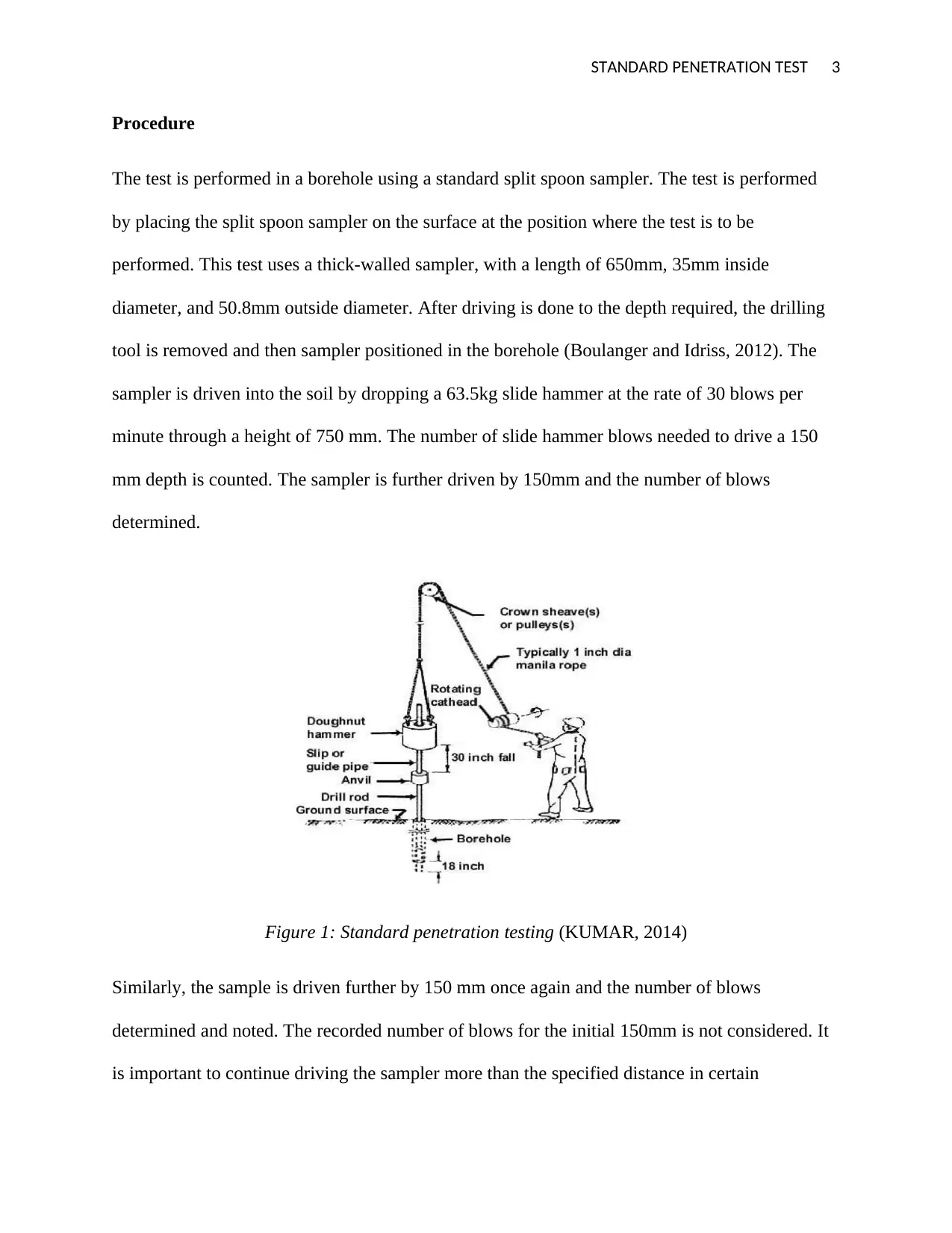
The test is performed in a borehole using a standard split spoon sampler. The test is performed
by placing the split spoon sampler on the surface at the position where the test is to be
performed. This test uses a thick-walled sampler, with a length of 650mm, 35mm inside
diameter, and 50.8mm outside diameter. After driving is done to the depth required, the drilling
tool is removed and then sampler positioned in the borehole (Boulanger and Idriss, 2012). The
sampler is driven into the soil by dropping a 63.5kg slide hammer at the rate of 30 blows per
minute through a height of 750 mm. The number of slide hammer blows needed to drive a 150
mm depth is counted. The sampler is further driven by 150mm and the number of blows
determined.
Figure 1: Standard penetration testing (KUMAR, 2014)
Similarly, the sample is driven further by 150 mm once again and the number of blows
determined and noted. The recorded number of blows for the initial 150mm is not considered. It
is important to continue driving the sampler more than the specified distance in certain
Procedure
The test is performed in a borehole using a standard split spoon sampler. The test is performed
by placing the split spoon sampler on the surface at the position where the test is to be
performed. This test uses a thick-walled sampler, with a length of 650mm, 35mm inside
diameter, and 50.8mm outside diameter. After driving is done to the depth required, the drilling
tool is removed and then sampler positioned in the borehole (Boulanger and Idriss, 2012). The
sampler is driven into the soil by dropping a 63.5kg slide hammer at the rate of 30 blows per
minute through a height of 750 mm. The number of slide hammer blows needed to drive a 150
mm depth is counted. The sampler is further driven by 150mm and the number of blows
determined.
Figure 1: Standard penetration testing (KUMAR, 2014)
Similarly, the sample is driven further by 150 mm once again and the number of blows
determined and noted. The recorded number of blows for the initial 150mm is not considered. It
is important to continue driving the sampler more than the specified distance in certain
⊘ This is a preview!⊘
Do you want full access?
Subscribe today to unlock all pages.

Trusted by 1+ million students worldwide

STANDARD PENETRATION TEST 4
circumstances, adding drilling rods further as necessary. The recorded number of blows for the
last two intervals of 150mm is summed to give the standard penetration number (N).
Therefore:
The standard penetration number, N
N = Number of blows needed for penetration of 150 mm beyond 150 mm seating drive (Muduli
and Sarat, 2013).
In case the number of blows for 150mm drive is more than 50 blows, it is assumed to be refusal
and the test is stopped. The N value attained through standard penetration tests must be rectified
for overburden cohesionless soil pressure. The entire sampler may sink under its weight
sometimes when a very soft sub-soil stratus is faced. It may not be necessary to direct any blow
to the sampler under such conditions, and the N should be recorded as zero.
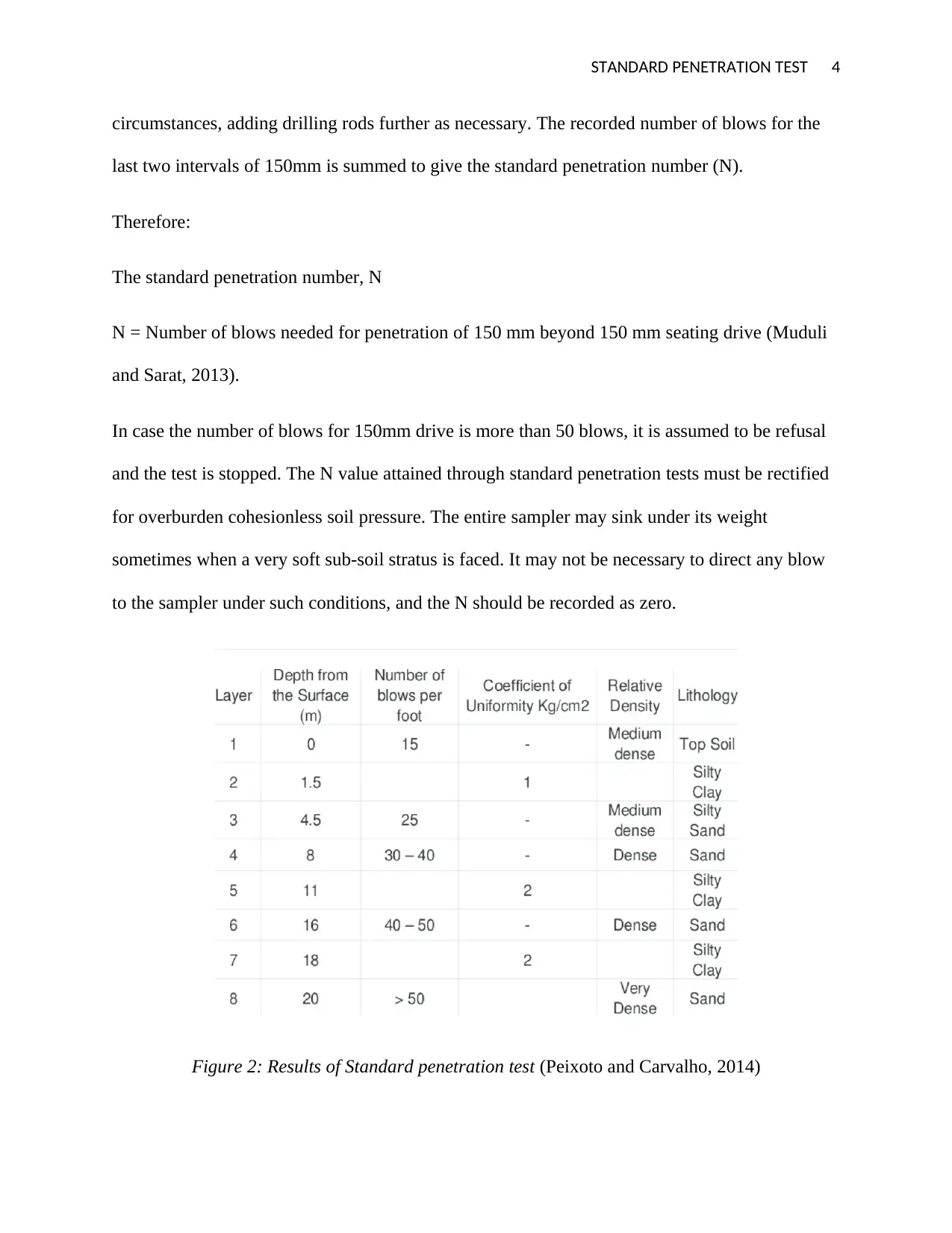
Figure 2: Results of Standard penetration test (Peixoto and Carvalho, 2014)
circumstances, adding drilling rods further as necessary. The recorded number of blows for the
last two intervals of 150mm is summed to give the standard penetration number (N).
Therefore:
The standard penetration number, N
N = Number of blows needed for penetration of 150 mm beyond 150 mm seating drive (Muduli
and Sarat, 2013).
In case the number of blows for 150mm drive is more than 50 blows, it is assumed to be refusal
and the test is stopped. The N value attained through standard penetration tests must be rectified
for overburden cohesionless soil pressure. The entire sampler may sink under its weight
sometimes when a very soft sub-soil stratus is faced. It may not be necessary to direct any blow
to the sampler under such conditions, and the N should be recorded as zero.
Figure 2: Results of Standard penetration test (Peixoto and Carvalho, 2014)
Paraphrase This Document
Need a fresh take? Get an instant paraphrase of this document with our AI Paraphraser

STANDARD PENETRATION TEST 5
The standard penetration test result above shows the number of blows driven, coefficient of
uniformity, relative density, and depth from the surface, and the lithography of every layer of soil
during testing (Dean and Mohammed, 2014). From the results above, it is clear that the deeper
the sampler goes down the ground the denser the layer becomes and the higher the number of
blows needed to reach the deeper layers.
Use and Benefit of Split Spoon Sampler
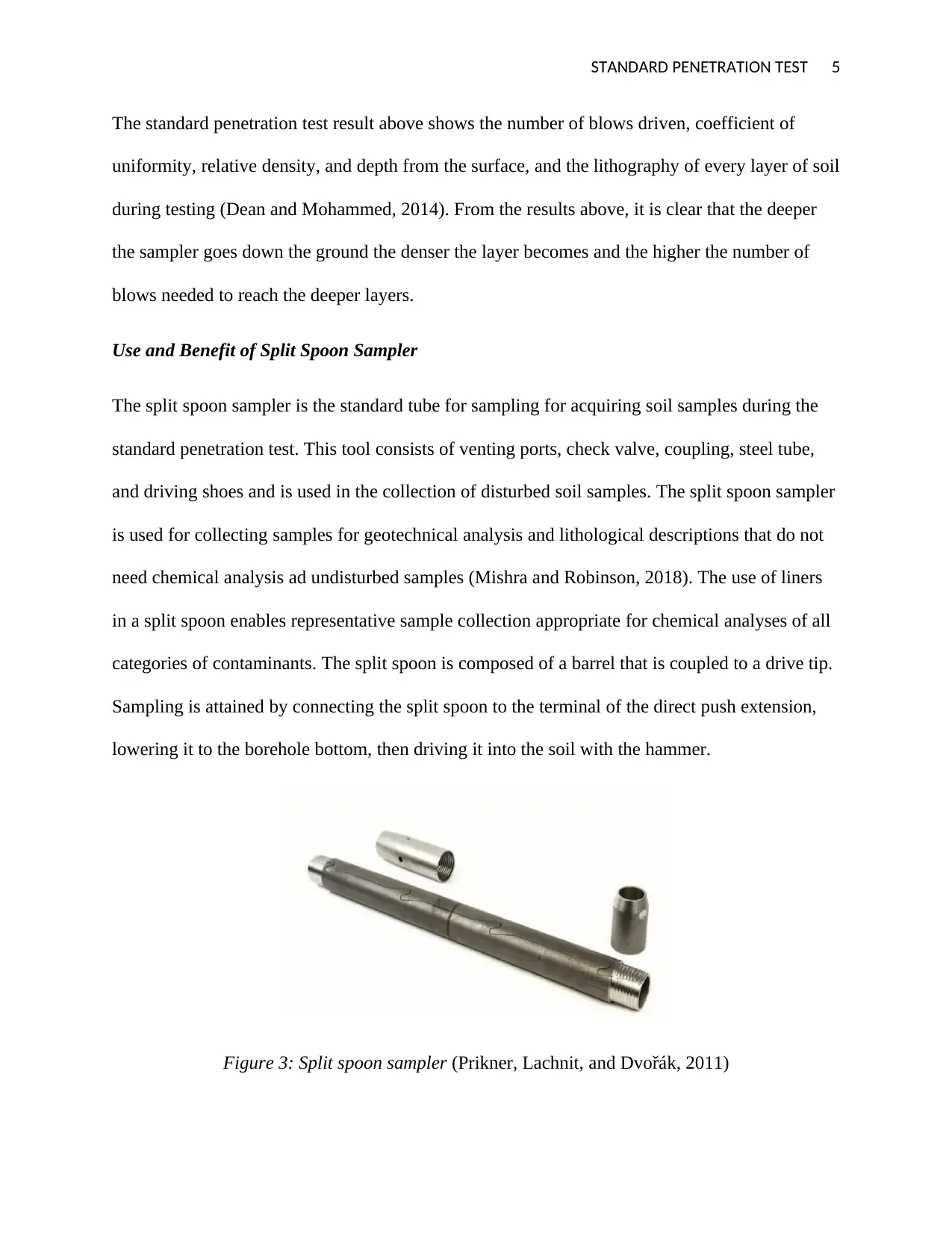
The split spoon sampler is the standard tube for sampling for acquiring soil samples during the
standard penetration test. This tool consists of venting ports, check valve, coupling, steel tube,
and driving shoes and is used in the collection of disturbed soil samples. The split spoon sampler
is used for collecting samples for geotechnical analysis and lithological descriptions that do not
need chemical analysis ad undisturbed samples (Mishra and Robinson, 2018). The use of liners
in a split spoon enables representative sample collection appropriate for chemical analyses of all
categories of contaminants. The split spoon is composed of a barrel that is coupled to a drive tip.
Sampling is attained by connecting the split spoon to the terminal of the direct push extension,
lowering it to the borehole bottom, then driving it into the soil with the hammer.
Figure 3: Split spoon sampler (Prikner, Lachnit, and Dvořák, 2011)
The standard penetration test result above shows the number of blows driven, coefficient of
uniformity, relative density, and depth from the surface, and the lithography of every layer of soil
during testing (Dean and Mohammed, 2014). From the results above, it is clear that the deeper
the sampler goes down the ground the denser the layer becomes and the higher the number of
blows needed to reach the deeper layers.
Use and Benefit of Split Spoon Sampler
The split spoon sampler is the standard tube for sampling for acquiring soil samples during the
standard penetration test. This tool consists of venting ports, check valve, coupling, steel tube,
and driving shoes and is used in the collection of disturbed soil samples. The split spoon sampler
is used for collecting samples for geotechnical analysis and lithological descriptions that do not
need chemical analysis ad undisturbed samples (Mishra and Robinson, 2018). The use of liners
in a split spoon enables representative sample collection appropriate for chemical analyses of all
categories of contaminants. The split spoon is composed of a barrel that is coupled to a drive tip.
Sampling is attained by connecting the split spoon to the terminal of the direct push extension,
lowering it to the borehole bottom, then driving it into the soil with the hammer.
Figure 3: Split spoon sampler (Prikner, Lachnit, and Dvořák, 2011)

STANDARD PENETRATION TEST 6
Some of the benefits of split spoon sampler include it is relatively inexpensive and efficient at
intermediate and shallow depths, produces high-quality samples for both chemical analysis and
lithological description and also it is easy to acquire samples in unconsolidated materials above
100 ft.
CONCLUSION
The standard penetration test is an in-situ test that is important in foundation design and site
exploration. The SPT is used to determine the geotechnical engineering soil properties. The test
generated the N-value which denotes the number of blows of a standardized sampler inserted
into the soil at standardized depth. This test acquires highly disturbed samples which are
normally not suitable for determining the properties of in-situ soil structure like consolidation
characteristics, strength, and density.
Some of the benefits of split spoon sampler include it is relatively inexpensive and efficient at
intermediate and shallow depths, produces high-quality samples for both chemical analysis and
lithological description and also it is easy to acquire samples in unconsolidated materials above
100 ft.
CONCLUSION
The standard penetration test is an in-situ test that is important in foundation design and site
exploration. The SPT is used to determine the geotechnical engineering soil properties. The test
generated the N-value which denotes the number of blows of a standardized sampler inserted
into the soil at standardized depth. This test acquires highly disturbed samples which are
normally not suitable for determining the properties of in-situ soil structure like consolidation
characteristics, strength, and density.
⊘ This is a preview!⊘
Do you want full access?
Subscribe today to unlock all pages.

Trusted by 1+ million students worldwide

STANDARD PENETRATION TEST 7
REFERENCES
Boulanger, R., and Idriss, M. (2012). Probabilistic Standard Penetration Test–Based Liquefaction–
Triggering Procedure. Journal of Geotechnical and Geoenvironmental Engineering, 138, 1185-
1195.
Dean, R., and Mohammed, R. (2014). Simplified Shockwave Analysis of the Standard Penetration Test.
International Journal of Geomechanics, 14, 401.
Dwipa, S., Arya, W., Wiraga, W., and Pramana, M. (2020). Evaluation of liquefaction potential using cone
penetration test (CPT) and standard penetration test (SPT). Journal of Physics: Conference
Series, 1450, 120.
KUMAR, U. (2014). A study on the Effect of Distorted Sampler Shoe on Standard Penetration Test Result
in Cohesionless soil. International Journal of Innovative Research in Science, Engineering and
Technology, 3, 16654-16658.
Mishra, S., and Robinson, G. (2018). A combined split-spoon sampler and spherical penetrometer:
laboratory trials. Géotechnique Letters, 8, 118-123.
Muduli, P., and Sarat, D. (2013). Evaluation of liquefaction potential of soil based on standard
penetration test using multi-gene genetic programming model. Acta Geophysica, 62, 529-543.
Peixoto, A., and Carvalho, D. (2014). Determination of soil properties from standard penetration test
complemented by torque measurement (SPT-T). Acta Scientiarum. Technology, 36, 617-621.
Prikner, P., Lachnit, F., and Dvořák, F. (2011). A new soil core sampler for determination bulk density in
soil profile. Plant, Soil and Environment, 50, 250-256.
Suits, D., Sheahan, C., Anbazhagan, P., & Sitharam, G. (2010). Relationship between Low Strain Shear
Modulus and Standard Penetration Test N Values. Geotechnical Testing Journal, 33, 122.
Tarawneh, B. (2017). Predicting standard penetration test N-value from cone penetration test data using
artificial neural networks. Geoscience Frontiers, 8, 199-204.
REFERENCES
Boulanger, R., and Idriss, M. (2012). Probabilistic Standard Penetration Test–Based Liquefaction–
Triggering Procedure. Journal of Geotechnical and Geoenvironmental Engineering, 138, 1185-
1195.
Dean, R., and Mohammed, R. (2014). Simplified Shockwave Analysis of the Standard Penetration Test.
International Journal of Geomechanics, 14, 401.
Dwipa, S., Arya, W., Wiraga, W., and Pramana, M. (2020). Evaluation of liquefaction potential using cone
penetration test (CPT) and standard penetration test (SPT). Journal of Physics: Conference
Series, 1450, 120.
KUMAR, U. (2014). A study on the Effect of Distorted Sampler Shoe on Standard Penetration Test Result
in Cohesionless soil. International Journal of Innovative Research in Science, Engineering and
Technology, 3, 16654-16658.
Mishra, S., and Robinson, G. (2018). A combined split-spoon sampler and spherical penetrometer:
laboratory trials. Géotechnique Letters, 8, 118-123.
Muduli, P., and Sarat, D. (2013). Evaluation of liquefaction potential of soil based on standard
penetration test using multi-gene genetic programming model. Acta Geophysica, 62, 529-543.
Peixoto, A., and Carvalho, D. (2014). Determination of soil properties from standard penetration test
complemented by torque measurement (SPT-T). Acta Scientiarum. Technology, 36, 617-621.
Prikner, P., Lachnit, F., and Dvořák, F. (2011). A new soil core sampler for determination bulk density in
soil profile. Plant, Soil and Environment, 50, 250-256.
Suits, D., Sheahan, C., Anbazhagan, P., & Sitharam, G. (2010). Relationship between Low Strain Shear
Modulus and Standard Penetration Test N Values. Geotechnical Testing Journal, 33, 122.
Tarawneh, B. (2017). Predicting standard penetration test N-value from cone penetration test data using
artificial neural networks. Geoscience Frontiers, 8, 199-204.
1 out of 7
Your All-in-One AI-Powered Toolkit for Academic Success.
+13062052269
info@desklib.com
Available 24*7 on WhatsApp / Email
Unlock your academic potential
Copyright © 2020–2025 A2Z Services. All Rights Reserved. Developed and managed by ZUCOL.