A Detailed Report on Standard Procedure: Paediatric Ear Infections

Verified

Added on  2023/04/21

|9
|1477
|481
Report
AI Summary
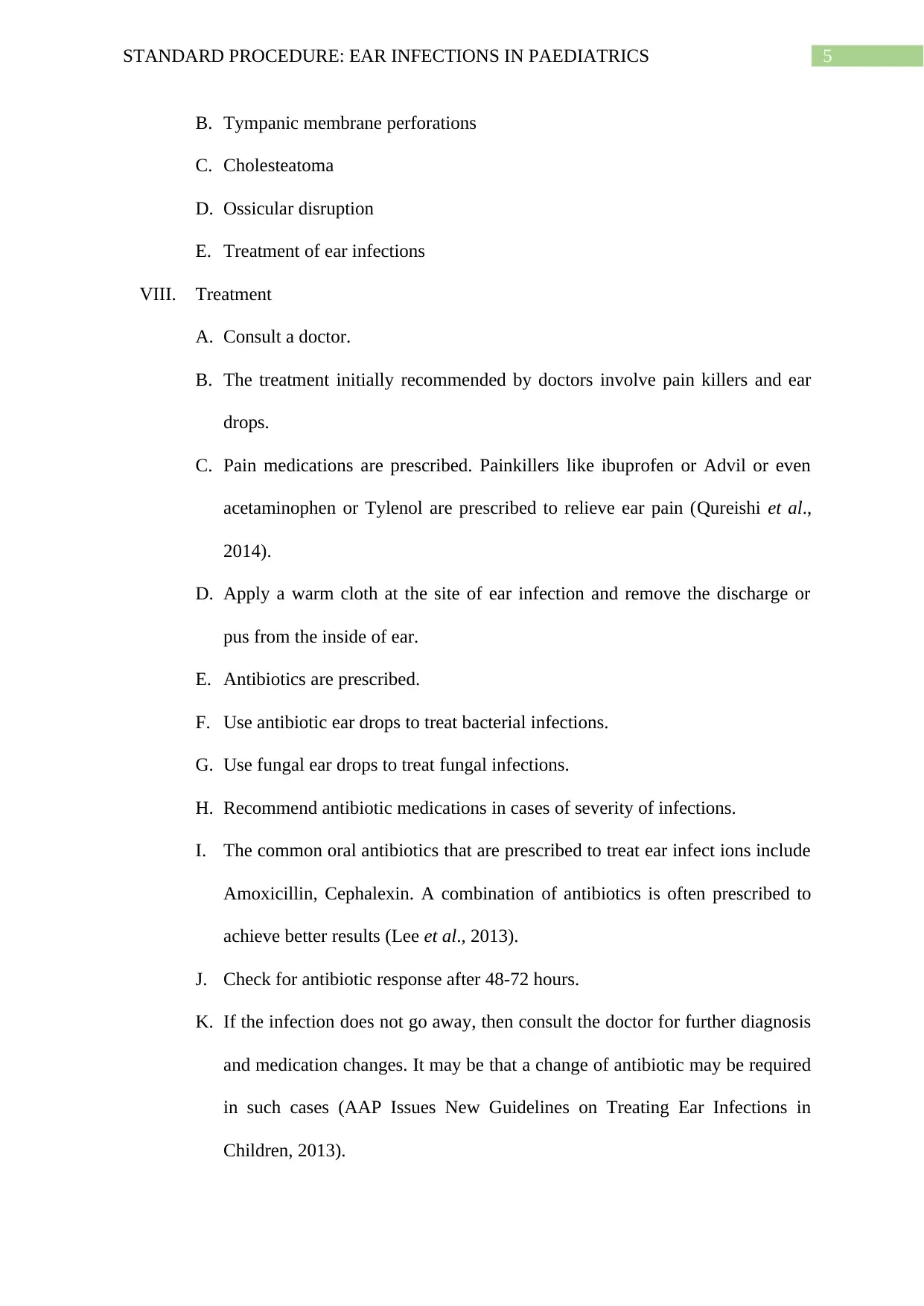
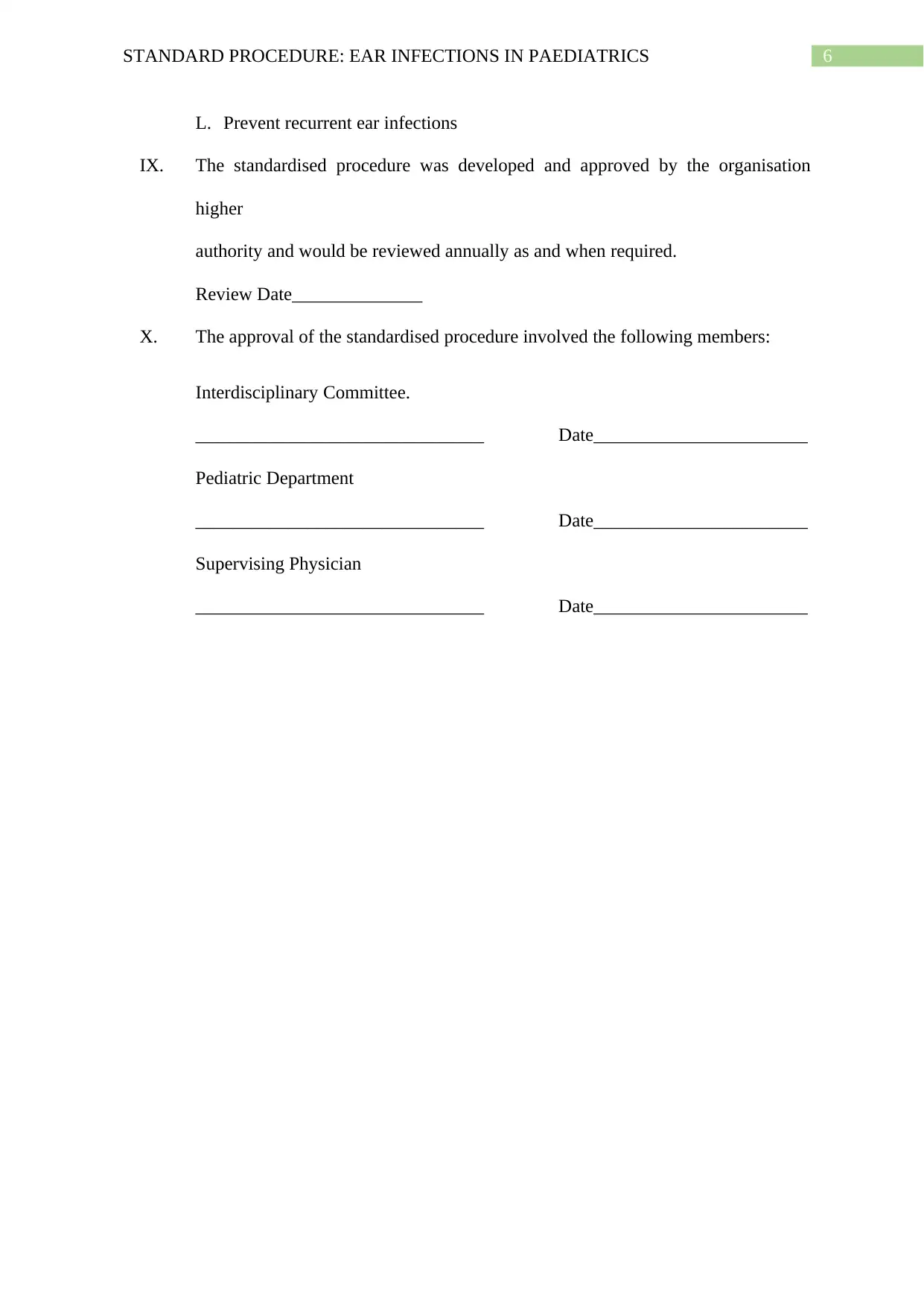
This report outlines a standardized procedure for managing ear infections in paediatric patients, focusing on the role of nurse practitioners in acute care settings. It details the necessary qualifications, evaluation methods, and clinical documentation required for nurses. The protocol includes a rationale, definition, and epidemiology of ear infections, along with information on history, physical exams, and diagnostic tests. Differential diagnoses such as otitis media with effusion and tympanic membrane perforations are discussed. The report also covers treatment options, including pain management, antibiotics, and preventative measures. The procedure emphasizes the importance of annual reviews and interdisciplinary collaboration for approval and maintenance of standards.
Document Page
Running head: STANDARD PROCEDURE: EAR INFECTIONS IN PAEDIATRICS
Standard Procedure: Ear Infections In Paediatrics
Name of student:
Name of university:
Author Note:
tabler-icon-diamond-filled.svg

Paraphrase This Document

Need a fresh take? Get an instant paraphrase of this document with our AI Paraphraser
Document Page
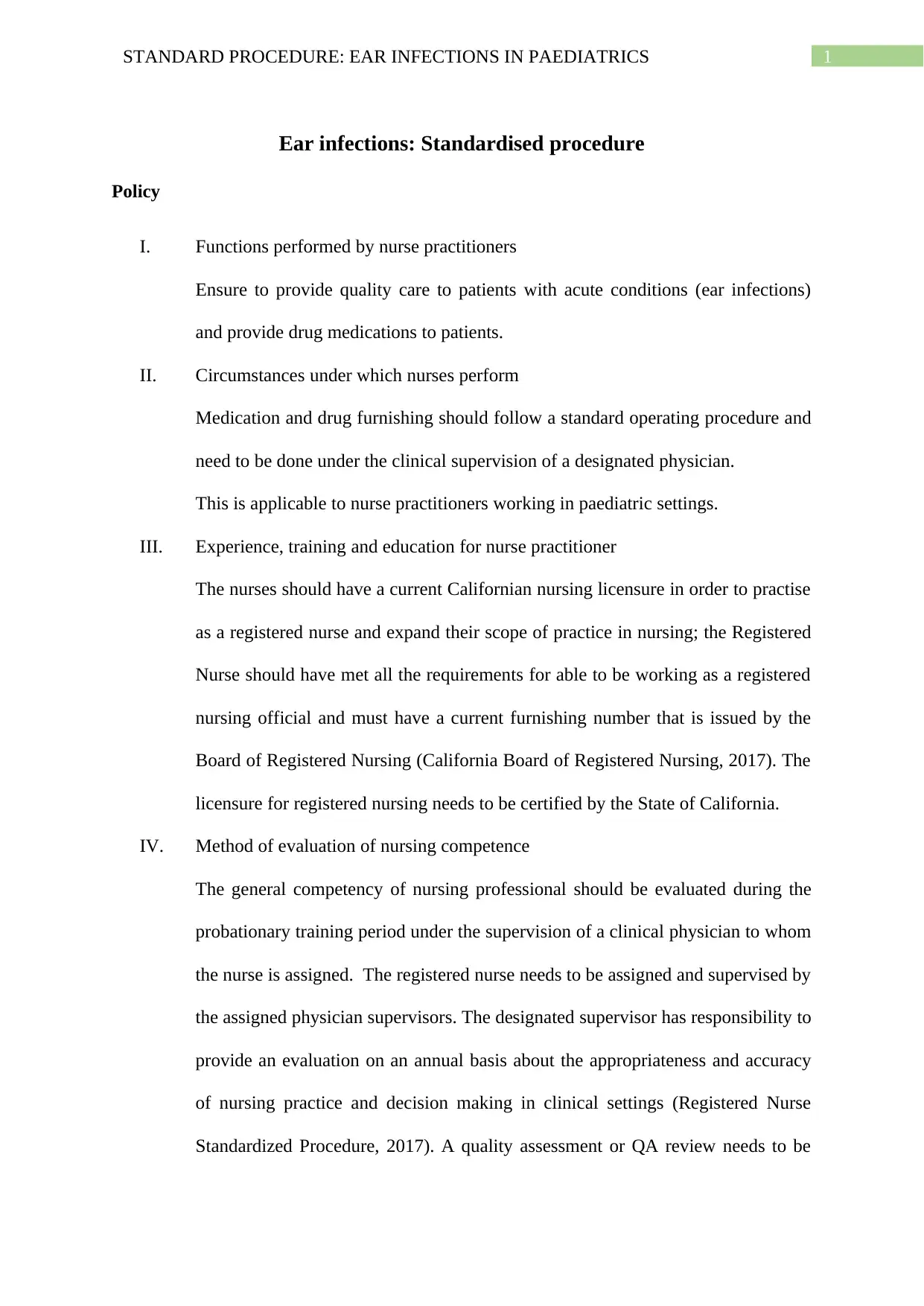
1STANDARD PROCEDURE: EAR INFECTIONS IN PAEDIATRICS
Ear infections: Standardised procedure
Policy
I. Functions performed by nurse practitioners
Ensure to provide quality care to patients with acute conditions (ear infections)
and provide drug medications to patients.
II. Circumstances under which nurses perform
Medication and drug furnishing should follow a standard operating procedure and
need to be done under the clinical supervision of a designated physician.
This is applicable to nurse practitioners working in paediatric settings.
III. Experience, training and education for nurse practitioner
The nurses should have a current Californian nursing licensure in order to practise
as a registered nurse and expand their scope of practice in nursing; the Registered
Nurse should have met all the requirements for able to be working as a registered
nursing official and must have a current furnishing number that is issued by the
Board of Registered Nursing (California Board of Registered Nursing, 2017). The
licensure for registered nursing needs to be certified by the State of California.
IV. Method of evaluation of nursing competence
The general competency of nursing professional should be evaluated during the
probationary training period under the supervision of a clinical physician to whom
the nurse is assigned. The registered nurse needs to be assigned and supervised by
the assigned physician supervisors. The designated supervisor has responsibility to
provide an evaluation on an annual basis about the appropriateness and accuracy
of nursing practice and decision making in clinical settings (Registered Nurse
Standardized Procedure, 2017). A quality assessment or QA review needs to be
Document Page
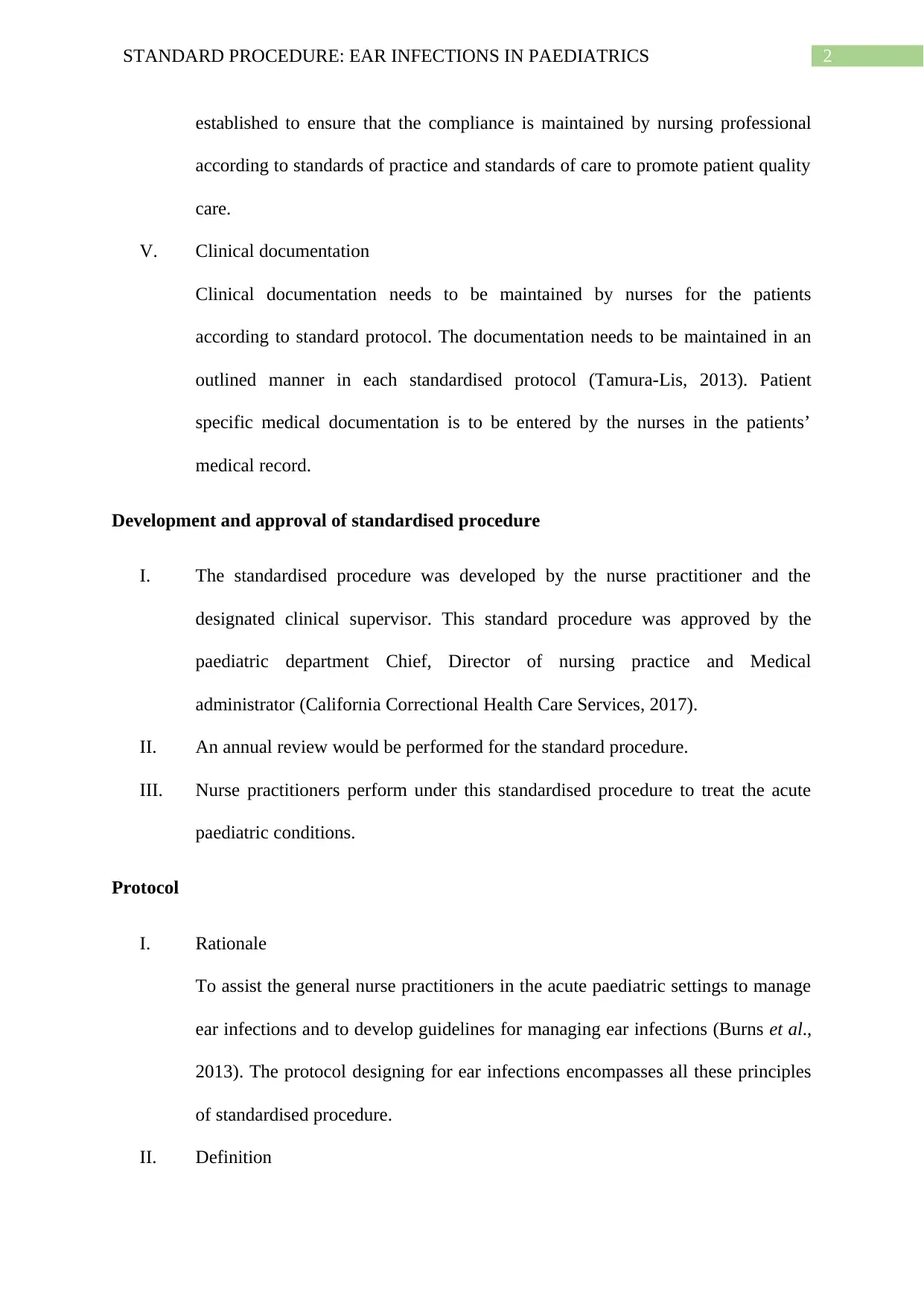
2STANDARD PROCEDURE: EAR INFECTIONS IN PAEDIATRICS
established to ensure that the compliance is maintained by nursing professional
according to standards of practice and standards of care to promote patient quality
care.
V. Clinical documentation
Clinical documentation needs to be maintained by nurses for the patients
according to standard protocol. The documentation needs to be maintained in an
outlined manner in each standardised protocol (Tamura-Lis, 2013). Patient
specific medical documentation is to be entered by the nurses in the patients’
medical record.
Development and approval of standardised procedure
I. The standardised procedure was developed by the nurse practitioner and the
designated clinical supervisor. This standard procedure was approved by the
paediatric department Chief, Director of nursing practice and Medical
administrator (California Correctional Health Care Services, 2017).
II. An annual review would be performed for the standard procedure.
III. Nurse practitioners perform under this standardised procedure to treat the acute
paediatric conditions.
Protocol
I. Rationale
To assist the general nurse practitioners in the acute paediatric settings to manage
ear infections and to develop guidelines for managing ear infections (Burns et al.,
2013). The protocol designing for ear infections encompasses all these principles
of standardised procedure.
II. Definition
Document Page
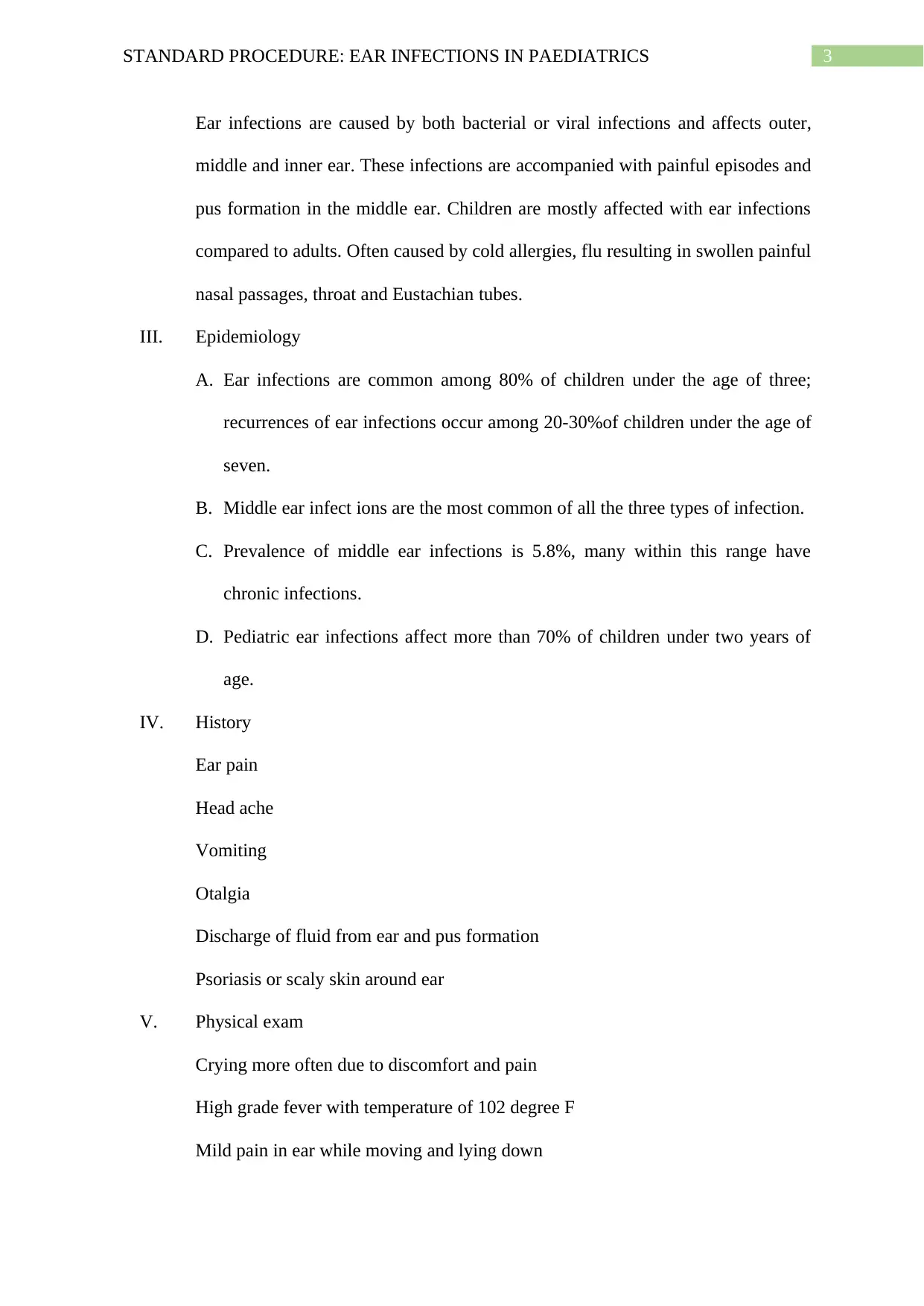
3STANDARD PROCEDURE: EAR INFECTIONS IN PAEDIATRICS
Ear infections are caused by both bacterial or viral infections and affects outer,
middle and inner ear. These infections are accompanied with painful episodes and
pus formation in the middle ear. Children are mostly affected with ear infections
compared to adults. Often caused by cold allergies, flu resulting in swollen painful
nasal passages, throat and Eustachian tubes.
III. Epidemiology
A. Ear infections are common among 80% of children under the age of three;
recurrences of ear infections occur among 20-30%of children under the age of
seven.
B. Middle ear infect ions are the most common of all the three types of infection.
C. Prevalence of middle ear infections is 5.8%, many within this range have
chronic infections.
D. Pediatric ear infections affect more than 70% of children under two years of
age.
IV. History
Ear pain
Head ache
Vomiting
Otalgia
Discharge of fluid from ear and pus formation
Psoriasis or scaly skin around ear
V. Physical exam
Crying more often due to discomfort and pain
High grade fever with temperature of 102 degree F
Mild pain in ear while moving and lying down
tabler-icon-diamond-filled.svg

Paraphrase This Document

Need a fresh take? Get an instant paraphrase of this document with our AI Paraphraser
Document Page
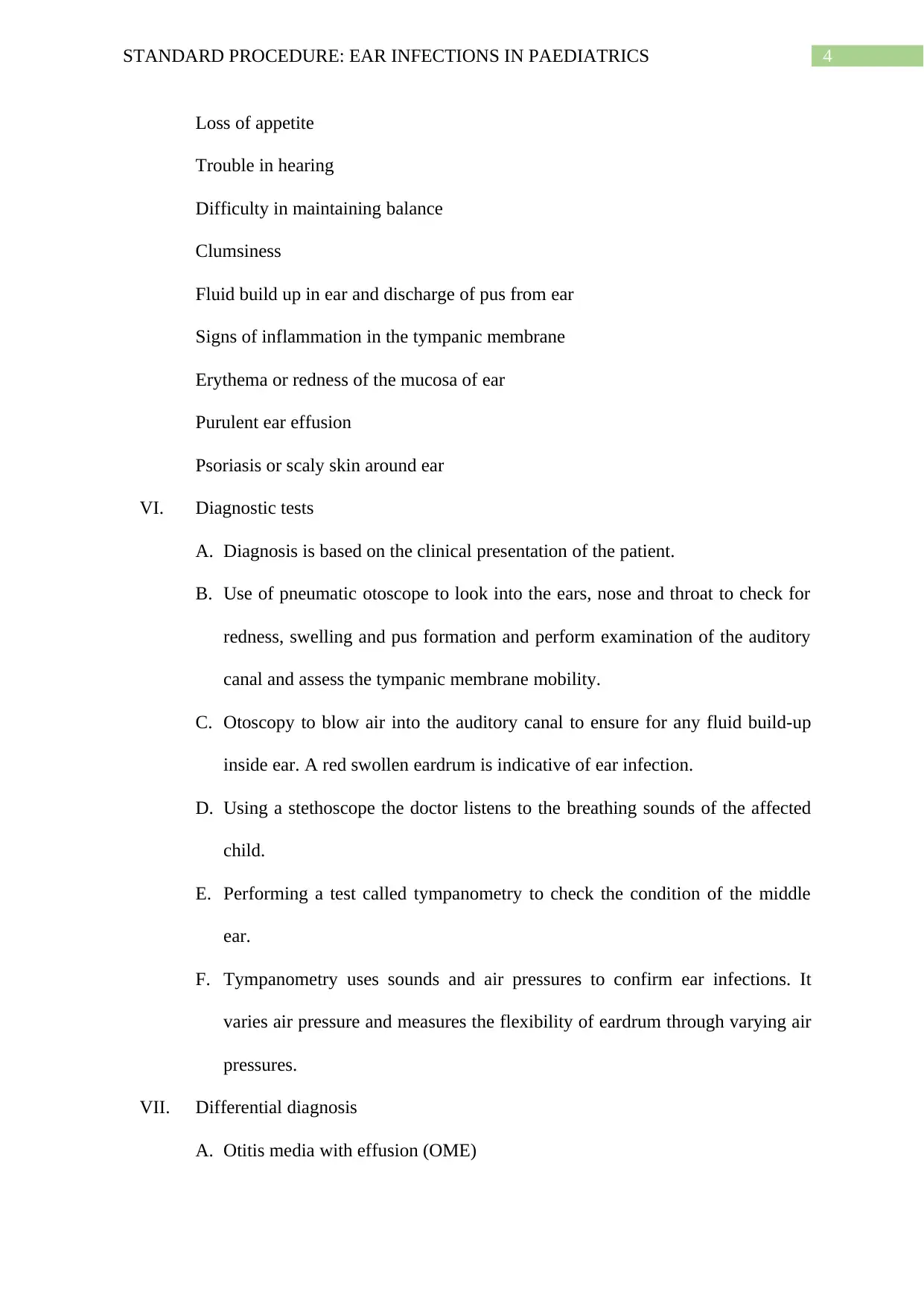
4STANDARD PROCEDURE: EAR INFECTIONS IN PAEDIATRICS
Loss of appetite
Trouble in hearing
Difficulty in maintaining balance
Clumsiness
Fluid build up in ear and discharge of pus from ear
Signs of inflammation in the tympanic membrane
Erythema or redness of the mucosa of ear
Purulent ear effusion
Psoriasis or scaly skin around ear
VI. Diagnostic tests
A. Diagnosis is based on the clinical presentation of the patient.
B. Use of pneumatic otoscope to look into the ears, nose and throat to check for
redness, swelling and pus formation and perform examination of the auditory
canal and assess the tympanic membrane mobility.
C. Otoscopy to blow air into the auditory canal to ensure for any fluid build-up
inside ear. A red swollen eardrum is indicative of ear infection.
D. Using a stethoscope the doctor listens to the breathing sounds of the affected
child.
E. Performing a test called tympanometry to check the condition of the middle
ear.
F. Tympanometry uses sounds and air pressures to confirm ear infections. It
varies air pressure and measures the flexibility of eardrum through varying air
pressures.
VII. Differential diagnosis
A. Otitis media with effusion (OME)
Document Page
5STANDARD PROCEDURE: EAR INFECTIONS IN PAEDIATRICS
B. Tympanic membrane perforations
C. Cholesteatoma
D. Ossicular disruption
E. Treatment of ear infections
VIII. Treatment
A. Consult a doctor.
B. The treatment initially recommended by doctors involve pain killers and ear
drops.
C. Pain medications are prescribed. Painkillers like ibuprofen or Advil or even
acetaminophen or Tylenol are prescribed to relieve ear pain (Qureishi et al.,
2014).
D. Apply a warm cloth at the site of ear infection and remove the discharge or
pus from the inside of ear.
E. Antibiotics are prescribed.
F. Use antibiotic ear drops to treat bacterial infections.
G. Use fungal ear drops to treat fungal infections.
H. Recommend antibiotic medications in cases of severity of infections.
I. The common oral antibiotics that are prescribed to treat ear infect ions include
Amoxicillin, Cephalexin. A combination of antibiotics is often prescribed to
achieve better results (Lee et al., 2013).
J. Check for antibiotic response after 48-72 hours.
K. If the infection does not go away, then consult the doctor for further diagnosis
and medication changes. It may be that a change of antibiotic may be required
in such cases (AAP Issues New Guidelines on Treating Ear Infections in
Children, 2013).
Document Page
6STANDARD PROCEDURE: EAR INFECTIONS IN PAEDIATRICS
L. Prevent recurrent ear infections
IX. The standardised procedure was developed and approved by the organisation
higher
authority and would be reviewed annually as and when required.
Review Date______________
X. The approval of the standardised procedure involved the following members:
Interdisciplinary Committee.
_______________________________ Date_______________________
Pediatric Department
_______________________________ Date_______________________
Supervising Physician
_______________________________ Date_______________________
tabler-icon-diamond-filled.svg

Paraphrase This Document

Need a fresh take? Get an instant paraphrase of this document with our AI Paraphraser
Document Page
7STANDARD PROCEDURE: EAR INFECTIONS IN PAEDIATRICS
References
AAP Issues New Guidelines on Treating Ear Infections in Children (2013). Retrieved from
https://www.aap.org/en-us/about-the-aap/aap-press-room/Pages/AAP-Issues-New-
Guidelines-on-Treating-Ear-Infections-in-Children.aspx
Burns, C. E., Dunn, A. M., Brady, M. A., Starr, N. B., & Blosser, C. G. (2013). Pediatric
Primary Care (5th ed.). Philadelphia, PA: Elsevier.
California Board of Registered Nursing (2017). Retrieved from
https://www.rn.ca.gov/forms/pubs.shtml
California Correctional Health Care Services (2017). Retrieved from https://cchcs.ca.gov/wp-
content/uploads/sites/60/2018/06/Earache.pdf
Lee, H., Kim, J., & Nguyen, V. (2013). Ear infections: otitis externa and otitis
media. Primary Care: Clinics in Office Practice, 40(3), 671-686.
DOI: https://doi.org/10.1016/j.pop.2013.05.005
Qureishi, A., Lee, Y., Belfield, K., Birchall, J. P., & Daniel, M. (2014). Update on otitis
media–prevention and treatment. Infection and drug resistance, 7, 15.
doi: 10.2147/IDR.S39637
Registered Nurse Standardized Procedure (2017). Retrieved from
https://ccalac.org/wordpress/wp-content/uploads/RN-Protocols_Street-
BasedEngagement_Pilot_2017.pdf
Tamura-Lis, W. (2013). Teach-back for quality education and patient safety. Urologic
Nursing, 33(6), 267. doi:10.7257/1053-816X.2013.33.6.267
Document Page
8STANDARD PROCEDURE: EAR INFECTIONS IN PAEDIATRICS
chevron_up_icon
1 out of 9
circle_padding
hide_on_mobile
zoom_out_icon
[object Object]