Standardized Nursing Languages: Benefits, Challenges, and Impact

Verified

Added on  2022/09/01

|4
|752
|19
Report
AI Summary
This report examines the critical role of standardized nursing languages in healthcare, emphasizing their importance for effective communication among healthcare professionals. It highlights how these languages, facilitated by electronic medical records, improve patient care, enhance adherence to nursing standards, and support research and documentation. The report discusses the benefits, such as improved patient safety through clear data interpretation and the ability to track patient activities, as well as challenges, including miscommunication across different nursing specialties. It stresses the need for standardization to ensure consistent understanding and accurate diagnoses, particularly in critical and emergency settings where patient information must be seamlessly transferred. The report references key literature to support its findings, including the works of Rutherford (2008), Wang, Kung, & Byrd (2018), and the Office of the National Coordinator for Health Information (2017).
Document Page
Running Head: STANDARDIZED NURSING LAGUAGES. 1
Standardized Nursing Languages.
Name
Institution of Affiliation
tabler-icon-diamond-filled.svg

Paraphrase This Document

Need a fresh take? Get an instant paraphrase of this document with our AI Paraphraser
Document Page
STANDARDIZED NURSING LAGUAGES. 2
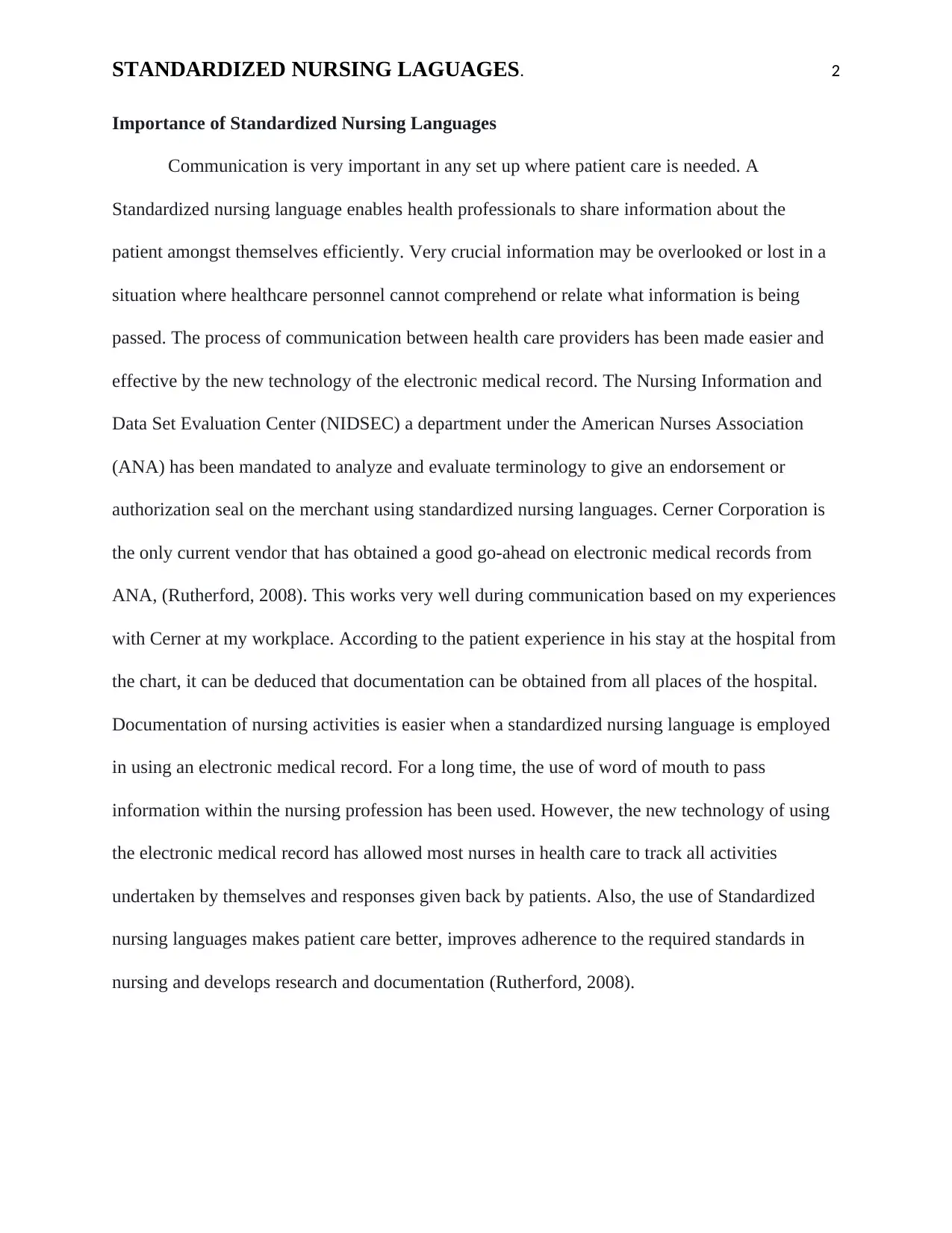
Importance of Standardized Nursing Languages
Communication is very important in any set up where patient care is needed. A
Standardized nursing language enables health professionals to share information about the
patient amongst themselves efficiently. Very crucial information may be overlooked or lost in a
situation where healthcare personnel cannot comprehend or relate what information is being
passed. The process of communication between health care providers has been made easier and
effective by the new technology of the electronic medical record. The Nursing Information and
Data Set Evaluation Center (NIDSEC) a department under the American Nurses Association
(ANA) has been mandated to analyze and evaluate terminology to give an endorsement or
authorization seal on the merchant using standardized nursing languages. Cerner Corporation is
the only current vendor that has obtained a good go-ahead on electronic medical records from
ANA, (Rutherford, 2008). This works very well during communication based on my experiences
with Cerner at my workplace. According to the patient experience in his stay at the hospital from
the chart, it can be deduced that documentation can be obtained from all places of the hospital.
Documentation of nursing activities is easier when a standardized nursing language is employed
in using an electronic medical record. For a long time, the use of word of mouth to pass
information within the nursing profession has been used. However, the new technology of using
the electronic medical record has allowed most nurses in health care to track all activities
undertaken by themselves and responses given back by patients. Also, the use of Standardized
nursing languages makes patient care better, improves adherence to the required standards in
nursing and develops research and documentation (Rutherford, 2008).
Document Page
STANDARDIZED NURSING LAGUAGES. 3
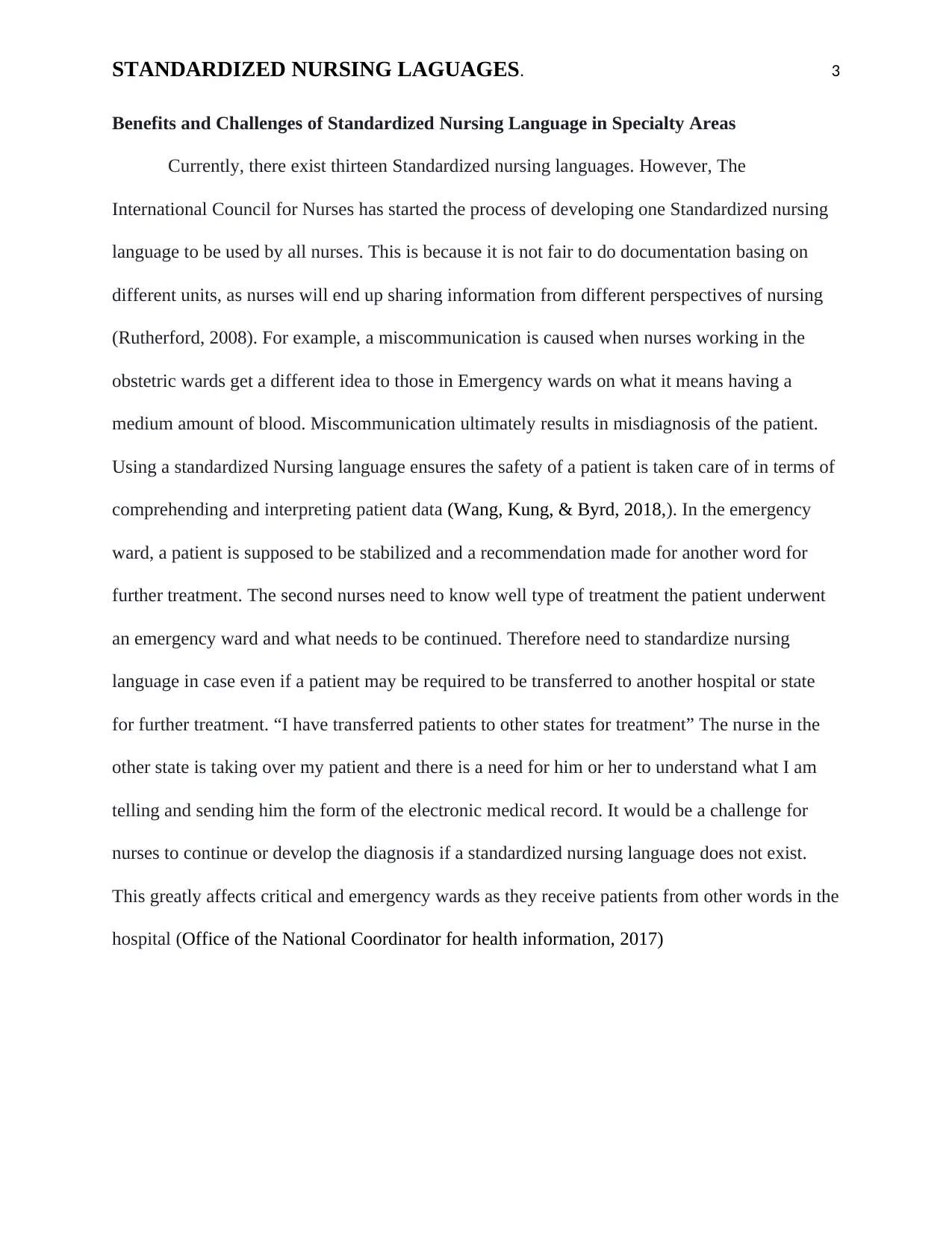
Benefits and Challenges of Standardized Nursing Language in Specialty Areas
Currently, there exist thirteen Standardized nursing languages. However, The
International Council for Nurses has started the process of developing one Standardized nursing
language to be used by all nurses. This is because it is not fair to do documentation basing on
different units, as nurses will end up sharing information from different perspectives of nursing
(Rutherford, 2008). For example, a miscommunication is caused when nurses working in the
obstetric wards get a different idea to those in Emergency wards on what it means having a
medium amount of blood. Miscommunication ultimately results in misdiagnosis of the patient.
Using a standardized Nursing language ensures the safety of a patient is taken care of in terms of
comprehending and interpreting patient data (Wang, Kung, & Byrd, 2018,). In the emergency
ward, a patient is supposed to be stabilized and a recommendation made for another word for
further treatment. The second nurses need to know well type of treatment the patient underwent
an emergency ward and what needs to be continued. Therefore need to standardize nursing
language in case even if a patient may be required to be transferred to another hospital or state
for further treatment. “I have transferred patients to other states for treatment” The nurse in the
other state is taking over my patient and there is a need for him or her to understand what I am
telling and sending him the form of the electronic medical record. It would be a challenge for
nurses to continue or develop the diagnosis if a standardized nursing language does not exist.
This greatly affects critical and emergency wards as they receive patients from other words in the
hospital (Office of the National Coordinator for health information, 2017)
Document Page
STANDARDIZED NURSING LAGUAGES. 4
References.
Office of the National Coordinator for health information (2017) Standard nursing
Terminologies A Landscape analysis
Rutherford, M. A. (2008). Standardized nursing language: What does it mean for nursing
Practice? OJIN: The Online Journal of Issues in Nursing, 13(1).
Wang, Y., Kung, L., & Byrd, T. A. (2018). Big data analytics: Understanding its capabilities
and potential benefits for healthcare organizations. Technological Forecasting and
Social Change, 126, 3-13.
chevron_up_icon
1 out of 4
circle_padding
hide_on_mobile
zoom_out_icon
[object Object]