Ethical Implications & Correctional System Changes: Stanford Study

Verified

Added on  2023/04/21

|5
|1133
|475
Essay
AI Summary
This essay critically examines the ethical considerations surrounding the Stanford Prison Experiment, focusing on the treatment of participants and the trade-off between suffering and knowledge gained. It compares the ethical dilemmas to those presented in Stanley Milgram's obedience experiments, arguing that despite the ethical concerns, both studies offer valuable insights into human behavior and the potential for abuse of power. The essay further explores whether the experimenter should have conducted the study, suggesting modifications such as adhering to participants' rights to withdraw and alternating roles to mitigate biases. Finally, it addresses the challenges of reforming correctional institutions and proposes recommendations for improving the correctional system, including reducing prison overcrowding, increasing staff, limiting correctional officer tenure, and promoting humane treatment of prisoners. The author emphasizes the importance of transparency and accountability within the prison system to prevent abuses of power and ensure the protection of prisoners' rights. Desklib provides access to similar essays and study resources for students.

Document Page
P a g e | 0
Criminal Justice
tabler-icon-diamond-filled.svg

Paraphrase This Document

Need a fresh take? Get an instant paraphrase of this document with our AI Paraphraser
Document Page
P a g e | 1
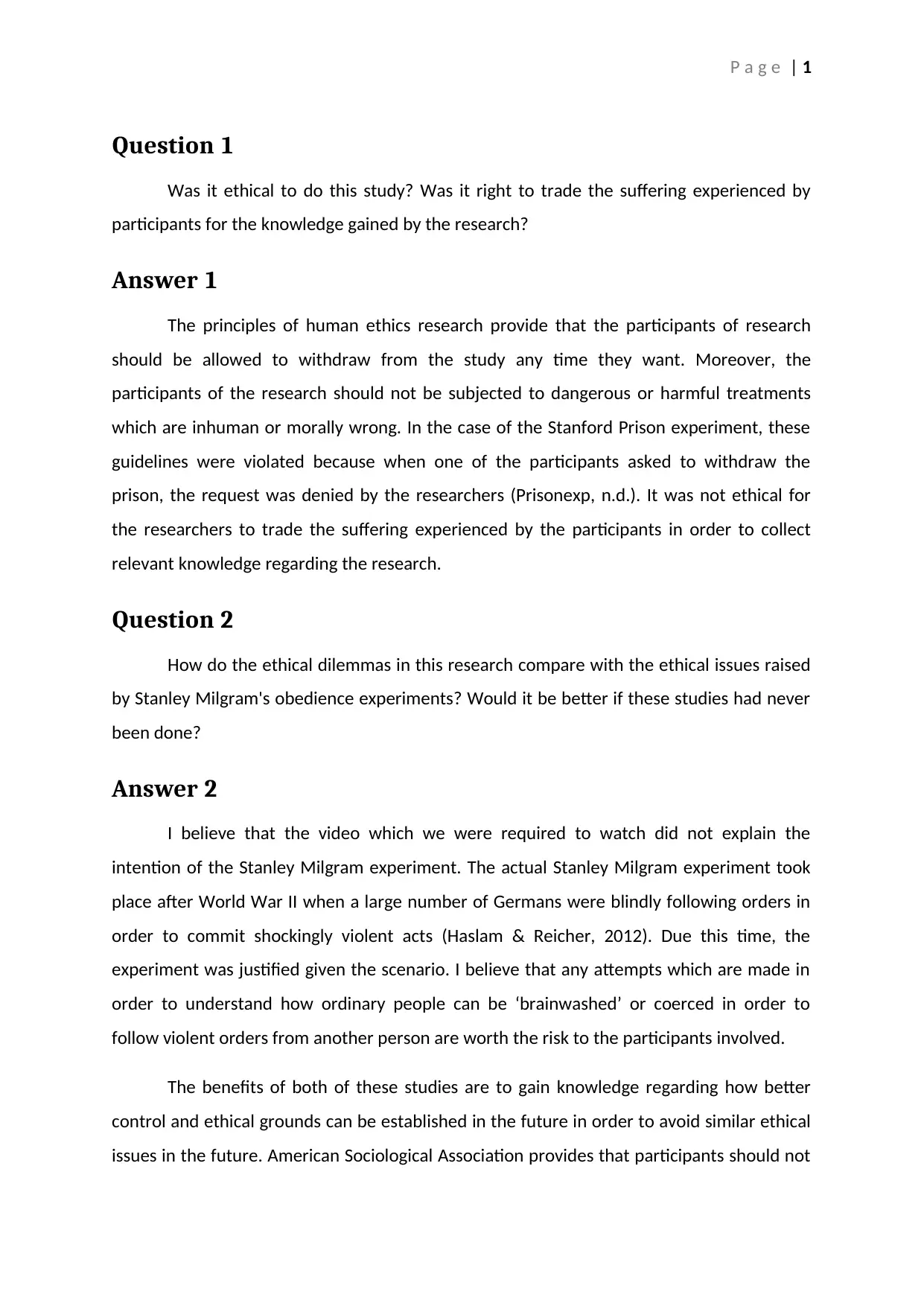
Question 1
Was it ethical to do this study? Was it right to trade the suffering experienced by
participants for the knowledge gained by the research?
Answer 1
The principles of human ethics research provide that the participants of research
should be allowed to withdraw from the study any time they want. Moreover, the
participants of the research should not be subjected to dangerous or harmful treatments
which are inhuman or morally wrong. In the case of the Stanford Prison experiment, these
guidelines were violated because when one of the participants asked to withdraw the
prison, the request was denied by the researchers (Prisonexp, n.d.). It was not ethical for
the researchers to trade the suffering experienced by the participants in order to collect
relevant knowledge regarding the research.
Question 2
How do the ethical dilemmas in this research compare with the ethical issues raised
by Stanley Milgram's obedience experiments? Would it be better if these studies had never
been done?
Answer 2
I believe that the video which we were required to watch did not explain the
intention of the Stanley Milgram experiment. The actual Stanley Milgram experiment took
place after World War II when a large number of Germans were blindly following orders in
order to commit shockingly violent acts (Haslam & Reicher, 2012). Due this time, the
experiment was justified given the scenario. I believe that any attempts which are made in
order to understand how ordinary people can be ‘brainwashed’ or coerced in order to
follow violent orders from another person are worth the risk to the participants involved.
The benefits of both of these studies are to gain knowledge regarding how better
control and ethical grounds can be established in the future in order to avoid similar ethical
issues in the future. American Sociological Association provides that participants should not
Document Page
P a g e | 2
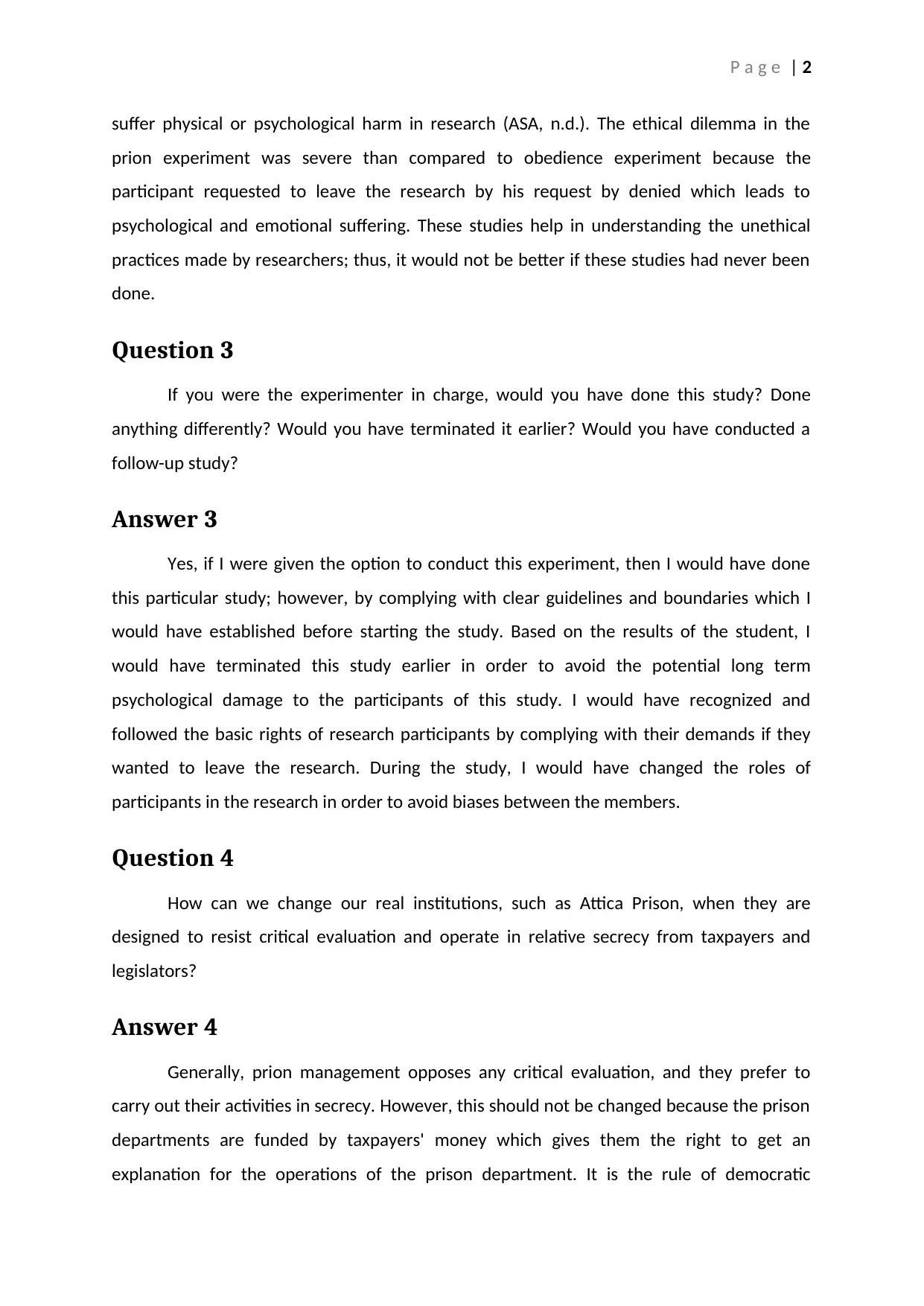
suffer physical or psychological harm in research (ASA, n.d.). The ethical dilemma in the
prion experiment was severe than compared to obedience experiment because the
participant requested to leave the research by his request by denied which leads to
psychological and emotional suffering. These studies help in understanding the unethical
practices made by researchers; thus, it would not be better if these studies had never been
done.
Question 3
If you were the experimenter in charge, would you have done this study? Done
anything differently? Would you have terminated it earlier? Would you have conducted a
follow-up study?
Answer 3
Yes, if I were given the option to conduct this experiment, then I would have done
this particular study; however, by complying with clear guidelines and boundaries which I
would have established before starting the study. Based on the results of the student, I
would have terminated this study earlier in order to avoid the potential long term
psychological damage to the participants of this study. I would have recognized and
followed the basic rights of research participants by complying with their demands if they
wanted to leave the research. During the study, I would have changed the roles of
participants in the research in order to avoid biases between the members.
Question 4
How can we change our real institutions, such as Attica Prison, when they are
designed to resist critical evaluation and operate in relative secrecy from taxpayers and
legislators?
Answer 4
Generally, prion management opposes any critical evaluation, and they prefer to
carry out their activities in secrecy. However, this should not be changed because the prison
departments are funded by taxpayers' money which gives them the right to get an
explanation for the operations of the prison department. It is the rule of democratic
Document Page
P a g e | 3
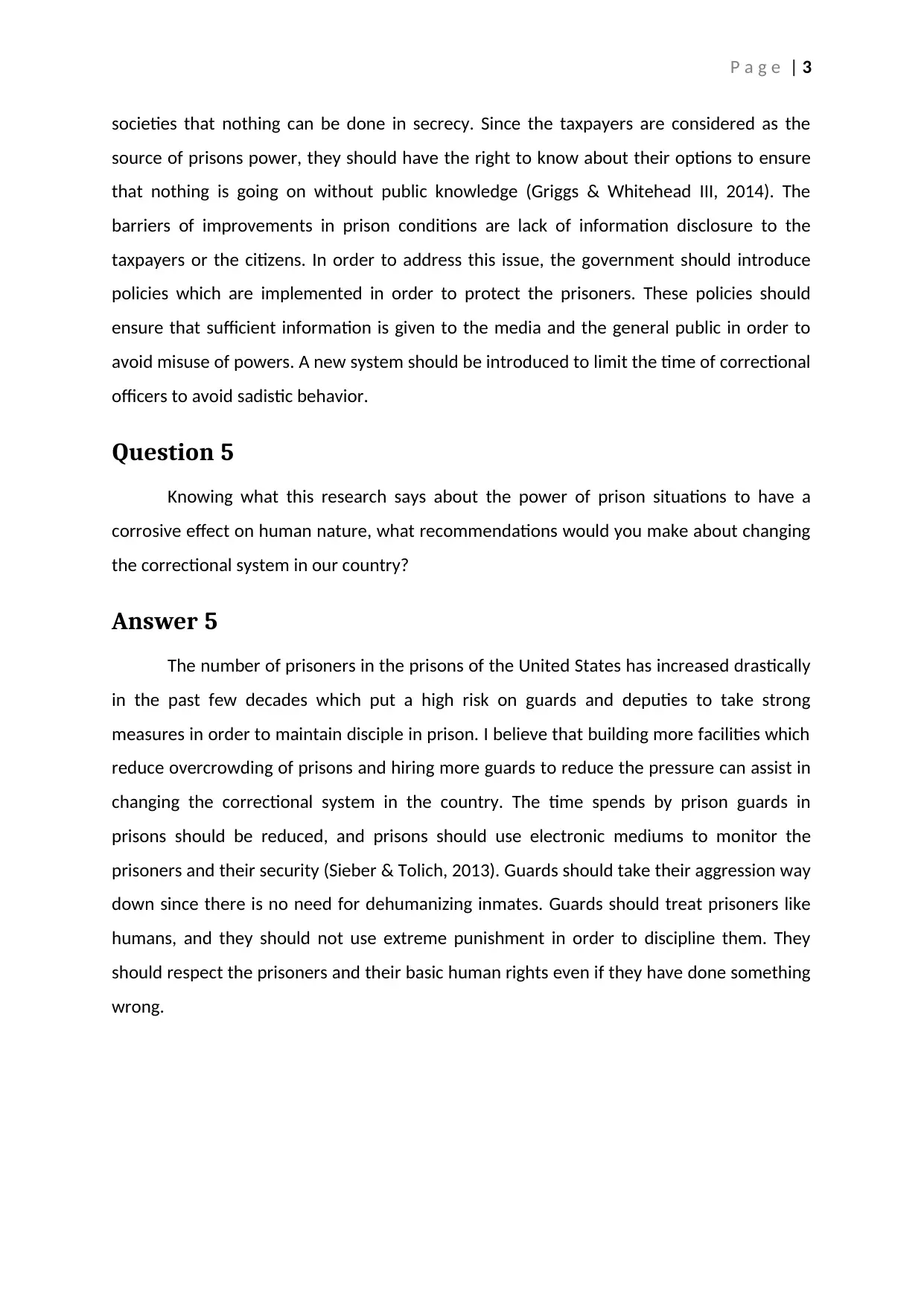
societies that nothing can be done in secrecy. Since the taxpayers are considered as the
source of prisons power, they should have the right to know about their options to ensure
that nothing is going on without public knowledge (Griggs & Whitehead III, 2014). The
barriers of improvements in prison conditions are lack of information disclosure to the
taxpayers or the citizens. In order to address this issue, the government should introduce
policies which are implemented in order to protect the prisoners. These policies should
ensure that sufficient information is given to the media and the general public in order to
avoid misuse of powers. A new system should be introduced to limit the time of correctional
officers to avoid sadistic behavior.
Question 5
Knowing what this research says about the power of prison situations to have a
corrosive effect on human nature, what recommendations would you make about changing
the correctional system in our country?
Answer 5
The number of prisoners in the prisons of the United States has increased drastically
in the past few decades which put a high risk on guards and deputies to take strong
measures in order to maintain disciple in prison. I believe that building more facilities which
reduce overcrowding of prisons and hiring more guards to reduce the pressure can assist in
changing the correctional system in the country. The time spends by prison guards in
prisons should be reduced, and prisons should use electronic mediums to monitor the
prisoners and their security (Sieber & Tolich, 2013). Guards should take their aggression way
down since there is no need for dehumanizing inmates. Guards should treat prisoners like
humans, and they should not use extreme punishment in order to discipline them. They
should respect the prisoners and their basic human rights even if they have done something
wrong.
tabler-icon-diamond-filled.svg

Paraphrase This Document

Need a fresh take? Get an instant paraphrase of this document with our AI Paraphraser
Document Page
P a g e | 4
References
ASA. (n.d.). ASA Code of Ethics. Retrieved from www.asanet.org/code-ethics
Griggs, R. A., & Whitehead III, G. I. (2014). Coverage of the Stanford prison experiment in
introductory social psychology textbooks. Teaching of Psychology, 41(4), 318-324.
Haslam, S. A., & Reicher, S. D. (2012). Contesting the “nature” of conformity: What Milgram
and Zimbardo's studies really show. PLoS Biology, 10(11), e1001426.
Prisonexp. (n.d.). Conclusion. Retrieved from https://www.prisonexp.org/conclusion
Sieber, J. E., & Tolich, M. B. (2013). Planning ethically responsible research. California: Sage.
chevron_up_icon
1 out of 5
circle_padding
hide_on_mobile
zoom_out_icon
[object Object]