Exploring Genre and Film Elements in Star Trek (2009) Analysis
VerifiedAdded on 2023/06/09
|6
|1314
|401
Essay
AI Summary
This essay provides a comprehensive film analysis of Star Trek (2009), examining its adherence to science fiction genre conventions. It delves into the film's plot, directing by J.J. Abrams, acting performances, sound design, and cinematography, using film-specific vocabulary to dissect its elements. The analysis highlights the film's use of time travel, its place as both a continuation of the original series and a reboot, and its visual style. The essay further draws connections between Star Trek and other films like 'Beasts of Southern Wild' and 'Hugo', emphasizing shared themes of survival, innovation, and the importance of human connection, ultimately positioning Star Trek as a film that inspires and captivates audiences with its blend of science fiction and human spirit.
Running head: INTRODUCTION TO FILM STUDIES: STAR TREK
Introduction to Film Studies: Star Trek
Name of Student
Name of University
Author note
Introduction to Film Studies: Star Trek
Name of Student
Name of University
Author note
Paraphrase This Document
Need a fresh take? Get an instant paraphrase of this document with our AI Paraphraser

1
INTRODUCTION TO FILM STUDIES: STAR TREK
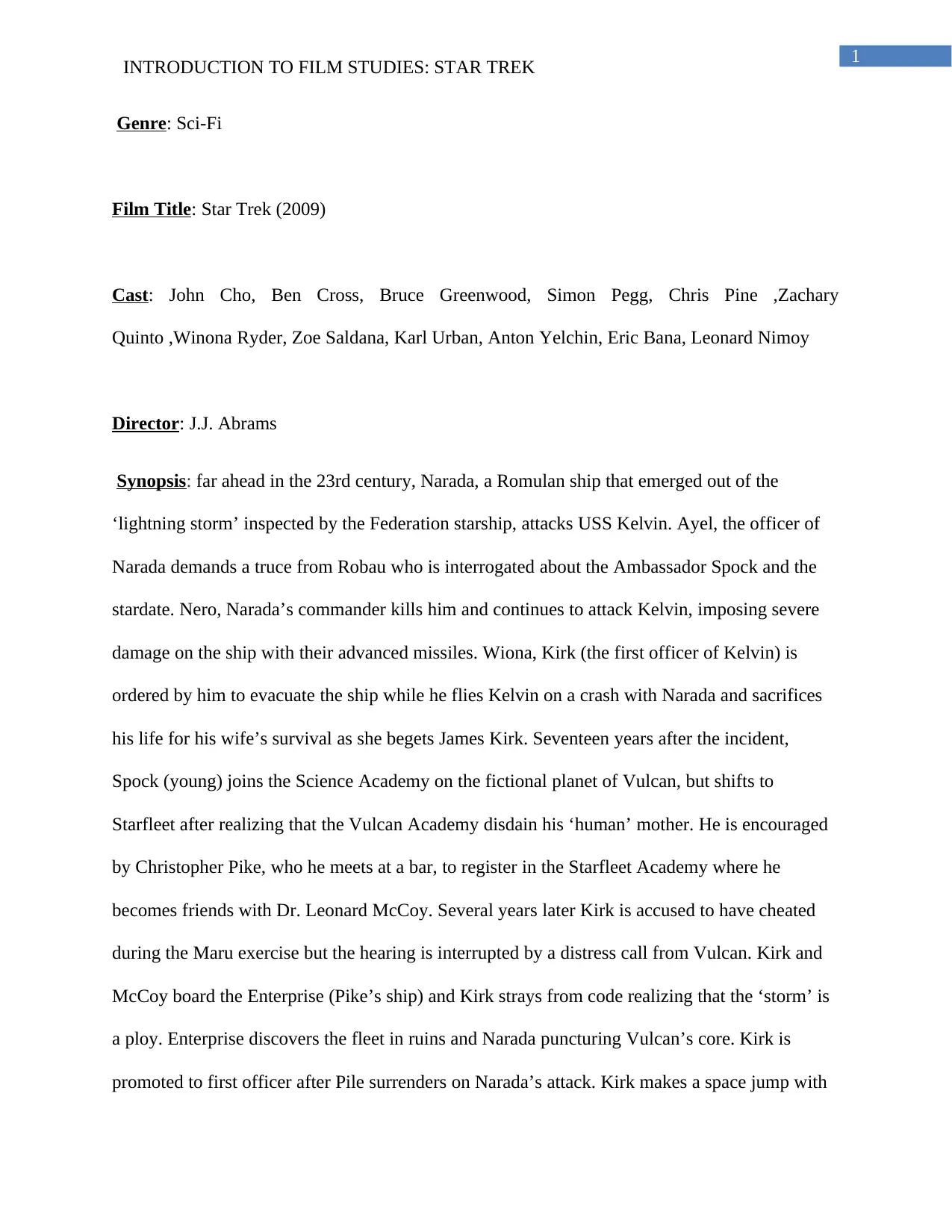
Genre: Sci-Fi
Film Title: Star Trek (2009)
Cast: John Cho, Ben Cross, Bruce Greenwood, Simon Pegg, Chris Pine ,Zachary
Quinto ,Winona Ryder, Zoe Saldana, Karl Urban, Anton Yelchin, Eric Bana, Leonard Nimoy
Director: J.J. Abrams
Synopsis: far ahead in the 23rd century, Narada, a Romulan ship that emerged out of the
‘lightning storm’ inspected by the Federation starship, attacks USS Kelvin. Ayel, the officer of
Narada demands a truce from Robau who is interrogated about the Ambassador Spock and the
stardate. Nero, Narada’s commander kills him and continues to attack Kelvin, imposing severe
damage on the ship with their advanced missiles. Wiona, Kirk (the first officer of Kelvin) is
ordered by him to evacuate the ship while he flies Kelvin on a crash with Narada and sacrifices
his life for his wife’s survival as she begets James Kirk. Seventeen years after the incident,
Spock (young) joins the Science Academy on the fictional planet of Vulcan, but shifts to
Starfleet after realizing that the Vulcan Academy disdain his ‘human’ mother. He is encouraged
by Christopher Pike, who he meets at a bar, to register in the Starfleet Academy where he
becomes friends with Dr. Leonard McCoy. Several years later Kirk is accused to have cheated
during the Maru exercise but the hearing is interrupted by a distress call from Vulcan. Kirk and
McCoy board the Enterprise (Pike’s ship) and Kirk strays from code realizing that the ‘storm’ is
a ploy. Enterprise discovers the fleet in ruins and Narada puncturing Vulcan’s core. Kirk is
promoted to first officer after Pile surrenders on Narada’s attack. Kirk makes a space jump with
INTRODUCTION TO FILM STUDIES: STAR TREK
Genre: Sci-Fi
Film Title: Star Trek (2009)
Cast: John Cho, Ben Cross, Bruce Greenwood, Simon Pegg, Chris Pine ,Zachary
Quinto ,Winona Ryder, Zoe Saldana, Karl Urban, Anton Yelchin, Eric Bana, Leonard Nimoy
Director: J.J. Abrams
Synopsis: far ahead in the 23rd century, Narada, a Romulan ship that emerged out of the
‘lightning storm’ inspected by the Federation starship, attacks USS Kelvin. Ayel, the officer of
Narada demands a truce from Robau who is interrogated about the Ambassador Spock and the
stardate. Nero, Narada’s commander kills him and continues to attack Kelvin, imposing severe
damage on the ship with their advanced missiles. Wiona, Kirk (the first officer of Kelvin) is
ordered by him to evacuate the ship while he flies Kelvin on a crash with Narada and sacrifices
his life for his wife’s survival as she begets James Kirk. Seventeen years after the incident,
Spock (young) joins the Science Academy on the fictional planet of Vulcan, but shifts to
Starfleet after realizing that the Vulcan Academy disdain his ‘human’ mother. He is encouraged
by Christopher Pike, who he meets at a bar, to register in the Starfleet Academy where he
becomes friends with Dr. Leonard McCoy. Several years later Kirk is accused to have cheated
during the Maru exercise but the hearing is interrupted by a distress call from Vulcan. Kirk and
McCoy board the Enterprise (Pike’s ship) and Kirk strays from code realizing that the ‘storm’ is
a ploy. Enterprise discovers the fleet in ruins and Narada puncturing Vulcan’s core. Kirk is
promoted to first officer after Pile surrenders on Narada’s attack. Kirk makes a space jump with

2
INTRODUCTION TO FILM STUDIES: STAR TREK
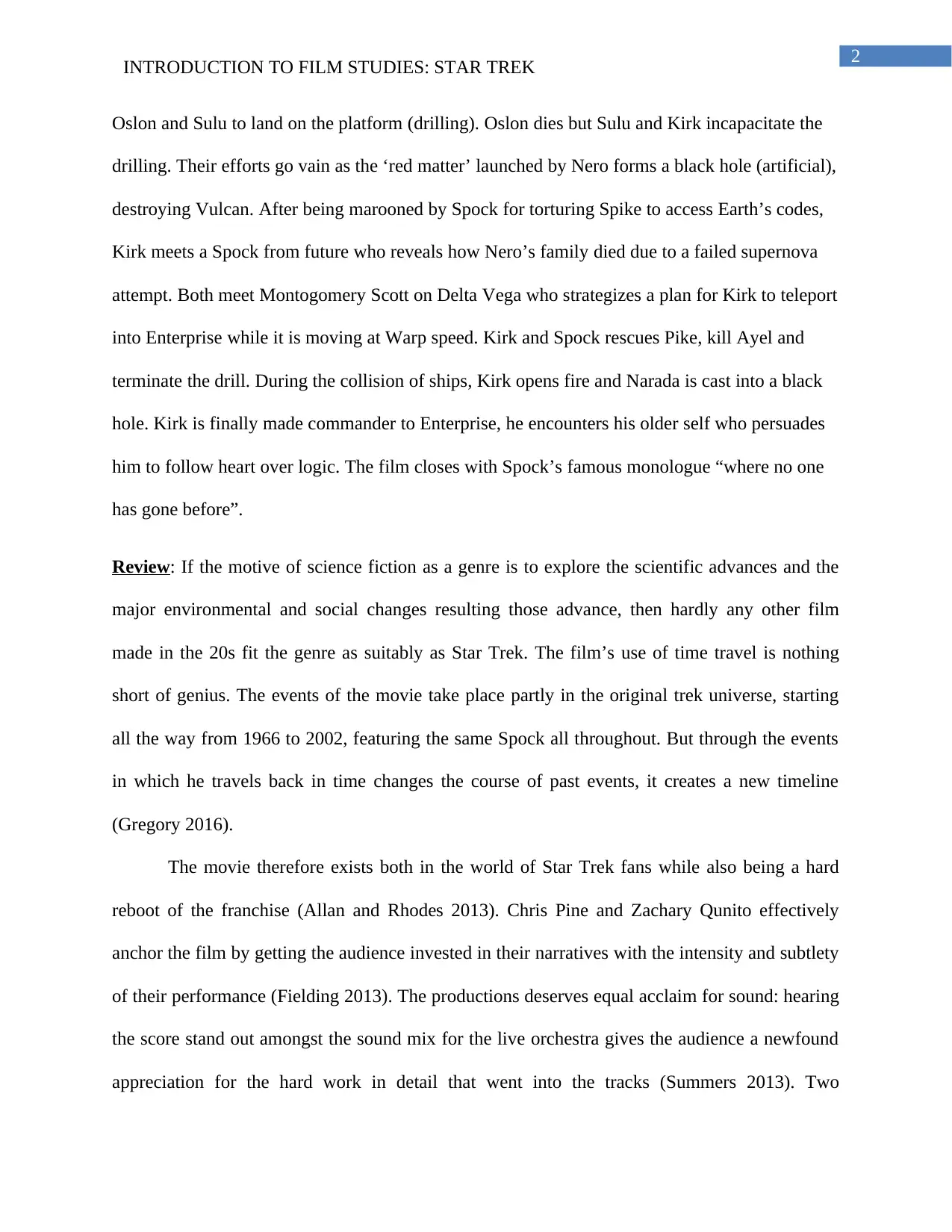
Oslon and Sulu to land on the platform (drilling). Oslon dies but Sulu and Kirk incapacitate the
drilling. Their efforts go vain as the ‘red matter’ launched by Nero forms a black hole (artificial),
destroying Vulcan. After being marooned by Spock for torturing Spike to access Earth’s codes,
Kirk meets a Spock from future who reveals how Nero’s family died due to a failed supernova
attempt. Both meet Montogomery Scott on Delta Vega who strategizes a plan for Kirk to teleport
into Enterprise while it is moving at Warp speed. Kirk and Spock rescues Pike, kill Ayel and
terminate the drill. During the collision of ships, Kirk opens fire and Narada is cast into a black
hole. Kirk is finally made commander to Enterprise, he encounters his older self who persuades
him to follow heart over logic. The film closes with Spock’s famous monologue “where no one
has gone before”.
Review: If the motive of science fiction as a genre is to explore the scientific advances and the
major environmental and social changes resulting those advance, then hardly any other film
made in the 20s fit the genre as suitably as Star Trek. The film’s use of time travel is nothing
short of genius. The events of the movie take place partly in the original trek universe, starting
all the way from 1966 to 2002, featuring the same Spock all throughout. But through the events
in which he travels back in time changes the course of past events, it creates a new timeline
(Gregory 2016).
The movie therefore exists both in the world of Star Trek fans while also being a hard
reboot of the franchise (Allan and Rhodes 2013). Chris Pine and Zachary Qunito effectively
anchor the film by getting the audience invested in their narratives with the intensity and subtlety
of their performance (Fielding 2013). The productions deserves equal acclaim for sound: hearing
the score stand out amongst the sound mix for the live orchestra gives the audience a newfound
appreciation for the hard work in detail that went into the tracks (Summers 2013). Two
INTRODUCTION TO FILM STUDIES: STAR TREK
Oslon and Sulu to land on the platform (drilling). Oslon dies but Sulu and Kirk incapacitate the
drilling. Their efforts go vain as the ‘red matter’ launched by Nero forms a black hole (artificial),
destroying Vulcan. After being marooned by Spock for torturing Spike to access Earth’s codes,
Kirk meets a Spock from future who reveals how Nero’s family died due to a failed supernova
attempt. Both meet Montogomery Scott on Delta Vega who strategizes a plan for Kirk to teleport
into Enterprise while it is moving at Warp speed. Kirk and Spock rescues Pike, kill Ayel and
terminate the drill. During the collision of ships, Kirk opens fire and Narada is cast into a black
hole. Kirk is finally made commander to Enterprise, he encounters his older self who persuades
him to follow heart over logic. The film closes with Spock’s famous monologue “where no one
has gone before”.
Review: If the motive of science fiction as a genre is to explore the scientific advances and the
major environmental and social changes resulting those advance, then hardly any other film
made in the 20s fit the genre as suitably as Star Trek. The film’s use of time travel is nothing
short of genius. The events of the movie take place partly in the original trek universe, starting
all the way from 1966 to 2002, featuring the same Spock all throughout. But through the events
in which he travels back in time changes the course of past events, it creates a new timeline
(Gregory 2016).
The movie therefore exists both in the world of Star Trek fans while also being a hard
reboot of the franchise (Allan and Rhodes 2013). Chris Pine and Zachary Qunito effectively
anchor the film by getting the audience invested in their narratives with the intensity and subtlety
of their performance (Fielding 2013). The productions deserves equal acclaim for sound: hearing
the score stand out amongst the sound mix for the live orchestra gives the audience a newfound
appreciation for the hard work in detail that went into the tracks (Summers 2013). Two
⊘ This is a preview!⊘
Do you want full access?
Subscribe today to unlock all pages.

Trusted by 1+ million students worldwide

3
INTRODUCTION TO FILM STUDIES: STAR TREK
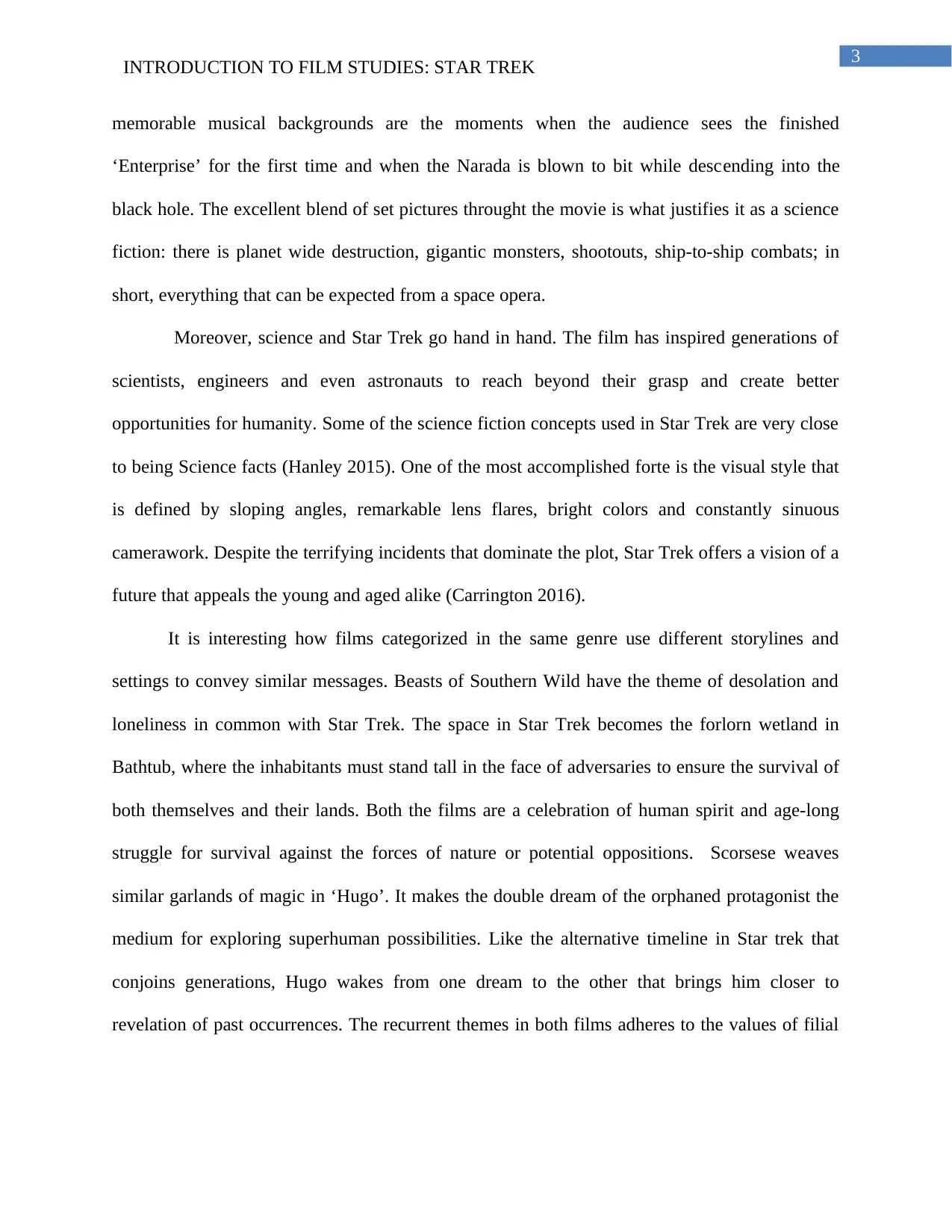
memorable musical backgrounds are the moments when the audience sees the finished
‘Enterprise’ for the first time and when the Narada is blown to bit while descending into the
black hole. The excellent blend of set pictures throught the movie is what justifies it as a science
fiction: there is planet wide destruction, gigantic monsters, shootouts, ship-to-ship combats; in
short, everything that can be expected from a space opera.
Moreover, science and Star Trek go hand in hand. The film has inspired generations of
scientists, engineers and even astronauts to reach beyond their grasp and create better
opportunities for humanity. Some of the science fiction concepts used in Star Trek are very close
to being Science facts (Hanley 2015). One of the most accomplished forte is the visual style that
is defined by sloping angles, remarkable lens flares, bright colors and constantly sinuous
camerawork. Despite the terrifying incidents that dominate the plot, Star Trek offers a vision of a
future that appeals the young and aged alike (Carrington 2016).
It is interesting how films categorized in the same genre use different storylines and
settings to convey similar messages. Beasts of Southern Wild have the theme of desolation and
loneliness in common with Star Trek. The space in Star Trek becomes the forlorn wetland in
Bathtub, where the inhabitants must stand tall in the face of adversaries to ensure the survival of
both themselves and their lands. Both the films are a celebration of human spirit and age-long
struggle for survival against the forces of nature or potential oppositions. Scorsese weaves
similar garlands of magic in ‘Hugo’. It makes the double dream of the orphaned protagonist the
medium for exploring superhuman possibilities. Like the alternative timeline in Star trek that
conjoins generations, Hugo wakes from one dream to the other that brings him closer to
revelation of past occurrences. The recurrent themes in both films adheres to the values of filial
INTRODUCTION TO FILM STUDIES: STAR TREK
memorable musical backgrounds are the moments when the audience sees the finished
‘Enterprise’ for the first time and when the Narada is blown to bit while descending into the
black hole. The excellent blend of set pictures throught the movie is what justifies it as a science
fiction: there is planet wide destruction, gigantic monsters, shootouts, ship-to-ship combats; in
short, everything that can be expected from a space opera.
Moreover, science and Star Trek go hand in hand. The film has inspired generations of
scientists, engineers and even astronauts to reach beyond their grasp and create better
opportunities for humanity. Some of the science fiction concepts used in Star Trek are very close
to being Science facts (Hanley 2015). One of the most accomplished forte is the visual style that
is defined by sloping angles, remarkable lens flares, bright colors and constantly sinuous
camerawork. Despite the terrifying incidents that dominate the plot, Star Trek offers a vision of a
future that appeals the young and aged alike (Carrington 2016).
It is interesting how films categorized in the same genre use different storylines and
settings to convey similar messages. Beasts of Southern Wild have the theme of desolation and
loneliness in common with Star Trek. The space in Star Trek becomes the forlorn wetland in
Bathtub, where the inhabitants must stand tall in the face of adversaries to ensure the survival of
both themselves and their lands. Both the films are a celebration of human spirit and age-long
struggle for survival against the forces of nature or potential oppositions. Scorsese weaves
similar garlands of magic in ‘Hugo’. It makes the double dream of the orphaned protagonist the
medium for exploring superhuman possibilities. Like the alternative timeline in Star trek that
conjoins generations, Hugo wakes from one dream to the other that brings him closer to
revelation of past occurrences. The recurrent themes in both films adheres to the values of filial
Paraphrase This Document
Need a fresh take? Get an instant paraphrase of this document with our AI Paraphraser

4
INTRODUCTION TO FILM STUDIES: STAR TREK
bonds and the necessity of innovation and willpower in the struggle for survival and ensuing
success.
INTRODUCTION TO FILM STUDIES: STAR TREK
bonds and the necessity of innovation and willpower in the struggle for survival and ensuing
success.

5
INTRODUCTION TO FILM STUDIES: STAR TREK
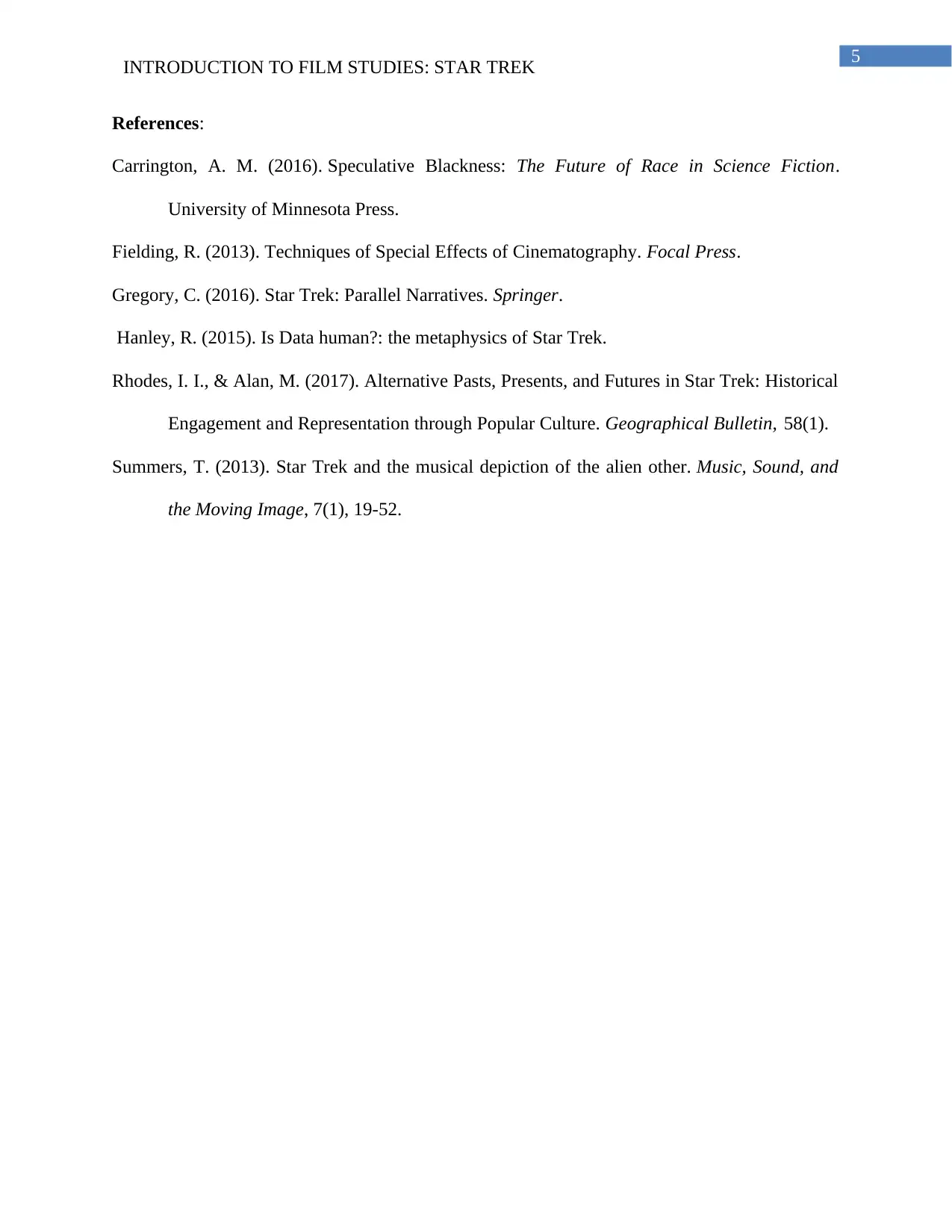
References:
Carrington, A. M. (2016). Speculative Blackness: The Future of Race in Science Fiction.
University of Minnesota Press.
Fielding, R. (2013). Techniques of Special Effects of Cinematography. Focal Press.
Gregory, C. (2016). Star Trek: Parallel Narratives. Springer.
Hanley, R. (2015). Is Data human?: the metaphysics of Star Trek.
Rhodes, I. I., & Alan, M. (2017). Alternative Pasts, Presents, and Futures in Star Trek: Historical
Engagement and Representation through Popular Culture. Geographical Bulletin, 58(1).
Summers, T. (2013). Star Trek and the musical depiction of the alien other. Music, Sound, and
the Moving Image, 7(1), 19-52.
INTRODUCTION TO FILM STUDIES: STAR TREK
References:
Carrington, A. M. (2016). Speculative Blackness: The Future of Race in Science Fiction.
University of Minnesota Press.
Fielding, R. (2013). Techniques of Special Effects of Cinematography. Focal Press.
Gregory, C. (2016). Star Trek: Parallel Narratives. Springer.
Hanley, R. (2015). Is Data human?: the metaphysics of Star Trek.
Rhodes, I. I., & Alan, M. (2017). Alternative Pasts, Presents, and Futures in Star Trek: Historical
Engagement and Representation through Popular Culture. Geographical Bulletin, 58(1).
Summers, T. (2013). Star Trek and the musical depiction of the alien other. Music, Sound, and
the Moving Image, 7(1), 19-52.
⊘ This is a preview!⊘
Do you want full access?
Subscribe today to unlock all pages.

Trusted by 1+ million students worldwide
1 out of 6
Your All-in-One AI-Powered Toolkit for Academic Success.
+13062052269
info@desklib.com
Available 24*7 on WhatsApp / Email
Unlock your academic potential
Copyright © 2020–2025 A2Z Services. All Rights Reserved. Developed and managed by ZUCOL.