Corporate Social Responsibility: Starbucks and Nestle Analysis
VerifiedAdded on 2020/02/19
|12
|2733
|51
Report
AI Summary
This report provides a comparative analysis of the business values and corporate social responsibility (CSR) initiatives of Starbucks and Nestle. The report begins with an overview of each company, including their core values and operational areas. It then delves into a detailed comparison of their CSR activities, highlighting both similarities and differences. Starbucks focuses on ethical sourcing, farmer support, and environmental sustainability through initiatives like recycling and greener stores. Nestle emphasizes nutrition, rural development, and water conservation, with a specific focus on improving the lives of children and supporting farmers. The report also applies the social accounting approach, evaluating both companies based on Zadek et al.'s (1997) eight principles of quality reporting. The analysis reveals that while both companies demonstrate a commitment to CSR, their approaches differ due to their operational contexts. The report concludes with a discussion of the group's differing perspectives on the effectiveness of each company's CSR efforts, emphasizing the unique value of each company's approach. This assessment, contributed by a student, is available on Desklib, a platform offering AI-powered study tools.
Running head: BUSINESS VALUES ASSESSMENT
Business Values and Assessment
Name of the Student:
Name of the University:
Author note:
Business Values and Assessment
Name of the Student:
Name of the University:
Author note:

Paraphrase This Document
Need a fresh take? Get an instant paraphrase of this document with our AI Paraphraser
1
BUSINESS VALUES ASSESSMENT
1. The companies selected to study their corporate social responsibilities are Starbucks and
Nestle.
Starbucks
Starbucks is an American coffee company that was founded in Seattle in the year 1971.
The industry in which Starbucks operates is coffee shop and the area served is
worldwide. Starbucks serve hot and cold drinks , whole beans, micro ground, instant
coffee through, espresso, cafe latte, they also offer loose leaf teas, like Teavana tea
products. Starbucks also sell of products related to tea and coffee ("Starbucks", 2017).
The core values of Starbucks are creation of a culture of belongingness that is warm
where ever one is welcomed. Starbucks believe in acting with courage where the status
quo is challenged. They believe in being present, connected with transparency, dignity
and respect. They believe in delivering their best in whatever they do, they hold
themselves responsible for whatever be the results. They are driven by performance
through the perspective of humanity. According to the CEO of Starbucks Howard
Schultz, he always believed in the link between success and values. He says that they are
not into coffee business that serves people, rather they are in to people business serving
coffee ("Starbucks", 2017).
Nestle
Nestle is Swiss company, the head quarter of the company is in Vevey, Vaud,
Switzerland. The founder of the company is Henri Nestle, Charles Page and George Page.
The industry that they operate in is food Processing (Nestle.com 2017). It is one of the
largest food companies of the world. Nestle is a multinational company, they are into
manufacturing of a wide range of food products, like baby food, breakfast cereals,
BUSINESS VALUES ASSESSMENT
1. The companies selected to study their corporate social responsibilities are Starbucks and
Nestle.
Starbucks
Starbucks is an American coffee company that was founded in Seattle in the year 1971.
The industry in which Starbucks operates is coffee shop and the area served is
worldwide. Starbucks serve hot and cold drinks , whole beans, micro ground, instant
coffee through, espresso, cafe latte, they also offer loose leaf teas, like Teavana tea
products. Starbucks also sell of products related to tea and coffee ("Starbucks", 2017).
The core values of Starbucks are creation of a culture of belongingness that is warm
where ever one is welcomed. Starbucks believe in acting with courage where the status
quo is challenged. They believe in being present, connected with transparency, dignity
and respect. They believe in delivering their best in whatever they do, they hold
themselves responsible for whatever be the results. They are driven by performance
through the perspective of humanity. According to the CEO of Starbucks Howard
Schultz, he always believed in the link between success and values. He says that they are
not into coffee business that serves people, rather they are in to people business serving
coffee ("Starbucks", 2017).
Nestle
Nestle is Swiss company, the head quarter of the company is in Vevey, Vaud,
Switzerland. The founder of the company is Henri Nestle, Charles Page and George Page.
The industry that they operate in is food Processing (Nestle.com 2017). It is one of the
largest food companies of the world. Nestle is a multinational company, they are into
manufacturing of a wide range of food products, like baby food, breakfast cereals,
2
BUSINESS VALUES ASSESSMENT
medical food, coffee, tea, ice-creams, chocolates, frozen food, pet food and snacks. The
company was founded in the year 1905. It operates in approximately 194 countries and
they have four hundred and forty seven factories employing 339,000 people worldwide.
As per the core values of the company they conduct their business as per the set
principles that are based o fairness, honesty and concern towards people. Their code of
business has created standards that cannot be negotiated or compromised, this behavior is
set for all the employees that work in the organization, their overall beliefs and their
leadership and corporate busiess and management principles set the commitments. Their
concern for children can be seen by the way they manufacture healthy whole grain
breakfast cereals for children and teenagers (Nestle.com. 2017).
2. The differences in the corporate social responsibilities of Starbucks and Nestle are not
much because the some of the causes that they work for, both Starbucks and Nestle work
for environmental sustainability like saving water and energy sources. One more thing
common to both the companies is that they both work for the welfare of their suppliers,
Starbucks makes sure that the farmers have good livelihood. Nestle also works for its
suppliers and stakeholders’ welfare. One social responsibility activity that can be seen
different in the organization, Nestle is that they take initiatives for the good health of
children, they manufacture breakfast cereals in which they make sure that there is
adequate content of whole grains, these breakfast cereals are meant for the young
children and teenagers. On the other hand, Starbucks take initiatives by recycling they
recycle their cups, they have greener stores for inventory management, where large open
refrigerators are not used because of high carbon emission this CSR is done for the
welfare of environment. Though both the companies take initiative for environment but
BUSINESS VALUES ASSESSMENT
medical food, coffee, tea, ice-creams, chocolates, frozen food, pet food and snacks. The
company was founded in the year 1905. It operates in approximately 194 countries and
they have four hundred and forty seven factories employing 339,000 people worldwide.
As per the core values of the company they conduct their business as per the set
principles that are based o fairness, honesty and concern towards people. Their code of
business has created standards that cannot be negotiated or compromised, this behavior is
set for all the employees that work in the organization, their overall beliefs and their
leadership and corporate busiess and management principles set the commitments. Their
concern for children can be seen by the way they manufacture healthy whole grain
breakfast cereals for children and teenagers (Nestle.com. 2017).
2. The differences in the corporate social responsibilities of Starbucks and Nestle are not
much because the some of the causes that they work for, both Starbucks and Nestle work
for environmental sustainability like saving water and energy sources. One more thing
common to both the companies is that they both work for the welfare of their suppliers,
Starbucks makes sure that the farmers have good livelihood. Nestle also works for its
suppliers and stakeholders’ welfare. One social responsibility activity that can be seen
different in the organization, Nestle is that they take initiatives for the good health of
children, they manufacture breakfast cereals in which they make sure that there is
adequate content of whole grains, these breakfast cereals are meant for the young
children and teenagers. On the other hand, Starbucks take initiatives by recycling they
recycle their cups, they have greener stores for inventory management, where large open
refrigerators are not used because of high carbon emission this CSR is done for the
welfare of environment. Though both the companies take initiative for environment but
⊘ This is a preview!⊘
Do you want full access?
Subscribe today to unlock all pages.

Trusted by 1+ million students worldwide
3
BUSINESS VALUES ASSESSMENT
the approach used by them differ, Nestle has taken the initiative for water management to
ensure that the employees, customers and the people of the community that the
organization operates gets clean water. Starbucks for the welfare of the farmers from
whom they get their raw materials like coffee beans and cocoa. Starbucks provide loans
to the farmers so that the farmers can put all the required fertilizers and other essential
elements to make a good yield. Other issues raised by Starbucks are forest conservation
and climate change. The other initiatives of Starbucks are that they provide employment
opportunities for the youth. While Nestle focuses on waste reduction issues, in their
Nescafe factory at Orbe Switzerland, they are utilizing the wastes by converting it into
energy, the use coffee grounds to generate steam and use it as renewable source of
energy. Thus, it can be seen that some of their issues are similar and some are different,
there are some similar issues like environmental conservation and welfare of the society,
but the approach here is different (Mason, Cole & Goza, 2017).
3. The differences that can be seen in the corporate social responsibilities of the
organizations exist because their difference in their operations, the main operations of
Starbucks is beverages, they process coffee beans, and they have coffee shops that
provide coffee and snacks to their customers. Nestle is quite diversified in their
production of processed food, this is reason that some of initiatives taken by Nestle like
increasing the whole grain content in the breakfast cereals cannot be undertaken by
Starbucks because they are not into manufacturing of process and packaged food.
Starbucks takes other steps like recycling; the cups used by the customers are recycled
because there is scope for that. Starbucks belongs to beverages as well as service industry
but Nestle belongs to food manufacturing industry (Glowik, 2017). Since Starbucks have
BUSINESS VALUES ASSESSMENT
the approach used by them differ, Nestle has taken the initiative for water management to
ensure that the employees, customers and the people of the community that the
organization operates gets clean water. Starbucks for the welfare of the farmers from
whom they get their raw materials like coffee beans and cocoa. Starbucks provide loans
to the farmers so that the farmers can put all the required fertilizers and other essential
elements to make a good yield. Other issues raised by Starbucks are forest conservation
and climate change. The other initiatives of Starbucks are that they provide employment
opportunities for the youth. While Nestle focuses on waste reduction issues, in their
Nescafe factory at Orbe Switzerland, they are utilizing the wastes by converting it into
energy, the use coffee grounds to generate steam and use it as renewable source of
energy. Thus, it can be seen that some of their issues are similar and some are different,
there are some similar issues like environmental conservation and welfare of the society,
but the approach here is different (Mason, Cole & Goza, 2017).
3. The differences that can be seen in the corporate social responsibilities of the
organizations exist because their difference in their operations, the main operations of
Starbucks is beverages, they process coffee beans, and they have coffee shops that
provide coffee and snacks to their customers. Nestle is quite diversified in their
production of processed food, this is reason that some of initiatives taken by Nestle like
increasing the whole grain content in the breakfast cereals cannot be undertaken by
Starbucks because they are not into manufacturing of process and packaged food.
Starbucks takes other steps like recycling; the cups used by the customers are recycled
because there is scope for that. Starbucks belongs to beverages as well as service industry
but Nestle belongs to food manufacturing industry (Glowik, 2017). Since Starbucks have
Paraphrase This Document
Need a fresh take? Get an instant paraphrase of this document with our AI Paraphraser
4
BUSINESS VALUES ASSESSMENT
coffee houses that serve customers coffee and other snacks, therefore, manpower is
required, these employees do not need manufacturing or engineering skills, so Starbucks
gives opportunities to youth to work at their stores. While Nestle requires skill manpower
who can perform manufacturing related tasks, therefore it is only possible for Starbucks
to employ less skilled youth, Nestle cannot take this initiatives in their CSR it would be a
risk for them (Fontaine, 2013).
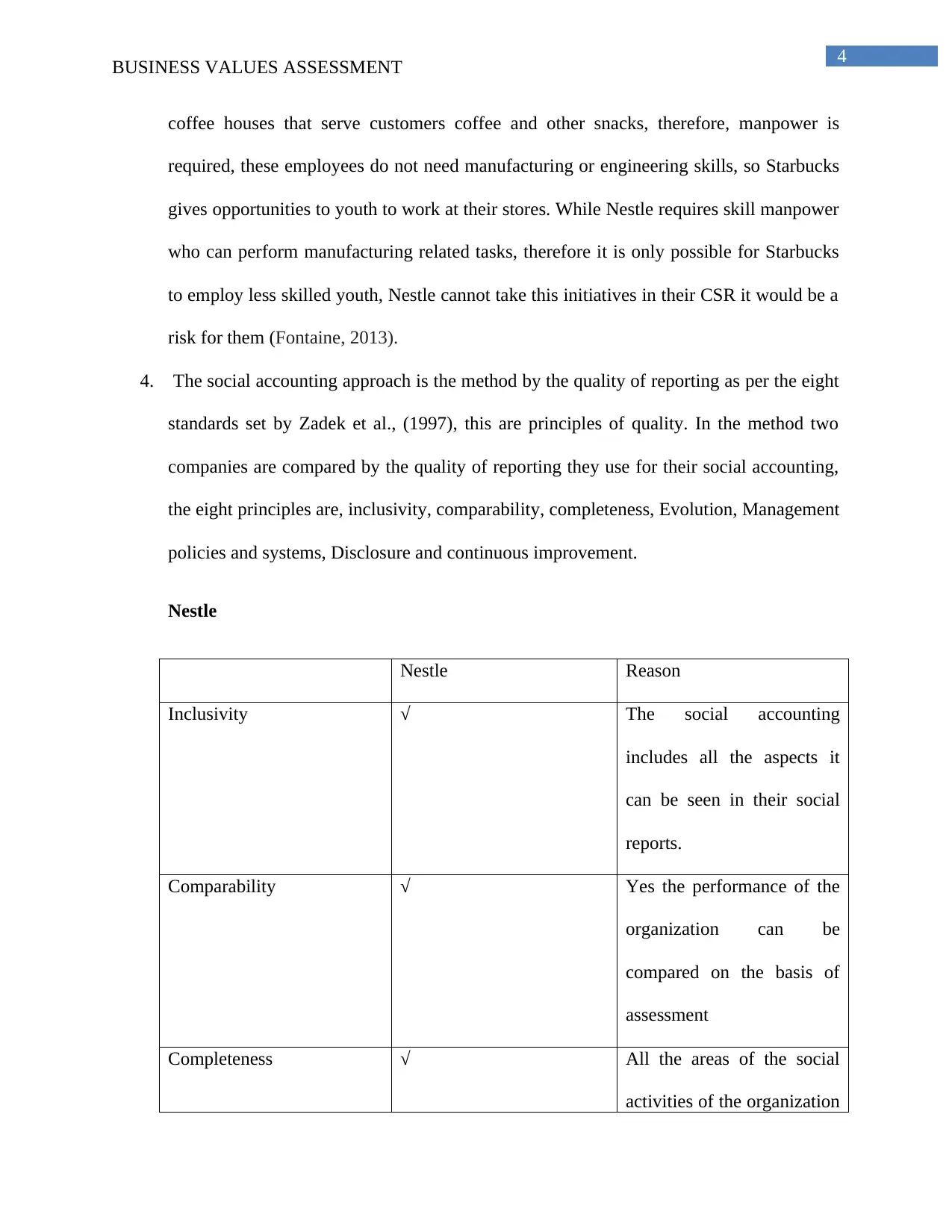
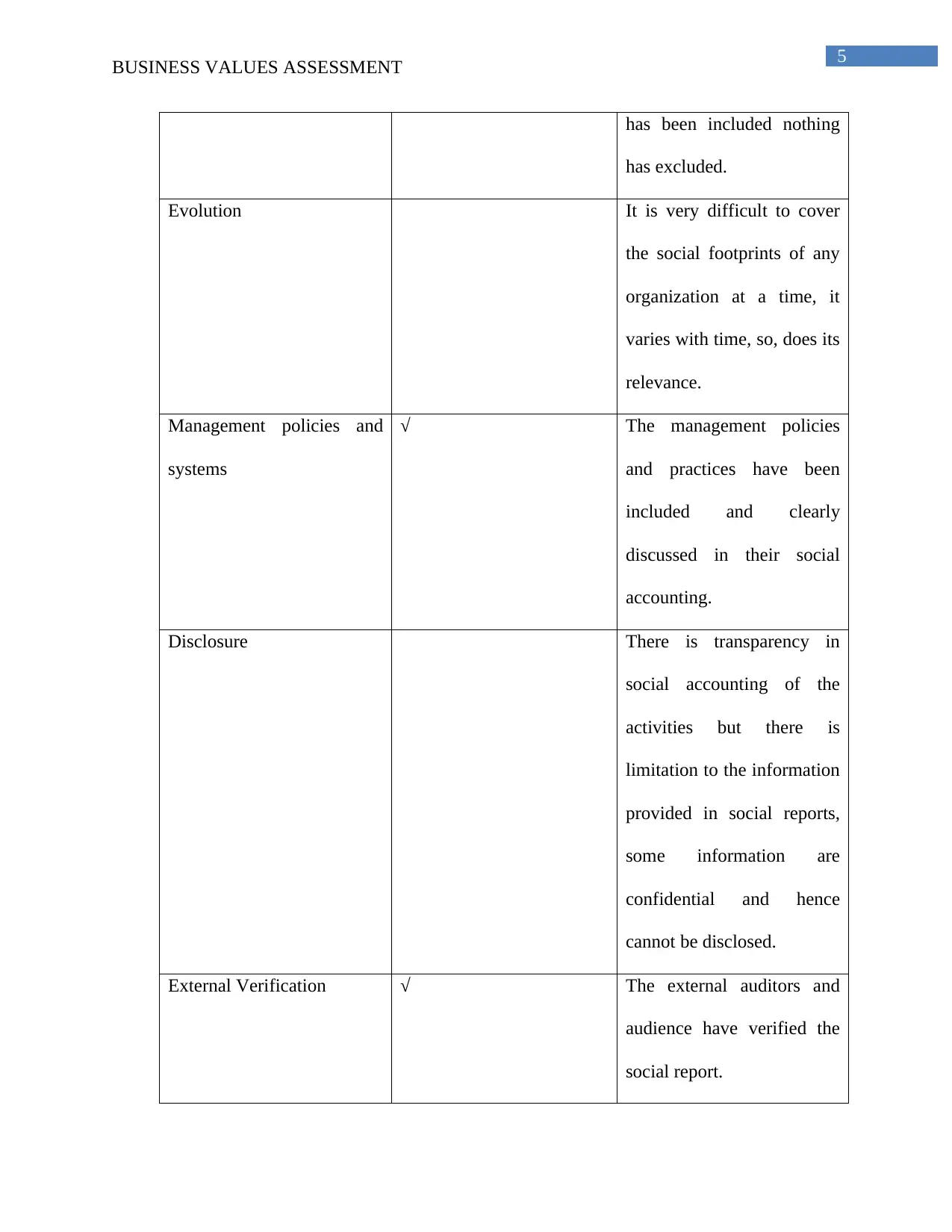
4. The social accounting approach is the method by the quality of reporting as per the eight
standards set by Zadek et al., (1997), this are principles of quality. In the method two
companies are compared by the quality of reporting they use for their social accounting,
the eight principles are, inclusivity, comparability, completeness, Evolution, Management
policies and systems, Disclosure and continuous improvement.
Nestle
Nestle Reason
Inclusivity √ The social accounting
includes all the aspects it
can be seen in their social
reports.
Comparability √ Yes the performance of the
organization can be
compared on the basis of
assessment
Completeness √ All the areas of the social
activities of the organization
BUSINESS VALUES ASSESSMENT
coffee houses that serve customers coffee and other snacks, therefore, manpower is
required, these employees do not need manufacturing or engineering skills, so Starbucks
gives opportunities to youth to work at their stores. While Nestle requires skill manpower
who can perform manufacturing related tasks, therefore it is only possible for Starbucks
to employ less skilled youth, Nestle cannot take this initiatives in their CSR it would be a
risk for them (Fontaine, 2013).
4. The social accounting approach is the method by the quality of reporting as per the eight
standards set by Zadek et al., (1997), this are principles of quality. In the method two
companies are compared by the quality of reporting they use for their social accounting,
the eight principles are, inclusivity, comparability, completeness, Evolution, Management
policies and systems, Disclosure and continuous improvement.
Nestle
Nestle Reason
Inclusivity √ The social accounting
includes all the aspects it
can be seen in their social
reports.
Comparability √ Yes the performance of the
organization can be
compared on the basis of
assessment
Completeness √ All the areas of the social
activities of the organization
5
BUSINESS VALUES ASSESSMENT
has been included nothing
has excluded.
Evolution It is very difficult to cover
the social footprints of any
organization at a time, it
varies with time, so, does its
relevance.
Management policies and
systems
√ The management policies
and practices have been
included and clearly
discussed in their social
accounting.
Disclosure There is transparency in
social accounting of the
activities but there is
limitation to the information
provided in social reports,
some information are
confidential and hence
cannot be disclosed.
External Verification √ The external auditors and
audience have verified the
social report.
BUSINESS VALUES ASSESSMENT
has been included nothing
has excluded.
Evolution It is very difficult to cover
the social footprints of any
organization at a time, it
varies with time, so, does its
relevance.
Management policies and
systems
√ The management policies
and practices have been
included and clearly
discussed in their social
accounting.
Disclosure There is transparency in
social accounting of the
activities but there is
limitation to the information
provided in social reports,
some information are
confidential and hence
cannot be disclosed.
External Verification √ The external auditors and
audience have verified the
social report.
⊘ This is a preview!⊘
Do you want full access?
Subscribe today to unlock all pages.
Trusted by 1+ million students worldwide
6
BUSINESS VALUES ASSESSMENT
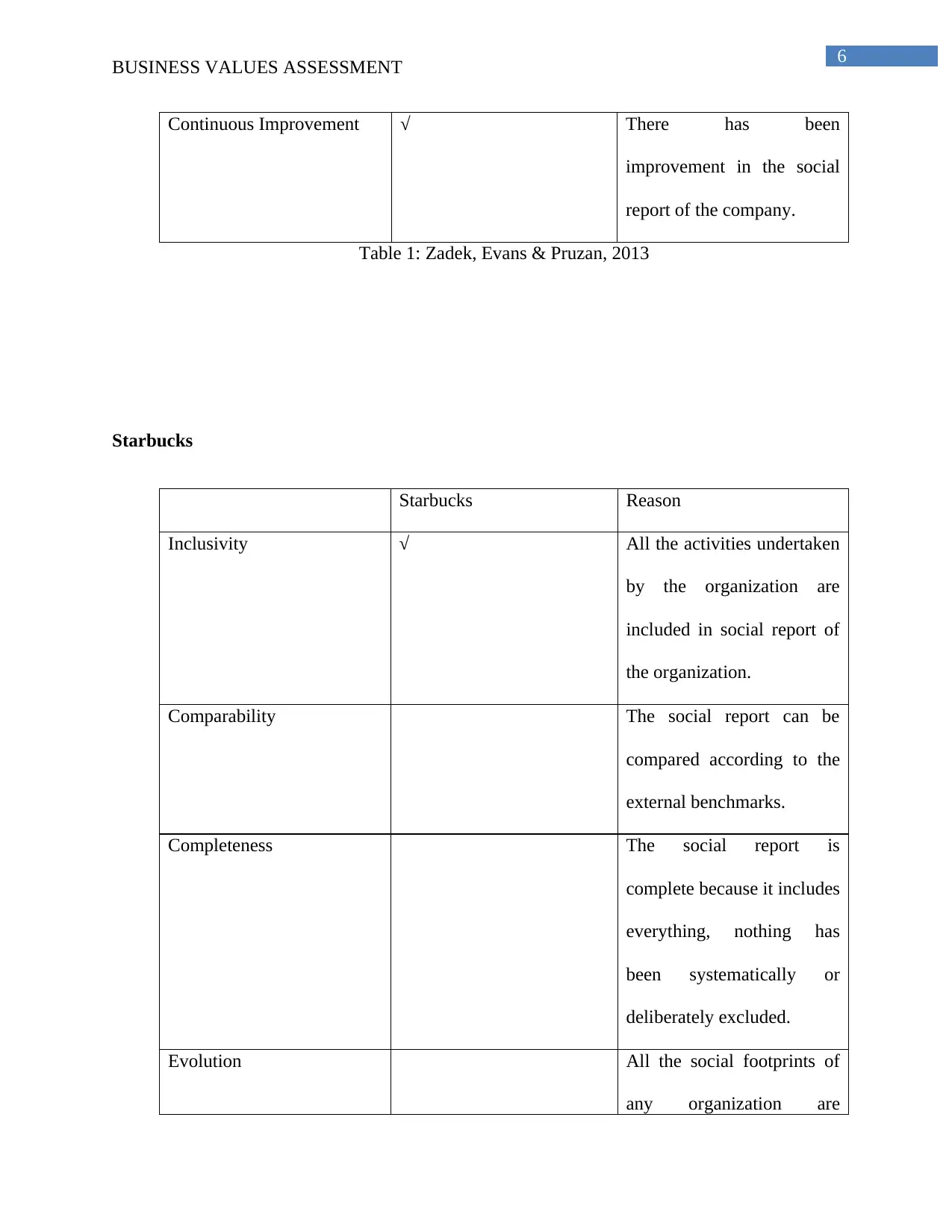
Continuous Improvement √ There has been
improvement in the social
report of the company.
Table 1: Zadek, Evans & Pruzan, 2013
Starbucks
Starbucks Reason
Inclusivity √ All the activities undertaken
by the organization are
included in social report of
the organization.
Comparability The social report can be
compared according to the
external benchmarks.
Completeness The social report is
complete because it includes
everything, nothing has
been systematically or
deliberately excluded.
Evolution All the social footprints of
any organization are
BUSINESS VALUES ASSESSMENT
Continuous Improvement √ There has been
improvement in the social
report of the company.
Table 1: Zadek, Evans & Pruzan, 2013
Starbucks
Starbucks Reason
Inclusivity √ All the activities undertaken
by the organization are
included in social report of
the organization.
Comparability The social report can be
compared according to the
external benchmarks.
Completeness The social report is
complete because it includes
everything, nothing has
been systematically or
deliberately excluded.
Evolution All the social footprints of
any organization are
Paraphrase This Document
Need a fresh take? Get an instant paraphrase of this document with our AI Paraphraser
7
BUSINESS VALUES ASSESSMENT
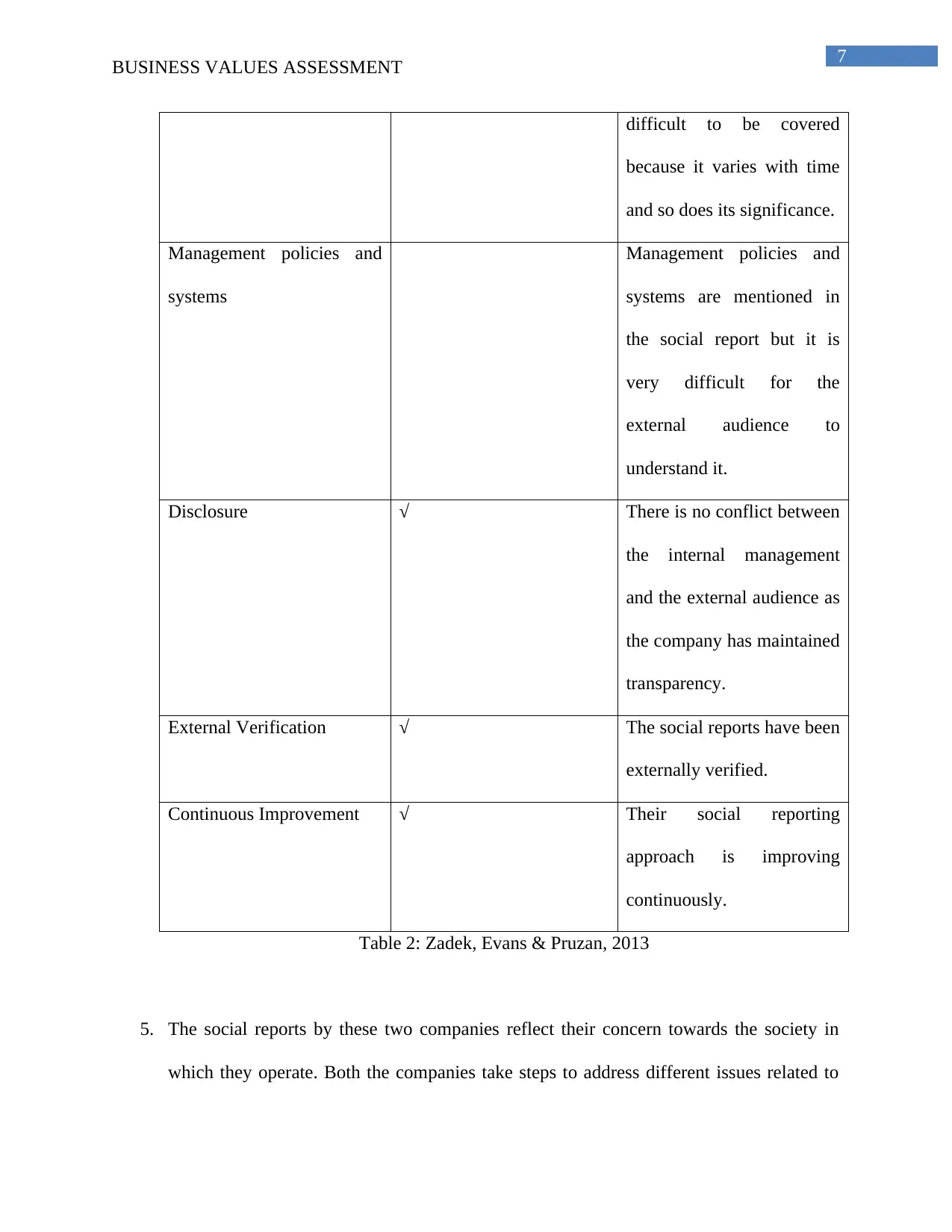
difficult to be covered
because it varies with time
and so does its significance.
Management policies and
systems
Management policies and
systems are mentioned in
the social report but it is
very difficult for the
external audience to
understand it.
Disclosure √ There is no conflict between
the internal management
and the external audience as
the company has maintained
transparency.
External Verification √ The social reports have been
externally verified.
Continuous Improvement √ Their social reporting
approach is improving
continuously.
Table 2: Zadek, Evans & Pruzan, 2013
5. The social reports by these two companies reflect their concern towards the society in
which they operate. Both the companies take steps to address different issues related to
BUSINESS VALUES ASSESSMENT
difficult to be covered
because it varies with time
and so does its significance.
Management policies and
systems
Management policies and
systems are mentioned in
the social report but it is
very difficult for the
external audience to
understand it.
Disclosure √ There is no conflict between
the internal management
and the external audience as
the company has maintained
transparency.
External Verification √ The social reports have been
externally verified.
Continuous Improvement √ Their social reporting
approach is improving
continuously.
Table 2: Zadek, Evans & Pruzan, 2013
5. The social reports by these two companies reflect their concern towards the society in
which they operate. Both the companies take steps to address different issues related to
8
BUSINESS VALUES ASSESSMENT
the society and the planet. The companies have tried to be ethically strong by taking a
number of initiatives in their corporate social responsibilities. It can be seen in their
social and sustainability reports. Nestle has an agenda to improve the quality of life of the
people and leading them to a healthier future. The impact areas of Nestle’s “Creating
Shared Value” model are,
Nutrition, health and wellness
Rural development
Water conservation
Under the domain of Nutrition, health and wellness they have set an ambition to improve
the lives of 50 million children by 2030, they have aimed to help these children lead
healthier lives. With the help of Cereals Partners worldwide, they have joined hands with
the General Mills with an aim to fulfill the wholegrain requirements of the children and
teenagers. All the breakfast cereals of the brand have 8 gram of whole grain content per
serving. Their objectives for 2020 is to add 750 million portions of vegetables and 300
million portions of fiber rich grains, like pulses, nuts and seeds (Salib et al., 2015).
Under the domain of rural development, Nestle aims at improving the lives of farmers
who supply them resources that are required for manufacturing of the products of the
organization. For this purpose they use tools like Rural development framework and
Response-Inducing sustainability Evaluation, this tools are consistent and hence are used
for enhancing the lively hoods of rural farmers (Tai & Chuang, 2014).
Under the domain water conservation, According to the company water is the human
right and hence they ensure, their employees, customers, farmers and the society receive
pure and clean water. They consider the sustainability concept and control their usage and
BUSINESS VALUES ASSESSMENT
the society and the planet. The companies have tried to be ethically strong by taking a
number of initiatives in their corporate social responsibilities. It can be seen in their
social and sustainability reports. Nestle has an agenda to improve the quality of life of the
people and leading them to a healthier future. The impact areas of Nestle’s “Creating
Shared Value” model are,
Nutrition, health and wellness
Rural development
Water conservation
Under the domain of Nutrition, health and wellness they have set an ambition to improve
the lives of 50 million children by 2030, they have aimed to help these children lead
healthier lives. With the help of Cereals Partners worldwide, they have joined hands with
the General Mills with an aim to fulfill the wholegrain requirements of the children and
teenagers. All the breakfast cereals of the brand have 8 gram of whole grain content per
serving. Their objectives for 2020 is to add 750 million portions of vegetables and 300
million portions of fiber rich grains, like pulses, nuts and seeds (Salib et al., 2015).
Under the domain of rural development, Nestle aims at improving the lives of farmers
who supply them resources that are required for manufacturing of the products of the
organization. For this purpose they use tools like Rural development framework and
Response-Inducing sustainability Evaluation, this tools are consistent and hence are used
for enhancing the lively hoods of rural farmers (Tai & Chuang, 2014).
Under the domain water conservation, According to the company water is the human
right and hence they ensure, their employees, customers, farmers and the society receive
pure and clean water. They consider the sustainability concept and control their usage and
⊘ This is a preview!⊘
Do you want full access?
Subscribe today to unlock all pages.
Trusted by 1+ million students worldwide
9
BUSINESS VALUES ASSESSMENT
withdrawal of water resources and they focus on water treatment (Clapp & Rowlands,
2014).
As far as star bucks are concerned, under corporate social responsibility they carry out
different tasks. The categories that falls under the CSR of star bucks are,
Ethical sourcing- Star bucks believes in ethical sourcing and for that purpose they have
been committed towards providing the best quality of products through ethical sourcing,
they respect their suppliers of coffee beans, cocoa and tea (Galalae & George, 2017).
Farmer support- They know it pretty well that that they need to support their farmers.
Environment- They take initiatives towards the environment by reducing their impact on
environment, conserving the energy and water, using stores and facilities that are energy
efficient, they use Greener stores.
Recycling- They use recycling techniques in recycling and food packaging they recycle
the cups (Phillips, 2014).
6. The discussion of the group was mainly focused on comparing the CSR activities of the
two companies, group members mainly focused on rating the companies on the basis of
their initiatives in the CSR activities. There were conflicting views as one of them
believed that Starbucks’ CSR activities are much effective than Nestle, while one other
group member had an opinion that what Nestle does for the society is more useful.
According to my friend, thinking about the nutrient intake of children is a unique idea
and it is very important, the other one strongly argued that providing the employment
opportunities to the disengaged youth. I have a different opinion from that of my group
members; according to me, the corporate social responsibilities cannot be compared.
Both the companies take initiatives that are effective in their own ways, every measure
BUSINESS VALUES ASSESSMENT
withdrawal of water resources and they focus on water treatment (Clapp & Rowlands,
2014).
As far as star bucks are concerned, under corporate social responsibility they carry out
different tasks. The categories that falls under the CSR of star bucks are,
Ethical sourcing- Star bucks believes in ethical sourcing and for that purpose they have
been committed towards providing the best quality of products through ethical sourcing,
they respect their suppliers of coffee beans, cocoa and tea (Galalae & George, 2017).
Farmer support- They know it pretty well that that they need to support their farmers.
Environment- They take initiatives towards the environment by reducing their impact on
environment, conserving the energy and water, using stores and facilities that are energy
efficient, they use Greener stores.
Recycling- They use recycling techniques in recycling and food packaging they recycle
the cups (Phillips, 2014).
6. The discussion of the group was mainly focused on comparing the CSR activities of the
two companies, group members mainly focused on rating the companies on the basis of
their initiatives in the CSR activities. There were conflicting views as one of them
believed that Starbucks’ CSR activities are much effective than Nestle, while one other
group member had an opinion that what Nestle does for the society is more useful.
According to my friend, thinking about the nutrient intake of children is a unique idea
and it is very important, the other one strongly argued that providing the employment
opportunities to the disengaged youth. I have a different opinion from that of my group
members; according to me, the corporate social responsibilities cannot be compared.
Both the companies take initiatives that are effective in their own ways, every measure
Paraphrase This Document
Need a fresh take? Get an instant paraphrase of this document with our AI Paraphraser
10
BUSINESS VALUES ASSESSMENT
taken by the companies affect the society and the community in a positive way so it
cannot be compared. Moreover, their areas of operations are also different, so there are
chances that activities that they undertake will be different because mostly companies
include CSR activities in their areas of operations. It depends upon the companies what
are the most concerning issues to them and what steps will be feasible for them to
undertake. It also depends upon the human beings to see and judge, every individual has
different perspective that is the reason there is difference in opinions, but according to me
CSR activities cannot be judged. After I kept I shared m views with m group members all
of them agreed that comparison cannot be done and hence it would not be wise to rate the
companies based on their CSR. In the end it was concluded that both the companies have
been doing a lot incorporate social responsibility, their operations are different if they
were in to similar operations, comparing and contrasting could have been possible.
BUSINESS VALUES ASSESSMENT
taken by the companies affect the society and the community in a positive way so it
cannot be compared. Moreover, their areas of operations are also different, so there are
chances that activities that they undertake will be different because mostly companies
include CSR activities in their areas of operations. It depends upon the companies what
are the most concerning issues to them and what steps will be feasible for them to
undertake. It also depends upon the human beings to see and judge, every individual has
different perspective that is the reason there is difference in opinions, but according to me
CSR activities cannot be judged. After I kept I shared m views with m group members all
of them agreed that comparison cannot be done and hence it would not be wise to rate the
companies based on their CSR. In the end it was concluded that both the companies have
been doing a lot incorporate social responsibility, their operations are different if they
were in to similar operations, comparing and contrasting could have been possible.
11
BUSINESS VALUES ASSESSMENT
References
Clapp, J., & Rowlands, I. H. (2014). Corporate social responsibility. The Essential Guide to
Global Environmental Governance. Routledge: London, 42-44.
Fontaine, M. (2013). Corporate social responsibility and sustainability: the new bottom
line?. International Journal of Business and Social Science, 4(4).
Galalae, C., & George, S. (2017). Case Study 1: Nestlé in Mexico: The Good Food Versus The
Good Life Dilemma. In Strategic Marketing Cases in Emerging Markets (pp. 1-10).
Springer International Publishing.
Glowik, M. (2017). 4.7 Case study: Starbucks. Global Strategy in the Service Industries:
Dynamics, Analysis, Growth, 156.
Home. (2017). https://www.nestle.in. Retrieved 6 September 2017, from https://www.nestle.in/
Mason, A., Cole, T., & Goza, N. (2017). STARBUCKS: A CASE STUDY OF EFFECTIVE
MANAGEMENT IN THE COFFEE INDUSTRY. Journal of International Management
Studies, 17(1).
Phillips, N. (2014). Corporate Social Responsibility Reporting–Nestlé Company. City.
Salib, J., Sun, D., Wu, J., Wen, X., & Huang, C. C. (2015). Corporate Social Responsibility.
Starbucks. (2017). Starbucks Coffee Company. Retrieved 4 September 2017, from
http://www.starbucks.in/
Suliman, A. M., Al-Khatib, H. T., & Thomas, S. E. (2016). Corporate Social
Responsibility. Corporate Social Performance: Reflecting on the Past and Investing in
the Future, 15.
Tai, F. M., & Chuang, S. H. (2014). Corporate social responsibility. Ibusiness, 6(03), 117.
BUSINESS VALUES ASSESSMENT
References
Clapp, J., & Rowlands, I. H. (2014). Corporate social responsibility. The Essential Guide to
Global Environmental Governance. Routledge: London, 42-44.
Fontaine, M. (2013). Corporate social responsibility and sustainability: the new bottom
line?. International Journal of Business and Social Science, 4(4).
Galalae, C., & George, S. (2017). Case Study 1: Nestlé in Mexico: The Good Food Versus The
Good Life Dilemma. In Strategic Marketing Cases in Emerging Markets (pp. 1-10).
Springer International Publishing.
Glowik, M. (2017). 4.7 Case study: Starbucks. Global Strategy in the Service Industries:
Dynamics, Analysis, Growth, 156.
Home. (2017). https://www.nestle.in. Retrieved 6 September 2017, from https://www.nestle.in/
Mason, A., Cole, T., & Goza, N. (2017). STARBUCKS: A CASE STUDY OF EFFECTIVE
MANAGEMENT IN THE COFFEE INDUSTRY. Journal of International Management
Studies, 17(1).
Phillips, N. (2014). Corporate Social Responsibility Reporting–Nestlé Company. City.
Salib, J., Sun, D., Wu, J., Wen, X., & Huang, C. C. (2015). Corporate Social Responsibility.
Starbucks. (2017). Starbucks Coffee Company. Retrieved 4 September 2017, from
http://www.starbucks.in/
Suliman, A. M., Al-Khatib, H. T., & Thomas, S. E. (2016). Corporate Social
Responsibility. Corporate Social Performance: Reflecting on the Past and Investing in
the Future, 15.
Tai, F. M., & Chuang, S. H. (2014). Corporate social responsibility. Ibusiness, 6(03), 117.
⊘ This is a preview!⊘
Do you want full access?
Subscribe today to unlock all pages.
Trusted by 1+ million students worldwide

1 out of 12


Related Documents


Your All-in-One AI-Powered Toolkit for Academic Success.
+13062052269
info@desklib.com
Available 24*7 on WhatsApp / Email
![[object Object]](/_next/static/media/star-bottom.7253800d.svg)
Unlock your academic potential
Copyright © 2020–2026 A2Z Services. All Rights Reserved. Developed and managed by ZUCOL.