MSc Management: Operations Management Analysis of Starbucks Coffee
VerifiedAdded on 2023/05/28
|18
|3628
|99
Report
AI Summary
This report provides an in-depth analysis of Starbucks' operations management, focusing on key decision areas such as designing goods and services, quality management, process and capacity design, location strategy, layout design, job design, supply chain management, inventory management, scheduling, and maintenance. The analysis identifies several operational problems, including matching product design to specific customer groups, narrow focus on premium customers, space limitations during rush hours, and the lack of a sustainable eco-system for international operations. Recommendations for improvement include integrating local innovativeness in operational processes and accommodating local needs, improving space utilization in stores, and developing a sustainable eco-system for guiding international operations. The report concludes by emphasizing the need for Starbucks to adopt operational techniques to increase efficiency and maintain its competitive advantage.
OPERATIONS MANAGEMENT
1
1

Paraphrase This Document
Need a fresh take? Get an instant paraphrase of this document with our AI Paraphraser
Executive Summary
Operations Management includes processes and activities of an organisation which is used to produce
products and services. Starbucks is a leading global coffee and beverage company, which aims at
integrating highly effective and efficient operations management processes. In the current analysis OM of
Starbucks evaluating key decision areas of the Company is integrated. While evaluating the key decision
areas in Operations Management of the Company, various challenges have been identified. In order to
overcome such challenges, certain recommendations are provided so that the organisation can establish its
OM in a sustainable manner.
2
Operations Management includes processes and activities of an organisation which is used to produce
products and services. Starbucks is a leading global coffee and beverage company, which aims at
integrating highly effective and efficient operations management processes. In the current analysis OM of
Starbucks evaluating key decision areas of the Company is integrated. While evaluating the key decision
areas in Operations Management of the Company, various challenges have been identified. In order to
overcome such challenges, certain recommendations are provided so that the organisation can establish its
OM in a sustainable manner.
2
Table of Contents
OPERATIONS MANAGEMENT...............................................................................................................1
Executive Summary.....................................................................................................................................2
Table of Figures...........................................................................................................................................3
1.0 Introduction.....................................................................................................................................4
1.1 Company Details and Background....................................................................................................4
2.0 Operations Problem.........................................................................................................................5
3.0 Recommendations for Improvement................................................................................................9
4.0 Conclusion.......................................................................................................................................9
5.0 References...........................................................................................................................................10
Table of Figures
Figure 1: Starbucks Coffee Operations Management Process Map.............................................................6
Figure 2: Global Map Showing Centralized Innovation................................................................................8
Figure 3: Starbucks Sustainability................................................................................................................9
Figure 4: Starbucks Global Stores..............................................................................................................10
Figure 5: Starbucks Supply Chain Distribution Network............................................................................11
Figure 6: Starbucks Supply Chain...............................................................................................................14
3
OPERATIONS MANAGEMENT...............................................................................................................1
Executive Summary.....................................................................................................................................2
Table of Figures...........................................................................................................................................3
1.0 Introduction.....................................................................................................................................4
1.1 Company Details and Background....................................................................................................4
2.0 Operations Problem.........................................................................................................................5
3.0 Recommendations for Improvement................................................................................................9
4.0 Conclusion.......................................................................................................................................9
5.0 References...........................................................................................................................................10
Table of Figures
Figure 1: Starbucks Coffee Operations Management Process Map.............................................................6
Figure 2: Global Map Showing Centralized Innovation................................................................................8
Figure 3: Starbucks Sustainability................................................................................................................9
Figure 4: Starbucks Global Stores..............................................................................................................10
Figure 5: Starbucks Supply Chain Distribution Network............................................................................11
Figure 6: Starbucks Supply Chain...............................................................................................................14
3
⊘ This is a preview!⊘
Do you want full access?
Subscribe today to unlock all pages.

Trusted by 1+ million students worldwide
1.0 Introduction
Operations management (OM) includes the activity of management of resources that are used for the
purpose of production and delivering of products or services (Spring & Araujo, 2014). Developing a
competitive operations management can create competitive advantage for the Company, and it includes
the firm’s infrastructure, technology, human resource management and procurement. In the current
discussion operations management for Starbucks Coffee for a standard coffee is undertaken. A detailed
operations management process includes all transformation that is incorporated for making the input
products into the output (Oltra & Luisa Flor, 2010). It encompasses equipment, fittings, and staff for
converting raw materials into finished products. A process map is used to depict various parts of the
process of an organisation for creating a product or service. A process map allows the process view of
OM activities. The scope of OM includes organisation and coordination of activities within the
organisation’s scope such that it can meet its customer’s needs (Brown, Squire & Lewis, 2010).
Organisation’s need to match with the growing trends of digitalisation, globalisation, servitisation and
sustainable operations, there is needed a resilient and dynamic approach for system design and operations.
1.1 Company Details and Background
Starbucks Corporation is an American coffee chain company with headquarters in Seattle, Washington,
U.S. The company founders include Jerry Baldwin, Zev Siege and Gordon Bowkar. The Company has
various products which include coffee-beverage, tea, smoothies, baked goods and sandwiches, and it
serves worldwide areas. The Company’s revenue is US$22.387 billion and net income of US$2.885
billion. It employs 238,000 employees world over. The coffee chain store is well-known for its taste and
high quality of roasted coffee. The Company makes us of automated coffee machine for safety and
efficiency of coffee manufacturing.
4
Operations management (OM) includes the activity of management of resources that are used for the
purpose of production and delivering of products or services (Spring & Araujo, 2014). Developing a
competitive operations management can create competitive advantage for the Company, and it includes
the firm’s infrastructure, technology, human resource management and procurement. In the current
discussion operations management for Starbucks Coffee for a standard coffee is undertaken. A detailed
operations management process includes all transformation that is incorporated for making the input
products into the output (Oltra & Luisa Flor, 2010). It encompasses equipment, fittings, and staff for
converting raw materials into finished products. A process map is used to depict various parts of the
process of an organisation for creating a product or service. A process map allows the process view of
OM activities. The scope of OM includes organisation and coordination of activities within the
organisation’s scope such that it can meet its customer’s needs (Brown, Squire & Lewis, 2010).
Organisation’s need to match with the growing trends of digitalisation, globalisation, servitisation and
sustainable operations, there is needed a resilient and dynamic approach for system design and operations.
1.1 Company Details and Background
Starbucks Corporation is an American coffee chain company with headquarters in Seattle, Washington,
U.S. The company founders include Jerry Baldwin, Zev Siege and Gordon Bowkar. The Company has
various products which include coffee-beverage, tea, smoothies, baked goods and sandwiches, and it
serves worldwide areas. The Company’s revenue is US$22.387 billion and net income of US$2.885
billion. It employs 238,000 employees world over. The coffee chain store is well-known for its taste and
high quality of roasted coffee. The Company makes us of automated coffee machine for safety and
efficiency of coffee manufacturing.
4
Paraphrase This Document
Need a fresh take? Get an instant paraphrase of this document with our AI Paraphraser
2.0 Operations Problem
Starbucks Corporation mission is to; “Establish the Company as a premier purveyor of the finest coffee in
the world while maintaining our uncompromising principles while we grow.” The company’s goals are;
o Building a Company with Soul
o Opposing Franchising because of Quality control and Culture
o Only selling coffee beans without artificial flavors
o Employees’’ contribution and involvement in making Starbucks a better company
o Satisfy customers by all means
The operations strategy of the Company is devised in alliance with the mission statement of the
Company. The operations strategy includes actions and decisions which shape the long-term vision,
objectives and capabilities of operations to contribute to the overall strategy (Jacobs, Chase & Lummus,
2014). The operations management of the Company needs to be effective, efficient and innovative such
that it is able to create advantage for the Company. A strategic operation determines competitive position
of the Company within the industry. In order to compete with today’s global environment, the companies
need to establish sustainable operations processes. The environmental mission statement of the Company
is; “Starbucks is committed to a role of environmental leadership in all facets of our business.”
According to Burton’s 5 sources of collaborative advantages can arise from either previously unrelated
industries, suppliers, industry collaborators, buyers or substitutes and complements (Nahmias & Cheng,
2009). For Starbucks, the operations strategy is devised such that it can lead to creation of a strategic
advantage for the Company. Starbucks Corporation worldwide adopts similar operations process
throughout its global retail chains. A process map for its operations is depicted as below for the
company’s coffee operations processes.
5
Starbucks Corporation mission is to; “Establish the Company as a premier purveyor of the finest coffee in
the world while maintaining our uncompromising principles while we grow.” The company’s goals are;
o Building a Company with Soul
o Opposing Franchising because of Quality control and Culture
o Only selling coffee beans without artificial flavors
o Employees’’ contribution and involvement in making Starbucks a better company
o Satisfy customers by all means
The operations strategy of the Company is devised in alliance with the mission statement of the
Company. The operations strategy includes actions and decisions which shape the long-term vision,
objectives and capabilities of operations to contribute to the overall strategy (Jacobs, Chase & Lummus,
2014). The operations management of the Company needs to be effective, efficient and innovative such
that it is able to create advantage for the Company. A strategic operation determines competitive position
of the Company within the industry. In order to compete with today’s global environment, the companies
need to establish sustainable operations processes. The environmental mission statement of the Company
is; “Starbucks is committed to a role of environmental leadership in all facets of our business.”
According to Burton’s 5 sources of collaborative advantages can arise from either previously unrelated
industries, suppliers, industry collaborators, buyers or substitutes and complements (Nahmias & Cheng,
2009). For Starbucks, the operations strategy is devised such that it can lead to creation of a strategic
advantage for the Company. Starbucks Corporation worldwide adopts similar operations process
throughout its global retail chains. A process map for its operations is depicted as below for the
company’s coffee operations processes.
5
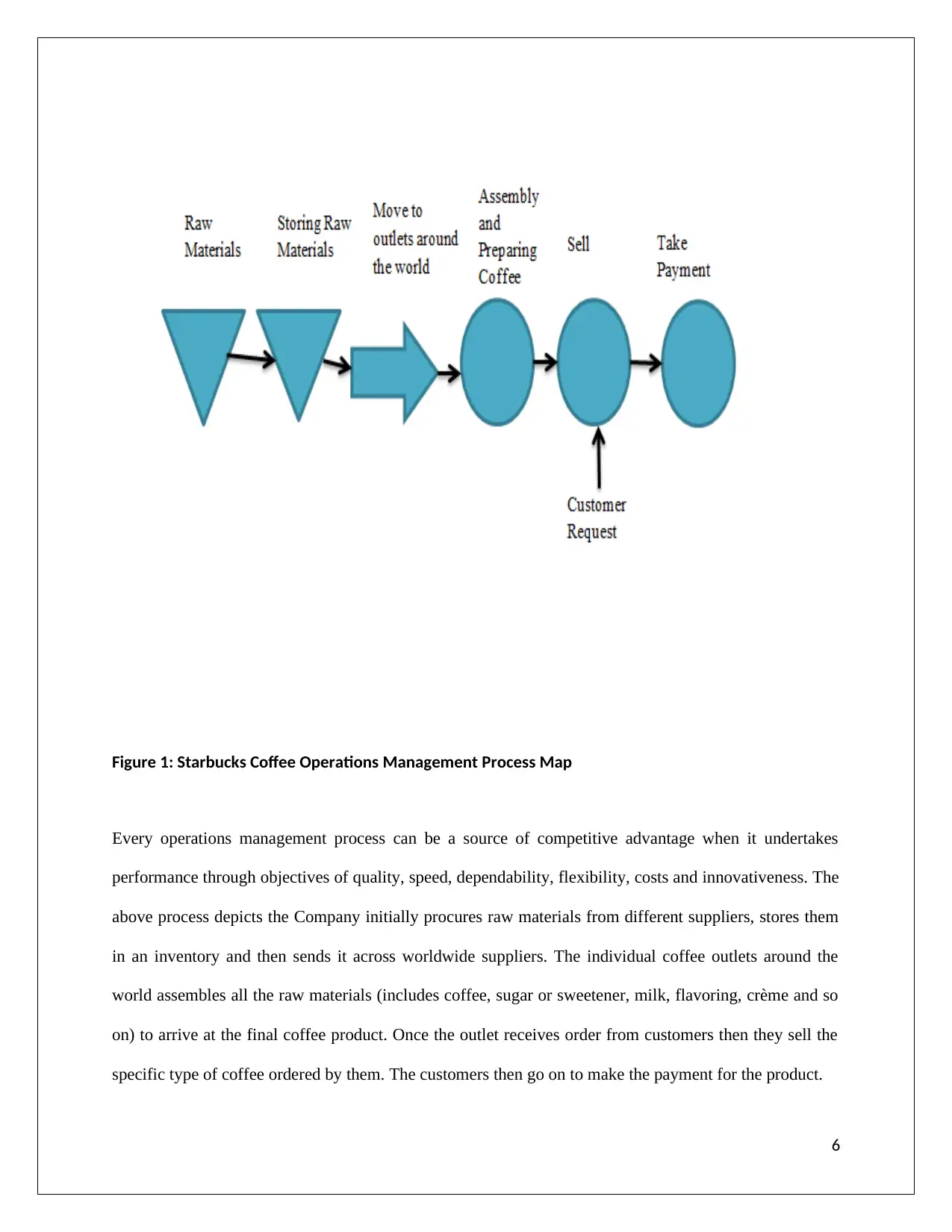
Figure 1: Starbucks Coffee Operations Management Process Map
Every operations management process can be a source of competitive advantage when it undertakes
performance through objectives of quality, speed, dependability, flexibility, costs and innovativeness. The
above process depicts the Company initially procures raw materials from different suppliers, stores them
in an inventory and then sends it across worldwide suppliers. The individual coffee outlets around the
world assembles all the raw materials (includes coffee, sugar or sweetener, milk, flavoring, crème and so
on) to arrive at the final coffee product. Once the outlet receives order from customers then they sell the
specific type of coffee ordered by them. The customers then go on to make the payment for the product.
6
Every operations management process can be a source of competitive advantage when it undertakes
performance through objectives of quality, speed, dependability, flexibility, costs and innovativeness. The
above process depicts the Company initially procures raw materials from different suppliers, stores them
in an inventory and then sends it across worldwide suppliers. The individual coffee outlets around the
world assembles all the raw materials (includes coffee, sugar or sweetener, milk, flavoring, crème and so
on) to arrive at the final coffee product. Once the outlet receives order from customers then they sell the
specific type of coffee ordered by them. The customers then go on to make the payment for the product.
6
⊘ This is a preview!⊘
Do you want full access?
Subscribe today to unlock all pages.
Trusted by 1+ million students worldwide
Starbucks Coffee business operations earlier had manual operations for its coffee manufacturing process,
which has been transformed into automated manufacturing process. The OM of the Company is focused
on 10 key decision areas which encompasses, including a rank of problems in order of importance, as
given below;
1. Designing Goods and Services: The Company designs various types of coffee with different
flavoring. It aims at providing its customers premium coffee quality which can be differentiated
from rest of the products found in the market. The Company undertakes broad differentiation
generic strategy and premium pricing strategy for its products (Sousa & Voss, 2008). It
manufactures various kinds of mugs for serving its coffee, which is designed at the Company. At
all stages of product preparation the Company ensures that the high brand image of the Company
is reflected to its end customers. The major operational problem that the company faces in
designing of its goods and services is matching it to specific target customers groups . As
customer group in Asian countries might like smaller cups and stronger tea flavors, whereas
customers in America might prefer long slender mugs and different flavor of coffee.
7
which has been transformed into automated manufacturing process. The OM of the Company is focused
on 10 key decision areas which encompasses, including a rank of problems in order of importance, as
given below;
1. Designing Goods and Services: The Company designs various types of coffee with different
flavoring. It aims at providing its customers premium coffee quality which can be differentiated
from rest of the products found in the market. The Company undertakes broad differentiation
generic strategy and premium pricing strategy for its products (Sousa & Voss, 2008). It
manufactures various kinds of mugs for serving its coffee, which is designed at the Company. At
all stages of product preparation the Company ensures that the high brand image of the Company
is reflected to its end customers. The major operational problem that the company faces in
designing of its goods and services is matching it to specific target customers groups . As
customer group in Asian countries might like smaller cups and stronger tea flavors, whereas
customers in America might prefer long slender mugs and different flavor of coffee.
7
Paraphrase This Document
Need a fresh take? Get an instant paraphrase of this document with our AI Paraphraser
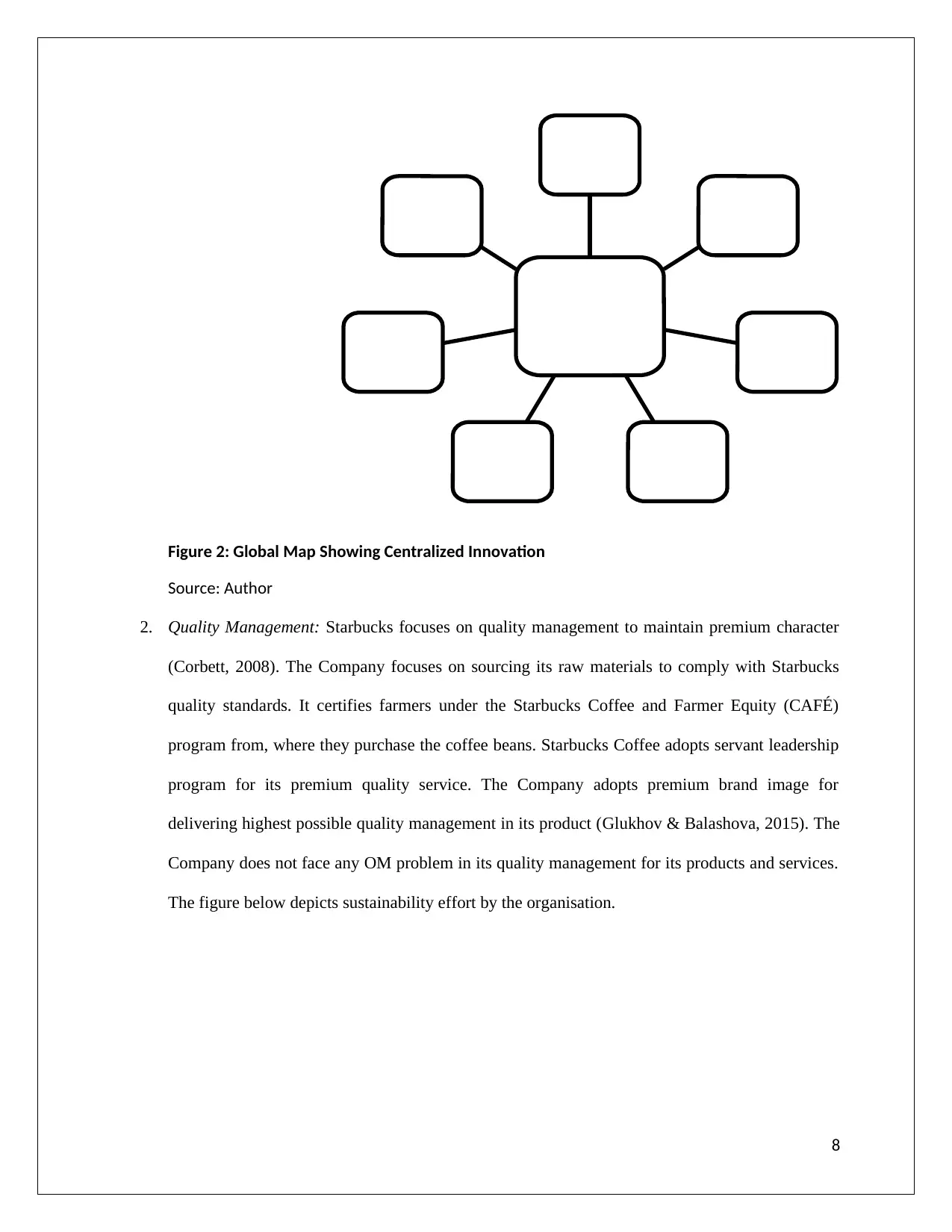
Figure 2: Global Map Showing Centralized Innovation
Source: Author
2. Quality Management: Starbucks focuses on quality management to maintain premium character
(Corbett, 2008). The Company focuses on sourcing its raw materials to comply with Starbucks
quality standards. It certifies farmers under the Starbucks Coffee and Farmer Equity (CAFÉ)
program from, where they purchase the coffee beans. Starbucks Coffee adopts servant leadership
program for its premium quality service. The Company adopts premium brand image for
delivering highest possible quality management in its product (Glukhov & Balashova, 2015). The
Company does not face any OM problem in its quality management for its products and services.
The figure below depicts sustainability effort by the organisation.
8
Centralised
Innovation
(USA)
Asia
Canada
Europe
ChinaRussia
Mexico
Taiwa
n
Source: Author
2. Quality Management: Starbucks focuses on quality management to maintain premium character
(Corbett, 2008). The Company focuses on sourcing its raw materials to comply with Starbucks
quality standards. It certifies farmers under the Starbucks Coffee and Farmer Equity (CAFÉ)
program from, where they purchase the coffee beans. Starbucks Coffee adopts servant leadership
program for its premium quality service. The Company adopts premium brand image for
delivering highest possible quality management in its product (Glukhov & Balashova, 2015). The
Company does not face any OM problem in its quality management for its products and services.
The figure below depicts sustainability effort by the organisation.
8
Centralised
Innovation
(USA)
Asia
Canada
Europe
ChinaRussia
Mexico
Taiwa
n
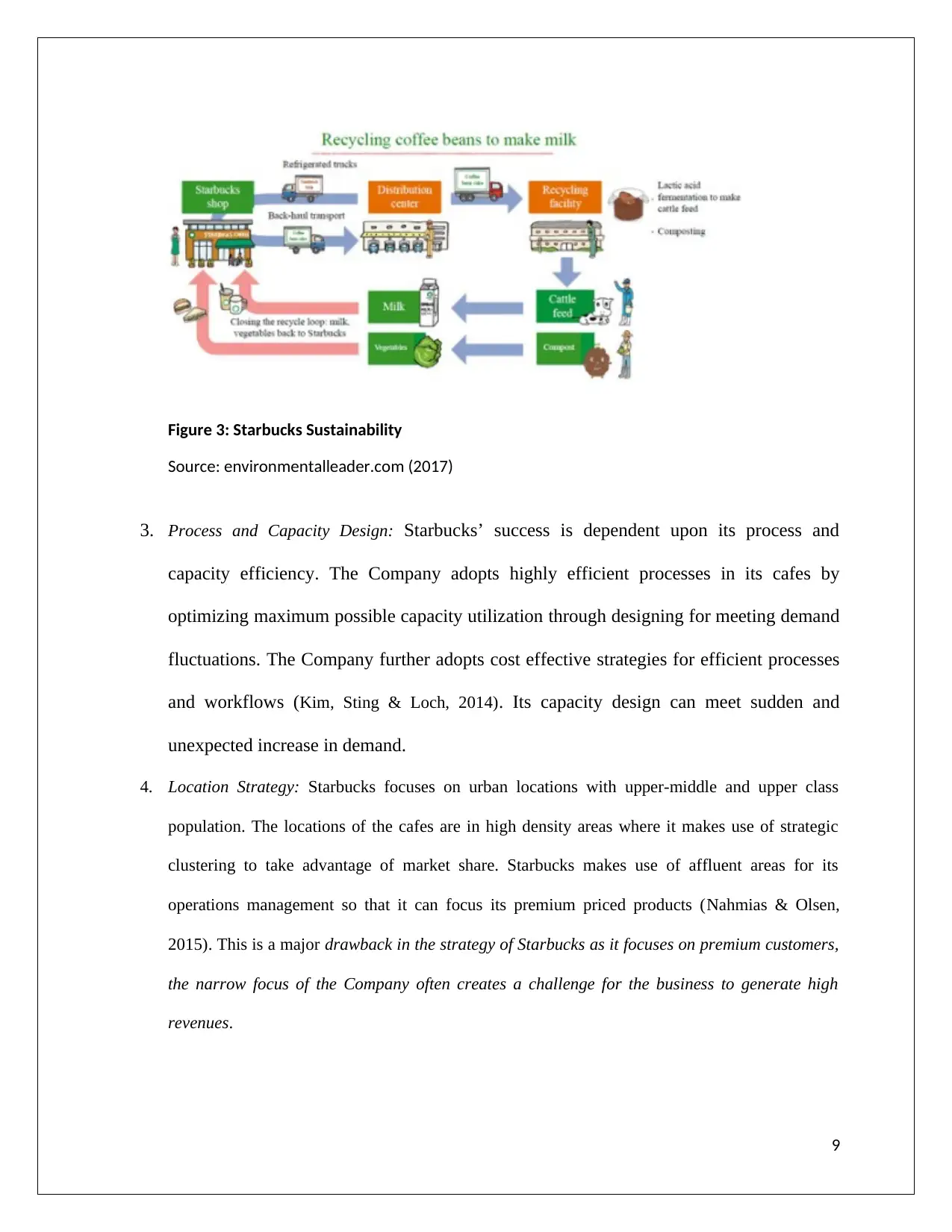
Figure 3: Starbucks Sustainability
Source: environmentalleader.com (2017)
3. Process and Capacity Design: Starbucks’ success is dependent upon its process and
capacity efficiency. The Company adopts highly efficient processes in its cafes by
optimizing maximum possible capacity utilization through designing for meeting demand
fluctuations. The Company further adopts cost effective strategies for efficient processes
and workflows (Kim, Sting & Loch, 2014). Its capacity design can meet sudden and
unexpected increase in demand.
4. Location Strategy: Starbucks focuses on urban locations with upper-middle and upper class
population. The locations of the cafes are in high density areas where it makes use of strategic
clustering to take advantage of market share. Starbucks makes use of affluent areas for its
operations management so that it can focus its premium priced products (Nahmias & Olsen,
2015). This is a major drawback in the strategy of Starbucks as it focuses on premium customers,
the narrow focus of the Company often creates a challenge for the business to generate high
revenues.
9
Source: environmentalleader.com (2017)
3. Process and Capacity Design: Starbucks’ success is dependent upon its process and
capacity efficiency. The Company adopts highly efficient processes in its cafes by
optimizing maximum possible capacity utilization through designing for meeting demand
fluctuations. The Company further adopts cost effective strategies for efficient processes
and workflows (Kim, Sting & Loch, 2014). Its capacity design can meet sudden and
unexpected increase in demand.
4. Location Strategy: Starbucks focuses on urban locations with upper-middle and upper class
population. The locations of the cafes are in high density areas where it makes use of strategic
clustering to take advantage of market share. Starbucks makes use of affluent areas for its
operations management so that it can focus its premium priced products (Nahmias & Olsen,
2015). This is a major drawback in the strategy of Starbucks as it focuses on premium customers,
the narrow focus of the Company often creates a challenge for the business to generate high
revenues.
9
⊘ This is a preview!⊘
Do you want full access?
Subscribe today to unlock all pages.
Trusted by 1+ million students worldwide
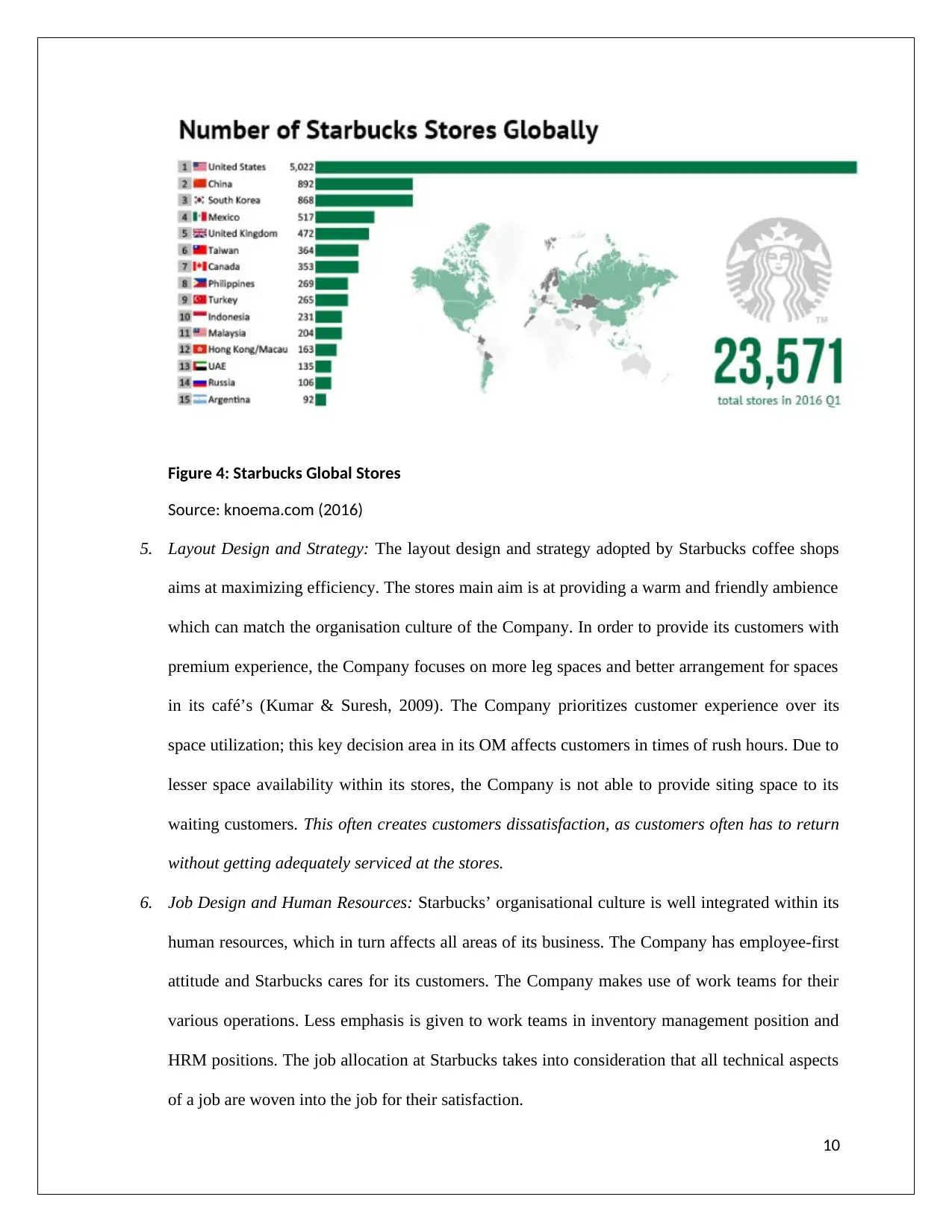
Figure 4: Starbucks Global Stores
Source: knoema.com (2016)
5. Layout Design and Strategy: The layout design and strategy adopted by Starbucks coffee shops
aims at maximizing efficiency. The stores main aim is at providing a warm and friendly ambience
which can match the organisation culture of the Company. In order to provide its customers with
premium experience, the Company focuses on more leg spaces and better arrangement for spaces
in its café’s (Kumar & Suresh, 2009). The Company prioritizes customer experience over its
space utilization; this key decision area in its OM affects customers in times of rush hours. Due to
lesser space availability within its stores, the Company is not able to provide siting space to its
waiting customers. This often creates customers dissatisfaction, as customers often has to return
without getting adequately serviced at the stores.
6. Job Design and Human Resources: Starbucks’ organisational culture is well integrated within its
human resources, which in turn affects all areas of its business. The Company has employee-first
attitude and Starbucks cares for its customers. The Company makes use of work teams for their
various operations. Less emphasis is given to work teams in inventory management position and
HRM positions. The job allocation at Starbucks takes into consideration that all technical aspects
of a job are woven into the job for their satisfaction.
10
Source: knoema.com (2016)
5. Layout Design and Strategy: The layout design and strategy adopted by Starbucks coffee shops
aims at maximizing efficiency. The stores main aim is at providing a warm and friendly ambience
which can match the organisation culture of the Company. In order to provide its customers with
premium experience, the Company focuses on more leg spaces and better arrangement for spaces
in its café’s (Kumar & Suresh, 2009). The Company prioritizes customer experience over its
space utilization; this key decision area in its OM affects customers in times of rush hours. Due to
lesser space availability within its stores, the Company is not able to provide siting space to its
waiting customers. This often creates customers dissatisfaction, as customers often has to return
without getting adequately serviced at the stores.
6. Job Design and Human Resources: Starbucks’ organisational culture is well integrated within its
human resources, which in turn affects all areas of its business. The Company has employee-first
attitude and Starbucks cares for its customers. The Company makes use of work teams for their
various operations. Less emphasis is given to work teams in inventory management position and
HRM positions. The job allocation at Starbucks takes into consideration that all technical aspects
of a job are woven into the job for their satisfaction.
10
Paraphrase This Document
Need a fresh take? Get an instant paraphrase of this document with our AI Paraphraser
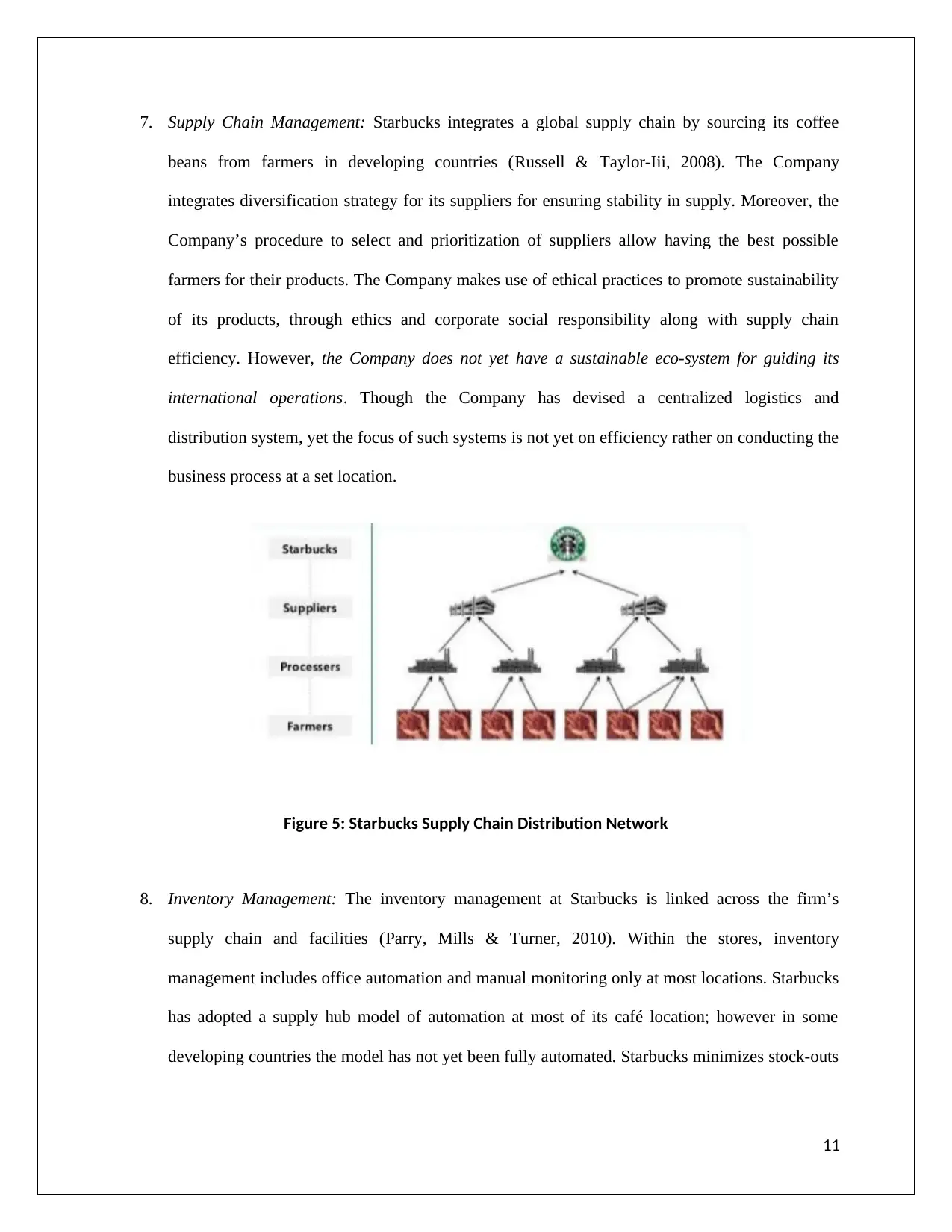
7. Supply Chain Management: Starbucks integrates a global supply chain by sourcing its coffee
beans from farmers in developing countries (Russell & Taylor-Iii, 2008). The Company
integrates diversification strategy for its suppliers for ensuring stability in supply. Moreover, the
Company’s procedure to select and prioritization of suppliers allow having the best possible
farmers for their products. The Company makes use of ethical practices to promote sustainability
of its products, through ethics and corporate social responsibility along with supply chain
efficiency. However, the Company does not yet have a sustainable eco-system for guiding its
international operations. Though the Company has devised a centralized logistics and
distribution system, yet the focus of such systems is not yet on efficiency rather on conducting the
business process at a set location.
Figure 5: Starbucks Supply Chain Distribution Network
8. Inventory Management: The inventory management at Starbucks is linked across the firm’s
supply chain and facilities (Parry, Mills & Turner, 2010). Within the stores, inventory
management includes office automation and manual monitoring only at most locations. Starbucks
has adopted a supply hub model of automation at most of its café location; however in some
developing countries the model has not yet been fully automated. Starbucks minimizes stock-outs
11
beans from farmers in developing countries (Russell & Taylor-Iii, 2008). The Company
integrates diversification strategy for its suppliers for ensuring stability in supply. Moreover, the
Company’s procedure to select and prioritization of suppliers allow having the best possible
farmers for their products. The Company makes use of ethical practices to promote sustainability
of its products, through ethics and corporate social responsibility along with supply chain
efficiency. However, the Company does not yet have a sustainable eco-system for guiding its
international operations. Though the Company has devised a centralized logistics and
distribution system, yet the focus of such systems is not yet on efficiency rather on conducting the
business process at a set location.
Figure 5: Starbucks Supply Chain Distribution Network
8. Inventory Management: The inventory management at Starbucks is linked across the firm’s
supply chain and facilities (Parry, Mills & Turner, 2010). Within the stores, inventory
management includes office automation and manual monitoring only at most locations. Starbucks
has adopted a supply hub model of automation at most of its café location; however in some
developing countries the model has not yet been fully automated. Starbucks minimizes stock-outs
11
by ensuring continuous supply of coffee beans to all its cafes, which often leads to wastages at its
various locations.
9. Scheduling: Starbucks makes use of manual as well as automated scheduling approaches for its
business activities. The Company integrates flexible schedules for the purpose of managing its
personnel. It aims at streamlining its supply chain processes with application of some degree of
flexibility in various management positions. Often automated scheduling hampers capability of
the organisation in terms of scheduling its raw materials or staff personnel which leads to
challenge in managing of operations.
10. Maintenance: Starbucks aims at maintaining their physical asset by trained and dedicated
employees for maintaining of facilities and equipment (Walker, Seuring, Sarkis & Klassen,
2014). Often the Company employee’s third party for its maintenance services, these third parties
include local businesses, which provide equipment tune-ups for its cafés’. All these personnel
ensure appropriate maintenance of the facilities at Starbucks.
3.0 Recommendations for Improvement
Starbucks in order to increase efficiency in its operations need to accommodate aspects of
Operational techniques. There has been identified a number of operational areas, where Starbucks
lacks in its operational efficiency, hence the recommendations for improving those aspects are
included as below;
Designing Goods & Services: Starbucks need to integrate innovativeness in its operational
processes. The innovativeness in its operational processes needs to be widespread all over
the globe such that innovativeness is accommodated in a local manner. Accommodating
local innovativeness will imply that its operational processes are coordinated in a cost
effective manner. Resources will need to be sourced and sent across to majority localities
such that they can integrate innovation. Local based innovation will provide the
12
various locations.
9. Scheduling: Starbucks makes use of manual as well as automated scheduling approaches for its
business activities. The Company integrates flexible schedules for the purpose of managing its
personnel. It aims at streamlining its supply chain processes with application of some degree of
flexibility in various management positions. Often automated scheduling hampers capability of
the organisation in terms of scheduling its raw materials or staff personnel which leads to
challenge in managing of operations.
10. Maintenance: Starbucks aims at maintaining their physical asset by trained and dedicated
employees for maintaining of facilities and equipment (Walker, Seuring, Sarkis & Klassen,
2014). Often the Company employee’s third party for its maintenance services, these third parties
include local businesses, which provide equipment tune-ups for its cafés’. All these personnel
ensure appropriate maintenance of the facilities at Starbucks.
3.0 Recommendations for Improvement
Starbucks in order to increase efficiency in its operations need to accommodate aspects of
Operational techniques. There has been identified a number of operational areas, where Starbucks
lacks in its operational efficiency, hence the recommendations for improving those aspects are
included as below;
Designing Goods & Services: Starbucks need to integrate innovativeness in its operational
processes. The innovativeness in its operational processes needs to be widespread all over
the globe such that innovativeness is accommodated in a local manner. Accommodating
local innovativeness will imply that its operational processes are coordinated in a cost
effective manner. Resources will need to be sourced and sent across to majority localities
such that they can integrate innovation. Local based innovation will provide the
12
⊘ This is a preview!⊘
Do you want full access?
Subscribe today to unlock all pages.
Trusted by 1+ million students worldwide

1 out of 18


Related Documents


Your All-in-One AI-Powered Toolkit for Academic Success.
+13062052269
info@desklib.com
Available 24*7 on WhatsApp / Email
![[object Object]](/_next/static/media/star-bottom.7253800d.svg)
Unlock your academic potential
Copyright © 2020–2026 A2Z Services. All Rights Reserved. Developed and managed by ZUCOL.