A Detailed Analysis of Starbucks' Service Marketing and Systems

Verified

Added on  2020/03/07

|8
|1630
|99
Report
AI Summary
This report provides an in-depth analysis of Starbucks' service marketing and relationship marketing strategies, focusing on the front and back stage service processes. It examines the significance of the front stage, where customer interactions and experiences are paramount, highlighting the role of employees in delivering a satisfying barista experience and building customer relationships. The report details the front stage service encounter, including order taking, payment, and product delivery. It also explores the back stage service processes, emphasizing the importance of efficient operations, resource management, and service design in supporting the front stage experience. The analysis considers the integration of technology and employee interaction, the competitive landscape of the barista coffee industry, and the importance of maintaining a positive customer relationship through quality service and product offerings. The report also includes a bibliography of supporting sources.
Document Page
Running Head: SERVICE AND RELATIONSHIP MARKETING 1
SERVICE MARKETING AND RELATIONSHIP MARKETING
Name
University
Course
Tutor
Date
tabler-icon-diamond-filled.svg

Paraphrase This Document

Need a fresh take? Get an instant paraphrase of this document with our AI Paraphraser
Document Page
SERVICE MARKETING AND RELATIONSHIP MARKETING 2
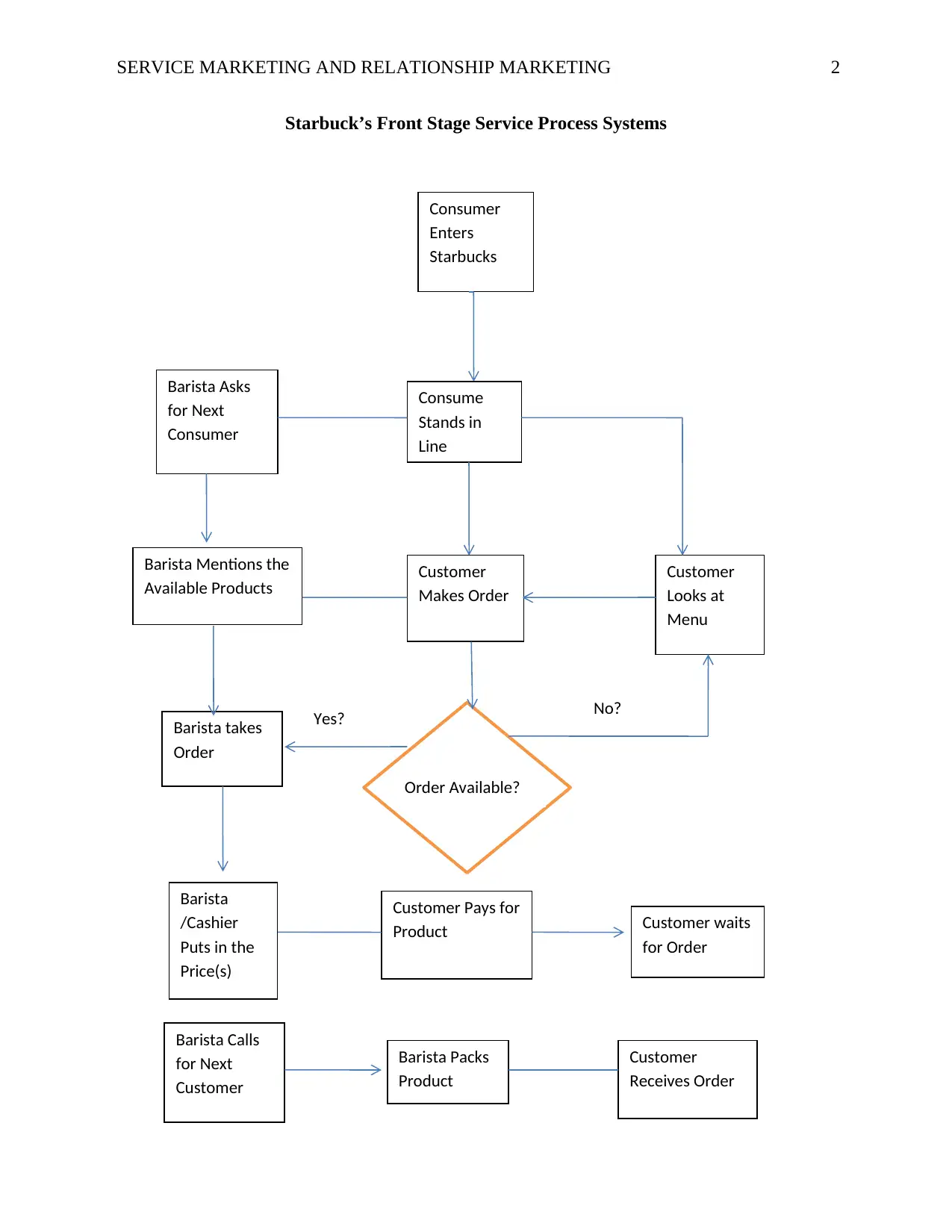
Starbuck’s Front Stage Service Process Systems
Consumer
Enters
Starbucks
Consume
Stands in
Line
Customer
Looks at
Menu
Barista Asks
for Next
Consumer
Customer
Makes Order
Barista Mentions the
Available Products
Order Available?
No?
Yes?
Barista takes
Order
Barista
/Cashier
Puts in the
Price(s)
Customer Pays for
Product Customer waits
for Order
Barista Calls
for Next
Customer
Barista Packs
Product
Customer
Receives Order
Document Page
SERVICE MARKETING AND RELATIONSHIP MARKETING 3
Significance of the Front Stage Service Encounter
The primary role of the front stage service encounter is to be able to provide the consumer with a
satisfying experience when they approach the company. Most organizations will opt for using
front-stage employees who are stationed on site to deal with the consumer needs or sometimes,
the organization may rely solely on technological appliances to serve the consumer (Teboul,
2006). As portrayed, Starbucks depends on both technology and employees at the front stage to
be able to serve the consumer. In fact, most of the activity is done by the front stage employees
who form most of the consumer relations at the front stage level. Accordingly, Starbucks outlets
usually have employees who wear uniforms that represent the company and are responsible for
setting up the premises in a manner that confirms to the consumer that they are receiving services
from Starbucks Company (Carrie, 2012). The main significance of the front stage employees is
that they are primarily responsible for the consumer experience of the service and have a role in
determining the reputation of the company outlets. For Starbucks, the outlets are meant to serve
coffee products giving the consumer the full barista experience. Therefore, the main idea behind
Starbucks’ front stage service is to ensure that the employees are able to relive the vision of their
directors in providing the barista service while also ensuring that they work according to the
consumer preferences. The implications are not as complex but the front stage employees also
have to work with the demands of the consumer to ensure that they maintain a positive consumer
relationship which may not auger with their employer requirements (Glushko R.J., and Tabas L.,
2008).Nevertheless, the front stage processes are rather focused on the consumer experience such
that the director requirements are mostly in line with what the experience the consumer expects
to get.
Document Page
SERVICE MARKETING AND RELATIONSHIP MARKETING 4
As in a normal barista, the Starbucks Front Stage experience is based on the manual services as
opposed to more optimized services supported by technology. The approach is rather traditional
of the barista outlets by other companies. (Zomerdijk, L.G. and Voss, C.A., 2010) explains that
there are benefits to the use of technology in the sense that it results in convenience on both the
consumer and the company. However, consumer still tend to prefer front stage services that rely
more on front stage employees other than technological appliances, probably due to the fear of
technical failures. The idea may form the basis of having a cashier and a barista to serve the
coffee. Furthermore, (Stern, 2017) reports that Starbucks did not have a successful start in
Australia due to the saturated market and the increased preference for barista coffee over instant
coffee. The company therefore opts to provide the Australian consumer with a barista experience
to ensure that they are able to retain their new consumers. The use of front stage employees is
therefore a flexible manner in which the company is able to change its consumer experience to
differentiate itself from other barista outlets. Furthermore, the front stage system process allows
the consumer to make real life connections to the company through a favorite barista or a
friendly and satisfactory service which is more lasting than a simple money-service transaction.
tabler-icon-diamond-filled.svg

Paraphrase This Document

Need a fresh take? Get an instant paraphrase of this document with our AI Paraphraser
Document Page
SERVICE MARKETING AND RELATIONSHIP MARKETING 5
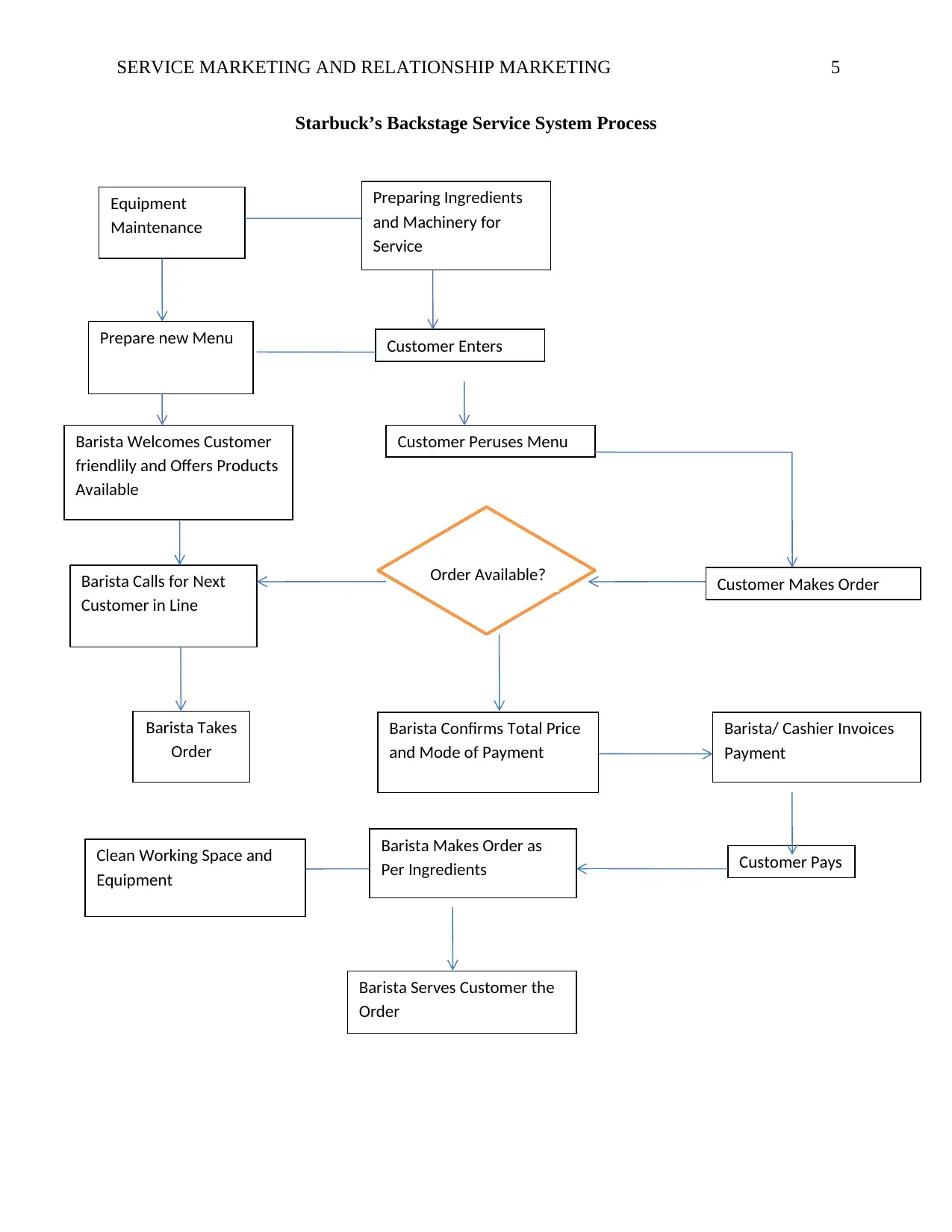
Starbuck’s Backstage Service System Process
Equipment
Maintenance
Preparing Ingredients
and Machinery for
Service
Customer EntersPrepare new Menu
Customer Peruses MenuBarista Welcomes Customer
friendlily and Offers Products
Available
Customer Makes Order
Order Available?Barista Calls for Next
Customer in Line
Barista Takes
Order
Customer Pays
Barista Confirms Total Price
and Mode of Payment
Barista Makes Order as
Per Ingredients
Barista/ Cashier Invoices
Payment
Clean Working Space and
Equipment
Barista Serves Customer the
Order
Document Page
SERVICE MARKETING AND RELATIONSHIP MARKETING 6
Significance of Back Stage Service Process
The back store service processes have to complement the desired front stage service encounter.
Starbucks’ barista coffee is aimed at providing the consumer with the quality product but at
minimal financial loss which makes the back stage process an important aspect of the service
delivery. The main significance of the back stage process is that it is the main driving machine of
the service design. The activities in the back stage are what make possible the service that the
consumer experiences at the front stage. Therefore there is always a need for a level of
coordination and sometimes integration between the back stage and the front stage to deliver the
best service experience to the consumer (Glushko, R.J. and Tabas, L. , 2009). Service design is
important for Starbucks primarily because the barista coffee industry is rather competitive in
Australia and most of the outlets provide their coffees at price ranges that are uniform across the
companies. The service design is also, therefore, dependent largely on the back stage processes
such that it forms part of the tangible and intangible brand experiences that keep the users loyal
to the company. For Starbucks, the backstage processes involve keeping the premises welcoming
for the consumer and ensuring that all the required resources are available to deliver service to
the consumer on request. Some of the back stage processes include equipment maintenance,
arrangement of working spaces, organizing for coordination of the payment and service process
as well as “face” aspect of the outlets involving use of branded uniforms and menus.
The perception of service encounters as information exchange may lead to the assumption that
intense encounters may lead to a better service. However, the back stage process at Starbucks is
focused on efficiency. The consumers are allowed to make their payments first as a means of
alleviating the employee and space costs for waiters. The service is therefore delivered by a
minimum number of employees who receive payments and prepare orders. (Zomerdijk, L.G. and
Document Page
SERVICE MARKETING AND RELATIONSHIP MARKETING 7
Voss, C.A., 2010) suggests that intense interaction with the consumer is not only tedious but
bears the risk of failing to satisfy consumer desires, contrary to expectations of most company
owners. In this back stage process, Starbucks is focused on putting products and ingredients as
well as equipment in place and working towards efficiently getting the consumers services as
quickly as possible. After the consumer has made a decision on their order, the barista (but
mostly, the cashier) quickly invoices their payment and makes receipts which the consumer uses
to receive their orders. (Carrie, 2012) suggests that barista outlet owners should have an idea the
most demanded types of coffee beforehand to be able to deliver quicker service. The back stage
process therefore influences the front stage orderliness and timeliness in provision of services.
As the consumer receives payment and waits to be called for the order the barista works on
making the coffee such that the consumer gets the barista experience in terms of suggesting their
own ingredient and art preferences.
tabler-icon-diamond-filled.svg

Paraphrase This Document

Need a fresh take? Get an instant paraphrase of this document with our AI Paraphraser
Document Page
SERVICE MARKETING AND RELATIONSHIP MARKETING 8
Bibliography
Glushko, R.J. and Tabas, L. . (2009). Information Systems and E-Business Management, 407-427.
Carrie, D. (2012). What a Starbucks Barista Can Teach You About Good Customer Service Skills. Carrie
Dils, n.d.
Glushko R.J., and Tabas L. (2008). Bridging the "front stage" and "back stage" in service system design.
Hawaii International Conference on System Sciences, Proceedings of the 41st Annual, 106.
Glushko, R.J and Tabas, L. . (n.d.). Bridging the "front stage.
Stern, M. (2017). Is Starbucks pasing the buck to barista on consumer service. Retail Wire, n.d.
Teboul, J. (2006). Service is front stage: positioning serices for value advantage. n.d, n.d.
Zomerdijk, L.G. and Voss, C.A. (2010). Service design for experience-centric services. Journal of Service
Research, 67-82.
chevron_up_icon
1 out of 8
circle_padding
hide_on_mobile
zoom_out_icon
[object Object]