Data Analysis Report: Calculating Sleep Hours and Forecasting Trends

Verified

Added on  2023/01/11

|12
|1661
|40
Report
AI Summary
This report presents a comprehensive data analysis of sleep patterns over ten consecutive days. It begins with data arrangement in a table format, followed by the use of line charts and scatter plots to visualize the data. The main body of the report includes detailed calculations of key statistical measures such as mean, mode, median, range, and standard deviation. The report also demonstrates linear forecasting to predict sleep hours for future days. Formulas and step-by-step calculations are provided. The conclusion summarizes the findings and emphasizes the importance of data analysis in informed decision-making. The report references relevant sources and provides a clear and structured approach to the analysis of the sleep data.
Document Page
Numeracy and Data
Analysis
tabler-icon-diamond-filled.svg

Paraphrase This Document

Need a fresh take? Get an instant paraphrase of this document with our AI Paraphraser
Document Page
Document Page
Contents
INTRODUCTION.......................................................................................................................................3
MAIN BODY..............................................................................................................................................3
1. Arrangement of data in table format....................................................................................................3
2. Using two types of charts....................................................................................................................3
3. Steps for the calculation and highlight the values................................................................................5
4. Linear forecasting................................................................................................................................8
CONCLUSION.........................................................................................................................................10
REFERENCES..........................................................................................................................................11
Document Page
INTRODUCTION
In corporate big data is being used to help companies make informed business decisions.
If it's marketing strategy, product testing, marketing, consumer feedback, result will be analyzed,
or some other topic that data was available for, analysis of data can offer information that
companies use to make the right decisions (Cavadel and Frye, 2017). Currently for an enterprise,
data management is critical, since data-driven decisions are the only way to be absolutely
convinced in management decisions. Upon a hunch, some large companies can be made, but
nearly all profitable business decisions are data-based. This report based on the sleep per day of
ten consecutive days as per the choice. In this report consist of two types of charts, calculate
mean, mode, median, range and standard deviation.
MAIN BODY
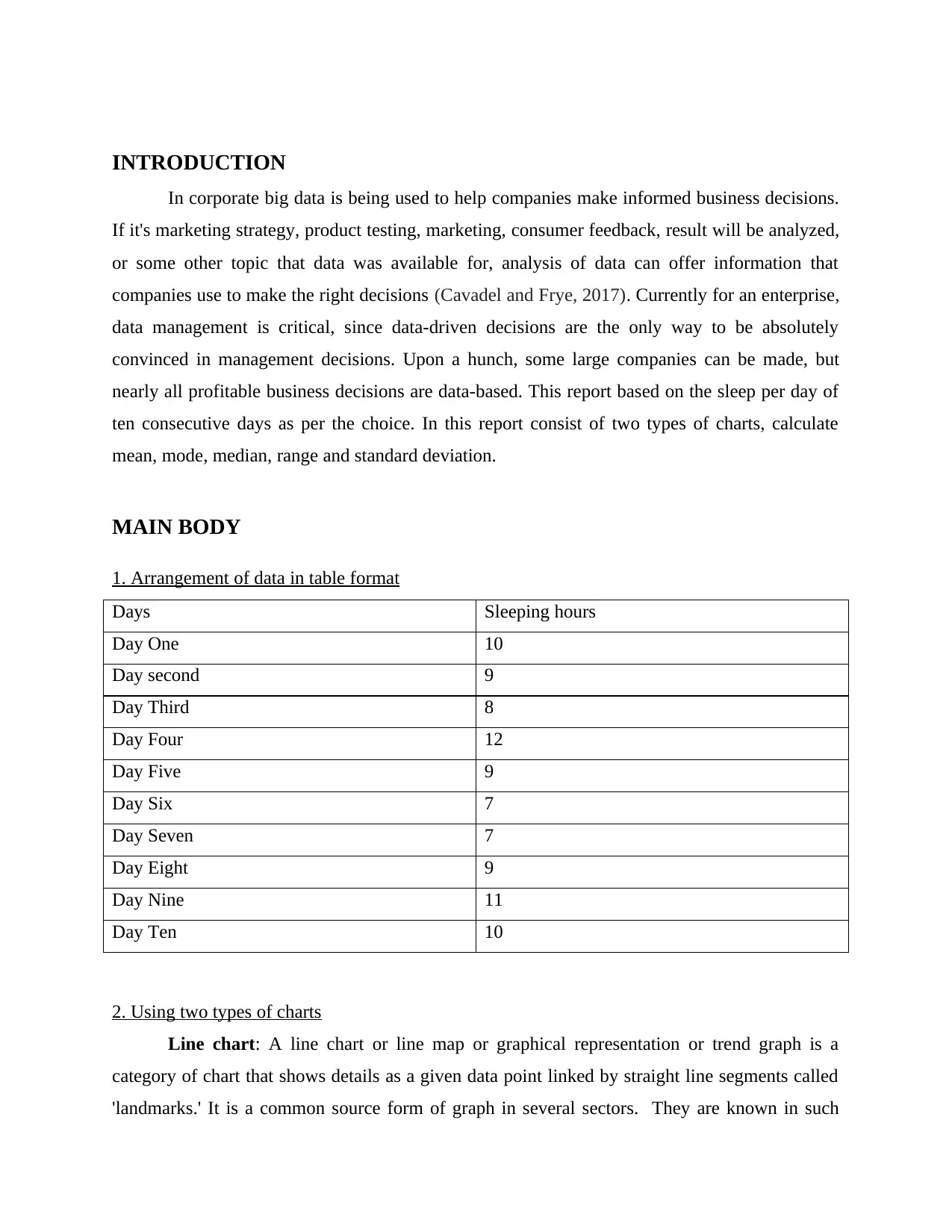
1. Arrangement of data in table format
Days Sleeping hours
Day One 10
Day second 9
Day Third 8
Day Four 12
Day Five 9
Day Six 7
Day Seven 7
Day Eight 9
Day Nine 11
Day Ten 10
2. Using two types of charts
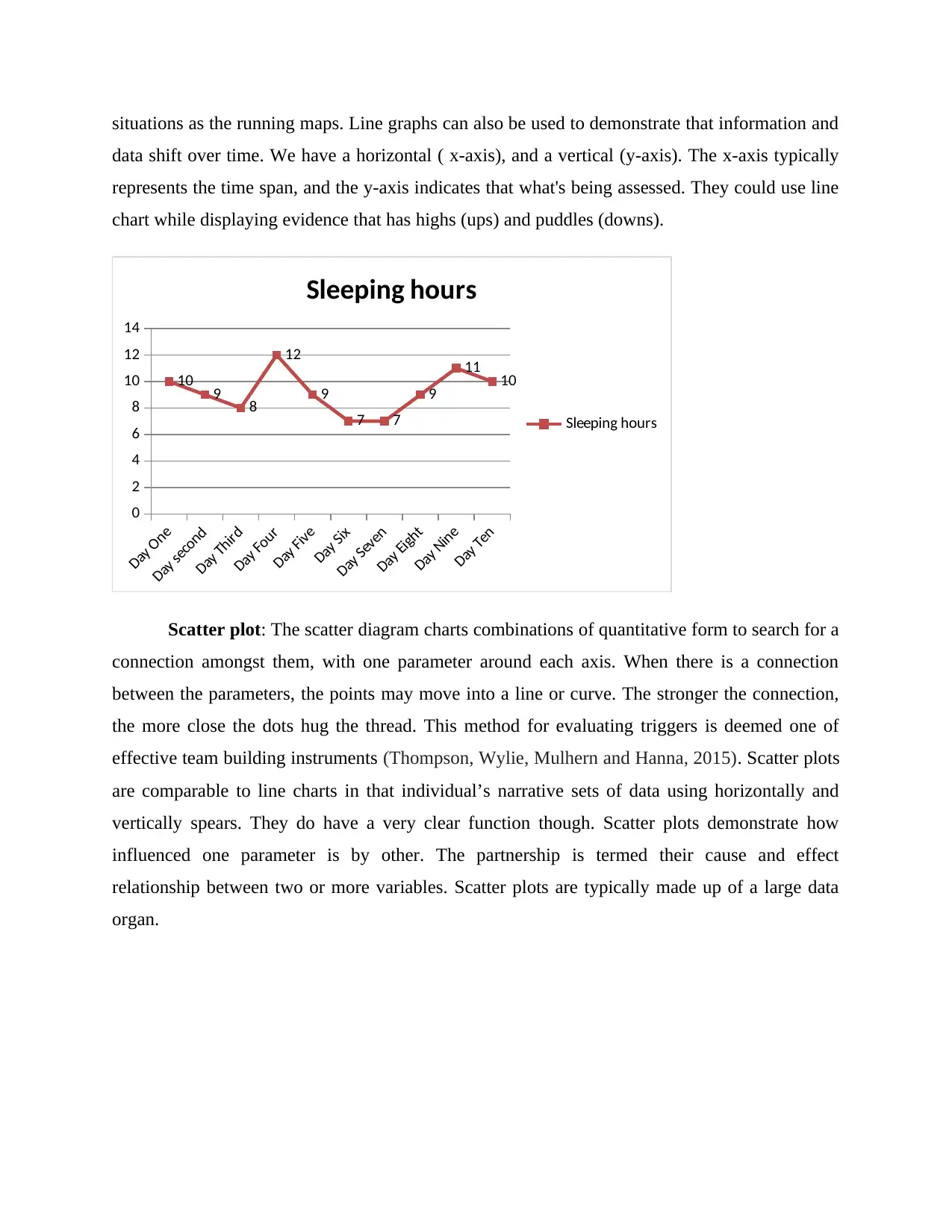
Line chart: A line chart or line map or graphical representation or trend graph is a
category of chart that shows details as a given data point linked by straight line segments called
'landmarks.' It is a common source form of graph in several sectors. They are known in such
tabler-icon-diamond-filled.svg

Paraphrase This Document

Need a fresh take? Get an instant paraphrase of this document with our AI Paraphraser
Document Page
situations as the running maps. Line graphs can also be used to demonstrate that information and
data shift over time. We have a horizontal ( x-axis), and a vertical (y-axis). The x-axis typically
represents the time span, and the y-axis indicates that what's being assessed. They could use line
chart while displaying evidence that has highs (ups) and puddles (downs).
Day One
Day second
Day Third
Day Four
Day Five
Day Six
Day Seven
Day Eight
Day Nine
Day Ten
0
2
4
6
8
10
12
14
10 9 8
12
9
7 7
9
11 10
Sleeping hours
Sleeping hours
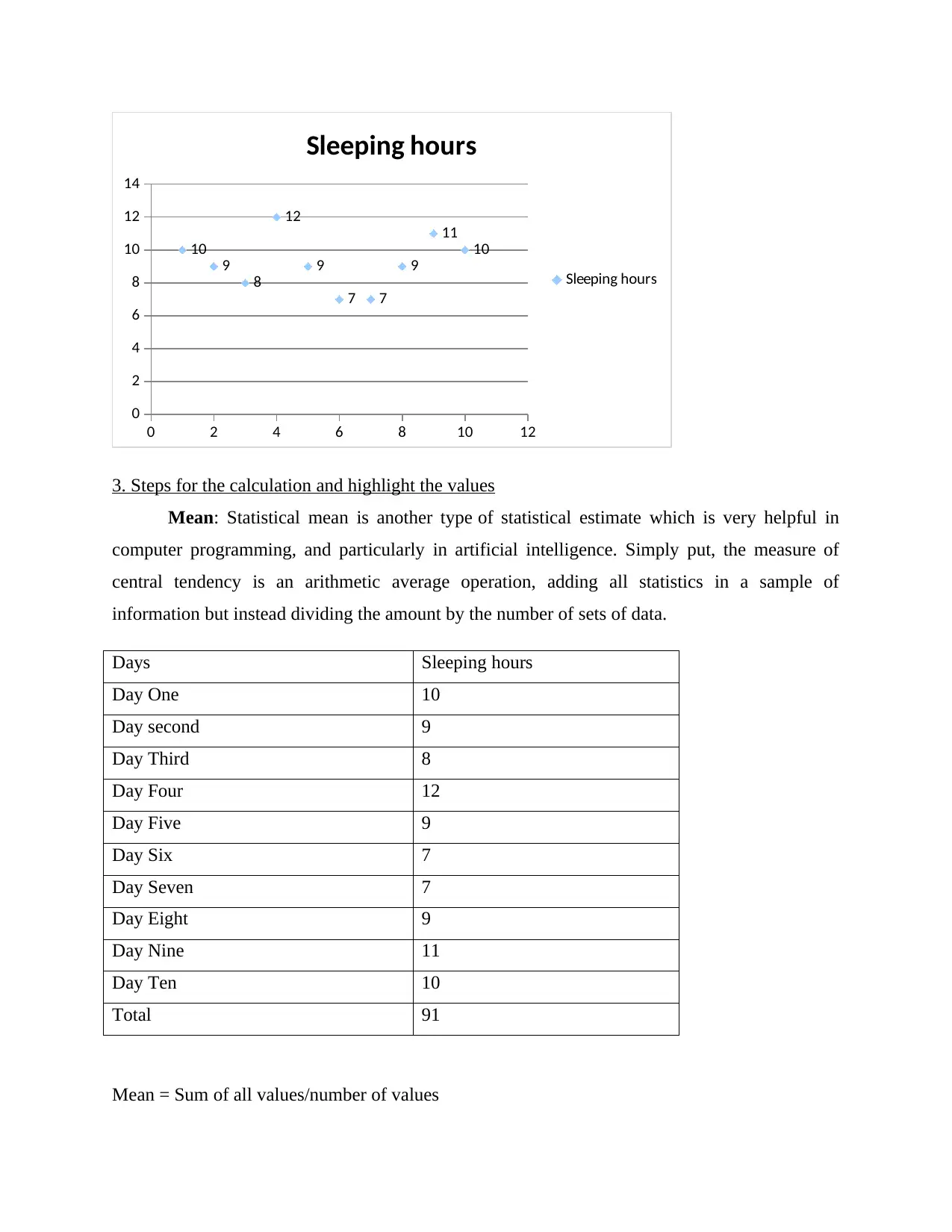
Scatter plot: The scatter diagram charts combinations of quantitative form to search for a
connection amongst them, with one parameter around each axis. When there is a connection
between the parameters, the points may move into a line or curve. The stronger the connection,
the more close the dots hug the thread. This method for evaluating triggers is deemed one of
effective team building instruments (Thompson, Wylie, Mulhern and Hanna, 2015). Scatter plots
are comparable to line charts in that individual’s narrative sets of data using horizontally and
vertically spears. They do have a very clear function though. Scatter plots demonstrate how
influenced one parameter is by other. The partnership is termed their cause and effect
relationship between two or more variables. Scatter plots are typically made up of a large data
organ.
Document Page
0 2 4 6 8 10 12
0
2
4
6
8
10
12
14
10
9
8
12
9
7 7
9
11
10
Sleeping hours
Sleeping hours
3. Steps for the calculation and highlight the values
Mean: Statistical mean is another type of statistical estimate which is very helpful in
computer programming, and particularly in artificial intelligence. Simply put, the measure of
central tendency is an arithmetic average operation, adding all statistics in a sample of
information but instead dividing the amount by the number of sets of data.
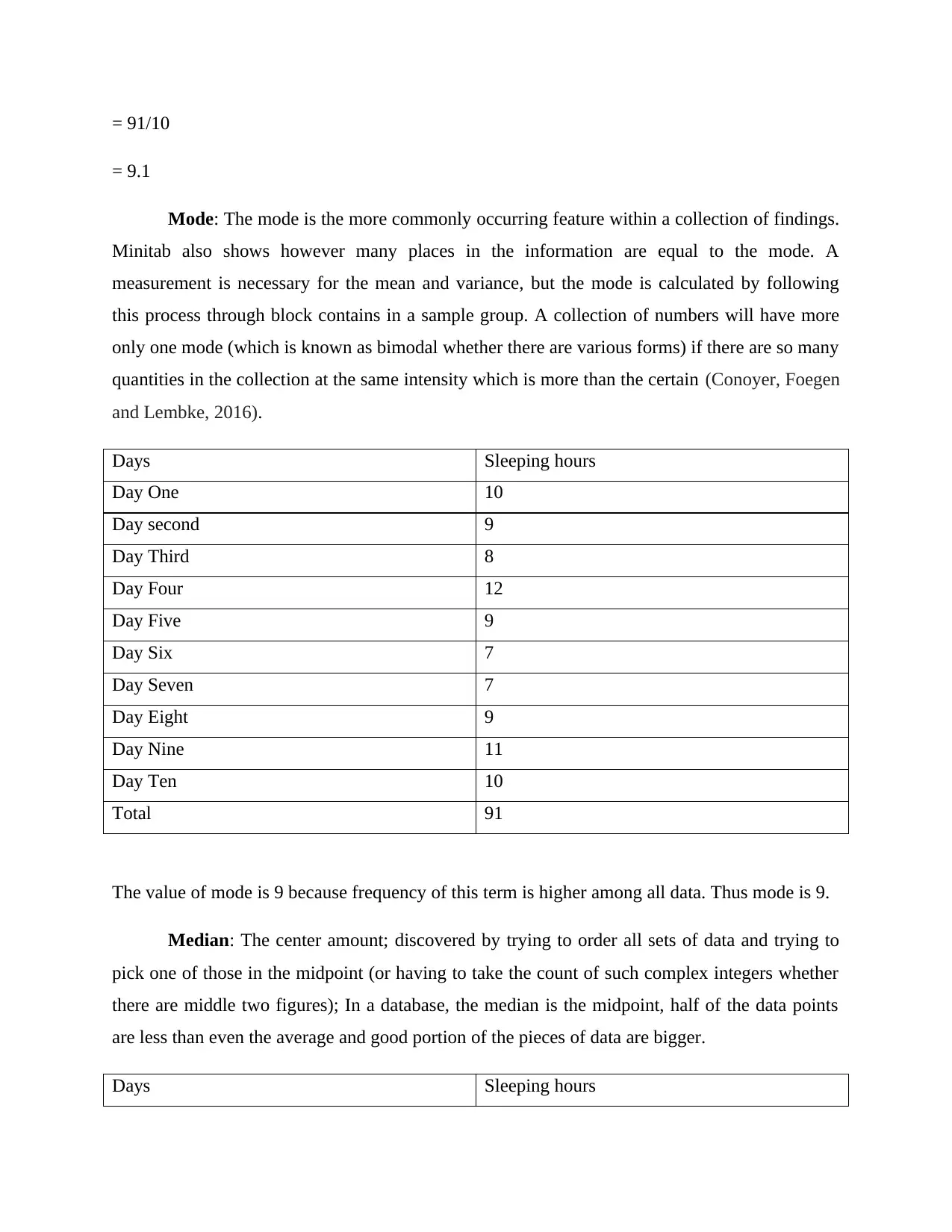
Days Sleeping hours
Day One 10
Day second 9
Day Third 8
Day Four 12
Day Five 9
Day Six 7
Day Seven 7
Day Eight 9
Day Nine 11
Day Ten 10
Total 91
Mean = Sum of all values/number of values
Document Page
= 91/10
= 9.1
Mode: The mode is the more commonly occurring feature within a collection of findings.
Minitab also shows however many places in the information are equal to the mode. A
measurement is necessary for the mean and variance, but the mode is calculated by following
this process through block contains in a sample group. A collection of numbers will have more
only one mode (which is known as bimodal whether there are various forms) if there are so many
quantities in the collection at the same intensity which is more than the certain (Conoyer, Foegen
and Lembke, 2016).
Days Sleeping hours
Day One 10
Day second 9
Day Third 8
Day Four 12
Day Five 9
Day Six 7
Day Seven 7
Day Eight 9
Day Nine 11
Day Ten 10
Total 91
The value of mode is 9 because frequency of this term is higher among all data. Thus mode is 9.
Median: The center amount; discovered by trying to order all sets of data and trying to
pick one of those in the midpoint (or having to take the count of such complex integers whether
there are middle two figures); In a database, the median is the midpoint, half of the data points
are less than even the average and good portion of the pieces of data are bigger.
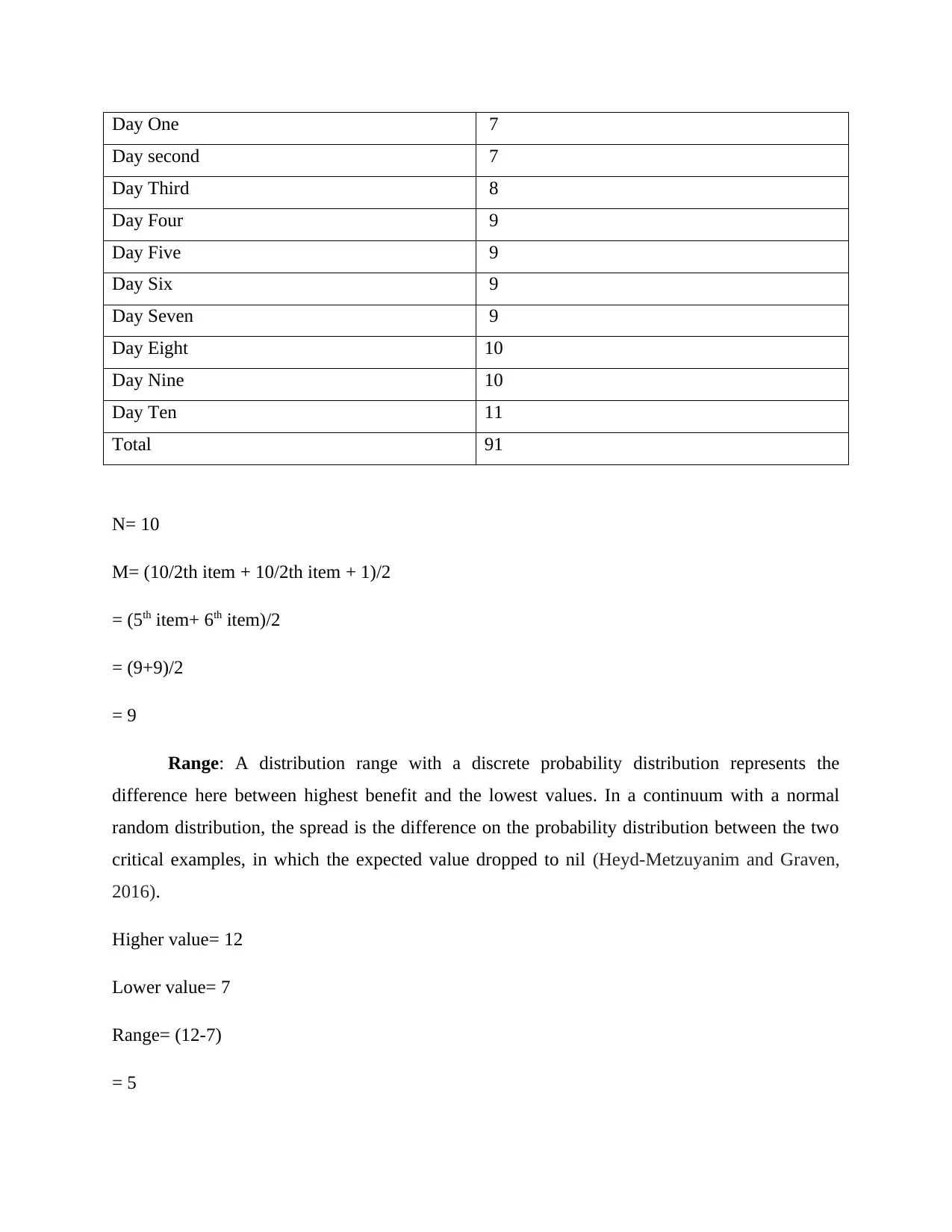
Days Sleeping hours
tabler-icon-diamond-filled.svg

Paraphrase This Document

Need a fresh take? Get an instant paraphrase of this document with our AI Paraphraser
Document Page
Day One 7
Day second 7
Day Third 8
Day Four 9
Day Five 9
Day Six 9
Day Seven 9
Day Eight 10
Day Nine 10
Day Ten 11
Total 91
N= 10
M= (10/2th item + 10/2th item + 1)/2
= (5th item+ 6th item)/2
= (9+9)/2
= 9
Range: A distribution range with a discrete probability distribution represents the
difference here between highest benefit and the lowest values. In a continuum with a normal
random distribution, the spread is the difference on the probability distribution between the two
critical examples, in which the expected value dropped to nil (Heyd-Metzuyanim and Graven,
2016).
Higher value= 12
Lower value= 7
Range= (12-7)
= 5
Document Page
Standard deviation: Standard deviation is a quantity used only to inform why the
ordinary (mean) or calculated return of measurement data for a collective is distributed out. A
small standard deviation the bulk of the figures are below the norm. A value of standard
deviation indicates the percentages are more distributed.
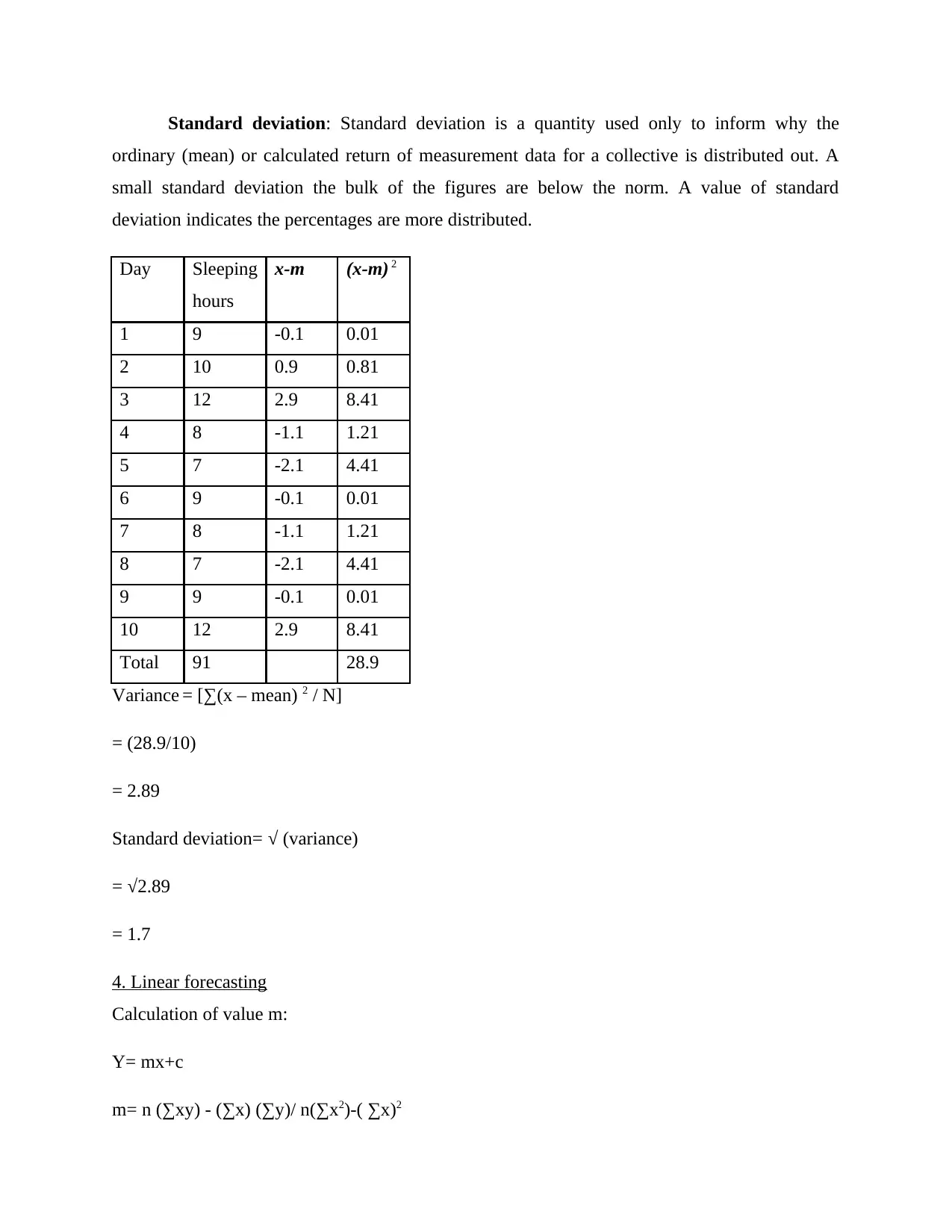
Day Sleeping
hours
x-m (x-m) 2
1 9 -0.1 0.01
2 10 0.9 0.81
3 12 2.9 8.41
4 8 -1.1 1.21
5 7 -2.1 4.41
6 9 -0.1 0.01
7 8 -1.1 1.21
8 7 -2.1 4.41
9 9 -0.1 0.01
10 12 2.9 8.41
Total 91 28.9
Variance = [∑(x – mean) 2 / N]
= (28.9/10)
= 2.89
Standard deviation= (variance)
= √2.89
= 1.7
4. Linear forecasting
Calculation of value m:
Y= mx+c
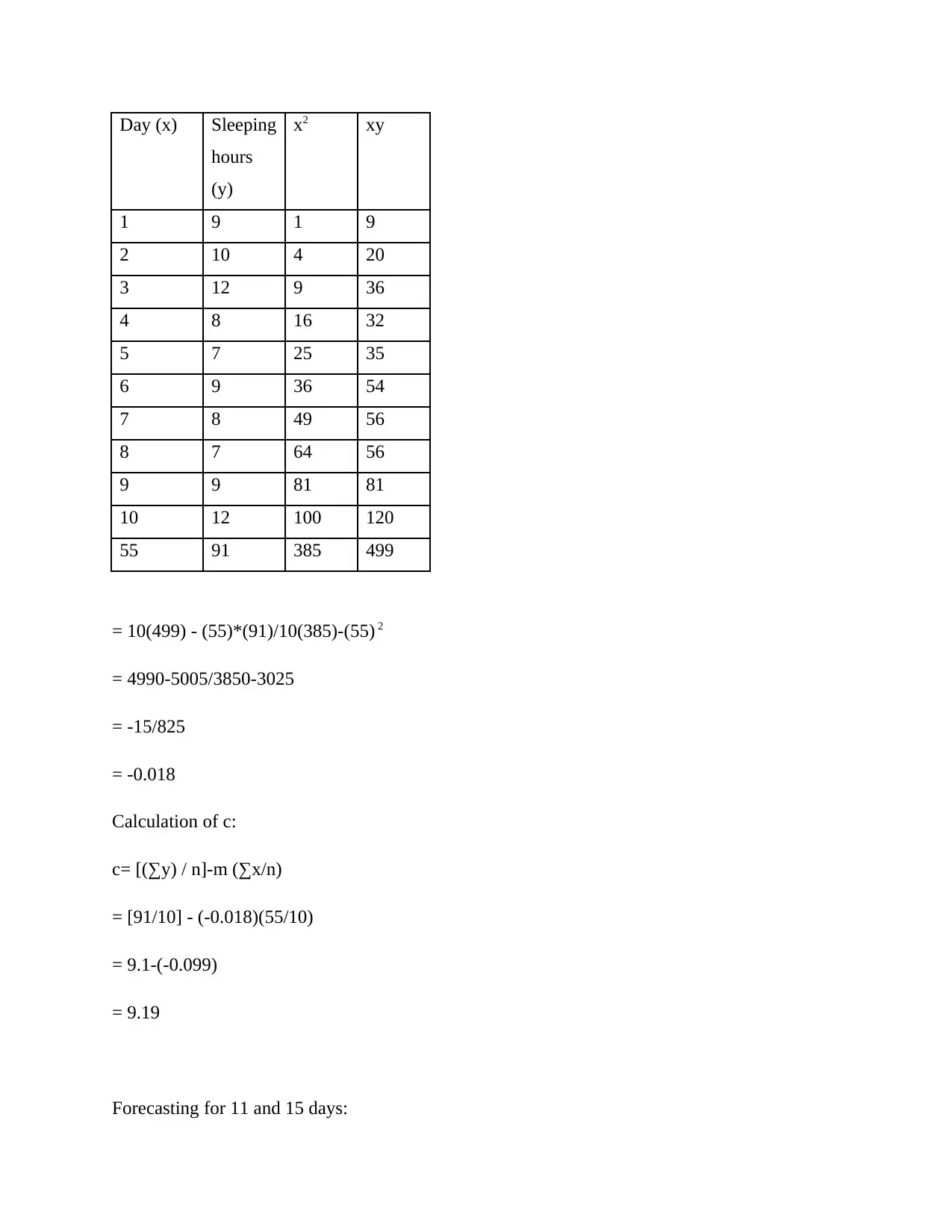
m= n (∑xy) - (∑x) (∑y)/ n(∑x2)-( ∑x)2
Document Page
Day (x) Sleeping
hours
(y)
x2 xy
1 9 1 9
2 10 4 20
3 12 9 36
4 8 16 32
5 7 25 35
6 9 36 54
7 8 49 56
8 7 64 56
9 9 81 81
10 12 100 120
55 91 385 499
= 10(499) - (55)*(91)/10(385)-(55) 2
= 4990-5005/3850-3025
= -15/825
= -0.018
Calculation of c:
c= [(∑y) / n]-m (∑x/n)
= [91/10] - (-0.018)(55/10)
= 9.1-(-0.099)
= 9.19
Forecasting for 11 and 15 days:
tabler-icon-diamond-filled.svg

Paraphrase This Document

Need a fresh take? Get an instant paraphrase of this document with our AI Paraphraser
Document Page
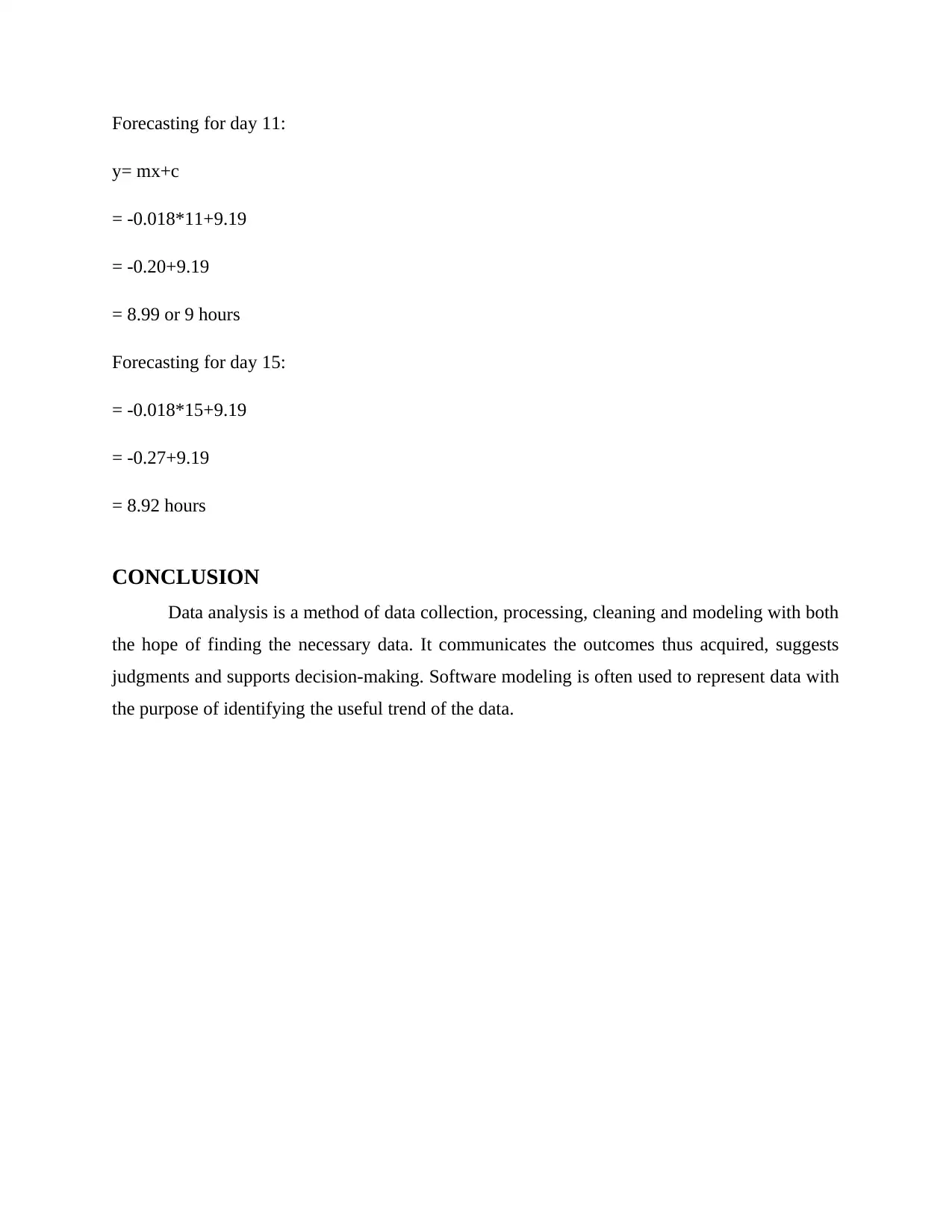
Forecasting for day 11:
y= mx+c
= -0.018*11+9.19
= -0.20+9.19
= 8.99 or 9 hours
Forecasting for day 15:
= -0.018*15+9.19
= -0.27+9.19
= 8.92 hours
CONCLUSION
Data analysis is a method of data collection, processing, cleaning and modeling with both
the hope of finding the necessary data. It communicates the outcomes thus acquired, suggests
judgments and supports decision-making. Software modeling is often used to represent data with
the purpose of identifying the useful trend of the data.
Document Page
REFERENCES
Books and Journal
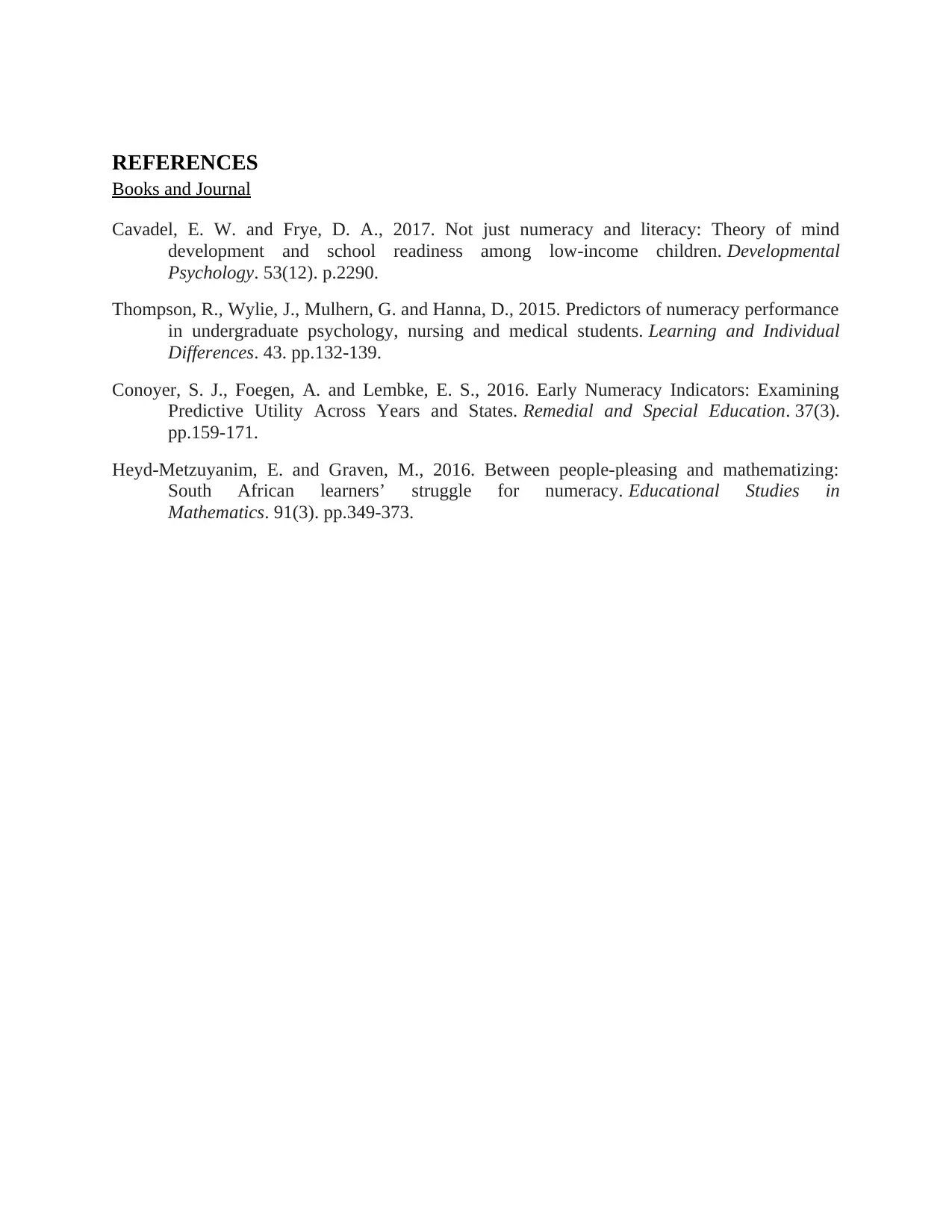
Cavadel, E. W. and Frye, D. A., 2017. Not just numeracy and literacy: Theory of mind
development and school readiness among low-income children. Developmental
Psychology. 53(12). p.2290.
Thompson, R., Wylie, J., Mulhern, G. and Hanna, D., 2015. Predictors of numeracy performance
in undergraduate psychology, nursing and medical students. Learning and Individual
Differences. 43. pp.132-139.
Conoyer, S. J., Foegen, A. and Lembke, E. S., 2016. Early Numeracy Indicators: Examining
Predictive Utility Across Years and States. Remedial and Special Education. 37(3).
pp.159-171.
Heyd-Metzuyanim, E. and Graven, M., 2016. Between people-pleasing and mathematizing:
South African learners’ struggle for numeracy. Educational Studies in
Mathematics. 91(3). pp.349-373.
chevron_up_icon
1 out of 12
circle_padding
hide_on_mobile
zoom_out_icon
[object Object]