Research Report: Statistics Anxiety in Higher Education Students
VerifiedAdded on 2023/01/19
|9
|1827
|27
Report
AI Summary
This research report investigates statistics anxiety among undergraduate and postgraduate students. The study begins with an introduction and literature review, exploring factors like value systems, interest, and cognitive ability that influence statistical anxiety. The methodology includes the use of descriptive statistics and a t-test to analyze the data and compare anxiety scores between the two groups. The results indicate no significant difference in statistics anxiety scores between undergraduate and postgraduate students. The discussion section synthesizes the findings, emphasizing that factors such as goals, interest, value systems, cognitive ability, and the perceived difficulty of the subject contribute to consistent levels of anxiety across both groups. The report concludes by highlighting the need for educators to present statistical concepts in a simplified manner and acknowledges the challenges in changing individual value systems. The report, complete with references, is available on Desklib, a platform providing study tools like past papers and solved assignments to support students' learning.
RESEARCH REPORT
Paraphrase This Document
Need a fresh take? Get an instant paraphrase of this document with our AI Paraphraser

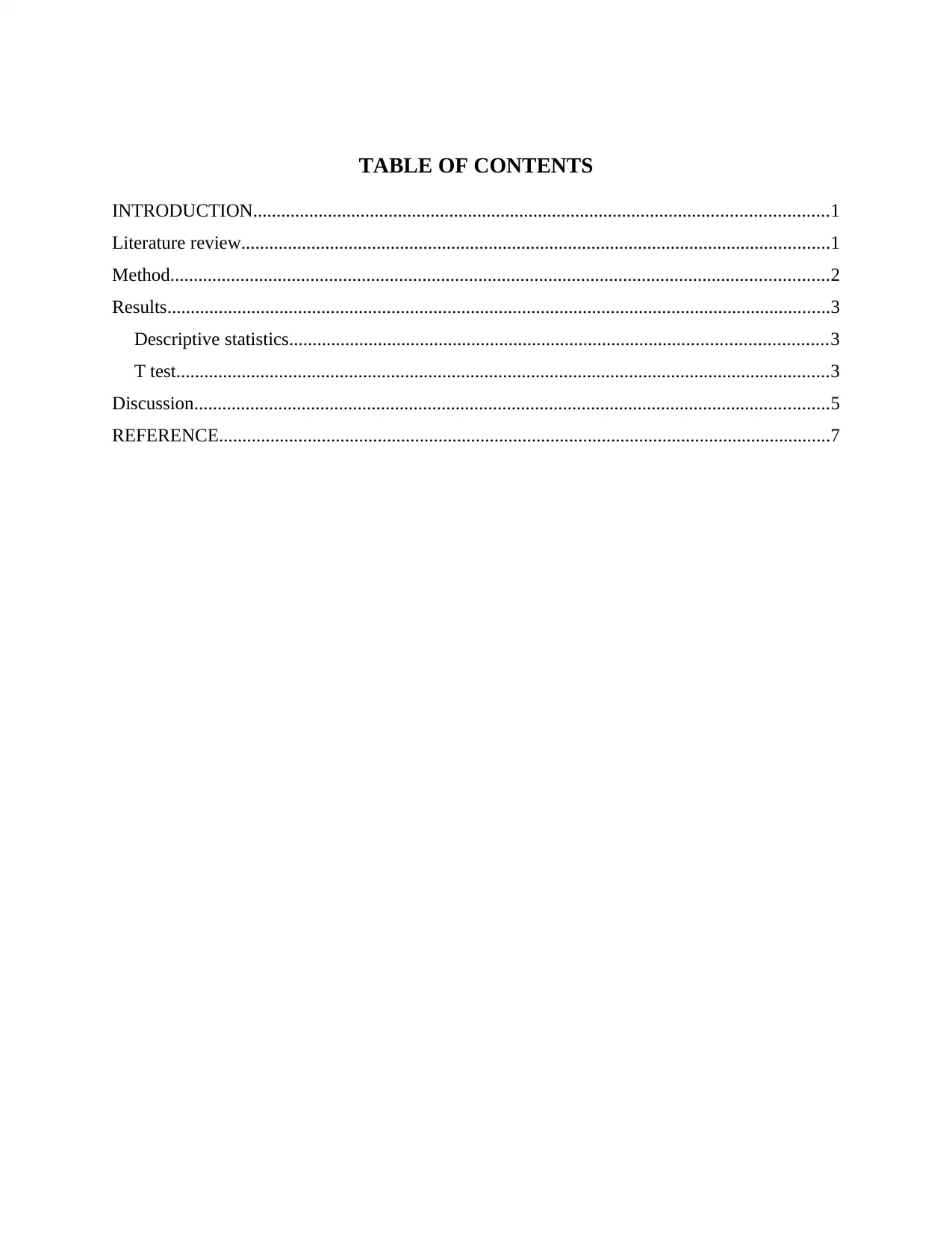
TABLE OF CONTENTS
INTRODUCTION...........................................................................................................................1
Literature review..............................................................................................................................1
Method.............................................................................................................................................2
Results..............................................................................................................................................3
Descriptive statistics...................................................................................................................3
T test............................................................................................................................................3
Discussion........................................................................................................................................5
REFERENCE...................................................................................................................................7
INTRODUCTION...........................................................................................................................1
Literature review..............................................................................................................................1
Method.............................................................................................................................................2
Results..............................................................................................................................................3
Descriptive statistics...................................................................................................................3
T test............................................................................................................................................3
Discussion........................................................................................................................................5
REFERENCE...................................................................................................................................7

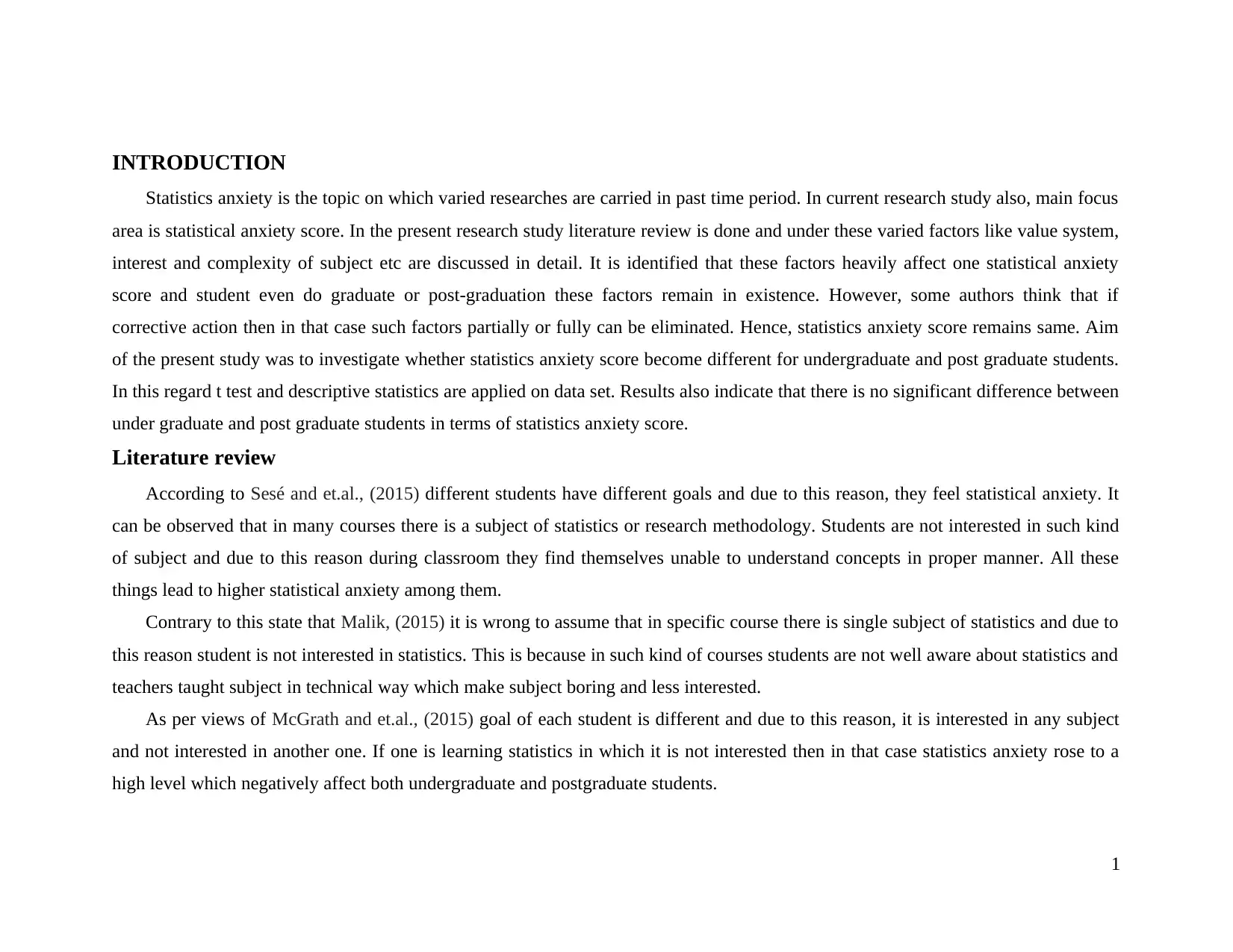
INTRODUCTION
Statistics anxiety is the topic on which varied researches are carried in past time period. In current research study also, main focus
area is statistical anxiety score. In the present research study literature review is done and under these varied factors like value system,
interest and complexity of subject etc are discussed in detail. It is identified that these factors heavily affect one statistical anxiety
score and student even do graduate or post-graduation these factors remain in existence. However, some authors think that if
corrective action then in that case such factors partially or fully can be eliminated. Hence, statistics anxiety score remains same. Aim
of the present study was to investigate whether statistics anxiety score become different for undergraduate and post graduate students.
In this regard t test and descriptive statistics are applied on data set. Results also indicate that there is no significant difference between
under graduate and post graduate students in terms of statistics anxiety score.
Literature review
According to Sesé and et.al., (2015) different students have different goals and due to this reason, they feel statistical anxiety. It
can be observed that in many courses there is a subject of statistics or research methodology. Students are not interested in such kind
of subject and due to this reason during classroom they find themselves unable to understand concepts in proper manner. All these
things lead to higher statistical anxiety among them.
Contrary to this state that Malik, (2015) it is wrong to assume that in specific course there is single subject of statistics and due to
this reason student is not interested in statistics. This is because in such kind of courses students are not well aware about statistics and
teachers taught subject in technical way which make subject boring and less interested.
As per views of McGrath and et.al., (2015) goal of each student is different and due to this reason, it is interested in any subject
and not interested in another one. If one is learning statistics in which it is not interested then in that case statistics anxiety rose to a
high level which negatively affect both undergraduate and postgraduate students.
1
Statistics anxiety is the topic on which varied researches are carried in past time period. In current research study also, main focus
area is statistical anxiety score. In the present research study literature review is done and under these varied factors like value system,
interest and complexity of subject etc are discussed in detail. It is identified that these factors heavily affect one statistical anxiety
score and student even do graduate or post-graduation these factors remain in existence. However, some authors think that if
corrective action then in that case such factors partially or fully can be eliminated. Hence, statistics anxiety score remains same. Aim
of the present study was to investigate whether statistics anxiety score become different for undergraduate and post graduate students.
In this regard t test and descriptive statistics are applied on data set. Results also indicate that there is no significant difference between
under graduate and post graduate students in terms of statistics anxiety score.
Literature review
According to Sesé and et.al., (2015) different students have different goals and due to this reason, they feel statistical anxiety. It
can be observed that in many courses there is a subject of statistics or research methodology. Students are not interested in such kind
of subject and due to this reason during classroom they find themselves unable to understand concepts in proper manner. All these
things lead to higher statistical anxiety among them.
Contrary to this state that Malik, (2015) it is wrong to assume that in specific course there is single subject of statistics and due to
this reason student is not interested in statistics. This is because in such kind of courses students are not well aware about statistics and
teachers taught subject in technical way which make subject boring and less interested.
As per views of McGrath and et.al., (2015) goal of each student is different and due to this reason, it is interested in any subject
and not interested in another one. If one is learning statistics in which it is not interested then in that case statistics anxiety rose to a
high level which negatively affect both undergraduate and postgraduate students.
1
⊘ This is a preview!⊘
Do you want full access?
Subscribe today to unlock all pages.

Trusted by 1+ million students worldwide

Baloglu, Abbassi and Kesici, (2017) state that statistics is the important subject and it is taught to the students in both
undergraduate and postgraduate courses. Those who complete graduate passed on post graduate studies. It is normally observed that
students who are not interested in statistics in undergraduate programs usually in their post-graduation are also not interested in
statistics.
According to Williams, (2015) cognitive capability is the one of the main reason that is responsible for student statistics anxiety.
If one cognitively is not sound then in that case it finds it difficult to learn statistics in proper manner. Students face this problem when
they are in graduate class and postgraduate class.
Opposite to this Primi, Donati and Chiesi, (2018) state that if statistics will be presented in simple way in front of the students
they can understand subject in better way. Videos and animations can be used to make them understand statistics tough concepts.
As per views of Förster and Maur, (2015) value system of any individual play crucial role in determining whether student will
suffer from statistics anxiety. This is because value system reflects things that people like and dislike. If someone does not like
complexity in the life or does not like to discuss complex topic that individual can not like statistics as subject. Such kind of student
even move from graduate to post graduate class will not prefer statistics as subject. Thus, value system heavily affects statistics
anxiety level.
On other hand Daud, Daud and Kassim, (2016) state that value system of individual does not matter to great extent because if one
has cognitive ability then in that case it can easily learn subject. Thus, value system cannot be assumed solely responsible for student
suffer from statistics anxiety under graduate and post graduate programs.
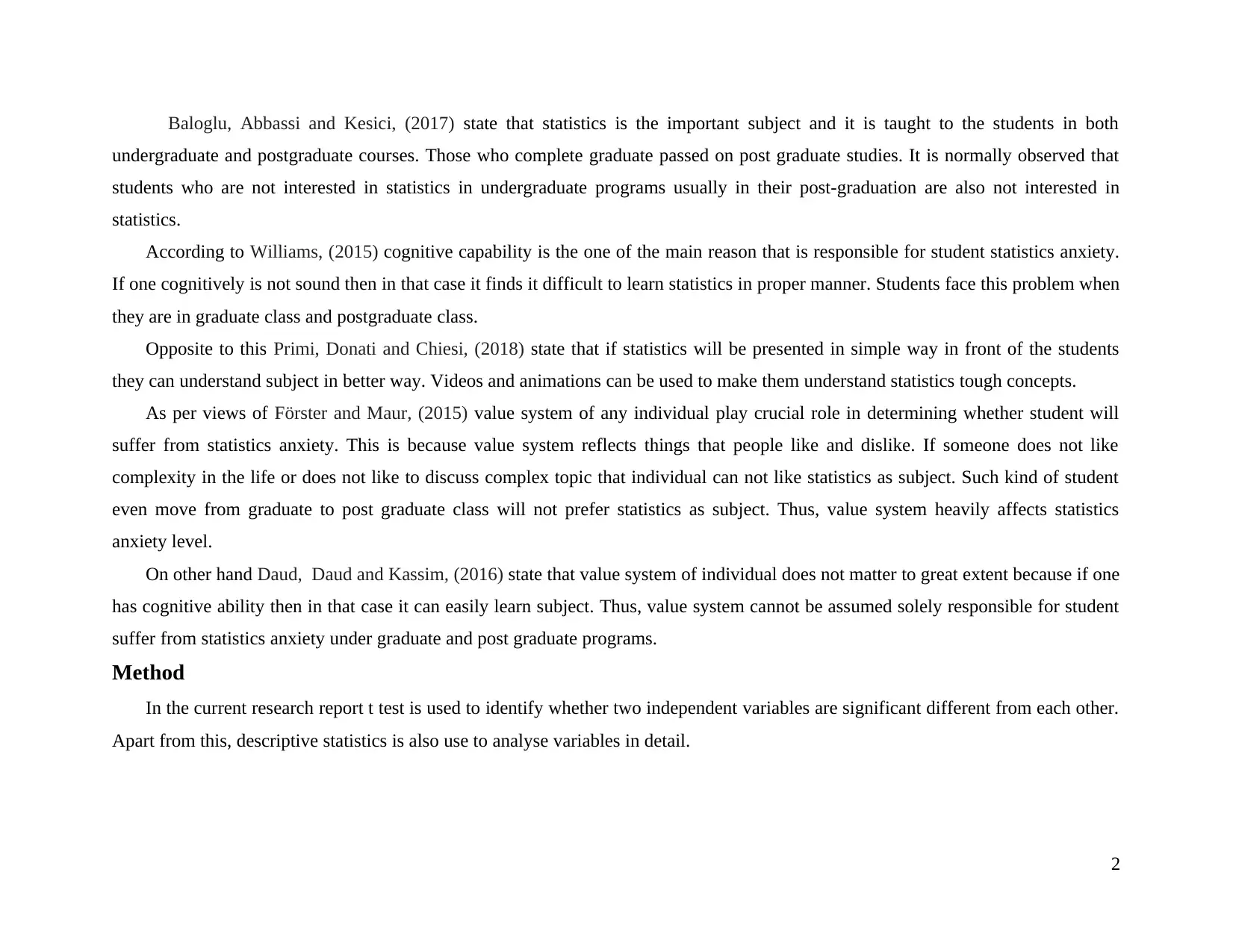
Method
In the current research report t test is used to identify whether two independent variables are significant different from each other.
Apart from this, descriptive statistics is also use to analyse variables in detail.
2
undergraduate and postgraduate courses. Those who complete graduate passed on post graduate studies. It is normally observed that
students who are not interested in statistics in undergraduate programs usually in their post-graduation are also not interested in
statistics.
According to Williams, (2015) cognitive capability is the one of the main reason that is responsible for student statistics anxiety.
If one cognitively is not sound then in that case it finds it difficult to learn statistics in proper manner. Students face this problem when
they are in graduate class and postgraduate class.
Opposite to this Primi, Donati and Chiesi, (2018) state that if statistics will be presented in simple way in front of the students
they can understand subject in better way. Videos and animations can be used to make them understand statistics tough concepts.
As per views of Förster and Maur, (2015) value system of any individual play crucial role in determining whether student will
suffer from statistics anxiety. This is because value system reflects things that people like and dislike. If someone does not like
complexity in the life or does not like to discuss complex topic that individual can not like statistics as subject. Such kind of student
even move from graduate to post graduate class will not prefer statistics as subject. Thus, value system heavily affects statistics
anxiety level.
On other hand Daud, Daud and Kassim, (2016) state that value system of individual does not matter to great extent because if one
has cognitive ability then in that case it can easily learn subject. Thus, value system cannot be assumed solely responsible for student
suffer from statistics anxiety under graduate and post graduate programs.
Method
In the current research report t test is used to identify whether two independent variables are significant different from each other.
Apart from this, descriptive statistics is also use to analyse variables in detail.
2
Paraphrase This Document
Need a fresh take? Get an instant paraphrase of this document with our AI Paraphraser

Results
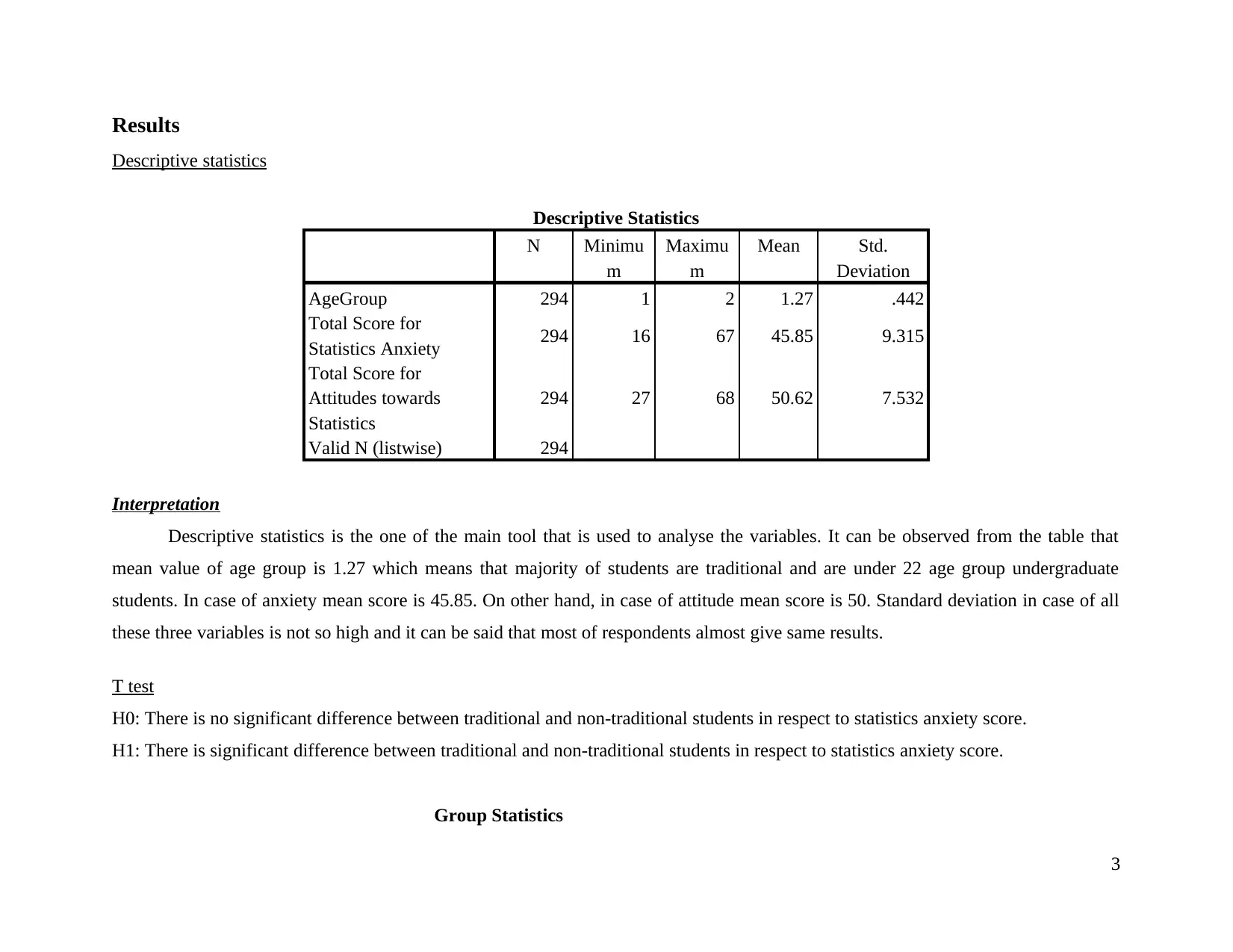
Descriptive statistics
Descriptive Statistics
N Minimu
m
Maximu
m
Mean Std.
Deviation
AgeGroup 294 1 2 1.27 .442
Total Score for
Statistics Anxiety 294 16 67 45.85 9.315
Total Score for
Attitudes towards
Statistics
294 27 68 50.62 7.532
Valid N (listwise) 294
Interpretation
Descriptive statistics is the one of the main tool that is used to analyse the variables. It can be observed from the table that
mean value of age group is 1.27 which means that majority of students are traditional and are under 22 age group undergraduate
students. In case of anxiety mean score is 45.85. On other hand, in case of attitude mean score is 50. Standard deviation in case of all
these three variables is not so high and it can be said that most of respondents almost give same results.
T test
H0: There is no significant difference between traditional and non-traditional students in respect to statistics anxiety score.
H1: There is significant difference between traditional and non-traditional students in respect to statistics anxiety score.
Group Statistics
3
Descriptive statistics
Descriptive Statistics
N Minimu
m
Maximu
m
Mean Std.
Deviation
AgeGroup 294 1 2 1.27 .442
Total Score for
Statistics Anxiety 294 16 67 45.85 9.315
Total Score for
Attitudes towards
Statistics
294 27 68 50.62 7.532
Valid N (listwise) 294
Interpretation
Descriptive statistics is the one of the main tool that is used to analyse the variables. It can be observed from the table that
mean value of age group is 1.27 which means that majority of students are traditional and are under 22 age group undergraduate
students. In case of anxiety mean score is 45.85. On other hand, in case of attitude mean score is 50. Standard deviation in case of all
these three variables is not so high and it can be said that most of respondents almost give same results.
T test
H0: There is no significant difference between traditional and non-traditional students in respect to statistics anxiety score.
H1: There is significant difference between traditional and non-traditional students in respect to statistics anxiety score.
Group Statistics
3

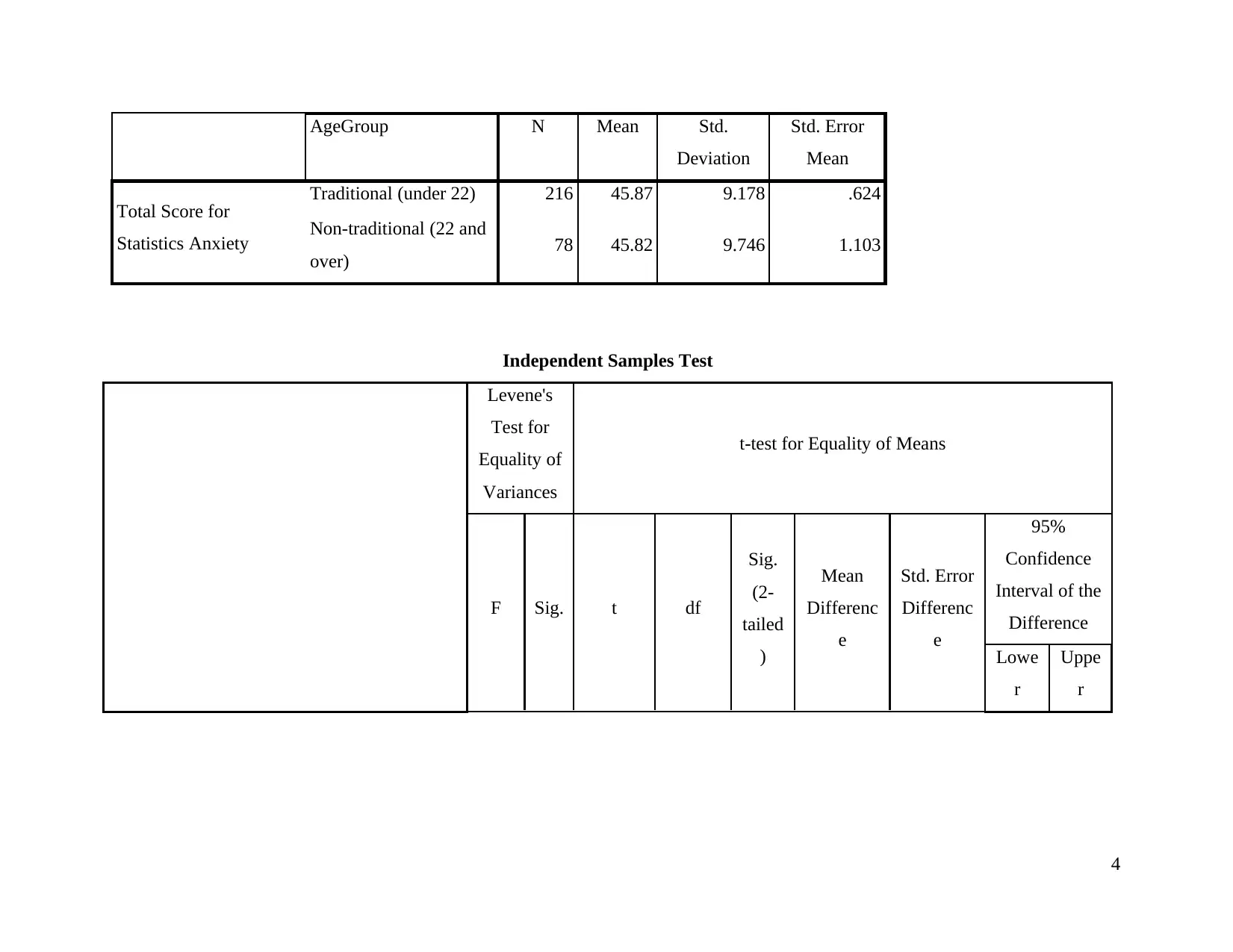
AgeGroup N Mean Std.
Deviation
Std. Error
Mean
Total Score for
Statistics Anxiety
Traditional (under 22) 216 45.87 9.178 .624
Non-traditional (22 and
over) 78 45.82 9.746 1.103
Independent Samples Test
Levene's
Test for
Equality of
Variances
t-test for Equality of Means
F Sig. t df
Sig.
(2-
tailed
)
Mean
Differenc
e
Std. Error
Differenc
e
95%
Confidence
Interval of the
Difference
Lowe
r
Uppe
r
4
Deviation
Std. Error
Mean
Total Score for
Statistics Anxiety
Traditional (under 22) 216 45.87 9.178 .624
Non-traditional (22 and
over) 78 45.82 9.746 1.103
Independent Samples Test
Levene's
Test for
Equality of
Variances
t-test for Equality of Means
F Sig. t df
Sig.
(2-
tailed
)
Mean
Differenc
e
Std. Error
Differenc
e
95%
Confidence
Interval of the
Difference
Lowe
r
Uppe
r
4
⊘ This is a preview!⊘
Do you want full access?
Subscribe today to unlock all pages.

Trusted by 1+ million students worldwide

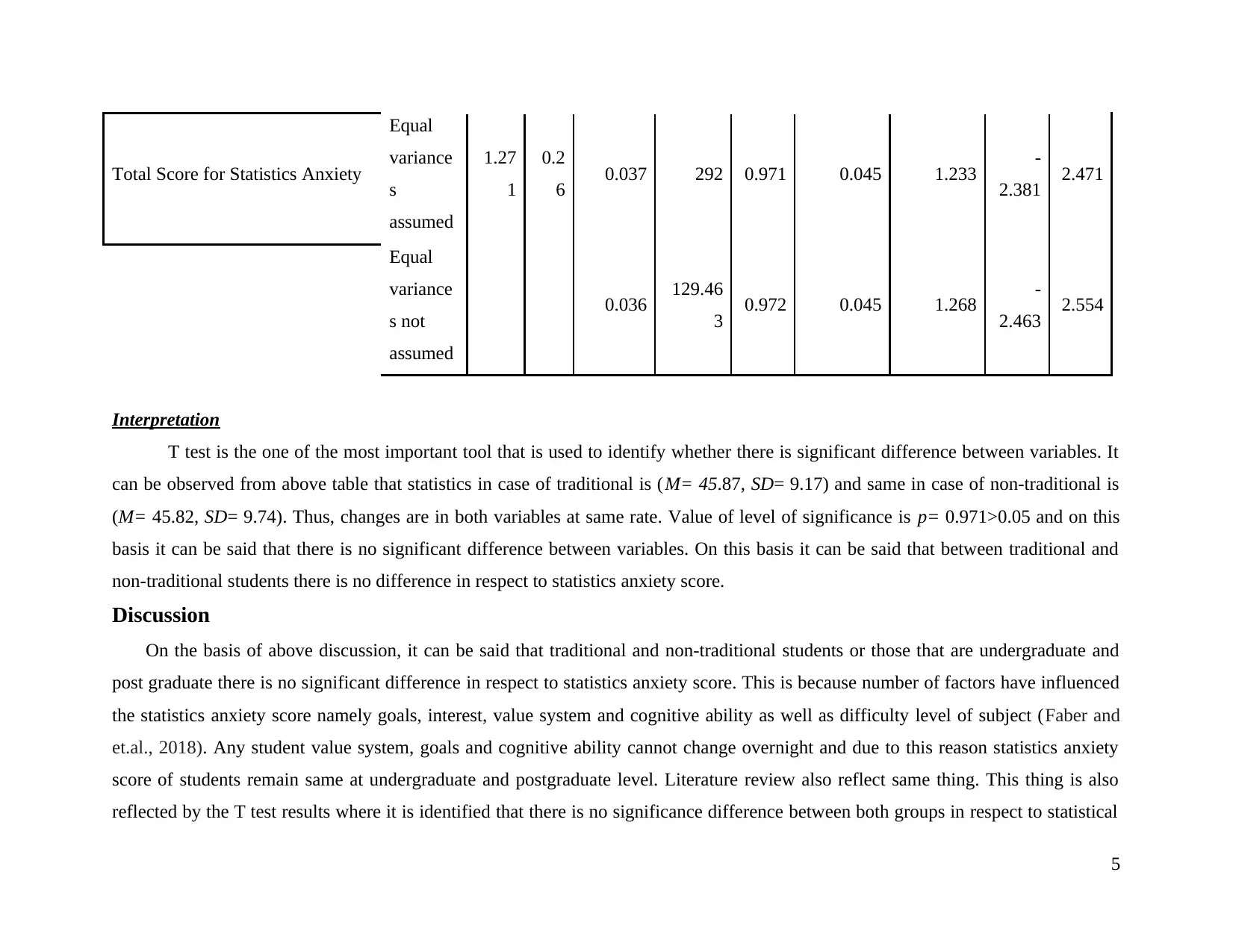
Total Score for Statistics Anxiety
Equal
variance
s
assumed
1.27
1
0.2
6 0.037 292 0.971 0.045 1.233 -
2.381 2.471
Equal
variance
s not
assumed
0.036 129.46
3 0.972 0.045 1.268 -
2.463 2.554
Interpretation
T test is the one of the most important tool that is used to identify whether there is significant difference between variables. It
can be observed from above table that statistics in case of traditional is (M= 45.87, SD= 9.17) and same in case of non-traditional is
(M= 45.82, SD= 9.74). Thus, changes are in both variables at same rate. Value of level of significance is p= 0.971>0.05 and on this
basis it can be said that there is no significant difference between variables. On this basis it can be said that between traditional and
non-traditional students there is no difference in respect to statistics anxiety score.
Discussion
On the basis of above discussion, it can be said that traditional and non-traditional students or those that are undergraduate and
post graduate there is no significant difference in respect to statistics anxiety score. This is because number of factors have influenced
the statistics anxiety score namely goals, interest, value system and cognitive ability as well as difficulty level of subject (Faber and
et.al., 2018). Any student value system, goals and cognitive ability cannot change overnight and due to this reason statistics anxiety
score of students remain same at undergraduate and postgraduate level. Literature review also reflect same thing. This thing is also
reflected by the T test results where it is identified that there is no significance difference between both groups in respect to statistical
5
Equal
variance
s
assumed
1.27
1
0.2
6 0.037 292 0.971 0.045 1.233 -
2.381 2.471
Equal
variance
s not
assumed
0.036 129.46
3 0.972 0.045 1.268 -
2.463 2.554
Interpretation
T test is the one of the most important tool that is used to identify whether there is significant difference between variables. It
can be observed from above table that statistics in case of traditional is (M= 45.87, SD= 9.17) and same in case of non-traditional is
(M= 45.82, SD= 9.74). Thus, changes are in both variables at same rate. Value of level of significance is p= 0.971>0.05 and on this
basis it can be said that there is no significant difference between variables. On this basis it can be said that between traditional and
non-traditional students there is no difference in respect to statistics anxiety score.
Discussion
On the basis of above discussion, it can be said that traditional and non-traditional students or those that are undergraduate and
post graduate there is no significant difference in respect to statistics anxiety score. This is because number of factors have influenced
the statistics anxiety score namely goals, interest, value system and cognitive ability as well as difficulty level of subject (Faber and
et.al., 2018). Any student value system, goals and cognitive ability cannot change overnight and due to this reason statistics anxiety
score of students remain same at undergraduate and postgraduate level. Literature review also reflect same thing. This thing is also
reflected by the T test results where it is identified that there is no significance difference between both groups in respect to statistical
5
Paraphrase This Document
Need a fresh take? Get an instant paraphrase of this document with our AI Paraphraser

anxiety score (Mousa and et.al., 2016). It is normally observed that every student has different cognitive score and due to this reason,
many of them failed to understand things in proper manner. Such kind of things make statistics difficult for the students and finally
they observe statistics anxiety. In order to solve such kind of problems teachers must present statistics concepts in simple way. Value
system of individuals cannot be changed to great extent and due to this reason in both undergraduate and post graduate course students
suffer from same problem of statistics anxiety.
6
many of them failed to understand things in proper manner. Such kind of things make statistics difficult for the students and finally
they observe statistics anxiety. In order to solve such kind of problems teachers must present statistics concepts in simple way. Value
system of individuals cannot be changed to great extent and due to this reason in both undergraduate and post graduate course students
suffer from same problem of statistics anxiety.
6

REFERENCE
Books and Journals
Sesé, A. and et.al., 2015. Can attitudes towards statistics and statistics anxiety explain students’ performance. Revista de
Psicodidáctica. 20(2). pp.285-304.
Malik, S., 2015. Undergraduates’ statistics anxiety: a phenomenological study. The Qualitative Report. 20(2). pp.120-133.
McGrath, A.L and et.al., 2015. Reducing anxiety and increasing self-efficacy within an advanced graduate psychology statistics
course. Canadian Journal for the Scholarship of Teaching and Learning. 6(1). p.5.
Baloglu, M., Abbassi, A. and Kesici, S., 2017. Multivariate relationships between statistics anxiety and motivational
beliefs. Education. 137(4). pp.430-444.
Williams, A.S., 2015. Statistics anxiety and worry: The roles of worry beliefs, negative problem orientation, and cognitive
avoidance. Statistics Education Research Journal. 14(2). pp.53-75.
Primi, C., Donati, M.A. and Chiesi, F., 2018. The role of statistics anxiety in learning probability. In Teaching and Learning
Stochastics (pp. 145-157). Springer, Cham.
Förster, M. and Maur, A., 2015. Statistics anxiety and selfconcept of beginning students in the social sciences–a matter of gender and
socio-cultural background. Zeitschrift für Hochschulentwicklung (ZfHE). 10(4). pp.67-90.
Daud, N.S.M., Daud, N.M. and Kassim, N.L.A., 2016. Second language writing anxiety: Cause or effect?. Malaysian journal of ELT
research. 1(1). p.19.
Faber, G. and et.al., 2018. Education science students’ statistics anxiety: Developing and analyzing a scale for measuring their worry,
avoidance, and emotionality cognitions. International Journal of Educational Psychology: IJEP,. 7(3). pp.248-285.
Mousa, O.Y. and et.al., 2016. The MD blues: under-recognized depression and anxiety in medical trainees. PloS one. 11(6).
p.e0156554.
7
Books and Journals
Sesé, A. and et.al., 2015. Can attitudes towards statistics and statistics anxiety explain students’ performance. Revista de
Psicodidáctica. 20(2). pp.285-304.
Malik, S., 2015. Undergraduates’ statistics anxiety: a phenomenological study. The Qualitative Report. 20(2). pp.120-133.
McGrath, A.L and et.al., 2015. Reducing anxiety and increasing self-efficacy within an advanced graduate psychology statistics
course. Canadian Journal for the Scholarship of Teaching and Learning. 6(1). p.5.
Baloglu, M., Abbassi, A. and Kesici, S., 2017. Multivariate relationships between statistics anxiety and motivational
beliefs. Education. 137(4). pp.430-444.
Williams, A.S., 2015. Statistics anxiety and worry: The roles of worry beliefs, negative problem orientation, and cognitive
avoidance. Statistics Education Research Journal. 14(2). pp.53-75.
Primi, C., Donati, M.A. and Chiesi, F., 2018. The role of statistics anxiety in learning probability. In Teaching and Learning
Stochastics (pp. 145-157). Springer, Cham.
Förster, M. and Maur, A., 2015. Statistics anxiety and selfconcept of beginning students in the social sciences–a matter of gender and
socio-cultural background. Zeitschrift für Hochschulentwicklung (ZfHE). 10(4). pp.67-90.
Daud, N.S.M., Daud, N.M. and Kassim, N.L.A., 2016. Second language writing anxiety: Cause or effect?. Malaysian journal of ELT
research. 1(1). p.19.
Faber, G. and et.al., 2018. Education science students’ statistics anxiety: Developing and analyzing a scale for measuring their worry,
avoidance, and emotionality cognitions. International Journal of Educational Psychology: IJEP,. 7(3). pp.248-285.
Mousa, O.Y. and et.al., 2016. The MD blues: under-recognized depression and anxiety in medical trainees. PloS one. 11(6).
p.e0156554.
7
⊘ This is a preview!⊘
Do you want full access?
Subscribe today to unlock all pages.

Trusted by 1+ million students worldwide
1 out of 9
Related Documents
Your All-in-One AI-Powered Toolkit for Academic Success.
+13062052269
info@desklib.com
Available 24*7 on WhatsApp / Email
Unlock your academic potential
Copyright © 2020–2026 A2Z Services. All Rights Reserved. Developed and managed by ZUCOL.